
Creative Arts
Unit VI, Lesson 26Shelves, Boxes & Storage That Lasts
Professor Cogbranch Timberclank
Master Artisan, Head of House Occidens
The Creative Arts Workshop • School of Evershade
Professor's Introduction

Set up your bench, scholars. Everything this school makes, gathers, dries, and distills ends in the same question: where does it live?
Storage is the least celebrated work in the workshop and the most consequential. A potion on the wrong shelf is a hazard. A seed in a damp box is a funeral. A specimen without a label in an unlisted box is a rumor. The maker who builds storage is deciding, in wood, what the future will still be able to find. Egyptian boxes in museum cases are holding their contents' stories after five thousand years because some carpenter built them as though the contents mattered. They did. So do yours.
This lesson builds the unit's full set: a potion shelf and an herb shelf, a seed storage box, a vessel rack, and archive and specimen boxes in wood. An archive box is a box built to keep records or specimens stable for the long term: a close-fitting lid, no gaps for pests or dust, materials that will not harm the contents, and a label that says what is inside and when it was put there. The techniques are the unit's own, spent together: Lesson 23's tools and layout, Lesson 4's fastening, Lesson 25's squared frames, and the dovetail marked out in Lesson 23's drill, now cut in earnest, because storage is where the dovetail earned its reputation. The dovetail is the interlocking corner joint whose fan-shaped tails on one board lock into matching pins on the other; its shape resists being pulled apart because the tails widen into their sockets, and the wider the pull, the tighter the wedge. And the lesson ends where all storage ends, with the rule that no box can break: cool, dry, and dark, the principle that runs from the Egyptian tomb to the seed vault inside a Norwegian mountain.
Level One scholars will build with screws, brackets, and glued butt joints, honestly made. Level Two scholars will dovetail the seed box and peg the shelves. Both levels deliver storage built to be found in, fifty years on.
PROFESSOR COGBRANCH TIMBERCLANK
Creative Arts Workshop
Master Artisan, Head of House Occidens
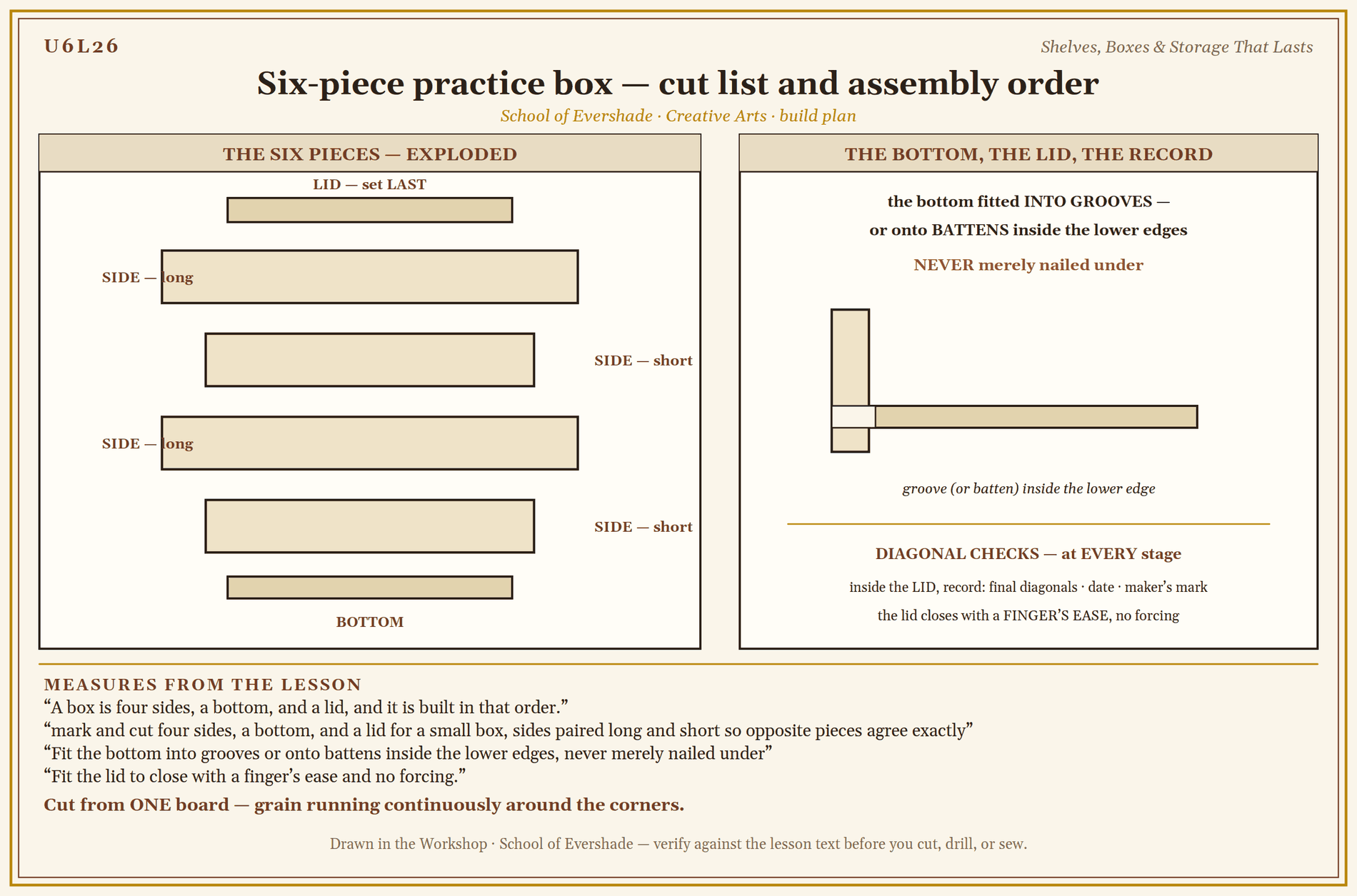
Six-piece practice box — cut list and assembly order
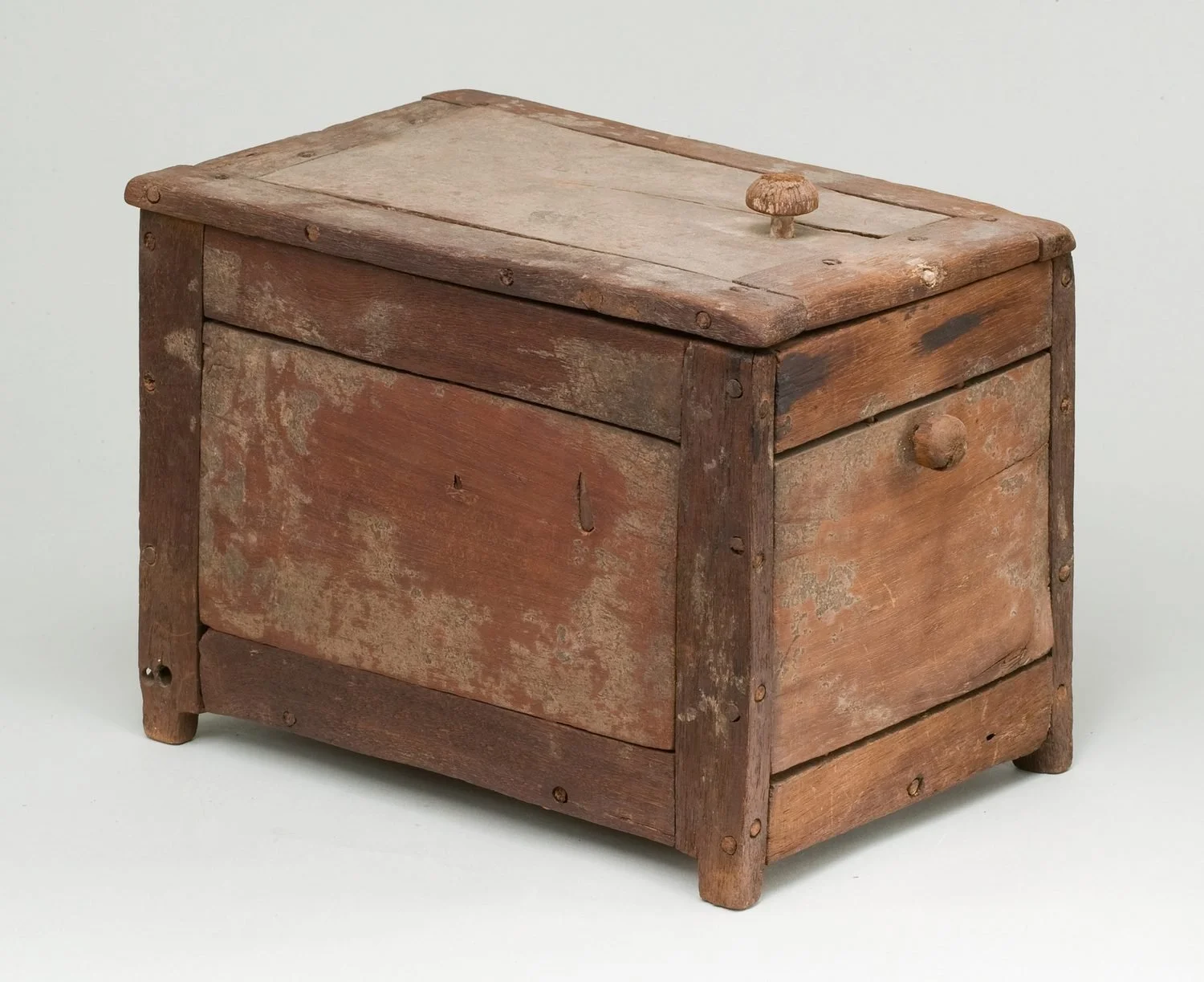
A second Egyptian wooden box (cosmetic box, Dynasty 12–18, ca. 1981–1550 BCE), wood, with its lid.
The Metropolitan Museum of Art (Object 32.8.2a, b), Open Access (CC0).
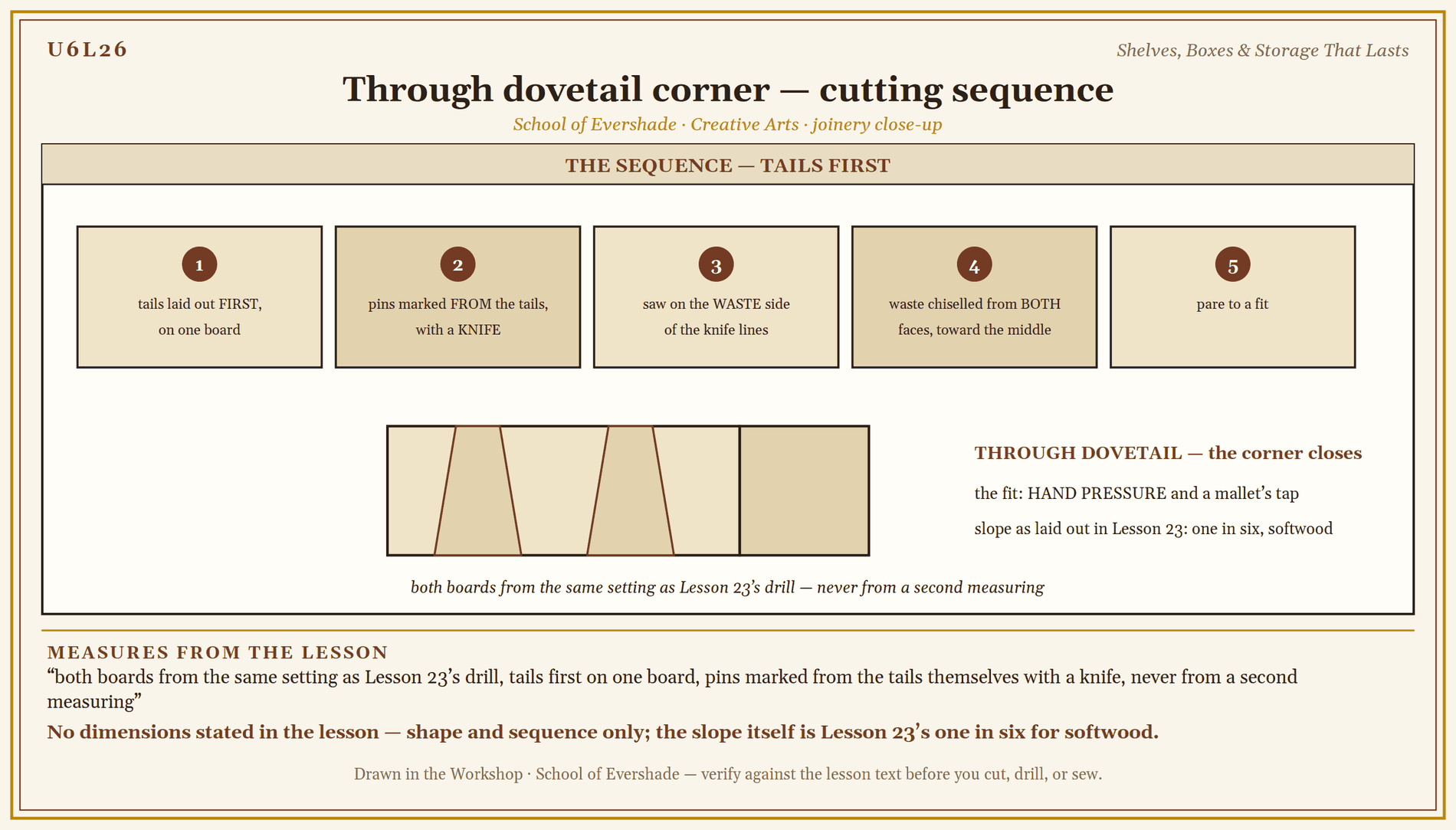
Through dovetail corner — cutting sequence
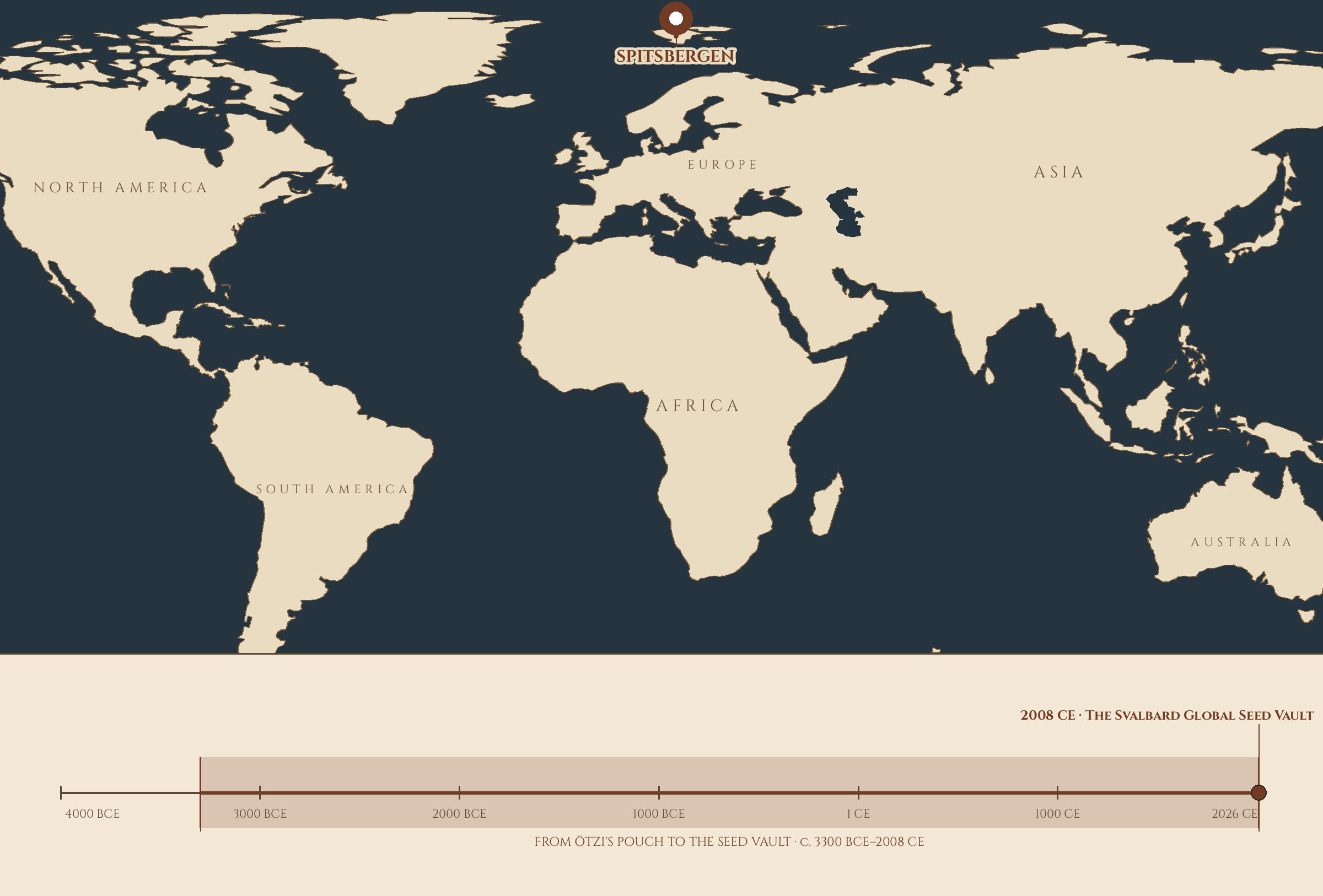
Where and when: Spitsbergen, Svalbard — 2008 CE, the Svalbard Global Seed Vault.
Lesson Objectives
By the end of this lesson, students should be able to:
- Build a practice box from six measured pieces, fitted and squared, and state what each piece's errors do to the whole.
- Cut a through dovetail corner and explain why its shape resists being pulled apart.
- Build a shelf or box for a named station, sized to the actual vessels, jars, or specimens it will hold.
- State the storage rule, cool, dry, and dark, and explain what each word protects against.
- Describe how Egyptian boxes and medieval coffers were built and kept, and how apothecary and library shelving organized a working collection.
- Explain how modern seed banks apply the same rule at industrial scale, including drying, sealed containers, and cold.
Your Assignment Packet
This lesson's assignments live in its packet: the Lexicon Handout (every term, course terms marked ◆), the Assignment Manual, and the Reflection Questions. Download the packet before you begin and keep it beside you as you read — work from it as each subject is taught, or take the assignments as homework afterward.
Boxes from Egypt to the Coffer
Egypt gives this lesson its beginning, as it gave Lesson 23 its bench. Objects in ancient Egypt were stored in boxes, very often, and in baskets; the cosmetic box was so standard a possession that tombs across periods contain them. Egyptian boxes were joined with the carpenter's full art, mortise and tenon, dovetails in fine work, dowels, and careful fitting, and the desert's dry darkness preserved them so well that UCL's Digital Egypt collection can still show a box from Lahun beside the stools and headrests it was buried with. Notice what preserved them: not the carpenter's intention, but the storage conditions. Cool, dry, and dark is not a modern rule. It is the description of every place old things have ever survived.
The medieval coffer carried the same art into a harder world. A great chest of joined boards, its corners pegged, nailed, or dovetailed in fine work, bound with iron straps, and closed with a lock, the coffer held the household's documents, plate, and coin, and traveled with the household when the household moved, which in a world of itinerant courts was often. Furniture historians read dovetails as dates and signatures, because the joint's form changed by period and place; a box's corners can tell a scholar where and roughly when its maker worked. Storage built well becomes evidence. That is the standard this lesson builds to: a box that could testify.
Shelves for the Apothecary and the Library
The shelf is the box opened for daily use, and its history is the history of collections getting large enough to need order. The apothecary's shop and the still room's store shelves held rows of jars whose contents were valuable, perishable, and dangerous to confuse: the albarello jars of Lesson 20's clay work stood in ranks, labeled, at a height the hand could reach and the eye could check. Order on a shelf is a safety system. A shelf built for a collection is therefore built to the collection: the shelf spacing is the jars' height plus a finger's clearance, the depth is the jars' depth and no more, because depth beyond the vessel hides a second row, and a hidden row is where old, forgotten, and mislabeled things breed.
Libraries learned the same lesson at larger scale. Chained books lay flat on lecterns in the earliest libraries; as collections grew, books stood upright on shelves — chained books fore-edge out at first, and only later, once titles were printed on spines, spine-out, which turned the shelf into an index, findable at a glance. The principle crosses back to this workshop unchanged: storage succeeds when the thing wanted can be found, identified, and reached without disturbing the rest. Build the shelf to the vessels. Label at the shelf, not only on the jar. Leave the front row the only row.
Cool, Dry, and Dark: The Seed Banks
Seeds are storage's hardest test, because a seed is alive and waiting, and bad storage kills it quietly. The seed keeper's rule is the lesson's rule. Cool slows the seed's slow decline. Dry prevents mold and stops the seed waking early. Dark protects against light and the warmth that comes with it. A scholar's seed box applies the rule with a fitted lid, a dry room, and paper envelopes, labeled, one lot to an envelope, with the date and the plant's name, which is an accession record in miniature.
The modern seed banks are the same rule, engineered to the limit. At Kew's Millennium Seed Bank, seeds are dried in a dry room at 15 degrees and 15 percent relative humidity, a process whose arithmetic every seed keeper should know: each one percent drop in a seed's moisture content roughly doubles its lifespan (within the working range — very dry seed gains no more). Banked seeds are then sealed and frozen at minus 20 degrees. The Svalbard Global Seed Vault, opened on 26 February 2008 inside a mountain on the Norwegian island of Spitsbergen, more than 100 meters into the rock, keeps duplicate seed collections from the world's gene banks at minus 18 degrees, free of charge to depositors, as a backup against loss. As of June 2025 it held more than 1,355,000 accessions. The vault is a box. It is a very large, very cold box, with a fitted lid of mountain, built on the same three words as the scholar's seed box on the workshop shelf. The words scale. That is why they are worth learning in wood first.
A Sealed Note from Professor Timberclank
Storage work is the unit's techniques together, and its hazards are the unit's hazards entire: the saw of Lesson 23, the drill of Lesson 4, the edge tools of the dovetail's cutting.
So the rules stand as written in those lessons, and they are repeated here once, briefly, because a last lesson is where a workshop gets careless. Clamp the work. Hands behind the cut line, off the road. Pilot holes in narrow stock before screws. Cut the dovetail's pins and tails with the work held and the knife scored first, so the chisel follows a line instead of a hope. When a cut binds or a corner will not close, we do not force it. We stop. We make it safe. Then we begin again.
A shelf is a promise made to weight. Test yours before you trust it: load it with books to the vessels' weight and leave it overnight. A shelf that bows in the test has told you the truth cheaply. Believe it, and build the next one stronger. That is not failure, scholars. That is the workshop working as it should.
PROFESSOR COGBRANCH TIMBERCLANK
Creative Arts Workshop
Master Artisan, Head of House Occidens
Technique: Boxes and Shelves
The six-piece box. A box is four sides, a bottom, and a lid, and it is built in that order. Cut the sides to length from one board where possible, so the grain runs continuously around the corners. Join the corners by your level's method. Fit the bottom into grooves or onto battens inside the lower edges, never merely nailed under, because a bottom that carries weight should be held by the box. Set the lid last, hinged or lifted, fitted to close without forcing and open without sticking. Square is checked by diagonals at every stage; a box out of square at the sides will be out of square at the lid, with interest.
Cutting the dovetail. Lay out both boards from the same setting as Lesson 23's drill, tails first on one board, pins marked from the tails themselves with a knife, never from a second measuring. Saw on the waste side of the knife lines, chisel the waste from both faces toward the middle so neither face blows out, and pare to a fit that seats with hand pressure and a mallet's tap. A dovetail cut too tight splits; too loose, it is a butt joint with ambitions. Pare a shaving at a time and test often. The first corner will be the worst you ever cut. Keep it. It is the record of the lesson, and Lesson 28's plaques will show what became of the hands that cut it.
Shelves in cases. A shelf is seated in dados — rectangular grooves cut across a board to receive the end or edge of another, the standard seat for a shelf in a case side, held by the case itself rather than by its fasteners — where the case allows, glued and pinned, or carried on battens screwed to the case sides with pilot holes. Space shelves to the vessels they will hold, measured from the actual jars with a finger's clearance, and never deeper than one row. A fixed shelf is stronger than an adjustable one; an adjustable shelf is kinder to a growing collection. Choose for the collection's real future, not its present vanity.
The vessel rack. A rack for vessels is a shelf with opinions: rails or a holed board that keep round vessels from rolling and touching. Space the rails to the vessels' shoulders, sand every edge a hand or a jar will meet, and finish it to wipe clean.
Labels and records. Every build in this lesson leaves the bench with its record started: what it holds, for which station, the maker's mark, and the date, on a label fixed where the user will see it. A storage piece without a label is unfinished, whatever its joinery.
Practice Practical: The Practice Box
This drill is checked for fit, not finish. All work is in scrap board.
- Measure six pieces. Bench drill first. From one scrap board, mark and cut four sides, a bottom, and a lid for a small box, sides paired long and short so opposite pieces agree exactly. Measure twice; the box will repeat every error four times.
- Join the sides. Join the four corners by your level's method, checking diagonals as you close each corner. The carcass must sit flat on the bench without rocking; a rocking carcass is corrected now, not after the lid. The carcass is the body of a piece of case furniture, its sides, top, bottom, and back, before doors, drawers, or fittings; a square carcass is the difference between a box and a riddle.
- Fit the bottom. Fit the bottom into its grooves or onto its battens and fix it. Turn the box over and load it with books: the bottom should carry without creaking or giving.
- Fit the lid. Fit the lid to close with a finger's ease and no forcing. If it binds, find the high corner by the diagonal measurements and pare there, not everywhere.
- Square and label. Take both diagonals of the finished box a final time and record them inside the lid, with the date and your mark. A maker who writes the measurements inside the work is a maker who expects to be checked, which is the right expectation.
- Record and put away. Keep the practice box as the pattern for the real builds. Note in your workbook which piece carried the largest error and what it did to the fit. Tools away, bench clear.
When six pieces of scrap become one box that closes true, your hands have learned what this lesson is for.
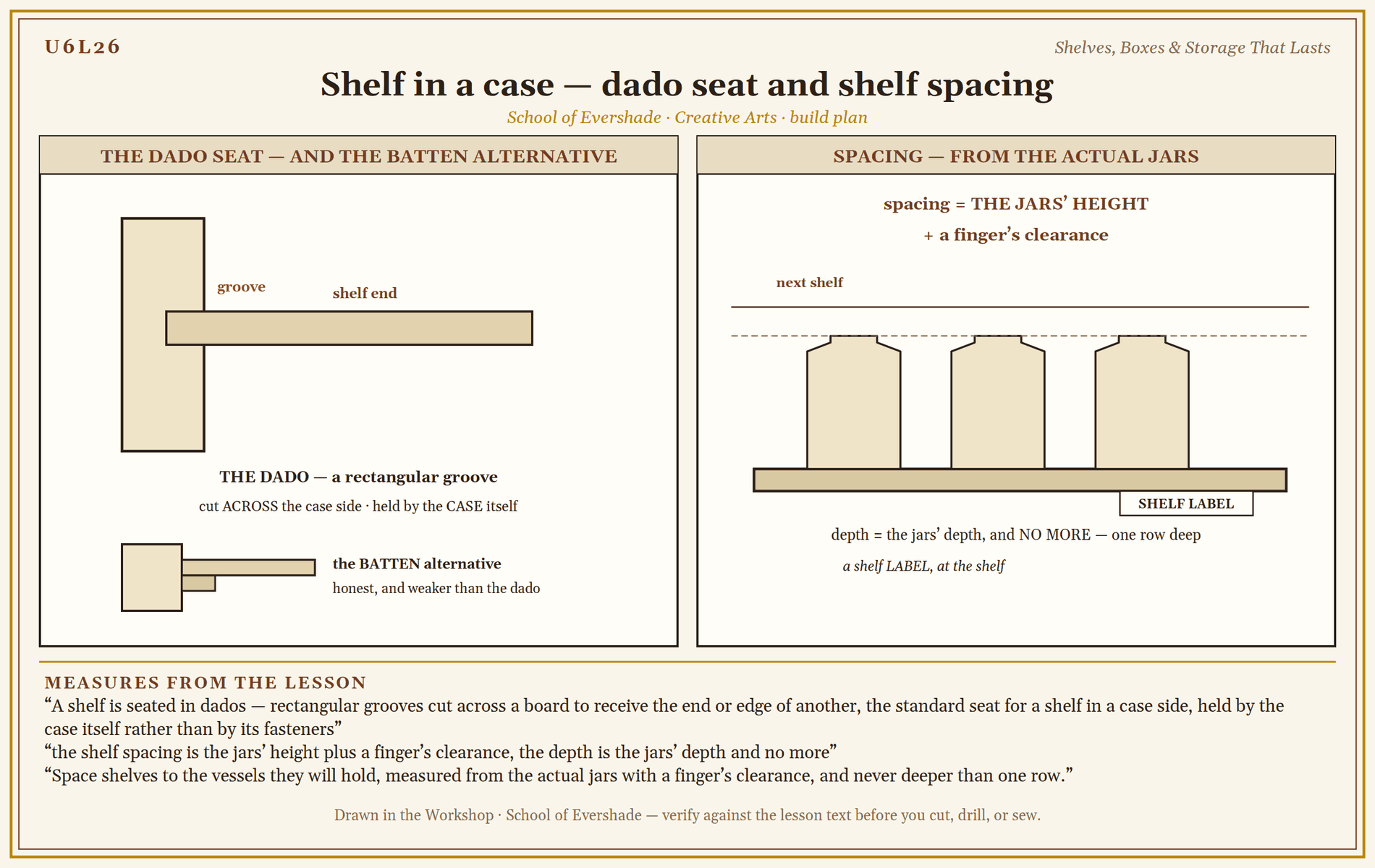
Shelf in a case — dado seat and shelf spacing
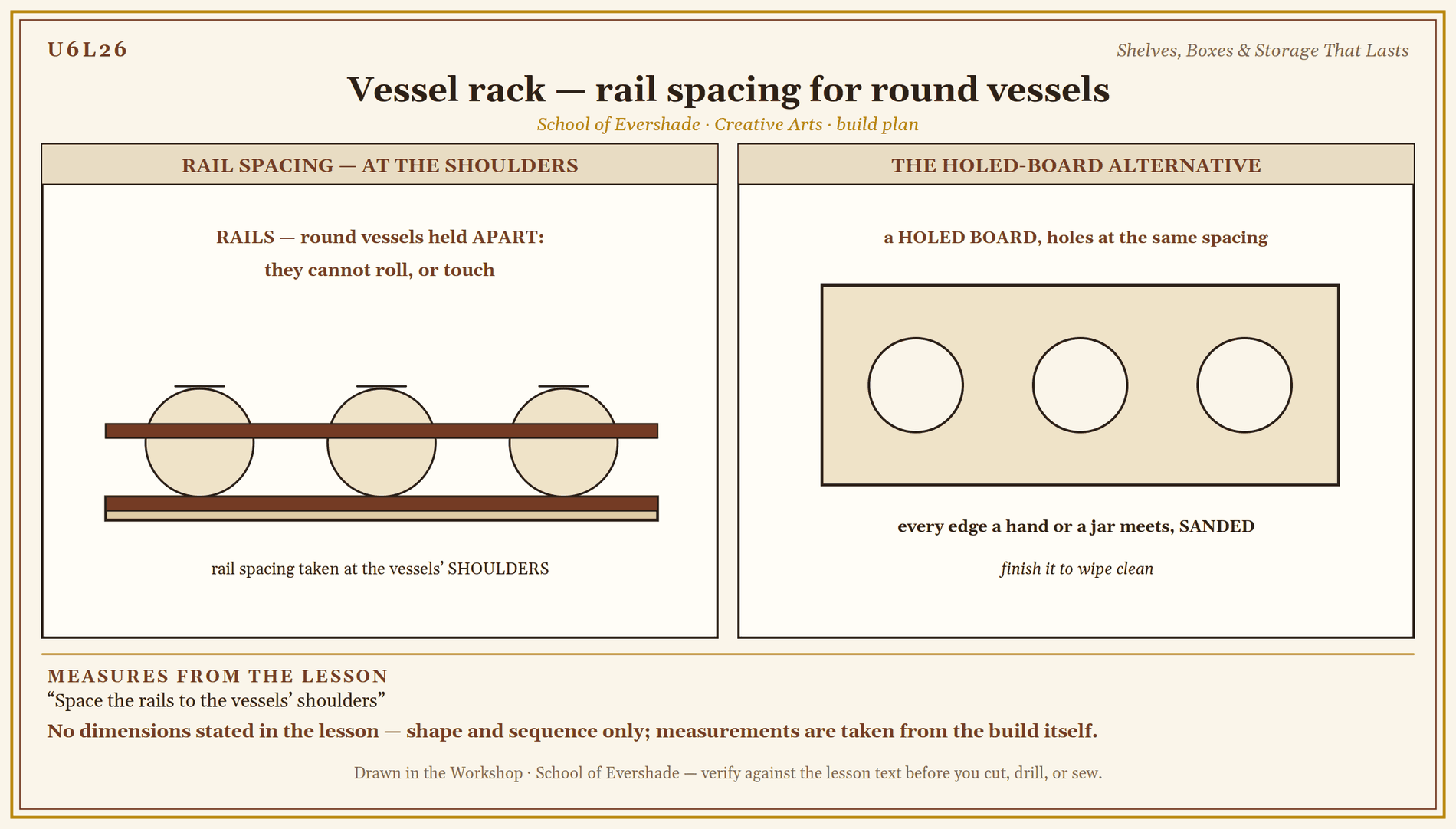
Vessel rack — rail spacing for round vessels
Assignment Manual
Assignment key: ✎ written work · ⚒ hands-on practical · ◐ both
Assignment I ⚒ — The Practice Practical
Complete the drill in this lesson: a practice box of six measured pieces, fitted, squared, load-tested, and labeled with its diagonals recorded inside the lid, all in scrap board. Your labeled box is the record of the drill.
Assignment II ✎ — From the Tomb to the Vault
Using the lesson and the sources below, write a short account of storage across this lesson's history. Include: what preserved the Egyptian boxes, how the medieval coffer protected its contents, and how Svalbard applies the same three-word rule at mountain scale.
Assignment III ◐ — Build Storage for a Real Station
Build one piece from this lesson for real service: a potion shelf, an herb shelf, a seed storage box with its first labeled accessions, a vessel rack, or an archive or specimen box. Size it to the actual contents, finish and label it, and write a short maker's note: what it holds, what you measured, and how a scholar fifty years on will know what is inside. Photograph or sketch the piece in place.
Materials
Level One (household)
- Board stock for the practice box and one real build: offcuts, crate board (checked for nails and staples), or prepared pine board
- Screws, brads, small hinges or a lift-off lid arrangement, and glue under Lessons 4 and 5
- A saw, drill, and driver from the earlier lessons; square, tape, pencil, and marking knife or awl for the dovetail layout
- Sandpaper in sequence and a finish from Lesson 23, wax over oil for working shelves
- Paper envelopes, labels, and a pencil that will not fade, for the seed box's first accessions
- Safety glasses; a mallet for seating joints
Level Two (historical)
Everything in Level One, plus:
- Hardwood stock for the dovetailed seed box, and pegs for the shelves in place of screws
- A dovetail saw or fine saw, chisels matched to the layout, and a marking gauge
- Traditional hinges or a fully wooden lid fitting, and beeswax finish
- A coffer-style iron-bound practice piece is read about, not built; the binding is Lesson 29's metalwork to come
Both levels teach the same craft. Level One builds with screws, brackets, and glued butt joints, honestly fitted; Level Two dovetails and pegs. Either scholar's box and shelf, squared, labeled, and in service, are the deliverable of the lesson.
Reflection Questions
Answer the following questions in your workbook.
- Which of your six pieces carried the largest error, and how did the box make that error impossible to hide?
- Why does the dovetail resist being pulled apart in a way a nailed butt corner does not? Explain it from the shape, not the glue.
- Cool, dry, and dark protected Egyptian boxes and protects Svalbard's seeds. What does each word defend against, in a seed box and in a specimen box alike?
- A shelf built deeper than one row hides a second row. Name another place in the school where the same mistake, hiding what is behind, causes real harm.
- Storage built well becomes evidence, the lesson says. What will your practice box testify about its maker, honestly?
Professor's Review
The unit's work stands in a row now: a board that thinks, a rack that breathes, a stand that holds steady, and a box that closes true. Look at the box longest. It is a plain thing, and it is the piece your grandchildren's scholars are most likely to meet, because storage is what survives.
You have spent the unit the way the castle was rebuilt: measured twice, rehearsed in scrap, squared by the diagonals, and finished for the hands that come after yours. Unit VII takes these same hands to the sharpest work in the course, carving and inscription and simple metal, and it will ask everything this unit taught about patience. Bring the patience. The tools will be sharper, and the standard will be the same.
PROFESSOR COGBRANCH TIMBERCLANK
Creative Arts Workshop
Master Artisan, Head of House Occidens
Cross-Class Connections

Herbology · Unit IV, Lesson 30 — Seed Saving & Storage
In my Greenhouse, scholars, seed saving is a promise made to next year’s garden: which seeds to save, and how to test them, is my lesson’s teaching. The box that keeps them is built here, in this workshop — a seed storage box with a fitted lid, an accession label for every envelope, and the rule no box can break: cool, dry, and dark. Build it at Professor Timberclank’s bench before your first seed harvest is stored, and size it to the collection your labeled envelopes begin.
PROFESSOR BERYL FERNFOOT
Herbology Greenhouse
Further Reading & Sources
Svalbard Global Seed Vault (official site). "About the Seed Vault." The vault's purpose and history from its operators: opened 26 February 2008, the storage area more than 100 meters inside the mountain, holding duplicates of the world's gene bank collections.
Royal Botanic Gardens, Kew. "Millennium Seed Bank celebrates 20 years." The drying room at 15 degrees and 15 percent relative humidity, the doubling of lifespan per percent of moisture removed, banking at minus 20 degrees, and 2.4 billion seeds of some 39,681 species.
Wikipedia. "Dovetail joint." The joint's geometry and strength, its types from through to secret mitred, and its earliest examples in ancient Egyptian furniture of the First Dynasty.
University College London, Digital Egypt. "Furniture in Ancient Egypt." Boxes as Egypt's standard storage, the cosmetic box in the tombs, and the Lahun box among the surviving pieces.
Student-friendly starting points for exploring this lesson's world. All links verified October 2026.
- Wikipedia. "Svalbard Global Seed Vault." The fuller account: construction, the minus 18 degree storage rooms, the black-box arrangement by which depositors keep ownership of their seeds, and the count of accessions, over 1,355,000 as of June 2025.
- UCL Digital Egypt, furniture galleries. The same collection as the reference above, worth browsing piece by piece: stools, headrests, and boxes, with the tomb evidence that shows how Egypt stored its goods.
Submit your work for this lesson using the form below.
THE UNIT VI QUIZ
CREATIVE ARTS WORKSHOP · UNIT VI: WOOD & FURNITURE
This quiz covers all 4 lessons of Unit VI — Wood & Furniture. Complete it from memory, in one sitting if you can, before consulting your lesson notes — it is a measure of what has stayed with you, not of what you can look up.
The quiz has two parts. Part I gathers the lesson questions, grouped by the lesson they came from. Part II is a vocabulary matching exercise drawn from the unit’s lessons. When you have finished, score it honestly, note the result in your workbook, and revisit any lesson whose questions went wrong before you move on.
CONTINUE IN THE CREATIVE ARTS WORKSHOP
← Previous · Lesson 25: Drying Racks, Screens & Bench Furniture Next · Lesson 27: First Cuts: Carving Safely →
Unit VI · Wood & Furniture Creative Arts Workshop · All 39 Lessons
Bookstore Shelf The Library · Creative Arts Shelf Course Supplies
The rest of Unit VI: Lesson 23 · Wood, Grain & Safe Hand Tools · Lesson 24 · Counting Boards & Thinking Tools · Lesson 25 · Drying Racks, Screens & Bench Furniture
From the Workshop Shelf
The printed companions to this lesson, from Professor Timberclank’s shelf in the shop.