

CELESTIAL STUDIES
Unit VI · Lesson 31The Astrolabe
Professor Vesper Glimmerwick
Astronomer & Celestial Historian
The Celestial Tower • School of Evershade
Professor's Introduction

Brass and starlight, scholars, I keep a small brass astrolabe on the desk in the Celestial Tower observatory. It is not an antique. It is a modern replica, made for students, and it cost less than a good pair of winter gloves. But when the evening light comes through the observatory windows and catches its little rotating star map, visitors always stop and stare, and someone always asks the same question: "Is that real? Does it actually work?" It is real, and it works. That is the whole wonder of it. Five hundred years before anyone built a telescope, a thousand years before anyone carried a phone, craftsmen were cutting the entire turning sky into a disk of brass you could hang from your belt. It told the time. It found directions. It carried a map of the stars, a calendar, and a mathematics lesson, all in one object. People have called it history's smartphone, and I will let that joke stand, because it makes a true point: this was the most information anyone had ever packed into something you could hold in one hand. Tonight you will learn how it works, who carried it across a thousand years of history, and then you will build one yourself out of paper and string. Paper is honest material. It will not impress anyone at a glance. But when you hold your paper astrolabe up, sight a real star through its little sights, and read the time off its rim, you will have done something remarkable: you will have repeated, with your own hands, one of the oldest tricks in the history of science. Come up to the Tower. The brass is waiting, and so am I. — Professor Vesper Glimmerwick, Celestial Studies • Astronomer & Celestial Historian
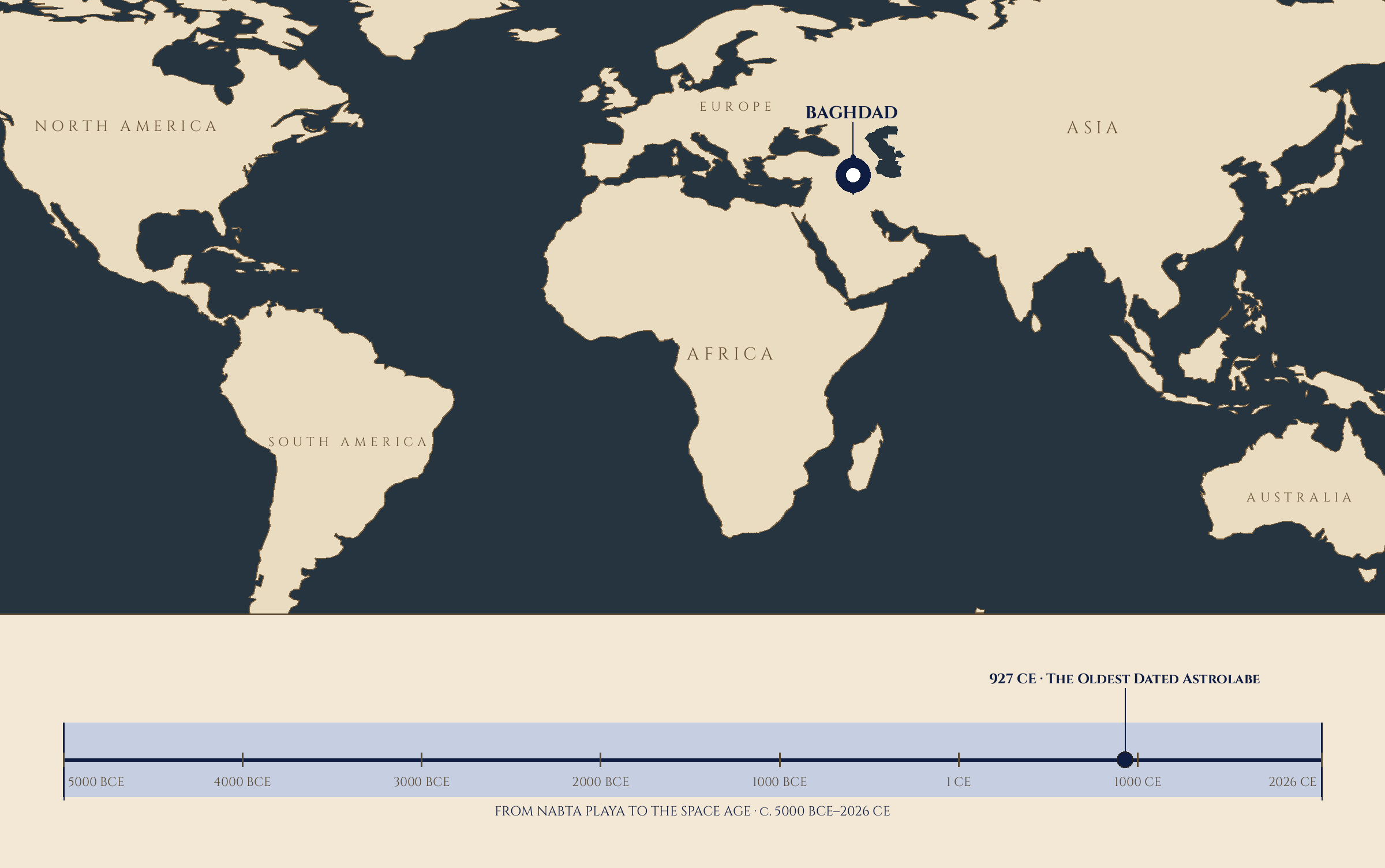
Where and when: BAGHDAD, 927 CE · The Oldest Dated Astrolabe (year 927) — The Astrolabe. The pin is this lesson. The line beneath the map is our road: every stop a moment when watching the sky changed, every lesson a pin upon it.
Lesson Objectives
By the end of this lesson, you will be able to:
- Name the five principal parts of a planispheric astrolabe (mater, tympan, rete, rule, alidade) and explain what each one does.
- Explain, in their own words, why an astrolabe needs a different plate for each latitude.
- Describe stereographic projection simply: the celestial sphere flattened onto a plate, circles staying circles, so that a rotating overlay can model the turning sky.
- Take an altitude measurement with a sighting rule and explain how one altitude plus the date gives the time.
- Trace the instrument's history honestly: Greek mathematics, the Islamic Golden Age workshops, the road into Europe through Spain, and Chaucer's English treatise of 1391.
- Build a working paper astrolabe for 39 degrees north latitude and use it to measure the altitude of one real celestial object.
Reading this lesson: ★ marks the passages to remember. They return on the unit quiz and the class test. Check in questions ask the material back as you go; answer them in your workbook when you meet them.
Working this lesson: Your assignment packet is the first download on this page. Work in it as the lesson moves along, answering each exercise as its subject is taught — or read the lesson through for your notes and take the exercises as homework afterward. Both are proper ways to sit this class. Signposts in the reading tell you where each exercise belongs. Written answers are short answers in your own words; a few honest lines are worth more than a filled page.
Your Assignment Packet
This lesson's exercises live in its packet: the Lexicon Handout (every term of the lesson), Materials, Guided Practice, the Assignment Manual with its answer key for self-checking, the Reflection Questions, and the Workbook Checklist. Download the packet before you begin and keep it beside you as you read. The packet's exercises are Glimmerwick's own word for the work: Exercise I: Build the Paper Astrolabe ⚒, Exercise II: One Real Measurement ◐, and Exercise III: The Equinox Calculation ✎. The manual's own Lesson Quiz is not printed in the packet; it pools to the Unit VI Quiz, where it will meet you again.
Safety Briefing
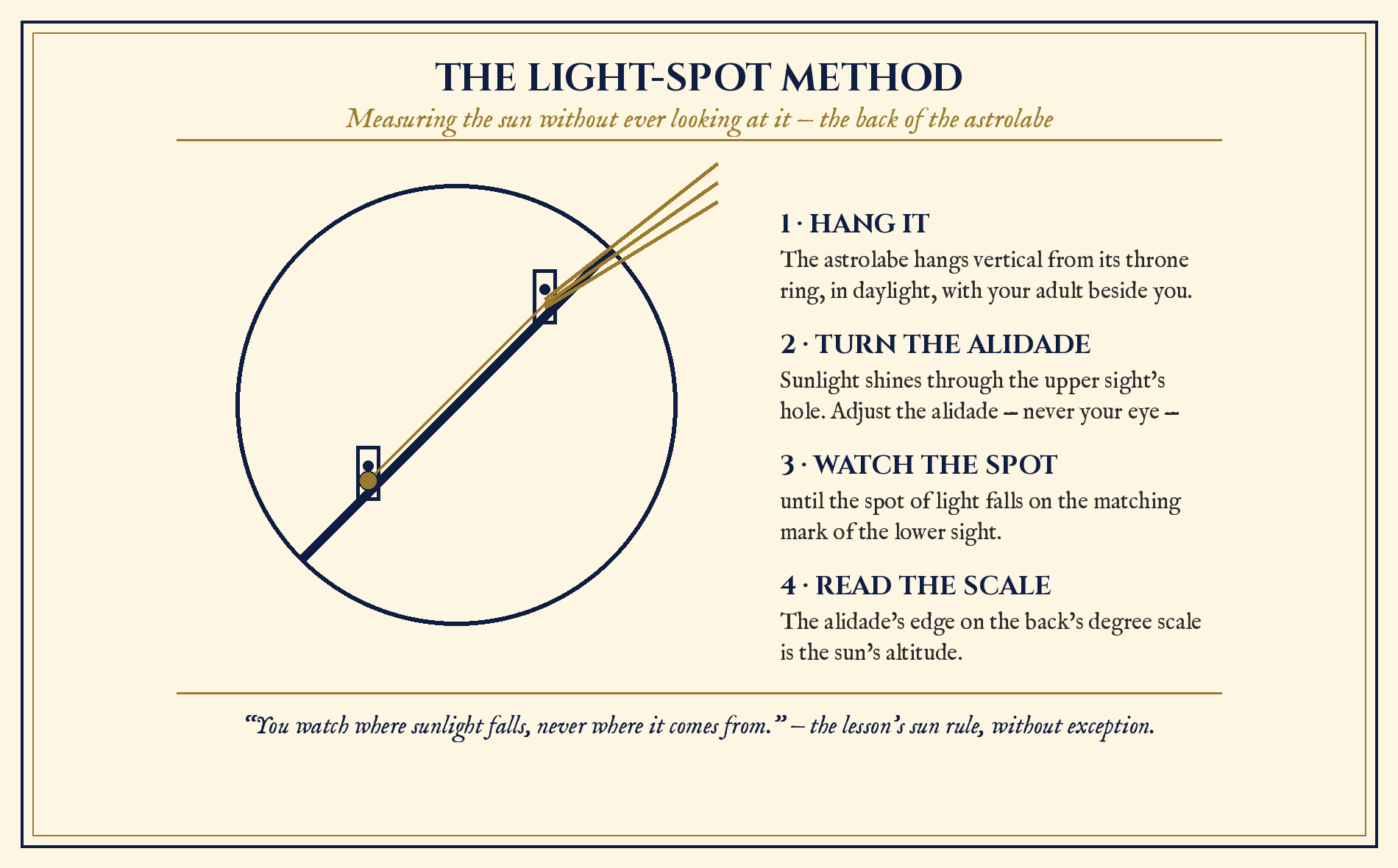
The light-spot method on the astrolabe’s back, in four steps — hang it, turn the alidade, watch the spot, read the scale: “You watch where sunlight falls, never where it comes from.”
School of Evershade teaching plate.
This lesson has two activities with two different kinds of care, and both matter.
Night observing. All night observing is done with an adult, in a safe and familiar location. Bring a red flashlight or cover a regular flashlight with red paper so your night vision survives the walk home. Dress for the temperature; October nights in Kansas are colder than they look from indoors.
The sun rule, stated plainly and without exception. Never look directly at the sun, not through the astrolabe's sights, not through any instrument, not with the naked eye. The daytime measurement in this lesson uses the light-spot method: you watch where sunlight falls, never where it comes from. If you are under eighteen, the sun measurement needs an adult beside you. There is no improvisation here and no brave exception. The scholars of the Islamic Golden Age, who used this instrument every day of their lives, knew this rule too.
Build safety. The paper astrolabe needs scissors or a craft knife and a compass with a sharp point. Cut away from your fingers, keep the compass point capped when it is not drawing, and put the tools away when the build is done.
The Wonder
Hold out your hand, palm up. Now imagine I set a disk of brass in it, about the size of a saucer, heavy for its size, warm from my pocket. On its face is a delicate metal lacework that turns when you touch it: a map of the brightest stars, each one a little pointed tongue of metal with a name. Under the lacework lies an engraved plate covered in arcs and circles, fine as handwriting. Around the rim runs a ring of numbers. On the back, a pivoting bar with two little upright sights, like the sights on a tiny rifle. Now imagine I tell you that this disk can tell you the time, day or night. That it can tell you when the sun will rise on any date you name, in any year. That it can find north without a compass, find the direction of a distant city you have never visited, and measure the height of the castle tower without climbing it. That it holds the whole turning sky inside it, and that by turning one lacework wheel with your thumb, you can watch the stars rise and set for any night of the year, past or future. That disk is an astrolabe. The word comes from Greek words meaning "star taker." For roughly two thousand years it was the most sophisticated portable instrument in the world, and it did everything I just listed with no battery, no signal, and no moving parts except the ones your thumb provides. A Cambridge historian, shown an eleventh-century astrolabe found in Verona, Italy, called it "the world's first smartphone." The joke lands because the comparison is honest: one object, many functions, carried everywhere, consulted constantly. Here is the part that should stop you in your tracks. The astrolabe does not work by magic, and it does not work by approximation or guesswork. It works by geometry: a single, beautiful piece of mathematics that flattens the whole celestial sphere onto a flat plate without breaking the relationships between the stars. When you understand that piece of mathematics, the instrument stops being mysterious and becomes something better. It becomes obvious. And then you get to build one.
❦ In your workbook: record the wonder in your own way — a disk of brass the size of a saucer that tells the time day or night, finds north without a compass, and holds the whole turning sky inside it — copy, sketch, or note what matters.
The Story
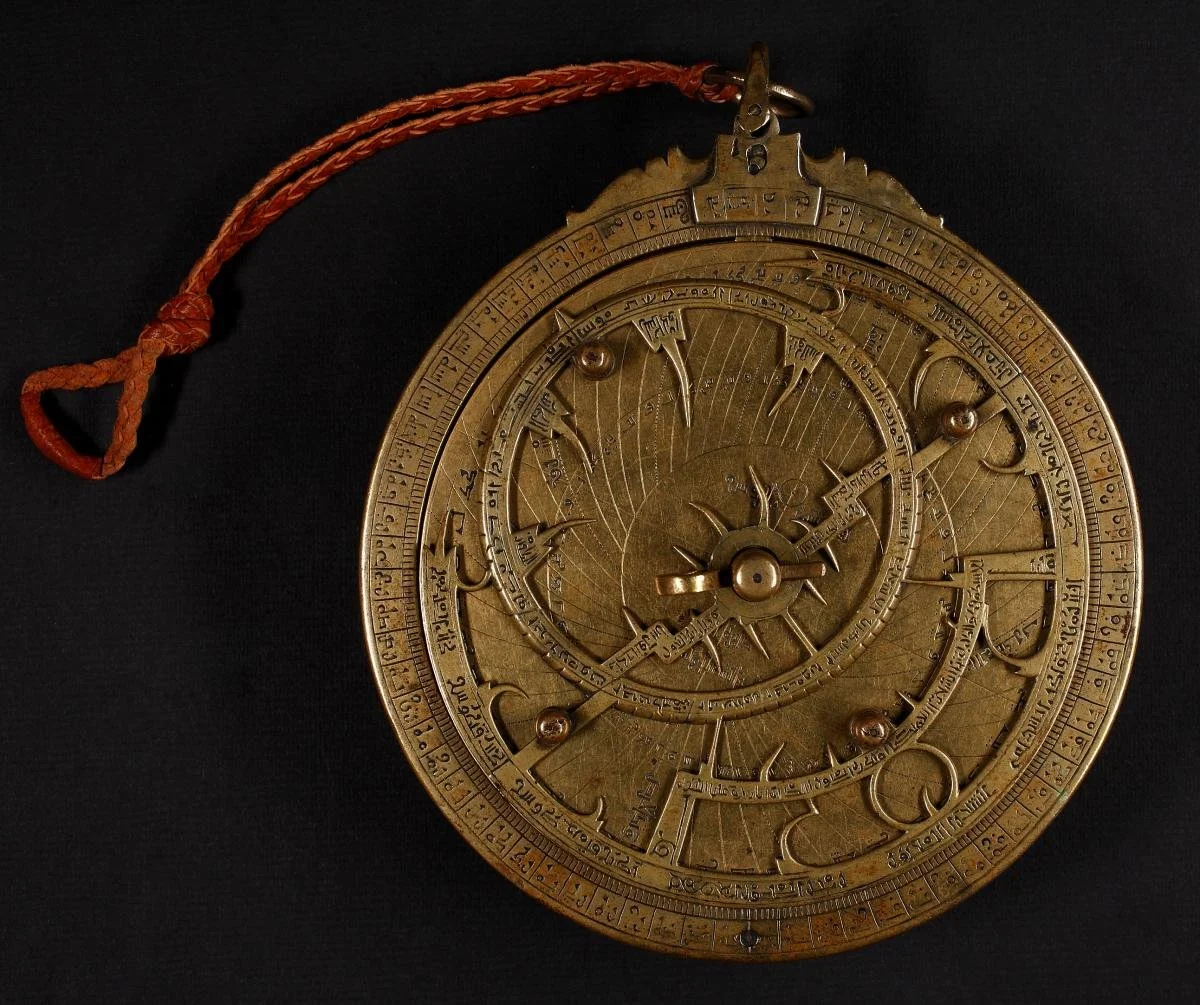
An Andalusian astrolabe dated 420 AH — about 1029 CE. The pierced framework on top is the rete; beneath it sit the plates, inside the mater.
Wikimedia Commons contributor (see file page). License: CC0 (verified on the file page via the Commons API).
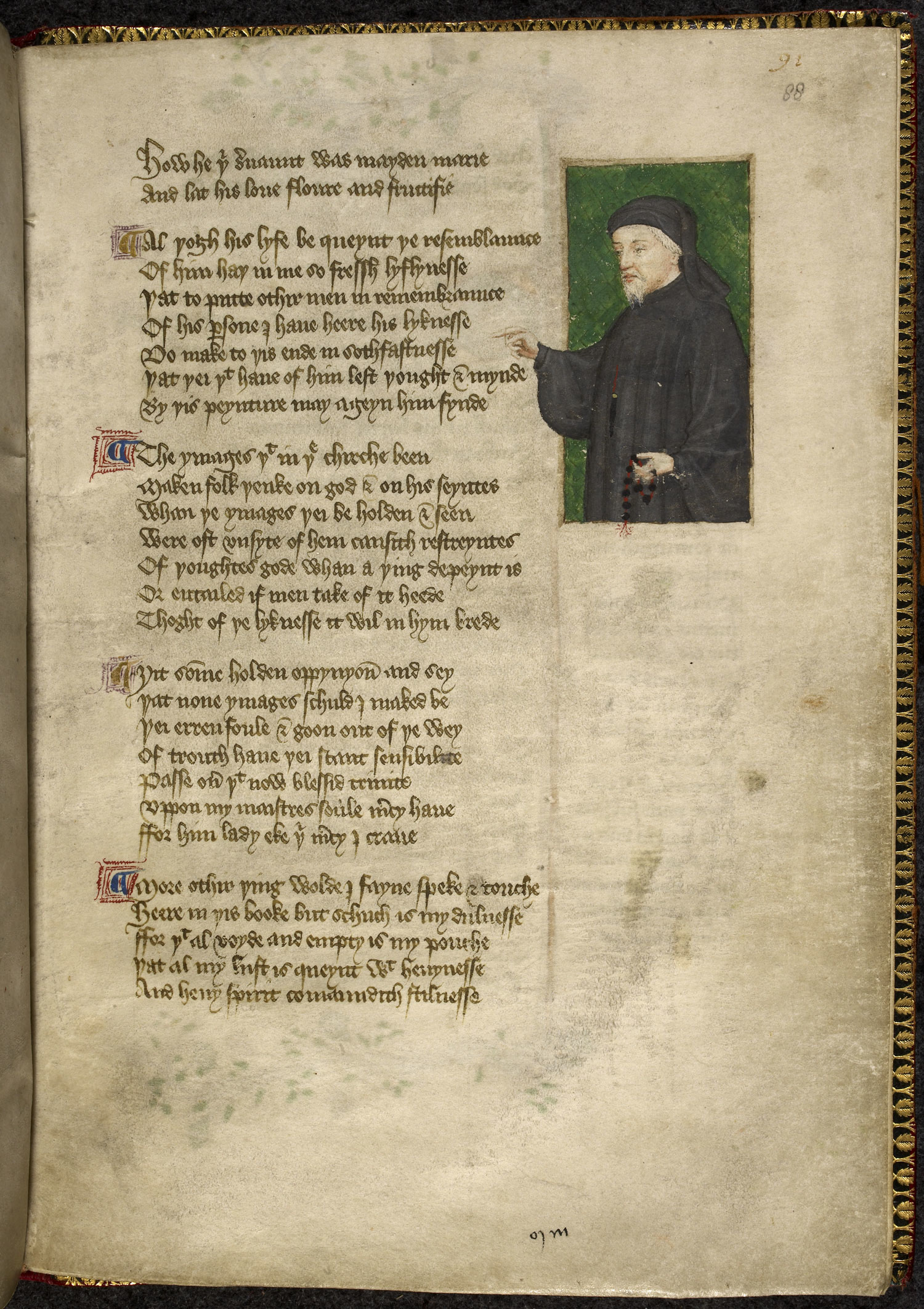
Chaucer, pictured in Hoccleve's Regiment of Princes (1412) — the poet who wrote the first technical manual in English so his ten-year-old son could work an astrolabe.
British Library Harley 4866, via Wikimedia Commons. License: Public domain (verified via the Commons API).
Every history of the astrolabe begins with an honest sentence: nobody knows who invented it. Anyone who tells you otherwise is selling something. What we know is the trail of the idea, and the trail is a good one, because it runs through three civilizations and a thousand years.
The Greek mathematics. The deep secret of the astrolabe is not the brass. It is the projection: the method of flattening the celestial sphere onto a flat plate so that circles stay circles. That mathematics was understood in the ancient Greek world. Hipparchus, the great astronomer of the second century BCE, used it to design an anaphoric clock, a water-driven device whose dial showed the rising times of stars. It is tempting to hand Hipparchus the whole invention, and many books do. There is no evidence for it, and this course does not deal in tempting stories. What the Greeks gave the astrolabe was the geometry it stands on.
In the second century CE, Ptolemy of Alexandria wrote the Planisphaerium, a treatise on exactly this projection: how to flatten the sphere. It survives only in fragments of Greek, preserved in Arabic and Latin translations. Note the honesty of the record: Ptolemy's own observing instrument, described in his great Almagest, was an armillary sphere, rings within rings, not an astrolabe. The projection existed before the instrument did.
Check in: What did the Greeks actually give the astrolabe — and what does the record refuse to hand Hipparchus?
❦ In your workbook: record the Greek mathematics in your own way — the projection that flattens the sphere with circles staying circles, Hipparchus's anaphoric clock, and Ptolemy's Planisphaerium surviving in Arabic and Latin — copy, sketch, or note what matters.
The first instrument makers. The earliest known treatise about the astrolabe itself was written by Theon of Alexandria around the fourth century CE. The work is lost; we know of it because the Suda, a tenth-century Byzantine encyclopedia, mentions it. The earliest surviving written account comes a little later, from the sixth century. And here is where a famous myth begins: a letter survives from Synesius of Cyrene, written around the year 400, describing how Hypatia of Alexandria, Theon's daughter, taught him to construct a silver plane astrolabe as a gift for an official. From that one letter grew the legend that Hypatia invented the astrolabe. She did not, or at least, no evidence says she did. What the letter proves is lovelier and more human: that around the year 400, a philosopher and her student were already making these instruments as gifts, the way you might give someone a fine watch.
Check in: What does Synesius's letter actually prove — and what legend grew from it that the evidence does not support?
❦ In your workbook: record the first instrument makers in your own way — Theon's lost treatise, the Suda, and a silver plane astrolabe made as a gift around the year 400 — copy, sketch, or note what matters.
The Islamic Golden Age. When the translation movement of Baghdad began rendering Greek science into Arabic in the eighth and ninth centuries, the astrolabe found the civilization that would perfect it. The astronomer al-Khwarizmi, whose name gives us the word "algorithm," wrote on the use of the astrolabe in the early 800s; his work survives only in fragments, but it is among the earliest Arabic treatments of the instrument. Over the following centuries, craftsmen in Baghdad, Damascus, Cairo, and Cordoba turned the astrolabe into a precision instrument and an art object at once, engraved with exquisite calligraphy, inlaid with silver.
It also found daily work. The five daily prayers of Islam are astronomically defined, tied to the sun's position, and the direction of prayer faces Mecca. The astrolabe answered both questions: what time is it by the sun, and which way is Mecca from here. The tenth-century astronomer al-Sufi is credited with listing more than a thousand uses for the instrument, which may be an exaggeration, but it is an instructive one. It tells you how the users felt about it. The oldest surviving astrolabe that carries a date was made in Baghdad in 927/928 CE. Think about that: a working scientific instrument, more than eleven hundred years old, still legible.
★ The great name of this period is al-Zarqali, known in Latin as Arzachel. Born in Toledo in 1029, he began as an engraver, which is what his Arabic nickname means, and became the most celebrated instrument maker of the western Islamic world. His masterwork was the universal astrolabe, which he called al-safiha: one plate that worked at any latitude, freeing the traveler from carrying a stack of latitude plates. Navigators were still using his design in the 1500s, and there is a crater on the moon named for him.
Check in: What daily work did the astrolabe do in the Islamic Golden Age — and what did al-Zarqali build that freed the traveler from the stack of plates?
❦ In your workbook: record the Islamic Golden Age in your own way — Baghdad's translation movement, prayer times and the direction of Mecca, the dated Baghdad astrolabe of 927/928, and al-Zarqali's al-safiha — copy, sketch, or note what matters.
The road into Europe. It was from the Islamic world that knowledge of the instrument traveled into medieval Europe, carried through Spain, where Muslim, Jewish, and Christian scholars worked within reach of one another. By about the year 1000, Latin texts on the astrolabe were circulating in Europe. In 2024, researchers authenticated an eleventh-century astrolabe, made in Muslim-ruled Spain, found in a museum in Verona, Italy: its brass carries Arabic inscriptions, later Hebrew additions, and finally Western numerals, added by successive owners across centuries and religions. One object, three civilizations, each one reading the sky through it. If you ever doubt that science is a shared inheritance, go look at a photograph of the Verona astrolabe.
Check in: Through where did the astrolabe reach Europe — and what do the Verona astrolabe's three sets of inscriptions show about science as a shared inheritance?
❦ In your workbook: record the road into Europe in your own way — Spain, Latin texts by about the year 1000, and one brass disk in Verona read by Muslims, Jews, and Christians in turn — copy, sketch, or note what matters.
★ Chaucer's little book. The most charming chapter of the European story belongs to Geoffrey Chaucer. In 1391, the poet of the Canterbury Tales wrote A Treatise on the Astrolabe: a practical handbook describing the instrument's parts and some forty operations you could perform with it. He wrote it in Middle English, not Latin, and he wrote it for his ten-year-old son, Lewis, opening with the words "Lyte Lowys my sone." He explains his choice directly: the boy knows only a little Latin as yet, and a child learns better in his own tongue. It is considered the oldest work in English written about an elaborate scientific instrument, and it was never finished: Chaucer planned five parts and completed two. He drew his material largely from Latin versions of an Arabic treatise by the eighth-century astronomer Masha'allah. So the little English book for a ten-year-old is itself a link in the chain: Greek geometry, Arabic craftsmanship, Latin translation, English prose, a father's handwriting.
Check in: For whom did Chaucer write his Treatise, in what language, and why — and from how far back does his little book's own chain of sources run?
❦ In your workbook: record Chaucer's little book in your own way — "Lyte Lowys my sone," Middle English over Latin, two parts finished of five planned, and Masha'allah's Arabic treatise behind the Latin — copy, sketch, or note what matters.
The long farewell. A simplified, rugged cousin, the mariner's astrolabe, went to sea with the explorers of the 1400s and 1500s for measuring the sun's noon altitude and finding latitude. On land, the instrument slowly yielded to mechanical clocks for timekeeping and to the sextant for navigation. By the 1700s the astrolabe had retired to cabinets and museums, where it remains: Oxford's History of Science Museum keeps one of the world's great collections of them. The instrument that told time for two thousand years now keeps museum time, behind glass, visited by schoolchildren who press their noses to the case. Some of those children, I like to think, go home and build one out of paper.
Check in: What carried the astrolabe's work away at the end — and where does the instrument keep its time now?
❦ In your workbook: record the long farewell in your own way — the mariner's astrolabe at sea, clocks and the sextant on land, and Oxford's museum cabinets — copy, sketch, or note what matters.
The Mechanism
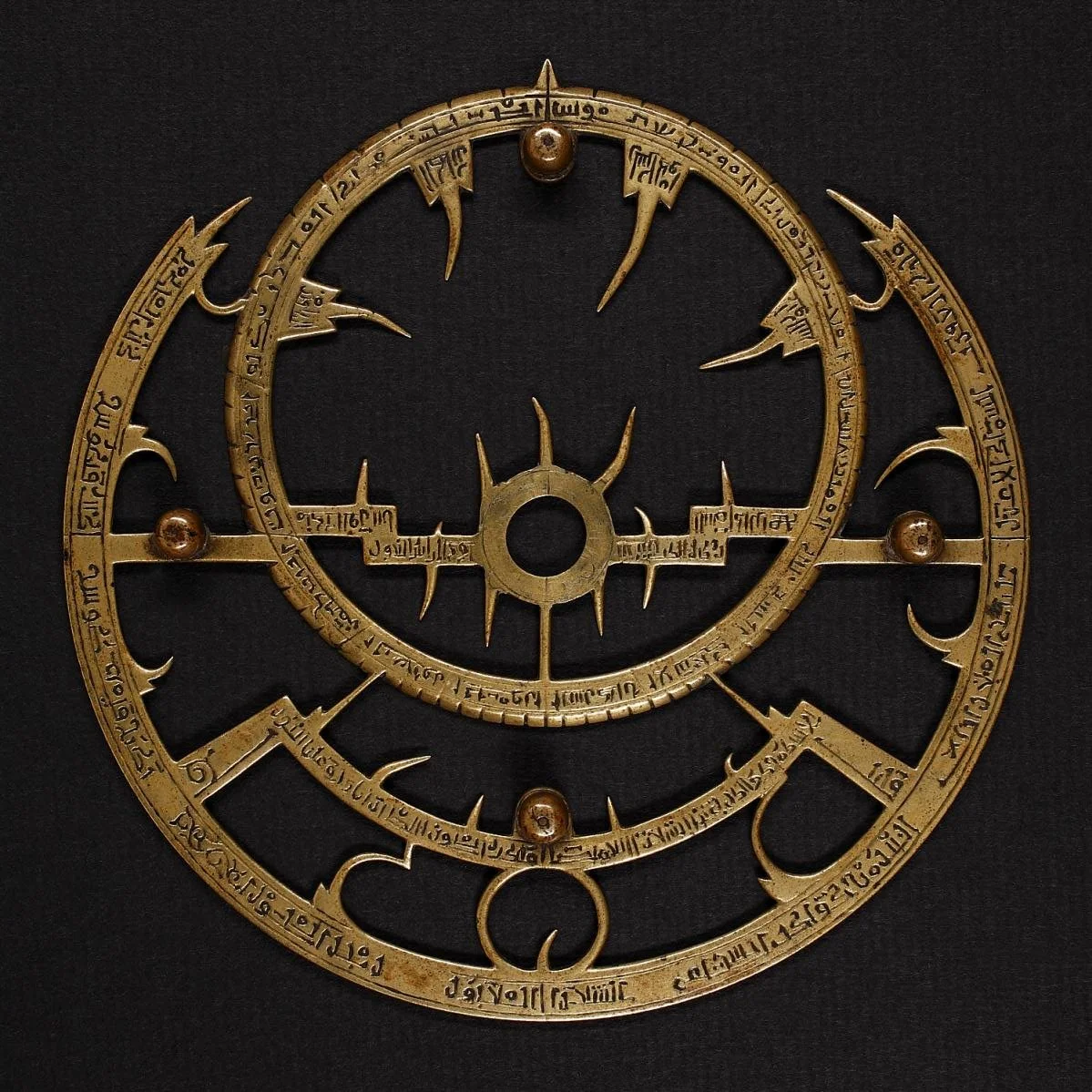
The rete of the same instrument, lifted out: a 'net' of metal whose points are stars, turning over the plate beneath.
Wikimedia Commons contributor (see file page). License: CC0 (verified via the Commons API).
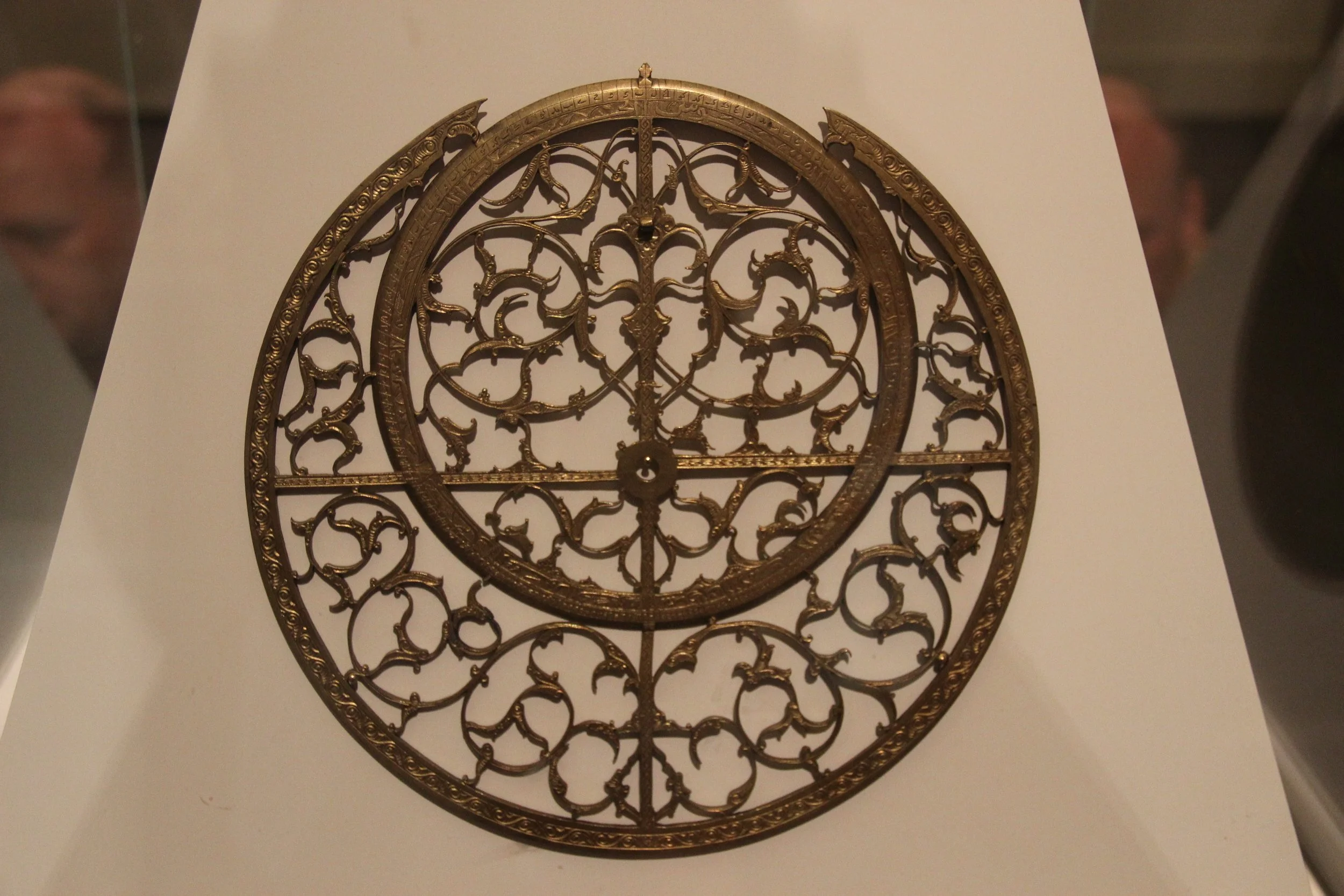
A rete on museum display — the pierced star-net was often the most beautiful metalwork on the instrument.
Gary Todd (via Flickr / Wikimedia Commons). License: CC0 (verified via the Commons API).
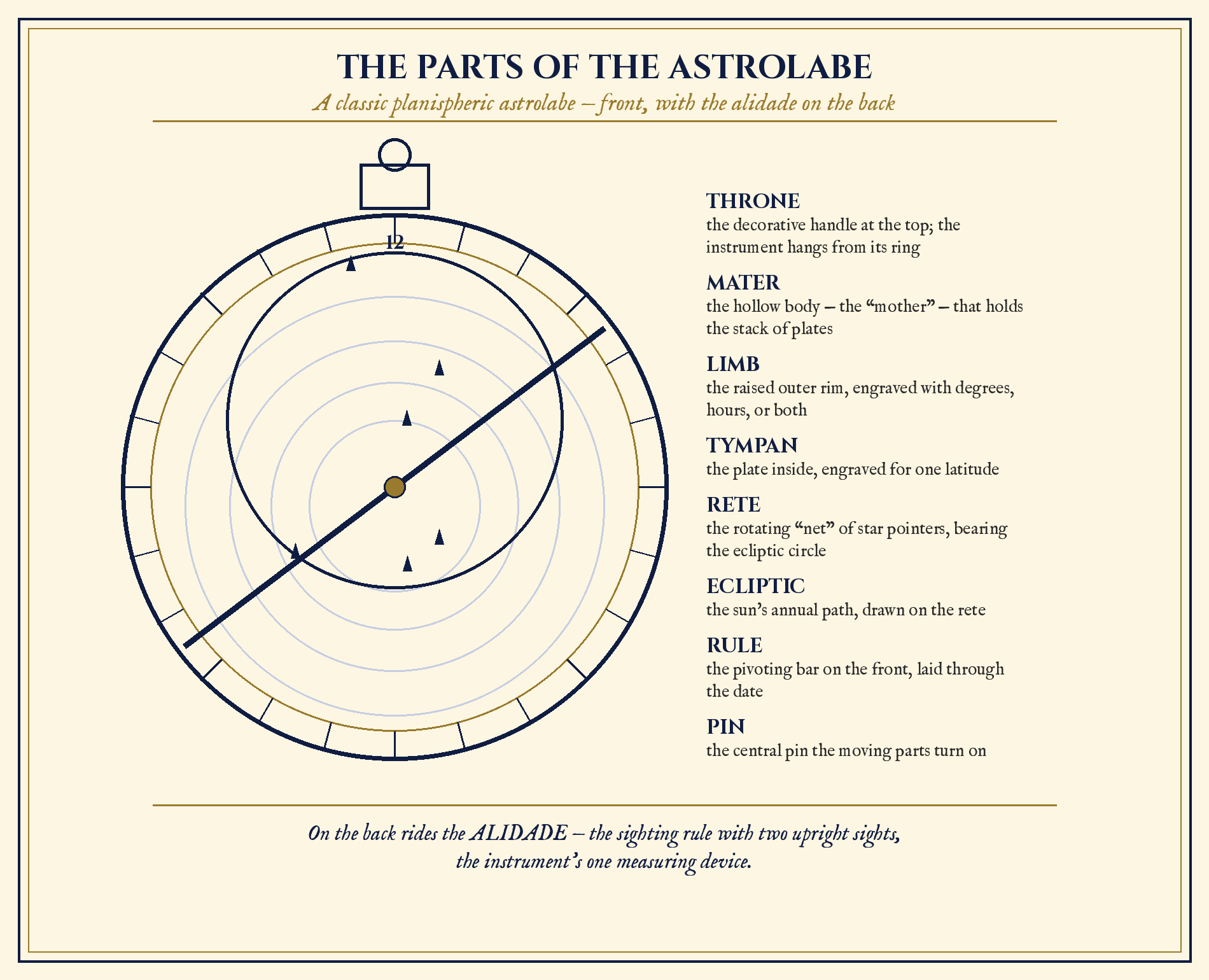
The astrolabe’s parts, labeled in the lesson’s own definitional language: throne and ring, mater and ticked limb, tympan, rete and ecliptic, rule and central pin — with a note on the alidade at the back.
School of Evershade teaching plate.
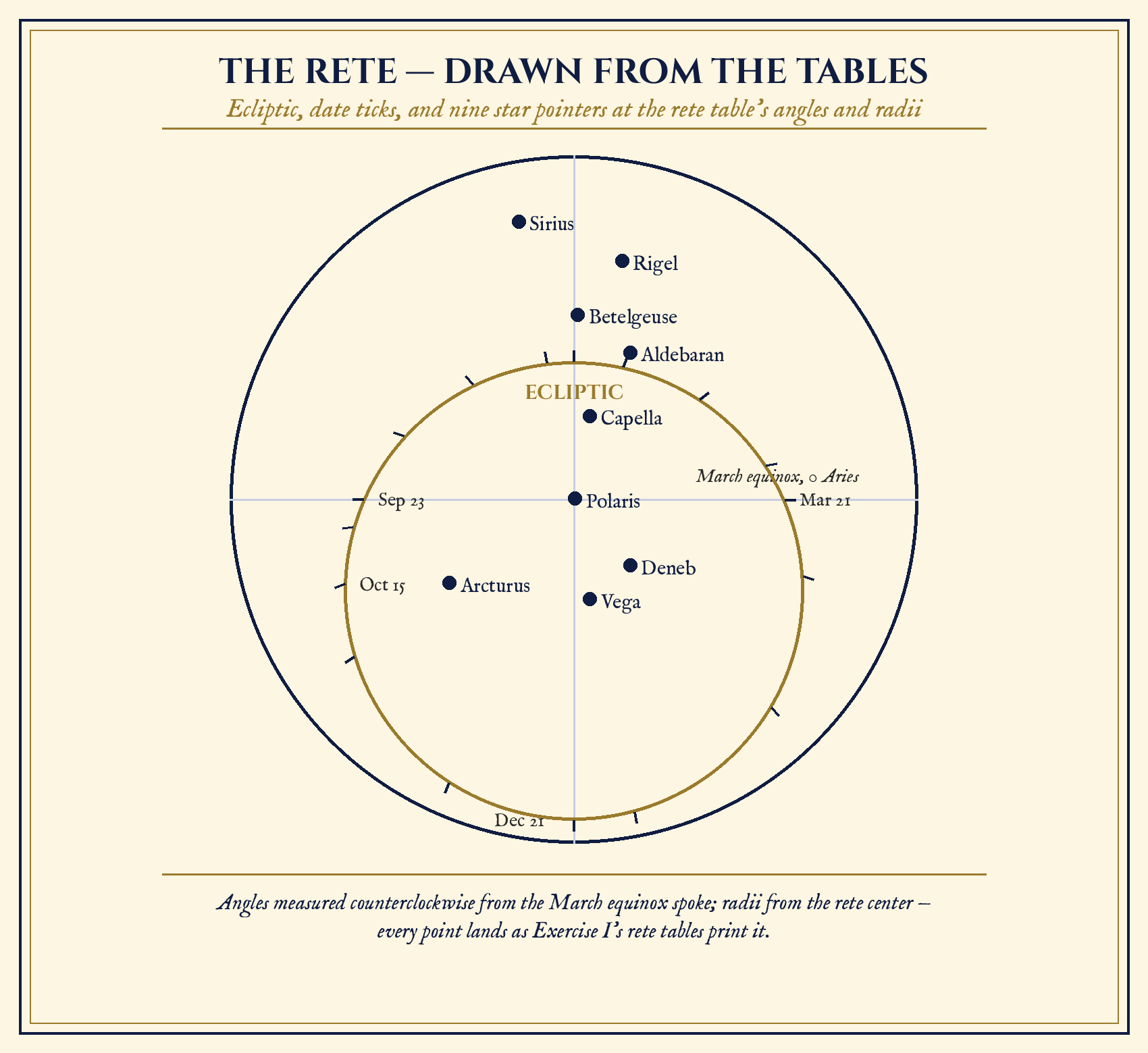
The rete drawn from Exercise I’s own tables: the ecliptic circle with its seventeen date ticks and nine star pointers, plotted at the tables’ printed angles and radii, the named stars labeled.
School of Evershade teaching plate.
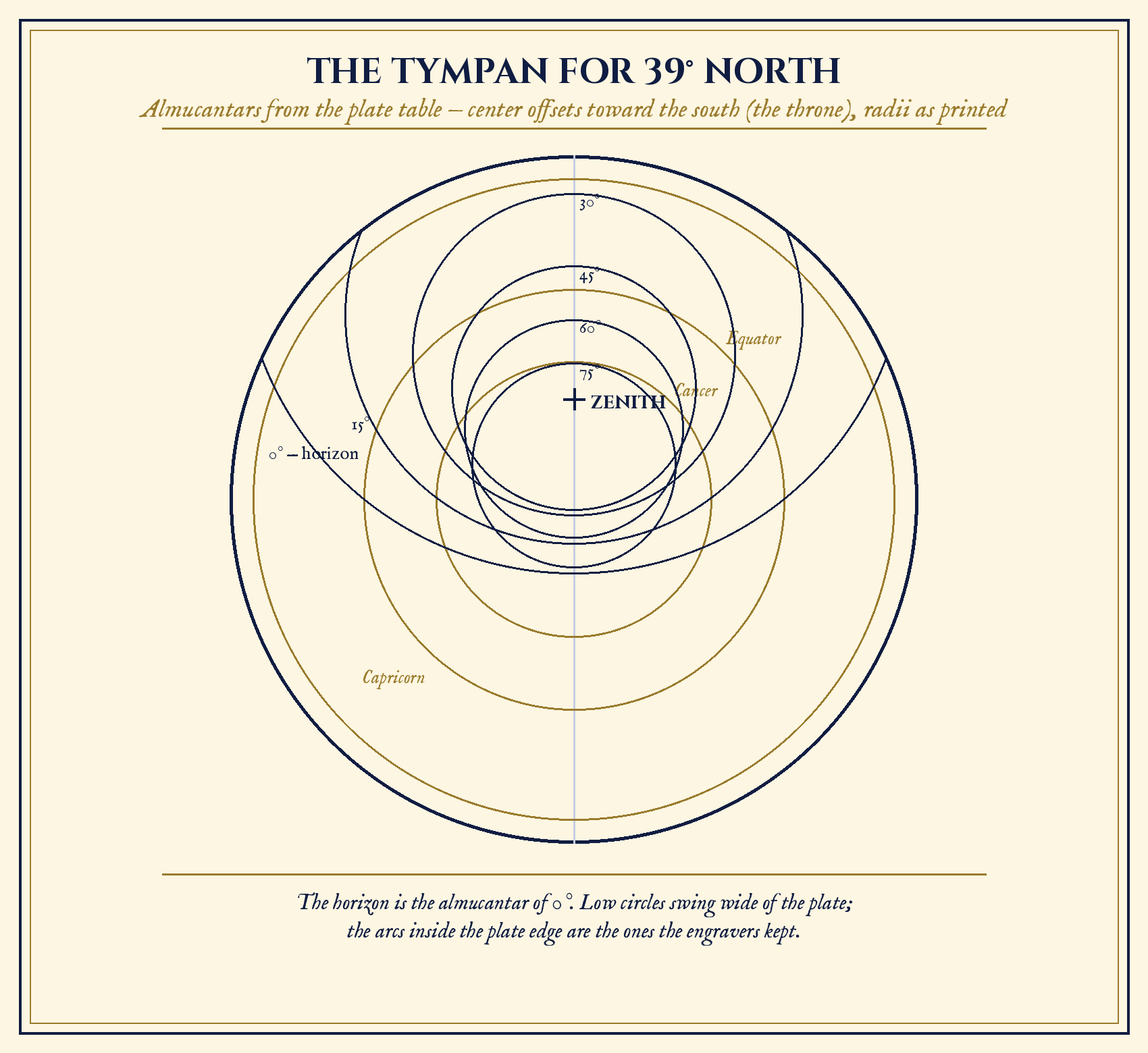
The tympan for 39° north, drawn from Exercise I’s plate table: six almucantar circles at their tabled offsets, the Cancer, equator and Capricorn reference circles, and the zenith cross.
School of Evershade teaching plate.
This is the heart of the lesson, and I want you to read it slowly, because everything the astrolabe does follows from one idea. When you finish this section, you should be able to explain the instrument to a friend without waving your hands.
The parts, and what each one does. A classic planispheric astrolabe has five working parts plus its jewelry.
★ The mater is the body: a hollowed brass disk, the "mother," deep enough to hold the plates. Its raised rim, the limb, is engraved with a scale: degrees, hours, or both. Think of the mater as the house everything lives in.
Inside the mater lie the tympans, also called plates or climates: thin disks, each engraved for one specific latitude. The engraving is a map of your sky's coordinate system: the horizon, the zenith, and nested circles of equal altitude called almucantars, plus arcs of azimuth running from horizon to zenith. A fine astrolabe carried a stack of them, one per latitude, because the sky's geometry changes as you travel north or south. We will come back to why.
★ Above the tympan turns the rete, the "net": a skeletal, rotating framework carrying the fixed stars. Each bright star is a little pointer, and across the rete runs the ecliptic circle, the sun's annual path, marked with the zodiac signs or the calendar months. The rete is a star map that moves. Turn it, and the stars rise and set.
★ On the front, over the rete, rides the rule: a straight pivoting bar, used to line up a date on the ecliptic with the hour scale on the rim. On the back rides the alidade: another pivoting bar, but this one has two upright sights with holes or notches. The alidade is the measuring part. You hang the astrolabe vertically, sight a star (or the sun, by the safe method) through both sights, and read its altitude off the degree scale on the back.
Holding the top is the throne, the decorative handle with its suspension ring: you hang the whole instrument from your thumb or a cord so gravity holds it vertical and steady. A central pin holds the stack together and lets the moving parts turn.
Check in: Name the five principal parts — mater, tympan, rete, rule, alidade — and say in one line what each one does.
❦ In your workbook: record the parts in your own way — the mater the house, the tympan your sky's plate, the rete the turning net of stars, the rule on the front, the alidade the measuring bar on the back, the throne and the pin — copy, sketch, or note what matters.
The projection: flattening the sky. Here is the mathematics, and it is genuinely beautiful. Imagine the celestial sphere: the imaginary enormous sphere around Earth on which the stars appear fixed. Now imagine standing at the south celestial pole, the point of the sphere directly below the Earth's south pole, and shining a light outward through every point of the sphere onto a flat plate laid across the sphere at the celestial equator. Every star, every circle in the sky, casts a shadow onto the plate. That is stereographic projection.
★ It has two properties that make the whole instrument possible. First, circles stay circles: any circle drawn on the sphere, a circle of constant altitude, the tropics, the ecliptic, becomes a circle (or, in special cases, a straight line) on the plate. Second, angles are preserved: the angle between any two directions in the sky is the same as the angle between their shadows on the plate. Mapmakers call this second property conformality, and it is the quiet miracle. Because angles are preserved, a rigid piece of metal shaped like the sky's star pattern can rotate over the plate and stay true at every position. The rete is that rigid piece. The plate is the shadow map. Turning the rete is turning the sky.
Check in: In stereographic projection, where do you stand, where does the light shine, and what two properties make the whole instrument possible?
❦ In your workbook: record the projection in your own way — the light at the south celestial pole, the plate at the equator, circles staying circles, and angles preserved — copy, sketch, or note what matters.
★ Why the plates are latitude-specific. Look at what the tympan carries: the horizon, the zenith, the almucantars. All of these belong to your location. Travel north, and your zenith slides toward the celestial pole; the horizon tips; every altitude circle shifts. The projection faithfully records that shift, which means a plate engraved for Baghdad gives wrong answers in Toledo. The rete, by contrast, carries the stars and the ecliptic, which are the same for everyone on Earth (the whole planet sees the same sky, only framed differently). So the instrument splits the problem in two: one swappable local plate per latitude, one universal star map. That split is the design genius of the astrolabe. Al-Zarqali's universal astrolabe was celebrated precisely because it found a clever way to do without the stack.
Check in: Why is the tympan latitude-specific while the rete serves everyone on Earth — and what was al-Zarqali's celebrated way around the stack?
❦ In your workbook: record the split in your own way — one swappable local plate per latitude, one universal star map, and the design genius that divides the problem in two — copy, sketch, or note what matters.
Taking an altitude. Hang the astrolabe from its ring so it hangs vertical. Turn the alidade on the back until the star (or the sun's light spot, never your eye) lines up through both sights. Read the number where the alidade crosses the degree scale. That number is the object's altitude: its angle above the horizon, in degrees. That is the instrument's one measurement, and everything else is computation built on top of it.
Check in: Taking an altitude takes one measurement — what exactly do you hang, turn, and read, and what number comes off the scale?
❦ In your workbook: record the one measurement in your own way — the instrument hanging vertical from its ring, the alidade turned until the star or the light spot lines up, and the altitude read in degrees — copy, sketch, or note what matters.
Turning an altitude into the time. Here is the trick, worked as an example. It is October 15. You are at 39 degrees north. Vega is sinking in the west, and your alidade says its altitude is 42 degrees.
Flip the astrolabe over. Turn the rete until Vega's little pointer sits exactly on the 42-degree almucantar circle, on the western side (you know Vega is in the west because you just looked at it). Now the rete shows the whole sky as it stands at this moment: every star is in its true place, because fixing one star fixes them all. The rigid map cannot lie.
Now find October 15 on the ecliptic circle of the rete. That tick marks where the sun is today, traveling its annual road. Lay the rule from the center through the October 15 tick, out to the hour ring on the rim. Read the number. It will say about half past nine in the evening.
★ Think about what just happened. You measured one angle, on one star, and the instrument told you the time. It could do that because the sky is a clock: the stars wheel overhead at a fixed rate, so a star's position is the time, once you know the date. The astrolabe is the device that converts between the two, with no arithmetic on your part. One caution the old users knew well: the time you read is local apparent solar time, sun-dial time, not the clock on your phone. Your phone's time has been corrected for your longitude within your time zone, for the equation of time, and for daylight saving. The astrolabe gives you the sun's own time, which is arguably the more honest of the two.
Check in: You measured one angle on one star — walk the chain: how do the rete, the date tick, and the rule turn that angle into the time, and whose time is it?
❦ In your workbook: record the time trick in your own way — Vega at 42 degrees on October 15, one star fixing the whole sky, the rule through the date tick, and local apparent solar time against your phone's corrected clock — copy, sketch, or note what matters.
What else it could do. Once you see the principle, the forty operations of Chaucer's little book stop sounding like magic. Sunrise and sunset: put the date tick on the horizon circle and read the time. The calendar: the ecliptic circle is a calendar. Prayer times and the direction of Mecca: altitude of the sun plus a table, or special engraved arcs. Heights and distances: the back of many astrolabes carries a shadow square, a little grid for solving triangles, so a tower's height falls out of two sightings. Latitude: measure the altitude of the pole star, and you are nearly done. Every one of these is the same move: measure an angle, let the geometry do the rest.
Check in: Sunrise, prayer times, a tower's height, your latitude — what single move do all forty of Chaucer's operations share?
❦ In your workbook: record the forty operations in your own way — the date tick on the horizon for sunrise, the shadow square for heights, the pole star for latitude, and one move underneath them all: measure an angle, let the geometry do the rest — copy, sketch, or note what matters.
In your packet: Exercise I: Build the Paper Astrolabe ⚒ begins from this section — its cutting list and its tables for 39 degrees north are computed from exactly this projection. Work it when you reach Try It Tonight, or mark the place and take it as homework — your choice.
A Sealed Note on the Honest Instrument
My dearest scholars, a word about honesty, because this instrument deserves it. You will sometimes read that Hipparchus invented the astrolabe, or that Hypatia did. Both stories are told with great confidence and neither has evidence behind it. The historians who study this instrument will tell you plainly: the inventor is unknown. I would rather give you that true sentence than a colorful false one, because the true sentence is more interesting. It means the astrolabe was not one genius's flash of insight. It was centuries of people, Greek geometers, Syrian scholars, Baghdad craftsmen, Andalusian engravers, each handing the idea along a little improved, until it gleamed. That is how most real science happens: not as lightning, but as relay. Remember that the next time someone offers you a simple story about a complicated past. Ask for the evidence, the way you would ask for the next plate in the stack. The sky rewards the careful. — Professor Vesper Glimmerwick, Celestial Studies • Astronomer & Celestial Historian
❦ In your workbook: record the sealed note in your own way — an inventor unknown, a relay rather than a lightning flash, and the sky rewarding the careful who ask for the evidence — copy, sketch, or note what matters.
Guided Observation
Try It Tonight
Tonight you build the instrument. The full cutting list, measurements, and tables live in Exercise I of your Assignment Packet, and every number in those tables was computed by genuine stereographic projection for 39 degrees north, the latitude of Evershade. What follows is the walkthrough; the packet holds the numbers.
The build, in brief. You will cut five parts from card stock: the mater (with its hour ring on the front rim and its degree scale on the back), one tympan for 39 degrees north (horizon, almucantars every 15 degrees, the three reference circles), the rete (ecliptic circle, date ticks, and nine star pointers), the rule, and the alidade with its two folded sights. A pin or brad through the center holds the stack, in order: mater, tympan, rete, rule on the front; alidade on the back. A loop of thread through the throne hole lets it hang vertical.
Check in: Before you observe: what are the build check's three tests — and in what order does the stack sit on its pin, front and back?
❦ In your workbook: record the build in your own way — five parts cut from card stock, the stack in order on its pin, and the build check passed before first light — copy, sketch, or note what matters.
First light. Take your finished astrolabe outside with your adult. Let it hang from the thread, perfectly still. Find a bright star: Vega, Arcturus, Sirius, any of the nine on your rete. Turn the alidade until the star shines through both sights at once, and read the altitude where the alidade crosses the back scale. Write it down, with the star's name, the date, and the clock time.
Check in: At first light, what do you record beside the altitude itself — and why does the star's name, the date, and the clock time all belong on the same line?
❦ In your workbook: record first light in your own way — the star you sighted through both sights at once, its altitude off the back scale, and the star's name, the date, and the clock time written down together — copy, sketch, or note what matters.
Close the loop. Go back inside. Turn the rete until that star's pointer rests on the matching almucantar, on the correct side (east or west, whichever you observed). Lay the rule through today's date tick on the ecliptic, out to the rim. Read the time. Compare it with your clock, remembering the lesson's caution: the astrolabe reads the sun's own local time, and your clock has opinions about time zones. If the two agree within half an hour, your paper instrument is working as truly as brass.
Check in: Closing the loop: how do you set the rete and lay the rule — and within what margin do the astrolabe's time and your clock count as agreeing?
❦ In your workbook: record the closed loop in your own way — the pointer on its almucantar on the side you observed, the rule through today's date tick, and the two times compared, the sun's own time against the clock's — copy, sketch, or note what matters.
The sun, safely. In daylight, with your adult, you may measure the sun by the light-spot method: hold the astrolabe so sunlight shines through the upper sight's hole and adjust the alidade until the spot of light falls on the matching mark of the lower sight. Read the altitude. Your eyes never go near the line of sight. This is how careful observers have always done it.
Check in: The sun, safely: what do your eyes watch in the light-spot method — and what do they never do? (Scout §7's sharpening, in the lesson's own words: you watch where sunlight falls, never where it comes from.)
❦ In your workbook: record the light-spot method in your own way — sunlight through the upper sight's hole, the spot fallen on the lower sight's mark, the altitude read, and your eyes never near the line of sight — copy, sketch, or note what matters.
If clouds defeat you tonight, the sky will keep. The instrument does not expire, and neither does the lesson.
Sky Log Entry
Record this night's work in your Sky Log as U6L31: The Astrolabe.
- The object you sighted (star name, or "sun by light-spot method"), its measured altitude in degrees, and whether it stood in the eastern or western half of the sky.
- The date, the clock time of your sighting, and the time your astrolabe reported. Note the difference, and note whether daylight saving time is in effect.
- Sky conditions in a sentence: clear, hazy, moonlit, cloudy.
- One sentence on the build: which part gave you the most trouble, and what you would change on a second instrument.
❦ In your workbook: record the Sky Log entry in your own way — U6L31: The Astrolabe: the object sighted and its altitude, east or west, the date and both times with their difference and the daylight-saving note, the sky in a sentence, and the build's hardest part — copy, sketch, or note what matters.
Materials
Required (Level One — household items)
- Card stock or a manila folder: the body of the instrument. Ordinary paper is too floppy for a working astrolabe.
- Scissors, a compass for drawing circles, a ruler, a protractor, and a pencil.
- Thread or string for hanging the astrolabe, plus tape.
- A pin, brad, or paper fastener for the central pivot: the rete and both bars must turn freely.
- Tracing paper for the rete if you have it; otherwise card with the interior cut away between the spokes.
Suggested (Level Two — historically closer)
- Brass paper fasteners and heavier card for a sturdier instrument that survives repeated observing nights.
- A printed star chart for your latitude, to check your pointer positions against the real sky.
Reflection Questions
Answer in your workbook, in complete sentences.
- The astrolabe's inventor is unknown, and this lesson refused to name one. Why is "we do not know" a stronger historical statement than a confident guess, and where else in this course have you seen scholars choose the honest sentence?
- The rete is latitude-independent but the tympan is not. In your own words, what does each part "know": what does the rete know about the sky, and what does the tympan know about the observer?
- Al-Zarqali began as an engraver and became the most celebrated instrument maker of his world. What does his career suggest about the relationship between craft and science?
- Your paper astrolabe and a museum's brass astrolabe do the same mathematics in different materials. Does the material matter to the science? Does it matter to anything else?
- Chaucer wrote his treatise in English for his ten-year-old son rather than in Latin for scholars. Who gets to learn, and who decides? How does Evershade answer that question?
Workbook Checklist — Lesson 31
In my workbook I have:
- ☐ built the paper astrolabe for 39 degrees north from the cutting list, drawn the tympan and the rete from the packet's tables, and passed the build check — the rete turning freely, the sights lining up, the hour ring reading 12 at the top and increasing clockwise
- ☐ taken one real measurement with my adult — one bright star's altitude on a clear night, or, if the night was cloudy, the sun's altitude by the light-spot method in daylight, my eyes never near the line of sight
- ☐ closed the loop indoors: set the rete, laid the rule through today's date tick, read the astrolabe's time, and written it beside the clock time with my two sentences on local apparent solar time
- ☐ written my Sky Log entry, U6L31: The Astrolabe — the object and its altitude, east or west, the date and both times with the daylight-saving note, the sky in a sentence, and the build's hardest part
- ☐ completed Exercise III's equinox calculation with the working shown in full — the altitude equation, the hour angle, the clock reading, and the two sentences on the morning/afternoon ambiguity
☐ Lesson completed Date: ___ Signature: ___
Cross-Class Connections

Runes · Unit I, Lesson 1 — The Structural Wedge
Tower scholars, the Babylonian star tablets Glimmerwick sends you back to were pressed the way my first lesson teaches: a cut reed stylus into wet clay, wedge by wedge, until the tablet held what the sky-watchers saw. Come to my classroom and learn the wedge itself — the tokens, the clay, the five basic forms, and why so many tablets survived to be read at all. The astrolabe is the same impulse refined into a computer; here is where the impulse learned to write.
PROFESSOR THISTLELOOM WEBBLETHORN
Runes & Ancient Writing
Scrollwork · Unit V, Lesson 17 — Hierarchy & Page Layout
Tower scholars, Chaucer's little book for Lewis survives because scribes laid it out to be used: a practical handbook's parts and operations, set on the page in an order a ten-year-old could follow, copied by hand in more than twenty manuscripts. My seventeenth lesson teaches that layout — how a page's hierarchy tells a reader what a thing is, what to do first, and where the working parts live. Glimmerwick's instrument is brass and geometry; mine is the page that carried its instructions across six centuries. Come and learn to build a page an instrument can live in.
PROFESSOR QUILLBERRY NOCTURNE
Scrollwork Library

Creative Arts · Studio Extension E1 — Precision Paper Instruments, Built to Last
Bring your paper astrolabe to my bench, scholars, and we will give it a body that lasts. You already know its weakness, because you have used it: a paper instrument fails at its center — the pivot hole stretches, the disk wobbles, the scales drift. In my extension we rebuild one instrument properly — the same scales, the same geometry, carried in board or thin wood with a fitted pivot, graduated and checked against your paper original, and a case to keep it in. Glimmerwick taught you the geometry. Here, we teach the center to hold it.
PROFESSOR COGBRANCH TIMBERCLANK
Creative Arts Workshop
The Professor's Closing Note
Fly gently home, scholars, You have now held two thousand years in your hands. Not as a story, not as a picture in a book, but as a working thing you built yourself, that answered a question about the real sky over your real town. There is a brass astrolabe in a museum in Oxford that was made before Columbus sailed. There is one in Verona that passed through the hands of Muslims, Jews, and Christians, each of whom needed it for the same sky. And now there is one made of paper and thread, in your hands, that does the same mathematics. The materials could not be more different. The geometry is identical. That is what I want you to carry away from this lesson: the good ideas do not belong to the brass or the paper. They belong to whoever learns them. Next lesson, we trade the brass disk for glass: the telescope, and the four hundred years in which every bigger eye rewrote the sky. Bring your curiosity. It has served you beautifully so far. — Professor Vesper Glimmerwick, Celestial Studies • Astronomer & Celestial Historian
Further Reading & Sources
- The Verona astrolabe: an 11th-century instrument that passed through Muslim, Jewish, and Christian hands: Archaeology News Online Magazine, on the 2024 authentication of the Toledo-made astrolabe researchers have called "the world's first smartphone."
- A Treatise on the Astrolabe: the full story of Chaucer's 1391 handbook for his son Lewis: its sources, its structure, and why it was never finished.
- Al-Zarqali (Arzachel): Muslim Heritage on the Toledan instrument maker and his universal astrolabe.
- The Astrolabe: astronomy's first hot app: Sky & Telescope walks through a modern replica part by part and takes it stargazing: the closest thing to trying one before you build yours.
- Origins of the astrolabe: historian Thony Christie on what is actually known about the instrument's beginnings, including the evidence against the famous attributions.
Browse the Celestial Studies shelf in the school Library for readable editions of these works.
Sealed in the Celestial Tower, in deep midnight blue, by Professor Vesper Glimmerwick.
Submit your work for this lesson using the form below.
CONTINUE IN THE CELESTIAL TOWER
← Previous · Lesson 30: The Planisphere & Star Charts Next · Lesson 32: Telescopes: From Galileo to JWST →
Unit VI — Instruments of the Sky Celestial Tower — All 33 Lessons
The rest of Unit VI: Lesson 29 · Sundials · Lesson 30 · Planisphere · Lesson 32 · Telescopes · Lesson 33 · Dark Skies