CELESTIAL STUDIES
Unit VI · Lesson 33Dark Skies
Professor's Introduction
Dear scholars,
Thirty-two lessons ago I asked you to go outside and look up. You learned to read the turning sky, to track the moon through its whole lunation, to name the wanderers and the fixed stars, to tell the stories people have told about them, and to build the instruments that extend human sight. We have come a long way together, and I am proud of every one of you.
So it is fitting that the last lesson of this course asks you to look up one more time and notice something that was never supposed to be part of the curriculum at all: whether the stars are still there to be seen. In my nightly flights I have watched towns below me grow brighter and brighter, until some of them glow like little lanterns laid out on a table. The light climbs into the sky and never comes back down. From my height, a city at midnight looks like a candle with the whole world for a saucer.
This lesson is about that light: what it is, where it goes, who counts its cost, and what you can do about it. The course began with looking up. It ends with protecting the darkness that makes looking up worthwhile.
Fly gently, and look up often.
PROFESSOR VESPER GLIMMERWICK
Celestial Studies
Astronomer & Celestial Historian
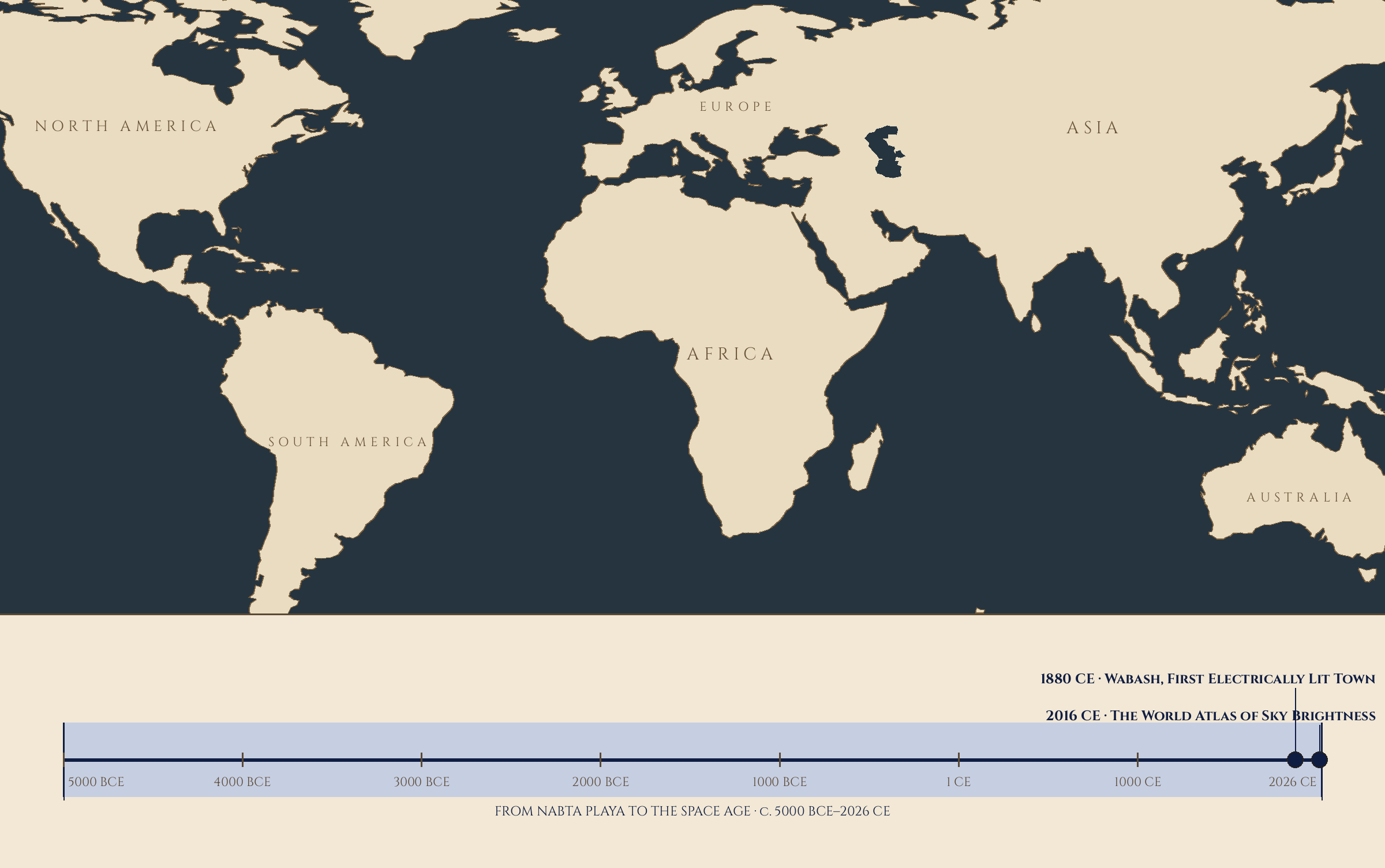
Where and when: your own sky, tonight — Dark Skies. This lesson has no pin: its place is wherever you stand under the night sky. Its stops stand on the road below: 1880 CE · Wabash, First Electrically Lit Town (year 1880) + 2016 CE · The World Atlas of Sky Brightness (year 2016). The line beneath the map is our road through the course: every stop a moment when watching the sky changed, every lesson a place upon it.
Lesson Objectives
By the end of this lesson, you will be able to:
- Define light pollution and name its three parts: skyglow, glare, and light trespass.
- Explain how wasted light becomes skyglow once it enters the atmosphere.
- Read the Bortle scale and estimate your own sky's class from what you can see.
- Report the findings of the 2016 world sky-brightness atlas honestly: what was measured, how, and what its limits are.
- Describe the satellite debate from both sides, with evidence for each.
- Explain what a certified Dark Sky Place is and what its rules protect.
- Measure your own naked-eye limiting magnitude and record it in your Sky Log.
Reading this lesson: ★ marks the passages to remember. They return on the unit quiz and the class test. Check in questions ask the material back as you go; answer them in your workbook when you meet them.
Working this lesson: Your assignment packet is the first download on this page. Work in it as the lesson moves along, answering each exercise as its subject is taught — or read the lesson through for your notes and take the exercises as homework afterward. Both are proper ways to sit this class. Signposts in the reading tell you where each exercise belongs. Written answers are short answers in your own words; a few honest lines are worth more than a filled page.
Your Assignment Packet
This lesson's exercises live in its packet: the Lexicon Handout (every term of the lesson), Materials, Guided Practice, the Assignment Manual with its answer key for self-checking, the Reflection Questions, and the Workbook Checklist. Download the packet before you begin and keep it beside you as you read. The packet's exercises are Glimmerwick's own word for the work: Exercise I: Measure Your Sky's Darkness ◐, Exercise II: The Home Light Audit ◐, and Exercise III: A Dark Sky Place Visitor's Guide ✎. The manual's own Lesson Quiz is not printed in the packet; it pools to the Unit VI Quiz, where it will meet you again.
Safety Briefing
Every night activity in this lesson follows the course's standing rules, and one new caution about your eyes.
- All night observing is done with an adult present, in a familiar and safe location. Tell someone where you are and when you expect to return.
- Walk slowly and carefully in the dark. Let your eyes adapt before you cross uneven ground, and watch for tripping hazards, curbs, and low branches.
- Guard your night vision and everyone else's. Use only dim red light while observing. Never point any flashlight at another person's face.
- Observe from places well away from roads. Do not step into a street or parking area to get a better view.
- For the satellite watch, no equipment is needed at all. Begin your watch after the sky is fully dark, and stop if you feel tired or cold.
The Wonder
Find a clear, moonless night and go outside with your adult, and look up. If you live under a truly dark sky, what you see is not blackness. It is texture: a pale uneven band crossing the heavens, mottled with bright knots and dark lanes, resolving into thousands of stars at its edges. That band is the Milky Way, our own galaxy seen from within.
For nearly all of human history it was not a destination. It was ordinary. Anyone standing beneath a clear moonless sky could see it, the way you can see the road outside your house. Every culture that told stories about the stars in this course, the Babylonian omen-readers of L24, the Polynesian wayfinders of L21, the Maya Venus-watchers of L14, learned their sky under that band.
Now consider the fact that will carry this whole lesson: in 2016, an international team of researchers estimated that the Milky Way is hidden from more than one-third of humanity. Not from a third of the sky. From a third of the people. For those scholars, and there may be some among you, the Milky Way is not a sight. It is a rumor.
❦ In your workbook: record the wonder in your own way — the Milky Way as texture rather than blackness, ordinary for nearly all of human history, and the fact that now carries the lesson: hidden from more than one-third of humanity, not because the galaxy faded but because we brightened the air — copy, sketch, or note what matters.
The galaxy has not faded. We have brightened the air between it and ourselves.
The Story
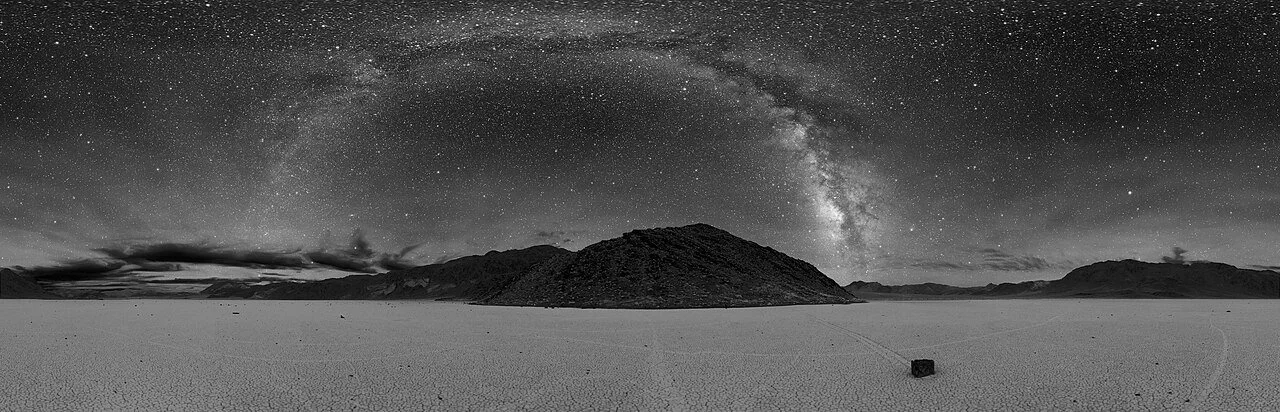
The Milky Way over Racetrack Playa, Death Valley National Park — designated an International Dark Sky Park in 2013, the third in the American national park system and the largest in the world at the time. The park service reduced its own excessive outdoor lighting to earn the gold-tier rating; skies like these are what its lighting rules protect.
Dan Duriscoe, for the U.S. National Park Service, via Wikimedia Commons.
The lamps of Wabash
Firelight, oil lamps, and gas street lighting changed the night long before electricity, but their brightness and reach were limited. Electric light changed the terms entirely: for the first time, a town could extend the day across an entire region, all night, every night.
The chronology is remarkably short. American cities demonstrated electric street lighting in the late 1870s. In 1880, Wabash, Indiana became the first electrically lit municipality in the United States. In 1882, Edison's Pearl Street station began generating electricity in New York. Adoption was not instant. As late as 1894, Washington still had far more gas lamps than electric ones, and rural electrification came much later in many places. But within a few generations, exterior lighting grew from a novelty into continuous infrastructure: roads, industrial sites, homes, car parks, advertising, all lit, all night.
Nobody voted to surrender the stars. The light was for safety, for work, for celebration. The stars were simply not on the agenda.
Check in: Wabash, Indiana, 1880 holds which first — and what does the lesson say nobody voted for, and why did the stars lose anyway?
❦ In your workbook: record the lamps of Wabash in your own way — firelight to gas to electricity, 1880 and 1882, gas still winning in Washington in 1894, and the stars simply not on the agenda — copy, sketch, or note what matters.
One third of humanity
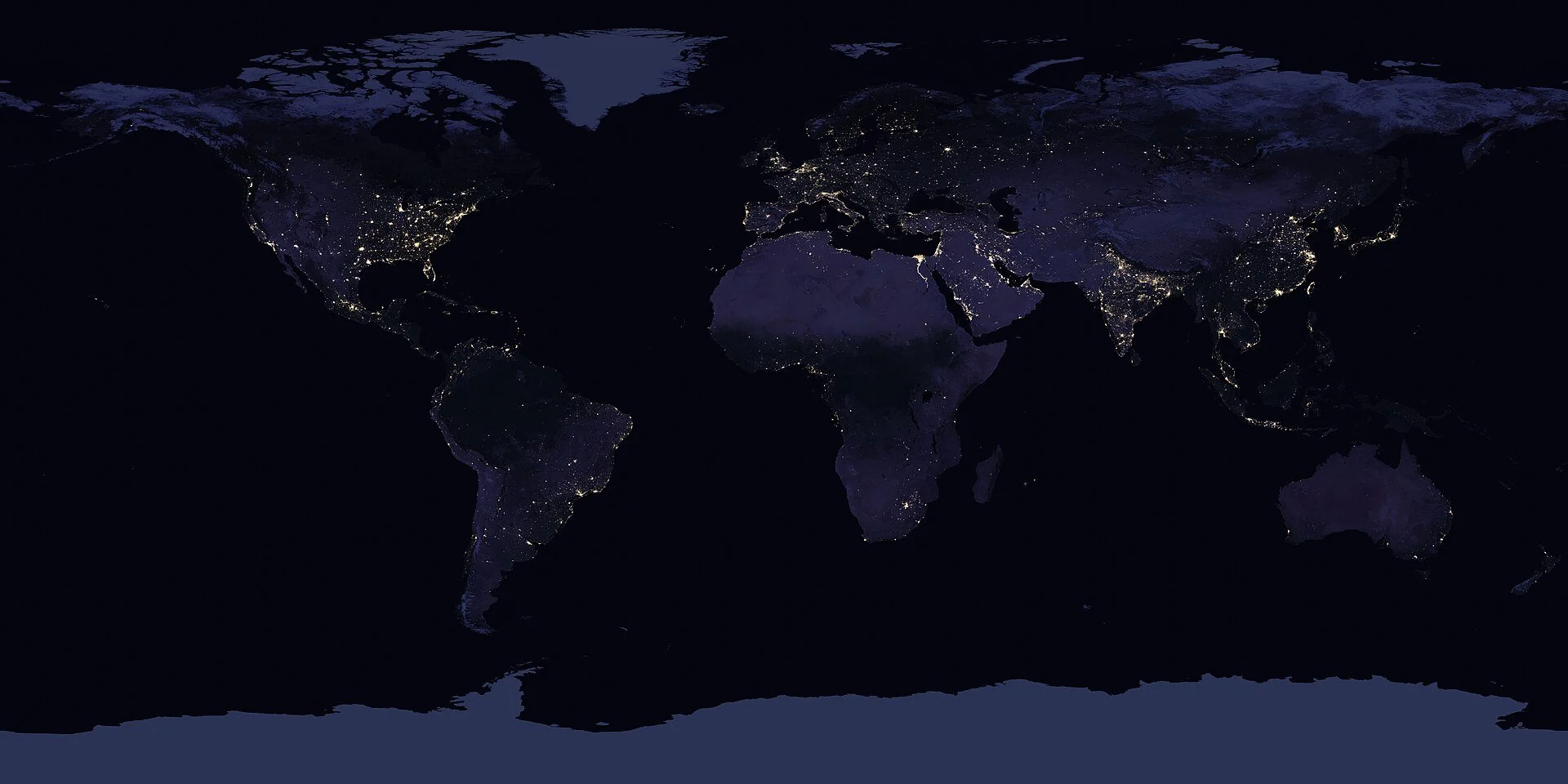
Earth at night: NASA's Black Marble 2016 composite, built from Suomi NPP VIIRS data — the same satellite instrument family whose 2014 upward-light measurements Falchi's team modeled into the 2016 world atlas of artificial night sky brightness. The atlas found more than 80 percent of humanity living under light-polluted skies, and the Milky Way hidden from more than one-third of us. (The atlas's own maps are CC BY-NC and are not reproduced here; this NASA composite is public domain.)
NASA Earth Observatory images by Joshua Stevens, using Suomi NPP VIIRS data from Miguel Román, NASA's Goddard Space Flight Center, via Wikimedia Commons.
In June 2016, the journal Science Advances published the most complete global study of light pollution ever made: "The new world atlas of artificial night sky brightness," by Fabio Falchi and an international team. The atlas was built from upward nighttime light measured by the Suomi NPP satellite, a computer model of how that light scatters through a standard clear atmosphere, and tens of thousands of calibrated measurements made on the ground.
★ Its headline results: more than 80 percent of the world's population lives under light-polluted skies, and more than 99 percent of the people in the United States and Europe do. The Milky Way is hidden from more than one-third of humanity, including about 60 percent of Europeans and nearly 80 percent of North Americans.
A good scholar reports a number honestly, so here are this number's honest edges. The one-third figure is a model, not a census: it describes typical clear-sky conditions from where people live, using satellite data from 2014, and it holds conditions constant so places can be compared. Individual eyesight, local obstacles, haze, and dark adaptation all vary. And the sky has not been standing still since. Citizen scientists contributing to the Globe at Night project between 2011 and 2022 reported skies brightening by roughly 7 to 10 percent per year at their locations, though those locations were not spread evenly around the globe, so that rate cannot simply be applied to the 2016 percentages to manufacture a new headcount.
Still, the atlas remains the most complete population-weighted global estimate of this loss, and it gave researchers vivid measures of it. The paper reports that people living near Paris would have to travel about 900 kilometers, to Corsica, central Scotland, or the Spanish province of Cuenca, to find skies whose zenith is essentially unaffected by artificial light. And it defines a brightness level, near one millicandela per square meter, at which people never experience conditions resembling a true night, because it is masked by an artificial twilight.
Check in: The atlas's headline figures are 80 percent, 99 percent, and one-third — of what, in each case — and what are the figure's honest edges: what was it built from, and why can the Globe at Night rate not simply be applied to it?
❦ In your workbook: record the one-third in your own way — the 2016 atlas, its satellite and its ground measurements, the Paris journey of about 900 kilometers, and the honest edges a good scholar reports with the number — copy, sketch, or note what matters.
A conga line of satellites
There is a second new light in the sky, and it moves.
★ Starlink is the satellite internet constellation built by the American company SpaceX: thousands of small satellites in low Earth orbit, roughly 550 kilometers up, beaming broadband to ground terminals. As of December 2025, more than 10,000 active satellites were in orbit, most of them Starlink's, and the service reported more than four million subscribers in over 100 countries, available on all seven continents.
When the first launches went up, skywatchers on the ground saw something nobody had prepared them for: neat trains of bright dots sliding silently across the sky in single file, catching the sun long after sunset. It was a curious sight, and then it became a routine one.
For astronomers it was less delightful. A long-exposure image of a faint galaxy can be ruined by one bright streak crossing it, and the problem grows with the number of satellites. Conservative studies predict that about 20 percent of midnight images from the new Rubin Observatory could show satellite trails, rising to 30 to 80 percent of exposures taken at twilight. A NASA-led study published in Nature in December 2025 estimated that by the 2030s, up to 39 percent of Hubble Space Telescope images could be contaminated, and that for newer wide-field telescopes like NASA's SPHEREx, the European ARRAKIHS, and China's Xuntian, more than 95 percent of images could be marred by streaks.
Now the other side, because a fair scholar hears both. The connectivity case is real. Starlink's satellites serve rural communities, ships, airplanes, research stations, and regions where infrastructure has been destroyed or never existed. For people with no other path to the internet, that access means school, medicine, work, and news. SpaceX has cooperated with astronomers on dimming measures: darker coatings, sunshades called VisorSats, and brightness targets aimed at making newer satellites too faint for the naked eye to see. The company has also agreed to tighter orbital-debris rules and spacing requirements.
But mitigation has limits. Newer Direct-to-Cell satellites carry much larger solar panels and shine far brighter than the dimmed models, and experimental craft like BlueWalker 3 have matched the brightness of the brightest stars. Many researchers argue that the only fully effective solution is limiting the total number of satellites in orbit, while the satellite industry and regulators point to the public interest in expanded access. The United Nations agency that coordinates orbital slots has called for stricter international rules, citing collision and debris risks alongside the astronomy concerns. This is an active, unresolved debate, and it belongs in this lesson because both sides are making honest claims about a shared sky.
Check in: State the satellite debate as two honest claims: what do the trails do to astronomy's images, with the Rubin and Hubble figures — and what does the connectivity side answer, and what has SpaceX itself done to dim its craft?
❦ In your workbook: record the conga line in your own way — the trains of bright dots, the ruined long exposures, BlueWalker 3 and the Direct-to-Cell craft on one side, and school, medicine, work, and news on the other — copy, sketch, or note what matters.
The night gets guardians
There is also a counter-story, and it has guardians with badges.
★ DarkSky International, an organization founded to call attention to the hazards of light pollution, certifies places around the world that protect their night skies. Its certified Dark Sky Places come in categories: Dark Sky Parks, Reserves, Sanctuaries, and Communities. Certification is not a plaque for having dark skies. It is a commitment to keep them, through lighting rules, public education, and measured proof.
Three examples, all real:
- Death Valley National Park, California. Designated in 2013 as only the third International Dark Sky Park in the American national park system, and the largest in the world at the time. The park service reduced its own excessive outdoor lighting to earn the gold-tier rating, and the desert now offers skies close to what could be seen before cities rose.
- Aoraki Mackenzie International Dark Sky Reserve, New Zealand. Designated in 2012, covering 4,367 square kilometers of the South Island, including Aoraki/Mount Cook National Park and the Mackenzie Basin. It was the world's largest dark sky reserve at designation, and its skies rank at Class 2 on the Bortle scale you will learn below. Lighting controls were first put in place there in the early 1980s, and the reserve's night sky is woven into Maori star lore that goes back centuries before any telescope.
- NamibRand Nature Reserve, Namibia. Designated in 2012 as Africa's first dark sky reserve, a private nature reserve in the Namib Desert. It earned its certification by modifying its artificial lighting to meet the standards, protecting one of the naturally darkest places on Earth.
What these places protect is not only astronomy. Their lighting rules protect nocturnal wildlife, save energy, preserve cultural heritage, and keep alive the ordinary human experience of a star-filled night. They prove that darkness is a resource, and that resources can be managed.
Check in: What does Dark Sky certification actually require of a place — and name the three examples, their countries, and the year each was designated.
❦ In your workbook: record the guardians in your own way — certification as a commitment, not a plaque, and the three real places: Death Valley 2013, Aoraki Mackenzie 2012, NamibRand 2012 — copy, sketch, or note what matters.
In your packet: Exercise III: A Dark Sky Place Visitor's Guide ✎ begins here — its one page is researched from a certified place like these three. Work it now, or mark the place and take it as homework — your choice.
The Mechanism
Where the wasted light goes
★ Light pollution is not one thing. It is three related problems, and a scholar should be able to name them apart.
★ Skyglow is the big one for astronomy: the brightening of the night sky over inhabited areas, caused by artificial light that enters the atmosphere and is scattered back down toward the ground. Picture an unshielded lamp. Some of its light escapes directly upward, above the horizontal. Even a well-aimed downward fixture contributes, because pavement, concrete, signs, and building fronts reflect light upward. Molecules and tiny particles in the air then scatter some of that upward light in all directions, including back down. The result is a luminous dome over every lit settlement, brightest near the horizon where light travels through the most atmosphere, visible from far beyond the town that produced it.
Why does a little extra brightness erase the Milky Way? Because the Milky Way is a broad, low-contrast feature. Your eye detects it as a slight brightening against the sky around it. When skyglow raises the background, the difference between the galactic band and its surroundings becomes too small to distinguish. The stars did not go anywhere. The contrast went.
Glare is excessive brightness that causes visual discomfort or makes seeing difficult: the blinding porch light, the oncoming headlights, the floodlight aimed at your eyes instead of the ground. Glare wastes light sideways and destroys night vision, and it is the component of light pollution you feel immediately.
Light trespass is light falling where it was not wanted and where no one is using it: the neighbor's security light shining through your bedroom window, the parking lot lamp spilling into a garden. One badly aimed floodlight can create all three problems at once, but only skyglow describes the atmospheric veil spread across a whole region.
Note the honest boundary the mechanism implies. The natural night is not perfectly black. Airglow, unresolved stars, zodiacal light, and scattered sunlight all contribute photons to a moonless sky. The pollution is the artificial addition, not every photon.
Check in: Name the three components of light pollution apart — and say why a little extra brightness erases the Milky Way, when the stars themselves have not moved.
❦ In your workbook: record where the wasted light goes in your own way — the unshielded lamp, the reflected uplight, the scattering air, the luminous dome, and the contrast that went — copy, sketch, or note what matters.
The Bortle scale
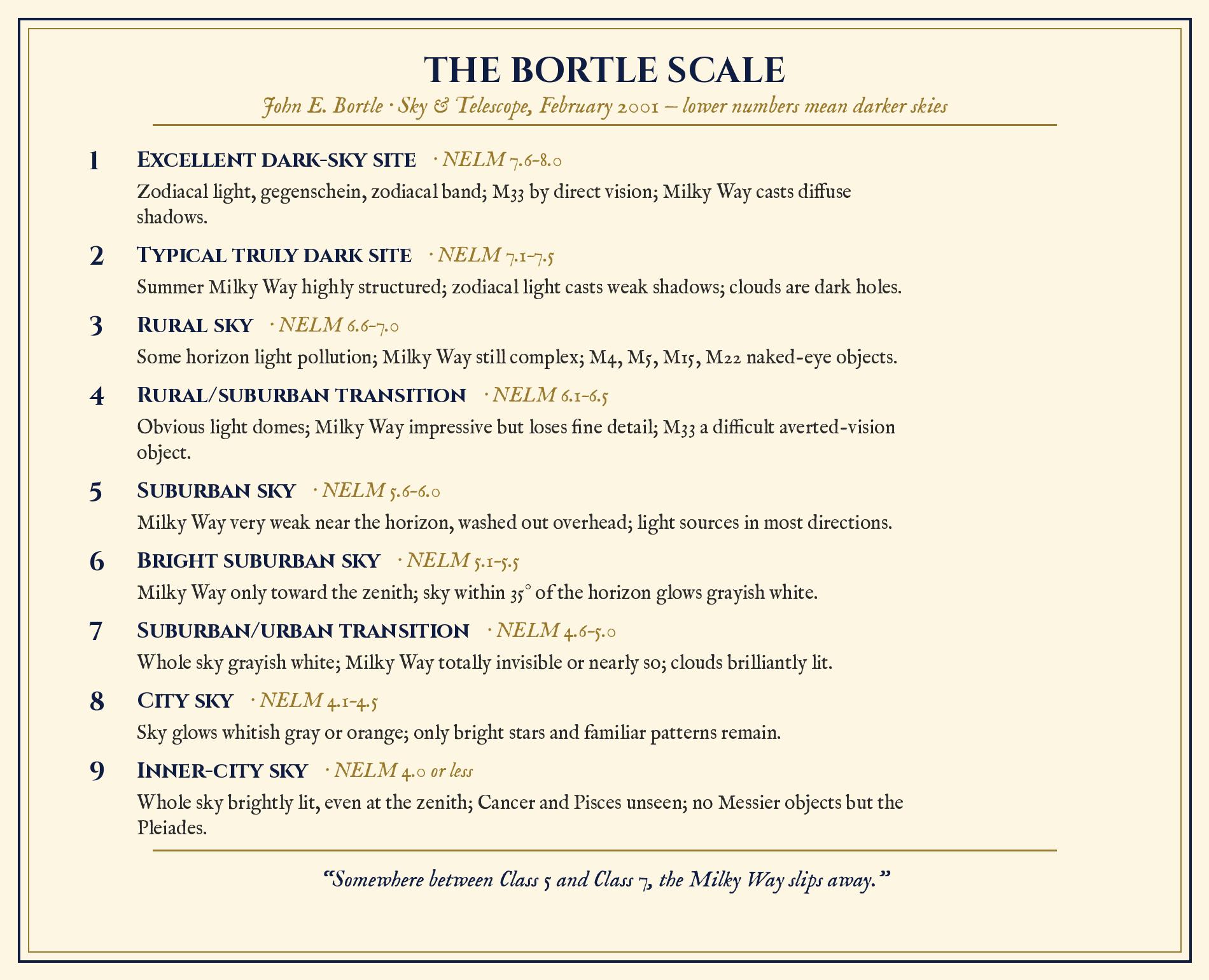
The Bortle Scale: nine classes of night sky, from an excellent dark-sky site where M33 is a direct-vision object to an inner-city sky where dim constellations are not seen at all — each class with its approximate naked-eye limiting magnitude, as taught in the lesson's table.
Built digitally for this overhaul (Python/PIL, typeset text), from the table taught in the lesson text (builder: ).
★ In February 2001, the amateur astronomer John E. Bortle published a nine-level system in Sky & Telescope for describing how dark a night sky really is. Before his scale, observers judged skies by naked-eye limiting magnitude alone, which Bortle considered a poor measure because it depends so heavily on the observer's eyesight and effort. His scale is purely observational: you walk outside, look at the Milky Way, the zodiacal light, familiar objects, and light domes, and you place yourself on it. Lower numbers mean darker skies.
Each class also carries an approximate naked-eye limiting magnitude, the faintest star you can see without optical aid. Treat these as guides, not guarantees.
| Class | Name | Approximate NELM | What you can see |
|---|---|---|---|
| 1 | Excellent dark-sky site | 7.6 to 8.0 | Zodiacal light, gegenschein, and the zodiacal band visible. The Triangulum Galaxy (M33) is a direct-vision naked-eye object. The Milky Way's brightest regions cast diffuse shadows on the ground. |
| 2 | Typical truly dark site | 7.1 to 7.5 | The summer Milky Way is highly structured. Zodiacal light bright enough to cast weak shadows. Clouds show only as dark holes against the starry background. |
| 3 | Rural sky | 6.6 to 7.0 | Some light pollution along the horizon. The Milky Way still shows complex structure. Globular clusters M4, M5, M15, and M22 are distinct naked-eye objects. |
| 4 | Rural/suburban transition | 6.1 to 6.5 | Obvious light domes over population centers. The Milky Way above the horizon is impressive but loses fine detail. M33 is a difficult averted-vision object. |
| 5 | Suburban sky | 5.6 to 6.0 | The Milky Way is very weak or invisible near the horizon and washed out overhead. Light sources evident in most directions. |
| 6 | Bright suburban sky | 5.1 to 5.5 | The Milky Way is visible only toward the zenith. The sky within 35 degrees of the horizon glows grayish white. M31 is a modest naked-eye object. |
| 7 | Suburban/urban transition | 4.6 to 5.0 | The entire sky has a grayish-white hue. The Milky Way is totally invisible or nearly so. Clouds are brilliantly lit. |
| 8 | City sky | 4.1 to 4.5 | The sky glows whitish gray or orange. Only the bright stars and familiar constellation patterns remain. Some constellation stars are difficult or missing. |
| 9 | Inner-city sky | 4.0 or less | The entire sky is brightly lit, even at the zenith. Dim constellations like Cancer and Pisces are not seen at all. Aside from the Pleiades, no Messier objects are visible to the unaided eye. |
Read down that table like a biography of a loss. Somewhere between Class 5 and Class 7, the Milky Way slips away. For most scholars in this course, that line runs through their own backyard.
Check in: Between which two classes does the Milky Way slip away — and why did Bortle build an observational scale instead of trusting limiting magnitude alone?
❦ In your workbook: record the Bortle scale in your own way — nine classes from excellent dark-sky site to inner-city sky, each with its approximate limiting magnitude, and the line where the Milky Way slips away — copy, sketch, or note what matters.
In your packet: Exercise I: Measure Your Sky's Darkness ◐ begins here — its measurement reads your own sky against exactly this table. Work it now, or mark the place and take it as homework — your choice.
Five rules for a kind light
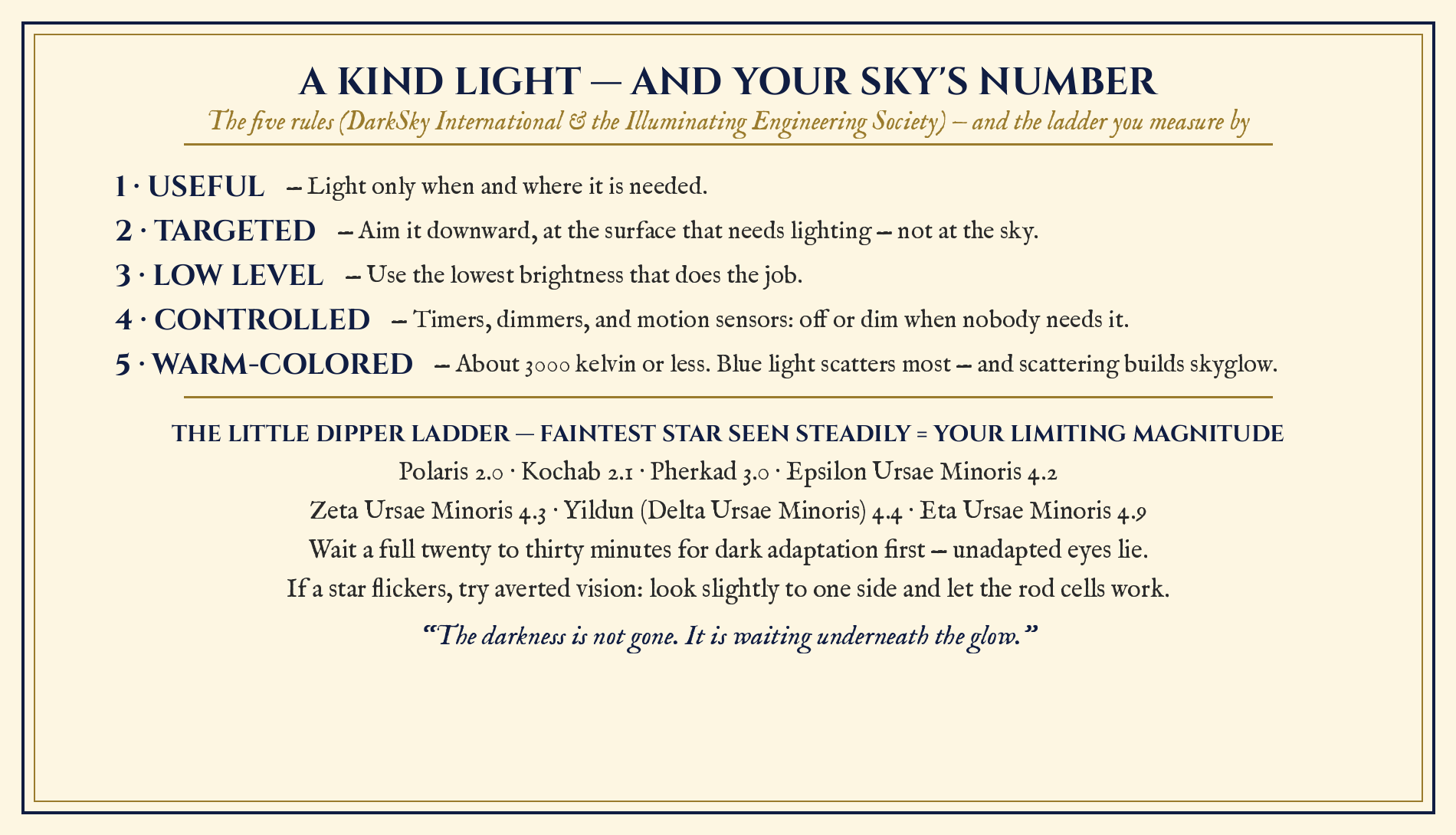
A Kind Light — and Your Sky's Number: the five principles of responsible outdoor lighting (DarkSky International & the Illuminating Engineering Society), and the Little Dipper ladder you measure your own limiting magnitude by, faintest star seen steadily after a full dark adaptation.
Built digitally for this overhaul (Python/PIL, typeset text), from the rules and star list taught in the lesson text (builder: ).
Here is the genuinely hopeful mechanism in this lesson: skyglow is one of the most reversible forms of environmental damage known. The atmosphere needs no decades to digest it. Switch off the lights, dim them, or redirect them, and the darkness returns immediately. What matters is not abandoning necessary outdoor light. It is deciding what the light is for.
The joint principles published by DarkSky International and the Illuminating Engineering Society are deliberately plain. Make lighting:
- Useful. Light only when and where it is needed. A lamp burning all night over an empty lot is not useful.
- Targeted. Aim it downward, at the surface that needs lighting, not at the sky, the neighbor's window, or the empty air beyond.
- Low level. Use the lowest brightness that does the job. More lumens do not automatically mean more safety.
- Controlled. Use timers, dimmers, and motion sensors so lights are off or dim when nobody needs them.
- Warm-colored. Choose warm light, about 3000 kelvin or less, rather than blue-white. Short-wavelength blue light scatters more efficiently in the atmosphere, which is exactly the physics that builds skyglow.
Two cautions belong here, because this lesson teaches mechanisms, not slogans. First, efficient LED lighting does not automatically fix light pollution. LEDs use less electricity, which is a real advantage, but cheaper light can encourage more fixtures, brighter fixtures, and longer hours, surrendering the gain. And many white LEDs are rich in blue wavelengths, which worsen skyglow. Second, real places have real lighting requirements: roads, industrial work, and emergency access all need light. Good design begins with those requirements and applies the five rules to them, rather than assuming darkness everywhere.
Check in: Recite the five rules of a kind light in order — and give the two cautions: why LEDs do not automatically fix the problem, and where good design must begin.
❦ In your workbook: record the five rules in your own way — useful, targeted, low level, controlled, warm-colored — and the two cautions that keep them mechanisms rather than slogans — copy, sketch, or note what matters.
In your packet: Exercise II: The Home Light Audit ◐ begins here — its five questions for every fixture at home are these five rules. Work it now, or mark the place and take it as homework — your choice.
The sky that switches back
★ Say it once more, because it is the hinge of the whole lesson. A river poisoned takes years to clean. A sky polluted by light takes one switch. The darkness is not gone. It is waiting underneath the glow, the way the stars are waiting underneath the daylight. We lose the night sky nightly, and we can win it back nightly, one fixture at a time.
❦ In your workbook: record the sky that switches back in your own way — a river poisoned takes years, a sky polluted by light takes one switch, and the darkness waiting underneath the glow — copy, sketch, or note what matters.
A Sealed Note on What the Dark Is For
Scholars,
I am a bat, so I will confess something: I have never once wished the world were brighter. The dark is not the absence of things. It is a place where different things happen. Moths navigate by it. Flowers open for it. Tides of small creatures rise and fall by it. Your own eyes, given twenty quiet minutes, rebuild themselves for it, the way this course has rebuilt your attention, lesson by lesson.
People sometimes speak of darkness as something to be cured. I fly through it every night of my life, and I promise you it needs no cure. It needs stewards. That is a fancier word than it sounds. A steward is simply someone who has decided a thing is worth keeping.
You have spent thirty-three lessons learning to see. Now you know the seeing needs protecting. That makes you, whether you meant to be or not, a steward of the night.
Keep your corner of it well.
❦ In your workbook: record the sealed note in your own way — the dark as a place where different things happen, not an absence, and the steward as simply someone who has decided a thing is worth keeping — copy, sketch, or note what matters.
PROFESSOR VESPER GLIMMERWICK
Celestial Studies
Astronomer & Celestial Historian
Guided Observation
Try It Tonight
Part One: Measure your sky's darkness
Your practical assignment for this lesson is a real measurement. Tonight, on a clear moonless night, you will find your naked-eye limiting magnitude, the faintest star you can see without optical aid, and estimate your Bortle class from it.
You will need: an adult, a dark-adapted pair of eyes, and the Little Dipper (Ursa Minor). Face north. The Little Dipper hangs near the north celestial pole you studied in L2. Its seven main stars have well measured magnitudes:
- Polaris, the end of the handle: magnitude 2.0
- Kochab, one side of the bowl: magnitude 2.1
- Pherkad, the other side of the bowl: magnitude 3.0
- Epsilon Ursae Minoris, in the handle: magnitude 4.2
- Zeta Ursae Minoris, in the bowl: magnitude 4.3
- Yildun (Delta Ursae Minoris), in the handle: magnitude 4.4
- Eta Ursae Minoris, in the bowl: magnitude 4.9
The procedure:
- Go outside with your adult at least an hour after sunset, and put away every white light. Cover your flashlight with red film or use a dim red light.
- Wait a full twenty to thirty minutes for dark adaptation. This is not optional: your limiting magnitude is set by your eyes, and unadapted eyes lie.
- Find the Little Dipper. Start with Polaris and Kochab, the two you will see first, and work down the list toward the fainter stars.
- Note the faintest star you can see steadily, without straining. If it flickers in and out, try averted vision: look slightly to one side of it and let your rod cells, which live off-center in the retina, do the work.
- Your limiting magnitude is roughly the magnitude of that faintest star. Compare it to the Bortle table: 6.6 to 7.0 suggests Class 3, 5.1 to 5.5 suggests Class 6, 4.0 or less suggests Class 9.
- Record the date, time, location, weather, your faintest star, your estimated limiting magnitude, and your estimated Bortle class in your Sky Log. Repeat on another night if you can. Skies vary.
A note for scholars under bright skies: if you can find only Polaris and Kochab, your limiting magnitude is around 2, and that is a real result, not a failure. It is the measurement this lesson asked for, and it is worth recording honestly.
Check in: Why is the twenty-to-thirty-minute wait not optional — and if you can find only Polaris and Kochab, what have you measured, and is it a failure?
❦ In your workbook: record the measurement in your own way — the faintest Little Dipper star you saw steadily, your estimated limiting magnitude, the table row you matched, and whether the result surprised you — copy, sketch, or note what matters.
Part Two: The light audit
Tomorrow, in daylight, walk your home's outdoor lighting with your adult and a notebook. For every fixture, ask the five questions from the mechanism: Is it useful? Is it targeted downward, with shielding so no light escapes above the horizontal? Is it low level? Is it controlled by a timer, dimmer, or motion sensor? Is it warm-colored rather than blue-white?
Pick the worst offender and sketch a better version: a shielded fixture, aimed down, on a motion sensor. You do not have to buy or install anything. The sketch is the assignment. Good design starts on paper.
❦ In your workbook: record the light audit in your own way — every outdoor fixture at home judged by the five questions, and your sketch of the worst offender redesigned: shielded, aimed down, on a motion sensor — copy, sketch, or note what matters.
Part Three: The moonless watch
On the next moonless night, lie back with your adult and simply watch for twenty minutes. If you can see the Milky Way, trace its band and note where it is brightest and where the dark lanes interrupt it, the way you learned in L22. If you cannot see it, note that too, and note the color and direction of the brightest skyglow on your horizon. Watch also for moving lights: the steady blink of aircraft and, in the hour after sunset or before sunrise, the silent steady glide of satellites. Log everything in your Sky Log. This is the last formal observation of the course. Make it a good one.
❦ In your workbook: record the moonless watch in your own way — the Milky Way traced or its absence noted honestly, the color and direction of the brightest skyglow, and every moving light, aircraft or satellite, in twenty quiet minutes — copy, sketch, or note what matters.
Sky Log Entry
Date: _______________ Time: _______________ Location: _______________
Moon: _______________ Weather and transparency: _______________
Faintest Little Dipper star seen steadily: _______________
Estimated naked-eye limiting magnitude: _______________
Estimated Bortle class: _______________
Direction and color of brightest skyglow: _______________
Satellites or aircraft seen: _______________
Milky Way visible? (yes / no / faintly) _______________
Notes: _______________________________________________________________
❦ In your workbook: record the Sky Log entry in your own way — the dated form above filled from your own night: faintest star, limiting magnitude, Bortle class, skyglow direction and color, satellites or aircraft, and whether the Milky Way showed itself — copy, sketch, or note what matters.
Materials
Required (Level One — household items)
- Your workbook and a pencil for the Sky Log, the light audit, and the visitor's guide.
- A dim red light for night observing (a flashlight covered with red film, or a red bicycle light). No white light after you begin dark-adapting.
- A notebook for the home light audit, plus a pencil and ruler for sketching the redesigned fixture.
- A blanket or reclining chair for the moonless watch, and warm layers: stillness gets cold fast.
- An adult present for every night activity.
Suggested (Level Two — historically closer)
- A printed light pollution map of your region (from the map linked in Further Reading) to compare against your measured limiting magnitude.
- Red theatrical gel for a properly filtered observing light.
- A tripod or phone mount for a long-exposure photo of your sky, to compare what the camera sees with what your eyes see.
Reflection Questions
Answer in your workbook, in complete sentences.
- "The galaxy has not faded. We have brightened the air." What does this reframe about losing the night sky? Is the darkness lost, lent, hidden, or something else, and why does the word you choose matter?
- Present the satellite debate as fairly as you can: the strongest argument for the megaconstellations and the strongest argument against them. Which concern would you weigh most heavily if you were deciding, and why?
- Skyglow vanishes almost the moment the lights are switched off. Name one other environmental problem that is this reversible, and one that is not. What does reversibility change about how we should think and act?
- You measured your own sky's darkness tonight. How does having a number for it, a limiting magnitude and a Bortle class, change what "the sky" means to you? Would you feel differently about a number you measured versus one you read on a map?
- Lesson 1 asked you to go outside and look up. This lesson asks you to protect the darkness that makes looking up worthwhile. What is the scholar's charge now, in your own words, and what is the first small thing you will do about it?
Workbook Checklist — Lesson 33
In my workbook I have:
- ☐ measured my sky's darkness on a clear, moonless night: the faintest Little Dipper star seen steadily after full dark adaptation, my estimated limiting magnitude, and my Bortle class with the table row I matched — and written whether the result surprised me
- ☐ completed the home light audit in daylight: every outdoor fixture judged by the five questions, the worst offender sketched redesigned with each of the five rules labeled, and the resistance sentences with their practical answer
- ☐ kept the moonless watch for twenty minutes and logged it in my Sky Log — the Milky Way traced or its absence noted, the brightest skyglow's color and direction, and every satellite or aircraft seen
- ☐ filled my Sky Log entry in full: date, time, location, moon, weather and transparency, faintest star, limiting magnitude, Bortle class, skyglow, moving lights, and notes
- ☐ written Exercise III's one-page visitor's guide to a certified Dark Sky Place — its category, its skies, its lighting rules, and one thing besides astronomy its darkness protects
☐ Lesson completed Date: ___ Signature: ___
Cross-Class Connections

Herbology · Unit II, Lesson 12 — Photoperiod Dynamics: Understanding Sunlight
Come down to the greenhouse a moment, scholars. Glimmerwick has taught you that the dark is a resource; in my garden it is also a signal. It is the length of the uninterrupted night — not the day — that tells many of my plants when to flower, and they read it the way you read your Sky Log. A sky that never truly darkens is a message garbled on its way to the leaf. When you shield a light, you are gardening for the night shift, as her lesson says. In mine, you will learn to measure a plant's ration of light in hours, and to see why the dark hours count just as much.
PROFESSOR BERYL FERNFOOT
Herbology Greenhouse

Creative Arts · Winter Workshop Special S2 — Feeders, Lanterns & Sealed Letters (named in full; no live slug for the Seasonal Specials is established — see the apparatus note above)
The commission is real, scholars, and it stands in my workshop still: a lantern built at full craft that lights a path without stealing the sky. In the Winter Workshop we build it properly — a hood, a working shutter in the old dark-lantern manner, warm light aimed at your chart and your feet and nowhere else — spending the wood ticket, the wax and glass discipline, and the seal craft you already hold. Glimmerwick's five rules, built in wood and glass. Come in the dark months, when the north house hosts, and we will test your lantern at dusk together.
PROFESSOR COGBRANCH TIMBERCLANK
Creative Arts Workshop
Scrollwork · Unit V, Lesson 18 — Gold Leaf & Gilding
Tower scholars, Glimmerwick tells you the star catalogues were written by candlelight, and she is right — but come and see what candlelight was FOR. A painted initial is seen once, in its shape. A gilded initial is seen twice: once in its shape, and once in the flash it throws back at the candle. The medieval illuminator did not decorate the page; he lit it, for a scriptorium of low, warm light aimed at the page and nowhere else — the dark-sky rules, kept five centuries early in gold. My eighteenth lesson teaches that lighting, leaf by leaf.
PROFESSOR QUILLBERRY NOCTURNE
Scrollwork Library
Runes · Unit I, Lesson 1 — The Structural Wedge
Tower scholars, the astronomical diaries Glimmerwick set before you tonight — the wanderers recorded night after night under skies near Bortle Class 1 — survive because they were pressed into clay. My first lesson teaches that pressing: the cut reed stylus, the wedge, the tablet, and why so many tablets outlasted every library built since. The Babylonians' darkness is gone from most of our skies. Their wedges are still legible. Come and learn how the record was made that her whole course reads.
— Professor Thistleloom Webblethorn, Runes & Ancient Writing
History of Magic (a future class) is named in the bullets above, exactly as the final frames it — prose only, no link, no invitation, as in every lesson of this class.
The Skywatcher's Charge
My dear scholars,
This is the last sealed note of our course, so I will make it count.
Somewhere above you right now, whether you can see it or not, the Milky Way is pouring its pale river across the sky. It has done this every night of your life. The only thing that ever changed was the air between.
I want you to remember three things from these thirty-three lessons. First, that the sky is readable: it keeps time, it keeps calendars, it has told every human culture that ever looked up when to plant, when to sail, and when to wonder. Second, that reading it honestly matters more than reading it comfortably: the Earth moves, not the sun; the moon does not change shape; the horoscope is history, not instruction. And third, the newest lesson, that the sky is losable. Not by fate. By floodlights.
Here is your charge, then, and it is small enough to fit in a pocket. Learn your own sky's number, the way you did tonight. Teach one other person the five rules of a kind light. And at least once a year, go somewhere dark on purpose, lie back, and let the river show itself. The universe spent thirteen billion years arranging that view. The least we can do is keep the porch light out of it.
You came to the Celestial Tower to learn the sky. Leave it as someone the sky can count on.
With all my heart, and all my wings,
— Professor Vesper Glimmerwick, Celestial Studies • Astronomer & Celestial Historian
❦ In your workbook: record the charge in your own way — the three things to remember (the sky is readable, reading it honestly matters more than reading it comfortably, and the sky is losable, not by fate but by floodlights) and the charge itself, small enough to fit in a pocket: learn your own sky's number, teach one other person the five rules of a kind light, and at least once a year go somewhere dark on purpose — copy, sketch, or note what matters.
This section is the lesson's closing note as well as its unique one: the final sets it here, after the Cross-Class Connections, as "the last sealed note of our course," and it is carried whole and in place. No separate Professor's Closing Note exists in the source for this lesson, and none has been invented; the Charge closes the course.
Further Reading & Sources
These are real destinations for further study, verified live at the time of writing. Start with the atlas paper and the SpaceDaily explainer; they are the authorities this lesson leans on.
- Falchi et al., "The new world atlas of artificial night sky brightness," Science Advances, June 10, 2016 (the primary source for the one-third figure). https://arxiv.org/pdf/1609.01041
- SpaceDaily: "For most of human history, anyone standing beneath a clear, moonless sky could see the Milky Way" (the one-third figure explained, its limits, the Globe at Night trend, and the five lighting principles). https://spacedaily.com/t-milky-way-hidden-one-third-humanity-artificial-skyglow/
- Light Pollution Map: an interactive world map of artificial sky brightness with estimated SQM and Bortle values for any point. https://www.lightpollutionmap.info/
- AstroBackyard: "Find Your Night Sky Brightness on the Bortle Scale" (full descriptions of all nine classes, with NELM and SQM values). https://astrobackyard.com/the-bortle-scale/
- NPR Illinois: "Light from satellites will ruin majority of some space telescope images, study says" (the December 2025 NASA-led Nature study on satellite trails). https://www.nprillinois.org/2025-12-07/light-from-satellites-will-ruin-majority-of-some-space-telescope-images-study-says
- Live Science: "Stargazers, Rejoice! Largest 'Dark Sky' Reserve Named" (the Aoraki Mackenzie Reserve and Africa's first reserve, NamibRand). https://www.livescience.com/20893-newzealand-dark-sky-reserve.html
Browse the Celestial Studies shelf in the school Library for readable editions of these works.
Sealed in the Celestial Tower, in deep midnight blue, by Professor Vesper Glimmerwick.
Submit your work for this lesson using the form below.
THE UNIT VI QUIZ
CELESTIAL TOWER · UNIT VI: INSTRUMENTS OF THE SKY
Unit VI is complete, and with it the lessons of the course: you have caught shadows with a sundial, built a planisphere for your own sky, held the astrolabe that once held the whole heavens in brass, followed the telescope from Galileo's tube to the Webb, and taken up the cause of the dark skies every one of those instruments needs. This quiz gathers the whole unit into one sitting. Take it from memory first, before you look back at your notes, because it measures what has stayed with you. If you kept the passages marked ★ in your workbook as you read, you have already practiced most of what it asks.
The quiz packet is a single download. Part I gathers multiple-choice questions from across the unit, Part II asks true or false, Part III matches the unit's vocabulary, and the answer key waits at the back for self-checking. When you have finished, score it honestly, note the result in your workbook, and revisit any lesson whose questions went wrong before you move on.
CONTINUE IN THE CELESTIAL TOWER
← Previous · Lesson 32: Telescopes: From Galileo to JWST Next · The Master Capstone: Chart Your Sky →
Unit VI — Instruments of the Sky Celestial Tower — All 33 Lessons
The rest of Unit VI: Lesson 29 · Sundials · Lesson 30 · Planisphere · Lesson 31 · The Astrolabe · Lesson 32 · Telescopes
From the Celestial Shelf
The printed companions to this lesson, from Professor Glimmerwick’s shelf in the shop.