
CELESTIAL STUDIES
Unit VI · Lesson 32Telescopes: From Galileo to JWST
Professor Vesper Glimmerwick
Astronomer & Celestial Historian
The Celestial Tower • School of Evershade
Professor's Introduction
Eyes to the glass, scholars,
I am a bat, and I must confess something at the start of this lesson: my eyes are not my best feature. In the dark I navigate by listening, by the echoes of my own voice coming home to me. Your human eyes are far better than mine at gathering light. And yet, for all of human history, even the sharpest human eyes could see only a few thousand stars, and the Milky Way stayed a pale river that nobody could cross.
Then, four hundred years ago, humans began building better eyes than the ones they were born with. Glass eyes. Mirror eyes. Eyes that sit above the air, and eyes parked a million miles from home. Here is the strangest and most wonderful part of the story you are about to read: every time the eye got bigger, the sky turned out to be different from what everyone had believed. Not a little different. Completely, outrageously different. Moons circling another world. A universe of galaxies. Invisible matter holding the whole spinning carousel together.
I have spent years restoring the old instruments in Evershade's observatory, polishing brass that had gone green and coaxing seized gears back to life, and every one of them taught me the same lesson. An instrument does not only show you the sky. It decides how much of the sky you are allowed to see.
Tonight we walk the whole road, from a Dutch spectacle-maker's tube of glass to a golden honeycomb unfolding a million miles from Earth. Keep your Sky Log close. You are about to watch the sky get rewritten, one bigger eye at a time.
PROFESSOR VESPER GLIMMERWICK
Celestial Studies
Astronomer & Celestial Historian
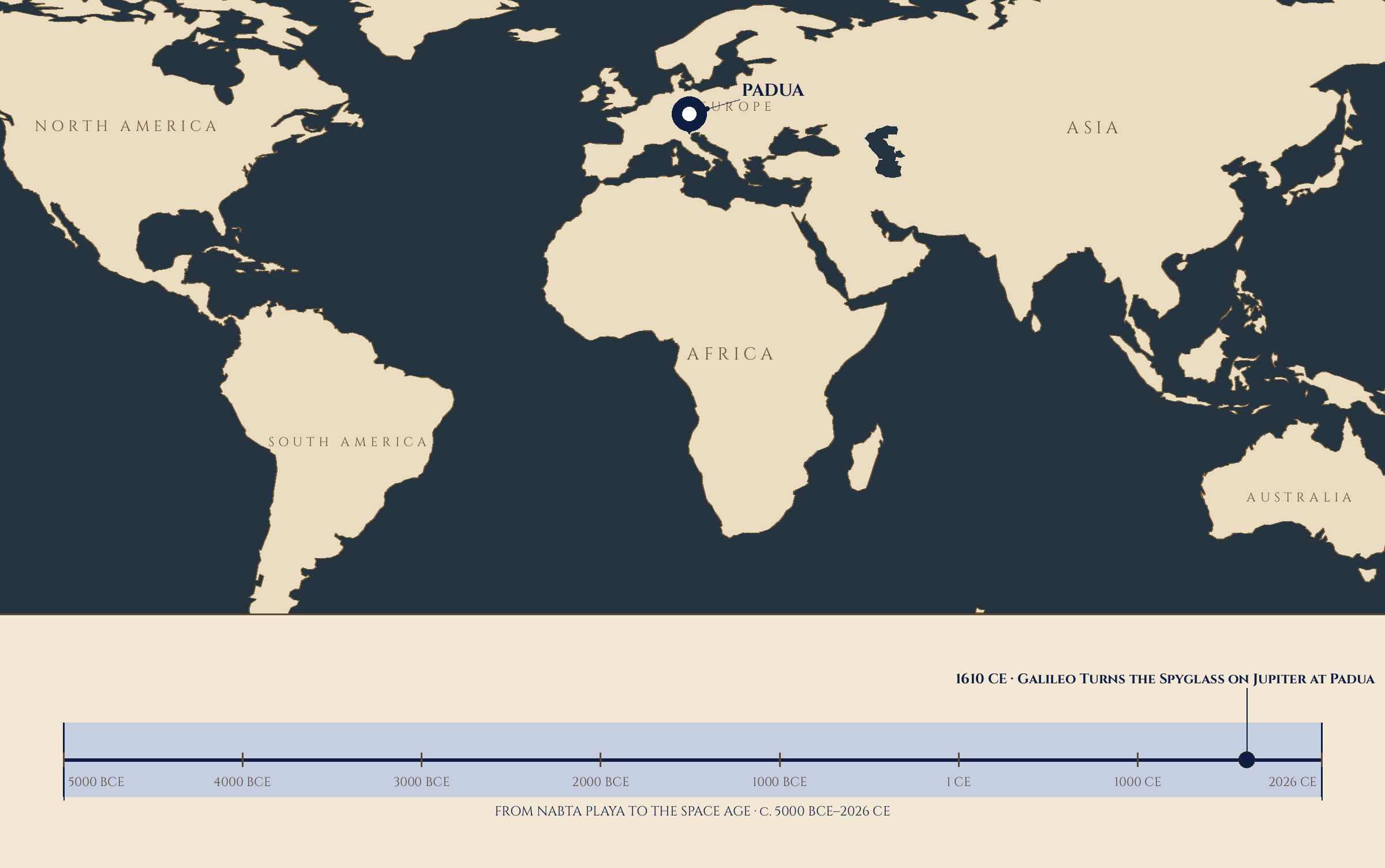
Where and when: PADUA, 1610 CE · Galileo Turns the Spyglass on Jupiter at Padua (year 1610) — Telescopes: From Galileo to JWST. The pin is this lesson. The line beneath the map is our road: every stop a moment when watching the sky changed, every lesson a pin upon it.
Lesson Objectives
By the end of this lesson, you will be able to:
- Explain, in their own words, why a telescope's aperture matters more than its magnification, and how light-gathering power grows with the square of the diameter.
- Describe how a refractor and a reflector each form an image, and name the strengths and limits of each design.
- Trace the telescope's story from Galileo's 1610 spyglass to the James Webb Space Telescope as a chain of mechanism milestones, naming what each new eye revealed.
- Name Caroline Herschel and her eight comets, and describe the Herschels' great reflectors and the giant-reflector century that followed.
- Explain how Edwin Hubble showed that the universe is expanding, and what Vera Rubin measured that pointed to dark matter.
- State the non-negotiable rules of telescope safety and demonstrate safe observing habits.
Reading this lesson: ★ marks the passages to remember. They return on the unit quiz and the class test. Check in questions ask the material back as you go; answer them in your workbook when you meet them.
Working this lesson: Your assignment packet is the first download on this page. Work in it as the lesson moves along, answering each exercise as its subject is taught — or read the lesson through for your notes and take the exercises as homework afterward. Both are proper ways to sit this class. Signposts in the reading tell you where each exercise belongs. Written answers are short answers in your own words; a few honest lines are worth more than a filled page.
Your Assignment Packet
This lesson's exercises live in its packet: the Lexicon Handout (every term of the lesson), Materials, Guided Practice, the Assignment Manual with its answer key for self-checking, the Reflection Questions, and the Workbook Checklist. Download the packet before you begin and keep it beside you as you read. The packet's exercises are Glimmerwick's own word for the work: Exercise I: The Cardboard Aperture Test ⚒, Exercise II: The Magnification Trade ✎, and Exercise III: The Rotation Curve Sketch ⚒. The manual's own Lesson Quiz is not printed in the packet; it pools to the Unit VI Quiz, where it will meet you again.
Safety Briefing
Telescope safety. A telescope gathers far more light than your eye, which makes it a wonderful tool and a dangerous one pointed at the wrong target. Read every rule below. They are absolute.
Never look at the sun through a telescope, binoculars, or any magnifying optics unless a certified full-aperture solar filter is mounted securely over the front of the instrument. The filter must cover the whole opening, the objective end, not the eyepiece end. Small filters that screw into the eyepiece can crack under the concentrated heat of the sun and must never be trusted. If you do not own a certified solar filter, the rule is simple: never point the telescope anywhere near the sun, and keep the dust cap on the finder scope too, since a finder is itself a small telescope.
Eclipse glasses and handheld solar viewers must conform to the ISO 12312-2 international standard, inspected before every use and discarded if scratched, punctured, torn, or loose. Ordinary sunglasses are never safe for solar viewing, with or without a telescope.
The moon is completely safe to observe with the naked eye, binoculars, or any telescope. It shines only by reflected light, far too dim to injure eyes.
Treat every instrument gently. Never touch a lens or mirror surface with your fingers; skin oils damage the coatings. Carry a telescope by its mount or tube, never by the eyepiece. If you borrow an instrument, return it cleaner than you found it.
Night-observing safety. All night observing in this course is done with an adult present, in a familiar and safe location. Tell someone where you are going and when you expect to return. Dress warmly, bring a flashlight, and watch your footing in the dark.
The Wonder
In January of 1610, a man in Padua pointed a tube of glass at the planet Jupiter and saw something impossible.
The tube was a toy, really, a novelty from a spectacle-maker's shop, a cylinder you held up to make distant ships look nearer. Galileo Galilei had built his own version and improved it until it magnified about twenty times. One clear night he aimed it at Jupiter and found four small points of light in a row beside the planet. Night after night he sketched them, and night after night they had moved. Within days he understood what he was seeing, and it rearranged his mind: the four points were not stars. They were worlds, circling Jupiter the way the moon circles Earth.
Stop and sit inside that moment. Every educated person in Europe believed that everything in the heavens circled Earth. It was not a guess; it was the structure of reality, blessed by philosophers and theologians alike. And now here were four bright bodies plainly, visibly, undeniably circling something else. A man with a tube of glass had found a second center of motion in the universe.
That is what this lesson is about. Not the tube. The rewriting. Four hundred years of bigger eyes, and every one of them found a sky that nobody had expected.
❦ In your workbook: record the wonder in your own way — four small points of light in a row beside Jupiter, moving night after night, and the moment a man with a tube of glass understood they were worlds circling another world — copy, sketch, or note what matters.
The Story
The spyglass, 1608
The telescope was not invented by an astronomer. In 1608, a spectacle-maker in the Dutch town of Middelburg, Hans Lippershey, applied for a patent on an instrument for "seeing faraway things as though nearby": a tube with a convex lens at one end and a concave lens at the other. Word of the spyglass raced across Europe. It was a curiosity, a sailor's tool, a rich man's amusement. Nobody thought to aim it at the sky, because nobody yet knew there was anything up there worth a closer look.
Check in: Who built the first telescope, in what year and town — and why did nobody think to aim it at the sky?
❦ In your workbook: record the spyglass in your own way — a Dutch spectacle-maker's tube of 1608, a convex lens and a concave lens, and a sky nobody yet thought to look at more closely — copy, sketch, or note what matters.
Galileo's starry messenger, 1609 to 1610
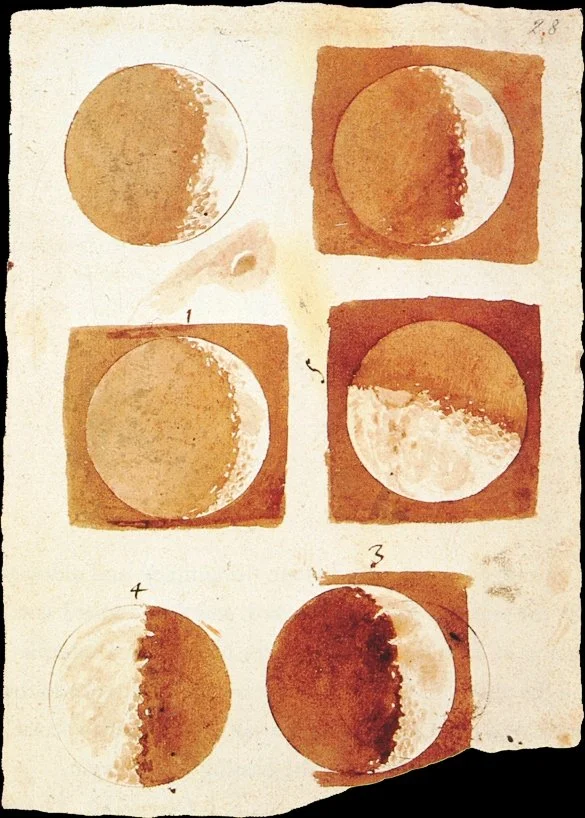
Galileo's wash drawings of the moon's phases, the studies behind the Sidereus Nuncius engravings of 1610: a ragged terminator that meant mountains, drawn by the first man to see them.
Galileo Galilei.
Galileo heard about the Dutch instrument in 1609, worked out the optics for himself, and built better and better versions until his spyglass magnified about twenty times. Then he did the thing nobody else had thought to do: he pointed it upward, and kept a notebook.
★ What he found, in a few astonishing months, fills the slim Latin book he rushed into print in March 1610, the Sidereus Nuncius, the Starry Messenger:
- The moon was not a perfect smooth sphere. Its terminator, the line between lunar day and night, was ragged, and from the shadows he could tell the moon had mountains and valleys, a landscape like Earth's.
- Jupiter had four moons, circling the planet. He had found them in January.
- The Milky Way, that pale river across the sky, resolved into innumerable individual stars, too faint and crowded for the naked eye to separate.
- Later in 1610 he watched Venus move through a full set of phases, crescent to gibbous and back, exactly like the moon's. In the old Earth-centered system, Venus was trapped between Earth and the sun and could never show a full disk. The only geometry that fit what he saw was one in which Venus circled the sun. He published those observations in 1613.
- ★ Saturn puzzled him: it looked as though the planet had two smaller bodies stuck to its sides, like handles on a cup. Two years later the "handles" had vanished. His little telescope could not resolve what was really there, Saturn's rings seen nearly edge-on, and he never solved it. A bigger eye would have to.
The moons of Jupiter cracked the old universe open; the phases of Venus finished the work. Between them, the Earth-centered cosmos was done as a physical description of reality, though it would take the authorities a long time to admit it.
Check in: Name Galileo's four great findings of 1609–1610 — and the one thing his little telescope could not resolve.
❦ In your workbook: record the starry messenger in your own way — the ragged terminator and the moon's mountains, four moons circling Jupiter, the Milky Way resolved into stars, the phases of Venus, and Saturn's handles that vanished unsolved — copy, sketch, or note what matters.
Newton's mirror, 1668
Galileo's design had a flaw that grew worse as telescopes grew longer: the lens bent different colors of light by different amounts, so bright objects wore fringes of false color. This is chromatic aberration, and you will meet it properly in The Mechanism. In 1668, Isaac Newton sidestepped the whole problem by building a telescope with no lens at all. His instrument used a curved mirror to gather the light instead. A mirror reflects every color to the same focus, so the false colors vanished. The reflecting telescope was born, small and crude in Newton's hands, but the idea was the future.
Check in: What flaw in Galileo's design grew worse as telescopes grew longer, and how did Newton's 1668 instrument sidestep it entirely?
❦ In your workbook: record Newton's mirror in your own way — a telescope with no lens at all, a curved mirror gathering the light, and every color reflected to the same focus so the false colors vanished — copy, sketch, or note what matters.
The Herschels and the giant reflectors
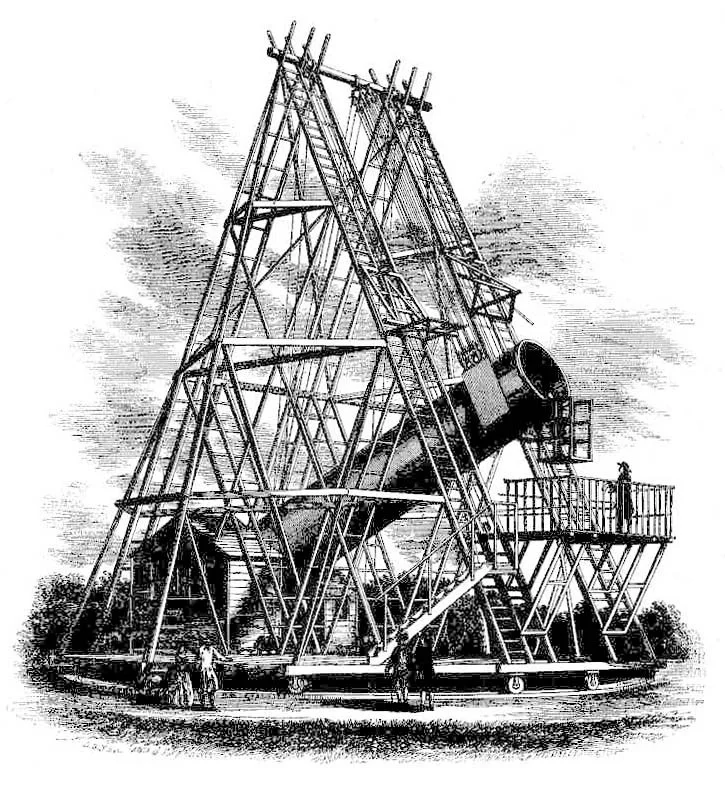
Herschel's 40-foot reflector at Slough, the largest telescope in the world for decades: a ship's mast of a tube, worked from ladders and platforms in the dark.
Engraving from The Leisure Hour, 2 November 1867 (Wikimedia Commons scan).
A century later, a German-born musician in Bath, England, taught himself to grind mirrors and began building reflectors bigger than anyone had dared. William Herschel's obsession paid off in March 1781, when he found a strange disk in the sky that moved against the stars. It had been observed and catalogued as a star before; Herschel was the first to recognize it as a planet. It became Uranus, the first planet discovered with a telescope, and the solar system doubled in size overnight in the human imagination.
Herschel kept building. His great 40-foot reflector, completed in the late 1780s with a mirror nearly four feet across, was the largest telescope of the 18th century. It was magnificent and miserable in equal measure: hard to aim, at the mercy of English weather, with a metal mirror that tarnished and had to be repolished constantly. But it proved the principle that would drive the next hundred years. Bigger mirror, deeper sky.
Check in: What did William Herschel recognize in March 1781 that earlier observers had catalogued as a star — and what did his great 40-foot reflector prove, for all its misery?
❦ In your workbook: record the giant reflectors in your own way — a musician in Bath grinding his own mirrors, a moving disk recognized as a new planet in 1781, and a 40-foot giant that proved the principle: bigger mirror, deeper sky — copy, sketch, or note what matters.
Caroline Herschel, comet-hunter
★ Say her name properly: Caroline Herschel. She began as William's assistant, recording his observations at his shoulder through freezing nights, and became one of the great observers in her own right. William gave her a small reflecting telescope of her own, a "comet sweeper," and between 1786 and 1797 she discovered eight comets, the first woman in history to do so officially. She catalogued nebulae, corrected the star catalogues of the Astronomer Royal, and was eventually paid a salary by the king for her astronomy, the first professional woman astronomer on record. When the history of the giant telescopes is told, her name belongs in it, not in a footnote.
Check in: How many comets did Caroline Herschel discover, in what years — and what two firsts for a woman in astronomy does this lesson record for her?
❦ In your workbook: record the comet-hunter in your own way — the assistant at her brother's shoulder through freezing nights, the little comet sweeper of her own, eight comets between 1786 and 1797, and a salary from the king — copy, sketch, or note what matters.
The century of giants
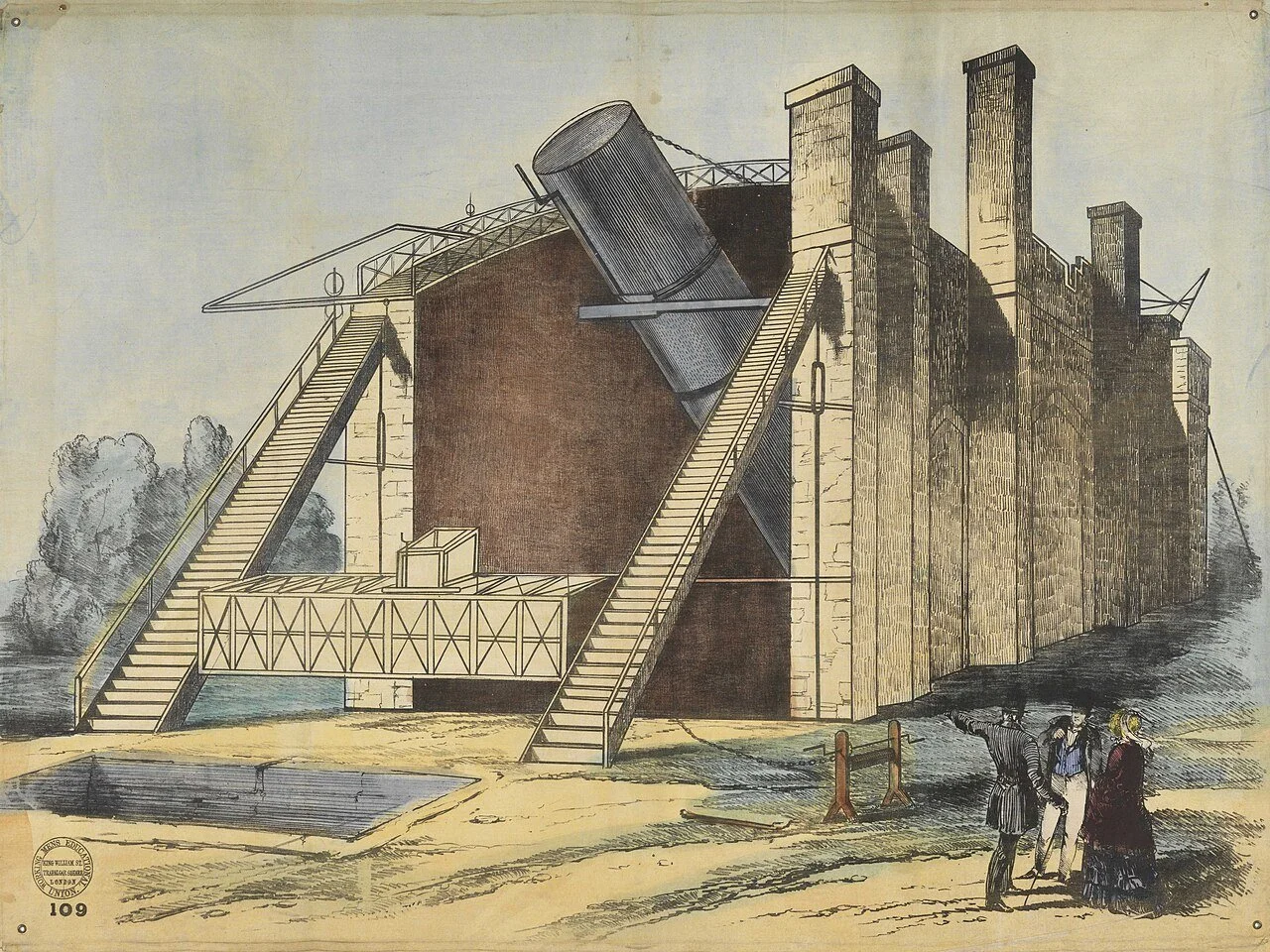
The Leviathan of Parsonstown, 1845: a 72-inch mirror in a tube slung between castle walls — the instrument that first resolved the Whirlpool Galaxy's spiral arms.
Print after the Earl of Rosse's telescope (Royal Museums Greenwich collection, via Wikimedia Commons).
The 19th century turned Herschel's principle into an arms race. In 1845, William Parsons, the Earl of Rosse, finished the Leviathan of Parsonstown at Birr Castle in Ireland: a 72-inch mirror, six feet across, in a tube 54 feet long, aimed by teams of men hauling ropes. It was the largest telescope in the world, and with it Rosse saw the spiral structure of the great Whirlpool Galaxy, the first hint that some of those cloudy "nebulae" were vast pinwheels of stars.
The refractor makers fought back. Lenses had one great advantage: a lens gives a crisp, high-contrast image, perfect for measuring star positions. American craftsmen Alvan Clark and Sons built refractor after refractor, each the largest in the world in its turn, culminating in the 40-inch refractor at Yerkes Observatory in Wisconsin, finished in 1897. It is still the largest refracting telescope ever built, and it will almost certainly keep the record forever, because a lens can only be held around its edge, and past a certain size the glass sags under its own weight and soaks up the very light it is meant to gather. The refractor had hit its ceiling. The future belonged to the mirror.
Glass mirrors with reflective silver coatings replaced the old tarnishing metal, and the giants kept coming: the 60-inch on Mount Wilson in 1908, the 100-inch Hooker telescope in 1917, and the 200-inch Hale telescope on Palomar Mountain, whose mirror was poured in the 1930s and which saw first light in 1949. Each one reached fainter, farther, and older light than anything before it.
Check in: What did the Leviathan of Parsonstown first show in the Whirlpool Galaxy — and why will the 40-inch Yerkes refractor of 1897 almost certainly keep its record forever?
❦ In your workbook: record the century of giants in your own way — a 72-inch mirror in a 54-foot tube seeing spiral arms, the Clark refractors' crisp images, a lens that sags under its own weight, and the road from the 60-inch to the 200-inch Hale — copy, sketch, or note what matters.
A new scale of the universe
★ The 100-inch Hooker telescope gave the century its two great rewrites. In October 1923, Edwin Hubble used it to find pulsing Cepheid variable stars in the Andromeda "nebula." Henrietta Leavitt had shown, a decade earlier, that a Cepheid's pulsation period reveals its true brightness, so measuring how faint these stars appeared told Hubble their distance. The answer placed Andromeda far outside the Milky Way: it was not a cloud inside our galaxy but an entire separate galaxy, millions of light-years away. The universe was suddenly full of island universes.
★ Then Hubble combined his distances with the redshift measurements of Vesto Slipher, who had been recording the spectra of galaxies at Lowell Observatory: redshift is the stretching of a receding object's light toward longer, redder wavelengths, and Slipher's spectra measured it galaxy by galaxy. In 1929 Hubble published the relationship: the farther a galaxy is, the faster it is receding from us. The universe is expanding. Run that expansion backward and everything was once close together, the founding observation of what we now call the Big Bang cosmology, the study of the universe as a whole. A bigger eye had rewritten not just the sky but the story of everything.
Check in: How did Hubble use Cepheid variables to place Andromeda outside the Milky Way — and what relationship did he publish in 1929?
❦ In your workbook: record the new scale in your own way — Cepheids pulsing in Andromeda in October 1923, Leavitt's period revealing true brightness, island universes, and Slipher's redshifts married to Hubble's distances: the farther, the faster — copy, sketch, or note what matters.
A different kind of eye
All of this was still one kind of seeing: collecting light. In 1932, an engineer named Karl Jansky, working for Bell Labs on the static plaguing transatlantic telephone calls, realized that one persistent hiss in his antenna rose and set with the stars. It was coming from beyond the solar system, from the Milky Way itself. He had detected radio waves from space, and he announced it in 1933.
Nobody in astronomy paid much attention, so an amateur took up the cause. In the summer of 1937, Grote Reber built a 31-foot radio dish in his mother's backyard in Wheaton, Illinois, with his own money, and began mapping the radio sky. It was the world's first radio telescope, and it founded radio astronomy, the art of seeing with a completely different kind of light.
Radio telescopes are light buckets too, but the "light" is radio waves, meters long instead of millionths of a meter. Radio waves pass through the dust clouds that block visible light, so radio eyes see straight into regions optical telescopes cannot reach. Modern radio astronomers link dishes across continents, combining their signals so precisely that the array sees as sharply as a single dish as wide as the distance between them. That technique, interferometry, is how the Very Large Array in New Mexico and its cousins turn many small ears into one enormous one.
Check in: Who detected radio waves from space, and when — and what technique lets many dishes see as sharply as one dish miles wide?
❦ In your workbook: record the different eye in your own way — Jansky's hiss that rose and set with the stars, Reber's 31-foot dish in his mother's backyard in 1937, radio waves gliding through dust, and interferometry linking dishes across continents — copy, sketch, or note what matters.
Above the air
Even the greatest ground telescopes look up through an ocean of air, and the air is a poor window. It blurs starlight, the shimmer you see with your naked eye, and it swallows whole bands of light: water vapor blocks most infrared, ozone blocks ultraviolet. Astronomers fight the blurring with adaptive optics, mirrors that flex hundreds of times per second to cancel the atmosphere's wobble in real time, but absorption cannot be flexed away. For some kinds of light, the only answer is to leave the atmosphere behind.
Check in: What two things does the air do to starlight — and which of the two can adaptive optics not fix?
❦ In your workbook: record the air in your own way — an ocean of air that blurs starlight and swallows whole bands of it, mirrors flexing hundreds of times a second against the shimmer, and the absorption no flexing can recover — copy, sketch, or note what matters.
The telescope named Hubble
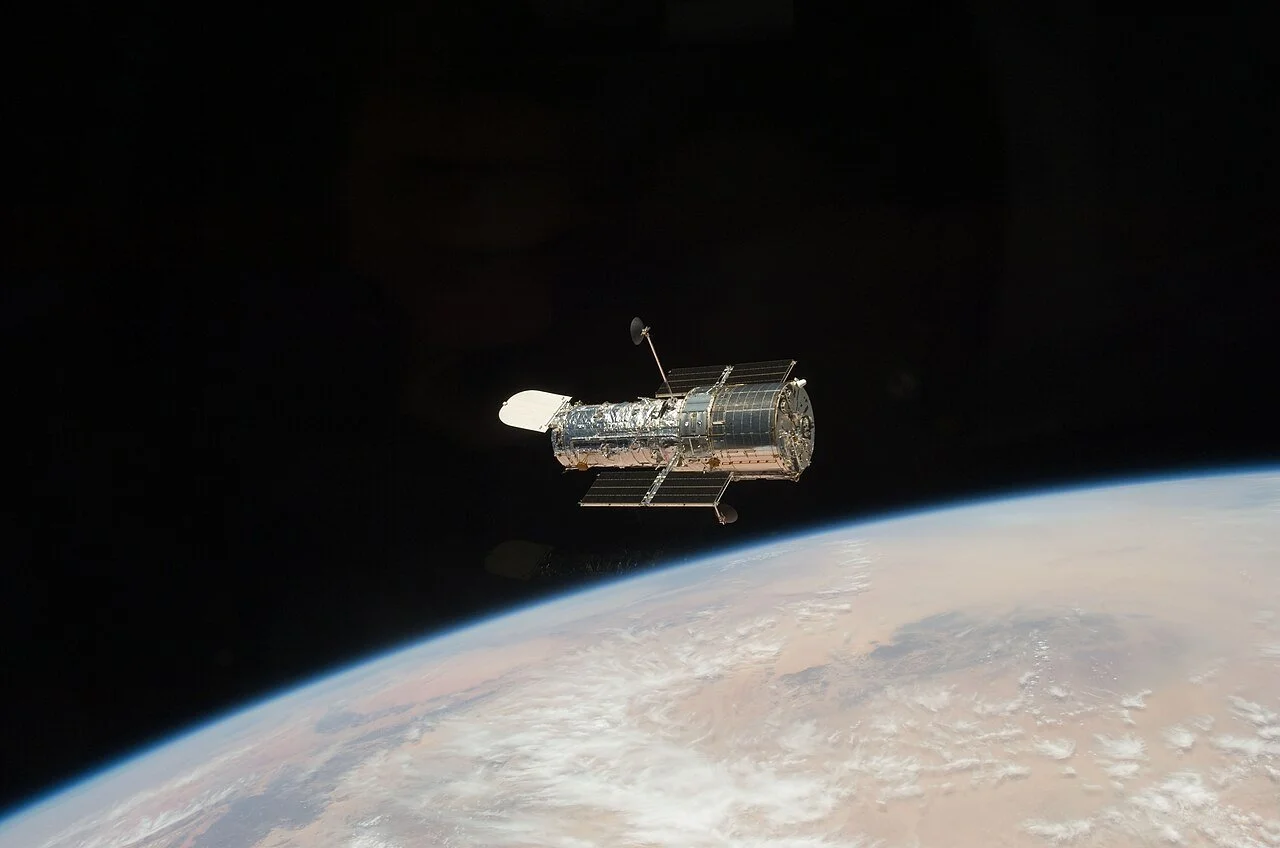
Hubble in orbit, 2009, photographed from Atlantis after the last servicing mission — the 2.4-meter mirror that had to be corrected in space.
NASA.
The Hubble Space Telescope, named for Edwin Hubble, launched aboard the space shuttle Discovery on April 24, 1990: a 2.4-meter reflector in low Earth orbit, above the blur and the absorption. Then came the most public embarrassment in the history of astronomy. The primary mirror had been polished to the wrong shape, too flat by about two microns, a fiftieth the width of a human hair, and the first images came back fuzzy. The flaw, spherical aberration, meant light from the mirror's edge focused in a different place than light from its center.
The rescue is one of the great repair stories ever told. In December 1993, astronauts aboard the shuttle Endeavour captured the telescope and installed corrective optics, essentially eyeglasses for Hubble: the COSTAR instrument for its older cameras and a replacement camera, WFPC2, with the correction built in. It worked. What followed, the Hubble Deep Field of 1995, ten days staring at one tiny dark patch of sky that bloomed into thousands of galaxies, and three decades of images after it, made Hubble the most productive telescope in history. Five servicing missions, the last in 2009, kept it alive and improving. It is still working.
Check in: What was wrong with Hubble's primary mirror, by how much — and what did the December 1993 rescue install to fix it?
❦ In your workbook: record the telescope named Hubble in your own way — a 2.4-meter mirror polished two microns too flat, images returned fuzzy, astronauts fitting eyeglasses in orbit in December 1993, and the Deep Field that followed — copy, sketch, or note what matters.
Vera Rubin and the invisible weight
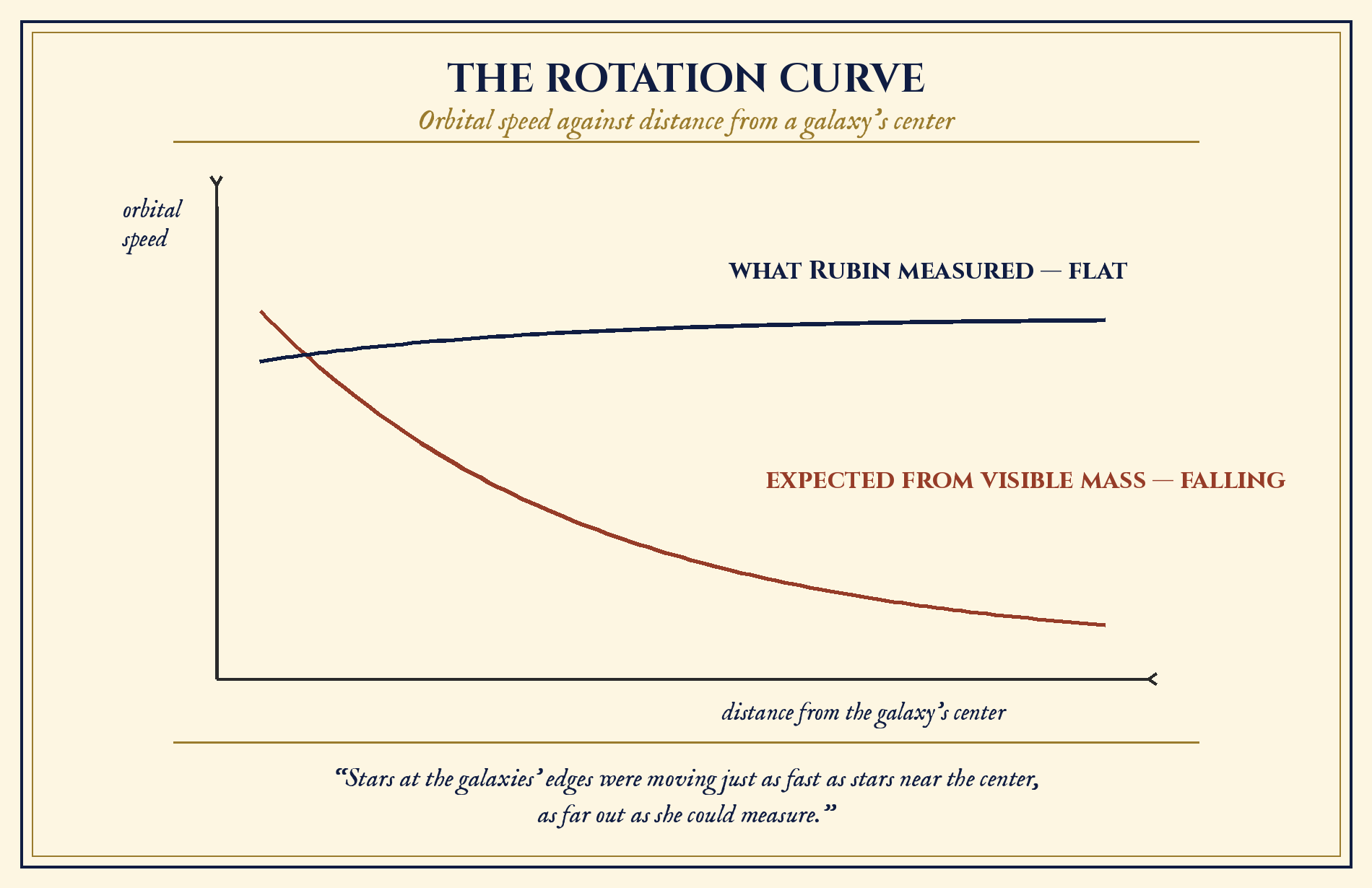
The two curves. Newton and the visible mass predict a fall; Rubin's spectrograph measured a line that would not fall — the missing mass made visible as a shape.
Typeset plate built for Evershade; the plotted curves are the lesson's schematic, drawn to its text.
The most profound rewrite of the late 20th century came from measuring motions. Starting in the late 1960s, astronomer Vera Rubin, working with her colleague Kent Ford at the Carnegie Institution in Washington, used Ford's sensitive new spectrograph to measure how fast stars and gas orbit within spiral galaxies. She began with Andromeda and extended the work to about ten other spirals through the 1970s.
★ What she expected was simple Newtonian sense: most of a galaxy's visible mass sits near its center, so outer stars should orbit more slowly, the way outer planets move more slowly around the sun. What she found was flat rotation curves. Stars at the galaxies' edges were moving just as fast as stars near the center, as far out as she could measure. By Newton's laws, that is impossible unless the galaxies contain far more mass than all their shining stars, mass that gives off no light at all.
Rubin had found powerful new evidence for dark matter: unseen mass supplying the gravitational glue that keeps fast-spinning galaxies from flying apart. An earlier astronomer, Fritz Zwicky, had seen hints of it in galaxy clusters in the 1930s, but Rubin's careful, repeated measurements across many galaxies were what convinced the field. She was characteristically precise about what she had and had not shown: she had discovered the evidence, not the thing itself. Dark matter's true nature remains one of the great unsolved problems in science, which makes her work not a closed case but an open door. She also broke ground as the first woman granted formal access to the great Palomar Observatory's instruments, in 1965, and received the National Medal of Science in 1993.
Check in: What did Rubin expect outer stars to do, what did she actually find — and what did she say, precisely, she had and had not shown?
❦ In your workbook: record the invisible weight in your own way — rotation curves that stay flat where Newton's laws say they should fall, unseen mass as gravitational glue, Zwicky's earlier hints, and a scientist who claimed the evidence, not the thing itself — copy, sketch, or note what matters.
In your packet: Exercise III: The Rotation Curve Sketch ⚒ begins here — its two curves are this section's own graph: the falling curve Newton predicts and the flat curve Rubin measured. Work it now, or mark the place and take it as homework — your choice.
The golden honeycomb
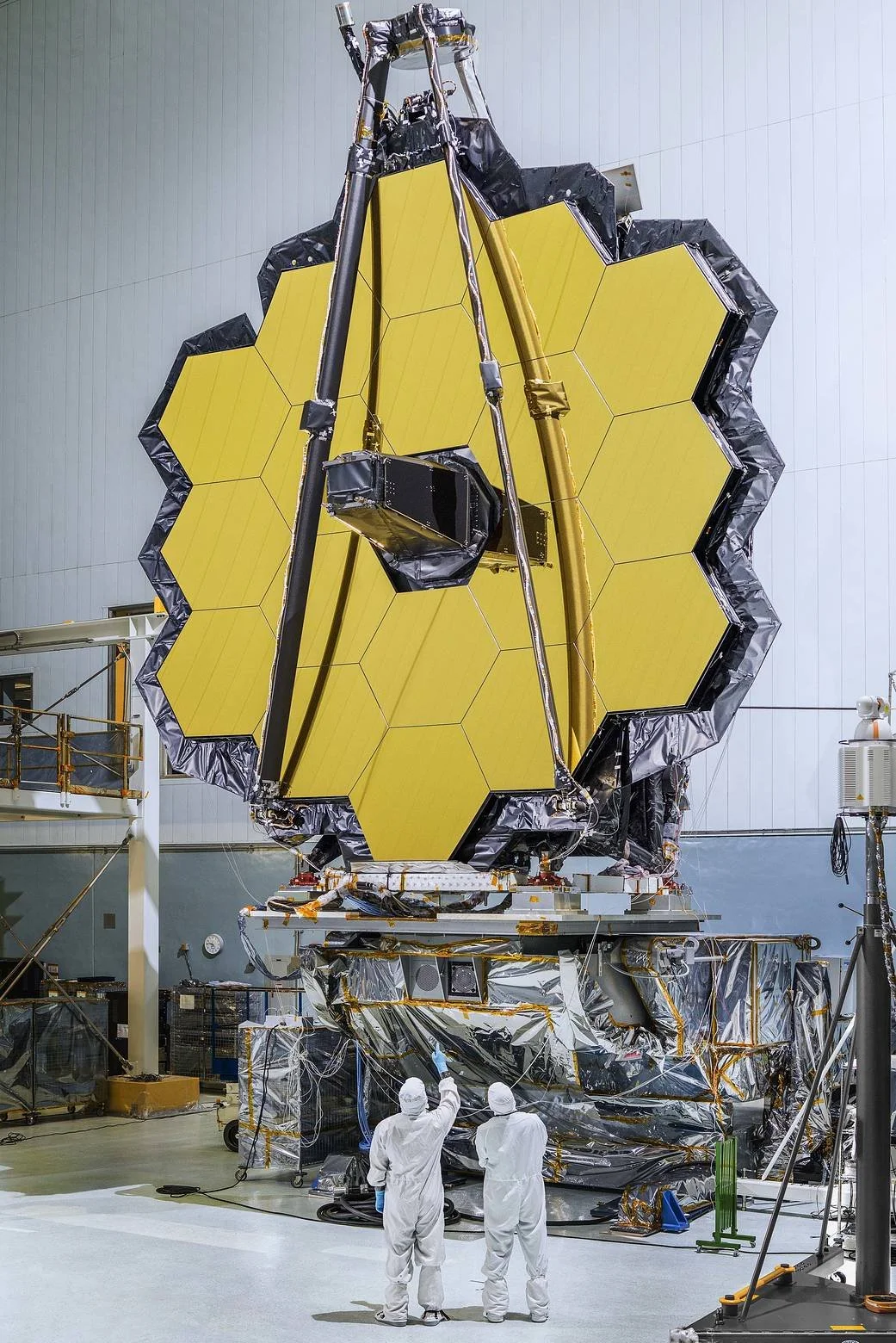
Webb's 6.5-meter primary mirror: eighteen beryllium hexagons coated in gold thinner than a human hair, standing in the Goddard cleanroom before folding for launch.
NASA.
The current champion eye is the James Webb Space Telescope, and it is a different kind of champion. Launched on Christmas Day 2021 aboard a European Ariane 5 rocket from French Guiana, a partnership of NASA, the European Space Agency, and the Canadian Space Agency, Webb is built for infrared light. Its primary mirror is 6.5 meters across, eighteen hexagonal segments of gold-coated beryllium that unfolded in space like a flower, giving it roughly six times the light-gathering area of Hubble.
★ Infrared is the light of the early universe and of hidden things. The expansion of the universe has stretched the first galaxies' light into infrared wavelengths, and infrared passes through the dust clouds where stars are born. But to see it, the telescope must be colder than the faint heat it is hunting, so Webb carries a sunshield the size of a tennis court, five layers of thin Kapton film, each thinner than a human hair, holding the hot sun-facing side hundreds of degrees warmer than the instruments. It orbits a gravitational balance point called L2, about 1.5 million kilometers from Earth, where sun, Earth, and moon all stay on the same side of the shield. Its first full-color images arrived in July 2022: galaxies as they were more than 13 billion years ago, star nurseries glowing through dust, the atmospheres of distant worlds analyzed for the chemistry of habitability.
Check in: Why must Webb be cold — and what two structures, the sunshield and the L2 orbit, keep it that way?
❦ In your workbook: record the golden honeycomb in your own way — eighteen gold-coated hexagons unfolding like a flower, six times Hubble's gathering area, a tennis-court sunshield of five whisper-thin layers, and a balance point 1.5 million kilometers from home — copy, sketch, or note what matters.
Every bigger eye rewrote the sky
Look at the road once more. The spyglass gave us moons around Jupiter and phases of Venus, and the Earth-centered universe fell. The great reflectors gave us Uranus, spiral galaxies, and island universes, and the universe grew. The radio dish gave us a sky made of static and dust-piercing sight. The space telescope gave us the deep field and the expansion measured to exquisite precision. Vera Rubin's spectrograph gave us invisible matter outweighing everything we see. Webb is giving us the first billion years.
The through-line is not the technology. It is the humility. Every generation's sky turned out to be a sketch of a larger one, and the instrument was the pencil. Your Sky Log is a small instrument of the same family. Use it the way Galileo used his notebook: write down what you actually see, and let the sky correct you.
Check in: Name the six rewrites in the lesson's own count — and what does Glimmerwick say the through-line really is?
❦ In your workbook: record the road in your own way — the spyglass, the great reflector, the radio dish, the space telescope, the spectrograph, the infrared honeycomb: six rewrites and counting, and the humility that is the through-line — copy, sketch, or note what matters.
The Mechanism
The light bucket
★ Here is the single most important sentence in this lesson: a telescope is a light bucket, and aperture is everything.
Your eye's pupil opens to about 7 millimeters in the dark. A modest backyard telescope with a 100-millimeter mirror has an opening roughly fourteen times wider, and light-gathering grows with the area of the opening, not the width. Double the diameter and you gather four times the light; triple it and you gather nine times. That 100-millimeter telescope collects about two hundred times more light than your naked eye, which is why it shows you stars your eye can never find and details your eye can never resolve.
This is also why astronomers barely care about magnification when they describe a telescope. A department-store telescope boasting "600x power!" through a tiny lens is nearly useless: magnifying a dim, blurry image just gives you a bigger dim, blurry image. Professionals describe telescopes by aperture, the diameter of the light bucket, because aperture decides two things that no eyepiece can fake: how faint an object you can see, and how fine a detail you can resolve.
Check in: A 100-millimeter telescope collects about how much more light than your naked eye — and why do professionals describe telescopes by aperture, not magnification?
❦ In your workbook: record the light bucket in your own way — a pupil of 7 millimeters against a mirror of 100, light-gathering growing with the area and not the width, and the department-store boast of 600x power exposed — copy, sketch, or note what matters.
In your packet: Exercise I: The Cardboard Aperture Test ⚒ begins here — its two tubes are this section's principle built from paper, and its sky work waits for you in Try It Tonight. Work it now, or mark the place and take it as homework — your choice.
Two ways to gather light
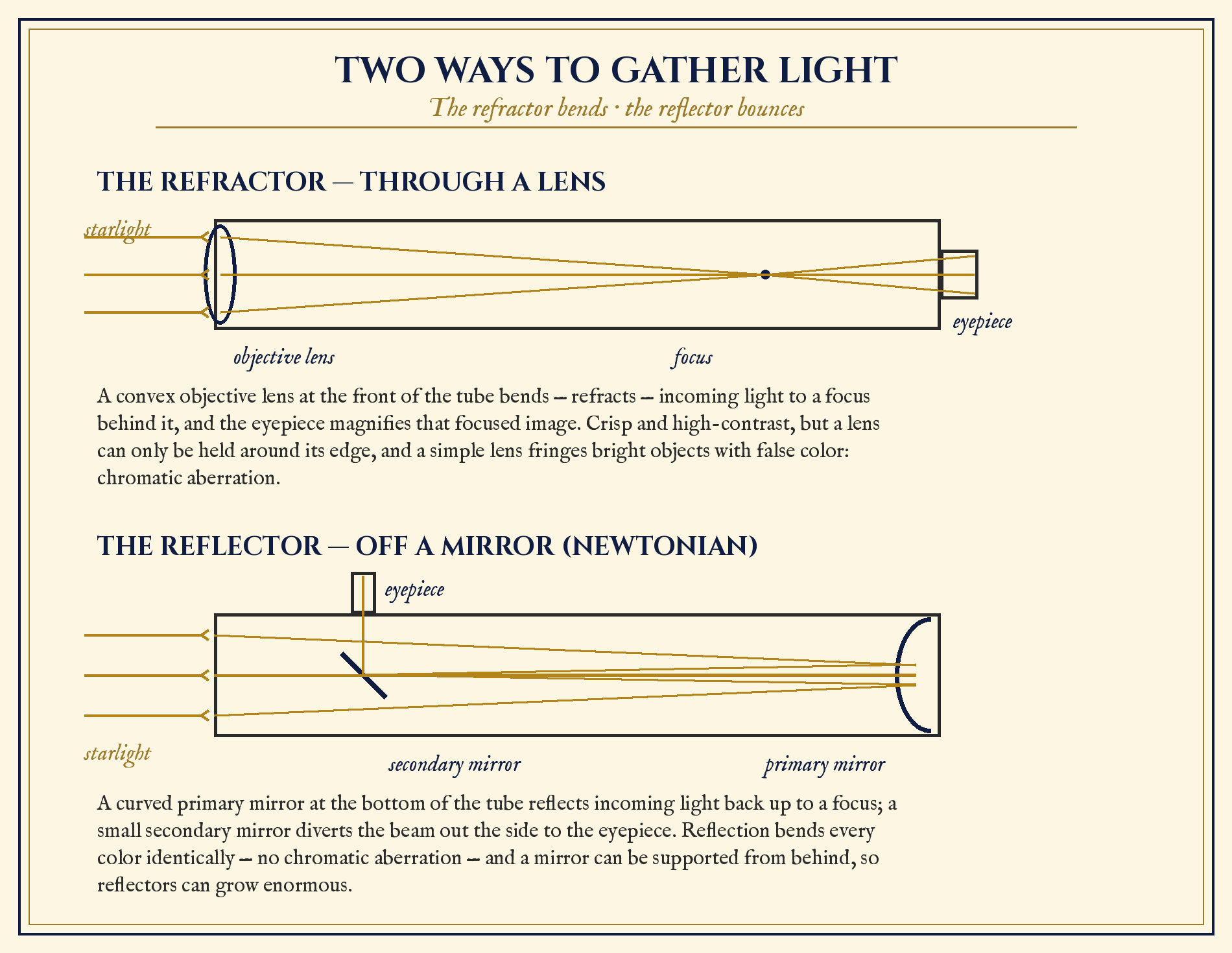
The two ways to gather light. A refractor bends light with a lens; a reflector folds it with mirrors — the fold is what lets telescopes grow.
Typeset plate built for Evershade; geometric construction only.
The refractor gathers light with a lens. A convex objective lens at the front of the tube bends, or refracts, incoming light to a focus behind it, and the eyepiece magnifies that focused image for your eye. Refractors give crisp, high-contrast views, which is why they ruled the 19th century.
But lenses have two deep problems. First, a simple lens bends blue light more sharply than red light, so the colors come to focus in slightly different places and bright objects wear fringes of false color. That is chromatic aberration, the flaw that drove Newton to mirrors. (Clever lens combinations can tame it, but never cheaply.) Second, a lens can only be held around its edge. Make it too big and it sags under its own weight, and thick glass soaks up precious light. That is why the 40-inch Yerkes refractor of 1897 is still the largest ever built: the design hit its ceiling.
★ The reflector gathers light with a mirror. A curved primary mirror at the bottom of the tube reflects incoming light back up to a focus, and a small secondary mirror diverts that focused beam out the side of the tube (in Newton's layout) or back through a hole in the primary (in the Cassegrain layout) to the eyepiece. Because reflection bends every color identically, there is no chromatic aberration at all. And because a mirror can be supported from behind across its whole surface, mirrors can grow enormous. Every giant telescope since Herschel, including Hubble and Webb, is a reflector.
Check in: A refractor gathers light with a ____ and a reflector with a ____ — and which design is free of chromatic aberration, and why can mirrors grow larger than lenses?
❦ In your workbook: record the two ways in your own way — the lens that bends blue more sharply than red, the mirror that reflects every color identically and rests supported from behind, and the 40-inch ceiling the refractor hit in 1897 — copy, sketch, or note what matters.
Magnification: the eyepiece's job
If aperture is the bucket, magnification is just the zoom, and it belongs to the eyepiece, not the telescope. A telescope's focal length is the distance from its objective to the point where it brings light to a focus. The rule is simple division:
Magnification = telescope focal length divided by eyepiece focal length.
A telescope with a 1000-millimeter focal length and a 25-millimeter eyepiece magnifies 40 times; swap in a 10-millimeter eyepiece and you get 100 times, with the same telescope. This is why antique refractors had such absurdly long tubes: with the eyepieces of the day, a long focal length was the only way to reach high magnification. Useful magnification has a ceiling set by the aperture and the steadiness of the air, which is why experienced observers reach for low, bright magnifications far more often than beginners expect.
Check in: A telescope of 1000 millimeters focal length with a 25-millimeter eyepiece magnifies how many times — and whose job is magnification, the telescope's or the eyepiece's?
❦ In your workbook: record the eyepiece's job in your own way — one simple division, 1000 by 25 for 40 times, the same telescope at 100 times with a 10-millimeter eyepiece, and the long tubes of the antique refractors explained — copy, sketch, or note what matters.
In your packet: Exercise II: The Magnification Trade ✎ begins here — its divisions are this section's own rule, telescope focal length divided by eyepiece focal length. Work it now, or mark the place and take it as homework — your choice.
Sharpness: resolution
Aperture's second gift is sharpness, called resolution: the finest detail the telescope can separate. A bigger mirror draws a tighter point of starlight, so close double stars split cleanly and distant galaxies show structure instead of smudge. Roughly speaking, doubling the aperture doubles the sharpness, and nothing else in the optical chain can substitute for it. Galileo's little spyglass could not split Saturn's "handles" into rings because its bucket was too small; the Leviathan could trace spiral arms because its bucket was six feet wide.
Check in: What is resolution, what sets it — and why could Galileo's spyglass never split Saturn's handles into rings, whatever eyepiece he used?
❦ In your workbook: record sharpness in your own way — the finest detail a telescope can separate, doubling as the aperture doubles, close double stars split cleanly, and the Leviathan tracing spiral arms because its bucket was six feet wide — copy, sketch, or note what matters.
Radio dishes and interferometry
A radio telescope is the same light bucket wearing a different coat. Its dish collects radio waves, which are millions of times longer than visible light, and funnels them to a receiver. Because the waves are so long, a single dish sees the sky very fuzzily, but radio waves glide through interstellar dust that stops visible light cold, so radio eyes map regions optical telescopes cannot enter.
Interferometry solves the fuzziness. Link many dishes together, combine their signals with exquisite timing, and the array resolves detail as finely as a single dish as wide as the greatest distance between the dishes. The Very Large Array in New Mexico is twenty-seven dishes on rails; working as one, they see with the sharpness of a dish miles across. Same bucket, multiplied.
Check in: Why does a single radio dish see the sky fuzzily — and what two gifts does radio light have that visible light does not?
❦ In your workbook: record the radio dishes in your own way — waves millions of times longer than visible light, dust that stops starlight and lets radio glide through, and twenty-seven dishes on rails seeing as one dish miles across — copy, sketch, or note what matters.
Why space, why infrared, why cold
Ground telescopes look up through miles of moving air, which blurs starlight, and the air drinks deeply of certain light: water vapor blocks most infrared, ozone blocks ultraviolet. Adaptive optics can flex a mirror fast enough to cancel the atmosphere's shimmer, but no flexing recovers light the air has already swallowed. For infrared and ultraviolet astronomy, the telescope must get above the atmosphere entirely, which is the whole argument for Hubble.
Webb goes further, and its design is a chain of necessities. The most distant galaxies' light has been stretched by the expansion of the universe from visible into infrared, and infrared also slips through the dust of star-forming clouds. But infrared is heat radiation, and a warm telescope glows in its own light, blinding itself. So Webb must be colder than what it observes: hence the tennis-court sunshield, five whisper-thin layers that step the temperature down hundreds of degrees from the sun-facing side to the instruments, and hence the orbit at L2, a gravitational balance point 1.5 million kilometers out where the sun, Earth, and moon all huddle on the same side of the shield. Every strange feature of the golden honeycomb is the mechanism answering the sky's conditions.
Check in: Why is Webb an infrared telescope — and why would a warm telescope blind itself at those wavelengths?
❦ In your workbook: record the cold in your own way — the first galaxies' light stretched into infrared, heat radiation that makes a warm telescope glow in its own light, five whisper-thin layers stepping the temperature down, and L2 holding sun, Earth, and moon behind the shield — copy, sketch, or note what matters.
A Sealed Note on Bigger Eyes
Scholars sometimes ask me, shyly, whether I am jealous of your telescopes. I am a bat. I fly by echo, and I have never seen the rings of Saturn, not even as a smudge.
Here is my honest answer: no. My ears tell me where the moth is, and that is all the sky I need for supper. But I am something better than jealous. I am delighted. Delighted that a creature with such modest eyes refused to accept them, and built better ones out of sand and silver, and then pointed those better eyes at the dark and wrote down what came back, even when it contradicted everything the creature believed.
There is a lesson in the instrument story that has nothing to do with glass. Galileo's notebook is full of careful sketches and wrong guesses side by side. Herschel polished hundreds of mirrors before the good one. The Hubble team admitted, in front of the whole world, that their mirror was wrong, and then they fixed it in orbit, with gloves on, while falling around the Earth at five miles per second. That is not a story about genius. It is a story about people who kept excellent notes and refused to flinch.
Keep excellent notes, my dears. Refuse to flinch. The sky rewards both habits.
❦ In your workbook: record the sealed note in your own way — a bat who flies by echo and has never seen the rings of Saturn, delighted rather than jealous, and the story's real subject: people who kept excellent notes and refused to flinch — copy, sketch, or note what matters.
PROFESSOR VESPER GLIMMERWICK
Celestial Studies
Astronomer & Celestial Historian
Guided Observation
Try It Tonight
Level One: household items, naked-eye relevant
Part One: The Cardboard Aperture Test. Roll two paper tubes: a narrow one from a sheet of paper rolled tight (about the width of a coin) and a wide one from a paper towel tube or a rolled magazine page. After dark, with your adult, stand in one spot and look at the same patch of sky through each tube in turn, resting the tube gently against your brow so no stray light leaks in.
Count, or simply compare: which tube shows you more stars? Which shows the fainter ones? The wide tube is a bigger light bucket, and you have just demonstrated, with trash and moonlight, the founding principle of every great observatory: aperture is everything. Record your comparison in your Sky Log.
Part Two: Galileo's Sketch Challenge. Look at the moon with your naked eyes and sketch its face in your Sky Log, shading the dark patches, the maria, as carefully as you can. Then compare your sketch to your memory of this lesson: Galileo's first telescopic act was exactly this, drawing what he actually saw instead of what he had been told was there. Label one feature you are sure of and one you are guessing at. Honest labels are the whole craft.
Check in: Which tube showed you more stars, and which showed the fainter ones — and what founding principle of every great observatory have you just demonstrated with paper and moonlight?
❦ In your workbook: record the aperture test and the sketch in your own way — the two tubes described honestly, the wide tube's fainter stars, your moon sketch with one sure label and one guessing label — copy, sketch, or note what matters.
Level Two: for scholars with a telescope or binoculars
First light protocol. If you have access to a telescope or binoculars, begin the way every astronomer begins: with the moon. It is bright, easy to find, and utterly safe. Note the mountains and craters along the terminator, where shadows are longest.
Next, find Jupiter, the bright unblinking "star" of the evening. At even modest magnification you can repeat Galileo's January 1610 observation: look for the tiny points of light in a row beside the planet, and sketch their positions. Check again an hour later, or the next night. If they have moved, you have seen moons circling another world, four hundred years after the first witness.
Know your numbers. Read the focal length printed on your telescope's tube and on your eyepiece, and divide: telescope focal length by eyepiece focal length. That is your magnification. Try two different eyepieces and feel the trade directly: higher magnification, dimmer and shakier image. Aperture is the bucket; the eyepiece is only the zoom.
The one rule, repeated: never point the instrument at the sun without a certified full-aperture solar filter over the front, and never trust an eyepiece-end filter. No filter, no sun. The moon, the planets, and the stars will keep.
Check in: What is your instrument's magnification with each eyepiece you tried — and what happened to the image's brightness and steadiness as the magnification rose?
❦ In your workbook: record first light in your own way — the moon's terminator shadows, Jupiter's points of light in a row and whether they moved, your two focal lengths and their division, and the one rule, repeated — copy, sketch, or note what matters.
Sky Log Entry
Date, time, and location. Sky conditions: clear, hazy, moonlit, or cloudy.
- Record your Cardboard Aperture Test: describe the two tubes and which showed more and fainter stars, in your own words.
- Attach or describe your Galileo moon sketch, with your sure label and your guessing label.
- Level Two only: record your instrument, its focal length, the eyepiece used, your computed magnification, and what you observed at the moon and at Jupiter. If you repeated the Jupiter sketch on a second night, note how the points moved.
- One sentence: what surprised you most about what your eyes, with or without help, could actually gather tonight?
❦ In your workbook: record the Sky Log entry in your own way — the aperture test in your own words, the moon sketch with its sure and guessing labels, the Level Two numbers if you ran them, and your one sentence on what surprised you — copy, sketch, or note what matters.
Materials
Required (Level One — household items)
- Two paper tubes: a narrow one rolled tight from a sheet of paper (about the width of a coin) and a wide one from a paper towel tube or a rolled magazine page.
- Your workbook and a pencil for the aperture test, the moon sketch, the Sky Log entry, and the exercises.
- Graph paper for the rotation-curve sketch in Exercise III.
- A flashlight for night observing (a red filter or dim setting preserves night vision).
Suggested (Level Two — historically closer)
- A telescope or pair of binoculars, borrowed or your own, for the first-light protocol in Try It Tonight.
- A certified full-aperture solar filter if you intend any solar observing at all: mounted over the front of the instrument, never at the eyepiece.
- A red flashlight for reading your Sky Log without ruining your night vision.
Reflection Questions
Answer in your workbook, in complete sentences.
- "Every bigger eye rewrote the sky." Choose one rewrite from this lesson and describe the sky before and after: what did people believe, what did the new eye show, and what had to change in human minds?
- Jupiter's moons and the phases of Venus each struck a blow against the Earth-centered universe. Which blow do you find more decisive, and why? Defend your choice with the geometry from the lesson.
- Caroline Herschel began as her brother's recording assistant and became an independent discoverer with her own telescope and salary. What does her story suggest about who gets to do science, and what has to change for that to widen?
- Vera Rubin measured something she could not see by carefully watching something she could. Where else in this course have scholars done the same thing: weighed or measured the invisible by its effects on the visible?
- The Webb telescope "sees" infrared light that no human eye will ever detect. Is that still seeing? What does your answer suggest about what an eye actually is?
Workbook Checklist — Lesson 32
In my workbook I have:
- ☐ performed the Cardboard Aperture Test with my adult — both tubes, same patch of sky, same spot — and recorded which showed more stars and which showed fainter ones
- ☐ sketched the moon's face with my naked eyes, shaded the maria, and labeled one feature I am sure of and one I am guessing at
- ☐ written my Sky Log entry: the aperture test in my own words, the sketch described, and my one sentence on what surprised me
- ☐ completed Exercise I: the tubes described, the area explanation written, and both light-gathering divisions shown in full
- ☐ completed Exercise II: both magnifications computed, the brightness-and-steadiness answer written, and the 600x advertisement judged by the lesson's rule
- ☐ completed Exercise III: both rotation curves drawn and labeled on graph paper, the flat curve's implication explained, and the evidence-versus-thing answer written
- ☐ Level Two only: recorded my instrument, its focal length, the eyepiece used, my computed magnification, and what I observed at the moon and at Jupiter
☐ Lesson completed Date: ___ Signature: ___
Cross-Class Connections

Creative Arts · Studio Extension E1 — Precision Paper Instruments, Built to Last
Set up square, scholars, and bring the tower's paper with you. Professor Glimmerwick has walked you past four hundred years of instruments built by somebody's hands — Herschel grinding his own mirrors, the Clarks called artists in optics, a sunshield sewn and folded like a vast kite. In my workshop the instrument of yours that comes first to the bench is the planisphere from her Lesson 30: a sound paper instrument whose pivot hole stretches a little with every turning, until the scales drift and one damp week finishes it. This extension rebuilds it to be turned ten thousand times — the same scales, the same geometry, carried in board and brass where brass earns its place, with a fitted case to keep it in. Every telescope in her lesson began exactly here: a maker who would not let a good instrument die of its materials.
— Professor Cogbranch Timberclank, Creative Arts Workshop
Scrollwork — named in the lesson; no invitation written. Glimmerwick's text above names the Sidereus Nuncius, its copper-engraved moon drawings, and the great star atlases, but no Scrollwork lesson teaches printed scientific books or astronomical illustration as such, so no destination lesson verifies for this hook (the same ruling this class recorded at Lesson 22). The connection stands as the lesson's own prose mention above.
History of Magic — named in the lesson; a future class. The final names it as "(a future class)" that will give the second question — what the sky has meant for us — its own full telling when it opens its doors. There is no lesson to link and no professor to invite. The mention stands exactly as sourced.
The Professor's Closing Note
And so the instrument story ends, for now, with a golden honeycomb unfolding in the dark a million miles from home, sending back light older than the Earth itself.
I want you to carry the through-line out of this lesson the way you would carry a lantern: every bigger eye rewrote the sky. Not once, as a single revolution, but over and over, as a habit of the universe and of the people studying it. The spyglass, the great reflector, the radio dish, the space telescope, the spectrograph, the infrared honeycomb: six rewrites and counting, and nobody serious believes the counting is done.
Next lesson is our last, and it is about the darkness itself: light pollution, the disappearing Milky Way, and the satellites crowding the night. It is the most practical lesson of the course, because it asks what you will do, not only what you will know. Bring your Sky Log. We will measure your sky together.
Look up tonight, scholars. Somewhere out there, an eighteen-sided golden eye is looking back at the beginning of everything, and it started with a man, a tube of glass, and a notebook.
PROFESSOR VESPER GLIMMERWICK
Celestial Studies
Astronomer & Celestial Historian
Further Reading & Sources
These are real destinations for further study, verified live at the time of writing. Start with NASA; it is the authority this lesson leans on heaviest.
- NASA: Webb's Sunshield, why the telescope must be cold, and how five whisper-thin layers do the job. https://science.nasa.gov/mission/webb/webbs-sunshield/
- NASA: A Refresher on Hubble Facts, launch and servicing dates, mirror statistics, and what the telescope has accomplished. https://science.nasa.gov/centers-and-facilities/goddard/a-nasa-refresher-on-hubble-facts-for-the-25th-anniversary/
- Facsimile Finder: Galileo's Star Power, the Sidereus Nuncius and the Library of Congress's untrimmed 1610 copy. https://www.facsimilefinder.com/articles/galileo-sidereus-nuncius-facsimile/
- National Geographic: Comet-Hunter Caroline Herschel, her eight comets, her catalogues, and her salary from the king. https://www.nationalgeographic.com/adventure/article/160316-google-doodle-caroline-herschel-astronomy-comet-space-science
- Astronomy Magazine: Great Telescopes of the Past, Herschel's 40-foot, the Leviathan, the Clark refractors, and the road to Palomar. https://www.astronomy.com/observing/great-telescopes-of-the-past/
- National Radio Astronomy Observatory: Timeline of NRAO History, Jansky's 1933 announcement and Reber's 1937 backyard dish. https://www.nrao.edu/archives/nrao-timeline
- American Institute of Physics: Remembering Vera Rubin, the rotation-curve work and what it established. https://www.aip.org/inside-science/remembering-vera-rubin
Browse the Celestial Studies shelf in the school Library for readable editions of these works.
Sealed in the Celestial Tower, in deep midnight blue, by Professor Vesper Glimmerwick.
Submit your work for this lesson using the form below.
CONTINUE IN THE CELESTIAL TOWER
← Previous · Lesson 31: The Astrolabe Next · Lesson 33: Dark Skies →
Unit VI — Instruments of the Sky Celestial Tower — All 33 Lessons
The rest of Unit VI: Lesson 29 · Sundials · Lesson 30 · Planisphere · Lesson 31 · The Astrolabe · Lesson 33 · Dark Skies