

CELESTIAL STUDIES
Unit VI · Lesson 29Sundials: Catching Shadows
Professor Vesper Glimmerwick
Astronomer & Celestial Historian
The Celestial Tower • School of Evershade
Professor's Introduction

The sun has done its part, scholars,
There is a sundial in the castle garden, halfway down the south terrace, and I confess it took me three visits to notice it was there at all. It is a plain stone disk on a weathered pedestal, the kind of thing you walk past while thinking about dinner. On my fourth visit, the afternoon sun was doing exactly what afternoon sun does, and the little bronze pointer threw its shadow across the stone, and the shadow lay precisely along the line marked for the hour, and I stood there with my wings half open like a startled umbrella because the simplicity of it had ambushed me.
A shadow, telling the time. Nothing ticks. Nothing is wound. The same sun that rises whether we watch it or not has been persuaded, by a slanted stick and some lines on a stone, to report the hour.
This is the oldest instrument in this entire unit, scholars, and in some ways the deepest. It is easy to build a sundial badly. It is a genuine education to build one well, because building one well forces you to understand the geometry of the whole sky: the axis of the Earth, your latitude, the sun's apparent journey, and the difference between the time the sun keeps and the time your clock keeps. By the end of this lesson you will hold that geometry in your hands, on a paper plate, and it will work.
One promise before we begin, because it is the standing rule of this tower and I repeat it for every instrument lesson: the wonder is the doorway, not the destination. This lesson will not wave its wings at the sky and call it magic. It will teach you, truly and carefully, why the shadow moves the way it does, why the pointer must lean at exactly the angle it leans, and why your finished dial will disagree with your clock by a few honest minutes. Understanding is the whole pleasure. Let us begin.
PROFESSOR VESPER GLIMMERWICK
Celestial Studies
Astronomer & Celestial Historian
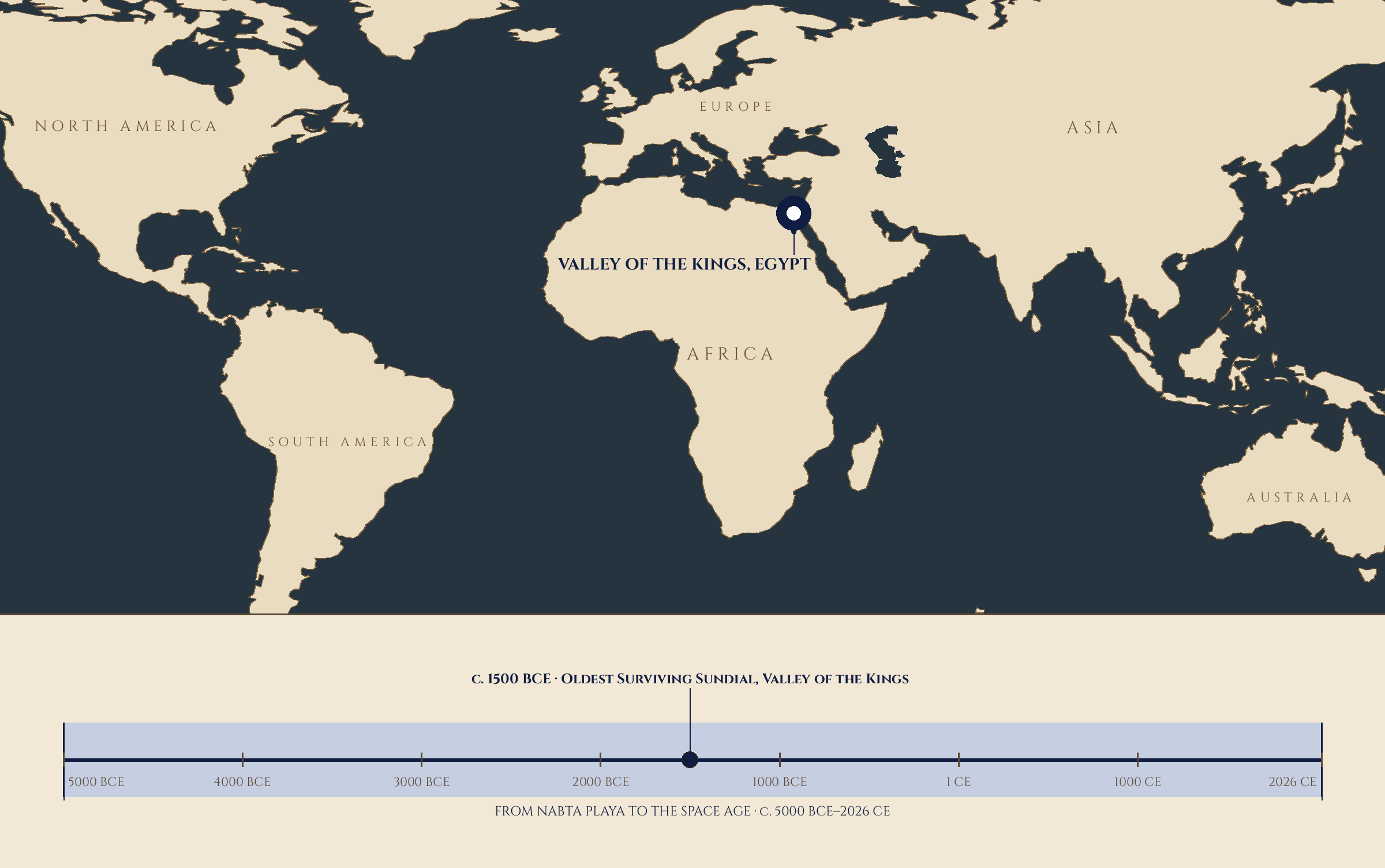
Where and when: VALLEY OF THE KINGS, EGYPT, c. 1500 BCE · Oldest Surviving Sundial, Valley of the Kings (year −1500) — Sundials: Catching Shadows. The pin is this lesson. The line beneath the map is our road: every stop a moment when watching the sky changed, every lesson a pin upon it.
Lesson Objectives
By the end of this lesson, you will be able to:
- Explain, in their own words, why a shadow can tell the time, using the sun's apparent motion and the Earth's rotation.
- Describe the polar alignment of a correctly made dial: the gnomon sits parallel to the Earth's axis, tilted above the horizontal at an angle equal to the observer's latitude, and explain why that single angle does the whole job.
- Explain why the hour lines of a polar or equatorial dial are spaced evenly at fifteen degrees per hour, and why the hour lines of a horizontal dial are not, using the projection of uniform motion onto a flat surface.
- Name at least four distinct kinds of historical dial (for example, the shadow clock, the scratch dial, the nodus dial, the analemmatic dial) and say honestly which ones use the polar arrangement and which do not.
- Explain the equation of time: why a perfect sundial and a perfect clock disagree by minutes, and name the two causes.
- Build a working horizontal sundial calibrated for their own latitude, test it against a clock, and correct its readings for longitude and the equation of time.
Reading this lesson: ★ marks the passages to remember. They return on the unit quiz and the class test. Check in questions ask the material back as you go; answer them in your workbook when you meet them.
Working this lesson: Your assignment packet is the first download on this page. Work in it as the lesson moves along, answering each exercise as its subject is taught — or read the lesson through for your notes and take the exercises as homework afterward. Both are proper ways to sit this class. Signposts in the reading tell you where each exercise belongs. Written answers are short answers in your own words; a few honest lines are worth more than a filled page.
Your Assignment Packet
This lesson's exercises live in its packet: the Lexicon Handout (every term of the lesson), Materials, Guided Practice, the Assignment Manual with its answer key for self-checking, the Reflection Questions, and the Workbook Checklist. Download the packet before you begin and keep it beside you as you read. The packet's exercises are Glimmerwick's own word for the work: Exercise I: Build, Test, and Correct the Dial ⚒, Exercise II: The Latitude Problem ✎, and Exercise III: The Honest Clock ✎. The manual's own Lesson Quiz is not printed in the packet; it pools to the Unit VI Quiz, where it will meet you again.
Safety Briefing
Watch the shadow, never the sun. A sundial is read by looking at the shadow on the dial plate, never by looking toward the sun. This is the gentlest instrument in the unit and also the one used in full daylight, so make the habit now: eyes on the plate, never on the sky near the sun. Ordinary sunglasses are not solar protection and do not change this rule. You never need them for dial work anyway, because you never look at the sun.
Blades and points need an adult. The build calls for a sharp pencil or pin to pierce the plate, and possibly scissors or a craft knife to trim the gnomon. An adult handles the piercing and any cutting. Fingers stay clear of the point while the gnomon is being seated.
Protractors are for measuring, not for dueling. A light note, scholars, but the corners are genuinely sharp, and the workshop has seen things.
Daylight means sun sense. You will be outdoors testing the dial. Hat, water, and sunscreen on bright days; do not leave the finished plate baking on dark pavement, which can warp paper and soften tape. Bring the dial in when storms threaten.
Night-observing rules still apply for the Sky Log's evening entries: adult present, familiar safe location, someone knows where you are.
The Wonder
Pick a sunny day, any sunny day, and plant a straight stick upright in open ground. Come back in an hour. The shadow has moved.
Come back in another hour. It has moved again, by about the same amount, in the same direction, sweeping around the stick like the hand of a clock laid flat on the grass.
Now consider what you have just done. You have not built anything. You have not wound anything, charged anything, or connected anything. You have stuck a stick in the dirt, and the turning of the entire Earth has announced itself to you, hour by hour, written in shadow on the ground. Every sundial ever made, from a pharaoh's courtyard to the garden of this castle, is a refinement of that stick. The refinement took about five thousand years. The stick itself was the whole idea.
There is a second wonder hiding inside the first, and it is the one this lesson is really about. If you lean the stick over, tilt it at exactly the right angle, and point it at exactly the right place in the sky, the shadow stops merely wandering and starts keeping perfect time: the same distance between every hour, morning to evening, in March and in September. The angle is not a guess and not a tradition. It is your latitude, and the place the stick points is the celestial pole, and together they turn the stick into a tiny model of the Earth's own axis, standing in your garden and turning with the planet. The shadow becomes honest.
You are about to build that. But first, the story of everyone who got there before you.
Check in: What have you just done with a stick in the dirt — and what is the second wonder, the one this lesson is really about?
❦ In your workbook: record the wonder in your own way — a stick planted in open ground, its shadow moved an hour later and again an hour after that, and the leaned stick whose shadow keeps perfect time — copy, sketch, or note what matters.
The Story
The oldest surviving clock of the sun
★ The earliest surviving sundial anyone has yet found comes from Egypt, and it is about three and a half thousand years old. It is a small limestone slab, roughly the size of a dessert plate, found in 2013 by archaeologists from the University of Basel in the Valley of the Kings, in what had been a village of the workers who built the royal tombs. Its face carries a semicircle divided into twelve parts, for the twelve hours of daylight, with a hole at the center where a peg, the gnomon, would have stood. Because it was found among workers' housing, the excavators suggested it may have been used to measure out the working day: timekeeping for labor, not for priests.
The Egyptians had simpler shadow devices too. The shadow clock, first used around 1500 BCE, was an L-shaped bar: a long stem marked with lines and a raised crossbar at one end that cast the shadow across the marks. In the morning it was pointed east; at noon it was turned around to face west, to catch the afternoon sun. Crude, but it worked, and it shows the essential discovery already made: shadows move in a pattern, and a pattern can be read.
Herodotus, the Greek historian, credited the Babylonians with inventing the sundial, and the claim survived for two thousand years. The honest modern answer is that the earliest surviving evidence is Egyptian, and the true inventor is lost to us, which is often the case with the oldest tools. Someone, somewhere, planted the stick and watched.
Check in: Where was the earliest surviving sundial found, how old is it, and what did the excavators suggest it was for — and what was the shadow clock, and how was it used?
❦ In your workbook: record the oldest clock of the sun in your own way — a limestone slab the size of a dessert plate, a semicircle in twelve parts, a hole for the peg, and the workers whose day it may have measured — copy, sketch, or note what matters.
Hours that stretched and shrank
The Egyptians, and after them the Greeks and Romans, divided the daylight into twelve hours. But these were not our hours. They were temporary hours: twelve equal divisions of whatever daylight the day happened to offer. In summer, when the days were long, an hour was long; in winter, when the days were short, an hour was short. Near the Mediterranean the difference was modest. In northern lands a summer hour could be twice as long as a winter hour.
Our hours, all the same length year round, are the equal hours, and they arrived much later. Royal Museums Greenwich notes that the idea was introduced in the thirteenth century and was in general use by the fifteenth. It is worth pausing on what that means: for most of the sundial's long history, the hours themselves changed length with the seasons, and nobody found this strange, because the sun was the clock and the sun did what it did.
Check in: What were temporary hours, how did they differ from our equal hours — and when did equal hours arrive, and come into general use?
❦ In your workbook: record the stretching hours in your own way — twelve divisions of whatever daylight the day offered, a summer hour twice a winter hour in northern lands, and equal hours arriving centuries later — copy, sketch, or note what matters.
The Greeks and the geometry
Sundials are said to have been introduced to Greece around 560 BCE, and by the time of the Roman writer Vitruvius, writing about 25 BCE, the subject had become a science. In Book IX of his De Architectura, Vitruvius listed all the known kinds of dials and credited each to its Greek inventor: bowl-shaped dials and disc dials, spiderweb dials and conical dials, portable dials a traveler could carry. The Greeks had the geometry, and they spent it lavishly. One mathematician, Theodosius of Bithynia, is credited with a universal dial meant to work at any latitude on Earth.
The Romans adopted the Greek dials with enthusiasm. The first recorded sundial in Rome dates to 293 BCE. Around 10 BCE the emperor Augustus built an enormous one, the Solarium Augusti, with an Egyptian obelisk as its gnomon casting a shadow across a great paved calendar. Dials became so common in Roman towns that a character in a comedy by Plautus complained that his day was being chopped into pieces by the things.
Notice something, scholars: these ancient dials did not, for the most part, use the polar arrangement this lesson teaches. Many were nodus dials, which read the time from the tip of the gnomon's shadow falling on curved or bowl-shaped surfaces, not from the angle of the shadow. They were beautiful, clever, and seasonal in their own ways. The polar gnomon, the tilted pointer parallel to the Earth's axis, is a refinement that came later, and the lesson will be honest about which dials use it and which do not.
Check in: Who listed all the known kinds of dials, in what book and roughly when — and what honest point does the lesson make about whether those ancient dials used the polar arrangement?
❦ In your workbook: record the Greeks and the geometry in your own way — Vitruvius's list in Book IX, bowl dials and spiderweb dials and portable dials, and the nodus dials that read the shadow's tip, not its angle — copy, sketch, or note what matters.
The church wall and the scratched lines
In medieval England, time was kept on the walls of churches. Scratch dials, also called mass dials, were cut or scratched into the stone of the south wall, usually at about eye level. A short wooden peg, the gnomon, was set into a central hole, sticking out at right angles to the wall, and lines were scratched radiating from it. The shadow of the peg crossed the lines through the day, and the priest could tell the time of the services: the canonical hours of prayer.
The Anglo-Saxons divided the day into tides: morgen (roughly 6 to 9 in the morning), undern (9 to noon), middaeg (noon to 3), and gelotendaeg (3 to 6). Some of our words are the survivors of that system: morning, noon, evening, and the tides in yuletide and eventide. The oldest dial in England is a tide dial carved into the Bewcastle Cross in Cumbria, from the seventh or early eighth century. Some dials even carry runic inscriptions; the Runes department will want a word with you about those.
About three thousand of these dials have been recorded in Britain, and the British Sundial Society keeps a register and still welcomes new finds. They were never precise instruments. They were parish clocks for a world that ran on prayer times and daylight, and they served for centuries. When mechanical clocks arrived in the 1300s and 1400s, the dials did not vanish at once; for two hundred years, churches kept both. By the mid-1500s, the scratch dial had surrendered to the clock and to the true sundial: the polar-aligned kind, with the gnomon tilted to the celestial pole for the local latitude, and hour lines graduated to give accurate, equal hours.
Check in: What was a scratch dial, where was it cut, and what did its peg's shadow tell the priest — and what are the four Anglo-Saxon tides?
❦ In your workbook: record the church wall in your own way — scratched lines at eye level on a south wall, a wooden peg at right angles, the tides morgen, undern, middaeg, and gelotendaeg, and the Bewcastle Cross tide dial — copy, sketch, or note what matters.
The dial that set the clocks
Here is the twist the story deserves. The mechanical clock did not kill the sundial; it made the sundial its master. Early clocks were poor timekeepers, drifting minutes every day, and they had to be reset regularly against something trustworthy. That something was the sundial. For centuries the relationship ran one way: the dial told the true solar time, and the clock was corrected to match it.
The partnership lasted astonishingly long. The French railways regulated their station clocks by sundials right up to the end of the nineteenth century. Portable dials were manufactured in large numbers from the 1500s through the 1800s, and fine collections of them are still on display at the Royal Observatory in Greenwich. The sundial went from being the only clock, to being the clock that checked the clocks, to being a garden ornament with a Latin motto. It never stopped being honest. The clocks just got better at agreeing with it.
Check in: The mechanical clock did not kill the sundial — what did it do instead, and how long did that partnership last?
❦ In your workbook: record the dial that set the clocks in your own way — drifting clocks reset against the trustworthy dial, French railway station clocks regulated by sundials into the late nineteenth century — copy, sketch, or note what matters.
The Mechanism
Why a shadow can tell time at all
Begin with the stick in the ground, because everything else is commentary.
The sun appears to cross the sky from east to west each day. This is apparent motion: it is the Earth turning beneath the sun, one full rotation every twenty-four hours, that makes the sun seem to circle us. As the sun's apparent position changes, the direction of its light changes, and so the shadow of any fixed object swings around it, pointing away from the sun at every moment.
Over the course of a day, the shadow sweeps through a full circle, 360 degrees, in about 24 hours. That is the whole foundation: a shadow is a pointer driven by the Earth's rotation, and the Earth's rotation is the steadiest clock humanity has ever owned. A sundial is simply a shadow with a scale drawn under it.
Check in: Why can a shadow tell time at all — what is apparent motion, and through how many degrees does the shadow sweep in a day?
❦ In your workbook: record the foundation in your own way — the Earth turning beneath the sun, the shadow pointing away from the sun at every moment, 360 degrees in about 24 hours — copy, sketch, or note what matters.
The gnomon as a miniature Earth axis
Now the great refinement, and the heart of this lesson.
Imagine the Earth's axis: the imaginary line through the planet around which it spins, tilted 23.5 degrees from the vertical of its orbit, pointing always at the same distant place in the sky, the celestial pole. In the northern hemisphere that pole is marked, near enough, by the North Star.
Now imagine a small rod that points in exactly the same direction as that axis: parallel to the Earth's own spin line, aimed at the celestial pole. As the Earth turns, the sun appears to circle around that rod, exactly as it circles around the Earth's axis, one full turn per day, at a perfectly steady rate. Because the rod and the axis are parallel, the geometry is identical: the sun goes around the rod the way it goes around the planet. And a shadow cast by the rod must therefore sweep around the rod at that same steady rate: 360 degrees in 24 hours, which is 15 degrees every hour, every hour alike.
★ That is why a correctly aligned polar-style sundial has its hour lines spaced evenly, fifteen degrees apart. It is not a convention or an approximation. It is the Earth's rotation, divided by arithmetic, drawn on a plate. The gnomon is a miniature Earth axis standing in the garden, and the shadow is the planet's turning made visible.
Check in: Why does a rod parallel to the Earth's axis make the shadow sweep evenly — and at how many degrees per hour?
❦ In your workbook: record the miniature axis in your own way — a rod aimed at the celestial pole, the sun circling it as it circles the planet, fifteen degrees every hour, every hour alike — copy, sketch, or note what matters.
The one angle that does the whole job
How do you aim a rod parallel to the Earth's axis from wherever you happen to stand? The celestial pole stands above the horizon at an altitude equal to your latitude. (This is the latitude you have used all course: at the North Pole the pole star is overhead, at the equator it sits on the horizon, and everywhere between it rides at your latitude's height.) So the recipe is one sentence long:
★ Tilt the gnomon above the horizontal by your latitude, pointing it toward the celestial pole: true north in the northern hemisphere, true south in the southern.
At Lawrence, Kansas, latitude about 39 degrees north, the gnomon leans 39 degrees above the horizontal, aimed at true north. At London, 51 degrees north, it leans 51 degrees. At the equator it would lie flat, pointing north along the ground; at the North Pole it would stand straight up. One angle, your latitude, and the rod is parallel to the axis of the Earth. That is Kali's correction to this lesson stated as a law, and it is exact: the gnomon parallel to the Earth's axis, its angle above the horizontal equal to the observer's latitude. Royal Museums Greenwich states the principle in the same terms: a rod placed parallel to the Earth's axis casts a shadow that moves uniformly, fifteen degrees per hour.
A note on north: a magnetic compass points to magnetic north, which is not true north. The difference, the magnetic declination, runs several degrees in most places. For the build, you will find true north by the sun itself at local solar noon, which is the most honest compass ever made.
Check in: State the one-sentence recipe for aiming the gnomon — and why is a compass not enough to find the north it must point to?
❦ In your workbook: record the one angle in your own way — tilt above the horizontal equal to your latitude, 39 degrees at Lawrence and 51 at London, flat at the equator and upright at the Pole — copy, sketch, or note what matters.
In your packet: Exercise II: The Latitude Problem ✎ begins here — its London question is this angle carried to 51 degrees, and its computations are this lesson's projection formula at 39 degrees. Work it now, or mark the place and take it as homework — your choice.
Why the hour lines bunch up on a garden dial
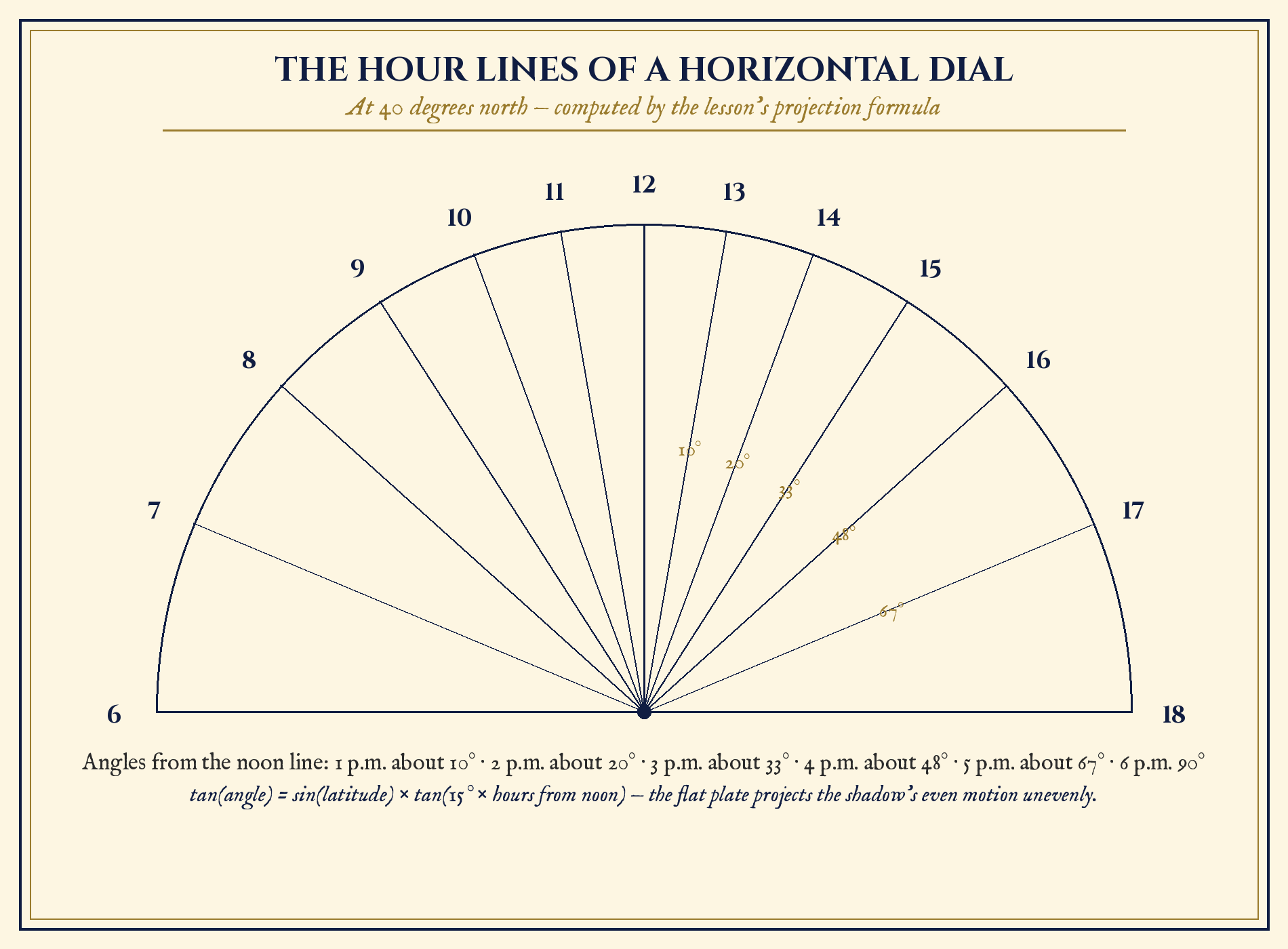
The hour lines of a horizontal dial at 40 degrees north, computed with the lesson's projection formula: the same angles the lesson works — about 10 degrees for 1 p.m., 20 for 2, 33 for 3, 48 for 4, 67 for 5, and 90 for 6 — bunched near noon and spread toward morning and evening, because the flat plate projects the shadow's even fifteen-degrees-per-hour motion at a slant.
Built digitally for this overhaul (Python/PIL, typeset text; every angle computed from the lesson's own formula, tan θ = sin φ · tan(15° × hours), at φ = 40°), builder:.
Here is the subtlety, and the lesson will not skip it.
The even fifteen-degree spacing belongs to the shadow's motion around the style, the edge of the gnomon that casts the time-telling shadow. If the dial plate is perpendicular to the style, parallel to the Earth's equatorial plane, the plate sees that motion face-on, and the hour lines radiate evenly, fifteen degrees apart. That is the equatorial or polar dial: the honest, simple one.
But the classic garden dial is a horizontal dial: the plate lies flat on the ground, and the style leans above it at the latitude angle. The shadow still sweeps uniformly around the style, but the flat plate sees that motion at a slant, projected downward. The projection stretches and squeezes the spacing. Near noon the hour lines crowd together; toward morning and evening they spread apart. At 40 degrees north, the 1 p.m. line sits about 10 degrees from the noon line, the 2 p.m. line about 20 degrees, the 3 p.m. line about 33 degrees, and so on out to the 6 o'clock lines at right angles. The shadow still moves at fifteen degrees per hour around the style; the plate just draws the projection of that motion.
There is a formula for the projection, for scholars who like their geometry written down. The angle of any hour line from the noon line is the angle whose tangent equals the sine of the latitude times the tangent of the hour angle (fifteen degrees times the hours from noon). You do not need it to build the dial in this lesson: you will calibrate by observation, which is older and just as true. But it is there, and it is exact, and it explains every garden dial you will ever see.
Check in: Why do a horizontal dial's hour lines crowd near noon and spread toward morning and evening — and what formula gives each line's angle?
❦ In your workbook: record the bunching lines in your own way — uniform motion around the style, projected at a slant onto the flat plate: about 10 degrees at 1 p.m., 20 at 2, 33 at 3, at 40 degrees north — copy, sketch, or note what matters.
Not every dial is a polar dial
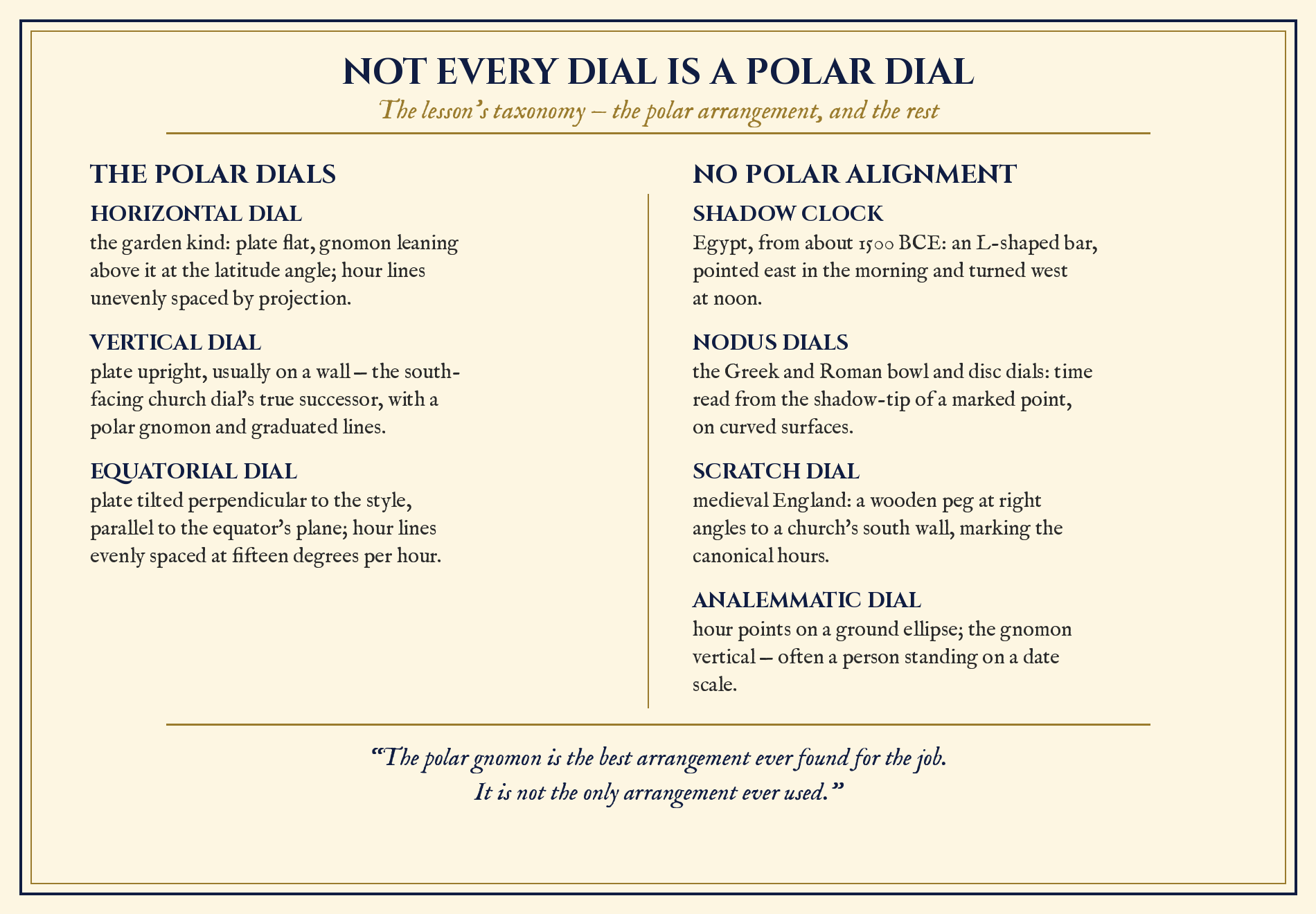
The lesson's taxonomy in one view: the three polar dial kinds, whose gnomons stand parallel to the Earth's axis, beside the four arrangements that never used it — the shadow clock, the nodus dials, the scratch dial, and the analemmatic dial.
Built digitally for this overhaul (Python/PIL, typeset text), reproducing the lesson's taught taxonomy (builder: ).
Kali's correction to this lesson, and the history you just read, both require this paragraph, so here it is plainly: not every historical sundial uses the polar arrangement, and the lesson would be dishonest to pretend otherwise.
The Egyptian shadow clocks were pointed east in the morning and turned west at noon: no polar alignment at all, just a crossbar and marks. The Greek and Roman bowl dials were nodus dials, reading the shadow's tip on curved surfaces. The medieval scratch dials set a wooden peg at right angles to a church wall: practical, local, and unpolar. The analemmatic dial, a favorite of modern parks, lays its hour points on an ellipse on the ground and uses a vertical gnomon, often a person standing on a date scale, whose position shifts with the season. Even among polar dials there is variety: horizontal dials (the garden kind, plate flat), vertical dials (on walls, plate upright), and equatorial dials (plate tilted perpendicular to the style, with the beautiful even spacing). The polar gnomon is the best arrangement ever found for the job, which is why the lesson teaches it. It is not the only arrangement ever used, which is why the history honors the rest.
Check in: Name the dial kinds this lesson names that do NOT use the polar arrangement — and name the three kinds of polar dial it names.
❦ In your workbook: record the honest variety in your own way — shadow clocks turned at noon, bowl nodus dials, pegs at right angles to church walls, a person standing on an analemmatic date scale — copy, sketch, or note what matters.
Why the dial and the clock disagree
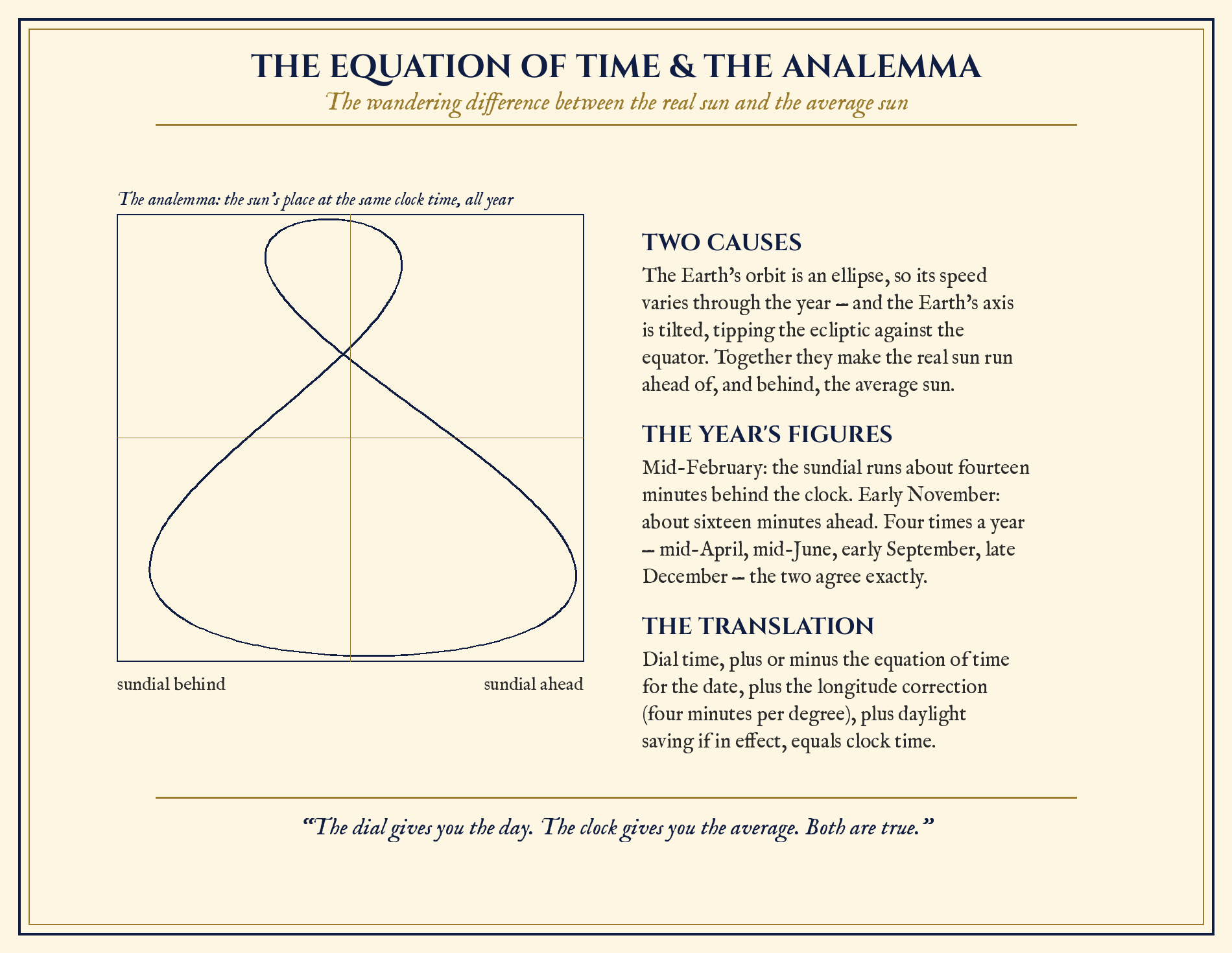
The equation of time made visible: the analemma's figure-eight, whose east-west width is the wandering difference between the real sun your dial reports and the average sun your clock keeps — about fourteen minutes one way in mid-February, about sixteen the other in early November, and zero four times a year.
Built digitally for this overhaul (Python/PIL; the curve computed, the text typeset from the lesson), builder:.
Build the dial perfectly, align it perfectly, and it will still disagree with your clock. This is not a flaw. It is astronomy, and it has a name: the equation of time.
Your clock keeps mean solar time: it pretends the sun crosses the sky at a perfectly steady rate all year, the average sun. Your dial keeps apparent solar time: it reports the real sun, the one actually in the sky. And the real sun does not keep a steady pace, for two reasons.
★ First, the Earth's orbit is an ellipse, not a circle, so the Earth moves faster near perihelion in January and slower near aphelion in July. The sun appears to run ahead of the average in one season and lag behind in another. Second, the Earth's axis is tilted, so the sun's apparent yearly path, the ecliptic, is tipped relative to the equator, and its eastward progress along the equator, which is what timekeeping measures, speeds up and slows down through the year. (You met this tilt in Lesson 3, and the two time systems in Lesson 6: apparent solar time is what the dial reads, mean solar time is what the clock keeps, and the equation of time is the wandering difference between them, up to about sixteen minutes across the year.)
The two effects combine into a smooth yearly wave. Around mid-February the sundial runs about fourteen minutes behind the clock; around early November it runs about sixteen minutes ahead. Four times a year, in mid-April, mid-June, early September, and late December, the two agree exactly. The rest of the year the dial is telling the truth about the sun and the clock is telling the truth about the average, and they are different truths.
Two more corrections stand between the dial and the clock on your wall. Your time zone is wide: the sun crosses the meridian later for every degree west you sit from your zone's central meridian, four minutes per degree. And daylight saving time, where observed, shifts the clock a full hour from the sun. So the complete translation reads: dial time, plus or minus the equation of time for the date, plus the longitude correction, plus daylight saving if in effect, equals clock time. When your finished dial seems wrong by a few minutes, check these three before you blame the plate. The dial is almost certainly innocent.
Check in: What is the equation of time, what are its two causes — and what three corrections stand between a dial reading and clock time?
❦ In your workbook: record the honest disagreement in your own way — the real sun against the average sun, the elliptical orbit and the tilted axis, about fourteen minutes slow in mid-February and sixteen fast in early November — copy, sketch, or note what matters.
In your packet: Exercise III: The Honest Clock ✎ begins here — its corrections are this section's three, applied in order to your own dial's noon reading. Work it now, or mark the place and take it as homework — your choice.
A Sealed Note on Being Wrong by Minutes
Scholars, I want to tell you about the first time I tested a sundial I had built myself, because I was wrong in a way that taught me something.
I had made a little horizontal dial for the observatory terrace, and I had been very careful: the latitude angle measured twice, the plate leveled with a spirit level, the noon line found by the sun itself. At what my clock said was noon, the shadow lay well away from the noon line, and I felt the particular embarrassment of a professor caught out by her own instrument.
I checked everything. The angle was right. The plate was level. The alignment was true. And then I remembered the equation of time, and I looked up the date, and the almanac said the sun was running eleven minutes slow that week, and there was my error, to the minute, explained and forgiven.
This is why I love the equation of time, and why I wanted this note to sit in the middle of the lesson rather than at the end. A sundial that disagrees with your clock is not a failed sundial. It is a sundial telling you something your clock cannot: where the real sun is in its real, slightly irregular year. The clock gives you the average. The dial gives you the day. Both are true, and the difference between them is one of the most beautiful facts in this whole course.
When you test your dial and find it off by minutes, do not be embarrassed. Be delighted. You have just measured the Earth's orbit with a paper plate.
❦ In your workbook: record the sealed note in your own way — a careful dial, a shadow well away from the noon line at clock noon, and the almanac's eleven minutes that explained and forgave the error — copy, sketch, or note what matters.
PROFESSOR VESPER GLIMMERWICK
Celestial Studies
Astronomer & Celestial Historian
Guided Observation
Try It Tonight
Part One: Build the Dial
You will need: a sturdy paper plate (the dial plate), a straight straw or pencil about 15 centimeters long (the gnomon), a protractor, a ruler, a pencil, tape, a marker, and a compass or a printout of your latitude. Professor Timberclank's Creative Arts workshop is the natural home for a grander version later: wood, brass, and engraving. Tonight, paper and straw, which is how every great instrument begins.
Workshop Note: The cutting work in this build is taught in Creative Arts Lesson 3, 'Cutting, Scoring & Clamping.'
Level One: everyone builds this.
- Find your latitude to the nearest degree. (Your map skill, a globe, or a willing adult with a phone will supply it. The castle sits near 39 degrees north; write down your own number and use it everywhere below.)
- Draw a straight line across the center of the plate, from one rim to the other. This is your noon line. Mark the center point clearly: this is where the gnomon will stand, and every hour line will radiate from it.
- Pierce a small hole at the center point. Push the straw through so that most of its length stands above the plate and a short stub anchors below; tape the stub firmly underneath. The straw is your gnomon.
- Now the essential angle. Using the protractor, tilt the straw so that it makes an angle with the plate equal to your latitude: 39 degrees at the castle, whatever your number is at your home. The straw must lean along the noon line, toward the end of the line you will point north. Tape and brace it so the angle holds. This single angle, set to your latitude, makes the straw parallel to the Earth's axis. Everything else follows from it.
- Take the dial outside to a spot with open sky all day: no trees, no walls, no eaves. Set the plate level. A small spirit level is ideal; a marble that stays put is acceptable.
- Point the noon line at true north, with the gnomon leaning northward (northern hemisphere). If you are in the southern hemisphere, reverse everything: the gnomon leans south, toward the south celestial pole, and the dial is a mirror image. To find true north without a compass, use the sun at local solar noon (Lesson 6): when the straw's shadow is shortest and lies exactly along the noon line, the line points true north-south. Mark which end is north.
- Calibrate by observation, the ancient way. Starting at a known clock hour, mark where the shadow falls on the plate rim, and write the hour beside the mark. Return each hour and mark again. By evening you will have a fan of hour lines, drawn by the sun itself, correct for your latitude without a single calculation. (Level Two scholars may instead compute the lines with the projection formula from The Mechanism and check the computed lines against the observed ones. If they disagree, trust the sun and recheck the arithmetic.)
Level Two: for scholars who want the mathematics.
- Compute your hour-line angles with the projection formula: the angle of each hour line from the noon line is the angle whose tangent equals sin(latitude) times tan(15 degrees times hours from noon). At 40 degrees north this gives roughly 10 degrees for the 1 p.m. line, 20 for 2 p.m., 33 for 3 p.m., 48 for 4 p.m., 67 for 5 p.m., and 90 for 6 p.m., mirrored for the morning hours. Draw these, then compare with the observed marks from step 7.
❦ In your workbook: record the build in your own way — your latitude written down and used at every step, the noon line drawn, the gnomon seated and tilted to your latitude along it, and the fan of hour lines the sun itself drew by evening — copy, sketch, or note what matters.
In your packet: Exercise I: Build, Test, and Correct the Dial ⚒ begins here — the build above is its first half, and Part Two below is its test. Work it now, or mark the place and take it as homework — your choice.
Part Two: Test and Correct
A dial is not finished when it is built. It is finished when it is tested.
- For one full sunny day, read the dial each hour and write the dial time beside the clock time. Expect disagreement: that is the lesson working.
- Apply the corrections in order: first the equation of time for the date (look up the value; around mid-February add about fourteen minutes of dial-behind, around early November subtract about sixteen minutes of dial-ahead, and check the four zero days), then your longitude offset from your time zone's central meridian (four minutes per degree west; subtract if east), then daylight saving if in effect.
- After correction, the dial and the clock should agree within a few minutes. If they do not, check the three usual suspects in order: the plate is not level, the latitude angle has slipped, the noon line is not true north-south. Fix, retest, and log what changed.
- Log one full week of noon readings in your Sky Log. Note the date, the raw dial reading, each correction applied, and the final corrected time. You are now doing what the keepers of every great dial did: maintaining the instrument.
❦ In your workbook: record the test in your own way — one full day of dial readings beside clock readings, the three corrections applied in order, and what you fixed and retested if the dial still disagreed — copy, sketch, or note what matters.
Part Three: Read It Like a Local
Find the oldest sundial in your town or county: a church wall, a garden, a courthouse lawn, a park. (There is almost always one, and almost nobody has read it.) Visit with your adult, find its gnomon, and answer in your workbook: is the gnomon polar-aligned or not? What kind of dial is it: horizontal, vertical, equatorial, or something stranger? What does its motto say, if it has one, and what do you think it means? Sketch it in your Sky Log.
❦ In your workbook: record the local dial in your own way — where it stands, its kind, whether its gnomon is polar-aligned or not, its motto and what you think it means, and your sketch of it in your Sky Log — copy, sketch, or note what matters.
Sky Log Entry
Date and time of observation: _______________
Your latitude (degrees): _______________
Gnomon angle set (should equal your latitude): _______________
True north found by (compass / solar noon / other): _______________
Hour-line marks: sketch the plate and label each hour line with its observed time.
Noon test: raw dial reading at clock noon _______________; equation-of-time correction _______________; longitude correction _______________; daylight saving _______________; corrected dial time _______________.
Local dial found (Part Three): where _______________; kind of dial _______________; polar-aligned? _______________; motto _______________.
❦ In your workbook: record the Sky Log entry in your own way — your latitude, your gnomon angle, how you found true north, the sketched plate with its labeled hour lines, the noon test with every correction shown, and the local dial you found — copy, sketch, or note what matters.
Materials
Required (Level One — household items)
- A sturdy paper plate for the dial plate.
- A straight straw or pencil about 15 centimeters long for the gnomon.
- A protractor for setting the gnomon at your latitude angle.
- A ruler, a pencil, and a marker for the noon line and hour marks.
- Tape for seating the gnomon firmly.
- A compass or a printout of your latitude for the build's alignment steps.
- Your workbook for the test table and corrections.
- Hat, water, and sunscreen for the outdoor testing sessions.
Suggested (Level Two — for scholars who want more)
- A small spirit level (or a marble that stays put) for leveling the plate precisely.
- A calculator for the hour-line projection formula.
- A current almanac or observatory table giving the equation of time for your test dates.
Reflection Questions
Answer in your workbook, in complete sentences.
- For most of the sundial's history, an hour in summer was longer than an hour in winter, and nobody found this strange. What does that tell you about what a "correct" hour is: a fact of nature, or an agreement between people?
- The lesson insists that not every historical dial uses the polar arrangement, and names the ones that do not. Why does that honesty matter: what would be lost if the lesson pretended the polar dial was the only kind ever built?
- Early clocks were reset from sundials; the dial was the master and the clock the servant. Today the relationship is reversed. What changed: the sun, the dial, or something else?
- The equation of time means your dial is "wrong" by minutes for most of the year and exactly right four days a year. Is the dial wrong, or is the clock wrong, or is the question wrong? Defend your answer.
- You built a working timepiece from a paper plate and a straw, calibrated it to your latitude, and corrected it with astronomy. What is one thing you understand now about the sky that you did not understand before you built it?
Workbook Checklist — Lesson 29
In my workbook I have:
- ☐ built the paper-plate dial by the numbered steps: latitude found, noon line drawn, gnomon seated by an adult and tilted to my latitude, plate leveled, noon line pointed at true north found by the sun
- ☐ calibrated the dial by observation, marking the shadow's place at each known clock hour until the sun had drawn the fan of hour lines
- ☐ run the one-day test: dial time beside clock time each hour, with the equation of time, the longitude correction, and daylight saving applied in order
- ☐ completed Exercise I: my latitude and gnomon angle, my true-north method, the one-day test table, the largest correction named with its numbers, and the first suspect I would fix
- ☐ completed Exercise II: the London dial explained, the single change named, the three hour-line angles computed with the formula shown, and the even-spacing flaw explained
- ☐ completed Exercise III: today's equation of time looked up, the noon reading corrected step by step, the two causes named, and the February 11:47 reading judged
- ☐ written my Sky Log entry: the plate sketched with its hour lines, the noon test with every correction, a week of noon readings begun, and the local dial found and read in Part Three
☐ Lesson completed Date: ___ Signature: ___
Cross-Class Connections

Runes · Unit IV, Lesson 13 — The English Expansion
Tower scholars, the runes scratched beside the hour lines on England's oldest dials were written in the alphabet my thirteenth lesson teaches: the Anglo-Saxon futhorc, the twenty-four runes the English carvers stretched to twenty-nine so that every sound of Old English could be written truly. Come to my web and learn that expansion — the thorn and the wynn, the Franks Casket's carved inscriptions, and the letters that outlived the runes themselves. Glimmerwick reads what the inscription was for. Here, we read the inscription.
PROFESSOR THISTLELOOM WEBBLETHORN
Runes & Ancient Writing

Scrollwork · Unit I, Lesson 1 — The Scriptorium Desk
Tower scholars, the dialing treatises Glimmerwick names tonight — Vitruvius's list of dials among them — survived because scribes copied them, century after century, at desks like the one my first lesson arranges: the board angled, the light placed, the tools laid out before a line was written. Come to the Scrollwork Library and learn how that desk was set, and why its order decided what the copy kept. Professor Glimmerwick reads the diagrams as construction plans. Here, we show you the desk the plans were copied at.
PROFESSOR QUILLBERRY NOCTURNE
Scrollwork Library

Creative Arts · Studio Extension E2 — The Permanent Sundial & Horizon Alignment
Bring your tested paper dial to my bench, scholars, and bring it as what it is: a pattern that has already proven itself. In this extension we build the dial the paper one was rehearsing — a leveled stone or hardwood plate, a brass gnomon cut to your latitude, hour lines engraved only after they are proven in pencil — and we lay a horizon alignment beside it for the garden's year. Slow work, honest work: level before everything, true north by shadow and not by needle, and no line cut until the sun has agreed with it.
PROFESSOR COGBRANCH TIMBERCLANK
Creative Arts Workshop

Herbology · Unit I, Lesson 5 — The Historian's Herbarium
Come down to the greenhouse a moment, scholars. Glimmerwick has shown you the dial on the monastery garden wall; my fifth lesson walks you through the gardens that wall overlooked — the monastery herb gardens where monks grew both food and medicine, Hildegard of Bingen compiling her Physica from her own convent garden, and the herbal tradition that ran from those beds to the printed herbals. The plants told the season and the dial told the hour, and the same hands tended both. Here, we tend the plants' side of that partnership, and keep their history as carefully as the Tower keeps the shadow's.
PROFESSOR BERYL FERNFOOT
Herbology Greenhouse
The Professor's Closing Note
And so the shadow comes full circle, scholars, as shadows do.
You began with a stick in the ground and the oldest idea in timekeeping. You walked through three thousand years of people refining it: the Egyptian workers measuring their day in twelve parts, the Greeks spending their geometry on bronze bowls, the monks scratching lines on church walls to know the hour of prayer, the clockmakers who learned to set their machines by the sun. And then you learned the secret the whole history was circling: that a rod parallel to the Earth's axis turns with the planet, that one angle, your latitude, aims it truly, and that the shadow it casts divides the day into fifteen-degree hours because the Earth itself turns fifteen degrees every hour.
You also learned the honest footnote, which is really the headline: the dial reads the real sun, the clock reads the average sun, and the few minutes between them are not an error but an orbit. When your dial disagrees with the clock, you are not wrong. You are informed.
Keep the dial somewhere sunny. Check it when you pass. And the next time someone asks you the time, consider answering with the shadow instead of the phone. It is slower. It is also five thousand years old, and it has never needed charging.
PROFESSOR VESPER GLIMMERWICK
Celestial Studies
Astronomer & Celestial Historian
Further Reading & Sources
These are real destinations for further study, verified live at the time of writing. Start with Royal Museums Greenwich and the British Sundial Society; they are the authorities this lesson leans on.
- Royal Museums Greenwich: Sundials (sundial theory, the polar gnomon, the equation of time, and the French railways). https://www.rmg.co.uk/stories/time/sundials
- British Sundial Society: How Sundials Work, Part 4 (gnomon, style, nodus, and the practical details of dial design). https://sundialsoc.org.uk/all-about-sundials/how-sundials-work/part-4-how-sundials-work/
- North American Sundial Society (conferences, courses, and a community of dial-makers). https://www.sundials.org
- History of sundials (Egypt to the present: shadow clocks, Greek geometry, Roman dials, medieval developments). https://en.wikipedia.org/wiki/History_of_sundials
- History of timekeeping devices in Egypt (the Valley of the Kings dial, shadow clocks, and the 2013 discovery). https://en.wikipedia.org/wiki/History_of_timekeeping_devices_in_Egypt
- Medieval Mass Dials Decoded (scratch dials on English churches: tides, canonical hours, and the register of surviving dials). http://buildingconservation.com/articles/mass-dials/mass-dials.htm
Browse the Celestial Studies shelf in the school Library for readable editions of these works.
Sealed in the Celestial Tower, in deep midnight blue, by Professor Vesper Glimmerwick.
A sundial you cannot carry, but may consult at any hour: the Wheel draws the Sun's whole road for your latitude and walks it with him, minute by minute.
Open the WheelPROFESSOR VESPER GLIMMERWICK · CELESTIAL TOWER
Submit your work for this lesson using the form below.
CONTINUE IN THE CELESTIAL TOWER
← Previous · Lesson 28: Why People Believe & How It's Used Today Next · Lesson 30: The Planisphere & Star Charts →
Unit VI — Instruments of the Sky Celestial Tower — All 33 Lessons
The rest of Unit VI: Lesson 30 · Planisphere · Lesson 31 · The Astrolabe · Lesson 32 · Telescopes · Lesson 33 · Dark Skies