
CELESTIAL STUDIES
Course CapstoneChart Your Sky
Professor Vesper Glimmerwick
Astronomer & Celestial Historian
The Celestial Tower • School of Evershade
Professor's Introduction

My dearest scholars,
When you first climbed the stairs to my tower, I asked you to do one small thing: look up. You have been looking up ever since, through thirty-three lessons, through one whole turning of the moon, through the slow wheel of the seasons. Tonight you look up as skywatchers. That is the whole of what I wanted for you, and it is everything.
This capstone is not a test of what you memorized. It is an assembling. You will put together three things you have made across this course: the planisphere you built with your own hands, calibrated for the ground you stand on; the Moon Journal you kept through one full lunation, at your own pace; and a constellation guide that belongs to no one but you, because no one else stands exactly where you stand under the sky.
Then comes the defense, and I want you to hear this clearly, because it matters: your defense is written or illustrated, whichever lets you show your sky best. There is no oral presentation. I read every format, from careful essays to pages of drawings with notes in the margins. Walk me through your sky and its real history, in your own words and your own pictures, and that is the whole of the defense.
The sky you have learned is the real one: the geometry behind the beauty, the true stories behind the names. Hold onto both. Wonder first, always. Mechanism always, too. Now, my dears, let us chart your sky.
PROFESSOR VESPER GLIMMERWICK
Celestial Studies
Astronomer & Celestial Historian
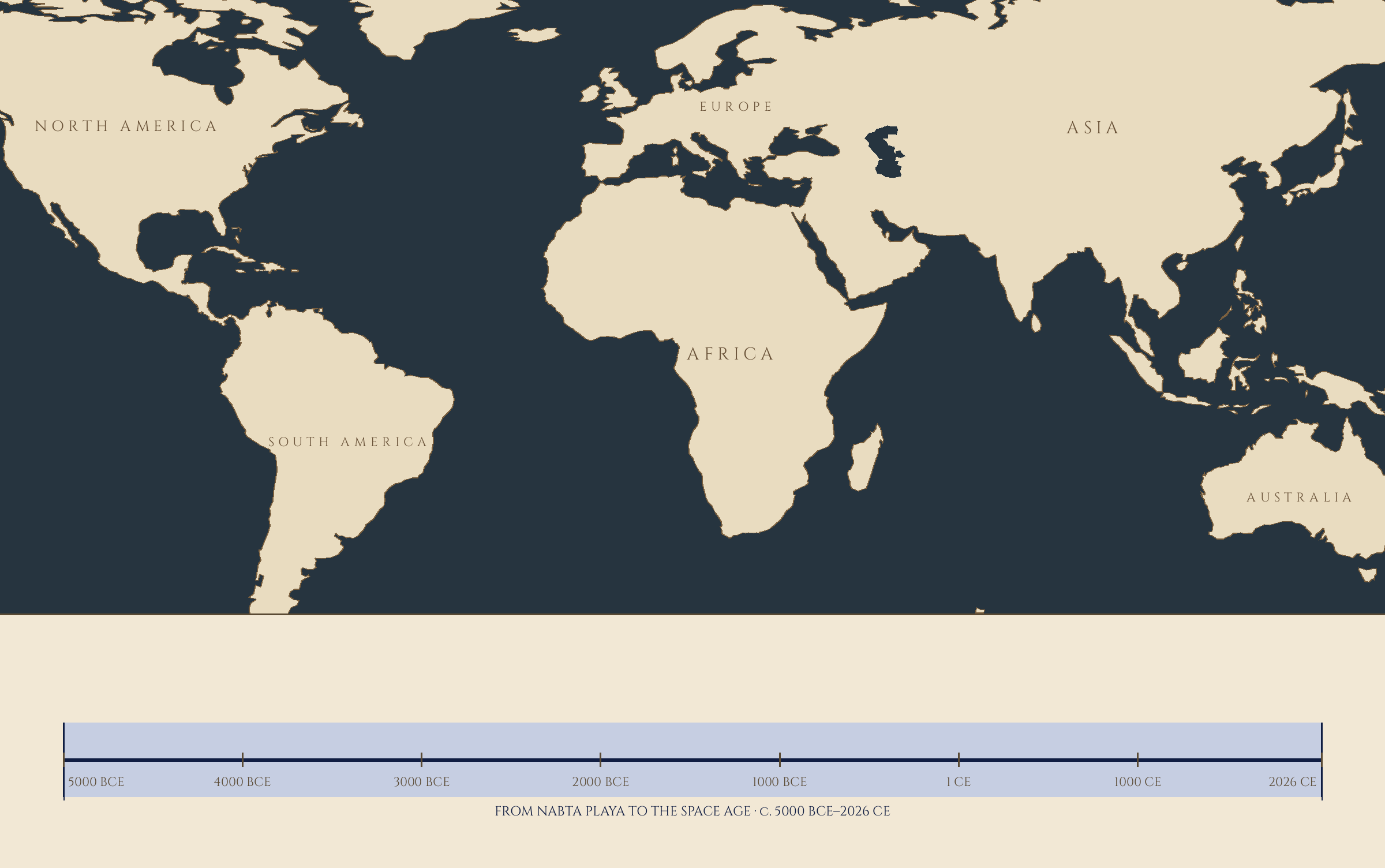
Where and when: your own sky, tonight — Chart Your Sky. This lesson has no pin and no stop: its place is wherever you stand under the night sky. The line beneath the map is our road through the course: every stop a moment when watching the sky changed, every lesson a place upon it.
Learning Objectives
By the end of this capstone, students should be able to:
- Assemble and calibrate a working planisphere for their own observing latitude (their angular distance north or south of the equator), and demonstrate its use on a chosen date and time.
- Complete one full lunation (new moon to new moon, about 29.5 days) of moon observations: dated entries, sketches, labeled phases, and a written reflection on what the cycle taught them.
- Build a personal constellation guide: five constellations the scholar can actually find, each with accurate locating directions, the science of its stars, and honestly sourced cultural history, including the scholar's approximate observing latitude and location.
- Explain the course's four key mechanisms — the phases, retrograde motion, precession, and the distance ladder — in their own words, as a revision spine for everything learned.
- Defend the work in a written or illustrated submission that walks Professor Glimmerwick through the scholar's sky and its real history. No oral presentation is required.
Reading this capstone: ★ marks the passages to remember. They are the spine the Self-Check Quiz and the class test draw on. Check in questions ask the material back as you go; answer them in your workbook when you meet them.
Working this capstone: Your assignment packet is the first download on this page. Work in it as the capstone moves along, completing each exercise and project as its subject is presented — or read the capstone through for your notes and build afterward. Both are proper ways to sit this class. Signposts in the reading tell you where each assignment belongs. Written answers are short answers in your own words; a few honest lines are worth more than a filled page.
Your Assignment Packet
This capstone's assessed work lives in its packet: the Lexicon Handout (every term of the capstone, course terms marked ◆), Materials, Guided Practice — the Four-Mechanism Sky Tour — the Assignment Manual with its answer key for self-checking, the Reflection Questions, and the Workbook Checklist. Download the packet before you begin and keep it beside you as you read. The packet renumbers the capstone's work as Glimmerwick's Assignments I–VIII: Assignment I: the Capstone Self-Check Quiz ✎, Assignment II: Exercise I — The Mechanism in One Page ✎, Assignment III: Exercise II — The Precession Calculation ✎, Assignment IV: Exercise III — The Distance Ladder ✎, Assignment V: Project I — The Planisphere ⚒, Assignment VI: Project II — The Moon Journal ◐, Assignment VII: Project III — The Personal Constellation Guide ◐, and Assignment VIII: Project IV — The Defense ◐. In this lesson the work keeps the final's own names — Exercises I–III and Projects I–IV; the packet's Assignment numbers are the packet's own, exactly as the original packet printed them.
About this capstone's assessment, plainly: the capstone stands beside the Celestial Studies class test as the course's second closing assessment — the test checks what was retained, the capstone assembles the work. Its Self-Check Quiz is the capstone's own Assignment I, printed in its packet with its key; it is not drawn into the class test. The three projects and the defense are graded by their printed rubrics — four rubrics, twenty points each, eighty points in all — and carry no answer key, because their rubrics are the grading tool.
Safety Briefing
Night-observing safety. Every observation for this capstone is done with an adult present, in a familiar and safe location. Tell someone where you are going and when you expect to return. Dress warmly, bring a flashlight (a dim or red-filtered one preserves your night vision), and watch your footing in the dark. Never observe from roadsides, rooftops, or anywhere you would not walk in daylight.
Sun safety, restated one final time. Never look directly at the sun. The capstone involves no solar observing, and that is deliberate. If your constellation guide work ever crosses an eclipse date, the rules from Lesson 9 still bind: direct viewing only through viewers conforming to the ISO 12312-2 international standard, inspected before every use; a pinhole projector is for indirect viewing only, and you never look at the sun through the pinhole; lunar eclipses need no eye protection at all. No exceptions, no improvisation.
Materials safety. The capstone builds use paper, card, scissors or a craft knife, and adhesives. An adult should handle or supervise any craft knife. Nothing in this capstone involves heat, chemicals, or anything you would not find in a school art room.
The Wonder
Come up to the tower with me one more time. It is late, the lamps are low, and the whole sky is out.
You know this sky now in a way you did not when you first climbed these stairs. There is the moon, and you can read its phase the way you read a clock face, and you know what tomorrow's moon will look like before it rises. There are the wanderers, the bright planets that refused to stay put, and you know why they loop and double back. The constellations wheel overhead in their seasonal procession, and you know the true stories behind their names, the Greek ones and the older ones and the ones from the other side of the world. And somewhere out beyond all of it, past the bright stars whose distances you can now name, the faint smudge of a whole other galaxy hangs in the dark, two and a half million light-years away, and you know what a light-year is.
Here is the wonder I want you to carry out of this course. Every one of those understandings was earned by someone who stood outside at night and refused to stop asking what they were seeing. The catalogues, the geometries, the instruments, the names in three languages layered on a single star: all of it began with a person looking up. You are that person now. The sky is not finished with you, and you are not finished with it.
This capstone gathers the whole course into three things you can hold: a wheel that turns the sky, a journal that followed the moon, and a guide to your own small piece of the dark. Let us begin with the story of how the mapping was done.
❦ In your workbook: record the wonder in your own way — the moon read like a clock face, the wanderers that loop and double back, the galaxy two and a half million light-years away, and the person looking up who began all of it — copy, sketch, or note what matters.
The Story
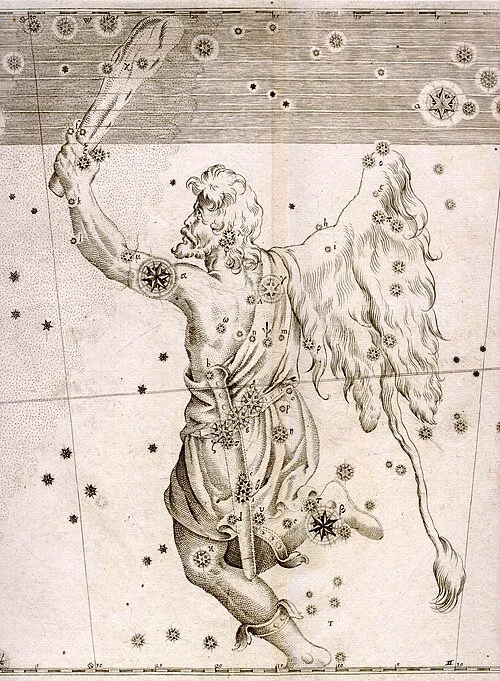
Orion in Bayer's Uranometria (1603), the first star atlas to cover the whole celestial sphere. The Greek letters Bayer gave the brighter stars — Alpha, Beta, Gamma, in rough order of brightness — are still the designations your constellation guide uses. The figure is drawn as seen on a globe, from behind, which is why the shoulder names sit reversed against the sky.
Johann Bayer, Uranometria (Augsburg, 1603), engraved by Alexander Mair; plate courtesy of the U.S. Naval Observatory Library, via Wikimedia Commons.
The man who caught the sky wobbling
Around 129 BCE, on the island of Rhodes, a Greek astronomer named Hipparchus did something no one had done before: he wrote down the positions of about 850 stars, measured as carefully as naked eyes and simple instruments could manage, and he ranked their brightness on a scale of 1 to 6 that astronomers still use in modified form today.
★ Then he did something stranger. He compared his measurements with older star records, made about 150 years earlier, and found that the whole sky had shifted. The stars rose and set in slightly different places than the old records said they should. Hipparchus concluded, correctly, that the shift was real and continuous: the direction of the sky's turning was slowly changing. He estimated the rate at no less than one degree per century, a rough figure, but the discovery itself was one of the great acts of attention in the history of science. He had caught the sky wobbling, and he did it with his eyes.
That wobble is precession, and you will meet it again in the Mechanism section below. For now, notice the method: write things down, compare across time, trust the discrepancy. That is the whole engine of astronomy in one man's working life.
The book that carried the sky for a thousand years
About three hundred years after Hipparchus, the astronomer Ptolemy, working in Alexandria around 150 CE, compiled the Almagest, the great summary of ancient astronomy. Its star catalogue lists 1,022 stars in 48 constellations, and it leans heavily on Hipparchus's lost catalogue, updated to account for the precession Hipparchus had discovered. Whether Ptolemy copied Hipparchus outright or re-observed, scholars still debate; what is certain is that the Almagest preserved the ancient sky through the centuries when almost everything else was lost.
The Almagest also fixed the machinery of the heavens as the ancient world understood it: an Earth-centered universe of circles within circles, good enough to predict the wanderers' loops for more than a thousand years. It was wrong about the center and right about the patience. The catalogue outlived the cosmology.
❦ In your workbook: record the Almagest in your own way — 1,022 stars in 48 constellations, Hipparchus's catalogue carried forward, and a catalogue that outlived its cosmology — copy, sketch, or note what matters.
The names on the stars
Many of the bright stars you learned this course carry names that traveled a long road. Betelgeuse, Rigel, Aldebaran, Deneb: these are Arabic-derived names, carried through the Islamic Golden Age, when astronomers preserved, corrected, and extended the Greek catalogues. The Persian astronomer al-Sufi, writing his Book of Fixed Stars around 964 CE, drew and described the constellations with their Arabic star names, and those names passed through Latin transliteration, manuscript copying, and centuries of retelling before they reached your planisphere.
Say this carefully, the way Lesson 20 taught you: the lesson defines its sample and sources the claim rather than asserting it loosely. Not every star name is Arabic, and the etymologies are layered, sometimes garbled, by the journey. But stand under Orion on a February evening and you are standing under an Arabian sky, and that is a true thing worth knowing.
★ In 1603, the German astronomer Johann Bayer published the Uranometria, the first star atlas to cover the whole celestial sphere, and he gave the brighter stars the Greek-letter designations we still use: Alpha, Beta, Gamma, in rough order of brightness within each constellation. Your guide's "Alpha Orionis" is Bayer's handwriting, four centuries old.
Check in: Why does this lesson tell you to say the Arabic star names carefully — what is claimed, and what is honestly not claimed?
❦ In your workbook: record the travelling names in your own way — Betelgeuse, Rigel, Aldebaran, Deneb, al-Sufi's Book of Fixed Stars around 964 CE, and Bayer's Greek letters of 1603 — copy, sketch, or note what matters.
The wheel and its ancestors
Your planisphere belongs to a very old family. The word itself comes from Ptolemy's Planisphaerium, a second-century work on the mathematics of flattening the sphere of the sky onto a plane, the stereographic projection that makes the wheel possible.
The planisphere's direct ancestor is the astrolabe, the great instrument of the Islamic Golden Age, whose rotating rete, a pierced plate carrying the bright stars, turns over a latitude plate the way your star wheel turns over its horizon mask. One complete turn of the rete is one day, exactly as one complete turn of your disk is one day. Printed star charts have been made since the 1500s, and paper star wheels have taught beginners the turning sky for centuries. When you turn your disk tonight, you are operating the simplified descendant of brass instruments that told time, found direction, and mapped the heavens for a thousand years.
❦ In your workbook: record the wheel's family in your own way — Ptolemy's Planisphaerium, the astrolabe's turning rete over its latitude plate, and one turn for one day — copy, sketch, or note what matters.
Drawing the borders
The constellations you learned are older than any living science, but their official borders are younger than your great-grandparents. In 1922 the International Astronomical Union adopted the list of 88 constellations; the Belgian astronomer Eugene Delporte then drew their precise boundaries along lines of right ascension (the sky's equivalent of longitude) and declination (a star's angular distance north or south of the celestial equator), adopted in 1928 and published in 1930. Every point in the sky now belongs to exactly one constellation, and saying an object "is in Orion" means it falls inside Orion's bordered region, not merely near the familiar hourglass of stars.
Remember Ophiuchus, the serpent-bearer, from Lesson 26. It is not a new discovery. It was one of Ptolemy's original 48, and it has been recognized as a constellation for two thousand years. The point of that lesson stands as the point of this whole course: the astronomical constellations and the conventional twelve-sign zodiac (the band of sky around the ecliptic, divided into twelve equal signs) are two different things, and the honest skywatcher keeps them straight.
Check in: What did the IAU adopt in 1922, what did Delporte draw in 1928 and 1930 — and why is Ophiuchus not a new discovery?
❦ In your workbook: record the borders in your own way — 88 constellations adopted in 1922, Delporte's boundaries of 1928 and 1930, and Ophiuchus, one of Ptolemy's original 48 — copy, sketch, or note what matters.
The Mechanism
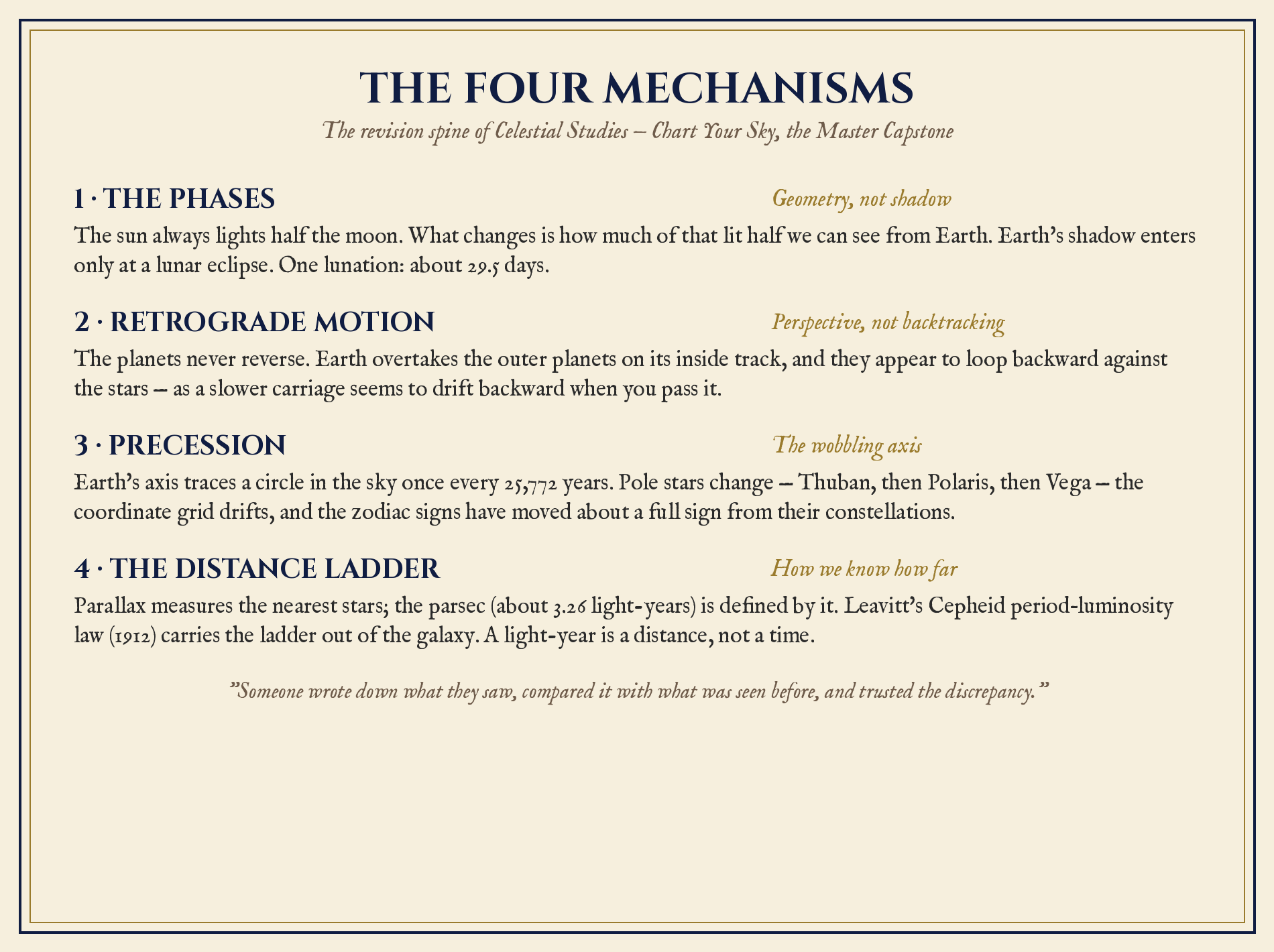
The Four Mechanisms: phases, retrograde motion, precession, and the distance ladder — the revision spine of the whole course, each one found the same way: write it down, compare, and trust the discrepancy.
Built digitally for this overhaul (Python/PIL, typeset text), from the mechanisms taught in the capstone text.
Everything in this course rests on four mechanisms. If you can explain these four in your own words, you carry the spine of the whole subject. This section is your revision: read it slowly, and let each mechanism click into place.
The phases: geometry, not shadow
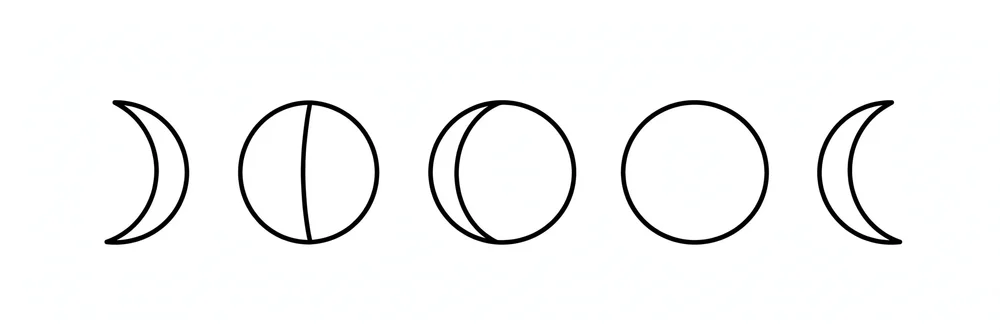
The moon does not change shape. What changes is how much of the moon's sunlit half we can see from Earth. The sun always lights half the moon, the way a lamp always lights half of any ball in a dark room. As the moon orbits us, we see that lit half from different angles: a sliver, a half, a whole, and back again.
★ This is why the correction from Lesson 7 matters so much. Earth's shadow is not normally involved in the phases at all. The shadow only enters the story during a lunar eclipse, when the full moon slides into it. Every month's crescent and gibbous and quarter is pure geometry: sunlight, a sphere, and your viewpoint moving around it. One full cycle, one lunation, takes about 29.5 days.
Check in: What changes through a lunation — the moon, or how much of its sunlit half we can see — and when does Earth's shadow actually enter the story?
❦ In your workbook: record the phases in your own way — the lamp-lit half of a ball, the shadow that enters only at a lunar eclipse, and one lunation of about 29.5 days — copy, sketch, or note what matters.
Retrograde: perspective, not backtracking
The planets never reverse direction. What reverses is how their motion looks from a moving Earth.
Picture the outer planets, Mars, Jupiter, Saturn. Earth orbits the sun faster than they do, on an inside track. Once per orbit we catch up and pass them, and as we do, the slower outer planet appears to slide backward against the stars for a few weeks, then resume its forward march. It is the same illusion as passing a slower carriage on the road: for a moment, the carriage seems to drift backward. Nothing about the planet changed. The viewpoint did.
The inner planets, Mercury and Venus, give us the mirror image: they lap us on the inside track, swinging from evening star to morning star and back.
★ This is the mechanism Lesson 13 insisted on teaching rather than narrating. Ptolemy's Earth-centered model explained the backward loops with epicycles, little circles rolling along bigger circles, a machine of impressive ingenuity built on a wrong center. Copernicus's sun-centered model explained the same loops as perspective, simpler and true. Galileo's telescope then supplied the evidence that settled it: Venus shows a full set of phases like the moon, which only makes sense if Venus circles the sun, and Jupiter has four moons circling it, which proved that not everything circles the Earth. The universe did not care which model flattered us. The geometry did the deciding.
Check in: Nothing about the planet changed — what did? Name the two pieces of Galileo's evidence that settled which model was true.
❦ In your workbook: record retrograde in your own way — the inside track, the slower carriage that seems to drift backward, epicycles against perspective, and Galileo's two proofs — copy, sketch, or note what matters.
Precession: the wobbling axis
Earth spins like a top, and like a top, its axis slowly wobbles. The axis traces a circle in the sky once every 25,772 years, about twenty-six thousand years, tugged by the gravity of the sun and moon on Earth's equatorial bulge. Hipparchus found it by comparing catalogues. You can find it tonight by remembering that the sky's grid is not fixed.
★ Precession has three consequences you have met. First, the pole stars change. Around 2800 BCE the north celestial pole stood near Thuban in Draco; today it stands near Polaris; in roughly twelve to fourteen thousand years it will stand near brilliant Vega. For most of the cycle there is no bright pole star at all. Second, the whole coordinate grid drifts, which is why old star charts need their epoch stated and why Delporte's 1930 boundaries are drawn for the sky of 1875. Third, the zodiac signs have drifted about a full sign away from the constellations they were named for, at roughly one degree every seventy-two years. That drift is the honesty engine of Unit V, and it is pure precession.
Check in: Name precession's three consequences — for pole stars, for the coordinate grid, and for the zodiac signs.
❦ In your workbook: record precession in your own way — the top's slow wobble of 25,772 years, Thuban to Polaris to Vega, and signs drifted a full sign from their constellations — copy, sketch, or note what matters.
The distance ladder: how we know how far
For the nearest stars, astronomers use parallax: photograph a star in spring, photograph it again in autumn, and measure how far it appears to shift against the distant background as Earth moves from one side of its orbit to the other. The smaller the shift, the farther the star. The parsec, the professional unit of distance, is defined by this method: about 3.26 light-years.
But parallax fails quickly. Beyond a few hundred light-years the shift is too tiny to measure, and the universe is vastly deeper than that. So the ladder needs a second rung, and Henrietta Leavitt built it in 1912. Studying variable stars in the Magellanic Clouds, she found that a certain kind, the Cepheid variables, pulse with a strict relationship between their period and their true brightness: longer period, greater luminosity. Measure the period, and you know how bright the star really is. Compare that with how bright it looks, and you have the distance. One rung, parallax, calibrates the next, and the ladder climbs out of the galaxy.
★ Hold the scale in your mind, because your constellation guide will need it. The moon: about 384,400 kilometers away, a little over a second of light-travel. The sun: about eight light-minutes and twenty seconds away. Proxima Centauri, the nearest star: 4.25 light-years, meaning its light left when you were four years younger. Sirius, the brightest star in our sky: 8.6 light-years. The Andromeda Galaxy, the farthest thing your naked eye can see: about 2.5 million light-years, its light older than the human species. A light-year is not a time. It is a distance, the distance light travels in a year, and it is the unit the universe is measured in.
Four mechanisms, my dears, and they are yours now. The phases taught you that seeming is not being. Retrograde taught you that the viewpoint is part of the observation. Precession taught you that even the fixed stars are not fixed, only slow. The distance ladder taught you that the universe has a scale and that human beings learned to climb it, one careful rung at a time.
Here is what I want you to notice: every one of these mechanisms was found the same way. Someone wrote down what they saw, compared it with what was seen before, and trusted the discrepancy more than the doctrine. Hipparchus with his catalogues. Galileo with his moons of Jupiter. Leavitt with her photographic plates. Your Moon Journal with its thirty sketches. You have been doing the oldest science there is, and doing it properly.
The defense asks you to walk me through your sky. When you reach the part where you explain one of these mechanisms in your own words, do not be shy about it. If you can teach it, you know it, and teaching is the whole of the defense.
— Professor Vesper Glimmerwick, Celestial Studies • Astronomer & Celestial Historian
Check in: Why does parallax fail beyond a few hundred light-years, and what did Leavitt's 1912 discovery let astronomers measure instead?
❦ In your workbook: record the ladder in your own way — parallax and the parsec, Leavitt's Cepheids of 1912, and the scale from the moon at a second of light-travel to Andromeda at 2.5 million light-years — copy, sketch, or note what matters.
❦ In your workbook: record the professor's closing word in your own way — four mechanisms, each found by writing down, comparing, and trusting the discrepancy — copy, sketch, or note what matters.
Try It Tonight
The Four-Mechanism Sky Tour
Tonight, take your planisphere outside and run the whole course in a single observing session. Bring this lesson, your wheel, and your Sky Log. An adult comes with you, as always.
First, the phases. Find the moon. Name its phase out loud, then check your Moon Journal: does the sky agree with your records? Predict what the moon will look like three nights from now, and write the prediction in your log. The mechanism says the lit portion grows or shrinks by geometry alone. Test it.
Second, retrograde. Find one of the bright wanderers, a planet, and note exactly where it stands relative to the nearby stars. Sketch the little patch of sky. You will not see it move tonight; the loops take weeks. But write down tonight's position, and you have begun the observation that would show you retrograde if you kept it up for a season. The mechanism says the motion is perspective. Your log is the first data point.
Third, precession. Find Polaris, if your latitude allows it, and the constellations wheeling around it. Stand still and feel the slowness underneath the turning: the pole star you are using will not be the pole star in twelve thousand years. Precession is too slow to watch, and that is the point. Some mechanisms you verify by watching; this one you verify by understanding, the way Hipparchus did, across centuries of records.
Fourth, the distance ladder. Pick the brightest star you can see and ask the ladder question: how far? If it is Sirius, the answer is 8.6 light-years, measured by parallax. If your sky is dark enough to show the faint smudge of the Andromeda Galaxy, you are looking at 2.5 million light-years, measured by Cepheid variables. Say the numbers out loud. They are the most vertiginous true sentences in this course.
Last, turn the wheel. Set your planisphere for tonight's date and time, hold it overhead with the correct edge toward the correct horizon, and confirm that the sky above the mask matches the sky above your head. If it matches, your calibration is good, and your capstone's first artifact is proven in the field.
❦ In your workbook: record the Sky Tour in your own way — the moon named and predicted, one planet placed among the stars, Polaris found, the ladder's farthest number said aloud, and the wheel turned and checked against the sky — copy, sketch, or note what matters.
Sky Log Entry
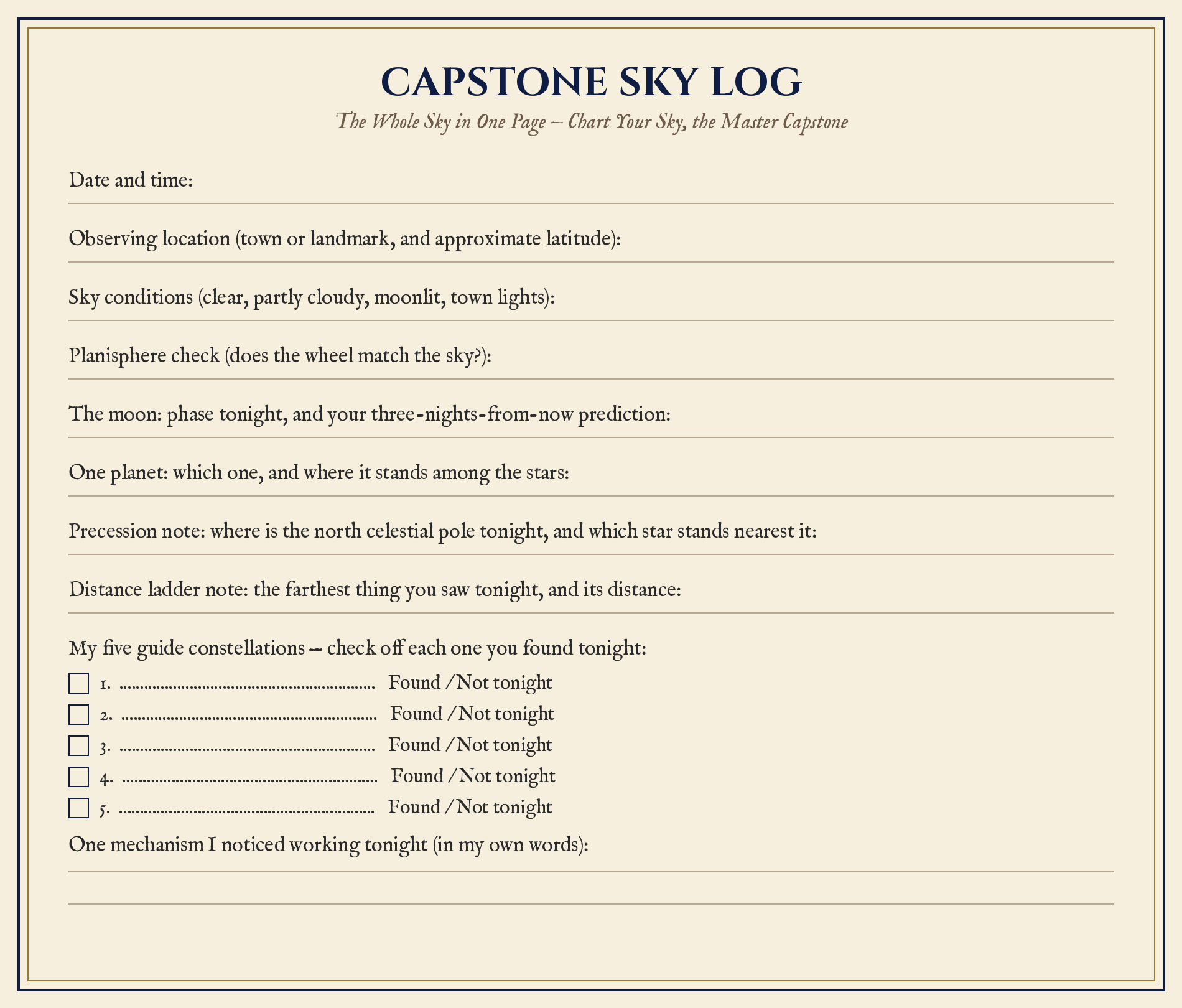
The Capstone Sky Log: the whole sky in one page — the tour's five checks and the night's whole record on a single chart, ready to print on parchment-style paper.
Built digitally for this overhaul (Python/PIL, typeset text), reproducing the final's Sky Log Entry fields verbatim.
Capstone Sky Log: The Whole Sky in One Page
Date and time: Observing location (town or landmark, and approximate latitude): Sky conditions (clear, partly cloudy, moonlit, town lights): Planisphere check (does the wheel match the sky?):
The moon: phase tonight, and your three-nights-from-now prediction:
One planet: which one, and where it stands among the stars:
Precession note: where is the north celestial pole tonight, and which star stands nearest it:
Distance ladder note: the farthest thing you saw tonight, and its distance:
My five guide constellations: check off each one you found tonight:
- .............................. Found / Not tonight
- .............................. Found / Not tonight
- .............................. Found / Not tonight
- .............................. Found / Not tonight
- .............................. Found / Not tonight
One mechanism I noticed working tonight (in my own words):
Materials
Required (Level One — household items)
- Your completed planisphere from Lesson 30, with your latitude written on it.
- Your completed Moon Journal: one full lunation of dated entries and sketches.
- A notebook and pencils for the exercises, the demonstration page, and the Sky Log.
- A dim or red-filtered flashlight for night observing without ruining dark adaptation (your eyes' growing sensitivity in darkness).
- Scissors or a craft knife, glue or tape, and a ruler for any final planisphere repairs or remounting. An adult handles or supervises any craft knife.
- Drawing supplies of your choice for the constellation guide and an illustrated defense.
Suggested (Level Two — historically closer)
- Binoculars or a small telescope for Level Two observing: the Andromeda Galaxy, double stars, and the moon's terminator (the line dividing its lit half from its dark half) repay optical aid.
- A sturdier planisphere mount: laminated disks or a printed wheel on card stock, for an instrument that lasts.
- A bound sketchbook for the constellation guide and defense, so the capstone keeps as one volume.
Reflection Questions
Answer in your workbook, in complete sentences.
- Which of the four mechanisms changed the way you see the night sky the most, and what did you believe before the course corrected it?
- The Moon Journal asked for a full lunation at your own pace. What did watching the whole cycle teach you that no single night's lesson could?
- Your planisphere only works when it is set for your latitude. What does that limitation tell you about the relationship between where we stand and what we can know?
- Choose one story from your constellation guide. Where does the true history differ from the version you first heard, and why does the honest version matter more?
- Someone asks you whether astrology is the same thing as astronomy. Drawing on Unit V, what do you tell them, kindly and accurately?
Workbook Checklist — Master Capstone
In my workbook I have:
- ☐ run the Four-Mechanism Sky Tour with my planisphere and completed the Capstone Sky Log: the whole sky in one page
- ☐ completed Exercise I: one of the four mechanisms explained in one full page — what seems to happen, what is really happening, and one piece of evidence
- ☐ completed Exercise II: both precession calculations with working shown, and the two-or-three-sentence verdict on Hipparchus's estimate
- ☐ completed Exercise III: the four objects ordered nearest to farthest, each with its distance and its ladder rung
- ☐ submitted Project I: my planisphere, calibrated for my latitude, with its demonstration page and honest night-sky check
- ☐ submitted Project II: my Moon Journal — one full lunation, dated, sketched, phases labeled, cloudy nights honestly marked, with its reflection
- ☐ submitted Project III: my Personal Constellation Guide — five constellations I can actually find, with locating directions, the science of their stars, honestly sourced history, and my approximate latitude and location stated
- ☐ submitted Project IV: my Defense — written or illustrated, touring all three artifacts, explaining one mechanism with evidence, telling one surprised-by-history story with its sources, and closing with what the sky looks like to me now
- ☐ scored each project honestly against its rubric and added the four scores out of eighty
☐ Capstone completed Date: ___ Signature: ___
Cross-Class Connections

Runes · Unit I, Lesson 1 — The Structural Wedge
Tower scholars, the sky you have just charted was first written down by scribes pressing a cut reed stylus into wet clay, wedge by wedge. My first lesson teaches that wedge — the tokens, the clay, the five basic forms, and why so many tablets survived to be read at all. The Venus Tablet of Ammisaduqa your professor names is one of those tablets. Glimmerwick reads what the writing was for; here, we press the marks it was written with.
PROFESSOR THISTLELOOM WEBBLETHORN
Runes & Ancient Writing

Herbology · Unit IV, Lesson 27 — Timing the Harvest
Come down to the greenhouse a moment, scholars. Your professor has taught you to keep observation and influence straight: your Moon Journal records what the moon did in the sky, not what it did to a seed tray. In my garden, timing claims are answered the same honest way — by watching the plant itself. A leaf gathered at dawn and a leaf gathered at noon are not the same leaf, and you can smell the difference. Bring your journal's habits with you, and we will keep both ledgers: what was believed, and what the evidence supports.
PROFESSOR BERYL FERNFOOT
Herbology Greenhouse
Scrollwork · Unit V, Lesson 17 — Hierarchy & Page Layout
Tower scholars, every catalogue in your capstone's Story was a planned page before it was an instrument. In my seventeenth lesson we study how a manuscript page is built before a word is copied — the ruling, the text block, the spaces left for the illuminator — the same planning by which al-Sufi's Book of Fixed Stars was copied and illustrated by hand for centuries, each constellation drawn twice. If your constellation guide is illustrated, come and learn the page it stands on.
PROFESSOR QUILLBERRY NOCTURNE
Scrollwork Library

Creative Arts · Unit I, Lesson 3 — Cutting, Scoring & Clamping
Set up your bench, scholars. Your planisphere is a workshop build wearing a Celestial Studies coat, and its cutting work is taught in my third lesson: the work clamped firm, the straightedge held true, the cut made in passes, and an adult's hand on or beside any craft knife — the very rule your capstone's materials note repeats. Build the practice corner first, on scrap, as always. Then bring your wheel, and we will make the lasting version together.
— Professor Cogbranch Timberclank, Creative Arts Workshop
History of Magic (a future class) is named only, exactly as the final frames it — no link, no invitation, until that class opens its doors.
The Professor's Closing Note
Well, my dears, this is the last lesson page of the course, and I want to close it the way we began: with the truth about what you have done.
You did not merely read about the sky. You built an instrument, you kept a journal through a whole turning of the moon, and you learned five constellations the way a naturalist learns birds: by finding them, night after night, until they were yours. That is fieldwork. That is the real thing, done at whatever latitude you call home, under whatever sky your town allows.
The defense is the last step, and I will say once more what the assignment pages say: written or illustrated, whichever shows your sky best. No oral presentation. I read every format with the same attention, and I have never yet been disappointed by a scholar who showed me their real sky and told me its real history.
When you are finished, go outside one more time, without any assignment at all. Find one of your five constellations, the one you found first, and just look at it for a while. You know what its stars are now, and how far away they are, and who named them, and why the names traveled. That feeling, the small bright weight of knowing, is the whole of what this tower was for.
Fly gently home, my dears. The sky will keep.
PROFESSOR VESPER GLIMMERWICK
Celestial Studies
Astronomer & Celestial Historian
Further Reading & Sources
- Sky and Telescope (skyandtelescope.org): The amateur astronomer's magazine, publishing since the 1940s: weekly "Sky at a Glance" observing guides, eclipse coverage, and equipment advice. Start here when you want to know what is up tonight.
- NASA Eclipses (science.nasa.gov/eclipses): NASA's eclipse pages: how eclipses work, eye-safety guidance, and maps and dates of upcoming solar and lunar eclipses.
- NASA Moon (moon.nasa.gov): NASA's moon portal, including the Daily Moon Guide and a Moon Observation Journal: a worthy companion to the journal you kept for this capstone.
- Stellarium (stellarium.org): A free, open-source planetarium for your computer. Set it to your location and any date in history, and check your planisphere's answers against it. It includes the constellations of more than forty cultures, which makes it excellent for researching the non-Western stories in your guide.
- American Astronomical Society (aas.org): The professional society of North American astronomy, and the authority behind the ISO 12312-2 eclipse-viewing safety standard used throughout this course.
- Time and Date Astronomy (timeanddate.com/astronomy): Moonrise and moonset times, moon-phase calendars, meteor-shower guides, and eclipse lookups for your city. Useful for planning every project in this packet.
- International Astronomical Union (iau.org): The body that adopted the 88 constellations and their boundaries: the official source for constellation names, abbreviations, and border definitions.
All links above were opened and verified live on 2026-10-12.
Browse the Celestial Studies shelf in the school Library for readable editions of these works.
Submit Your Work
When your capstone work is complete, submit it through the Submit Your Work form at the foot of this page: your scholar's name, your house (Septentrio / Oriens / Meridies / Occidens / Not sorted yet), this capstone (Celestial Studies Master Capstone — Chart Your Sky), a photo of your work — your calibrated planisphere, your Moon Journal, your constellation guide, or your defense — and, if you wish, the permission-to-display checkbox so your work can appear in the school galleries.
End of Chart Your Sky — the Celestial Studies Master Capstone.
Submit your work for this capstone using the form below.
THE CELESTIAL STUDIES CLASS TEST
CELESTIAL TOWER · THE WHOLE COURSE
Thirty-three lessons stand behind you now: the turning sky and the tilted year, the Moon in all her phases, the five wanderers, the fixed stars and their far-off fires, the long history of what people believed the sky meant, and the instruments that taught us to measure it. This test measures what the whole course left with you. Take it from memory first, in one honest sitting, before you look back at your Sky Log or your notes. If you kept the passages marked ★ through the course, you have been preparing for it all along.
The Class Test is not your capstone. The capstone — your planisphere, your Moon Journal, and your own guide to your sky, defended in writing or in pictures — is assembled and judged as its own work, and it stands on this page as exactly that. The test checks your retention; the capstone shows your sky. Two different kinds of proof, both worth having.
The test packet is a single download in five parts: multiple choice, true or false, a short vocabulary matching, short answers in your own words, and applied problems that ask you to use the sky rather than recite it. The answer key waits at the back for self-checking. Score it honestly, note the result in your workbook, and let it tell you which tower stairs are worth climbing once more.
CONTINUE IN THE CELESTIAL TOWER
← Previous · Lesson 33: Dark Skies
Unit VI — Instruments of the Sky Celestial Tower — All 33 Lessons
The rest of Unit VI: Lesson 29 · Sundials · Lesson 30 · Planisphere · Lesson 31 · The Astrolabe · Lesson 32 · Telescopes · Lesson 33 · Dark Skies · Chart Your Sky (Capstone)
From the Celestial Shelf
The printed companions to the capstone, from Professor Glimmerwick’s shelf in the shop.
Celestial Studies — Sky Log Pages: Capstone Packet: Chart Your Sky (17 Pages)
$4.99
View in the Shop