

Creative Arts
Studio Extension E2The Permanent Sundial & Horizon Alignment
Professor Cogbranch Timberclank
Master Artisan, Head of House Occidens
The Creative Arts Workshop • School of Evershade
This is a Studio Extension: optional, always, and never required for any lesson in any class. It assumes these tickets are already in your hands: Lesson 2, "Hands, Eyes, Measuring, Marking & Leveling," and Lesson 23, "Wood, Grain & Safe Hand Tools" — and, for scholars building in stone, Lesson 27, "First Cuts: Carving Safely." If the leveling ticket is missing, take it first. A permanent dial on an unlevel plate is a permanent error, set in stone for everyone to read.
Professor's Introduction

Bring your paper sundial from the Celestial tower, scholars, and look at what a season has done to it.
Professor Glimmerwick's paper dial is a good teacher. It showed you the gnomon's angle and the hour lines' fan, and it cost nothing but an afternoon. The gnomon is the part of a sundial that casts the shadow — on a horizontal dial, a triangular plate. But paper creeps, rain finds it, and the scholar who made it in October cannot read it in March. The sky, meanwhile, keeps its appointments with complete indifference to the state of our instruments. This extension builds the dial the paper one was rehearsing: in stone or hardwood, with a gnomon cut to your latitude, its hour lines engraved and inlaid, set level, and aligned to true north so carefully that it will still be telling honest time when the scholar who built it has grandchildren asking why it disagrees with their clocks. True north is the direction of the Earth's rotational pole, toward which the style must point. It is not where a compass needle points; the needle answers to the magnetic pole, which wanders, and the difference between the two, the declination, changes from place to place and year to year.
Beside the dial, we will lay a horizon alignment for the garden: markers for the equinox line and the solstice sunrises and sunsets, so the school's year has fixed points on its own ground. This is slow work, and some of it cannot be hurried at all. An alignment is finished by the sun, across a year of mornings. The Workshop's part is to build true, set level, and mark honestly what has been observed and what has only been computed. The sun will do the rest, on its own schedule.
PROFESSOR COGBRANCH TIMBERCLANK
Creative Arts Workshop
Master Artisan, Head of House Occidens
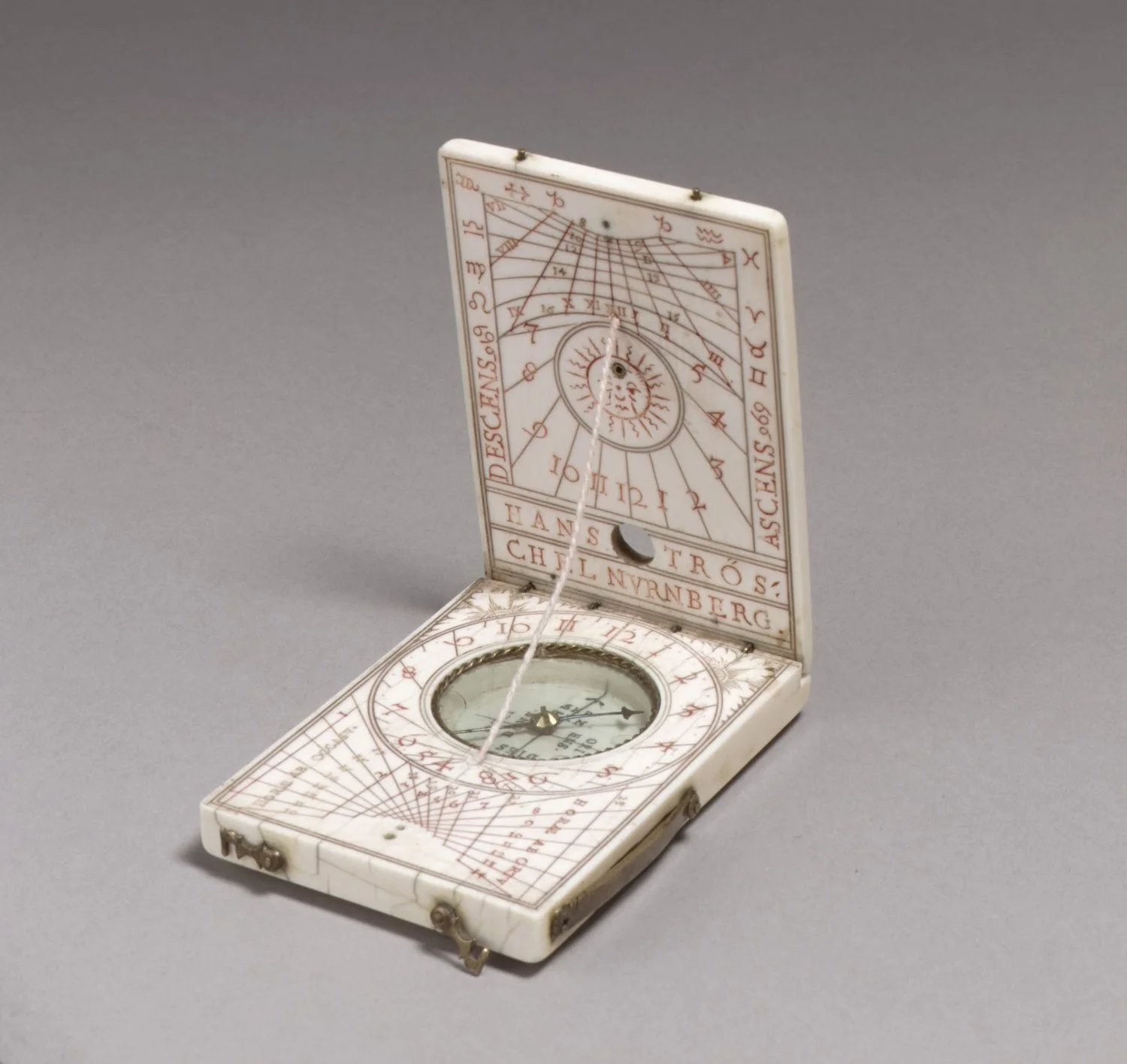
A portable diptych sundial by Hans Tröschel the Elder (Nuremberg, ca. 1598), ivory and brass — hinged leaves with string gnomon and compass, made to be set up and aligned wherever it was carried.
The Metropolitan Museum of Art, Open Access (CC0).
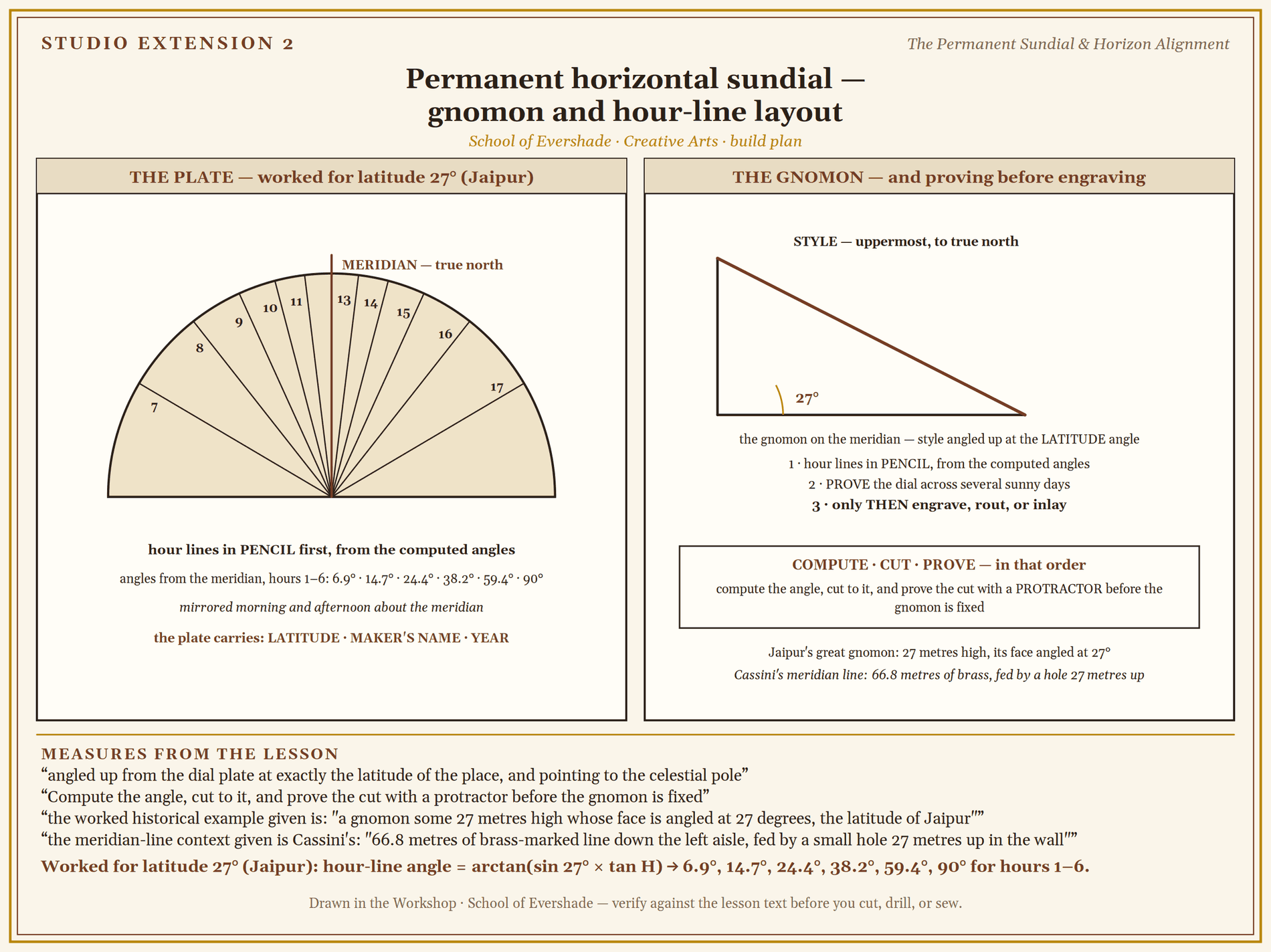
Permanent horizontal sundial — gnomon and hour-line layout
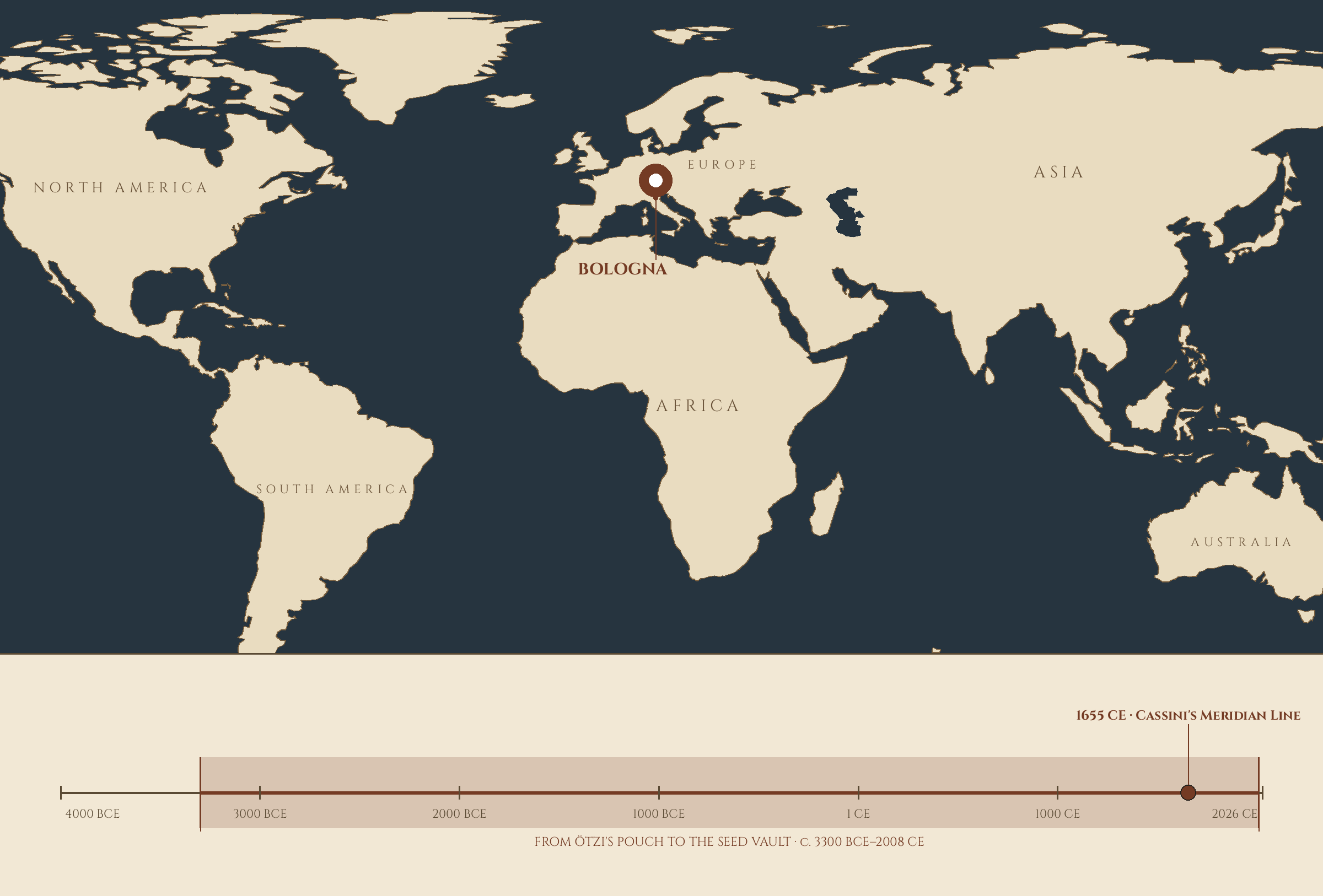
Where and when: Bologna — 1655 CE, Cassini’s meridian line.
Lesson Objectives
By the end of this extension, students should be able to:
- Explain the gnomon's geometry: why the style is angled to the latitude and aligned with the Earth's axis.
- Distinguish true north from magnetic north, and explain why a compass alone cannot set a permanent dial.
- Describe the scratch dials or mass dials of medieval churches and what they were for.
- Describe Cassini's meridian line in San Petronio and what its measurements made possible.
- Find true north by the equal-shadow method and lay out hour lines for a horizontal dial.
- Build, level, align, and prove a permanent sundial, and begin a garden horizon alignment with honestly marked observations.
Your Assignment Packet
This lesson's assignments live in its packet: the Lexicon Handout (every term, course terms marked ◆), the Assignment Manual, and the Reflection Questions. Download the packet before you begin and keep it beside you as you read — work from it as each subject is taught, or take the assignments as homework afterward.
Scratched on Church Walls: The First Permanent Dials
The first permanent sundials most Europeans ever saw were barely more than scratches. From the seventh century onward, churches across England and France acquired tide dials, also called mass dials or scratch dials: a semicircle cut into the south wall, usually near the priest's door, with lines radiating from a central hole. The priest set a wooden peg in the hole, and the peg's shadow crossing the marked lines told him the canonical hours, the times of prayer and Mass. The oldest surviving English dial of any kind rides on the seventh- or eighth-century Bewcastle Cross; the dial at Kirkdale in Yorkshire, dated by its inscription to 1055–1065, divides the day into its tides with crossed lines for the chief hours. More than three thousand survive in England and at least fifteen hundred in France, which tells you how ordinary the permanent dial once was: not an astronomer's instrument but a parish fixture, cut in stone because stone was what would still be there next year. Their lesson for this extension is humility about precision and respect for permanence. The scratch dial was crude, seasonal in its accuracy, and in use for centuries, because it was there.
The Line in the Church Floor: Bologna and Jaipur
Permanence at its grandest turned the building itself into the instrument. In 1655 the astronomer Giovanni Domenico Cassini inlaid a meridian line in the floor of Bologna's Basilica di San Petronio: 66.8 metres of brass-marked line down the left aisle, fed by a small hole 27 metres up in the wall, through which the sun projects its own image at noon. The image's position along the line gives the sun's noon altitude each day, and from that Cassini calculated the obliquity of the ecliptic, the length of the tropical year, and the timing of equinoxes and solstices with a precision no tabletop instrument of his century could match; the image's changing size even gave the first experimental verification of Kepler's second law. The line runs at a slight angle to the aisle, because the meridian answers to the Earth's axis and not to the architect, a detail worth remembering when your own dial refuses to sit square with the garden path.
Three generations later, permanence went outdoors and monumental. Between 1728 and 1734 the Maharaja Jai Singh II completed the Jantar Mantar at Jaipur, nineteen masonry instruments for naked-eye astronomy, now a UNESCO World Heritage Site. Its Samrat Yantra is the world's largest stone sundial: a gnomon some 27 metres high whose face is angled at 27 degrees, the latitude of Jaipur, with its shadow traveling visibly across the scale. Jai Singh built five such observatories, in Delhi, Jaipur, Ujjain, Mathura, and Varanasi, because the tables he inherited disagreed with the sky and he wanted instruments large enough to settle the argument. Size is not vanity in a sundial. Size is resolution: the longer the style and the wider the scale, the finer the shadow's divisions. The style is the gnomon's sloping upper edge, set parallel to the Earth's axis — angled up from the dial plate at exactly the latitude of the place, and pointing to the celestial pole — and the style's shadow, not the whole triangle's, is what tells the time. Your garden dial works on the same principle at a scholar's scale, and it obeys the same three witnesses.
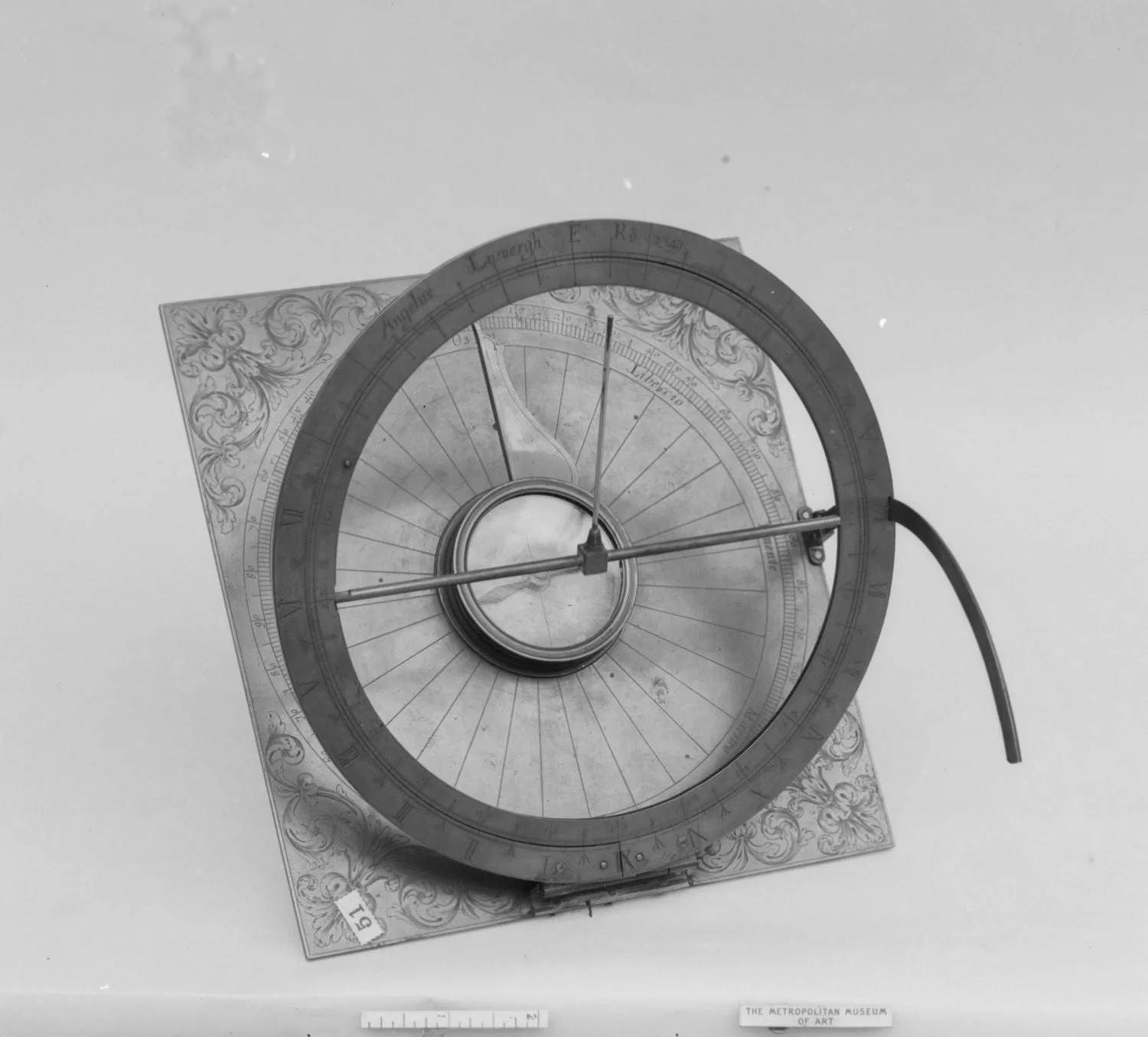
A portable equinoctial (equatorial) sundial by Angelus Lusuergh (Rome, 1747), brass — its ring tilted to the celestial equator, with folding sighting and adjustment fittings.
The Metropolitan Museum of Art, Open Access (CC0).
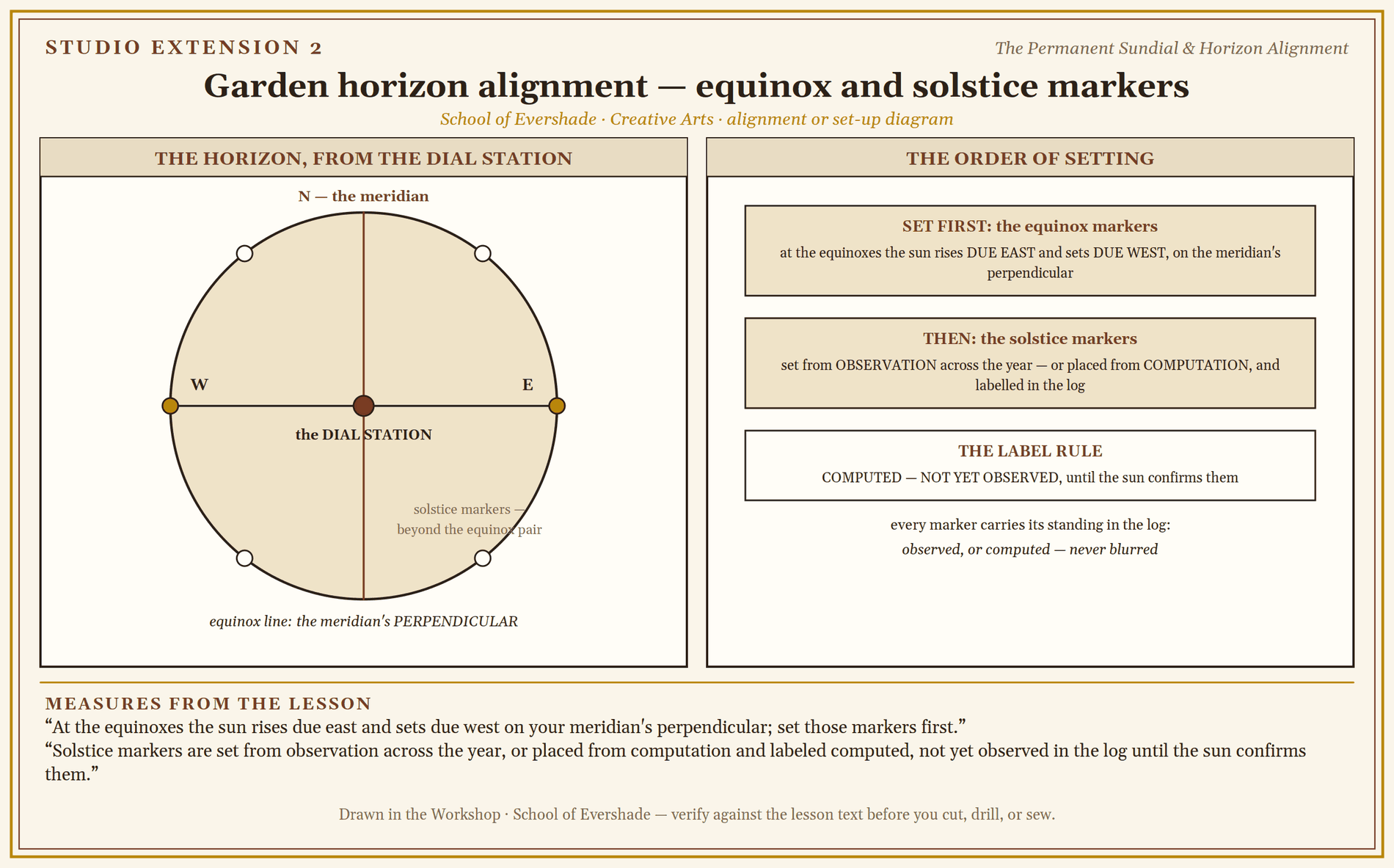
Garden horizon alignment — equinox and solstice markers
A Sealed Note from Professor Timberclank
Two hazards govern this build, scholars, and neither is the blade.
The first is the sun itself. Every observation in this extension is made by shadow, never by eye. No scholar sights the sun directly, through any instrument, at any stage, for any reason. We read where the shadow falls. The shadow is the whole instrument; the eye that looks at the sun is out of the work, and possibly out of the seeing, for good.
The second is stone. Cutting and engraving stone throws chips and raises dust. Eye protection is worn whenever a chisel or point touches stone, without exception and without negotiation, and the work follows Lesson 27's discipline in full: tool toward the work, never toward the body, and dust brushed down, not blown toward a face.
And the setting work is done with an adult present and the piece made fast before any weight is trusted to it. A dial that shifts after setting is a liar with a good reputation. We stop. We make it safe. Then we begin again.
One word on the inlay metals, scholars, because one of them asks to be handled plainly. Lead is worked on the bench only, never where food sits, and it is never put to the mouth, not even for a moment to free a hand. Hands that have handled lead are washed with soap before they touch food, a face, or another scholar's work, and lead offcuts go back into their own store, never into the general scrap, where a later hand might lift them unknowing. The metal is soft and patient, and entirely manageable at exactly that price. We stop. We make it safe. Then we begin again.
PROFESSOR COGBRANCH TIMBERCLANK
Creative Arts Workshop
Master Artisan, Head of House Occidens
Technique: Level, North, and the Honest Line
Level before everything. Lesson 2's leveling returns here by name, as the curriculum promised. The three are the Workshop's witnesses: a surface is level when it agrees with still water's plane, plumb when it agrees with a hanging line, and a build is true when it agrees with both. The dial plate is set on its bed and checked with the spirit level in two directions, then with the water level against a fixed mark, and the checks must agree. Shim, pack, and re-bed until they do. A plate out of level by the thickness of a coin across its width gives a small dial an error of minutes, wrong differently in the morning and the afternoon, and wrong forever.
True north by shadow, not by needle. A compass finds magnetic north, which may sit many degrees from true north and drifts a little every year; a permanent dial aligned by compass is aligned by rumor. Find true north the dial-maker's way. On a sunny morning, set a straight stick upright on level ground and mark the tip of its shadow. Wait until afternoon and mark the tip again when the shadow has grown back to exactly the morning's length, judged by a circle drawn around the stick's base. The line midway between the two marks, run through the base, is the meridian: true north–south. It costs a day of patience and nothing else, and it does not drift.
The gnomon carries the latitude. The style is angled up from the plate at the latitude of the place, because the style must stand parallel to the Earth's axis. This is why an astrolabe's tympan, in Extension E1, is cut for one latitude, and why a dial built for this garden will lie in a garden at another latitude. Compute the angle, cut to it, and prove the cut with a protractor before the gnomon is fixed; then prove the whole dial against a clock on a sunny day and log the difference, which is the equation of time and the longitude offset doing their honest work, not an error in your build.
Engrave what you have proven. Hour lines are laid out in pencil from the computed angles, the dial is proven in pencil for several sunny days, and only then are lines cut, engraved, or inlaid. Stone forgives slowly. The scratch-dial priests cut shallow for a reason.
The Build: A Dial That Stays
This build is checked for a level plate, a true meridian, a gnomon at the latitude angle, and a proving log kept honestly.
One word on the inlay metals, scholars, because one of them asks to be handled plainly. Lead is worked on the bench only, never where food sits, and it is never put to the mouth, not even for a moment to free a hand. Hands that have handled lead are washed with soap before they touch food, a face, or another scholar's work, and lead offcuts go back into their own store, never into the general scrap, where a later hand might lift them unknowing. The metal is soft and patient, and entirely manageable at exactly that price. We stop. We make it safe. Then we begin again.
- Choose the site and the latitude. Pick ground that sees the sun across the middle of the day, all year if it can be managed, and note what shades it in winter. Write your latitude at the head of the build log. Every angle in the build descends from that number.
- Find true north. Run the equal-shadow observation on the site itself, on a clear day: morning mark, afternoon mark at equal shadow length, bisect, and drive the meridian line with string and stakes. Check it on a second day before trusting it.
- Bed the plate level. Set the plate on its bed, aligned to the meridian, and bring it to level by both witnesses, spirit level and water level. Make it fast. A plate that can be rocked by a knee is not set.
- Lay out in pencil. Draw the meridian on the plate, set the gnomon's position, and lay out the hour lines from the computed angles for your latitude. Cut nothing yet.
- Cut and set the gnomon. Make the gnomon to the latitude angle and prove the angle. Fix it on the meridian line, style edge uppermost and pointing to true north, and check its plumb and its angle again after fixing. Fixing moves things; the check after is the one that counts.
- Prove the dial. Across several sunny days, read the dial against a reliable clock at marked hours and log every reading with the date. Expect a steady offset, the equation of time and your longitude within its time zone, and learn its pattern before you judge the build. Wild disagreement means a fault: find it in the log, not by eye.
- Cut the proven lines. Engrave, rout, or inlay the hour lines and the meridian permanently, under the sealed note's rules for stone. Add the latitude, the maker's name, and the year. A dial without its latitude on it is a riddle for whoever finds it in a century.
- Begin the horizon alignment. From the dial's station, mark where the sun rises and sets. At the equinoxes the sun rises due east and sets due west on your meridian's perpendicular; set those markers first. Solstice markers are set from observation across the year, or placed from computation and labeled computed, not yet observed in the log until the sun confirms them. The alignment is finished when the sun says so.
When the dial reads steady against the clock across a week of sun, and its lines are cut, and the first horizon markers stand where the equinox put them, the build is done, and the year can begin.
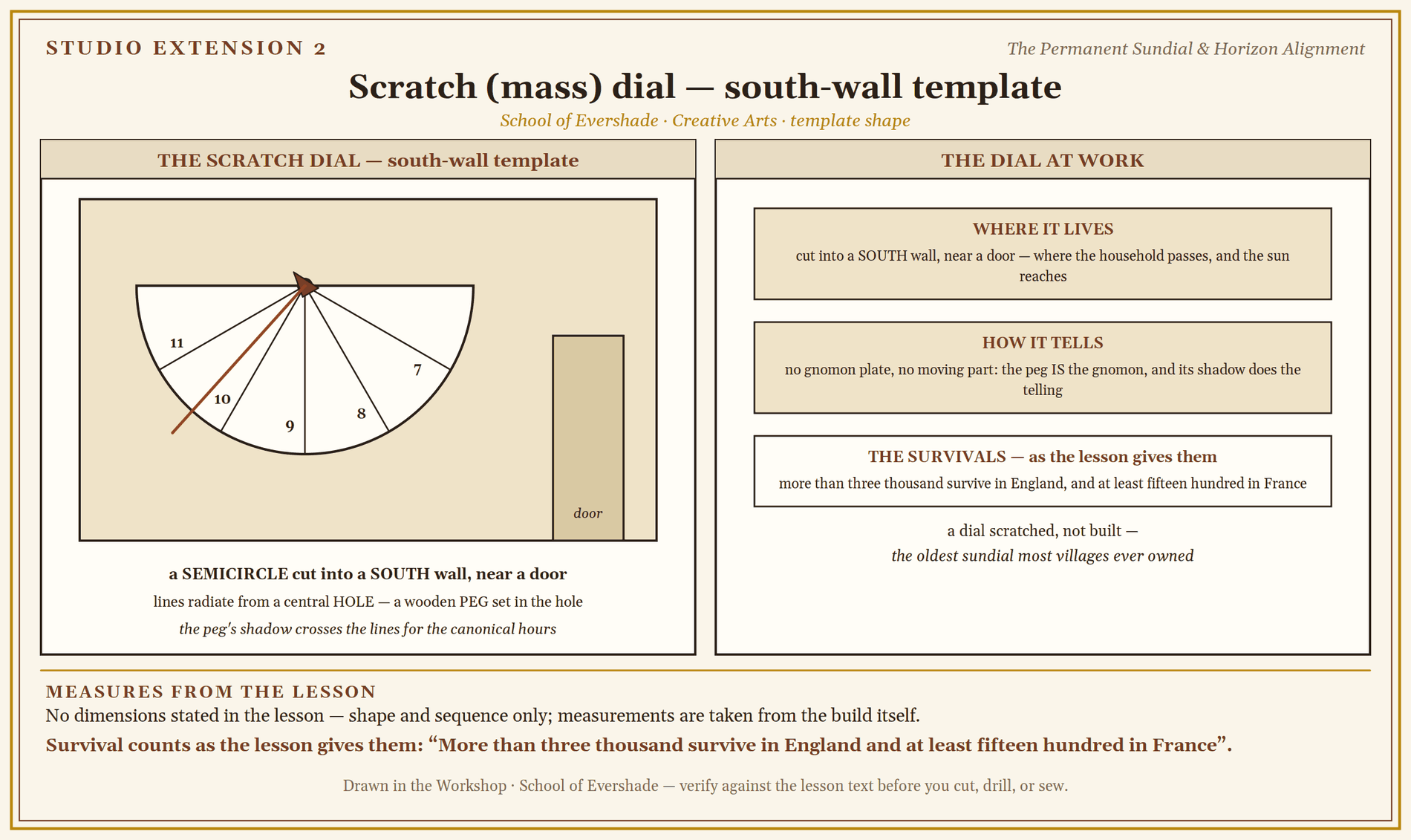
Scratch (mass) dial — south-wall template
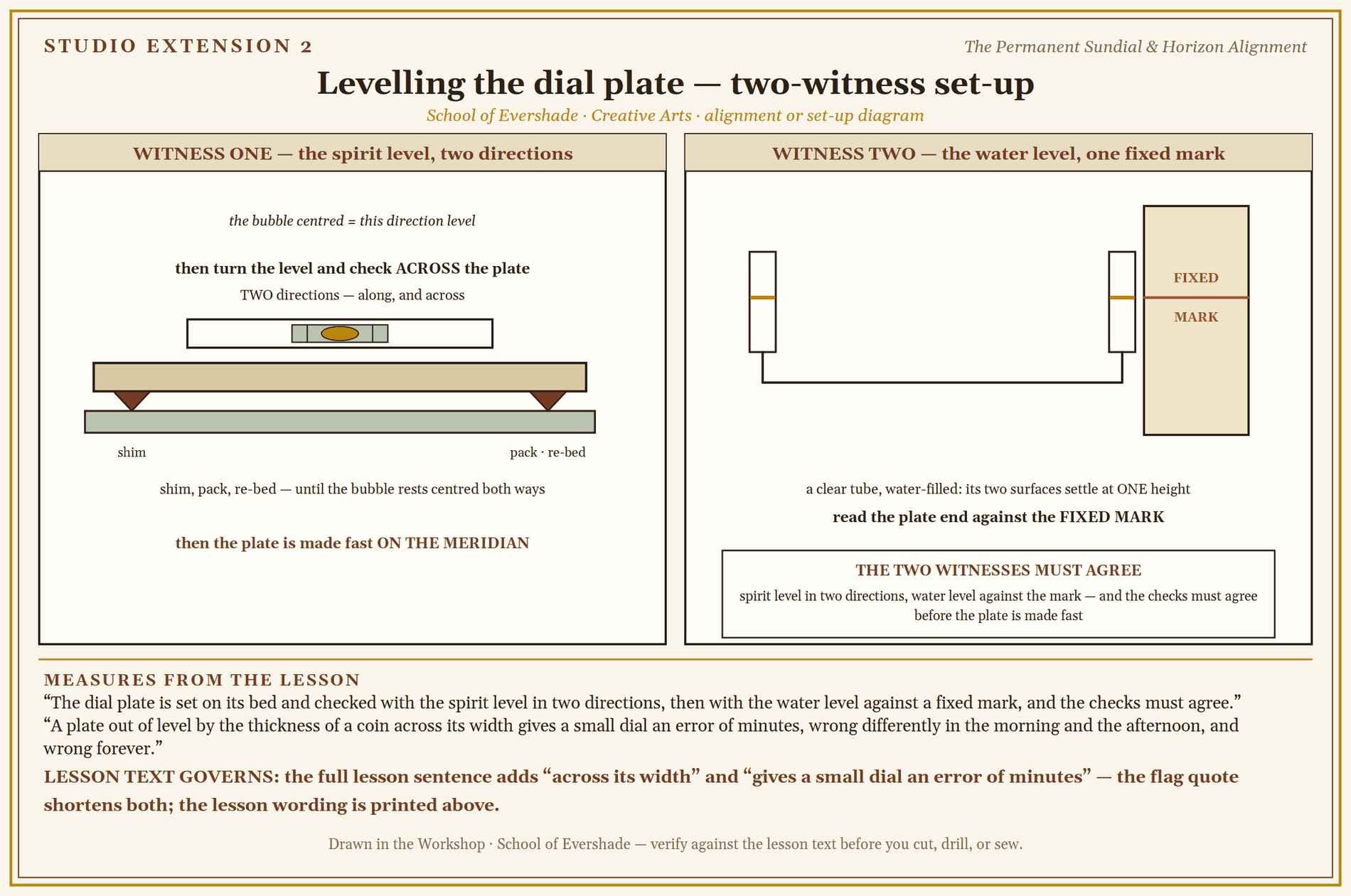
Levelling the dial plate — two-witness set-up
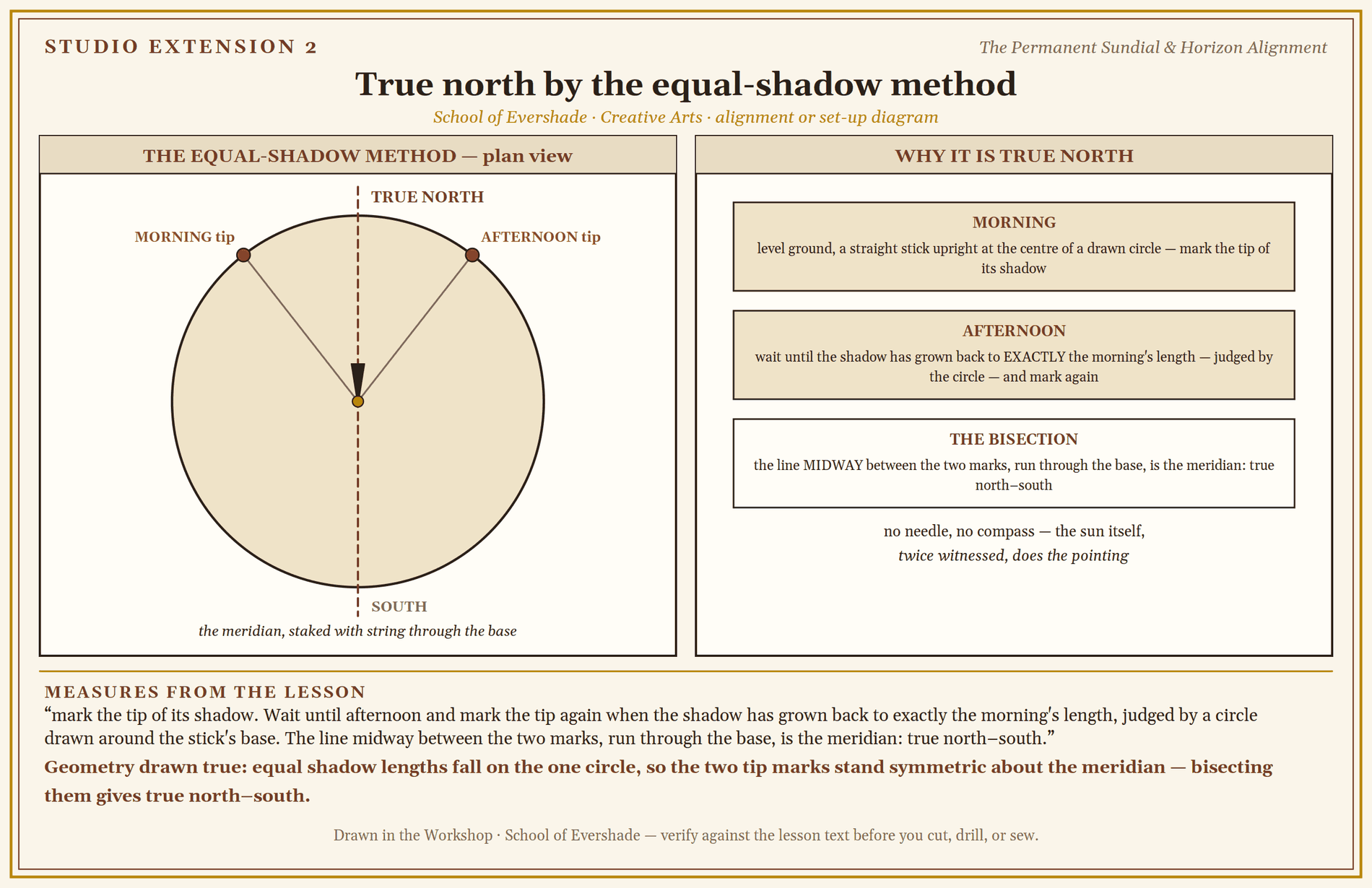
True north by the equal-shadow method
Assignment Manual
Assignment key: ✎ written work · ⚒ hands-on practical · ◐ both
Assignment I ⚒ — The Build
Complete the Build in this extension: a permanent sundial in hardwood or stone, leveled, aligned to true north by shadow, proven against a clock across several sunny days, with its hour lines permanently cut and its horizon alignment begun.
Assignment II ✎ — Three Kinds of Permanent
Using the lesson and the sources below, write a short account of permanence at three scales. Cover: the scratch dial's bargain (crude, seasonal, and in use for centuries), Cassini's meridian line and what a church floor could measure that a tabletop could not, and the Samrat Yantra's argument that size itself is an instrument's precision. End with your own dial: which of the three bargains did you make, and why?
Assignment III ◐ — The Proving Log, Presented
Present your build log as a finished document: the latitude and its source, the two days of meridian observations with their marks, the leveling checks, and at least five days of dial-versus-clock readings with dates. With it, write the explanation you would give a visitor who says your dial is wrong because it disagrees with their watch.
Materials
Level One (household)
- A hardwood board or thick slate tile for the dial plate, sized to the garden or windowsill it will live on
- A gnomon of hardwood or thick card sealed against weather, cut to the latitude angle, or a brass angle bracket of the nearest angle, proven with a protractor
- A spirit level and a plumb line, a length of clear tubing and water for a water level, string, stakes, and a straight stick for the shadow observations
- Pencils, a protractor, a ruler, and a workbook for the proving log
- Exterior wood finish or stone sealer, and paint or inlay material for the proven hour lines
- An adult for the setting work
Level Two (historical)
Everything in Level One, plus:
- A stone slab, slate or sandstone, for the plate, dressed flat, with chisels and points for engraving the lines under Lesson 27's discipline
- A gnomon cut in stone or cast in brass in the monumental manner, its style edge finished true
- Brass strip or lead for inlaying the hour lines and the meridian, as the church floors were inlaid
- Sighting stones or standing markers for the horizon alignment, set in the manner of the old observatories
Both levels produce the same instrument: a dial that agrees with the sun at its own place, proven in pencil before it is cut, and an alignment begun honestly. Level One's hardwood and Level Two's stone differ in how long they will keep the promise, not in whether they keep it.
Reflection Questions
Answer the following questions in your workbook.
- Your dial and a clock disagree, steadily, by some minutes. Which one is keeping the older promise, and what exactly is each of them measuring?
- The scratch-dial makers accepted a crude instrument because it would still be on the wall in a hundred years. Where is the right line, in a build, between precision and permanence?
- Cassini's line had to run at an angle to the church aisle, because the meridian answers to the Earth and not the architect. What did it cost the builders to obey the sky instead of the building, and was it worth it?
- The horizon alignment cannot be finished in less than a year of mornings, and some of it you must label computed, not yet observed. What does honest labeling protect, in a build meant to outlast its maker?
- Jai Singh built bigger instruments because the inherited tables disagreed with the sky. When a book and the world disagree in your own work, which do you rebuild first?
Professor's Review
Walk out with me at noon, scholars, and we will read it together. There: the shadow on the line, steady as a plumb bob, and your log open beside it with five days of honest numbers.
Understand what you have made. Every other instrument in this course measures something you carry to it. This one is measured by the Earth itself, and it will go on being measured, truly, on every clear day, whether or not anyone walks out to read it. That is what permanent means in a workshop: not that the object cannot fail, but that its truth does not depend on its maker's presence.
The alignment is yours to finish, across the year, morning by morning. I will not see all of it set. That is as it should be. Mark what you observe, label what you only computed, and leave the log where the next scholar will find it.
PROFESSOR COGBRANCH TIMBERCLANK
Creative Arts Workshop
Master Artisan, Head of House Occidens
Cross-Class Connections

Celestial Studies · Unit VI, Lesson 29 — Sundials: Catching Shadows
Workshop scholars, in the Tower we catch shadows with paper. My twenty-ninth lesson builds the sundial in card and teaches the gnomon’s geometry, and its small alignment marks the solstice line at garden scale — paper proves the geometry honestly, and then the seasons wear it. This extension is where the proven pattern is made permanent: the dial rebuilt in stone or hardwood at Professor Timberclank’s bench, the line set in standing markers, both true to the sun that agreed with them in pencil first. Learn the shadow’s road with me — then go and set it in stone.
PROFESSOR VESPER GLIMMERWICK
Celestial Studies
Further Reading & Sources
Wikipedia, "Tide Dial." The scratch or mass dial in full: the canonical hours, the south-wall semicircle, the Bewcastle Cross and Kirkdale examples, and the three thousand survivors in England.
Wikipedia, "San Petronio, Bologna." The basilica and its Cassini meridian line of 1655: the hole, the 66.8 metres of inlaid line, and the measurements it made possible.
UNESCO World Heritage Centre, "The Jantar Mantar, Jaipur." The official listing: some twenty fixed monumental instruments, naked-eye astronomy at building scale, and the observatory as the culmination of its tradition.
Wikipedia, "Jantar Mantar, Jaipur." The nineteen instruments one by one, with the Samrat Yantra's 27-metre gnomon face set at Jaipur's own latitude.
Student-friendly starting points for exploring this extension's world. All links verified October 2026.
- Atlas Obscura, "Meridian Line of Basilica di San Petronio." The noon crowd gathering in the aisle to watch the sun's image arrive on the line, and why the line squeezes between the columns at its stubborn angle.
- UNESCO's Jantar Mantar listing, with its gallery. Walk the observatory in photographs: solid geometry you can stand inside, built to settle an argument with the sky.
- Print only: J. L. Heilbron, The Sun in the Church: Cathedrals as Solar Observatories (Harvard University Press, 1999), the standard history of meridian lines and the churches that housed them, held by larger libraries.
Submit your work for this lesson using the form below.
CONTINUE IN THE CREATIVE ARTS WORKSHOP
← Previous · Studio Extension E1: Precision Paper Instruments, Built to Last Next · Studio Extension E3: Models That Move, Built as Machines →
Creative Arts Workshop · All 39 Lessons
Bookstore Shelf The Library · Creative Arts Shelf Course Supplies
The rest of the Workshop Extensions: E1 · Precision Paper Instruments · E3 · Models That Move · E4 · Painted Wheels at Full Size · E5 · Relief & Scale Displays