

Creative Arts
Studio Extension E4Painted Wheels at Full Size
Professor Cogbranch Timberclank
Master Artisan, Head of House Occidens
The Creative Arts Workshop • School of Evershade
This is a Studio Extension: optional, always, and never required for any lesson in any class. It assumes these tickets are already in your hands: Lesson 2, "Hands, Eyes, Measuring, Marking & Leveling," Lesson 7, "Paper, Card & Board Construction," and Lesson 15, "Pigments, Paints & Color Charts." If the pigment ticket is missing, take it first. A wheel at full size is a great deal of paint to waste on an unpracticed hand, and the chart in Lesson 15 is where this build's colors are decided.
Professor's Introduction

Bring the paper wheels from the Celestial tower, scholars: the moon-name wheel, the solar-cycle wheel, the zodiac wheel, charming, correct, and curling at the edges.
Professor Glimmerwick's paper wheels teach the cycles, and they teach them well. What they cannot do is hold a wall. A cycle deserves a monument, because a cycle is the one kind of knowledge that is never finished being true: the moon names will come around again, the solar cycle will complete its twenty-eight years and begin again, and the zodiac will outlast every scholar in this room. The solar cycle is the twenty-eight-year cycle of the Julian calendar, after which the days of the week fall on the same dates again, leap years included. This extension paints one of those wheels at full size, on board, in ground pigment laid the way Lesson 15 taught, with a rotating overlay where the wheel's working demands one, so that it can hang in a classroom or the Gallery and be read across the room, by lamplight, for decades. The overlay is the rotating disk or ring fitted over a painted wheel, carrying the moving part of the reckoning, a pointer, a moon, a year's index, so the fixed rings can stay painted and the variable can turn.
The medieval world understood this build in its bones. It filled its books with wheels, circles of elements and seasons and winds, because the circle is the shape a cycle draws when it is honest. You are not inventing a decoration. You are joining the oldest diagram tradition in the school, at the scale its makers would have chosen if their walls had allowed it.
PROFESSOR COGBRANCH TIMBERCLANK
Creative Arts Workshop
Master Artisan, Head of House Occidens
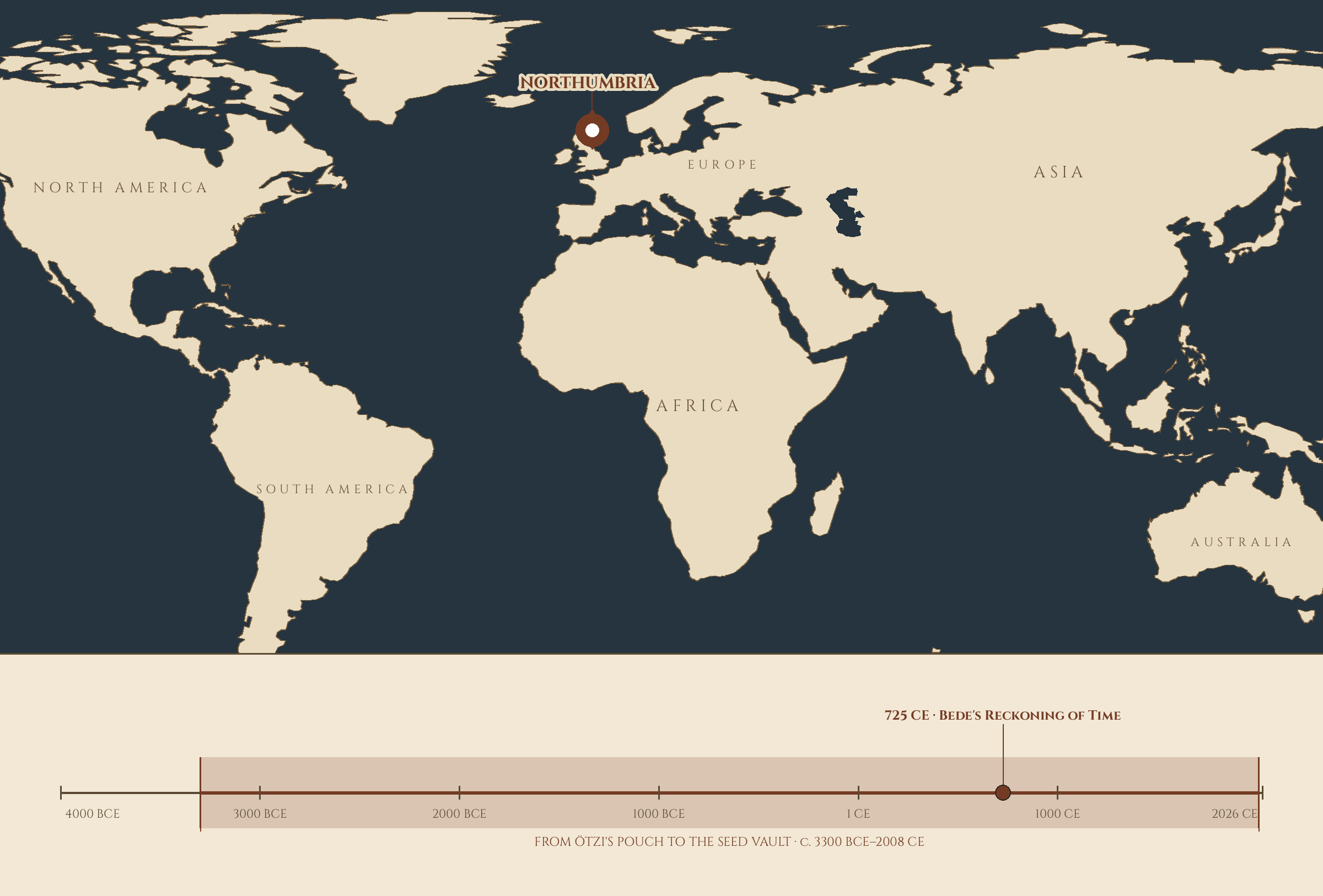
Where and when: Northumbria — 725 CE, Bede’s Reckoning of Time.
Lesson Objectives
By the end of this extension, students should be able to:
- Describe the medieval rota tradition: Isidore of Seville's wheel diagrams and the name his book of nature carried because of them.
- Explain computus, the medieval science of time reckoning, and the cycles it tracked: the nineteen-year lunar cycle, the twenty-eight-year solar cycle, and their 532-year product.
- Explain why Bede's Reckoning of Time stood at the center of that science, and what question the whole apparatus existed to answer.
- Divide a circle accurately into 12, 19, and 28 parts by geometry, and prove the division by closing the circle.
- Lay out, paint, and letter a full-size wheel on board using Lesson 15's pigment discipline, with a fitted rotating overlay where the cycle requires one.
- State, on the wheel's own plate, what the wheel shows, what it assumes, and where its reckoning comes from.
Your Assignment Packet
This lesson's assignments live in its packet: the Lexicon Handout (every term, course terms marked ◆), the Assignment Manual, and the Reflection Questions. Download the packet before you begin and keep it beside you as you read — work from it as each subject is taught, or take the assignments as homework afterward.
The Book of Wheels
In the seventh century, Isidore, bishop of Seville, wrote On the Nature of Things, a survey of the physical world, its astronomy, geography, weather, and time. What made the book beloved, and copied for eight hundred years, was its diagrams: wheel after wheel of concentric circles, setting out how the elements bind to the seasons, the seasons to the humors, the winds to their quarters, the year to its turning. Each such wheel is a rota, Latin for a wheel and the medieval name for the circular diagram: concentric rings and radiating divisions carrying everything that comes around again — elements, seasons, winds, humors, the zodiac, the ages of the world. Medieval readers knew the work by its wheels; it circulated under the affectionate title Liber rotarum, the Book of Wheels. A twelfth- or thirteenth-century copy now in Edinburgh still carries the text with its diagrams and figures intact, one of hundreds of manuscripts in which scribes redrew Isidore's circles century after century, because a wheel is a piece of knowledge you can copy with a compass and trust with your eyes. In the twelfth century the tradition flowered again in encyclopedias like Lambert of St-Omer's Liber Floridus, whose great wheels of the world, the ages, and the heavens are among the most famous diagrams of the Middle Ages.
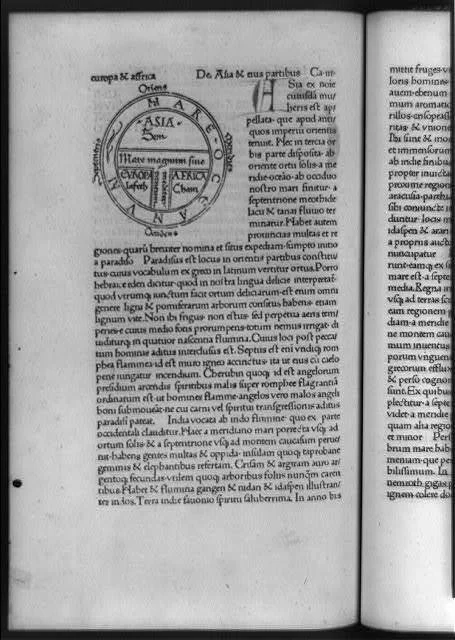
A medieval wheel diagram of the earth — the earth drawn as a wheel encircled by the ocean, with surrounding text — from the first printed edition of Isidore of Seville's *Etymologiae* (G. Zainer, 1472).
Public domain — Isidore of Seville, Etymologiae (G. Zainer, 1472); Library of Congress, via Picryl.
The Reckoning the Wheels Served
The wheels were not ornament. They were the working surface of computus, the reckoning of time, whose central problem was Easter: a feast fixed to a Sunday, after the Church's reckoned full moon, after the fixed spring equinox of 21 March, which is to say a feast fixed simultaneously to the week, the moon, and the sun, three cycles that share no common measure. Dionysius Exiguus built his Easter table in 525; the Northumbrian monk Bede gave the science its fullest account in The Reckoning of Time in 725, explaining the calendars of five peoples, the moon's cycles and their anomalies, and the great Paschal table itself. The arithmetic underneath is the wheel-builder's inheritance: the moon's phases return to the same dates after nineteen years, the weekdays after twenty-eight, and the two cycles together repeat only after 532 years, the Great Paschal Cycle, whose complete table Bede published in 725. The nineteen-year return is the lunar cycle, the Metonic cycle, after which the moon's phases return to the same dates of the solar year, near enough for reckoners; Easter lives where this ring and the solar ring agree. Every medieval calendar wheel is those three numbers drawn in rings. The computist's two keys are looked up on the wheel: the golden number gives a year's place in the nineteen-year lunar cycle, and the dominical letter gives its place in the week's turning — two small signs from which the whole year's feasts could be unfolded.
The tradition outlived the manuscript. An engraved Book of Common Prayer of 1717, now in the Bridwell Library's collection, still carries a volvelle, a rotating circular table, by which a reader could find the dates of Easter and the other moveable feasts for any year: the computus wheel, printed, bound, and still turning three centuries after Bede. Your full-size wheel stands in this line, and its plate should say so.
A Sealed Note from Professor Timberclank
A painted wheel's hazards are quiet ones, scholars, and they ride on tools you think you know.
Compasses and dividers are points, and a full-size wheel is drawn with large ones. A divider is carried point-down, set down in its cork or its block the moment the hand leaves it, and never, under any circumstances, left standing in the board where the next scholar's palm will come down. A point found by a hand teaches the lesson once, at full price.
The overlay disk is cut under Lesson 3's discipline entire: work clamped, cuts away from the body, holding hand behind the blade's road.
And Lesson 15's rule stands over all the painting: dry pigment is weighed, ground, and mulled with the dust kept down and out of the breath, modern student pigments only at this bench, and the historic colors that were poisons, lead white, vermilion's mercury, orpiment's arsenic, are studied in the book and never opened in the room. We stop. We make it safe. Then we begin again.
PROFESSOR COGBRANCH TIMBERCLANK
Creative Arts Workshop
Master Artisan, Head of House Occidens
Technique: Dividing the Circle, Painting the Rings
The division is the wheel. A wheel is believed or doubted at its divisions. Twelve parts yield to the compass alone: the radius steps around the circumference six times exactly, and every other point gives the twelvefold ring. Nineteen and twenty-eight are not so kind, and are laid out by computed angle: 360 divided by the count, each step set with a protractor or by chord lengths taken from a table, around the full circle. Then comes the proof that cannot be argued with: the last division must close exactly on the first. A wheel whose divisions do not close has an accumulated error hiding in it, and it is found now, in pencil, not after the paint.
Paint in rings, outward from the center, and let each ring cure. Lesson 15's discipline governs: colors chosen and proven on the color chart first, pigments ground and mulled in small batches, and the chart kept with the wheel's log so a repair in ten years can match its colors. Letter the rings last but one, with the hand rested and the lettering practiced on the chart's margin; a wheel is read by its lettering before it is admired for its colors.
The overlay is fitted like E1's disks, because it is one. Its center is the wheel's center, its pivot fitted snug and free, its edge bound, and its underside finished as faithfully as its face. At wall size, an overlay that sags will grind the paint off the rings beneath it within a year; a standoff washer at the pivot and a true, stiff disk are the whole remedy, applied now.
Hang it like you mean it. A full-size wheel on board is a heavy object with a point load at its hanging. Two fixings, into structure, with an adult checking the wall's substance before the wheel trusts it. The Gallery's walls have held worse, but they were asked first.
The Build: One Wheel, at the Size of Its Subject
This build is checked for divisions that close, colors that match their chart, and an overlay that turns clear of the paint.
- Choose the wheel and its reckoning. Decide which cycle the wall will carry: the moon-name wheel, the solar-cycle wheel, or the zodiac wheel, with or without an overlay. Write the wheel's numbers at the head of the log: 12, 19, 28, or 532, and the source your reckoning follows. The wheel is those numbers; the painting is their clothing.
- Prepare the board. Cut and seal the panel, both faces, and let it cure. Find its center by crossed diagonals, pinprick it, and prove the board hangs flat and true before a single ring is drawn. A warped board makes a wheel that lies in three dimensions.
- Lay out the rings in pencil. Strike the rings from the center: hub, inner ring, the cycle rings, the lettering band, the rim. Divide each ring by its count, twelve by compass, nineteen and twenty-eight by computed angle, and prove every division by closing the circle. Correct in pencil until every ring closes exactly.
- Prove the colors on the chart. Paint the wheel's whole scheme first on the Lesson 15 color chart, at reading distance, in the room's light. A color that sings in the hand can shout across a wall. Adjust on the chart; the board gets only proven colors.
- Paint the rings. Work outward from the hub, one ring at a time, letting each cure before the next is masked against it. Keep the chart beside the board and check every mixed batch against it before the brush touches the wheel.
- Letter the wheel. Letter the rings and divisions with the practiced hand: names, numbers, the golden numbers or moon names in their places. Lettering is done in short sittings. A tired hand writes a wheel that apologizes forever.
- Fit the overlay. If the wheel carries one, cut and finish its disk, fit its pivot at the wheel's center with its standoff washer, and turn it through a full cycle, checking clearance over every ring. It must pass over the paint like weather over a roof: close, and never touching.
- Plate and hang. Letter the maker's plate at the wheel's foot or on its frame: what the wheel shows, the cycles it carries, the reckoning it follows, its maker, and its year. Hang it on two fixings into structure, checked level by Lesson 2's witnesses, with an adult on the work.
When the divisions close, the rings read across the room, and the overlay turns its full cycle in silence, the wheel has taken its wall, and the wall is the better for it.
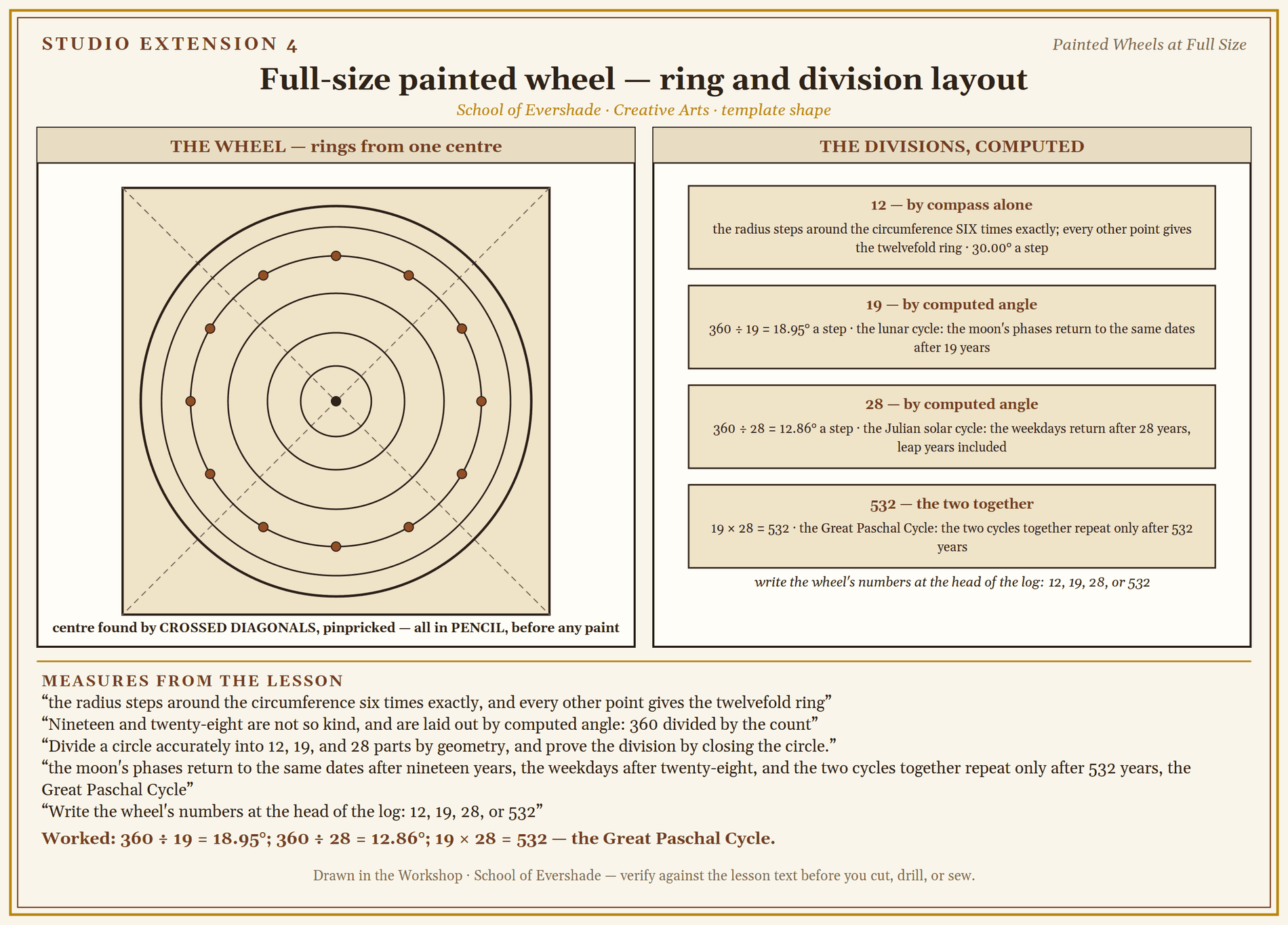
Full-size painted wheel — ring and division layout
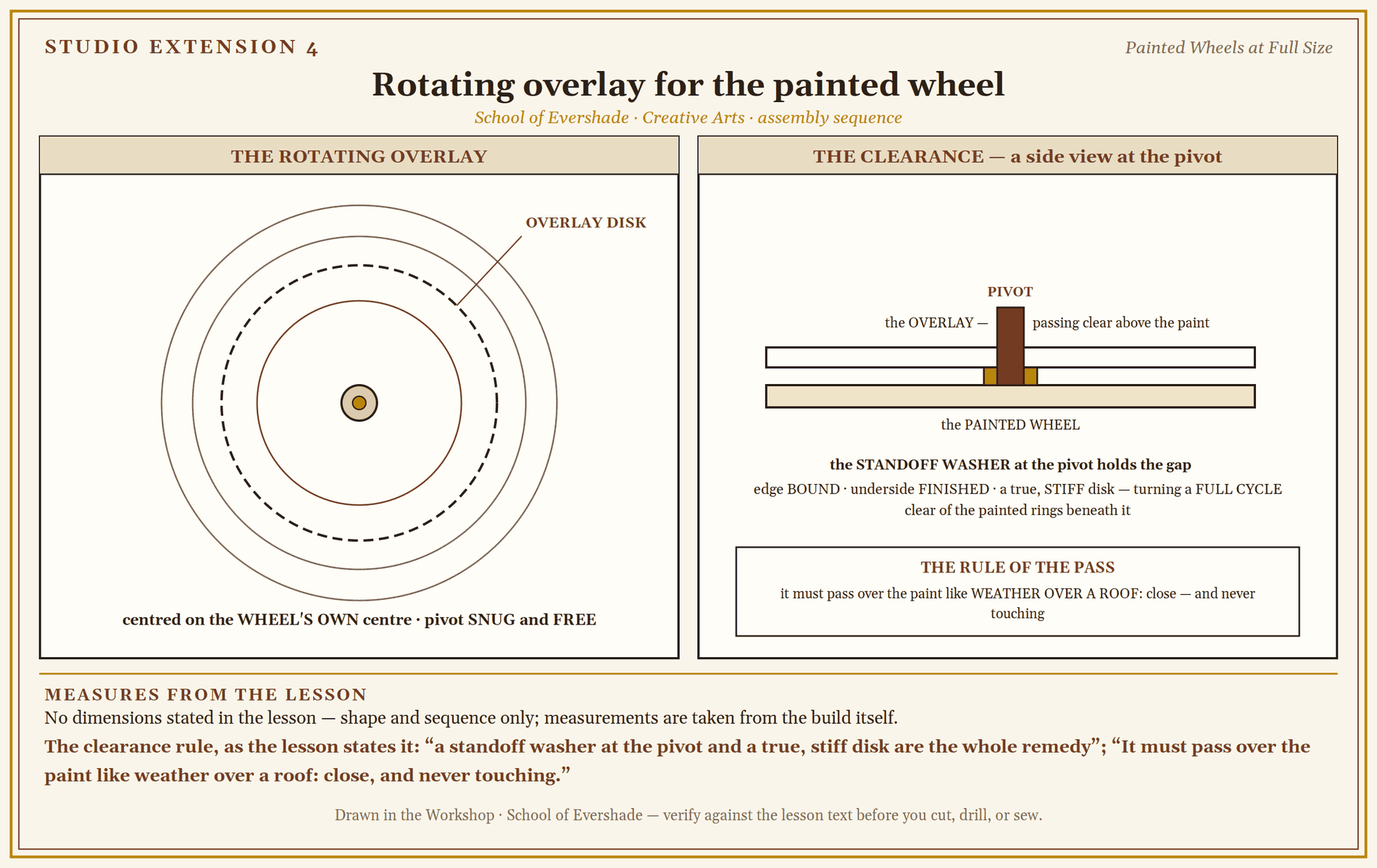
Rotating overlay for the painted wheel
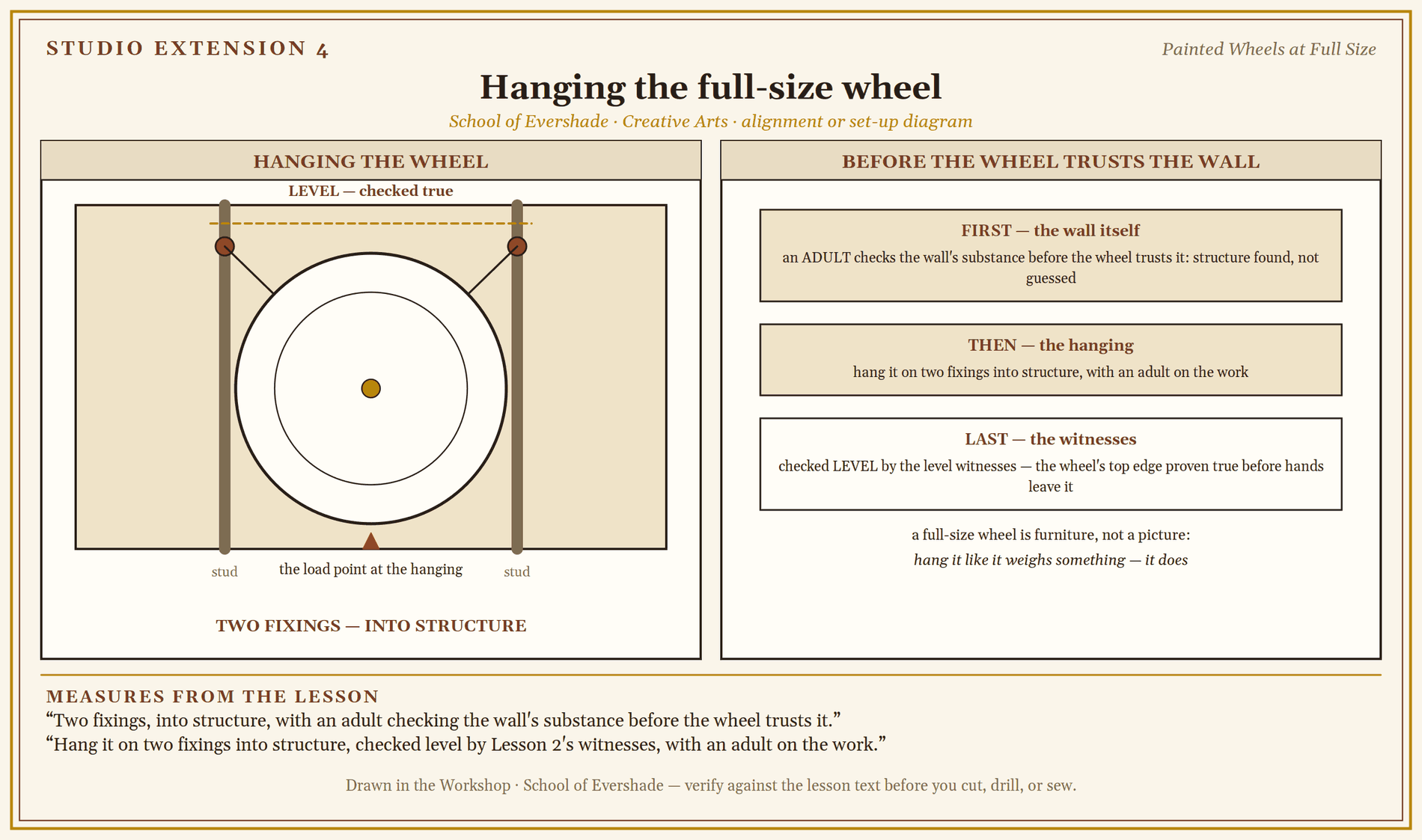
Hanging the full-size wheel
Assignment Manual
Assignment key: ✎ written work · ⚒ hands-on practical · ◐ both
Assignment I ⚒ — The Build
Complete the Build in this extension: one of Celestial Studies' paper wheels painted at full size on board, with closing divisions, chart-proven colors, a fitted overlay where the cycle requires one, a maker's plate, and a sound hanging.
Assignment II ✎ — The Book of Wheels
Using the lesson and the sources below, write a short account of the rota tradition. Cover: what Isidore put into wheels and what medieval readers called his book because of it, the problem computus existed to solve, and the three numbers, 19, 28, and 532, that every calendar wheel carries in its rings.
Assignment III ◐ — Read the Wall
Choose a date, past or future, and work it on your finished wheel: find its golden number, its dominical letter, its moon's age, or its feast, according to the wheel you built. Present the reading with a written account of each step, and a second scholar's independent reading of the same date from the same wheel. Where the readings differ, the account of why is the assignment's heart.
Materials
Level One (household)
- A board for the wheel: plywood, MDF, or joined planks, at the full size chosen, sanded and sealed on both faces
- A large compass or a beam compass made from a strip of wood, a pin, and a pencil, with dividers and a protractor
- Student pigments or quality poster/acrylic paints in the Lesson 15 palette, with brushes for ring work and lettering
- Board or thick card for the overlay disk, a brass paper fastener or screw post and washers for its pivot
- A straightedge, pencils, and the wheel's color chart from Lesson 15
- Hanging hardware rated for the finished weight, and an adult for the hanging
Level Two (historical)
Everything in Level One, plus:
- Pigments ground and mulled by hand at Lesson 15's stone, in the medieval palette of ochres, carbon black, red earth, and garden-grown woad or madder where the lesson provides them
- A solid planked panel, joined and planed, in place of manufactured board
- Gilding substitute or bronze paint for the sun ring and the hub, in the manner of the manuscript wheels' gold
- A turned wooden hub and a leather-hung frame, so the wheel hangs as the old rotae hung in their halls
Both levels paint the same wheel to the same proof: the divisions close, the colors match the chart, and the overlay turns without touching the paint. Level Two's hand-ground color will mellow where Level One's holds bright; both are honest aging, and the log records which to expect.
Reflection Questions
Answer the following questions in your workbook.
- Isidore's wheels were copied for eight hundred years by scribes who redrew them by hand. What does a wheel know that a paragraph cannot say, and what does the paragraph keep that the wheel loses?
- Easter's date is a negotiation among the sun, the moon, and the week. Why did that negotiation need to be a science, with wheels and tables, rather than a decision made fresh each year?
- Your wheel will be read by people who cannot ask you questions. What did you owe them when you lettered its plate, and did the plate pay the debt in full?
- A division that does not close is an error distributed politely around the whole circle. Where else does a small wrongness hide by spreading itself thin?
- The paper wheel taught the cycle; the painted wheel commemorates it. What is the difference between a teaching tool and a monument, and when does a class need the second?
Professor's Review
Stand back with me, scholars, all the way to the door, and read it from there. That is the test a wall piece must pass: not the bench's distance, the room's.
The cycles on that board were old when Isidore drew them, and they will be running when this castle is a ruin with better stories. You have not improved them. You have given them a body equal to their patience, which is all any maker in this course has ever done, and it is enough. When a scholar in some future year finds a feast or a moon's age from your wheel and never thinks to ask whose hand painted it, the wheel will be doing precisely the work its first makers intended, in a book or on a wall.
Keep the chart and the log with the wheel's records. Colors fade toward each other over decades, and the chart is how the next repairer will know what the rings once said.
PROFESSOR COGBRANCH TIMBERCLANK
Creative Arts Workshop
Master Artisan, Head of House Occidens
Further Reading & Sources
University of Edinburgh, ArchivesSpace. "De natura rerum by Isidore of Seville, 12th–13th century." A real Book of Wheels in its catalogue record: Isidore's text on the nature of things, accompanied, as the record notes, by its diagrams and figures.
Wikipedia, "The Reckoning of Time." Bede's treatise of 725: its structure, its Easter reckoning after Dionysius, and its instructions for the sun and moon through the zodiac.
Bridwell Library, Southern Methodist University. "Calendrical Volvelle." The computus wheel alive in print: the 1717 Book of Common Prayer's rotating table for Easter and the moveable feasts, with a worked example.
Wikipedia, "Volvelle." The rotating construction that carried the calendar wheels into books, from medieval astronomy pages onward.
Student-friendly starting points for exploring this extension's world. All links verified October 2026.
- The Bridwell Library's exhibition on moving parts in books. Begin with the calendrical volvelle and wander the exhibition: three centuries of wheels doing arithmetic inside prayer books.
- Print only: Isidore of Seville, On the Nature of Things, translated by Calvin B. Kendall and Faith Wallis (Liverpool University Press, Translated Texts for Historians 66, 2016), the first English translation, whose introduction explains how the diagrams gave the work its medieval name, the Book of Wheels.
- Print only: Bede, The Reckoning of Time, translated by Faith Wallis (Liverpool University Press, 1999), the standard English edition of the computus classic, with an introduction that maps the whole science of medieval time reckoning.
Submit your work for this lesson using the form below.
CONTINUE IN THE CREATIVE ARTS WORKSHOP
← Previous · Studio Extension E3: Models That Move, Built as Machines Next · Studio Extension E5: Relief & Scale Displays →
Creative Arts Workshop · All 39 Lessons
Bookstore Shelf The Library · Creative Arts Shelf Course Supplies
The rest of the Workshop Extensions: E1 · Precision Paper Instruments · E2 · The Permanent Sundial · E3 · Models That Move · E5 · Relief & Scale Displays