

Creative Arts
Studio Extension E1Precision Paper Instruments, Built to Last
Professor Cogbranch Timberclank
Master Artisan, Head of House Occidens
The Creative Arts Workshop • School of Evershade
This is a Studio Extension: optional, always, and never required for any lesson in any class. It assumes these tickets are already in your hands: Lesson 3, "Cutting, Scoring & Clamping," Lesson 4, "Piercing, Drilling & Fastening," and Lesson 7, "Paper, Card & Board Construction." If one of those is missing, take it first. The Workshop keeps no locked doors, but it does keep an order, and this build stands on those three.
Professor's Introduction

Set up your bench, scholars, and bring the paper instruments with you: the planisphere from Professor Glimmerwick's tower, the little astrolabe, and the cipher wheel from Professor Nocturne's library.
You already know their weakness, because you have used them. A paper instrument fails at its center. The pivot hole stretches a little with every turning, the disk begins to wobble, the scales drift out of agreement, and one damp week in a schoolbag finishes what the wobble began. The geometry on the paper is sound. It is the paper that cannot hold it.
This extension rebuilds one of those instruments so it can be turned ten thousand times: the same scales, the same geometry, carried in board, in thin wood, in brass where brass earns its place, with a pivot fitted the way a hinge is fitted, and a case to keep it in. Nothing here is decoration added to the original. It is the original, given a body that lasts.
Choose one instrument and build it properly. A planisphere that will serve a decade of Sky Logs, or a cipher wheel in the manner of Alberti that will outlast every correspondent who uses it. The craft is the same craft either way: everything hangs on the center, and the center is where we will spend our care.
PROFESSOR COGBRANCH TIMBERCLANK
Creative Arts Workshop
Master Artisan, Head of House Occidens
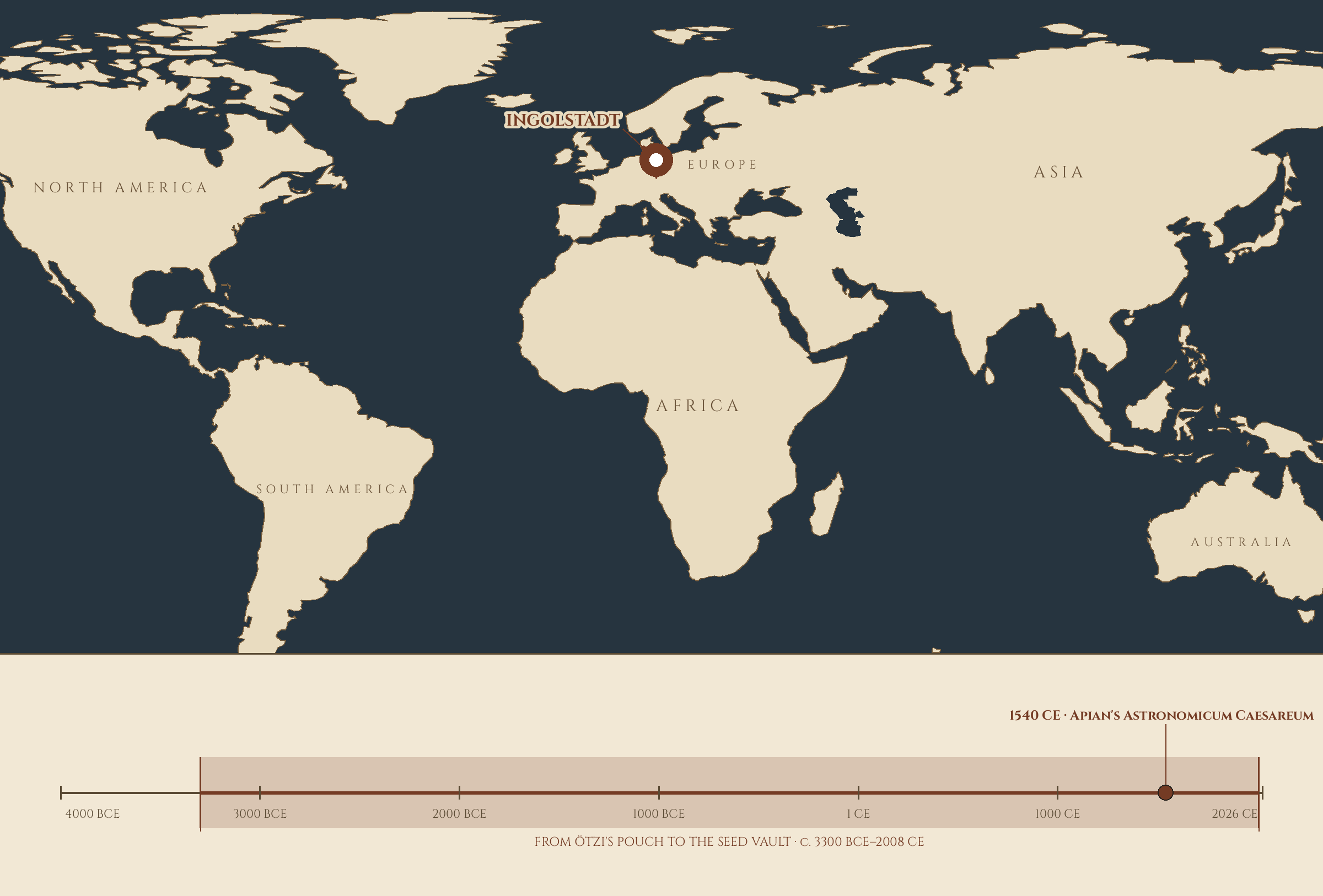
Where and when: Ingolstadt — 1540 CE, Apian’s Astronomicum Caesareum.
Lesson Objectives
By the end of this extension, students should be able to:
- Explain what a volvelle is and trace its path from medieval astronomy manuscripts to Apian's printed book of 1540.
- Describe Alberti's cipher disk of 1467: its two disks, its fixed and movable alphabets, and why the wheel itself was the invention.
- Name the parts of a planispheric astrolabe, mater, tympan, and rete, and say what each part does.
- Explain why a paper instrument fails at its pivot, and what concentricity means for any instrument built around a center.
- Build a durable rotating instrument in board or wood with a fitted pivot that turns without wobble.
- Graduate, check, and finish the instrument against its paper original, and make a fitted case for it.
Your Assignment Packet
This lesson's assignments live in its packet: the Lexicon Handout (every term, course terms marked ◆), the Assignment Manual, and the Reflection Questions. Download the packet before you begin and keep it beside you as you read — work from it as each subject is taught, or take the assignments as homework afterward.
Wheels in Books: The Volvelle and Apian
The rotating disk is older than printing. Volvelles appear in European astronomy manuscripts from the thirteenth century onward, sewn or pinned into books so that a reader could turn a wheel and find the Moon's place, a feast day, or the configuration of the spheres. The Majorcan thinker Ramon Llull built his logic on concentric — sharing one center exactly — rotating disks in the same centuries, turning combinations of letters against each other to work through questions systematically. The wheel chart was, from the beginning, a computer made of the book's own materials.
Print gave the volvelle its masterpiece. Peter Apian, mathematician and printer at Ingolstadt, spent some eight years producing the Astronomicum Caesareum, published in 1540 and dedicated to the Emperor Charles V and his brother Ferdinand. The Museum of the History of Science at Oxford describes it as predominantly an instrument in the form of a book: twenty-one volvelle pages — some carrying up to six movable parts — realizing the Ptolemaic planetary theory in paper, a pair for each planet, with small circles, the epicycles, rotating and traveling along large ones, the deferents, so a reader could compute a planet's longitude and latitude for any date. Those wheel charts are equatoria: instruments, in metal or as a book of volvelles, for computing the positions of the planets from tables without working the full geometry each time. The National Library of Scotland, which holds a hand-colored copy, notes that the volvelles were Apian's way of representing the functions of the astrolabe in print: as many as six independently rotatable dials on a page, with silk strings for fiducial lines and pearls threaded on the strings to mark a point. A fiducial line is a reference line trusted for measurement, against which positions are read. It was astronomy explained without the heavy mathematics, for patrons and readers who wanted the answers the instrument gives.
The book appeared just three years before Copernicus published the work that began displacing the Earth-centered system it so beautifully computes. That does not diminish it. Apian's volvelles are the paper instrument at its highest reach, and every planisphere in a modern schoolbag descends from that tradition.
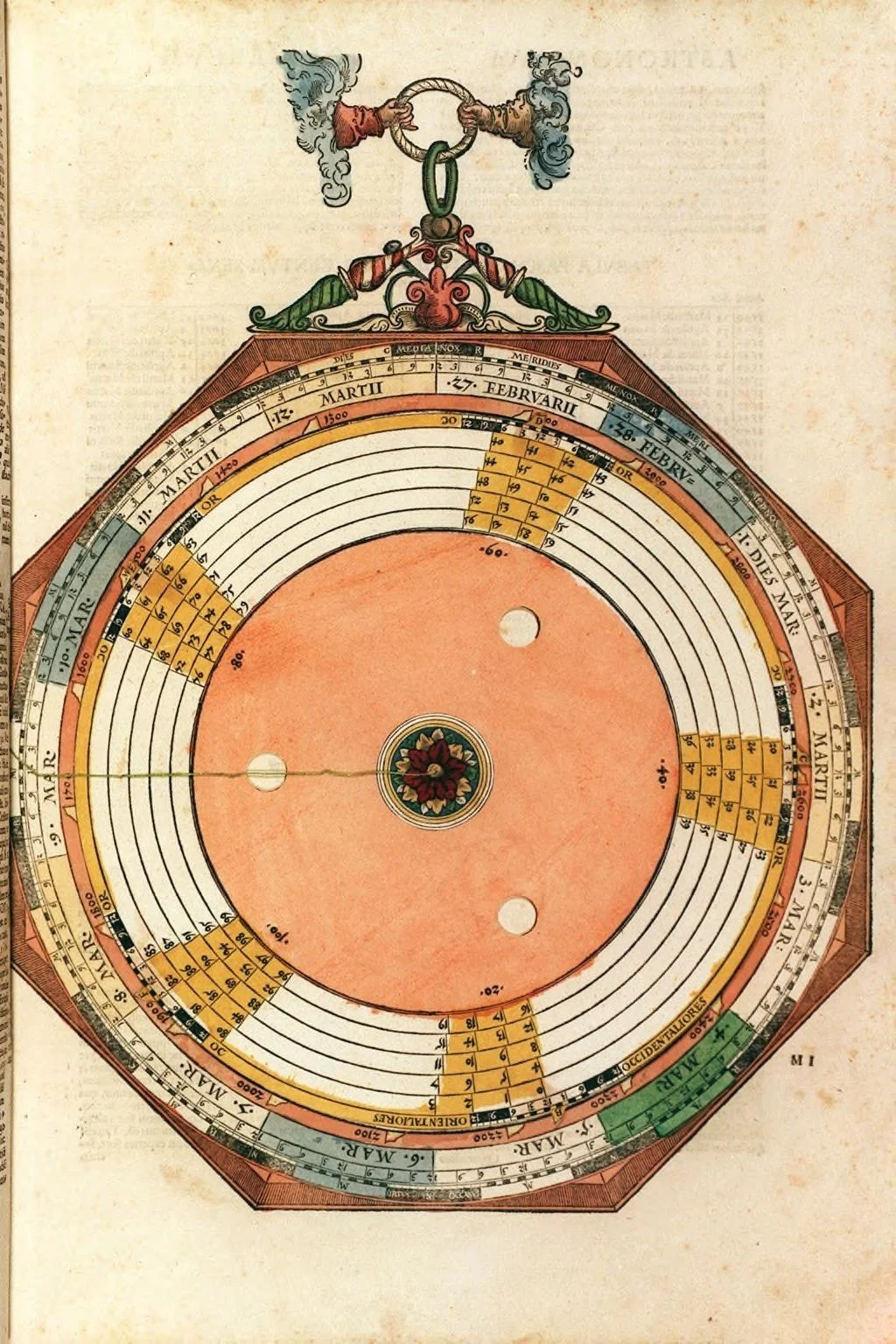
A movable paper disc (volvelle) from Petrus Apianus, *Astronomicum Caesareum* (1540) — a rotating paper instrument for determining the dates of the equinoxes to the minute.
Public domain — Petrus Apianus, Astronomicum Caesareum (1540), via Wikimedia Commons (Gallica / Bibliothèque nationale de France).
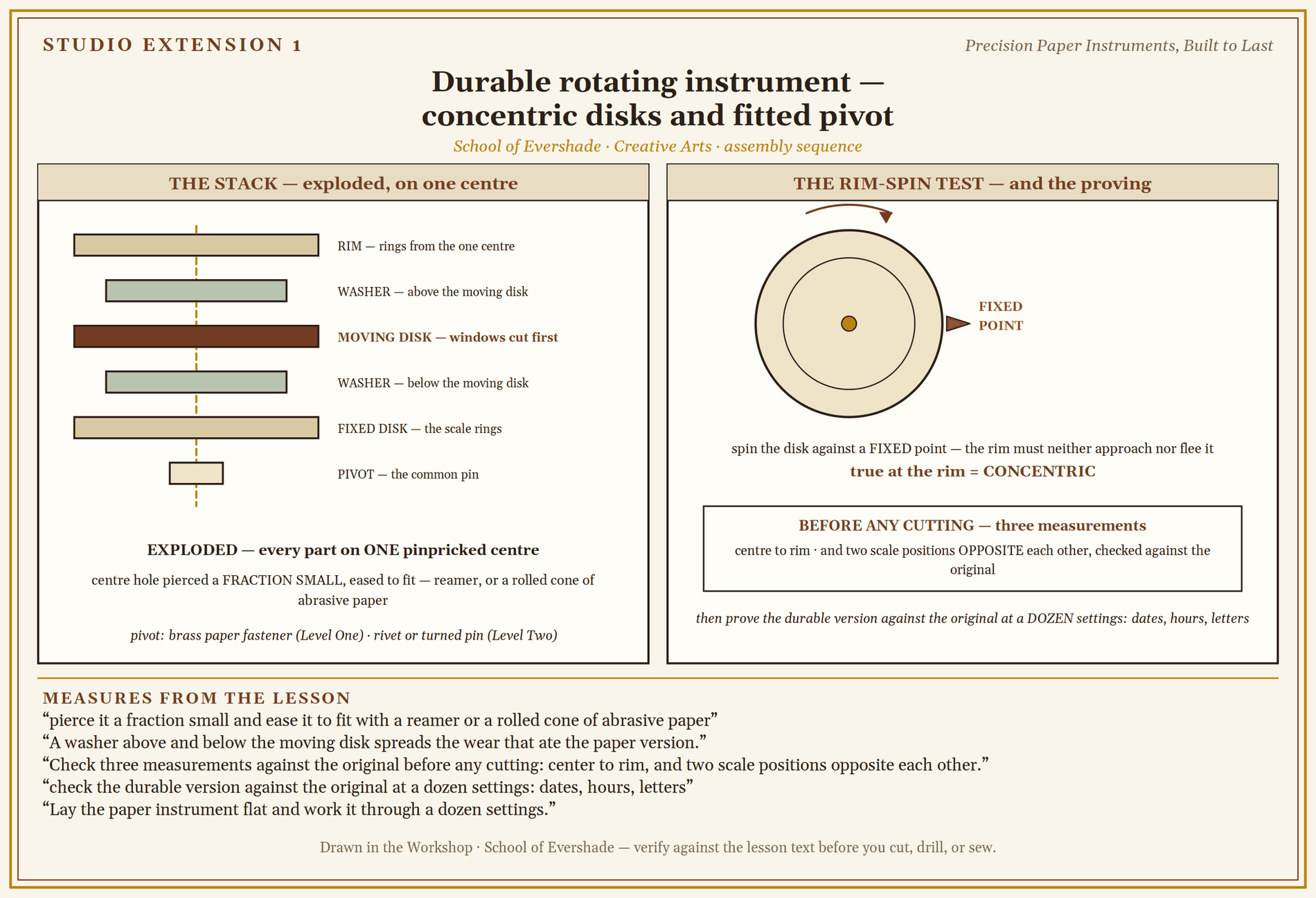
Durable rotating instrument — concentric disks and fitted pivot
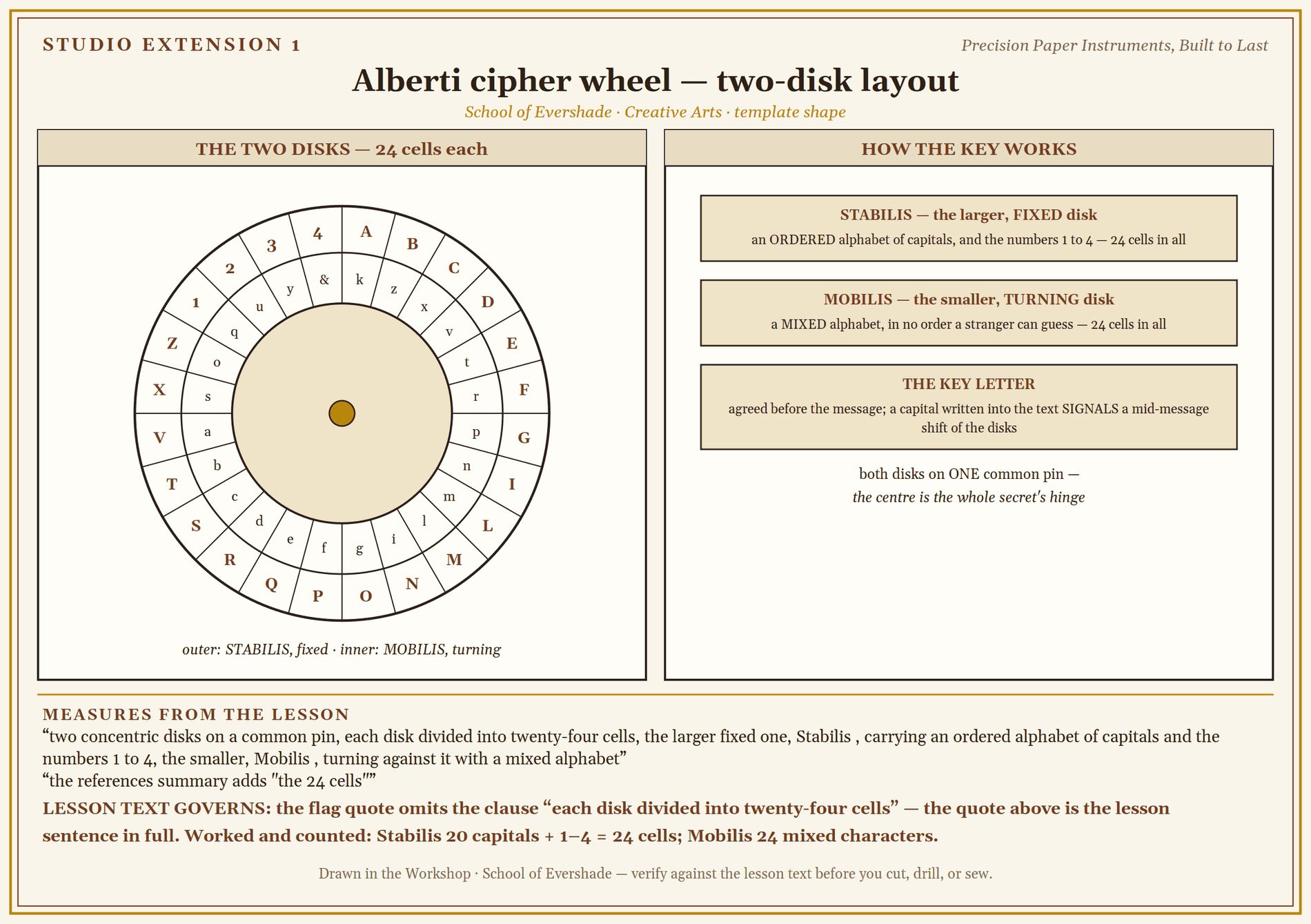
Alberti cipher wheel — two-disk layout
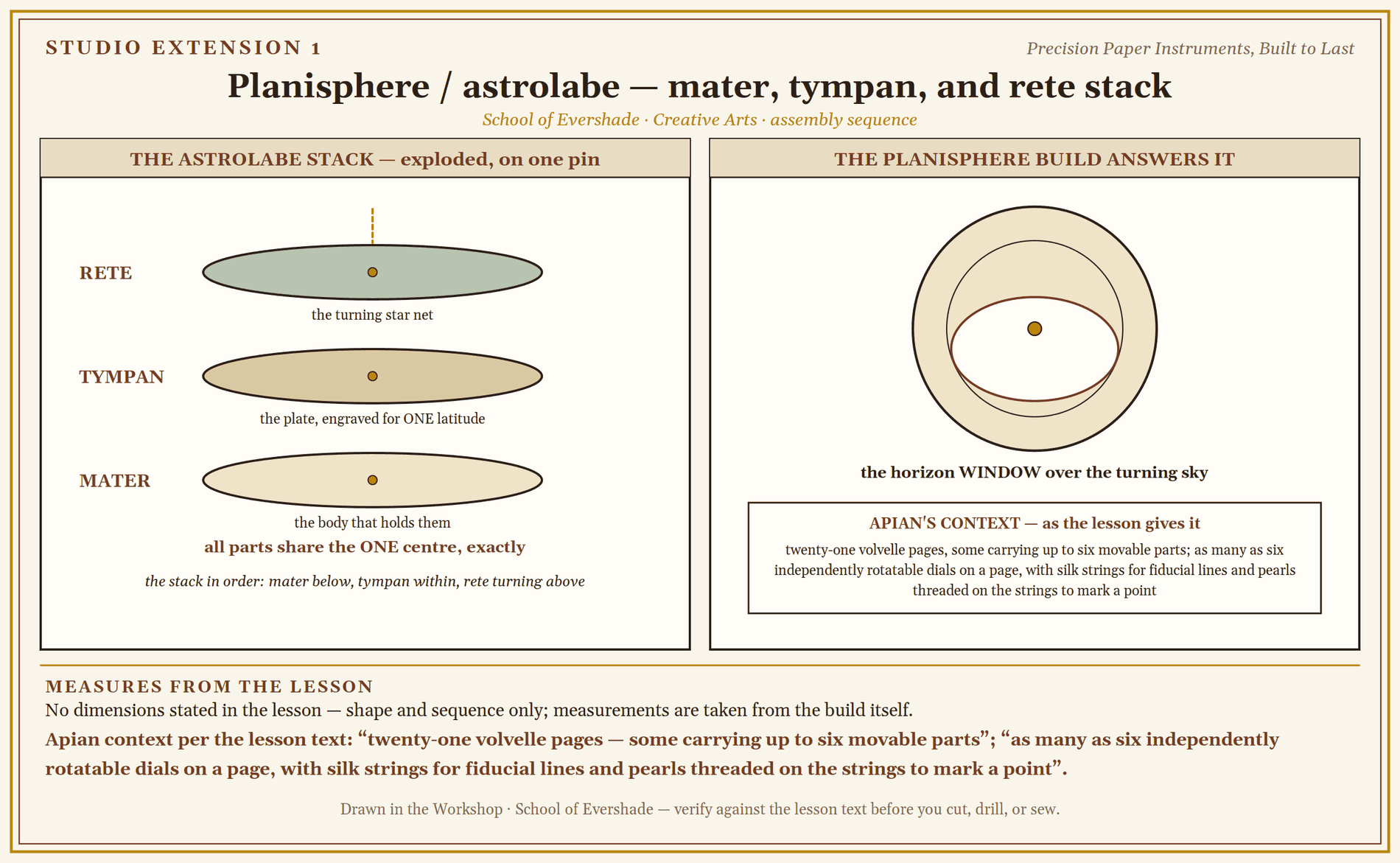
Planisphere / astrolabe — mater, tympan, and rete stack
Brass Before Paper: The Astrolabe and Alberti's Disk
Paper borrowed its geometry from metal. The planispheric astrolabe, a flat projection of the sky's dome onto a disk, has Greek roots: Theon of Alexandria wrote a detailed treatise on it in the fourth century, and the instrument was in brass in the Christian East by the seventh. Astronomers of the medieval Islamic world developed it into a precision instrument, adding azimuth circles to its plates; the earliest surviving astrolabe is dated to 927–928, and al-Sufi described more than a thousand uses for it. It passed into Europe through Spain, was written about for a young reader by Chaucer, and served astronomy, surveying, and timekeeping for the better part of two thousand years. Its construction is the construction of this extension: a mater, the body; a tympan, the plate engraved for a latitude; a rete, the turning star net; all stacked on one central pin, all depending on that pin being true. Metal astrolabes avoided the warping that large wooden ones suffered, which is the same lesson your paper planisphere teaches in a schoolbag.
The cipher wheel took the same form for a different secret. In 1467 Leon Battista Alberti described the disk he called his Formula: two concentric disks on a common pin, each disk divided into twenty-four cells, the larger fixed one, Stabilis, carrying an ordered alphabet of capitals and the numbers 1 to 4, the smaller, Mobilis, turning against it with a mixed alphabet. By shifting the movable disk mid-message, signaled by a key letter written into the text, Alberti made one of the first polyalphabetic ciphers, a cipher that changes its own alphabet as it goes. Scrollwork's paper cipher wheel is this device in classroom dress. Built in board and brass, fitted and cased, it is this device as Alberti's correspondents would have wished to own it.
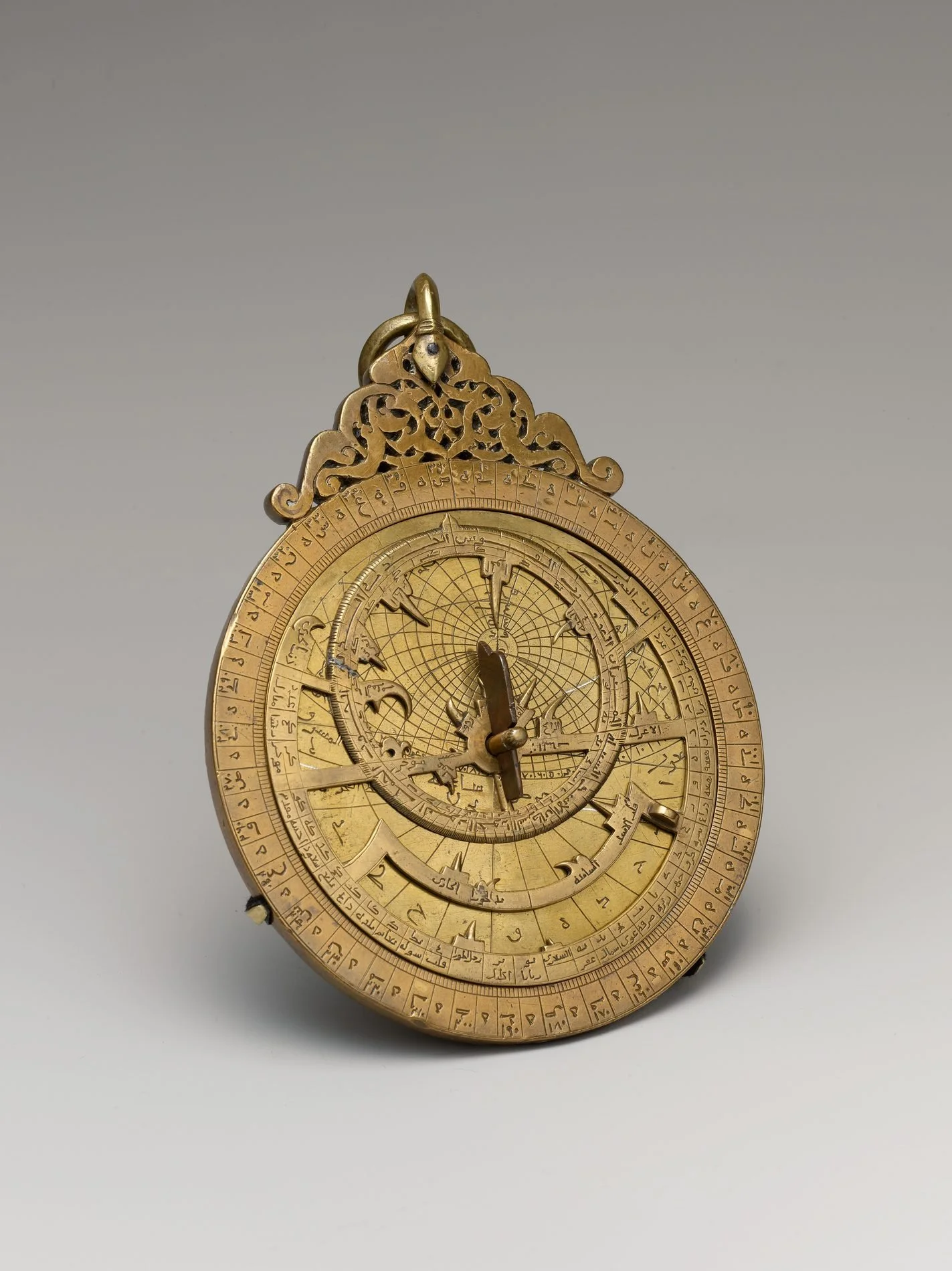
The planispheric astrolabe of ʿUmar ibn Yusuf ibn ʿUmar ibn ʿAli ibn Rasul al-Muzaffari, dated 690 AH / 1291 CE, Yemen — brass, cast and hammered, pierced, chased, and inlaid with silver; rete, plates, and case in one instrument, 15.6 cm in diameter.
The Metropolitan Museum of Art, Open Access (CC0).
A Sealed Note from Professor Timberclank
An instrument on a pivot is cut in circles, and circles are cut with tools that travel. Hear the rules for traveling tools.
The work is clamped or pinned to the bench before any circle is cut. A disk held in the hand while a compass cutter goes around it will end with the hand in the road. Keep the holding hand behind the center pin, never ahead of the blade's path, and let the tool make several light passes rather than one deep one.
The pivot hole is drilled or pierced with the disk flat on scrap wood, so the point comes through into scrap and not into the bench, a leg, or a palm. Awls and drills point down into the work, always, and are set down the moment they are not cutting.
A disk that binds on its pivot is not freed by forcing it. Forcing bends the pin, and a bent pin ruins every reading the instrument will ever give. We stop. We make it safe. Then we begin again.
The finish asks for the same respect as the blade, scholars, in a quieter voice. Varnish and lacquer are worked with air moving through the room and no flame near the bench, their lids closed the moment the brush leaves them, and any cloth they have touched spread flat outdoors to dry, never wadded into a bin while it is still wet with finish. If the room's air begins to carry the finish strongly, the work is telling you something. We stop. We make it safe. Then we begin again.
PROFESSOR COGBRANCH TIMBERCLANK
Creative Arts Workshop
Master Artisan, Head of House Occidens
Technique: The Center Decides Everything
Concentricity first. Every scale on the instrument is drawn from the center, and every part turns around it. Mark the center once, with a pinprick, and do all layout from that mark: compass work, scale rings, the rete's pointers. If a part's center and the instrument's center disagree by a hair, the readings disagree by more. Check by turning: set the finished disk spinning slowly and watch its rim against a fixed point. A true disk's rim stays steady; a false one breathes in and out.
The pivot is a fitted joint. Lesson 4's fastening ticket is spent here in full. The pivot, a brass paper fastener at Level One, a rivet or turned pin at Level Two, must be snug enough that the disk does not wander and free enough that it turns under a fingertip. The craft is in the hole: pierce it a fraction small and ease it to fit with a reamer or a rolled cone of abrasive paper, testing as you go. A washer above and below the moving disk spreads the wear that ate the paper version.
Graduate from the original, then check against it. The paper instrument from its home class is the master pattern. Transfer its scales exactly; invention has no place in a scale ring. Then check the durable version against the original at a dozen settings: dates, hours, letters. Where they disagree, the new build is wrong until proven otherwise, and the fault is almost always at the center.
Finish without warping. Board and thin wood warp when one face is sealed and the other is left thirsty. Whatever finish the faces get, varnish, lacquer, or wax, both faces get it, in the same session. The historical makers lacquered and edged their instruments for the same reason. A rim binding of cloth, leather, or thin brass is not decoration; it is armor for the edge that hands will actually hold.
The Build: One Instrument, Built to Last
This build is checked for a true center, a free pivot without wobble, and agreement with the paper original.
The finish asks for the same respect as the blade, scholars, in a quieter voice. Varnish and lacquer are worked with air moving through the room and no flame near the bench, their lids closed the moment the brush leaves them, and any cloth they have touched spread flat outdoors to dry, never wadded into a bin while it is still wet with finish. If the room's air begins to carry the finish strongly, the work is telling you something. We stop. We make it safe. Then we begin again.
- Choose and study the original. Lay the paper instrument flat and work it through a dozen settings. Note where it is already wearing: the pivot hole, the rim, any scale your thumb crosses. Those are the places the durable build must strengthen.
- Transfer the scales. Trace or copy every scale, ring, and lettering from the original onto your board or wood blanks, working from the pinpricked center outward. Check three measurements against the original before any cutting: center to rim, and two scale positions opposite each other.
- Cut the disks. Clamp the work. Cut each disk in light passes under the sealed note's rules, then sand the rim true, testing with a slow spin against a fixed point. Cut any windows or piercings (the planisphere's horizon window, a rete's openings) now, while the disk can still be replaced cheaply.
- Pierce and fit the pivot. Pierce the center hole in each part, a fraction small, over scrap wood. Ease each hole to the pivot until the part turns freely and sits without side-play. Fit washers above and below every moving part.
- Assemble and graduate the check. Stack the instrument in its working order. Run the full dozen settings against the paper original, disk by disk, and log every disagreement in your workbook with its cause: center, hole, or transfer. Correct the build, not the log.
- Finish both faces. Apply the finish to every face in one session, rim binding included, and let it cure fully before the instrument is handled. A finish tested too early wears in fingerprints.
- Make the case. Measure the finished instrument and build its case to those measurements, not the plan's: a board or cloth case with the instrument's name and latitude, cipher, or sky on its cover, and a closure that cannot swing open in a bag.
- Write the maker's plate. On the case's inside cover, write the instrument's particulars: what it computes, what it assumes (the latitude for a planisphere or tympan; the index convention for a cipher wheel), its maker's name, and its date. Brass instruments carried such plates. Yours is cased like one, so it is documented like one.
When the instrument turns freely, agrees with its original at every setting you test, and closes into its own case, it has earned the word precision in its title.
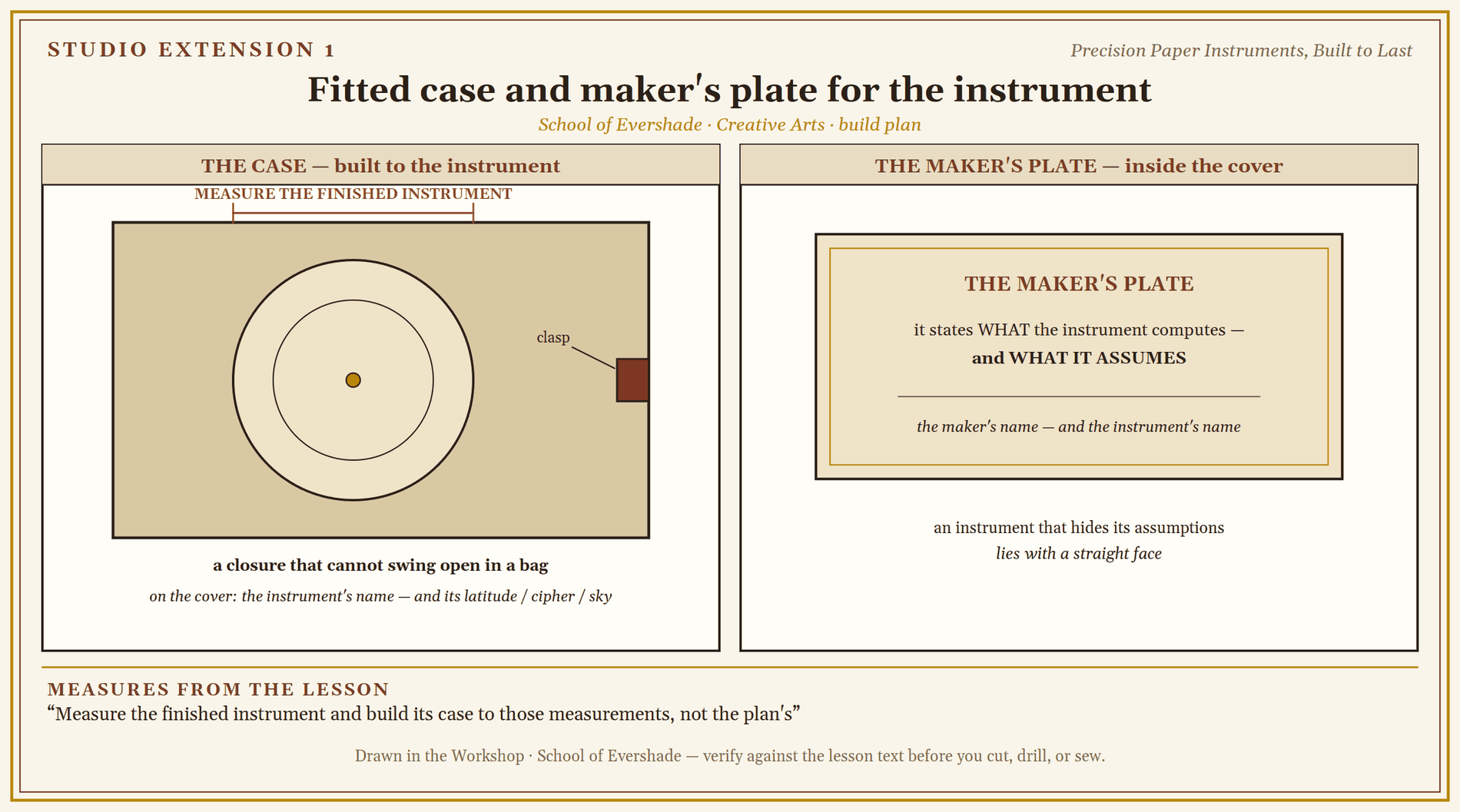
Fitted case and maker's plate for the instrument
Assignment Manual
Assignment key: ✎ written work · ⚒ hands-on practical · ◐ both
Assignment I ⚒ — The Build
Complete the Build in this extension: one paper instrument from a partner class rebuilt in durable materials, with a fitted pivot, finished faces, a case, and a maker's plate, checked against its paper original at a dozen settings.
Assignment II ✎ — From Brass to Paper and Back
Using the lesson and the sources below, write a short account of the translation this extension reverses. Cover: what the astrolabe's makers gained by working in brass, what Apian gained by rebuilding the astrolabe's functions as paper volvelles in a printed book, and what is lost each way. End with Alberti: why did a cipher, of all things, take the same two-disk form?
Assignment III ◐ — The Honest Instrument
Choose one setting of your finished instrument, a date, hour, or cipher shift, and verify it against an independent authority: the sky itself, a Sky Log, or a message enciphered and read back by a partner with the matching wheel. Present the instrument, the setting, and the verification together, with a short written account of any disagreement and its cause.
Materials
Level One (household)
- The paper instrument from its home class (planisphere, astrolabe, or cipher wheel), kept whole as the master pattern
- Thick board, mat board, or heavy card in two weights, or thin craft plywood
- A brass paper fastener of the longest reach available, with two washers cut from card or thin metal
- A compass, a compass cutter or craft knife and cutting mat, an awl, and a hand drill if the board is thick
- Glue suitable for board, fine abrasive paper, and clear varnish, lacquer, or furniture wax for finishing
- Cloth or heavy paper and board for the case, with a tie or button closure
Level Two (historical)
Everything in Level One, plus:
- Thin plywood or solid hardwood stock for the disks, and brass sheet for the rete or the cipher wheel's face
- A rivet, screw post, or turned wooden pin for the pivot, with metal washers
- Incising tools or a fine saw for cutting a pierced rete in the astrolabe manner
- Leather or tooled card for the case, in the manner of the instrument cases that traveled with brass astrolabes
Both levels build the same instrument to the same test: it must agree with its paper original at every setting, and turn freely without wobble. Level One's board and brass fastener, honestly fitted, will outlast a shelf of paper copies.
Reflection Questions
Answer the following questions in your workbook.
- Where exactly was your paper original wearing out, and what did that wear tell you about how the instrument is actually used, as opposed to how it was designed to be used?
- Apian's volvelles computed a system of the heavens that was already nearing its end. Does an instrument's craft outlive the theory it serves? What in this build would survive a change of theory?
- Alberti's disk hides information; the astrolabe reveals it. What does the same two-disk form do well in both services?
- The pivot hole is the smallest and least decorated part of the instrument, and it decides everything. Where else in the Workshop have you met that order of importance?
- A cased instrument with a maker's plate asks to be kept for decades. What do you owe a tool you build to that standard, and what does it owe the next pair of hands?
Professor's Review
Bring me the instrument and turn it. Slowly. There, you see: no wobble, no catch, the scale passing under the thread the way a well-hung door swings.
Paper taught you the geometry, and paper was the right teacher; it is cheap, forgiving, and quick to correct. But geometry deserves a body that can keep it. What you have built will be turned by scholars who have not yet arrived at this school, and it will give them the same true readings it gives you, which is the whole ambition of an instrument maker, stated plainly.
Keep the original with it. A durable instrument and its paper parent belong together in the case: the one to use, the other to remember what the use cost before you came.
PROFESSOR COGBRANCH TIMBERCLANK
Creative Arts Workshop
Master Artisan, Head of House Occidens
Cross-Class Connections

Scrollwork · Unit VII, Lesson 25 — Ciphers & Hidden Writing
Workshop scholars, the cipher wheel is born in my library: there we build Alberti’s disk in paper — two alphabets turning on one pin, a secret that changes its own key as it goes. Paper is the right first body for it, quick and forgiving and true. But a wheel meant to serve a year of correspondence deserves a stronger one, and this extension is that body: the same two disks rebuilt in board and brass, fitted to turn truly for a decade. Build the wheel with me first, and learn its principle in your fingers — then let Professor Timberclank make it last.
PROFESSOR QUILLBERRY NOCTURNE
Scrollwork Library
Further Reading & Sources
Museum of the History of Science, Oxford. "Peter Apian, Astronomicum Caesareum (Ingolstadt, 1540)." An instrument in the form of a book: the movable paper volvelles, epicycles riding on deferents, computing each planet's longitude and latitude for any date.
Wikipedia, "Volvelle." The rotating paper construction defined and illustrated, from medieval astronomy pages to Apian's Moon chart with its dragon markers.
Wikipedia, "Alberti Cipher." Alberti's Formula of 1467 in full: the fixed Stabilis and turning Mobilis, the 24 cells, the key letters, and the worked examples from his treatise.
Wikipedia, "Astrolabe." The brass parent of every paper instrument in this extension: its Greek roots, its development in the Islamic world, Chaucer's treatise, and the mater, tympan, and rete in detail.
Student-friendly starting points for exploring this extension's world. All links verified October 2026.
- National Library of Scotland. "Astronomicum Caesareum." The Library's hand-colored copy up close: five turning dials on a page, silk fiducial threads, and the pearls that mark a point on the line.
- Wikipedia's survey of the volvelle, with its gallery. A fifteenth-century volvelle of the Moon and the Sacrobosco wheel chart: the classroom planisphere's ancestors, in their books.
- Print only: Jessica Helfand, Reinventing the Wheel (Princeton Architectural Press, 2002), the standard modern celebration of the wheel chart in all its twentieth-century forms, held by larger libraries.
Submit your work for this lesson using the form below.
CONTINUE IN THE CREATIVE ARTS WORKSHOP
← Previous · Lesson 29: Foil, Wire & Simple Metalwork Next · Studio Extension E2: The Permanent Sundial & Horizon Alignment →
Creative Arts Workshop · All 39 Lessons
Bookstore Shelf The Library · Creative Arts Shelf Course Supplies
The rest of the Workshop Extensions: E2 · The Permanent Sundial · E3 · Models That Move · E4 · Painted Wheels at Full Size · E5 · Relief & Scale Displays