

Creative Arts
Studio Extension E3Models That Move, Built as Machines
Professor Cogbranch Timberclank
Master Artisan, Head of House Occidens
The Creative Arts Workshop • School of Evershade
This is a Studio Extension: optional, always, and never required for any lesson in any class. It assumes these tickets are already in your hands: Lesson 4, "Piercing, Drilling & Fastening," Lesson 23, "Wood, Grain & Safe Hand Tools," and Lesson 29, "Foil, Wire & Simple Metalwork." If one of those is missing, take it first. A machine is three crafts wearing one coat, and this build spends all three at once.
Professor's Introduction

Set up your bench, scholars, and bring the lamp-and-ball models from the Celestial tower: the Moon on its stick, the ball on its wire, the cardboard eclipse rig that has demonstrated a hundred phases and is held together now, if we are honest, largely by habit.
Those models taught you the geometry, which is the part Professor Glimmerwick teaches. Their weakness is the same weakness as Extension E1's paper instruments, one step further along: they move, and movement in cardboard is wear. Every demonstration loosens the joint it demonstrates. This extension builds the model as a machine: a framed base, arbors turning in real bearings, a crank, and a gear train or linkage chosen so that one slow turn of the handle carries the Moon through its month, or the balls through their eclipse geometry, at ratios that are right and will stay right. An arbor is the shaft a wheel or gear turns on, judged by its bearings: it must turn freely, without side-play, in the same plane forever. A linkage is a train of jointed bars that carries motion around corners and changes its character: rotation in, rocking out.
A machine is a promise that movement will repeat. Making that promise honestly, in wood and brass, with tooth counts you computed yourself and a crank that does not bite, is the most demanding bench work in this course, and the most satisfying. When it is done, your demonstrator will still be teaching eclipses to scholars not yet enrolled, which is the only fame a workshop should ask for.
PROFESSOR COGBRANCH TIMBERCLANK
Creative Arts Workshop
Master Artisan, Head of House Occidens
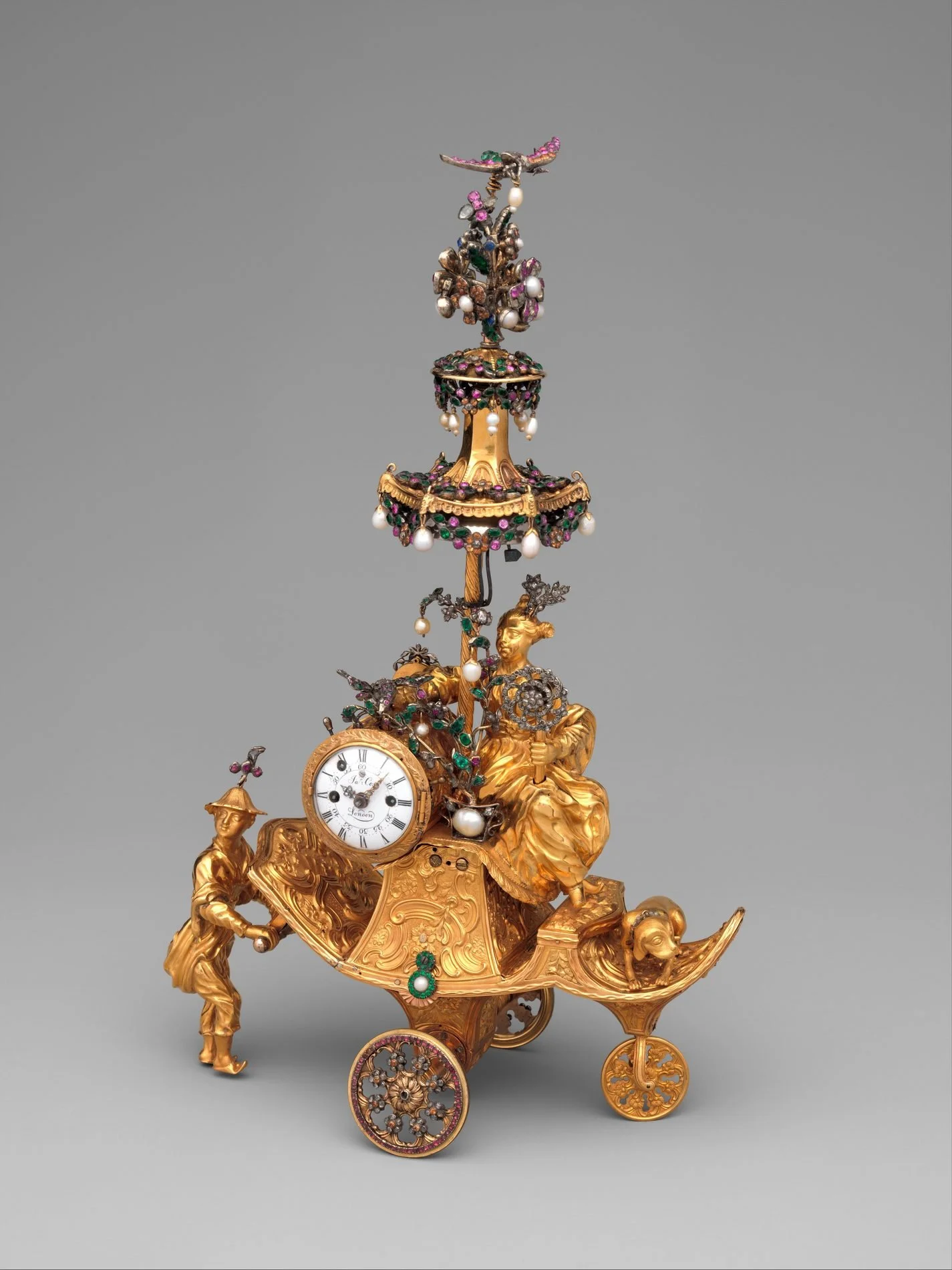
An automaton in the form of a chariot pushed by a Chinese attendant and set with a clock, by James Cox, London, 1766 — gold case set with paste jewels and pearls, white enamel dial, movement of partly gilded brass and steel.
The Metropolitan Museum of Art, Open Access (CC0).
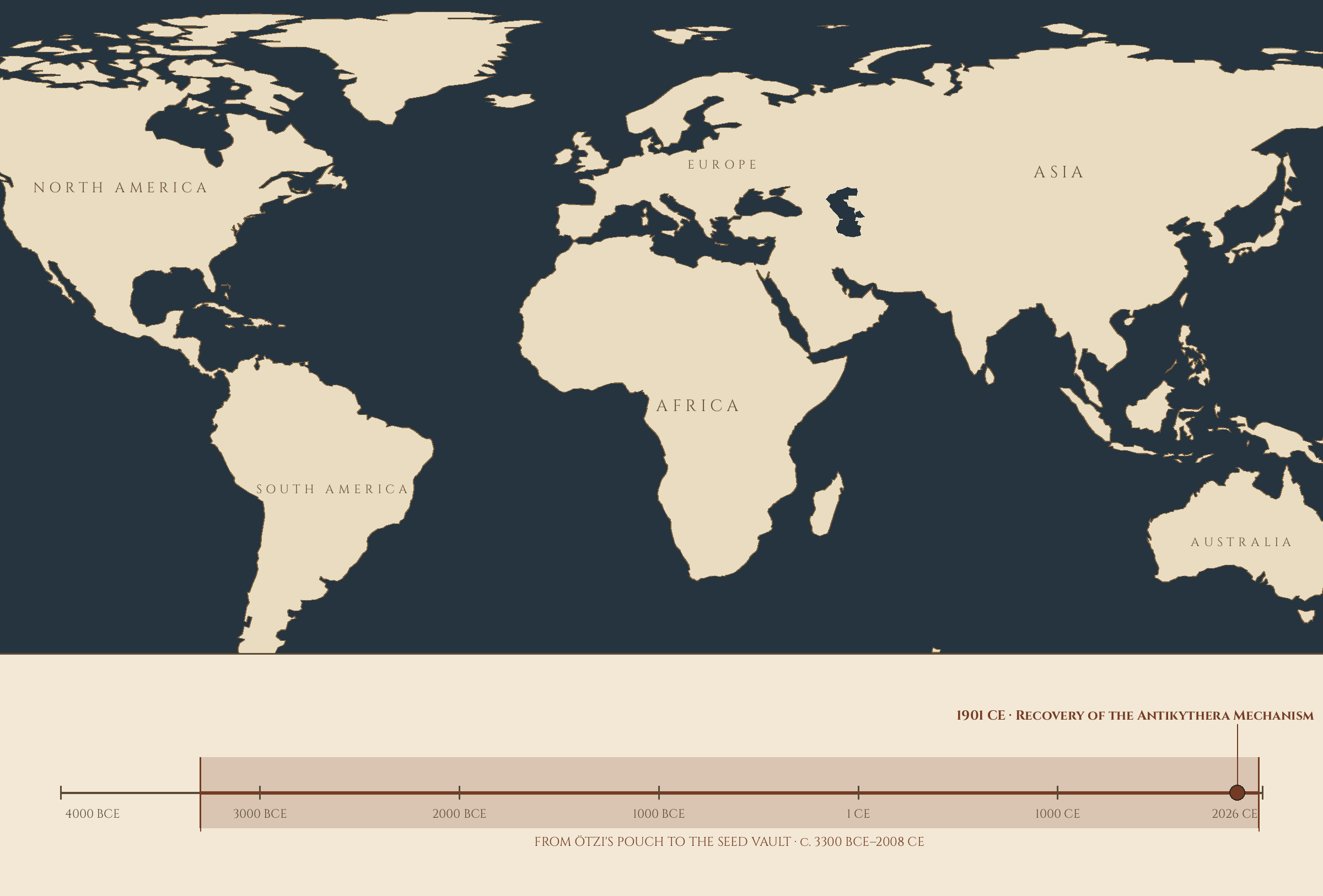
Where and when: the Antikythera wreck, Greece (no pin — the island is too small for this scale) — 1901 CE, recovery of the Antikythera mechanism.
Lesson Objectives
By the end of this extension, students should be able to:
- Describe the Antikythera mechanism at survey level: its date, its gears, what it computed, and which of its features remain debated.
- Trace the orrery tradition from Greek planetaria through Dondi's Astrarium to Graham and Tompion's orrery of 1704 and the name it took from the Earl of Orrery.
- Explain how Kelvin's tide-predicting machine summed astronomical cycles mechanically, and why it is this extension's patron instrument.
- Choose gear ratios from tooth counts to match a real astronomical period ratio, and explain backlash and why a demonstrator tolerates it.
- Distinguish the work of gears, cams, and linkages, and choose the right one for a given motion.
- Build a durable crank-driven demonstration model with a framed base, true arbors, and a maker's plate stating its ratios.
Your Assignment Packet
This lesson's assignments live in its packet: the Lexicon Handout (every term, course terms marked ◆), the Assignment Manual, and the Reflection Questions. Download the packet before you begin and keep it beside you as you read — work from it as each subject is taught, or take the assignments as homework afterward.
The Machine in the Shipwreck
In 1901 sponge divers working a wreck off the Greek island of Antikythera brought up, among statues and pottery, a corroded lump of bronze and wood about the size of a shoebox. When it dried and cracked, gear wheels showed inside it. The Antikythera mechanism, built in the second century BCE, is the oldest known analog computer: at least thirty bronze gears survive, of a total that reconstructions put far higher and still argue over, cut with triangular teeth, turning in a wooden case. Turned by a hand crank, it followed the Sun and Moon through the zodiac, predicted eclipses on its Saros dial, the 223-month eclipse cycle, tracked the nineteen-year Metonic calendar cycle, and kept the four-year cycle of the great games. Its Moon did not move at a steady speed: a pin-and-slot device made it hurry and linger as the real Moon does, following the lunar theory of Hipparchus. It is honest to say what remains debated: a portion of the machine is missing, and whether and how it displayed the five planets is reconstruction, not certainty. What is not debated is the gap after it. Nothing of comparable complexity appears again until the astronomical clocks of the fourteenth century, those of Richard of Wallingford and Giovanni de' Dondi, whose Astrarium, begun in 1348, drove its planetary dials by clockwork. The machine tradition, once lost, had to be reinvented at full price.
Orreries, and the Machine That Summed the Sea
The reinvented tradition flowered in the eighteenth century as the orrery: a geared model of the solar system with planets on brass arms over a wheelwork base, cranked or clock-driven. The Greeks had planetaria, but the first orrery of the modern era was built in 1704 by the clockmakers George Graham and Thomas Tompion; John Rowley's copy for Charles Boyle, 4th Earl of Orrery, gave the instrument its name. The family's specialist children, in the Museo Galileo's naming, are the lunarium, which models the Moon's motions around the Earth, and the tellurian, which models the Earth's revolution, rotation, and seasons. The Museo Galileo's catalogue notes what the orrery makers knew: the periods can be made nearly true by gearing, the Earth circling in about ten minutes on Graham-type demonstration models, while sizes and distances cannot be to scale in any room that exists, a confession this course makes on every maker's plate. And the tradition is not only a professionals' story. Eise Eisinga, a wool carder of Franeker, built a planetarium into his living-room ceiling between 1774 and 1781, planets circling in real time above his family's heads; it is still running, and is often called the oldest working planetarium in the world.
This extension's patron machine stands at the tradition's far end. In 1872–73 William Thomson, later Lord Kelvin, had the instrument maker Alexander Légé build his first tide-predicting machine: eight tidal components, each a geared shaft with an adjustable crank, their motions summed by pulleys and a cord into one drawn curve. Its successor of 1875–76 combined ten and could lay out a whole harbour's year of tides in about four hours. Kelvin's insight was that the bewildering tide is a sum of simple cycles, and a machine that turns each cycle at its true rate and adds them cannot help but draw the truth. Your demonstrator is Kelvin's machine at school scale: cycles, rates, an honest sum, and a crank.
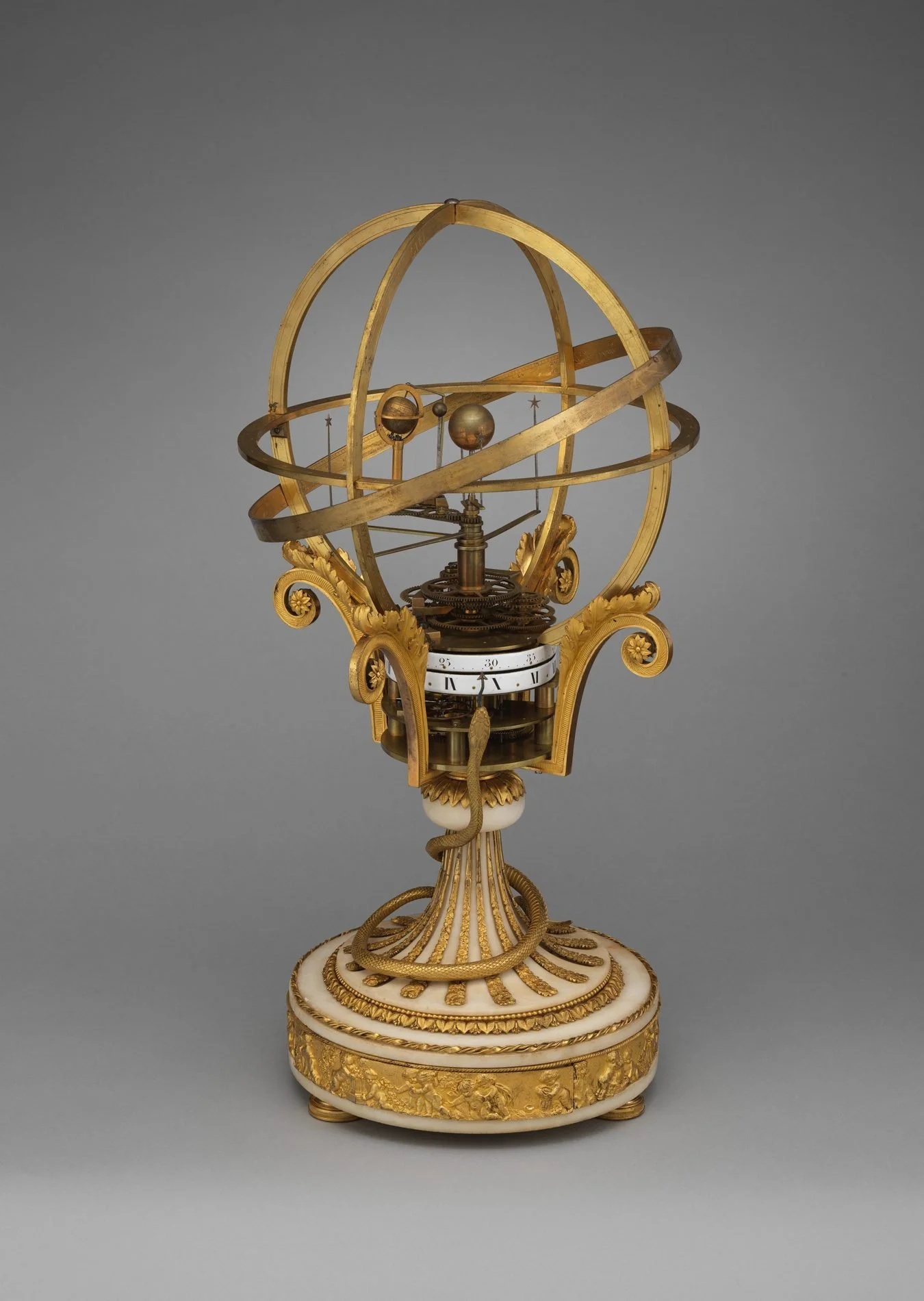
An orrery clock by Louis Thouverez (French, master 1788), dated 1790 — cast and gilded bronze, Carrara marble, copper, brass, steel, and enamel, 48.3 cm high: the planetary orrery carried on its clock.
The Metropolitan Museum of Art, Open Access (CC0).
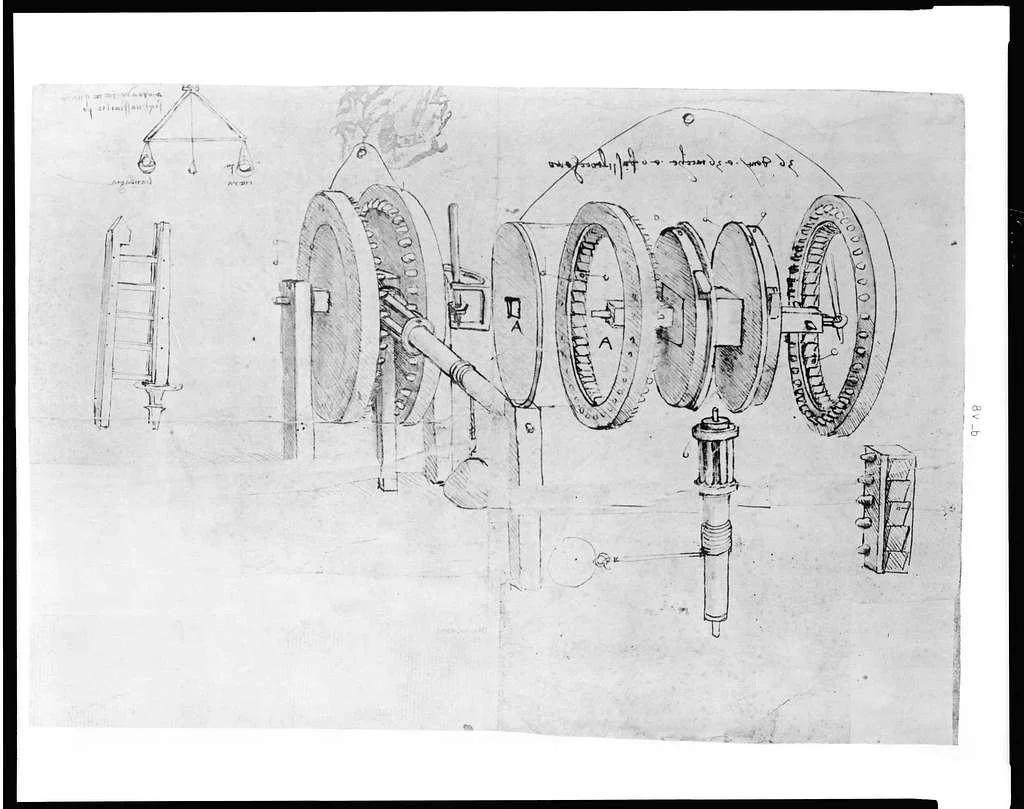
A page from Leonardo da Vinci's notebooks (Codice Atlantico) showing a geared device drawn twice — assembled and disassembled — gears, shafts, and mountings laid out as a working drawing.
Library of Congress — no known restrictions on publication (Leonardo da Vinci, Codice Atlantico, reproduction published 1894–1904).
A Sealed Note from Professor Timberclank
A machine's hazard is that it moves, scholars, and it keeps moving after your attention stops.
Fingers stay out of meshing gears while a crank is turning, and a model's crank is turned by one hand only, the other clear of the train. A gear pair does not know the difference between a demonstration and a pinch, and it will not learn.
When you test a train, turn it slowly, by hand, unpowered by any spring or weight, through two full cycles before it is ever run at speed. A tooth that binds at slow speed breaks at fast speed, and a spring-driven train is never opened under tension. Springs are let down before they are handled, the way Lesson 5 taught us to respect stored heat: stored motion is the same respect in another dress.
And small parts under tension, pins, clips, and spring ends, are worked over the bench, never over the lap, so that what flies, lands on wood. We stop. We make it safe. Then we begin again.
PROFESSOR COGBRANCH TIMBERCLANK
Creative Arts Workshop
Master Artisan, Head of House Occidens
Technique: Ratios, Arbors, and Honest Looseness
Compute the ratio before you cut a tooth. A gear ratio is the relation between two meshing gears' speeds, fixed by their tooth counts: a gear of 40 teeth driving one of 10 turns the small gear four times for each of its own turns. The machine's astronomy is a pair of numbers. The Moon circles the Earth about 13.37 times in a year; a phase demonstrator that turns its Moon once for each crank turn needs no ratio at all, but a model that shows the Moon's phase against the sun's direction needs the month against the day. Choose the period pair your model must honor, divide, and then find tooth counts that come close: 40 and 11 teeth give 3.636 where 3.64 is wanted, and the error is written on the maker's plate, not hidden in the base. Approximation admitted is craft; approximation concealed is advertising.
The arbor decides. Lay out the frame so every arbor sits in two bearings, and drill the bearing holes with the frame clamped in its assembled shape, so the holes agree. An arbor that binds is telling you the holes disagree; ream the bearing, never bend the shaft. Wooden arbors in hardwood bearings, waxed, will outlast the scholar; brass arbors in brass are Level Two's refinement, not its requirement.
Backlash is budgeted, not denied. Hand-cut teeth are not true, so gears are meshed with a paper's thickness of freedom, no more. Turn the finished train backward and feel the dead spot: that is your backlash, and it belongs in the model's documentation, so a demonstrator knows the pointers lag by that much on reversal and says so to the class.
Cam and linkage for the un-gearlike motions. Not every motion in the sky is a rotation. The Moon's nod, the tilt that makes eclipse seasons come and go, wants a cam or a rocking linkage: a slotted bar and a pin will tilt a Moon arm in and out of the ecliptic plane once a year, which is the whole geometry of why eclipses are not monthly. A cam is a shaped wheel that turns rotation into a rising and falling motion, as its edge lifts and drops a follower. Choose the mechanism that matches the motion, and say in the log why you chose it.
The Build: A Demonstrator That Keeps Its Ratios
This build is checked for computed ratios, free-turning arbors, and two full cycles run without a bind or a bite.
- Choose the phenomenon and its periods. Decide what the machine must show: the Moon's phases against a fixed lamp, an eclipse geometry with the Moon's tilt, or a precession or parallax demonstration from the Celestial list. Write the two periods it must relate, and their ratio, at the head of the log.
- Compute the train. Work out tooth counts that approximate the ratio, and write the achieved ratio and its error beside the true one. Both numbers go on the maker's plate. If the error offends you, change the counts now; paper is where ratios are corrected.
- Cut the gears. Lay out each gear's teeth with dividers from its center, cut in light passes, and file to a first fitting. Mesh each pair on a bench jig of two pins and turn them through each other a hundred turns; tight spots mark themselves. Ease the tight teeth, never the loose ones.
- Frame and arbor. Build the frame to hold the arbors in their planes, drill the bearing holes with the frame clamped assembled, and fit each arbor to turn freely without side-play. Wax wooden bearings. The frame is proven before a single gear is mounted: an arbor spun in its bearings should coast.
- Mount the moving sky. Fit the lamp stand, the Earth post, and the Moon arm or planet arms on their arbors, in the Celestial models' geometry: the lamp at the height of the ball's center, the Moon's orbit tilted if eclipses are to be shown, with its cam or linkage fitted to nod it through the nodes.
- First turning, by hand, slowly. Under the sealed note's rule, crank the machine through two full cycles at a scholar's walking pace. Log every bind, lag, and jump with its cause. Correct causes, not symptoms: a gear that jumps is a shallow tooth or a wandering arbor, and it will say which if you watch it slowly.
- Finish and document. Paint and letter the base, and fit the maker's plate where a demonstrator's eye lands: the phenomenon, the period pair, the tooth counts, the achieved ratio, the maker's name, and the year. A machine without its ratios on it is a toy with a secret.
- Hand it over by demonstration. Teach the model to one other scholar, from the plate, without your hands on it. Where their hands hesitate, the documentation is unfinished. Correct the plate, not the scholar.
When the machine runs two full cycles without a bind, its plate confesses its ratios, and another scholar can teach from it unaided, it is a machine and not a model, and it is done.
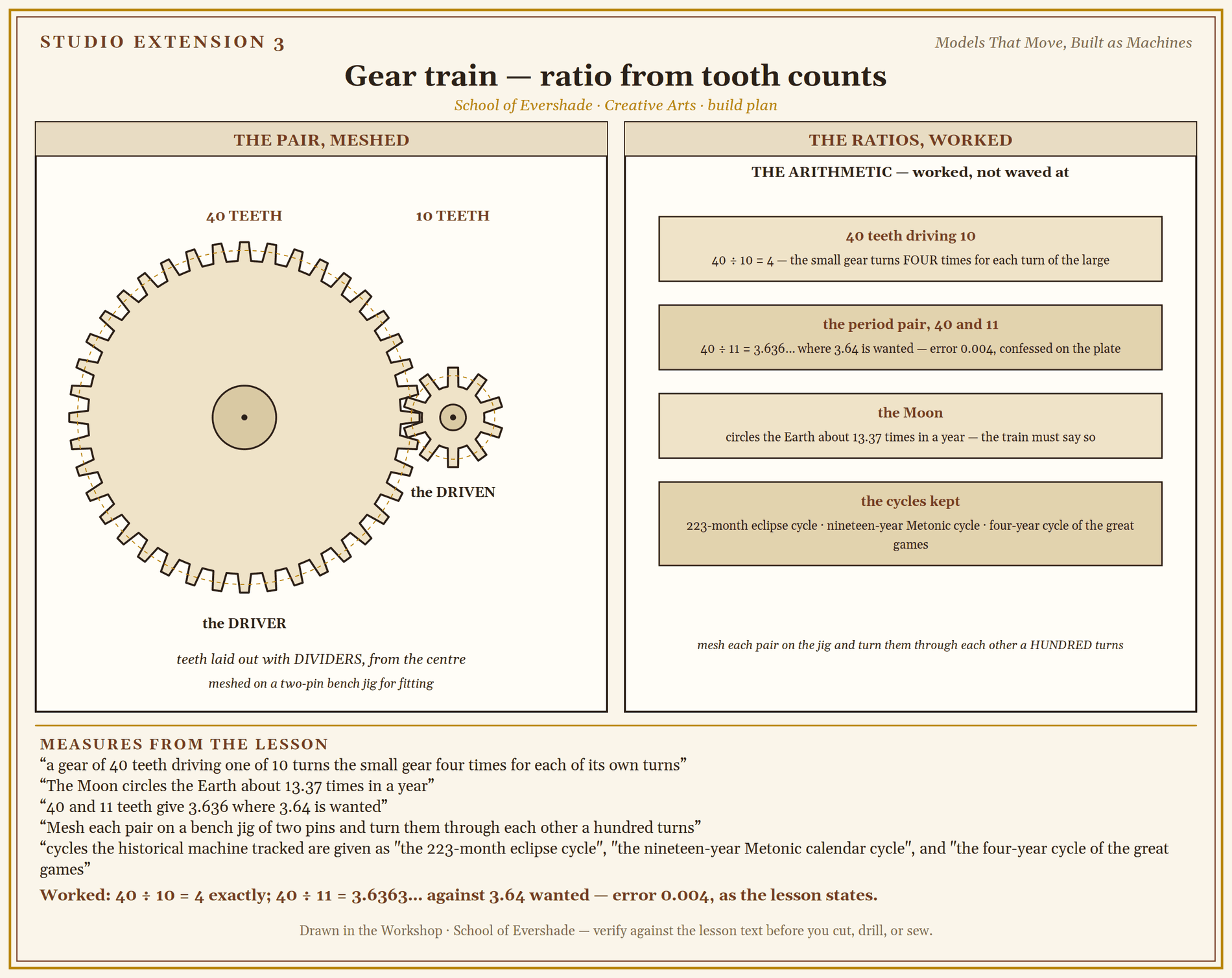
Gear train — ratio from tooth counts
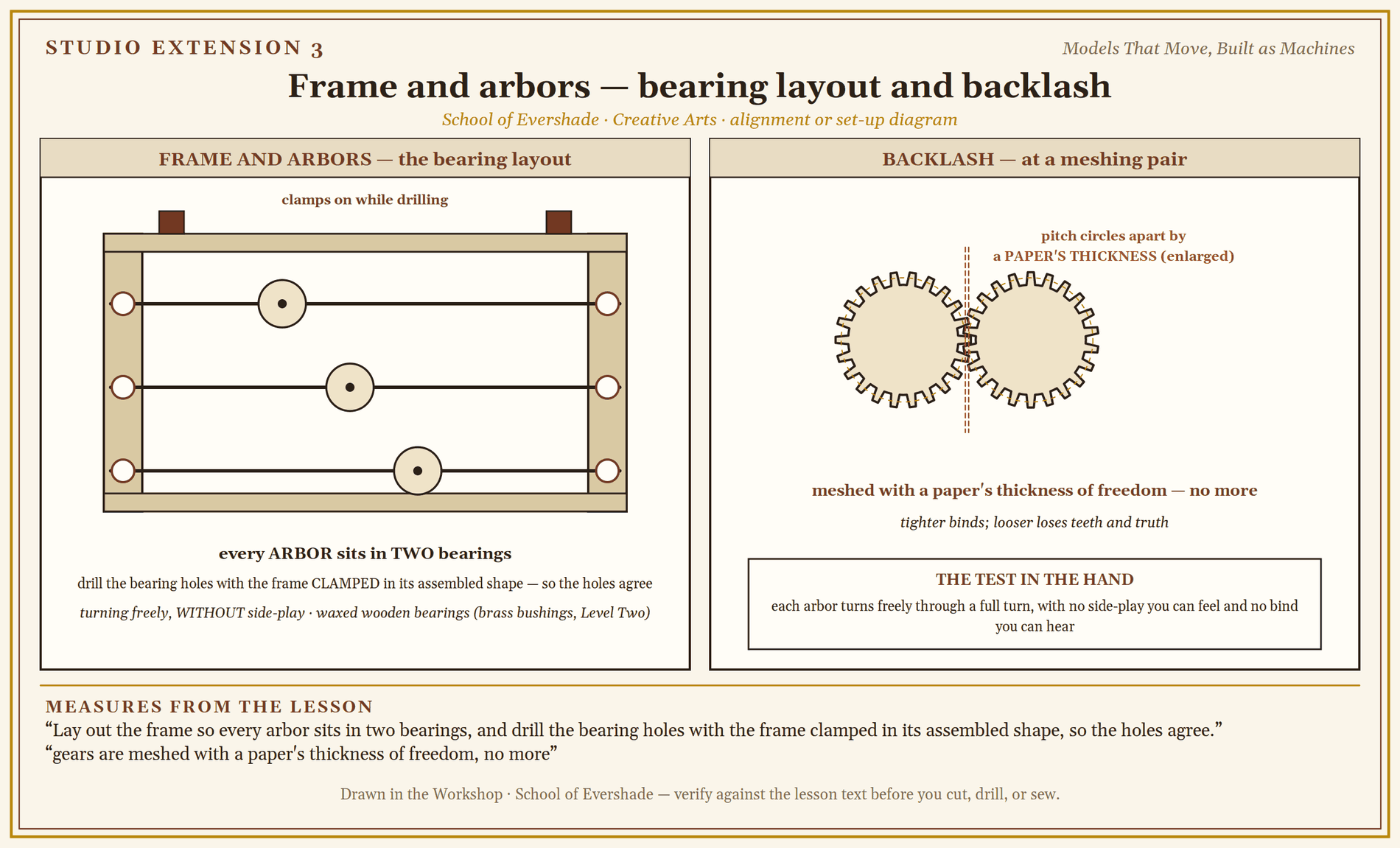
Frame and arbors — bearing layout and backlash
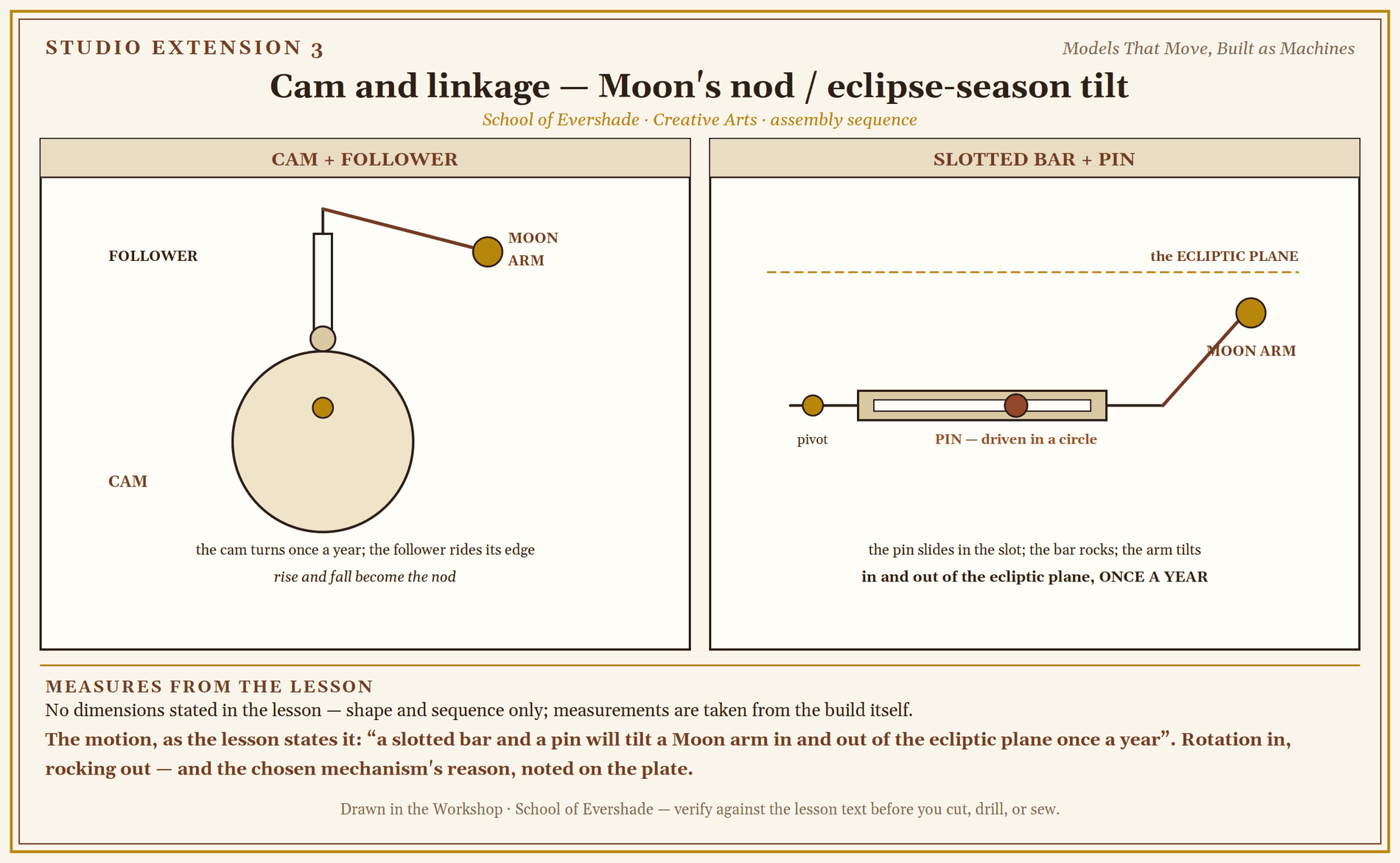
Cam and linkage — Moon's nod / eclipse-season tilt
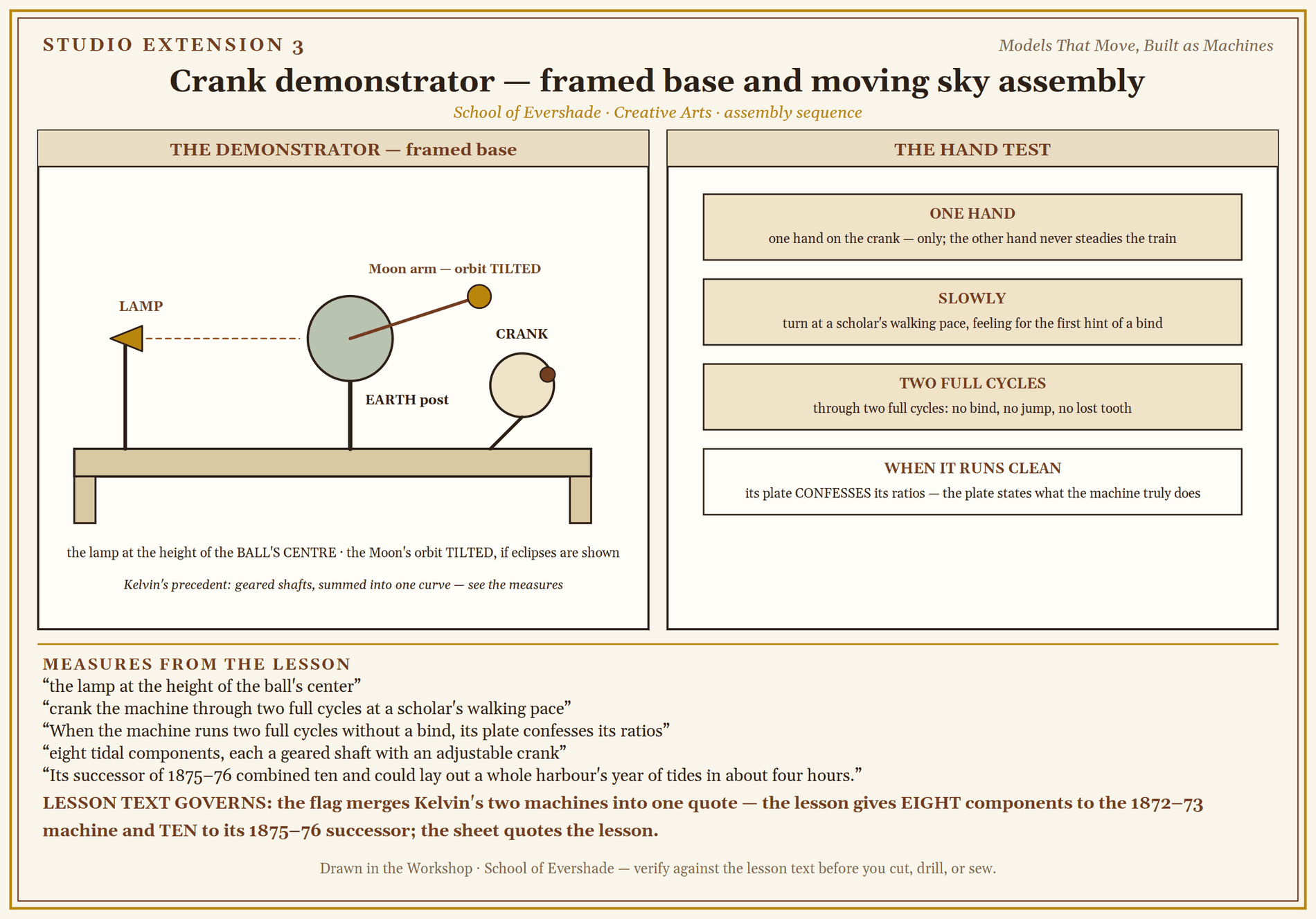
Crank demonstrator — framed base and moving sky assembly
Assignment Manual
Assignment key: ✎ written work · ⚒ hands-on practical · ◐ both
Assignment I ⚒ — The Build
Complete the Build in this extension: one Celestial demonstration model rebuilt as a durable crank-driven machine, with computed tooth counts, true arbors, a maker's plate stating its ratios, and two full cycles turned without a bind.
Assignment II ✎ — The Lump of Bronze
Using the lesson and the sources below, write a short account of the Antikythera mechanism. Cover: its recovery and date, three things it computed and the devices by which it computed them, one feature scholars still debate, and what its existence, and the fourteen-century gap after it, says about how craft knowledge survives or fails to.
Assignment III ◐ — Kelvin's Sum
Kelvin's tide machine added ten simple cycles into one true curve. Choose a complicated regular motion from any class's work, the Moon's apparent path, a season's sunrise times, a tide if you live by one, and present it as a sum: a chart or small working model of its component cycles, with a written account of what each component contributes and what the sum explains that no single cycle could.
Materials
Level One (household)
- A base board and frame stock of hardwood or thick plywood, from Lesson 23's stores
- Gear blanks of plywood, thick card laminated to stiffness, or hardwood, with a compass, dividers, and a fine saw or craft knife for cutting teeth
- Dowels for arbors, hardwood or brass rod if available, with wax for the bearings
- A crank handle, screws, pins, and glue from Lesson 4's fastening stock
- Wire, beads, a ball for the Moon, and a lamp stand in the Celestial pattern, from Lesson 29's stock
- Paint and lettering for the base, and a maker's plate card
Level Two (historical)
Everything in Level One, plus:
- Brass sheet and tube for gears and arbors in the instrument-maker's manner, cut and filed by hand
- A clockwork movement or weight drive to run the model unattended, let down and handled under the sealed note's rules
- Turned finials, engraved ratio rings, and a glazed case in the orrery tradition
- Finer bearings: brass bushings set into the frame plates, oiled
Both levels build the same machine to the same test: one crank, true ratios admitted on the plate, two full cycles turned by hand without a bind. Level Two's brass will be turning when Level One's plywood is old, but Level One's arithmetic is identical, and arithmetic is the machine.
Reflection Questions
Answer the following questions in your workbook.
- Your machine's ratio is an approximation of the sky's. Where does the difference show itself first, and how long would the machine have to run before a class could catch it lying?
- The Antikythera maker's name is lost, and the machine outlived its whole tradition. What does your maker's plate protect against, and what can it not protect against?
- Eisinga built his planetarium over his family's living room and it still runs. What does a machine ask of the household or school that keeps it, across decades?
- Backlash is a looseness you must allow and must admit. Where else in this course have you budgeted an imperfection honestly instead of pretending it away?
- Kelvin's machine drew a year of tides in four hours, work that had taken computers of the human kind weeks. What is gained, and what is lost, when a machine does the arithmetic?
Professor's Review
Crank it once more, scholars, all the way around, and listen. A good machine has a sound: even, unhurried, with nothing catching and nothing pleading. Yours has it.
Consider the company your demonstrator keeps. A bronze machine from a shipwreck, a wool carder's ceiling, a machine that summed the sea for the Admiralty. None of them was built by a person who thought small of the work. The scholar who demonstrates eclipses from your model in ten years' time will never know your name unless the plate tells it, and the model will not care either way. That indifference is not coldness. It is what a machine is for: to keep a true motion available to hands that have not yet learned it.
Keep its log with it. A machine's log is its memory, and you are the only one who can write its first pages.
PROFESSOR COGBRANCH TIMBERCLANK
Creative Arts Workshop
Master Artisan, Head of House Occidens
Further Reading & Sources
Wikipedia, "Antikythera Mechanism." The shipwreck machine in full: the 82 fragments, the thirty surviving gears, the Saros and Metonic dials, and the debates its missing pieces still host.
History of Science Museum, Oxford. "Orrery." The Graham and Tompion instrument and its world: ivory planets on brass arms, the Earl who gave it its name, and the honest confession that the distances cannot be to scale.
Science Museum Group. "William Thomson's Tide Predicting Machine, 1872." Kelvin's design in the museum's own record: geared shafts and cranks, and a year of one harbour's tides drawn in about four hours.
Museo Galileo. "Planetarium (Orrery)." The family's naming and nature: planetarium, orrery, tellurian, and lunarium distinguished, and Römer's and Huygens's machines with their Keplerian refinements.
Student-friendly starting points for exploring this extension's world. All links verified October 2026.
- Wikipedia's survey of the orrery, with its history. From Cicero's planetaria to Eisinga's ceiling in Franeker, and the philosopher lecturing by its light in Wright of Derby's painting.
- The History of Science Museum's orrery, shown in motion. Watch the wheelwork base do what your crank does, at an emperor's scale of finish.
- Print only: Jo Marchant, Decoding the Heavens (Da Capo Press, 2009), the readable modern account of the Antikythera mechanism's recovery and the century of argument it caused, held by larger libraries.
Submit your work for this lesson using the form below.
CONTINUE IN THE CREATIVE ARTS WORKSHOP
← Previous · Studio Extension E2: The Permanent Sundial & Horizon Alignment Next · Studio Extension E4: Painted Wheels at Full Size →
Creative Arts Workshop · All 39 Lessons
Bookstore Shelf The Library · Creative Arts Shelf Course Supplies
The rest of the Workshop Extensions: E1 · Precision Paper Instruments · E2 · The Permanent Sundial · E4 · Painted Wheels at Full Size · E5 · Relief & Scale Displays