

Creative Arts
Unit V, Lesson 21Building the Plant Press
Professor Cogbranch Timberclank
Master Artisan, Head of House Occidens
The Creative Arts Workshop • School of Evershade
Professor's Introduction

Set the bench by the window today, scholars. We are building an instrument, and it deserves the good light.
The plant press looks like the simplest thing in this workshop: two boards, some straps, paper between. Do not let it fool you. The press is five centuries old, it founded a science, and it works or fails on a principle Lesson 2 taught at the start of this course: evenness. A press that squeezes harder at one corner than another dries a flower in wrinkles and mold spots. A press built true, leveled, and strapped evenly keeps a plant flat, dry, and recognizable for longer than any of us will live. There are pressed plants in the world's herbaria — collections of pressed, dried plant specimens, kept as a scientific library of plants — older than the United States, still teaching botanists, because someone built the press right and used it right.
Understand the boundary before we lift a board. This lesson builds the press. What goes into it (which plants, gathered when, arranged how, mounted afterward onto the herbarium sheet) is Professor Fernfoot's teaching, in her Unit IV, Lesson 29, and her scholars carry a full pointer to this lesson for the build. Our work today ends at a press that has proven itself on plain paper. A press that presses paper evenly will press a plant honestly, and proving it first is the workshop's way.
PROFESSOR COGBRANCH TIMBERCLANK
Creative Arts Workshop
Master Artisan, Head of House Occidens
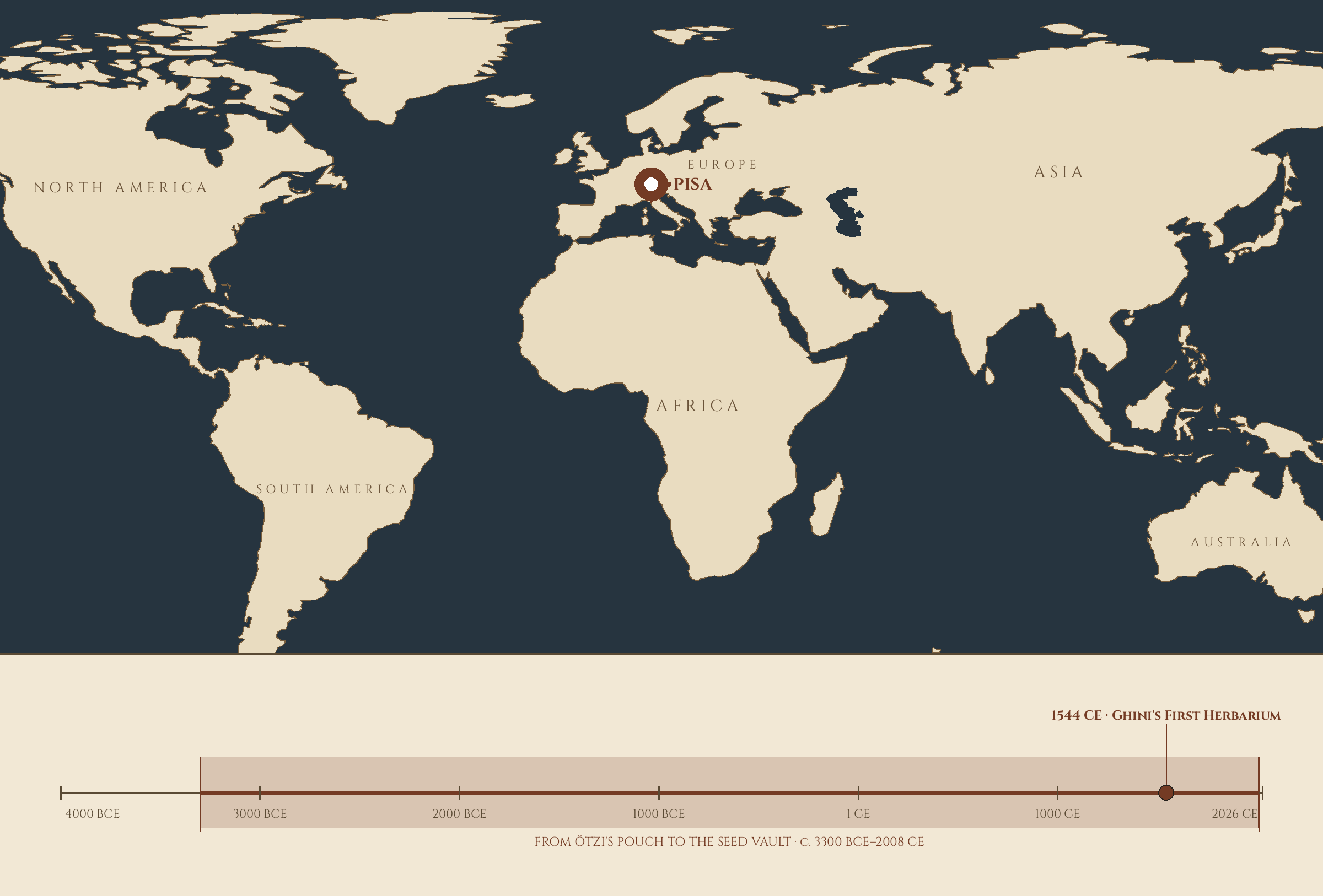
Where and when: Pisa — 1544 CE, Ghini’s first herbarium.
Lesson Objectives
By the end of this lesson, students should be able to:
- Tell the story of Luca Ghini and the first herbarium, and how pressed collections became scientific institutions.
- Explain what Linnaeus standardized (one specimen per sheet, one sheet size, cabinet storage) and why the standard still holds.
- Name the press's parts and the job of each: frames or boards, straps, corrugated cardboard ventilators, blotters, and newspaper folders.
- Explain even pressure as the science of the press, and connect it to Lesson 2's leveling.
- Build a strap press with level boards and even strap tension.
- Test a press on practice paper and read the result for uneven pressure.
Your Assignment Packet
This lesson's assignments live in its packet: the Lexicon Handout (every term, course terms marked ◆), the Assignment Manual, and the Reflection Questions. Download the packet before you begin and keep it beside you as you read — work from it as each subject is taught, or take the assignments as homework afterward.
The Scholar Who Pressed a Garden Flat
In 1544, at Pisa in Italy, the physician and botanist Luca Ghini did something no one had recorded before: he dried plants by pressing them between pieces of paper, then glued them to cardboard, and kept them. A garden that could be carried in a book. The early name for such a collection was hortus siccus, Latin for "dry garden": the name used in Ghini's century, when the specimens were dried under pressure and glued to the pages of a book. He called the practice into being with a garden beside it, for 1544 also saw him establish the botanical garden at Pisa, and the two inventions belong together: the living collection and the pressed one, each covering the other's weakness. The garden dies back in winter and cannot travel. The pressed garden keeps its form in January and can be posted to a colleague across Europe.
Ghini published almost nothing. His herbarium taught through his students instead: Gherardo Cibo, Andrea Cesalpino, Pietro Andrea Mattioli, names that run through the next century of botany like rings through a tree. None of Ghini's own pressed collections survive, but his student Gherardo Cibo's does — begun about 1532, while Cibo was studying under Ghini at Bologna, a decade before Pisa — which makes it among the oldest pressed gardens on earth. The practice spread across Europe within a generation, exactly as good workshop practices do: hand to hand, bench to bench.
Then the collections grew up. For two centuries herbaria were personal, specimens bound in books in scholars' studies, traded like letters. In the eighteenth century Carl Linnaeus faced the filing problem of a man whose collection would not stop growing: bound books cannot take insertions. His answer became the world's standard and still is: one specimen mounted on one large sheet of paper, all sheets one size, the sheets filed upright in cabinets by relationship, so new material can be added and the cabinet works like a filing system. The University of Washington's herbarium historians note that the standards hold several hundred years later, and so do the specimens: a delphinium from Linnaeus's own collection keeps its blue to this day.
The institutions followed. The Royal Botanic Gardens at Kew built its herbarium from the 1850s, and it now holds about seven million preserved specimens, including some 330,000 type specimens, the reference examples against which species are defined, gathered over more than 260 years of collecting. Botanists still collect the way Ghini taught: press the plant flat in the field, dry it between sheets, mount it on the standard sheet with its label. The instrument in this lesson is that instrument, at bench scale, and its long pedigree is why we build it carefully.
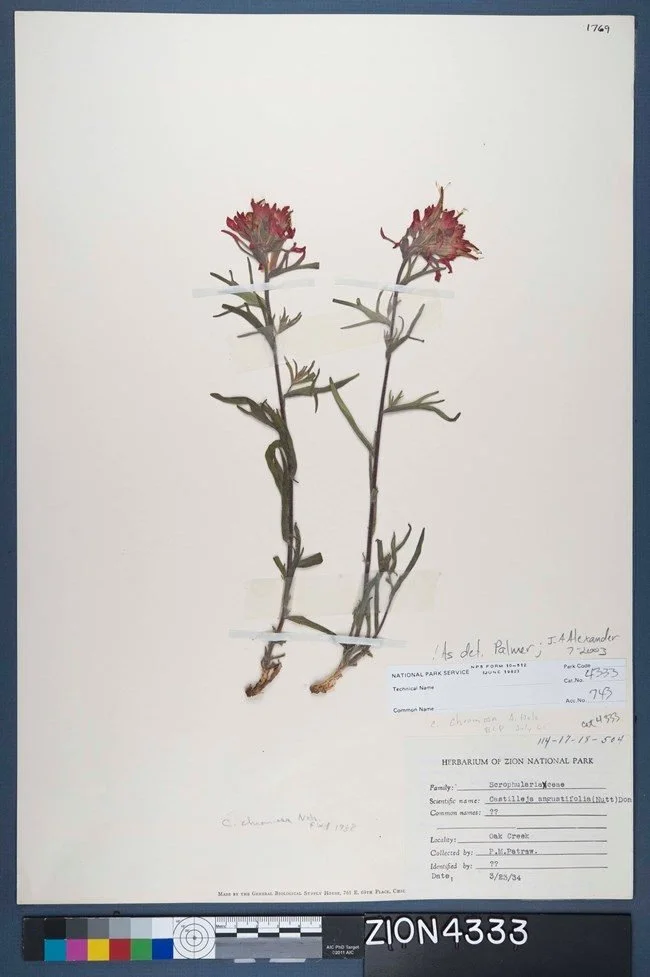
A finished herbarium specimen — a pressed pink-flowered plant mounted and taped to its sheet with its collection label, from Zion National Park's museum collection (collected 1934, ZION 4333).
U.S. National Park Service, Zion National Park museum collection (ZION 4333). Public domain.
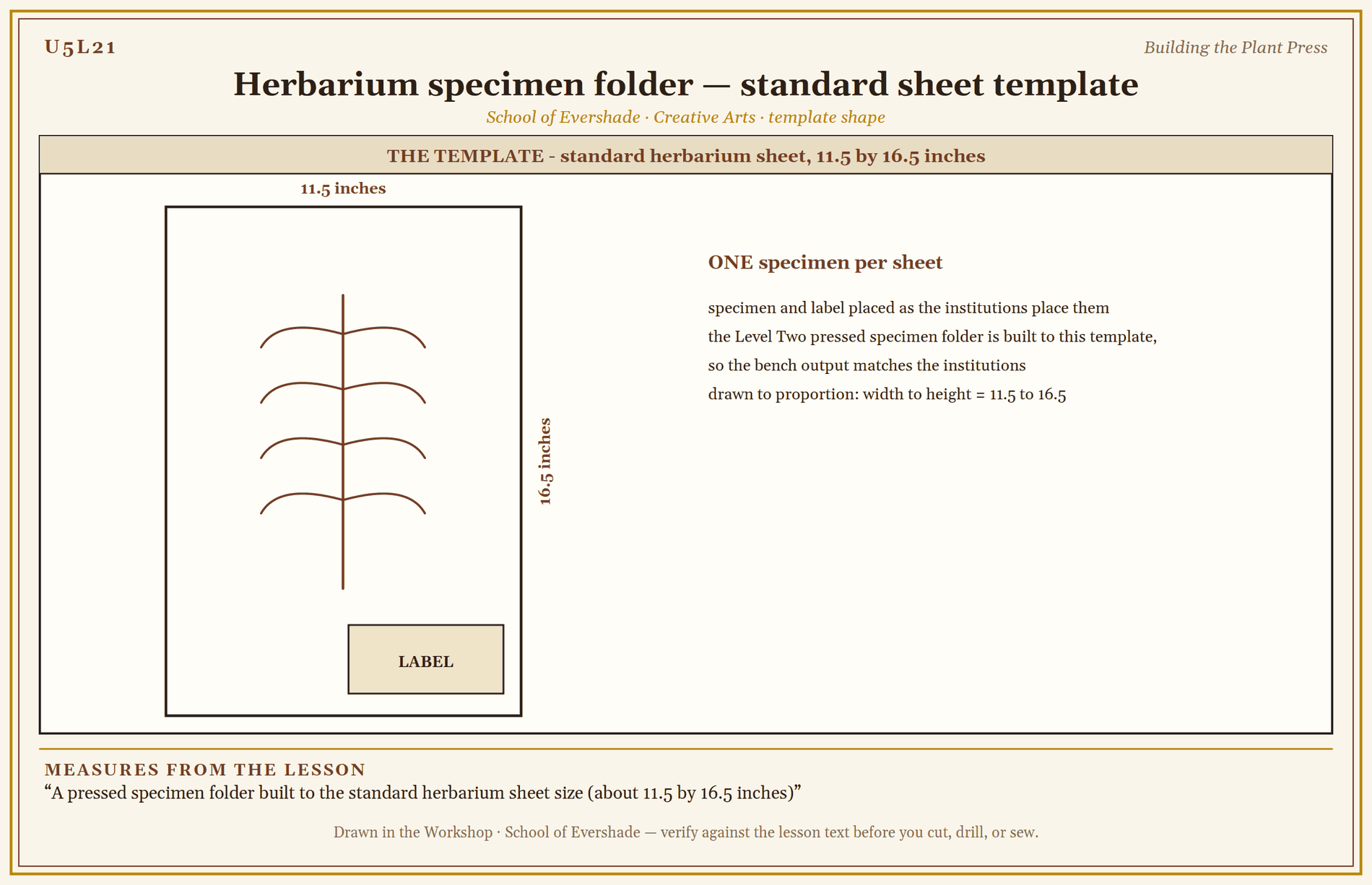
Herbarium specimen folder — standard sheet template
The Science of Even Pressure
A press has one job: hold a plant flat while water leaves it. Everything in its construction serves that sentence.
Pressure flattens. If the pressure is uneven, the parts pressed hardest dry thin and may crack, and the parts pressed lightly stay thick, hold moisture, wrinkle as they dry, and invite mold. The enemies are three. A board that is warped or a frame that racks presses on a diagonal. Straps tensioned unevenly squeeze one side more than the other, and the stack creeps. And layers built lopsided (thick specimen beside thin air) bridge the pressure across the gap and leave the thin work unpressed.
The counters are Lesson 2 come home. Boards are checked for flat and set level, because a press tightened on a slope tightens unevenly no matter how careful the hands. Straps are tensioned in turns, a little on one side, a little on the other, the way a wheel's nuts are drawn down in a pattern, and they are re-tensioned as drying proceeds, because a drying stack shrinks and loose straps press nothing. Corrugated ventilators go in with their channels running across the stack, spreading pressure and carrying damp air out. This is why the press is built, not bought casually or improvised from a pile of books: a pile of books presses at the middle and dreams at the edges. A built press presses everywhere alike, and the specimen can tell the difference even if the builder cannot.
A Sealed Note from Professor Timberclank
A press under tension is a stored push, scholars, and stored pushes deserve the same respect as sharp edges.
Straps are tensioned in turns, never one side hauled fully tight while the other hangs slack: a stack drawn down crooked is a stack that can shift, and a strap that slips under load snaps back at hands and faces. Keep your face out of the strap's line while you pull it tight, and ease a strap loose the way you tightened it, in turns, under control. A buckle that has bitten is persuaded open, never pried with a blade.
Boards for a press are cut to size as Lesson 3 taught, or bought cut, and edges are sanded so no scholar is splintered by the instrument itself. If a board cracks under tension, the press comes apart slowly and the board is retired whole: a cracked board under straps is a spring waiting for permission. We stop. We make it safe. Then we begin again.
PROFESSOR COGBRANCH TIMBERCLANK
Creative Arts Workshop
Master Artisan, Head of House Occidens
Technique: Building and Testing the Press
Make the frames or boards. The classic press is two lattice frames of wooden lath, about 12 by 16 inches, the strips nailed or riveted where they cross, built with the long strips on the outside so the frame cannot pull apart under the straps. Solid boards serve as well: two pieces of sound plywood or hardwood, flat, the same size, edges sanded. Whichever you build, check each piece for flat on the bench and reject a warped one now, kindly and without appeal. The press cannot be truer than its boards.
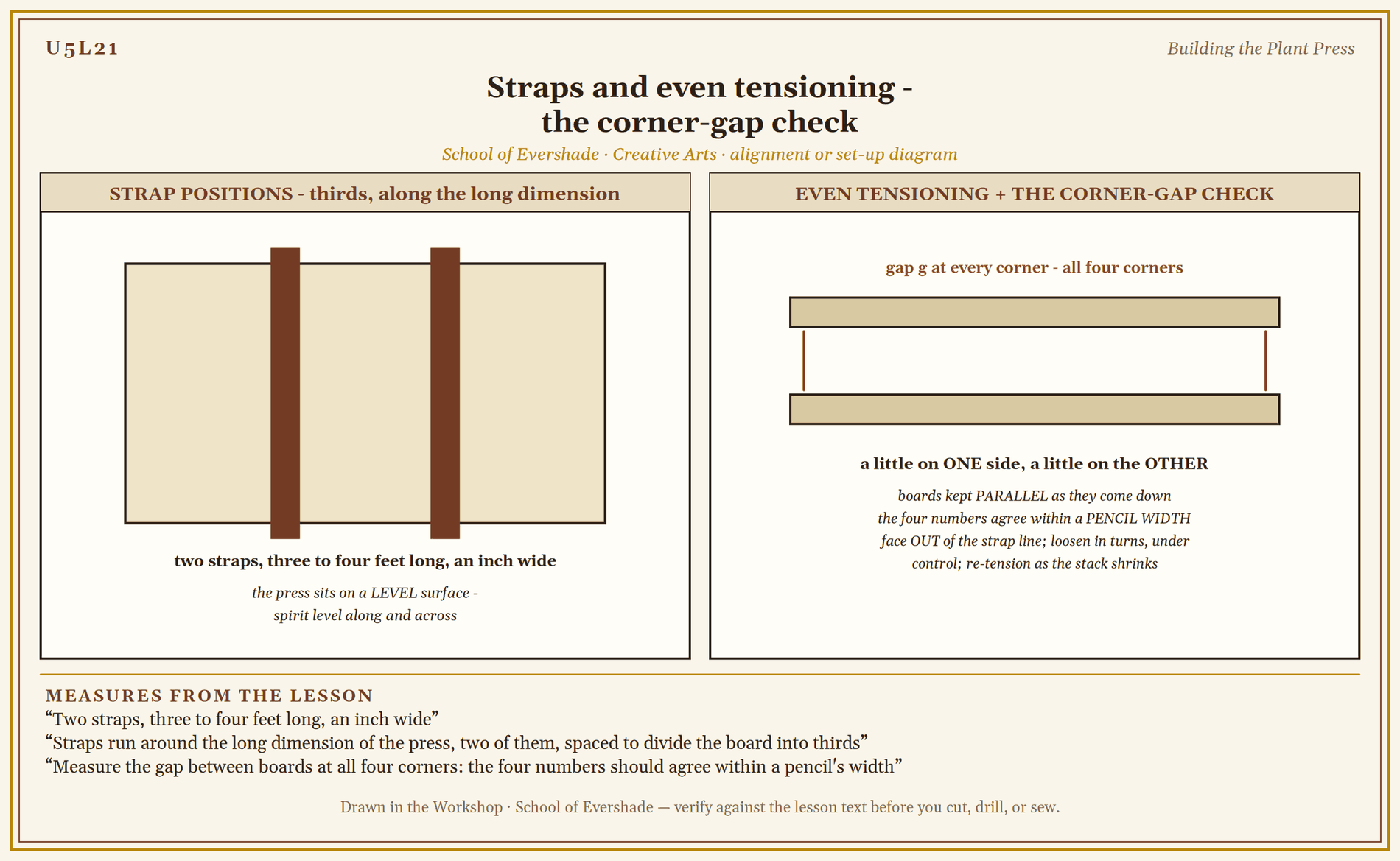
Cut the straps. Two straps, three to four feet long, an inch wide, with buckles that hold. Window sash cord with a loop tied in one end is the old substitute and still works. Straps run around the long dimension of the press, two of them, spaced to divide the board into thirds.
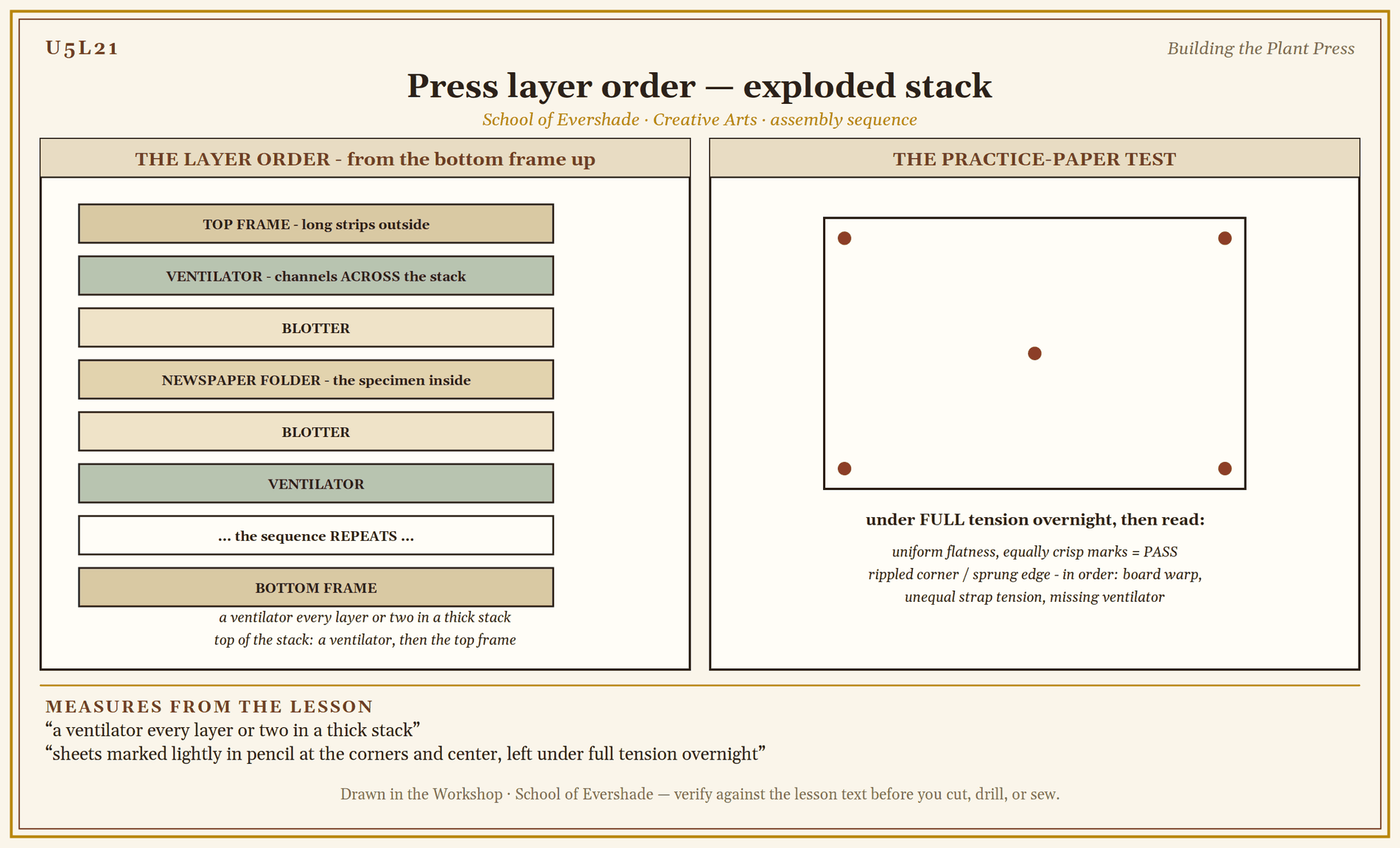
Build the layer order. From the bottom frame up: frame (long strips outside), a corrugated ventilator, a blotter, the folded newspaper that will hold the specimen, a blotter, and repeat, with a ventilator every layer or two in a thick stack, ending with a ventilator and the top frame. The blotter is the absorbent sheet that drinks moisture out of a pressing plant: blotters sandwich the specimen inside the press and are changed or dried as they take up water, because a damp blotter returned to the stack slows the very drying it serves. This order (Oregon State's Extension guide gives it in full) is not ceremony. Each layer has a job, and skipping the ventilators is the commonest way a home press disappoints.
Tension in turns. Set the press on a level surface and check it with the spirit level from Lesson 2, along and across. Draw the straps snug, then tighten a little at a time, alternating sides, keeping the boards parallel as they come down. As drying proceeds over the following days, re-tension: the stack shrinks as it gives up water, and the press must follow it down.
Test before trusting. Before any specimen goes in, press a stack of plain practice paper: sheets marked lightly in pencil at the corners and center, left under full tension overnight. In the morning, read the paper. Even pressure leaves the whole sheet uniformly flat and the pencil marks equally crisp. A sheet that ripples at one corner or keeps a spring at one edge has told you where the pressure fails: check the board for warp, the straps for equal tension, and the layer order for a missing ventilator, in that order.
Practice Practical: Press Checks
This drill is checked for level boards, strap tension drawn down in turns, and an honest reading of the pressure test.
- Prove the boards. Lay each board or frame on the bench and test it for flat: sight along it, rock it gently, and set the spirit level along and across. A warped board is set aside before the build, not forgiven during it. Say why.
- Assemble dry. Build the layer order without any specimen: frame, ventilator, blotter, newspaper folder, blotter, ventilator, top frame. Name each layer's job aloud as it goes in.
- Level and tension. Set the press on the bench, check it level with the spirit level, and draw the straps down in turns, a little each side, until the boards sit parallel and the stack is firm. Measure the gap between boards at all four corners: the four numbers should agree within a pencil's width.
- The practice-paper test. Open the press, lay in the marked practice sheets (pencil marks at corners and center), rebuild the layers, re-tension in turns, and leave the press under full tension overnight.
- Read the test. Next session, ease the straps loose in turns, open the press, and read the paper: flat everywhere, marks equally crisp, no rippled corner, no sprung edge. Log the result beside any fault you find and its likely cause, board, straps, or layers, in that order of suspicion.
- Re-tension drill. Rebuild and re-tension the empty press once more from scratch, start to finish, without help. The press is yours when your hands know the order without the page.
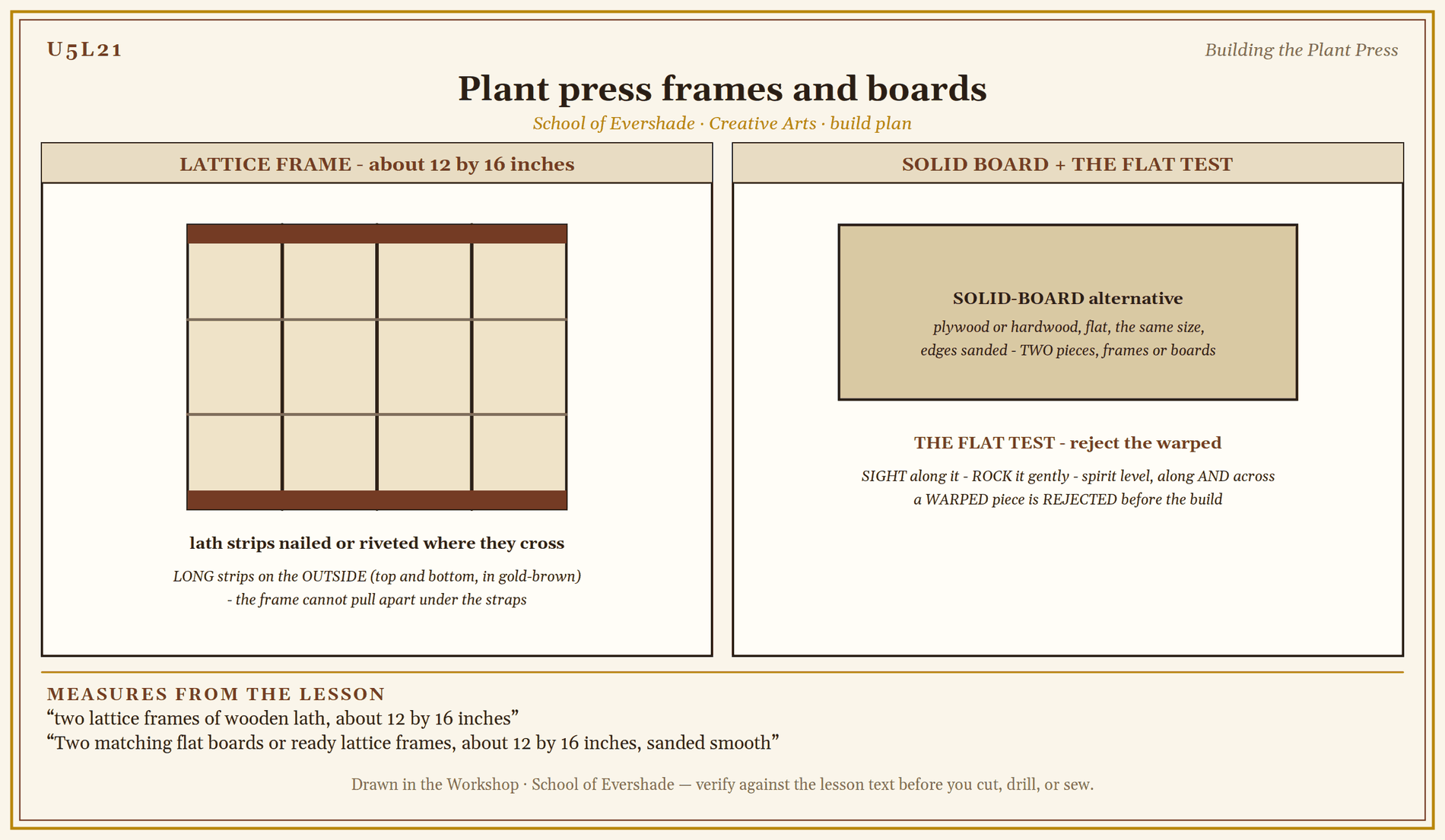
Plant press frames and boards
Straps and even tensioning - the corner-gap check
Press layer order — exploded stack
Assignment Manual
Assignment key: ✎ written work · ⚒ hands-on practical · ◐ both
Assignment I ⚒ — Build and Prove the Press
Complete the Practice Practical in this lesson: a press built with proven boards, its layers assembled in order, tensioned in turns on a level bench, and proven by the overnight practice-paper test, with the test result logged.
Assignment II ✎ — The Dry Garden
Write a short history of the herbarium: Ghini's pressed garden of 1544 and the students who carried the practice across Europe, the two centuries of bound collections, Linnaeus's filing reform and why it still rules, and the growth of the great institutional herbaria such as Kew's. End with what the pressed garden can do that the living one cannot, and the reverse.
Assignment III ◐ — Pressure, Proved on Paper
Repeat the pressure test with one deliberate fault introduced (one strap left slack, or a ventilator omitted) on a fresh set of marked sheets, with an adult's knowledge. Record what the paper shows, compare it with your true test, and write the diagnosis: how you knew which fault you were looking at. Restore the press to true before you finish.
Materials
Level One (household)
- Two matching flat boards or ready lattice frames, about 12 by 16 inches, sanded smooth
- Two straps with buckles (or sash cord), three to four feet long
- Corrugated cardboard cut to size, several pieces, corrugations sound
- Blotting paper, or clean plain paper and folded newspaper for specimen folders
- A spirit level (from Lesson 2) and the bench's measuring tools
- Practice paper for the pressure test, and a pencil
- Screws, nails, or rivets for frame building, and sandpaper for edges
Level Two (historical)
Everything in Level One, plus:
- Hardwood lath for true lattice frames, riveted at the crossings in the traditional manner
- Wing-nut and threaded-rod fittings to build the modern board press beside the strap press, and compare their pressure
- Leather straps with roller buckles, the field botanist's pattern
- A pressed specimen folder built to the standard herbarium sheet size (about 11.5 by 16.5 inches), so the bench's output matches the institutions'
Both levels build a press that presses evenly. Level Two keeps the traditional frame and the modern fitting side by side and learns what each does better.
Reflection Questions
Answer the following questions in your workbook.
- Ghini published almost nothing, and his herbarium does not survive, yet the practice is called his. What does it mean for a maker's work to live in their students instead of their objects?
- Linnaeus's great contribution here was a filing system: one specimen, one sheet, one size. Why is a standard a scientific instrument and not just tidiness?
- Lesson 2's leveling returns in this build by name. Where exactly does an unlevel press betray itself, and in what would the betrayal appear first?
- A pile of heavy books presses a flower too, after a fashion. Build the honest comparison: what does the built press do that the pile cannot?
- The press is built here; the pressing is taught in the Greenhouse. What other instruments in this school are built in one room and given their purpose in another?
Professor's Review
The press stands proven, scholars, and its proof is a sheet of plain paper that came out flat. That is how instruments earn trust in this workshop: on practice material, read honestly, before the real work is risked.
You know whose bench you have joined: Ghini's, and Cibo's, and the long line of collectors who carried a press into the field because a plant pressed true in June can still be studied in a hundred Januaries. You know why the boards must be level, why the straps come down in turns, and why the ventilators are not optional. Professor Fernfoot's scholars will build this same press from her pointer and press their specimens in the Greenhouse with it, and the Winter and Spring Specials will ask for it again by name.
Keep it dry, keep it labeled, and keep the test sheet in your notebook. Next lesson we plan at the scale of the whole garden: supports, the cold frame, and the Master Garden Plan built small, before anything full-size is cut.
PROFESSOR COGBRANCH TIMBERCLANK
Creative Arts Workshop
Master Artisan, Head of House Occidens
Cross-Class Connections

Herbology · Unit IV, Lesson 29 — Pressing & Preserving Plant Specimens
In my Greenhouse, scholars, a plant pressed well keeps its story for a century: which plants to gather, when to gather them, how to arrange them in the press, and how to mount them afterward onto the herbarium sheet — that teaching is mine, and my lesson carries the full pointer here. The press itself is built in this workshop: boards checked true, straps drawn down in turns, the layers in their order. Build the instrument at Professor Timberclank’s bench, then bring it to my lesson and we will fill it. The build is his; the specimens are ours to gather.
PROFESSOR BERYL FERNFOOT
Herbology Greenhouse
Further Reading & Sources
Wikipedia. "Luca Ghini." Ghini's record: the first herbarium (hortus siccus) created at Pisa in 1544, plants dried under pressure between paper and glued to cardboard, the botanical garden founded the same year, and his student Gherardo Cibo's surviving herbarium of about 1532.
University of Washington Bothell. "History and Modern Uses of a Herbarium." A herbarium's own history of itself: Ghini credited as the first to press and preserve plants under pressure, Linnaeus's one-specimen-per-sheet standard and cabinet filing, and how herbaria now lend, trade, and digitize their sheets.
Oregon State University Extension Service. Johnston, LaRea Dennis, et al. "Collecting, Preserving, and Mounting Plant Materials" (4-H 1007). The working guide this build follows: the press of two hardwood frames with long strips outside, straps drawn very tight with pressure even, blotters changed as they dampen, and the corrugated cardboard's role in drying.
Wikipedia. "Kew Herbarium." The great institutional herbarium: roughly seven million specimens by 2024, about 330,000 type specimens, traditional wooden-cabinet filing, and field collection methods largely unchanged since the herbarium's founding.
Bridson, Diane, and Leonard Forman, eds. The Herbarium Handbook. Royal Botanic Gardens, Kew. The professional manual of herbarium practice, from pressing to pest control. Print reference; consult in a library.
Student-friendly starting points for exploring this lesson's world. All links verified October 2026.
- University of Washington Bothell. "History and Modern Uses of a Herbarium." Begin here: a delphinium from Linnaeus's own collection, still blue after two and a half centuries, shows what a well-pressed specimen can outlast.
- Wikipedia. "Luca Ghini." The founder's short life and long shadow: the dry garden, the Pisa garden, and the students who carried pressing across Europe.
Submit your work for this lesson using the form below.
CONTINUE IN THE CREATIVE ARTS WORKSHOP
← Previous · Lesson 20: Clay II: Vessels, Tiles, Relief & Molds Next · Lesson 22: Garden Structures: Supports, Cold Frames & Garden Models →
Unit V · Clay & the Garden Bench Creative Arts Workshop · All 39 Lessons
Bookstore Shelf The Library · Creative Arts Shelf Course Supplies
The rest of Unit V: Lesson 18 · Outdoor & Garden Tools · Lesson 19 · Clay I: Pinch, Coil & Slab · Lesson 20 · Clay II: Vessels, Tiles, Relief & Molds · Lesson 22 · Garden Structures & Cold Frames