

Creative Arts
Unit I, Lesson 1Welcome to the Creative Arts Workshop
Professor Cogbranch Timberclank
Master Artisan, Head of House Occidens
The Creative Arts Workshop • School of Evershade
Professor's Introduction

Come in, scholars, and wipe your feet. The floor is swept, and I mean to keep it that way until the day's work starts.
I am Professor Cogbranch Timberclank, and this workshop is my classroom. Some of you have come from Professor Nocturne's library, where the rule is quiet hands and clean pages. Some from Professor Fernfoot's greenhouse, where the rule is patience. The rule here is simpler to say and longer to learn: we make things well, we make them safely, and we make them so they last.
Before I teach you a single cut, you will learn how this room works. Every workshop on Earth runs on an agreement between the people in it, whether they write it down or not. Ours is written down. You will learn it today, along with the bench drill that begins and ends every piece of work in this room: set up, work, put away. The bench is a maker's work surface, and by extension the whole workstation around it: the surface, the tools laid out on it, the light over it, and the habits of the person working there.
I kept this castle standing before it was a school, and I have mended most of what is in this room at least once. Look around you. Nearly everything here has been broken, or will be. That is not a warning. That is the job.
PROFESSOR COGBRANCH TIMBERCLANK
Creative Arts Workshop
Master Artisan, Head of House Occidens

Lesson Objectives
By the end of this lesson, students should be able to:
- State the workshop covenant and explain what each part of it asks of a scholar.
- Explain how workshops and craft training were organized in the ancient and medieval worlds.
- Set up a workbench with tools laid out deliberately, and put everything away in its place.
- Describe the difference between scrap stock, sampler stock, and project material, and why practice uses the first two.
- Explain why repair is treated as a maker's skill in this workshop, with historical examples.
Your Assignment Packet
This lesson's assignments live in its packet: the Lexicon Handout (every term, course terms marked ◆), the Assignment Manual, and the Reflection Questions. Download the packet before you begin and keep it beside you as you read — work from it as each subject is taught, or take the assignments as homework afterward.
Workshops in History
A workshop is one of the oldest classrooms there is, and for most of history it was nearly the only place a making skill could be learned. You could not read a joint in a book and know it. You stood beside someone who could cut it, you watched, you swept, you carried, and in time your hands were trusted with the work itself.
In ancient Egypt, the royal tomb builders of the New Kingdom lived in a village we now call Deir el-Medina, near the Valley of the Kings. They were organized in crews with foremen, they kept written records of attendance, supplies, and disputes on flakes of limestone, and their skill passed from parent to child across generations. Their village is one of the best documented working communities of the ancient world, precisely because they were record-keeping craftspeople, not because anyone thought them grand.
In medieval Europe, craft skill was organized by guilds. A young person entered a workshop as an apprentice, bound to a master for a term of years, learning in exchange for labor. After apprenticeship came the journeyman years, working for wages and often traveling between towns and masters. To become a master, a journeyman presented a masterpiece, a piece of work judged by the guild's own masters. The guilds guarded standards jealously, and their system was imperfect in many ways, but it kept difficult skills alive and taught for centuries: joinery, masonry, metalwork, weaving, and the rest.
Great buildings kept workshops of their own. A cathedral might take generations to build and needed maintaining forever after, so cathedrals and castles kept permanent works departments: lodges and yards of masons, carpenters, glaziers, and smiths whose job was the building itself, in every season, for as long as the building stood. When this castle was a ruin and became a school, the work that made it habitable again was the same kind of work, done the same old way: survey what stands, shore what is failing, rebuild what is gone, and use what the place offers before sending away for anything.
That is the tradition this room belongs to. You are not the first beginners to stand at a bench with a master watching. You are somewhere in a line of them several thousand years long, and the line holds because each generation taught the next one properly.
The Workshop Covenant
Our agreement has five parts. This is the workshop covenant, the standing agreement of this workshop: tools are respected and put away, work is secured before it is cut, a stopped job is a safe job, and a mistake brought to the bench is information, not failure. Learn them now; they are written here whenever you need them again.
First, tools are respected. A tool is never dropped in a pile, left on a floor, or put away dirty or wet. Every tool in this workshop has a place, and at the end of work it is in that place. This is not tidiness for its own sake. A tool you can find is a tool you can use, and a tool put away sharp and clean will be sharp and clean when the next scholar needs it.
Second, work is secured before it is worked on. Nothing in this room is cut, drilled, or carved while it is being held loose against the force of a tool. Clamps, benches, and vices hold the work. Hands hold tools. That division never changes, and Lesson 3 teaches it in full.
Third, a stopped job is a safe job. If anything feels wrong, if a tool slips, if you are tired or rushed or unsure, you stop. We stop. We make it safe. Then we begin again. No piece of work in this room is worth an injury, and stopping is never counted against a scholar here. It is counted in their favor.
Fourth, a mistake brought to the bench is information. You will spoil cuts. You will split wood, tear paper, and mismeasure. Every maker in history did the same while learning, including the one teaching you. What matters is that the mistake comes to the bench where it can be examined, not into a drawer where it can only be repeated.
Fifth, we mend before we replace. Bring me the broken thing before you bring me the new thing. Nine times out of ten, the broken one is better, and the tenth time we will learn something from taking it apart.
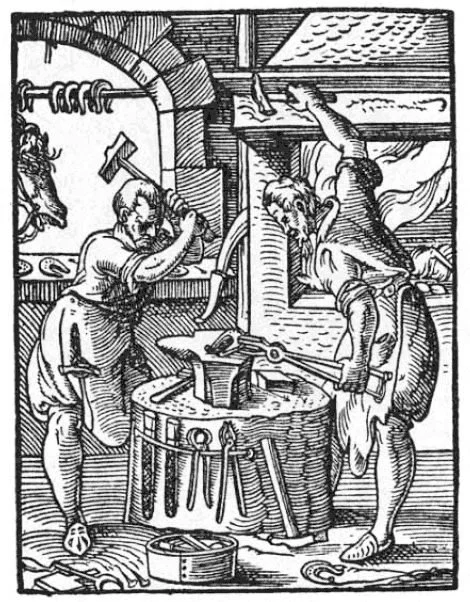
A 1568 woodcut of a smith at work in his workshop — forge, anvil, tools, and finished wares around him.
Woodcut from the Ständebuch (Book of Trades), Frankfurt, 1568. Public domain, via Wikimedia Commons.
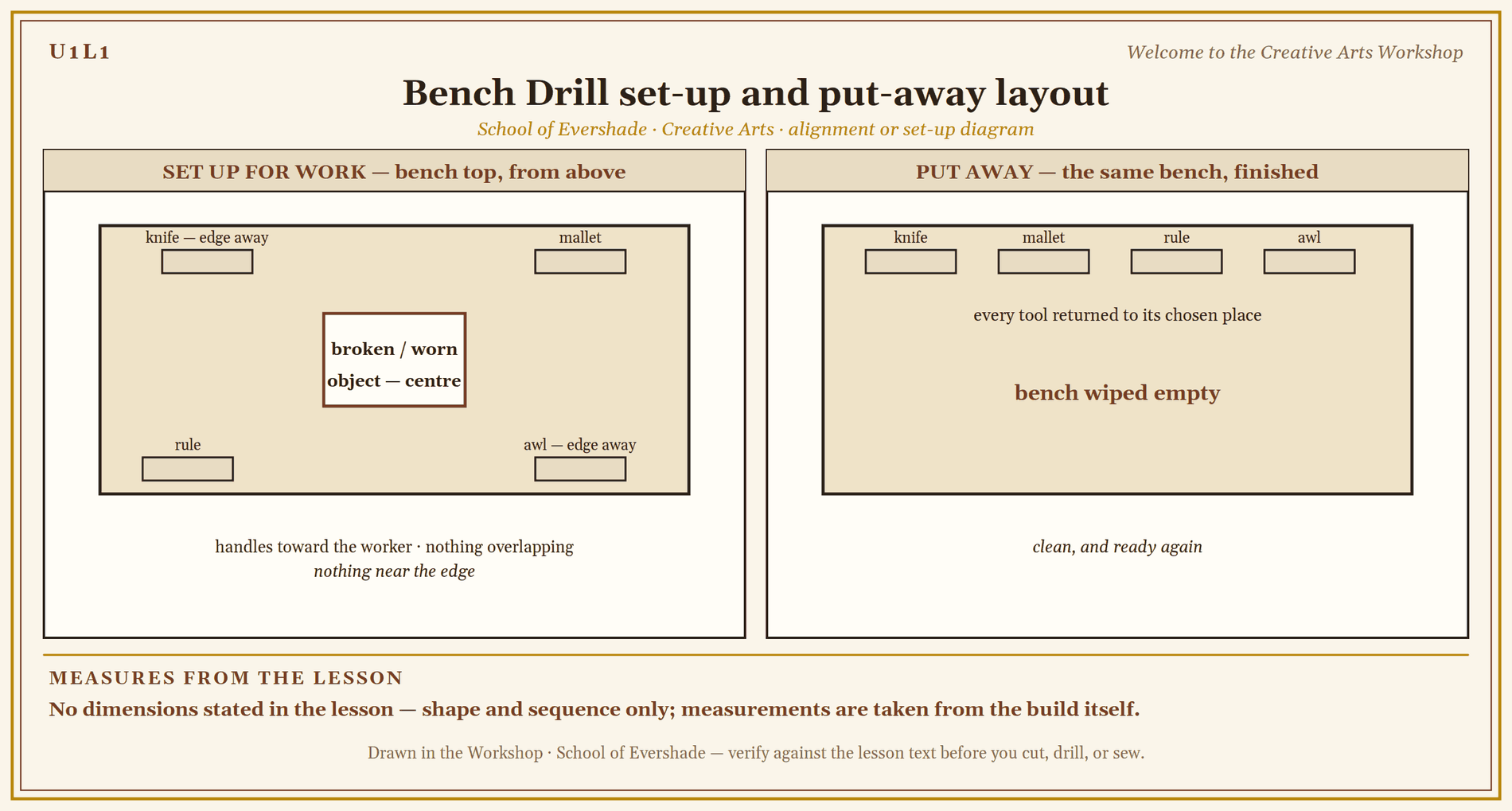
Bench Drill set-up and put-away layout
A Sealed Note from Professor Timberclank
You will notice I am in no hurry, scholars, and I would like you to notice something else: neither is the work.
A tree does not hurry, and it gets built. A river does not hurry, and it moves more stone in a year than any crew I ever led. Learn your tools at the pace the tools teach you. The scholar who practices a cut ten times on scrap will pass the scholar who rushed it once on good wood, every time, and will still have the good wood. Scrap stock is leftover and low-value material kept for practice, testing, and small jobs; in this workshop scrap is a teaching material, not rubbish.
Go slowly. Go steadily. That is the whole secret, and it was never a secret.
PROFESSOR COGBRANCH TIMBERCLANK
Creative Arts Workshop
Master Artisan, Head of House Occidens
Repair Is a Maker's Skill
Beginners often imagine that making means producing new things, and repair is what happens when making fails. History says otherwise. That habit has a name here: repair culture, the habit, normal through most of history, of mending objects rather than replacing them: rehafting tools, darning cloth, patching pots, rebuilding walls. For most makers in most centuries, repair was the larger half of the trade, and the more demanding half. Making a new pot follows a known pattern. Mending a broken one asks what it is made of, how it failed, what it must still do, and what can be persuaded to hold.
The evidence is everywhere once you look. Tools in museum collections carry ancient repairs: blades rehafted, handles replaced, rims patched. Medieval accounts for castles and cathedrals list far more spending on maintenance and mending than on new construction in most years. In Japan, broken pottery has for centuries been repaired with lacquer, a tradition that later became famous in its gold-dusted form, kintsugi, where the mend is left visible on purpose. In Britain during the Second World War, the government's Make Do and Mend campaign taught households to patch, darn, and renovate clothing as a matter of national necessity, and treated those skills as worth printing books about.
This workshop teaches repair the same way, as a first-class skill. Later lessons return to it again and again: a mended seam in Unit III, a reglued joint in Unit VI, and a capstone rule you have already heard. A mended build, honestly logged, passes with honor here. Learn to look at a broken object the way a physician looks at a patient: not as a failure, but as a question. What happened? What does it need? What do I have that will serve?
Practice Practical: The Bench Drill
This drill begins and ends every working day in this workshop. It is checked for order and completeness, not for speed.
- Clear the bench. Remove everything from your work surface. Wipe it down with the cloth. A bench starts empty, the way a page starts blank.
- Lay out the tools. Place each tool on the bench in a deliberate position: cutting tools with their edges turned away from where your hands will rest, handles toward you, nothing overlapping, nothing near the edge where an elbow could knock it to the floor.
- Name every tool. Touch each tool and say its name and its job aloud or in your workbook. A tool you cannot name is a tool you are not ready to use, and naming is how the workshop keeps its inventory.
- Examine the broken object. Set your broken or worn object in the center of the bench. Turn it over slowly. Find where it failed. Write down three things: what it is made of, where it broke or wore, and what it still needs to do.
- Put everything away. Return each tool to a chosen place, the same place every time from today forward. Wipe the bench again. The drill ends when the bench is exactly as it began: empty, clean, and ready.
A bench that has been set up and put away properly once has taught your hands the shape of every working day to come in this course.
Assignment Manual
Assignment key: ✎ written work · ⚒ hands-on practical · ◐ both
Assignment I ⚒ — The Bench Drill
Complete the Practice Practical in this lesson: set up your bench, name every tool on it, examine your broken object, and put everything away in its place. Repeat the drill on a second day. A drill done once is a visit; a drill done twice is a habit beginning.
Assignment II ✎ — Reading a Broken Thing
Choose your examined object or another broken household item you have permission to study. Write a repair report of one page or less covering: what the object is and what it is made of; where and how it failed; what repair it needs; and what tools and materials that repair would require, based on what this lesson taught. End with your honest judgment: mend it, or replace it, and why.
Assignment III ◐ — Workshops Through Time
Using the history in this lesson and the sources below, write a short comparison of two of these three: the tomb builders' village at Deir el-Medina, a medieval craft guild, and a cathedral or castle works department. Cover how a beginner was trained in each, and one thing each system did well that a modern scholar could still learn from. Then add one sentence about your own bench: which of the three would recognize it, and why.
Materials
Gather the following for this lesson's drill.
Level One (household)
- A table, desk, or counter you may use as a bench for an hour
- A pencil and a sheet of paper
- A small set of ordinary household tools to lay out: a ruler, scissors, a screwdriver, a hammer if one is in the house, a pair of pliers
- A cloth or old towel
- One broken, worn, or damaged household object you have permission to examine (a loose chair rung, a torn bag, a cracked plant pot, a wobbly anything)
Level Two (historical)
Everything in Level One, plus:
- A wooden crate, board, or tray to serve as a bench top or tool carrier, in the spirit of the workshop's carrying boxes
- One hand tool of traditional pattern (a wooden mallet, a hand drill, or a try square) if one is available in the household
- A repair candidate of natural materials (wood, leather, clay, or cloth) rather than plastic
Both levels teach the same lesson: how a bench is set up, worked at, and put away, and how a broken object is read before it is mended.
Reflection Questions
Answer the following questions in your workbook.
- Which part of the workshop covenant do you think will be hardest for you to keep, and why?
- Why did craft skills survive for centuries through apprenticeship rather than through books?
- What is the difference between scrap stock and rubbish, in this workshop's terms?
- Think of a broken object in your own home. After this lesson, do you read it differently? What do you notice first now?
- Why does this workshop count stopping a job in a scholar's favor rather than against them?
Professor's Review
And so the first lesson ends with an empty bench, which is exactly where good work starts.
You can state the covenant, you know how workshops taught their craftspeople in Egypt, in the guild towns, and in the great works yards, and your hands have done the bench drill: set up, name, examine, put away. Keep the drill. You will do it at the start of every practical lesson in this course until you no longer notice yourself doing it, which is when it will be doing its work.
Next lesson, we put the first real skills on that bench: measuring, marking, and leveling, the oldest instruments in the room and the ones every later build will spend.
Leave the bench as you found it, scholars.
PROFESSOR COGBRANCH TIMBERCLANK
Creative Arts Workshop
Master Artisan, Head of House Occidens
Further Reading & Sources
Encyclopaedia Britannica. "Guild." On the organization of medieval craft guilds, their regulation of trades, and their role in setting standards of workmanship.
Encyclopaedia Britannica. "Apprenticeship." On apprenticeship as a system of training, from its medieval guild form onward.
The Metropolitan Museum of Art. Heilbrunn Timeline of Art History. Essays and collection material on ancient Egyptian art and the craftspeople who produced it, including the tomb builders of western Thebes.
Imperial War Museums. Collections and articles on "Make Do and Mend." The British wartime campaign and its printed guides to repairing and renovating clothing and household goods.
Student-friendly starting points for exploring this lesson's world. All links verified October 2026.
- The British Museum, "Ancient Egypt" learning resources. Introductions to Egyptian daily life and craft, including the world of the tomb builders.
- Smarthistory, essays on ancient Egyptian art. Carefully explained introductions to Egyptian objects and the people who made them, with images from museum collections.
- Historic Royal Palaces and cathedral works departments. Several British cathedrals describe their own works departments and masons' yards online, a direct living descendant of the medieval system described in this lesson.
- Canterbury Cathedral, "Stonemasons at Canterbury Cathedral." The cathedral's own account of its in-house team of masons and their yard, where tools and methods a medieval mason would recognize still serve the building today.
- Imperial War Museums, "Top Tips for Winning at 'Make Do and Mend.'" The museum's guide to the wartime campaign's household advice, from darning and clothes care to refashioning what you already own.
Submit your work for this lesson using the form below.
CONTINUE IN THE CREATIVE ARTS WORKSHOP
Next · Lesson 2: Hands, Eyes, Measuring, Marking & Leveling →
Unit I · The Workshop Foundation Creative Arts Workshop · All 39 Lessons
Bookstore Shelf The Library · Creative Arts Shelf Course Supplies
The rest of Unit I: Lesson 2 · Measuring, Marking & Leveling · Lesson 3 · Cutting, Scoring & Clamping · Lesson 4 · Piercing, Drilling & Fastening · Lesson 5 · Adhesives, Heat, Wax & Glass · Lesson 6 · The Materials Library