

HERBOLOGY
Unit IV · Lesson 31Culinary Herbs in the Kitchen Garden
PROFESSOR BERYL FERNFOOT
Herbology Greenhouse
Master Herbalist
Unit IV · Lesson 31 · Harvest, Preservation & Use
Professor's Introduction

Take your time, scholars. Pull up a stool.
For three units you have been a gardener: choosing plants, reading soil, sowing seeds, taking cuttings, pruning with a steady hand. All of that work has been leading somewhere, and today we arrive. Most herb gardens in the world exist for one reason. They exist to be eaten.
There is a particular pleasure in walking out of your kitchen, snipping a handful of leaves, and carrying them straight to the pot. No packaging, no guessing how long they sat in a truck, no wilted bundle from the back of the refrigerator. The distance from soil to supper is measured in steps, and every step is yours.
Today you will meet the ten classic culinary herbs, the plants that have fed more kitchens than any others. You will learn how to harvest them so they keep producing, how to translate between fresh and dried, and how to keep a harvest fresh or put it by for winter. No recipes in this lesson. We are herbologists, not cooks, and our subject is the plant, from the garden gate to the kitchen door.
Wash your hands, scholars. We are going in.
— Professor Beryl Fernfoot, Herbology Greenhouse • Master Herbalist • Head of House Oriens

The line beneath the map is our road: every stop a place where the knowledge of plants changed, every lesson a step along it.
Lesson Objectives
By the end of this lesson, you will be able to:
- Name the ten classic culinary herbs and give one reliable growing note for each
- Sort kitchen herbs into tender herbs and hard herbs and explain why the distinction matters
- Harvest herbs by the cut-and-come-again method without weakening the plant
- Convert between fresh and dried herbs using the standard substitution ratio
- Store fresh herbs by the water-glass method and the damp-towel method, and freeze herbs for winter cooking
- Describe how your Scholar's Familiar, or an adopted plant, could serve a kitchen garden
Reading this lesson: ★ marks the passages to remember. They return on the unit quiz and the class test. Check in questions ask the material back as you go; answer them in your workbook when you meet them.
Working this lesson: Your assignment packet is the first download on this page. Work in it as the lesson moves along, answering each exercise as its subject is taught — or read the lesson through for your notes and take the exercises as homework afterward. Both are proper ways to sit this class. Signposts in the reading tell you where each exercise belongs. Written answers are short answers in your own words; a few honest lines are worth more than a filled page.
Your Assignment Packet
This lesson's exercises live in its packet: the Lexicon Handout (every term, course terms marked ◆), Materials, Guided Practice, the Assignment Manual with its answer key for self-checking, the Reflection Questions, and the Workbook Checklist. Download the packet before you begin and keep it beside you as you read.
The Ten Classic Herbs
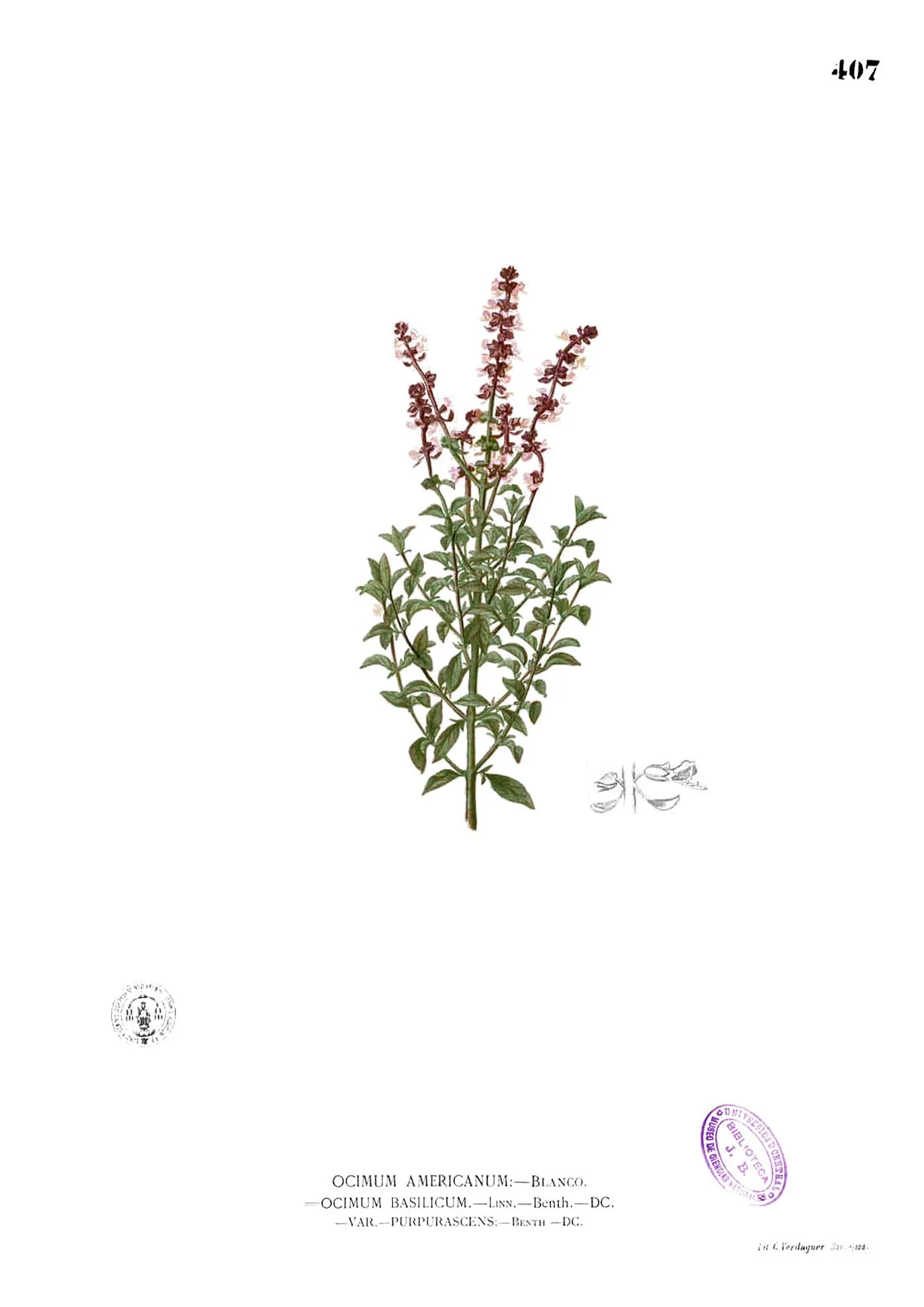
Basil (Ocimum basilicum), plate 407 of Blanco's Flora de Filipinas (1880–83), drawn in flower — the plate names the purple-stemmed variety, purpurascens. Flowering is the stage the kitchen gardener works to delay: once basil flowers, leaf production drops and flavor declines, so buds are pinched off the moment they appear.
Francisco Manuel Blanco, Flora de Filipinas, Gran edición, Atlas II, plate 407 (1880–83). Public domain.
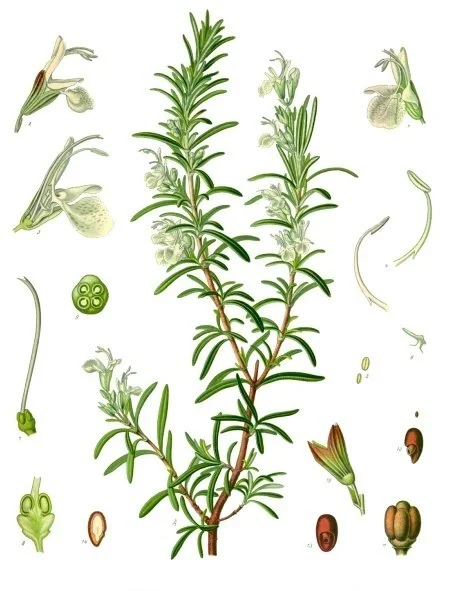
Rosemary (Salvia rosmarinus, long known as Rosmarinus officinalis), from Köhler's Medizinal-Pflanzen (plate 258). A hard herb: a woody stem and tough needle-like leaves that stand up to long cooking. Harvest by cutting several inches off the stem tips — no more than a third of the plant — and strip the leaves from the woody stems before cooking.
Franz Eugen Köhler, Köhler's Medizinal-Pflanzen (1887–1914), plate 258. Public domain.
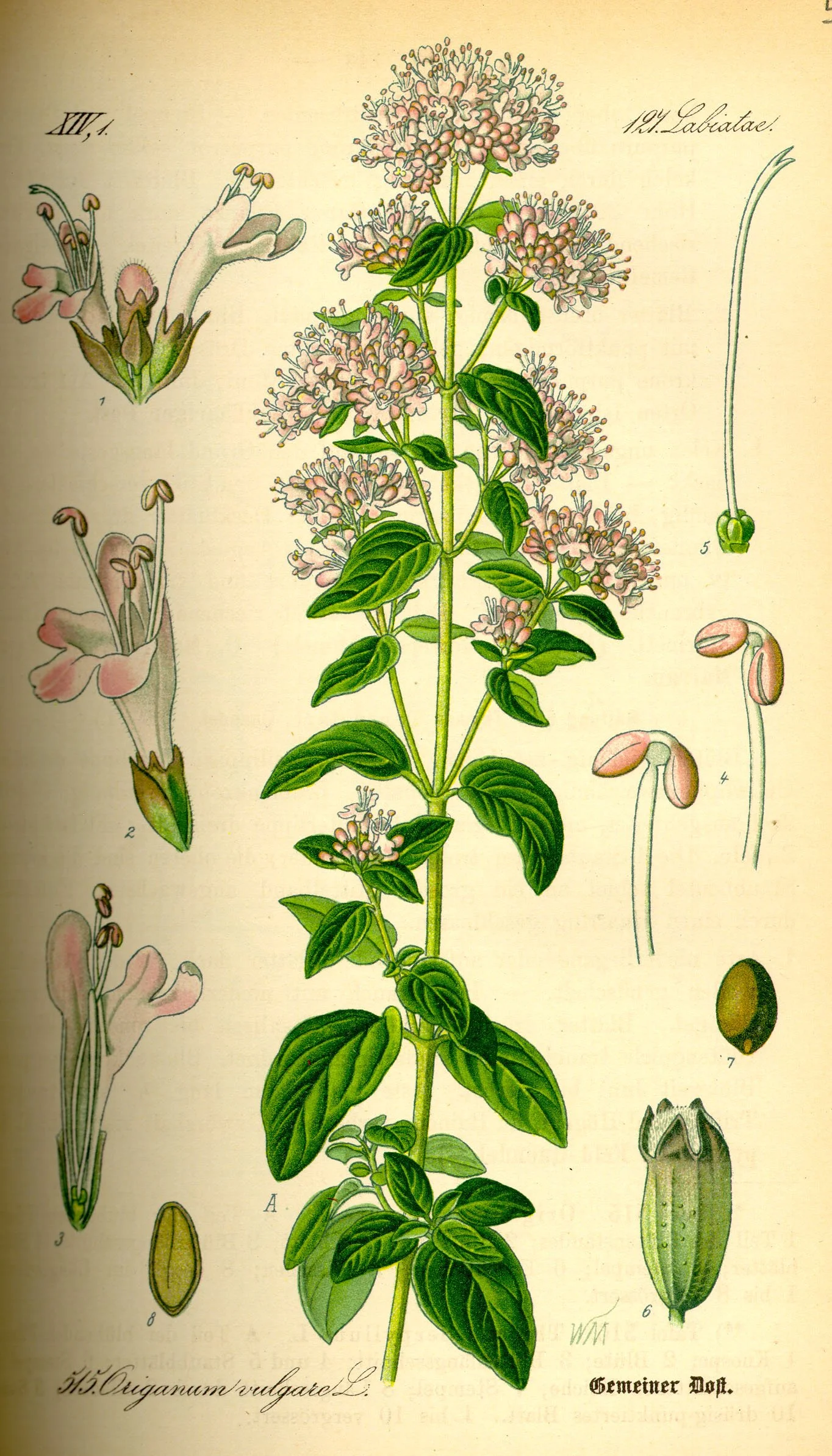
Oregano (Origanum vulgare), plate 121 of Thomé's Flora von Deutschland, Österreich und der Schweiz (1886): opposite oval leaves and clusters of small pink flowers. Clip branches with clean shears, leaving several inches of growth at the base. Oregano's robust flavor survives drying better than most herbs, which is why dried oregano is a pantry staple.
Otto Wilhelm Thomé, Flora von Deutschland, Österreich und der Schweiz (1886), plate 121. Public domain.
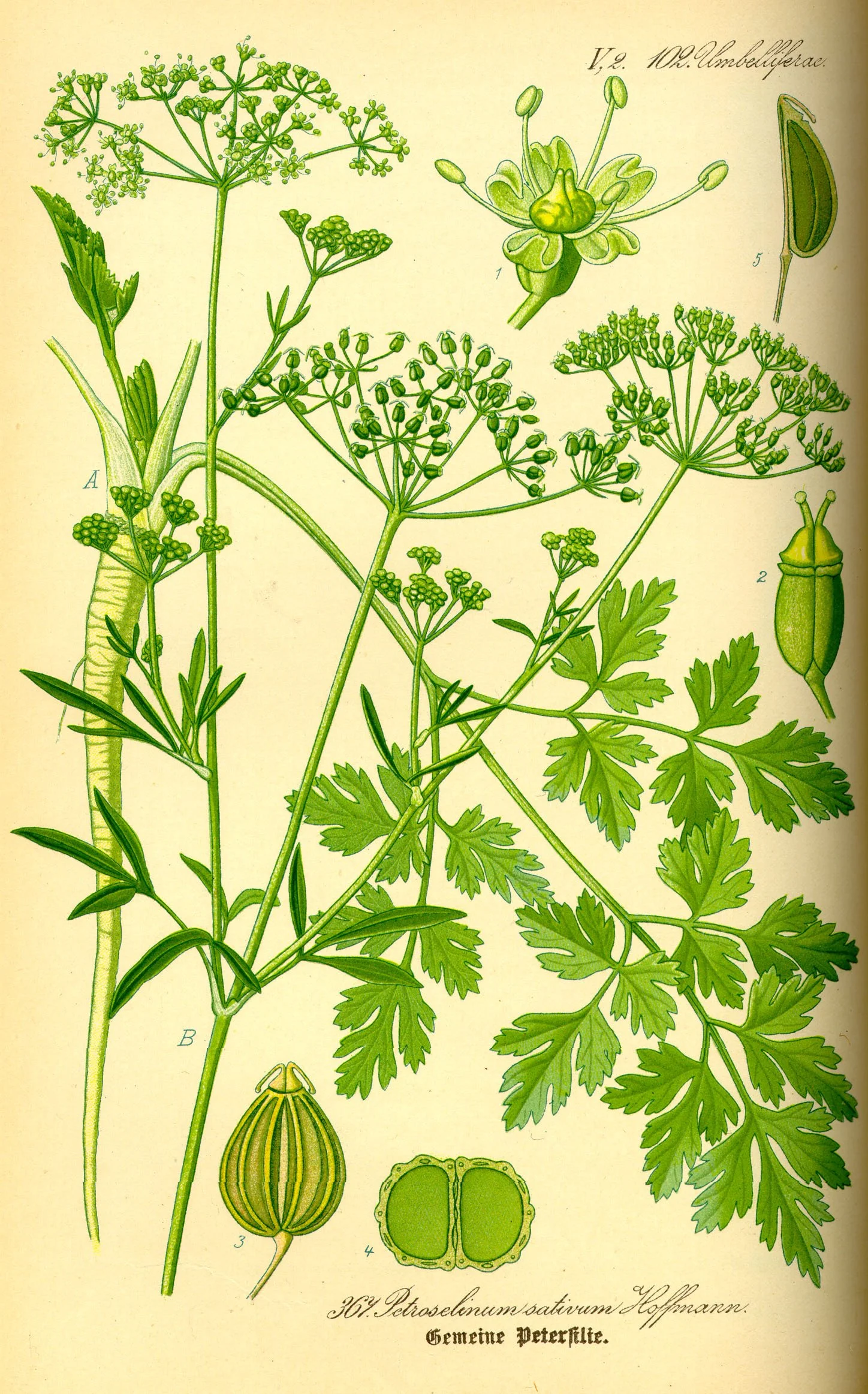
Parsley, plate 367 of Thomé's Flora (1885) — the plate uses the older name Petroselinum sativum for the plant now named Petroselinum crispum. This is parsley in its second year, flowering in umbels over its long taproot. In the kitchen garden it is grown as an annual and harvested the other way: take the outer stems at the base and work inward, leaving the young center to keep growing.
Otto Wilhelm Thomé, Flora von Deutschland, Österreich und der Schweiz (1885), plate 367. Public domain.
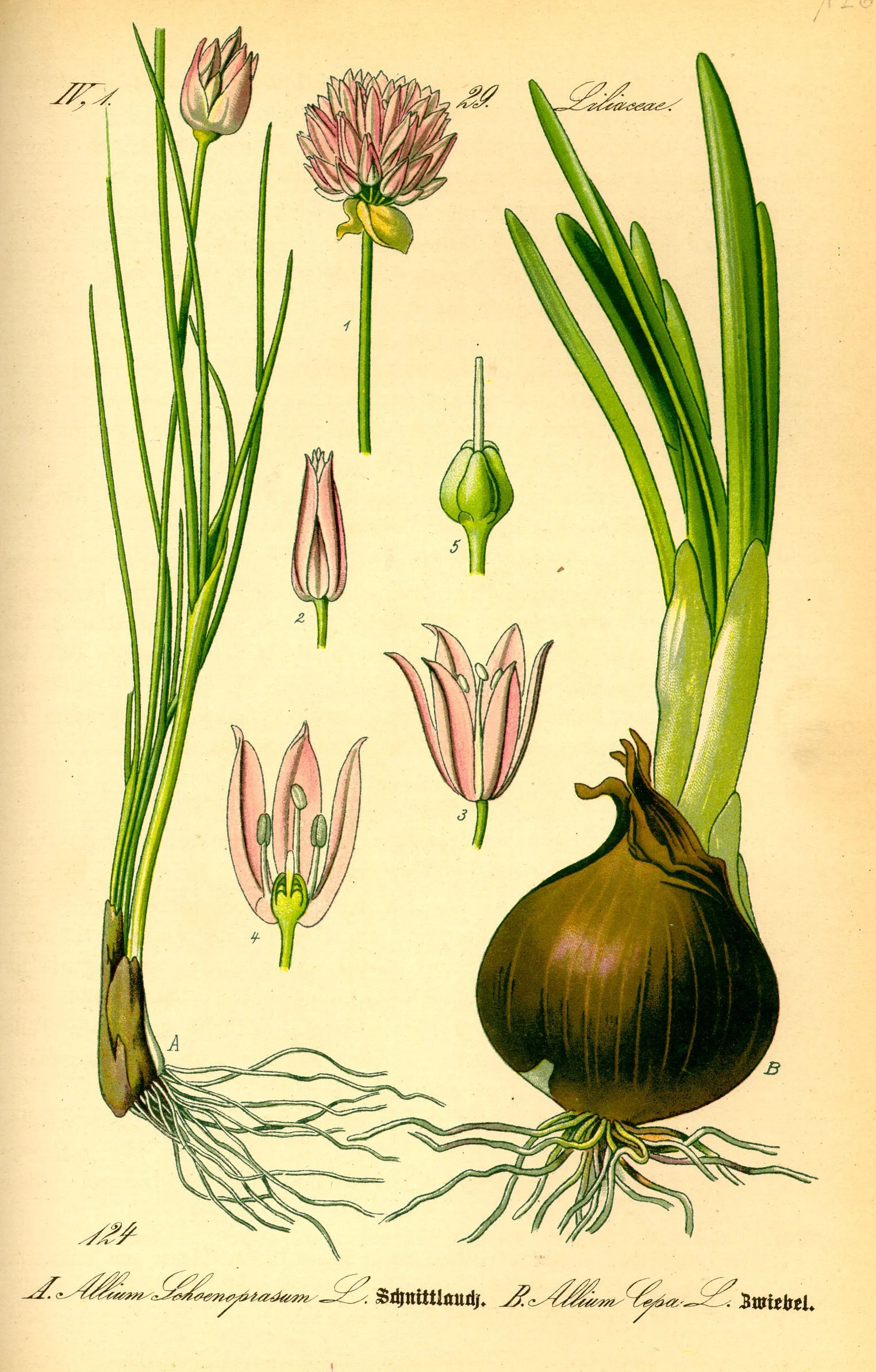
Chives (Allium schoenoprasum), plate 124 (figure A) of Thomé's Flora (1885), drawn beside their relative the onion (figure B) — chives are the one onion-family plant among the ten classic herbs. Cut bunches of the hollow leaves about an inch above the base and they regrow; chives are the exception to the one-third rule and tolerate hard cutting. The pink pom-pom flowers are edible too, with a mild onion flavor.
Otto Wilhelm Thomé, Flora von Deutschland, Österreich und der Schweiz (1885), plate 124. Public domain.
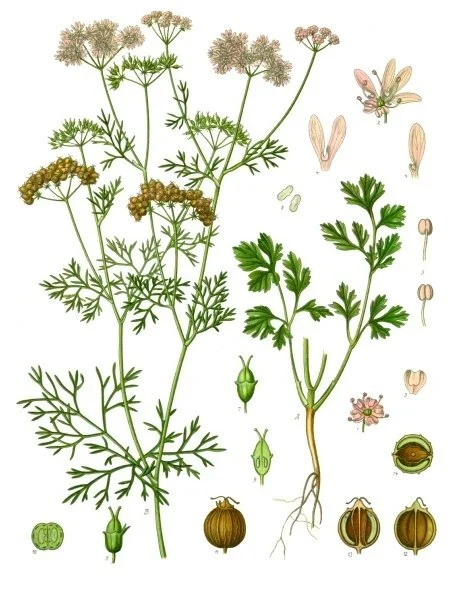
Coriander (Coriandrum sativum), from Köhler's Medizinal-Pflanzen (plate 193). One plant, two kitchen names: the fresh leaves, harvested young and cool-season, are cilantro; the round ribbed seeds drawn enlarged at the foot of the plate are the spice called coriander. The plate shows both leaf forms — the broad basal leaves (right) and the feathery leaves of the flowering stem (left).
Franz Eugen Köhler, Köhler's Medizinal-Pflanzen (1887–1914), plate 193. Public domain.
★ Every kitchen garden in the temperate world grows some version of the same ten plants. They are not the only edible herbs, but they are the foundation: the ones cooks reach for first, the ones worth knowing by name, habit, and temperament. Six belong to the mint family, Lamiaceae, which you met in Lesson 4. Three belong to the parsley family, whose umbrella-shaped flower clusters you studied as umbels in Lesson 6. One stands in the onion family. Learn the families and the individuals get easier to remember.
Check in: Ten classic herbs, three families. How many of the ten belong to each family — and why does learning the families make the individuals easier to remember?
Basil (Ocimum basilicum). The tender annual that defines summer cooking. Basil is frost-tender and sulks in cold, so it goes out only when frost danger has passed. Pinch it early and often: snip stems just above a leaf pair, never taking more than about a third of the plant, and pinch off flower buds the moment they appear. Once basil flowers, leaf production drops and flavor declines. Basil cuttings root readily in a glass of water, so one plant can become several.
Thyme (Thymus vulgaris). The patient perennial. Thyme asks for full sun and sharp drainage, then largely takes care of itself. It responds well to frequent light trims, which keep it compact and productive. Harvest by cutting stems just above a cluster of leaves. A hard herb: its flavor stands up to long, slow cooking.
Rosemary (Salvia rosmarinus, long known as Rosmarinus officinalis). The drought-tolerant evergreen. Rosemary wants sun, excellent drainage, and to be left alone by the watering can. In climates with hard freezes it is a tender perennial: grow it in a pot and bring it indoors for winter, or treat it as an annual. Harvest by cutting several inches off the stem tips, taking no more than a third of the plant. Strip the needle-like leaves from the woody stems before cooking.
Oregano (Origanum vulgare). The enthusiastic spreader. Oregano is easy to grow and eager to wander, so give it room or a pot of its own. Clip branches with clean shears, leaving several inches of growth at the base to send up fresh stems. Its robust flavor survives drying better than most herbs, which is why dried oregano is a pantry staple.
Parsley (Petroselinum crispum). The biennial in disguise. Parsley is usually grown as an annual, and it is famously slow to germinate, often taking two to four weeks, so sow it with patience (you learned the technique in Lesson 18). Harvest the outer stems at the base and work inward, leaving the young center to keep growing. The stems are edible, not just the leaves.
Chives (Allium schoenoprasum). The first green of spring. Chives are among the earliest perennials to wake up, and they ask almost nothing. Cut bunches of leaves about an inch above the base and they regrow obligingly. Chives are the exception to the one-third rule: the whole plant can be cut hard without harm. The pink pom-pom flowers are edible too, with a mild onion flavor.
Sage (Salvia officinalis). The steady perennial. Sage wants sun and drainage, dislikes wet feet, and rewards regular harvesting: cut stems just above a leaf pair and the plant responds with fresh growth. Harvest often rather than rarely. A hard herb, comfortable in long-cooked dishes.
Mint (Mentha spicata, spearmint, and its relatives). The escape artist. Mint spreads aggressively by underground runners and will take over a bed if given the chance, so the standard advice is absolute: grow mint in its own pot, sunk or standing. Harvest at will; mint forgives heavy cutting. Keep it away from your other herbs unless you want a mint garden with a few guests.
Dill (Anethum graveolens). The quick annual. Dill bolts, flowers and sets seed, at the first hint of sustained heat, so sow it in succession every few weeks for a continuous supply. Both the feathery leaves and the seed heads are used in cooking. It dislikes transplanting, so sow where it is to grow.
Cilantro (Coriandrum sativum). The cool-weather sprinter. Like dill, cilantro bolts quickly in heat. It is ready to harvest at six to eight inches tall: take the outer stems at the base, leave the young inner growth, and never take more than a third at once. Sow new seeds every few weeks for steady supply. The seeds of this same plant are the spice called coriander.
❦ In your workbook: record the ten classic herbs in your own way — copy, sketch, or note what matters.
In your packet: Exercise I — The Herb Census ◐ begins here. Work it now, or mark the place and take it as homework — your choice.
Tender Herbs and Hard Herbs
★ The kitchen divides these ten herbs into two camps, and the division governs almost everything: how you store them, when you add them to the pot, and how they behave when dried.
Check in: The tender/hard division is called a cook's classification, not a botanical one. What three things does it govern — and what question do you ask when you meet a new herb?
Tender herbs have soft, high-moisture leaves: basil, parsley, cilantro, dill, chives, and mint. Their flavor is bright and volatile, which means it escapes easily. Tender herbs are best used fresh, added at the end of cooking or not cooked at all, and they lose much of their character when dried. Handle them gently and use them quickly.
Hard herbs have woody stems and tougher, lower-moisture leaves: rosemary, thyme, oregano, and sage. Their flavor is concentrated and durable. Hard herbs can go into the pot early and stand up to long simmering, and they dry well, keeping much of their punch. They forgive rougher handling and longer storage.
This is not a botanical classification. It is a cook's classification, and it is worth learning because it predicts behavior. When you meet a new herb, ask which camp it belongs to and you will already know half of what to do with it.
❦ In your workbook: record tender herbs and hard herbs in your own way — copy, sketch, or note what matters.
Harvesting for the Kitchen
Most gardeners hesitate at the first harvest, afraid of harming the plant. For most herbs, the opposite is true: regular harvesting makes plants bushier, leafier, and more productive. The technique is called cut-and-come-again. You take some, the plant grows more, you take some more. But there are rules, and they exist to keep the plant strong enough to keep its side of the bargain.
★ The one-third rule. For perennial herbs, never remove more than about a third of the plant at one time. The plant needs its remaining leaves to photosynthesize and recover. Annual herbs near the end of the season are the exception: with frost coming, you may cut half to three-quarters at once for a final harvest. Chives, as noted, tolerate hard cutting.
Check in: State the one-third rule — and name its two exceptions in this lesson: the end-of-season annual, and the herb that tolerates hard cutting.
Cut above a node or leaf pair. Stems cut just above a leaf pair or node typically branch into two new shoots, which is how harvesting creates bushiness. Cutting between nodes leaves a stub that withers. You practiced this geometry in Lessons 22 and 23. The kitchen is where it pays off.
★ Harvest in the morning. Pick herbs after the dew has dried but before the heat of the day. This is when the aromatic oils in the leaves are at their highest concentration, and the plants are crisp from the night's rest.
Pinch the flowers. For leaf herbs like basil, cilantro, and dill, flowering signals the plant to slow leaf production and shift energy to seed. Pinch flower buds off as soon as they appear to keep the leaves coming. Late in the season you may let one plant bloom on purpose, for pollinators and for seed.
★ Bolting deserves its own warning. When a cool-weather herb like cilantro or dill bolts, it sends up a flower stalk and goes to seed quickly, often in response to heat. The leaves turn feathery and their flavor changes. Regular harvesting delays bolting, and succession sowing, planting new seeds every few weeks, guarantees that when one planting bolts, the next is already coming up.
Check in: What is bolting — and what two practices answer it, one that delays it and one that guarantees the next planting is already coming up?
❦ In your workbook: record harvesting for the kitchen in your own way — copy, sketch, or note what matters.
In your packet: Exercise II — The Kitchen Harvest ⚒ begins here. Work it now, or mark the place and take it as homework — your choice.
A Note from Professor Fernfoot
You are doing something your great-grandparents would have understood without a lesson, scholars, and that is rather wonderful.
For most of human history, the kitchen garden was not a hobby. It was the pantry. The cook stepped outside, cut what was needed, and came back in. Dried bundles hung from kitchen beams because winter was coming and the garden would sleep. Every technique in this lesson is old, and every one of them still works, which is the best recommendation any technique can have.
Harvest boldly but not greedily. The plant is your partner in this, not your supply closet. Take a third, leave two thirds, and come back next week to find the plant has kept its promise.
— Professor Beryl Fernfoot, Herbology Greenhouse • Master Herbalist • Head of House Oriens
The Fresh-to-Dried Ratio
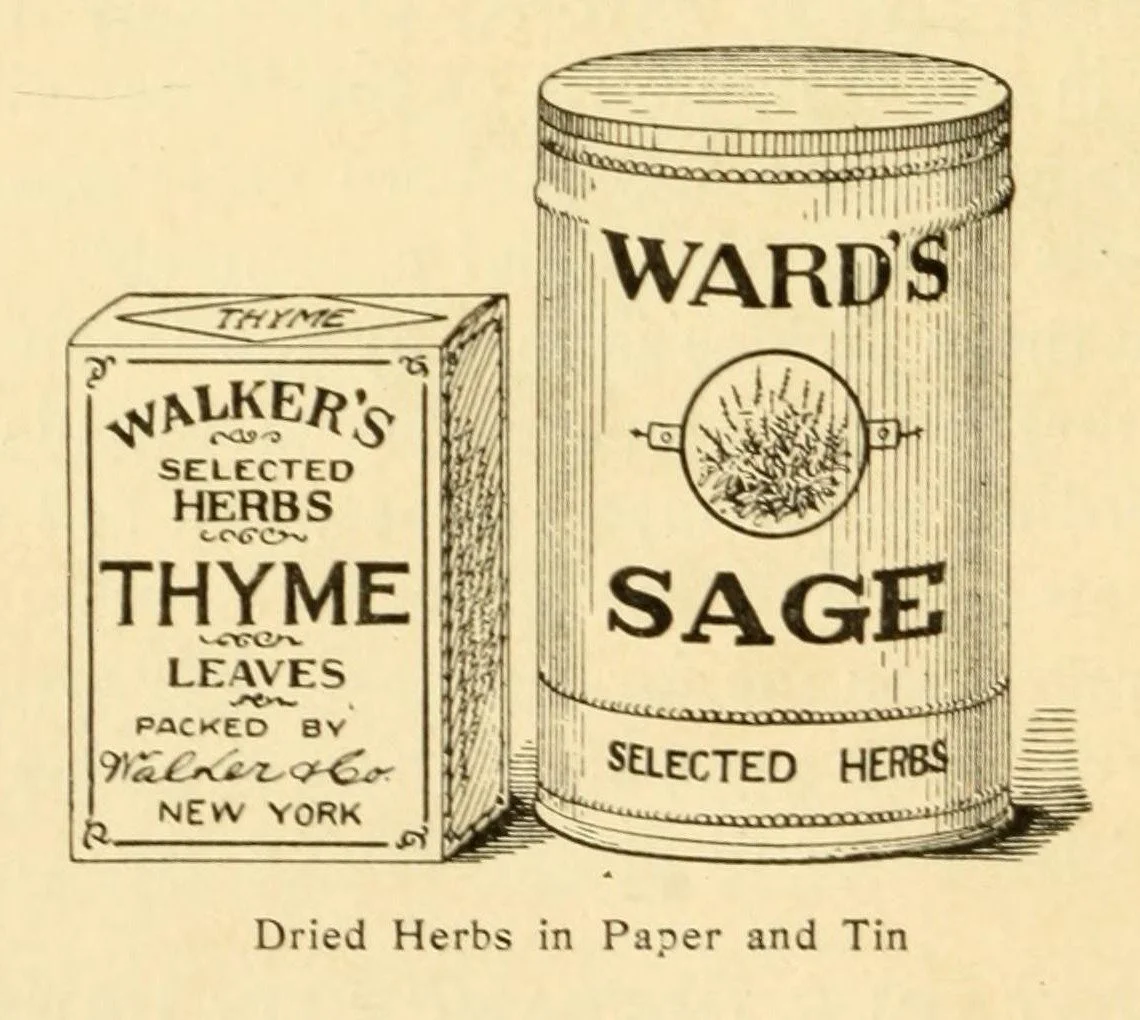
Dried herbs, sealed and labeled, as a 1912 herb manual pictured them: a paper packet of thyme leaves and a tin of sage. Drying drives off most of the plant's water and concentrates what remains — the lesson's ratio is three parts fresh to one part dried, one tablespoon of fresh herbs to about one teaspoon of dried. Hard herbs like thyme and sage keep much of their punch dried.
M. G. Kains, Culinary Herbs: Their Cultivation, Harvesting, Curing and Uses (New York: Orange Judd Company, 1912), p. 22; scan via the Internet Archive. Public domain.
Sooner or later every herb gardener faces the translation problem: a recipe calls for fresh herbs, but the garden is asleep and only the dried jar remains. Or the reverse. The standard conversion is simple and worth memorizing.
★ Three parts fresh equals one part dried. One tablespoon of fresh herbs equals about one teaspoon of dried herbs. Drying drives off most of the plant's water, often eighty to ninety percent of its weight, leaving the flavorful oils concentrated in a much smaller package.
Check in: Give the ratio both ways — parts, and tablespoon to teaspoon — and say what drying removes, and what it leaves concentrated.
Treat the ratio as a starting point, not a law. Dried herbs that have sat in a cupboard for a year have lost potency, so taste and adjust. Ground dried herbs are more concentrated than crumbled leaf, so use a little less. And hard herbs like rosemary and thyme, which hold less water even when fresh, dry down to a particularly strong product: err on the side of less and add more as needed.
Two more things the ratio does not tell you. First, dried herbs need time in heat to soften and release their flavor, so they belong in cooked dishes, not in salads or raw preparations where fresh herbs shine. Second, some herbs barely survive drying at all. Dill and cilantro lose much of their character when dried, which is why freezing, covered next, is the better way to keep them.
❦ In your workbook: record the fresh-to-dried ratio in your own way — copy, sketch, or note what matters.
Keeping the Harvest: Water, Towel, Freezer
A big harvest is only useful if it stays good until you need it. Three methods cover nearly every situation, and each suits a different kind of herb.
★ The water-glass method, for tender herbs. Treat parsley, cilantro, dill, mint, and chives like a bouquet of flowers. Trim the stem ends, strip off any leaves that would sit below the waterline, stand the bunch in a glass with an inch or two of cool water, and refrigerate, covered loosely. Change the water every couple of days. Stored this way, tender herbs keep for a week or two.
Check in: Walk the water-glass method in order — trim, strip, stand, cover, refrigerate, change — and name the five tender herbs it is taught for here.
★ Basil is the exception. Basil's leaves blacken in the cold of the refrigerator. Keep basil in its water glass at room temperature, out of direct sun, and it will stay fresh for days.
The damp-towel method, for hard herbs. Wrap rosemary, thyme, oregano, and sage loosely in a damp (not wet) paper towel, place the bundle in a container or bag in the refrigerator, and the herbs stay fresh for a week or two, sometimes longer. The towel keeps them from drying out; the container keeps excess air away.
Freezing, for the long winter. Freezing preserves the flavor of tender herbs far better than drying does. Chop the leaves, pack them into an ice cube tray, and cover with water or oil. Water cubes go straight into soups and sauces; oil cubes suit herbs destined for cooking. Once frozen solid, move the cubes to a labeled freezer bag. Frozen herbs keep up to a year, with the best flavor in the first few months. One honest warning: the leaves go limp when they thaw, so frozen herbs belong in cooked dishes, not as garnish.
★ A note on safety that matters: herbs mixed with oil must be frozen, never stored in oil at room temperature. And whatever the method, wash all produce before use, confirm you have identified the herb correctly before tasting anything from the garden, and keep food allergies in mind when sharing your harvest.
Check in: State the safety note whole: the oil rule, and the three things to do whatever the storage method.
❦ In your workbook: record keeping the harvest in your own way — copy, sketch, or note what matters.
In your packet: Exercise III — The Storage Trial ◐ begins here. Work it now, or mark the place and take it as homework — your choice.
Guided Observation: Your Scholar's Familiar Through a Cook's Eyes
This lesson's observation is the source's own Familiar check-in, worked in full: your Familiar — or an adopted kitchen herb — assessed for a kitchen harvest, by the one-third rule and the storage methods this lesson teaches, before anything is cut.
This week, look at your Familiar through a cook's eyes.
- Which of the ten classic herbs is your Familiar, or its closest relative? (Mint, basil, and chives are common Familiars.)
- If your Familiar is edible, assess it for a kitchen harvest: is it large enough to spare a third? Where would you cut, and which method, water glass or damp towel, would suit it?
- If your Familiar is not edible, identify which of the ten herbs you would plant beside it, and why that pairing suits your growing conditions.
Record your assessment in your grow ledger. Do not harvest your Familiar unless it is genuinely thriving and you have worked through the one-third rule honestly.
If you do not have a Scholar's Familiar, adopt any kitchen herb you can visit regularly, a potted basil on a neighbor's windowsill, a rosemary bush in a park, a mint patch in a community garden, and perform the same assessment there.
Materials
Required (Level One — household items)
- Clean scissors or garden snips: for harvesting stems cleanly, just above a leaf pair or node.
- A glass or jar: for the water-glass storage method.
- Paper towels: for the damp-towel storage method.
- An ice cube tray and labeled freezer bags: for freezing herbs in water or oil.
- Your grow ledger and a pencil: for the herb census, harvest log, and storage trial records.
Suggested (Level Two — historically closer)
- Herb scissors or a harvesting knife: the traditional gardener's cutting tools, kept clean and sharp.
- Linen produce bags: a reusable alternative to paper towels for wrapping hard herbs.
- Silicone freezer trays: for easy removal of frozen herb cubes.
- Plant labels: for marking frozen batches with the herb name and date.
Safety notes: Confirm you have correctly identified each herb before tasting anything from the garden. Never eat an unidentified plant. Wash all produce thoroughly before use. Keep food allergies in mind when sharing your harvest with others. Herbs mixed with oil must be frozen, never stored in oil at room temperature. Younger students: ask an adult for help with knife work and freezer tasks. Wash your hands after handling soil or garden plants.
Reflection Questions
Answer the following questions in your workbook.
- Why does the standard fresh-to-dried ratio work as a starting point but not as a law? Name two situations where you would adjust it.
- A friend stores basil in the refrigerator and rosemary in a water glass. Both wilt within days. Explain what went wrong in each case.
- Cut-and-come-again harvesting makes most herbs more productive, not less. Explain why, in terms of what happens at the cut point.
- Dill and cilantro are poor candidates for drying but excellent candidates for freezing. Why does the difference matter for a gardener planning winter supplies?
- Six of the ten classic herbs belong to the mint family. What traits of that family, as you have studied it, make its members such successful kitchen herbs?
Workbook Checklist — Lesson 31
In my workbook I have:
- ☐ named the ten classic culinary herbs, with one reliable growing note for each, and sorted the ten by family — six mint, three parsley, one onion
- ☐ sorted kitchen herbs into tender herbs and hard herbs and said why the distinction governs storage, timing in the pot, and drying
- ☐ stated the cut-and-come-again rules: the one-third rule with its exceptions, cut above a node or leaf pair, harvest in the morning, pinch the flowers, and answered bolting with regular harvesting and succession sowing
- ☐ converted between fresh and dried herbs by the standard ratio — three parts fresh to one part dried, one tablespoon fresh to about one teaspoon dried — and named when to adjust it
- ☐ stored fresh herbs by the water-glass method (basil at room temperature, never refrigerated) and the damp-towel method, and frozen herbs in cubes for winter cooking
- ☐ kept the kitchen safety rules whole: herbs in oil frozen, never stored in oil at room temperature; wash all produce before use; confirm the herb's identity before tasting; keep food allergies in mind when sharing
- ☐ assessed my Scholar's Familiar, or an adopted kitchen herb, through a cook's eyes for a kitchen harvest
- ☐ completed the Herb Census, the Kitchen Harvest, and the Storage Trial — or their market-bunch, adopted-plant, and workbook paths
☐ Lesson completed Date: ___ Signature: ___
The Professor's Closing Note
Well done, scholars. You now know the ten herbs that feed the world's kitchens, and you know how to take from them without taking too much.
There is a rhythm to this work that I want you to notice. Sow, tend, harvest, keep. The garden gives, the kitchen receives, and the gardener stands between the two, translating sunlight into supper. It is one of the oldest human rhythms there is, and you are now part of it.
Next, we turn from the kitchen to the keeping house in earnest: the drying racks, the storage jars, and the long, quiet work of preservation. Your harvests will need those skills soon.
The greenhouse doors stand open.
— Professor Beryl Fernfoot, Herbology Greenhouse • Master Herbalist • Head of House Oriens
Cross-Class Connections

Potions · Unit II, Lesson 13 — Seeds, Spices & Culinary Botanicals
Benches clear, notebooks open, scholars. Your kitchen spice rack is a laboratory shelf in disguise, and the herbs of this lesson keep company there with pepper, cinnamon, and cloves. Come and profile culinary botanicals the apothecary's way — by observation, by test, and by record: how fragrance is stored inside seeds and bark, why whole spices keep their aroma longer than ground ones, and how to judge whether a dried spice is still worth its jar, kept cool, dark, dry, and tightly sealed. We will not be cooking, and nothing here is medicine. We will be observing — Muddlenook.
Further Reading & Sources
- Fresh to Dried Herb Conversion — Taste of Home — The 3:1 rule explained with adjustments for ground herbs and herb forms. - The Correct Ratio When Substituting Dried Herbs for Fresh — The Kitchn — Why drying concentrates flavor, plus the note on dried herbs in raw preparations. - How to Store Fresh Herbs in the Fridge — The Kitchn — The water-glass method for tender herbs and the damp-towel method for hard herbs, with the basil exception. - Freezing Herbs — Penn State Extension — University guidance on freezing herbs in water, oil, and flat, including the room-temperature oil safety warning. - Tips for Harvesting Basil, Chives and Other Herbs — Horticulture Magazine — The one-third rule and herb-by-herb harvest technique from a trusted gardening source. - How to Harvest Cilantro So It Keeps Growing — Southern Living — Cut-and-come-again for cilantro, succession sowing, and the coriander connection. Browse the Herbology shelf in the school Library for readable editions of these works.
Plants from this lesson stand in the Materia Botanica, the school's shared archive — each kept with its lessons, its keepings, and its cautions. This lesson's company:
ChivesCorianderDillOnionSage The whole Materia BotanicaPROFESSOR BERYL FERNFOOT · HERBOLOGY GREENHOUSE
Submit your work for this lesson using the form below.
CONTINUE IN THE HERBOLOGY GREENHOUSE
← Previous · Lesson 30: Seed Saving & Storage Next · Lesson 32: Unit IV Harvest Festival Project →
Unit IV — Harvest, Preservation & Use Herbology Greenhouse — All 37 Lessons
The rest of Unit IV: Lesson 27 · Timing the Harvest · Lesson 28 · Drying Herbs · Lesson 29 · Pressing & Preserving · Lesson 30 · Seed Saving · Lesson 32 · Harvest Festival Project