
HERBOLOGY
Unit IV · Lesson 27TIMING THE HARVEST
PROFESSOR BERYL FERNFOOT
Herbology Greenhouse
Master Herbalist
Herbology Greenhouse • Unit IV: Harvest, Preservation & Use • Lesson 27
Professor's Introduction

Come and sit a while, gardeners,
For three units you have learned to grow things: to sow, to feed, to water, to prune, to watch. Now we come to the part of the gardener's year that all that work was leading toward. We are going to gather.
Gathering sounds simple. You reach out, you snip, you carry your basket home. But when you reach out matters as much as how. A leaf picked at dawn and a leaf picked at noon came from the same plant, yet they are not the same leaf. One is rich and fragrant; the other has spent its riches in the heat. The plant does not change. The hour does.
This lesson is about reading the right moment. Plants keep a schedule, and once you learn to read it, you will never again gather blindly.
— Professor Beryl Fernfoot, Herbology Greenhouse • Master Herbalist • Head of House Oriens

The line beneath the map is our road: every stop a place where the knowledge of plants changed, every lesson a step along it.
Lesson Objectives
By the end of this lesson, you will be able to:
- Explain why the time of day changes the flavor and fragrance of harvested herbs.
- Harvest leaves, flowers, seeds, and roots at the correct stage for each plant part.
- Read a plant for readiness, and judge when it has enough growth to spare a harvest.
- Apply the one-third rule, and know when the stricter and looser limits apply.
- Harvest respectfully, leaving every plant able to continue growing.
Reading this lesson: ★ marks the passages to remember. They return on the unit quiz and the class test. Check in questions ask the material back as you go; answer them in your workbook when you meet them.
Working this lesson: Your assignment packet is the first download on this page. Work in it as the lesson moves along, answering each assignment as its subject is taught — or read the lesson through for your notes and take the assignments as homework afterward. Both are proper ways to sit this class. Signposts in the reading tell you where each assignment belongs. Written answers are short answers in your own words; a few honest lines are worth more than a filled page.
Your Assignment Packet
This lesson's assignments live in its packet: the Lexicon Handout (every term, course terms marked ◆), Materials, Guided Practice, the Assignment Manual with its answer key for self-checking, the Reflection Questions, and the Workbook Checklist. Download the packet before you begin and keep it beside you as you read.
Why Timing Changes Everything
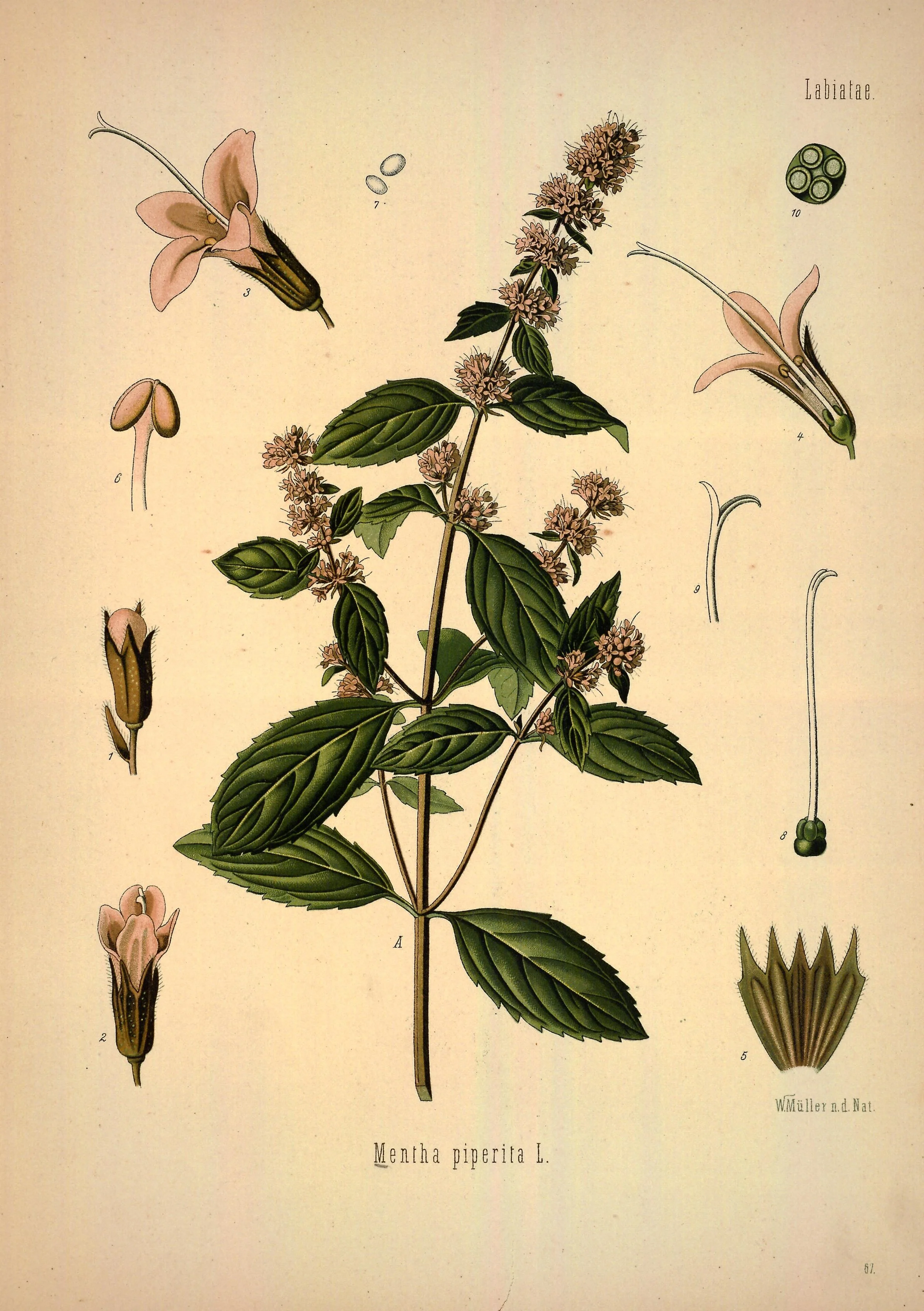
Peppermint (Mentha piperita), plate 67 of Köhler's Medizinal-Pflanzen (1887). Mint is this lesson's measuring instrument: the volatile oils that give its leaves their scent gather in the cool of the night and leave on the warm air, so the same stem cut at nine in the morning and cut at noon is not the same harvest. Exercise I asks you to prove that with your own nose.
Franz Eugen Köhler, Köhler's Medizinal-Pflanzen (1887), plate 67, via the Biodiversity Heritage Library. Public domain.
Every aromatic herb you grow carries tiny stores of volatile oils. These are the compounds that make basil smell like basil, mint smell like mint, and lavender smell like a summer afternoon. They are the plant's flavor, its fragrance, and much of its character. When you harvest an herb, you are really harvesting its oils.
★ Those oils are not fixed. They rise and fall with the hour of the day, the stage of the plant's life, and the turn of the season. In the cool of the night, the plant rests and its oils accumulate in the leaves. As the sun climbs and the day heats, the oils begin to evaporate into the warm air. This is why a garden smells strongest in the cool of the morning and faintest in the blaze of the afternoon. The fragrance you smell on the air is fragrance that has left the leaf.
Check in: In your own words: where do an herb's oils rest overnight, and where do they go as the day heats?
So the first lesson of the harvest is this: gather the oils before the sun spends them. Everything else in this lesson is a variation on that theme, played out across the day, across the plant, and across the year.
❦ In your workbook: record why timing changes everything in your own way — the volatile oils, their nightly accumulation, and their loss to the warm air — copy, sketch, or note what matters.
The Morning Harvest
★ The best hour to harvest herbs is the middle of the morning, after the dew has dried from the leaves but before the heat of the day arrives. This is the advice given by gardeners and agricultural extensions alike, and the reasoning behind it is simple.
Check in: Why must the dew dry first — and why must you not wait long after it does?
Dew must dry first. Leaves gathered while still wet are more likely to bruise, to wilt in the basket, and to grow mold later, especially if you plan to dry them. A wet harvest is a harvest already going soft. So you wait for the sun to lift the moisture off the leaves.
But you do not wait long. Once the day grows hot, the volatile oils begin to leave the leaves on the warming air, and the leaves themselves may wilt in the heat. An herb cut at noon is floppier, less fragrant, and less flavorful than the same herb cut at nine in the morning. The difference is real, and once you have smelled it, you will not forget it.
Aim for mid-morning on a clear, dry day. The dew is gone, the oils are still home, and the leaves are crisp. If your schedule will not allow a morning harvest, an evening harvest after the heat has passed is your second-best choice. The worst choice, for flavor and fragrance, is the hot middle of the day.
There is one exception worth knowing. If you are gathering herbs to use fresh within the hour, for a meal or a craft, the timing matters less. The oils have not had time to fade from your basket. But anything you mean to keep, to dry, or to store, deserves the morning.
❦ In your workbook: record the morning harvest in your own way — dew dried, oils still home, and the evening as second-best — copy, sketch, or note what matters.
In your packet: Exercise I — The Morning Comparison ⚒ begins here. Work it now, or mark the place and take it as homework — your choice.
Leaves: Before the Bloom
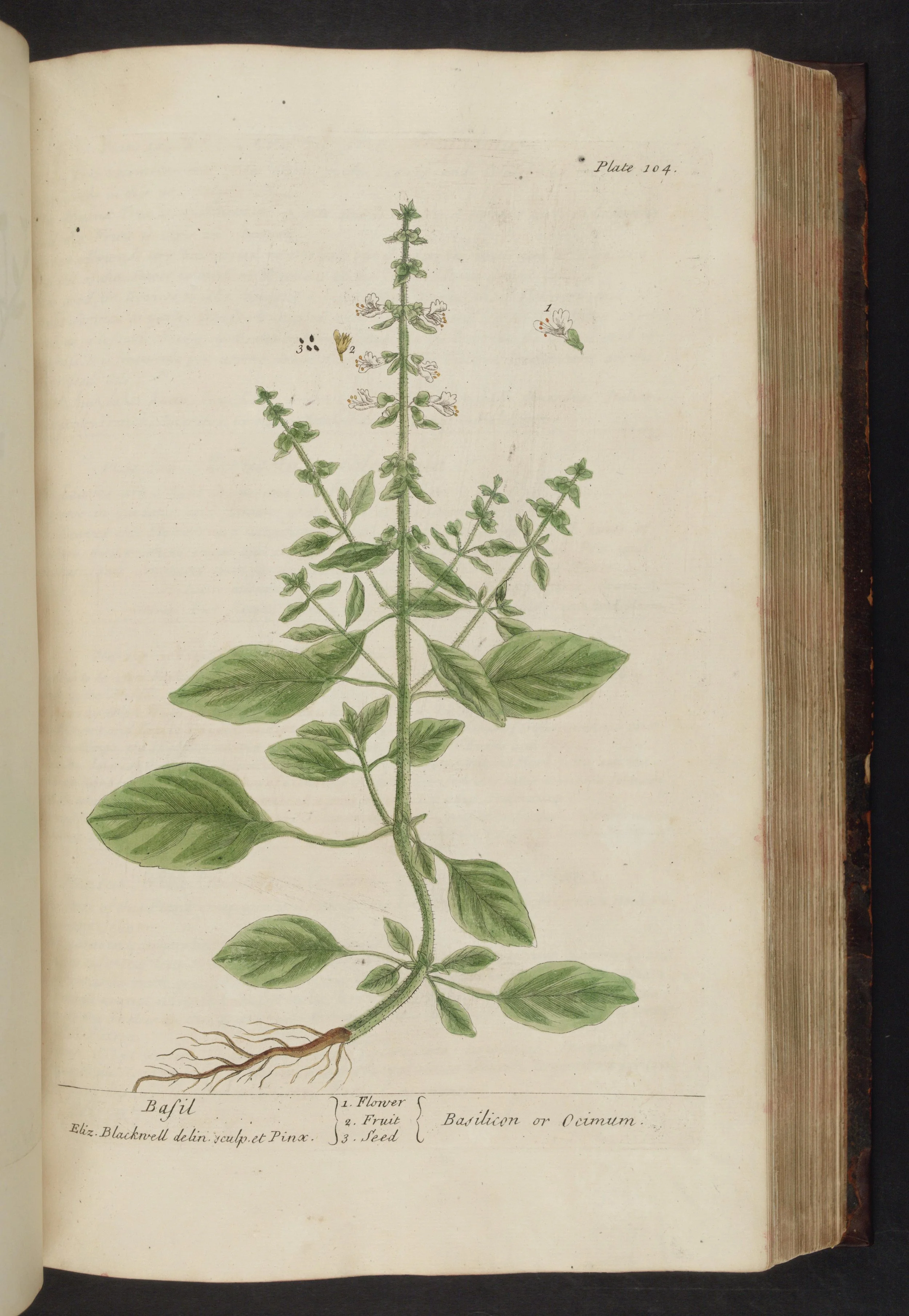
Basil drawn whole in 1737 (Elizabeth Blackwell, A Curious Herbal, Plate 104 — "Basil, Basilicon or Ocimum"): broad leaves in opposite pairs below, and at the top the leading stem already run up into a flower spike. That spike is the signal this lesson teaches — once a basil plant blooms, its energy turns from leaves to seed and the leaf flavor fades. Gather the leaves while the plant is still thinking about leaves, and pinch the buds away as you go.
Elizabeth Blackwell, A Curious Herbal (1737), Plate 104, via the Biodiversity Heritage Library / Wikimedia Commons.
★ Leaves are the part of the herb most students gather first, and the rule for leaves is the simplest in this lesson: harvest leafy herbs before they flower.
Check in: What signal tells you the leaf window is closing — and what does pinching those buds away tell the plant to do?
A plant that begins to bloom changes its priorities. Energy that was going into making broad, tender, flavorful leaves is redirected into making flowers and then seeds. The chemistry of the leaves shifts. Many herbs develop a sharper, duller, or simply less pleasant flavor once they bloom. Basil is the classic example: let it flower freely, and the leaves lose the sweet richness that made you plant it.
This does not mean a flowering herb is ruined. It means you should gather the leaves while the plant is still thinking about leaves. Watch for the first small buds forming at the stem tips. That is your signal. Gather what you need, and pinch those buds away as you go. Removing the flower buds, a habit called pinching back the bloom, tells the plant to keep making leaves instead. A basil plant whose buds are pinched regularly will produce fresh leaves all summer. A basil plant left to bloom will slow its leaf-making and hurry toward seed.
Some herbs are naturally more forgiving. Mint, chives, parsley, and oregano rebound quickly and tolerate regular cutting. Woody herbs like rosemary, thyme, and sage hold their character longer and can be gathered through the season, though even they are at their best just before blooming. Learn your plant's habits, and let the buds be your clock.
❦ In your workbook: record leaves before the bloom in your own way — the bud signal, pinching back the bloom, and the forgiving herbs — copy, sketch, or note what matters.
Flowers: Just as They Open
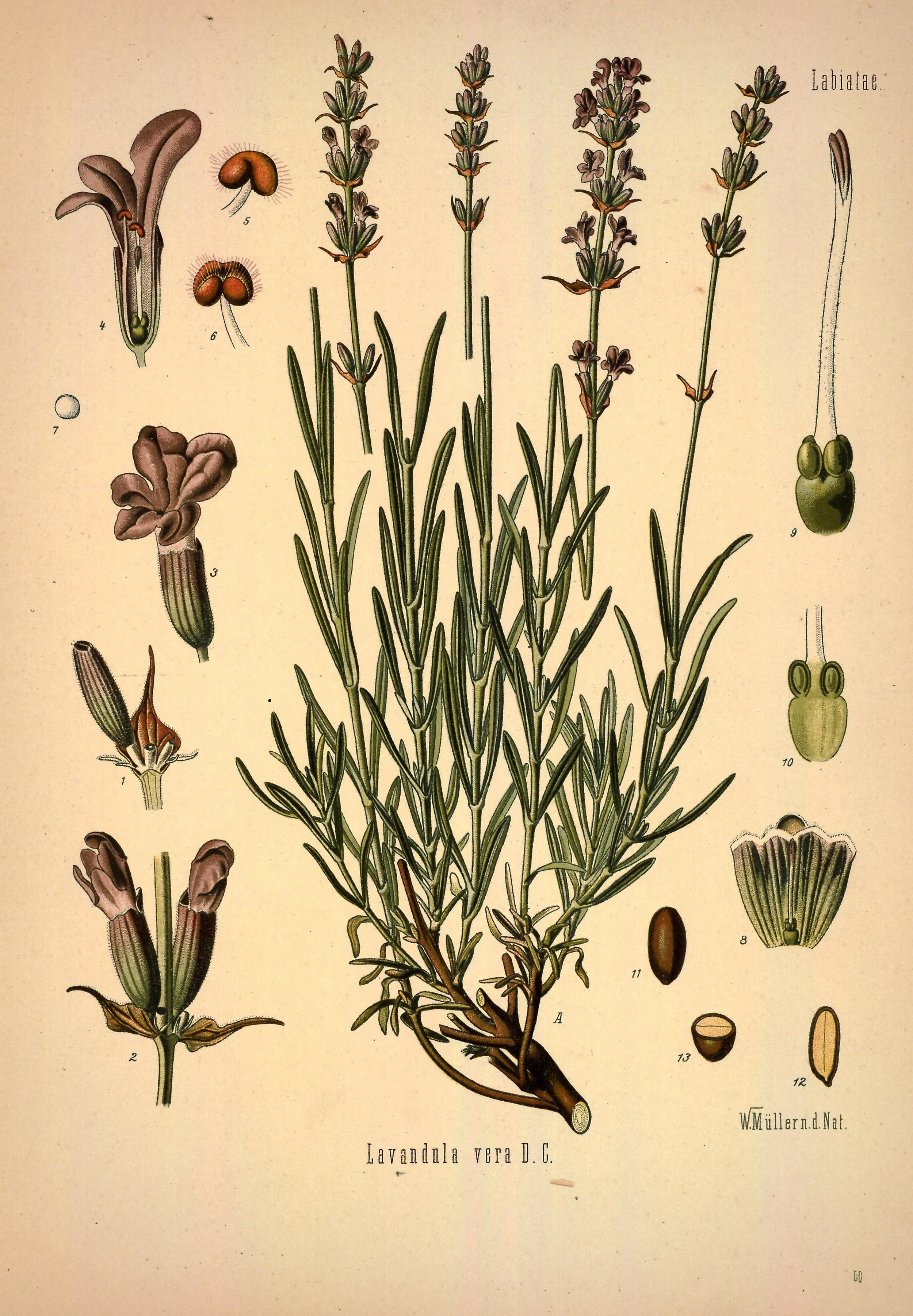
Lavender, Köhler's Medizinal-Pflanzen, plate 60 — printed with its period name, Lavandula vera, a synonym of Lavandula angustifolia. Read the four spikes as a clock: the lesson's moment is the spike whose lowest flowers have just opened while the rest are still in bud — at that moment the spike holds its maximum fragrance, and it keeps that fragrance as it dries.
From Köhler's Medizinal-Pflanzen (1887), plate 60, via the Biodiversity Heritage Library. Public domain.
★ When the flower itself is what you want, the timing reverses. Herb flowers carry their most intense concentration of oils just as the buds open, after the bud has formed but before the bloom is fully spent. Gather too early, and the flower has not yet developed its full character. Gather too late, and the petals are fading and the oils are already going.
Check in: Lavender is cut when the lowest flowers on the spike have just opened and the rest are still in bud. Why is that exact moment the prize?
Lavender is the great teacher here. Cut lavender stems when the lowest flowers on the spike have just opened and the rest are still in bud. At that moment the spike holds the maximum fragrance, and it will keep that fragrance as it dries. Chamomile is similar: pick the blossoms on a dry, sunny day when they have just opened fully. Borage, calendula, and other flowering herbs follow the same pattern: the just-opened bloom is the prize.
For flowers you mean to dry for craft or decoration rather than fragrance, you may pick them a touch earlier, just before they are fully open, so the petals hold their shape. But for flavor and scent, the just-opened flower is the moment.
My dears, there is a small heartbreak built into this lesson, and I want you to be ready for it. The most beautiful moment of a flower is also the moment to cut it. It feels wrong the first time. It will feel right the hundredth time, when you understand that the plant made that flower to be used, and that your gathering is part of its purpose, not an interruption of it.
— Professor Beryl Fernfoot, Herbology Greenhouse • Master Herbalist • Head of House Oriens
❦ In your workbook: record flowers just as they open in your own way — the lavender spike's moment, and the touch-earlier rule for craft flowers — copy, sketch, or note what matters.
Seeds: When Brown and Dry
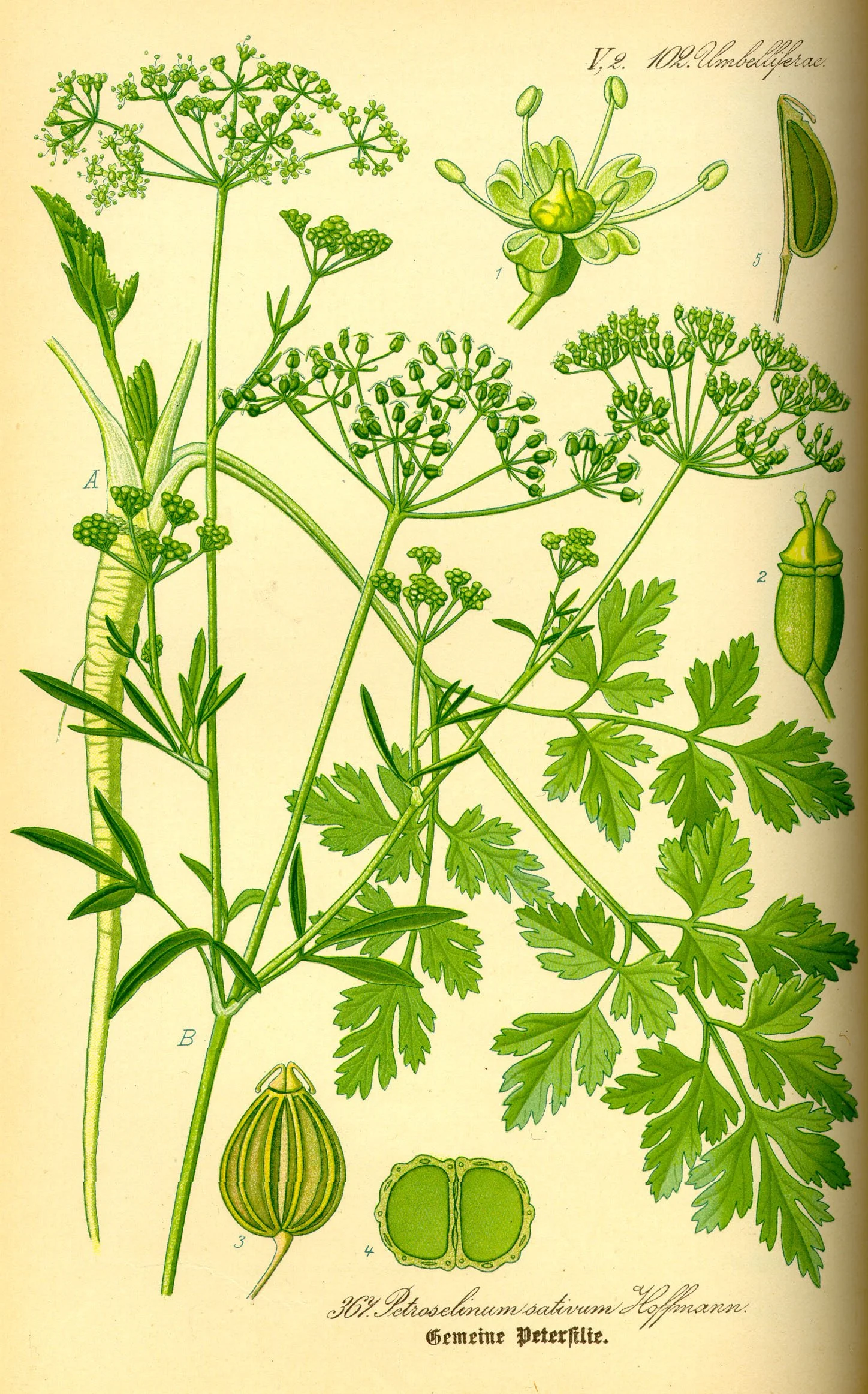
Parsley in its seed year, Thomé plate 367 — printed under its period name, Petroselinum sativum, a synonym of Petroselinum crispum. The umbrella of stalks is the umbel, the seed head this section watches; at the foot the plate draws the ribbed fruit whole (3) and cut across (4). Thomé draws the plant green, still forming its seed — the harvest moment comes later, when heads like these have turned brown and dry on the plant but have not yet split and scattered.
Prof. Dr. Otto Wilhelm Thomé, Flora von Deutschland, Österreich und der Schweiz (1885), plate 367, via biolib.de. Public domain.
★ Some herbs are grown for their seeds: dill, coriander, fennel, caraway, anise. For these, patience runs the other way. You do not hurry. You wait until the seed heads have dried and turned brown on the plant, because a seed gathered green will not finish ripening properly off the stem.
Check in: Why is each half of "brown and dry, but before they open" necessary?
Watch the pods or umbels change color, from green to brown to gray. When they are dry and crushable between your fingers, the seeds are ready. But do not wait too long past that point. Dry seed heads are designed to scatter their seeds, and a strong wind or a careless brush can empty them before you arrive.
The old gardener's trick is the paper bag. Slip a small paper bag over the ripening seed head and tie it loosely around the stem. As the seeds dry and loosen, they fall into the bag instead of onto the ground. Check the bag every few days. When it holds a good rattle of dry seed, bring it inside, spread the seeds on a tray, and let them finish drying in a warm, airy room before you store them.
❦ In your workbook: record seeds when brown and dry in your own way — the color change, the scatter risk, and the paper-bag trick — copy, sketch, or note what matters.
Roots: After the Foliage Fades
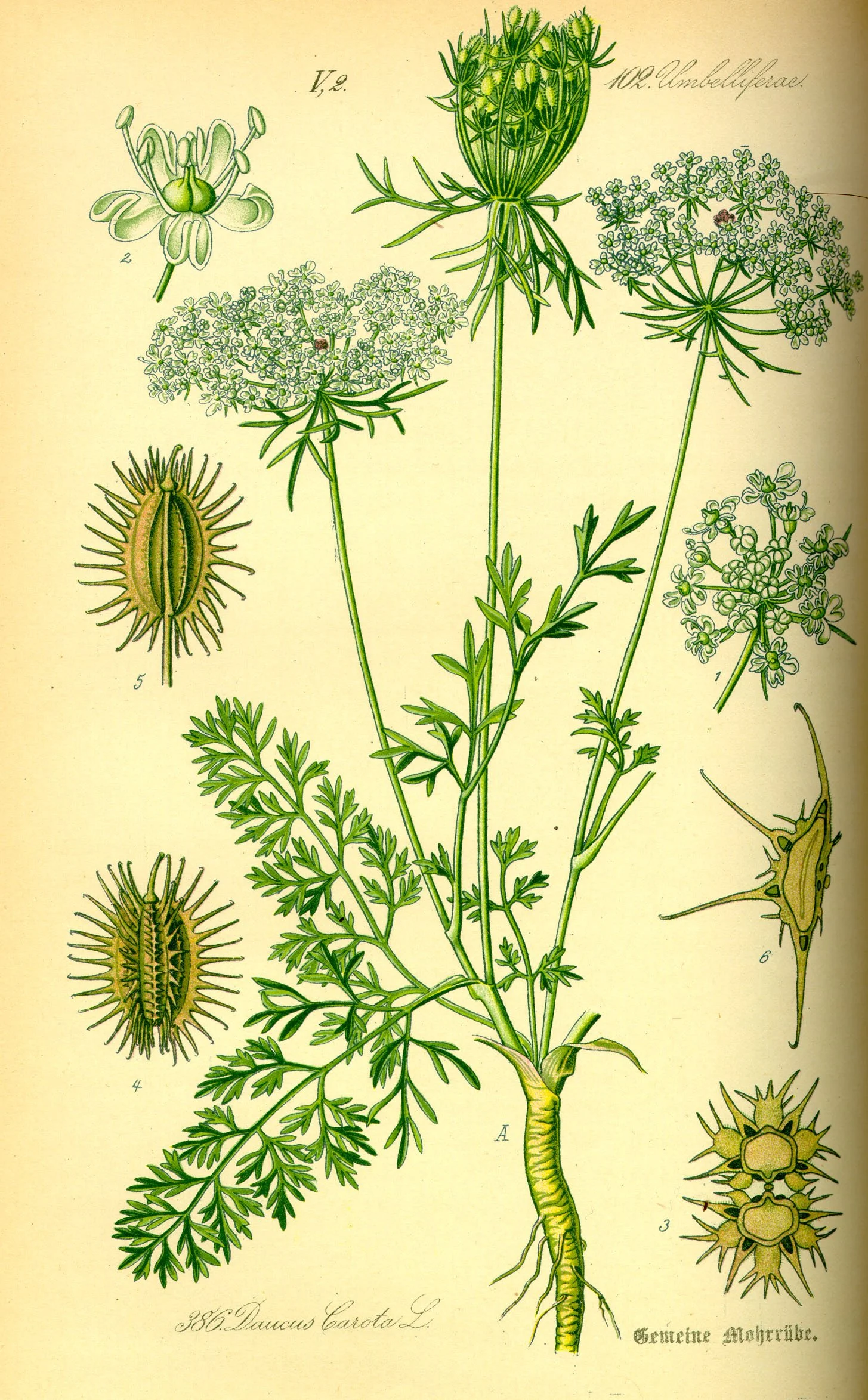
A root crop drawn whole (Thomé plate 386): carrot (Daucus carota) keeps its year's work in one thick taproot below ground. Roots are the year's last harvest — through summer the plant's energy travels up into leaves and flowers; as the foliage fades it travels back down, and the root is fullest then. Carrot is the lesson's biennial case: a biennial root is dug in its first autumn, before the plant flowers in its second year as the plate shows it.
Daucus carota, plate 386 from Otto Wilhelm Thomé, Flora von Deutschland, Österreich und der Schweiz (1885). Public domain.
★ Roots follow the deepest rhythm of all, the rhythm of the year itself. Through spring and summer, a perennial plant sends its energy upward into stems, leaves, and flowers. As autumn comes and the foliage fades, the plant reverses the flow. Energy travels back down into the roots, where it is stored for the winter. The root, which spent the summer as a servant of the leaves, becomes the plant's winter pantry.
Check in: Where is the plant's energy in autumn — and why does that make the root fullest then?
That is why roots are gathered in the fall, after the blooming is over and the foliage has faded. Echinacea, valerian, comfrey, and marshmallow roots are all traditionally dug once the tops have died back. The plant has packed its stores below ground, and the root is at its fullest.
A few roots are exceptions. Some biennial roots, like those of certain traditional herbs, are dug in their first autumn before the plant flowers in its second year. And a root can also be taken in very early spring, before new growth begins, when the stored energy has not yet been spent upward. But for the beginner, the rule holds: when the tops fade, the roots are ready.
Digging roots disturbs the plant more than any other harvest, so it deserves the most thought. Take only what you need, and only from plantings you can spare. A root harvest is a serious harvest. Treat it as one.
❦ In your workbook: record roots after the foliage fades in your own way — the year's energy flow, the fall rule and its two exceptions, and the seriousness of digging — copy, sketch, or note what matters.
In your packet: Exercise II — The Harvest Calendar ⚒ begins here. Work it now, or mark the place and take it as homework — your choice.
Weather and the Harvest
★ Choose your day as carefully as your hour. Never harvest on a rainy day. Wet foliage bruises easily, wilts faster in the basket, and invites mold the moment you try to dry or store it. If rain has just passed, give the plants a day to dry fully before you gather. The one situation where a light rain helps is the garden itself: rain washes dust from the leaves, and a day or two after a rain, on a dry morning, the foliage is at its cleanest.
Check in: Why is a rainy day never a harvest day — and where must you never gather at all?
Wind matters too. A hot, dry wind strips moisture and oils from leaves much like the midday sun does. On windy days, harvest early and get your cuttings into shade quickly. And avoid harvesting immediately after a heavy dust storm or near a road where dust and exhaust settle on the leaves. If leaves are dirty, rinse them gently and shake off every drop of water before you proceed. Clean leaves, dry leaves, morning leaves: that is the whole of it.
Where you harvest matters as much as when. Never gather from roadsides, from lawns or verges that may have been sprayed, or from anywhere you cannot be sure is clean. Exhaust, herbicides, and pesticides do not wash off as easily as dust. Your own garden, your pots, and wild places you know well are the safe choices.
❦ In your workbook: record weather and the harvest in your own way — the dry-day rule, the wind rule, and the clean-ground rule — copy, sketch, or note what matters.
The One-Third Rule and the Respectful Harvest
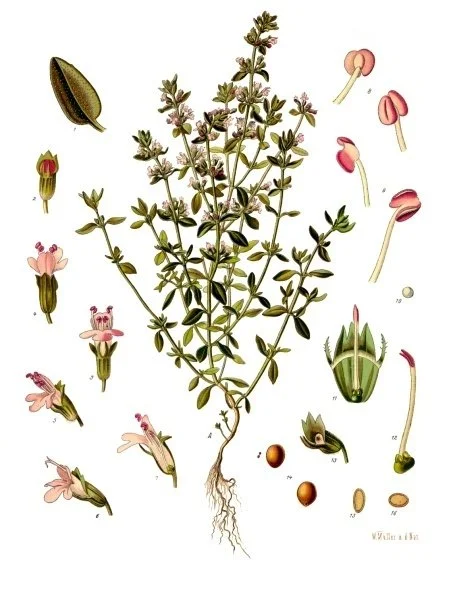
Common thyme, Thymus vulgaris (Köhler's Medizinal-Pflanzen): the whole perennial drawn entire, roots to flower heads — the standing stock the one-third rule protects. Never take more than one-third of a perennial like this thyme at one time: the plant keeps two-thirds of its foliage, goes on feeding its roots, and regrows what was taken. And stop altogether about a month before the first expected frost, so no tender new growth is caught by the cold.
Thymus vulgaris, plate from Franz Eugen Köhler, Köhler's Medizinal-Pflanzen (1887–1914). Public domain.
★ However eager you are, the plant's needs come first. The standing rule of the respectful harvest is this: never take more than one-third of a perennial plant at one time.
Check in: State the one-third rule — and the autumn limit that stands beside it.
A perennial herb, sage or thyme or oregano, must live through the winter on what it keeps. Strip it bare in summer and it cannot photosynthesize enough to recover, let alone store energy for the cold months ahead. Taking a third leaves two-thirds standing, still working, still feeding the roots. The plant barely notices your visit, and within weeks it has grown back what you took. That is the goal: a harvest the plant shrugs off.
Annuals are more generous. A basil or dill plant, which will die with the frost anyway, can spare up to three-quarters of its growth at one time, provided you leave enough lower foliage for it to keep growing. But the one-third rule is still the kinder habit, and the easier one to remember. When in doubt, take less. The plant will make more.
★ There is one more limit, and it belongs to autumn. Stop harvesting perennial herbs about one month before your first expected frost. Late cutting encourages the plant to push out tender new growth, and tender new growth cannot harden off before winter arrives. The frost will kill it, and the plant will have spent precious stored energy making it. Let your perennials rest into the cold undisturbed. Annuals, by contrast, may be gathered right up until the frost takes them. Their season is ending; take what the season offers.
My dears, I have watched students stand before a flourishing plant, basket in hand, and hesitate. They are afraid to cut, afraid to harm. Let me set your minds at rest. A plant that is never harvested grows leggy and tired. The herbs that are cut regularly, mint and basil and chives above all, grow back bushier and more vigorous than the ones left alone. Your gathering, done with restraint, is not an injury. It is a conversation. You take, the plant answers with new growth, and both of you are the better for it.
— Professor Beryl Fernfoot, Herbology Greenhouse • Master Herbalist • Head of House Oriens
❦ In your workbook: record the one-third rule and the respectful harvest in your own way — the perennial limit, the annual allowance, and the autumn stop — copy, sketch, or note what matters.
Reading Readiness: Is the Plant Ready?
Before you cut, ask the plant's permission. Not in words, but in observation. A plant tells you whether it can spare a harvest, if you know how to look.
★ First, size. A young seedling with four leaves cannot spare any of them. Wait until the plant has grown enough foliage to keep thriving after you take your share. The guideline from the agricultural extensions is plain: begin harvesting only when the plant has enough foliage to maintain its own growth.
Second, vigor. A plant that is wilted, yellowing, pest-chewed, or struggling is asking for help, not for harvest. Tend it first. Gather from the strong plants, and let the weak ones recover.
Third, proportion. Look at what you plan to take against what will remain. Can you picture the plant afterward, still full, still green, still growing? If the mental picture shows a skeleton, put the basket down and come back in two weeks.
Check in: Name the three readiness questions — size, vigor, and proportion — and say what a "skeleton" picture tells you to do.
Your Scholar's Familiar has been growing beside you since Lesson 1. You know its habits now: how fast it grows, how it responds to cutting, where its strength lies. There is no better teacher of readiness than a plant you have watched for months. Trust that knowledge. It is the whole point of the Familiar.
❦ In your workbook: record reading readiness in your own way — size, vigor, and proportion, and the Familiar as your teacher — copy, sketch, or note what matters.
The Familiar's First Harvest
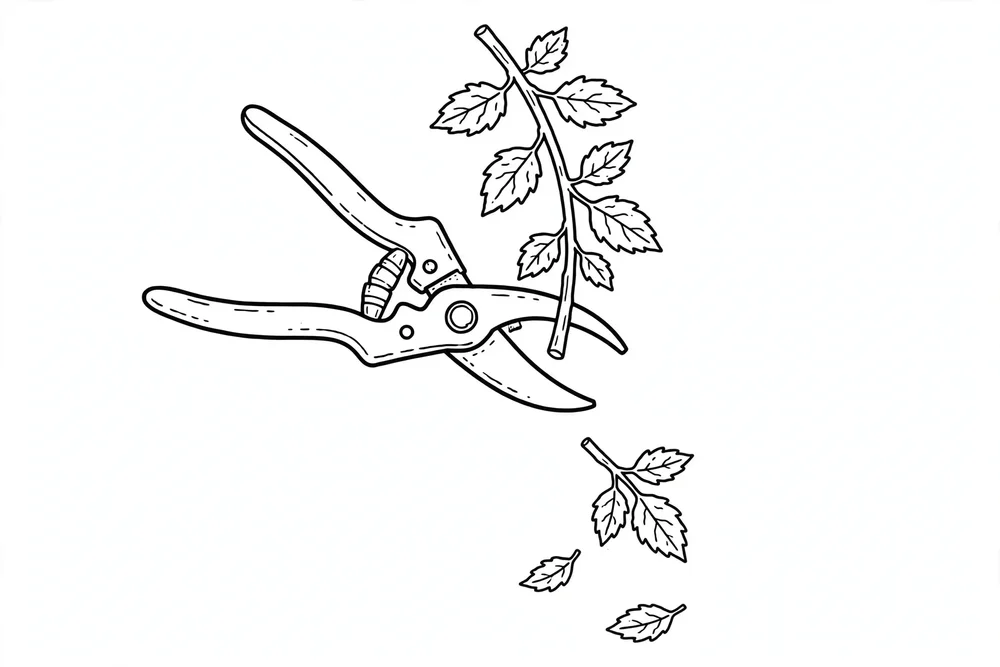
It is time to gather from your Scholar's Familiar, gently and with everything this lesson has taught you.
Choose a dry morning, after the dew has lifted. Look your plant over with a harvester's eye. Is it large enough and vigorous enough to spare a cutting? Where are the buds, if any? Which stems can you take while leaving the plant full and balanced? Take no more than one-third of its growth, and less if you are uncertain. Cut cleanly with sharp scissors or pruners, just above a leaf node where new growth can emerge.
Then record the harvest in your journal: the date, the hour, the weather, what you took, and why you judged the plant could spare it. In two weeks, record how the plant answered. Did it branch where you cut? Did it seem unchanged? This is the conversation the Professor spoke of. You are now having it.
If you are working the adopt-a-plant path, choose a plant you visit regularly and perform the same readiness reading without taking anything, or ask the plant's owner for permission to take a small trimming.
❦ In your workbook: record the Familiar's first harvest in your own way — the morning, the one-third limit, the clean cut above a node, and the two-week answer — copy, sketch, or note what matters.
In your packet: Exercise III — The Respectful Harvest Audit ◐ begins here. Work it now, or mark the place and take it as homework — your choice.
Safety Notes
- Use clean, sharp scissors or pruners for every harvest. Clean blades between plants, and cut away from your body. Younger students should harvest with an adult present.
- Never harvest from roadsides, sprayed lawns, or any ground you cannot be sure is clean. Exhaust fumes, herbicides, and pesticides do not rinse away.
- Wash your hands after harvesting, and rinse harvested leaves if they are dusty. Shake off all excess water before drying or storing.
- Wear gloves when handling plants with thorns, prickles, or sap that irritates skin.
- Never taste or eat any plant you cannot identify with certainty. A harvest basket is not a tasting plate.
- If you are gathering roots, fill the hole afterward and firm the soil. Leave the ground as you found it.
Guided Observation: Reading a Plant for Readiness
This lesson's observation is the readiness reading, worked in full before any blade is lifted: size, vigor, and proportion, read on a dry morning, in the order this lesson teaches — look first, judge honestly, and record everything before you take anything.
You will need:
- your Scholar's Familiar (or a plant you can visit regularly — see the alternative paths below)
- your journal
- a dry morning, after the dew has lifted
Read the size. A young seedling with four leaves cannot spare any of them. Wait until the plant has grown enough foliage to keep thriving after you take your share: begin harvesting only when the plant has enough foliage to maintain its own growth.
Read the vigor. A plant that is wilted, yellowing, pest-chewed, or struggling is asking for help, not for harvest. Tend it first. Gather from the strong plants, and let the weak ones recover.
Read the proportion. Look at what you plan to take against what will remain. Can you picture the plant afterward, still full, still green, still growing? If the mental picture shows a skeleton, put the basket down and come back in two weeks.
Note the buds and the hour. Where are the buds, if any? Which stems could you take while leaving the plant full and balanced? And is this the morning for it — dry, dew lifted, oils still home?
Consider:
- Which of the three readings — size, vigor, proportion — was hardest to judge honestly, and why?
- Did the plant pass all three readings, or is the honest verdict "not yet"?
- What will you watch for over the next two weeks before you read it again?
No-plant alternative: adopt any plant you can visit regularly (a garden plant, a park herb bed, a neighbor's pot) and perform the same readiness reading without taking anything.
Workbook path: if no living plant is within your reach this week, work the same reading on paper — take a plant you know well from earlier lessons or a clear photograph of a flourishing herb, and write its full readiness reading: size, vigor, proportion, buds, and your verdict. The reading is the skill; the cutting is its next occasion.
Materials
Required (Level One — household items)
- Sharp scissors or small pruners: clean blades make clean cuts that heal quickly.
- A basket, tray, or bowl: to carry your harvest without crushing it.
- Small paper bags: for gathering seed heads; one bag per kind of seed.
- Twine or rubber bands: for tying the seed-head bags loosely around stems.
- Gardening gloves: for thorny plants or sap that irritates skin.
- Notebook and pencil: your harvest journal for dates, hours, weather, and observations.
Suggested (Level Two — historically closer)
- A small harvesting knife or garden snips: the traditional hand tool for gathering, kept sharp and clean.
- A woven gathering basket: lets air move around cut herbs so they do not heat and wilt.
- Muslin bags: breathable cloth bags for seed heads, the old gardener's choice before paper.
Safety notes: Use clean, sharp scissors or pruners for every harvest. Clean blades between plants, and cut away from your body. Younger students should harvest with an adult present. Never harvest from roadsides, sprayed lawns, or any ground you cannot be sure is clean. Exhaust fumes, herbicides, and pesticides do not rinse away. Wash your hands after harvesting, and rinse harvested leaves if they are dusty. Shake off all excess water before drying or storing. Wear gloves when handling plants with thorns, prickles, or sap that irritates skin. Never taste or eat any plant you cannot identify with certainty. A harvest basket is not a tasting plate. If you are gathering roots, fill the hole afterward and firm the soil. Leave the ground as you found it.
Reflection Questions
Answer the following questions in your workbook.
- Why does harvesting in the morning produce more fragrant and flavorful herbs than harvesting in the heat of the afternoon?
- A friend wants to strip every leaf from their sage plant at once, in late October. Which two rules from this lesson would you explain to them, and why?
- Seeds are gathered "when brown and dry, but before they open." Why is each half of that timing important?
- Why are roots gathered in the fall, after the foliage fades, rather than in the spring when the plant is growing fastest?
- The one-third rule is sometimes called the rule of the respectful harvest. What does it say about the gardener's relationship with the plant?
Workbook Checklist — Lesson 27
In my workbook I have:
- ☐ stated why timing changes everything: volatile oils accumulate in the cool of the night and evaporate in the heat of the day
- ☐ given the morning rule: mid-morning, dew dried, before the heat — and never on a rainy day
- ☐ timed each part: leaves before the bloom, flowers just as they open, seeds brown and dry but before they scatter, roots after the foliage fades
- ☐ applied the one-third rule to perennials, the three-quarters allowance to annuals, and the autumn stop about a month before the first frost
- ☐ read a plant for readiness by size, vigor, and proportion — and put the basket down when the picture showed a skeleton
- ☐ kept the safety notes: clean blades cleaned between plants, no roadsides or sprayed ground, hands washed, gloves for thorns and sap, never taste an unidentified plant, root holes filled
- ☐ completed the Morning Comparison, the Harvest Calendar, and the Respectful Harvest Audit — or their bought-bunch, paper, and adopted-plant paths
☐ Lesson completed Date: ___ Signature: ___
The Professor's Closing Note
Dear scholars, you have now completed the full circle of the growing year in miniature. You chose your Familiar with love in Lesson 1. You learned to house it, feed it, water it, multiply it, and prune it. Today you gathered from it, and it gave willingly, because you asked at the right moment and took only what it could spare. That is stewardship. That is the whole of Herbology, held in one morning's basket.
Unit IV will teach you what to do with what you have gathered: how to dry it, how to keep it, and how to turn it into things worth keeping. But remember this morning. Everything you preserve later begins here, with the right plant, the right part, and the right hour.
— Professor Beryl Fernfoot, Herbology Greenhouse • Master Herbalist • Head of House Oriens
Cross-Class Connections

Creative Arts · Unit V, Lesson 18 — Outdoor & Garden Tools: Handling, Cleaning & Care
Boots by the door, scholars. Fernfoot has taught you to cut cleanly with sharp scissors or pruners, and to clean your blades between plants — she is right, and in my workshop you will learn the tool's side of that promise: carry latched, clean first, then disinfect, dry, oil, and store. Her word governs when and where the plant is cut; mine governs the blade that does it.

Potions · Unit II, Lesson 14 — Fragrant Botanicals & Aromatics
Welcome to the bench, scholars. You have learned in the Greenhouse that aromatic herbs were gathered in the cool of the morning to keep their volatile oils in the leaf — here is that principle's laboratory twin. Warm a specimen in your palms and you will feel the heat coax the scent out, exactly as the midday sun coaxes it out of the living leaf. Come and learn to smell what the morning kept.

Celestial Studies · Unit II, Lesson 8 — Names of the Moon
Scholars, the roots in this lesson come up in autumn and the perennials rest before the frost — and the full moon nearest the autumnal equinox carries the oldest working name of that whole season: the Harvest Moon, whose late-rising light once stretched the harvest day itself. Come to the Tower and learn how the moonrise geometry earned it that name.
Further Reading & Sources
- Harvest Herbs Properly for Best Flavor, Aroma — University of Georgia Extension on timing harvests to peak oil concentration, by plant part. - Herb Harvest Guidelines: Harvesting Herbs from the Garden — General rules for annuals and perennials, the one-third limit, and morning harvesting. - How to Harvest Herbs for Drying — The one-third rule, harvesting by plant part, and roots after blooming. - Drying Herbs for Winter Use — Harvest timing by herb, including roots in fall after foliage fades. - The Best Time of Day to Harvest Herbs for the Most Flavor — Morning versus afternoon harvest and the volatile-oil reasoning. Browse the Herbology shelf in the school Library for readable editions of these works.
The right plant, the right part, and the right hour. — Professor Beryl Fernfoot, Herbology Greenhouse • Master Herbalist • Head of House Oriens
Plants from this lesson stand in the Materia Botanica, the school's shared archive — each kept with its lessons, its keepings, and its cautions. This lesson's company:
BorageCalendulaChamomileChivesCoriander The whole Materia BotanicaPROFESSOR BERYL FERNFOOT · HERBOLOGY GREENHOUSE
Submit your work for this lesson using the form below.
CONTINUE IN THE HERBOLOGY GREENHOUSE
← Previous · Lesson 26: Unit III Stewardship Project Next · Lesson 28: Drying Herbs the Traditional Way →
Unit IV — Harvest, Preservation & Use Herbology Greenhouse — All 37 Lessons
The rest of Unit IV: Lesson 28 · Drying Herbs · Lesson 29 · Pressing & Preserving · Lesson 30 · Seed Saving · Lesson 31 · Culinary Herbs · Lesson 32 · Harvest Festival Project