

HERBOLOGY
Unit I · Lesson 3Anatomical Architecture: Root Vaults
PROFESSOR BERYL FERNFOOT
Herbology Greenhouse
Master Herbalist
Unit I · Lesson 3 · Morphology, Taxonomy & the Ancient Lore
Professor's Introduction

Settle in, scholars. Today we look downward, which is a direction gardeners too often forget.
Everything you studied in our last lesson, the leaves reaching for light and the stems standing tall, is only half the plant. The other half works in darkness, in silence, in soil you may never see. And yet without that hidden half, nothing above ground could exist for a single day.
Roots do not hurry. They do not show off. They simply hold, drink, and store, season after season, asking nothing in return but a little room to grow. There is a lesson in that, I think, for all of us who are quick to admire only what is visible.
We will study them gently today. No plant in this greenhouse will be pulled from its home for our curiosity. We learn by watching, not by taking.
— Professor Beryl Fernfoot, Herbology Greenhouse • Master Herbalist • Head of House Oriens
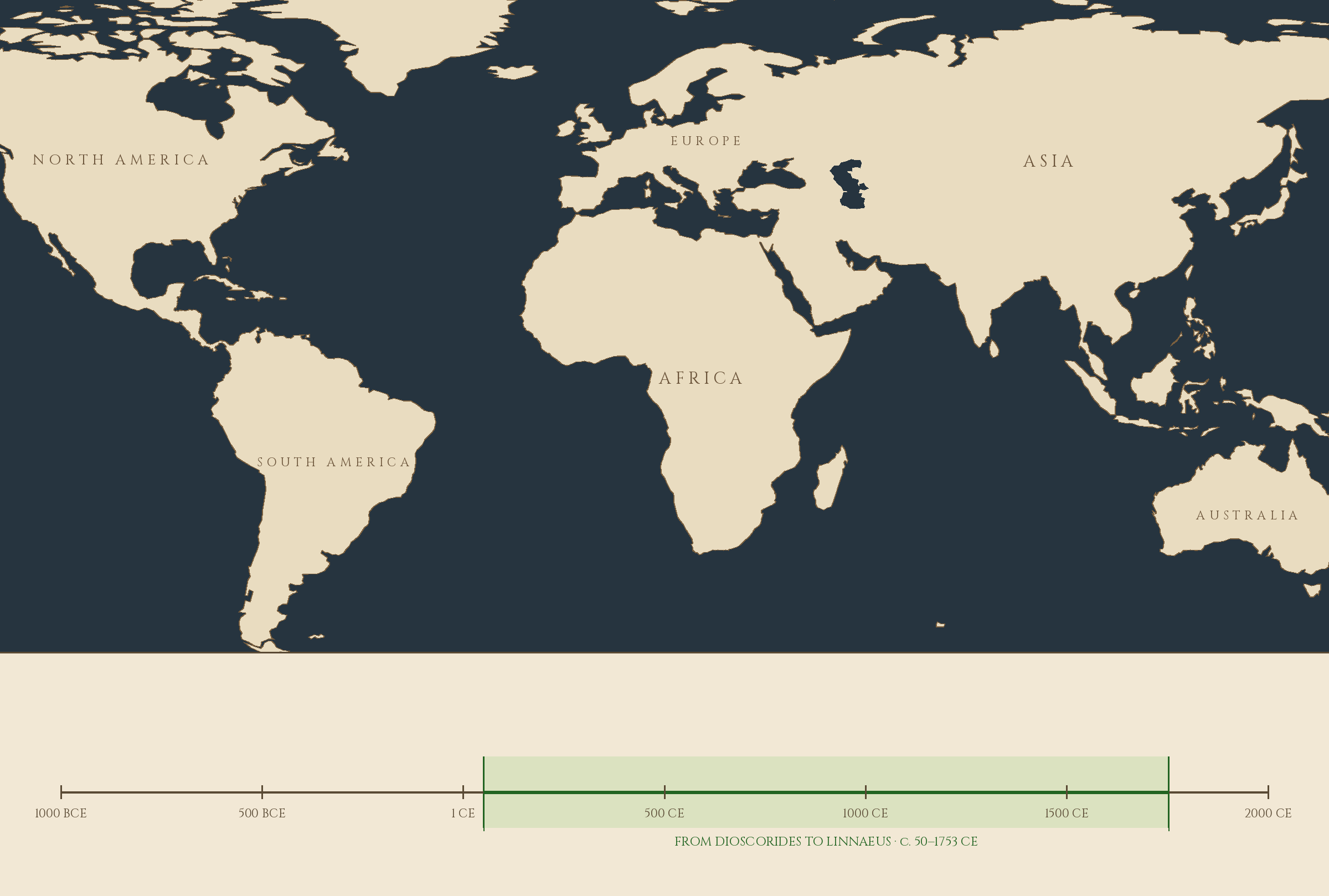
The line beneath the map is our road: every stop a place where the knowledge of plants changed, every lesson a step along it.
Lesson Objectives
By the end of this lesson, you will be able to:
- Distinguish a taproot system from a fibrous root system and name examples of each
- Identify the working parts of a growing root: root cap, zones of division and elongation, and root hairs
- Explain the three great tasks of roots: anchorage, absorption, and storage
- Recognize underground storage organs (rhizomes, tubers, bulbs, corms) and tell a stem tuber from a root tuber
- Describe, in simple terms, the partnership between roots and mycorrhizal fungi
- Observe a living plant's root zone safely, without pulling it from its soil
Reading this lesson: ★ marks the passages to remember. They return on the unit quiz and the class test. Check in questions ask the material back as you go; answer them in your grow ledger when you meet them.
Working this lesson: Your assignment packet is the first download on this page. Work in it as the lesson moves along, answering each exercise as its subject is taught — or read the lesson through for your notes and take the exercises as homework afterward. Both are proper ways to sit this class. Signposts in the reading tell you where each exercise belongs. Written answers are short answers in your own words; a few honest lines are worth more than a filled page.
Your Assignment Packet
This lesson's exercises live in its packet: the Lexicon Handout (every term, course terms marked ◆), Materials, Guided Practice, the Assignment Manual with its answer key for self-checking, the Reflection Questions, and the Workbook Checklist. Download the packet before you begin and keep it beside you as you read.
The Hidden Half
When you picture a plant, you probably picture what rises above the soil. Leaves, stems, flowers. But for many plants, as much biomass lives below ground as above it. A mature oak may spread roots as wide as its crown. A prairie grass may keep two thirds of itself underground, waiting out fire and drought in the safety of the soil.
★ Roots perform three great tasks, and every root you will ever meet is shaped by some combination of them.
Anchorage. The plant must stand. Wind pushes, rain softens soil, and gravity never rests. Roots grip the earth the way a hand grips a rope, and the deeper and wider the grip, the taller the plant dares to grow.
Absorption. Leaves need water and minerals, and neither falls from the sky in the right amounts at the right times. Roots drink for the whole plant, pulling water and dissolved nutrients from the soil and sending them upward through the stem.
Storage. When times are good, wise plants save. Sugars made in the leaves travel down and are packed away as starch in thickened roots and underground stems, a pantry the plant draws on through winter, drought, or the burst of spring growth.
Hold these three in mind. Anchorage, absorption, storage. Every structure in this lesson exists to serve one or more of them.
Check in: A plant survives the winter on food it packed away in autumn, then bursts into spring growth. Which of the three great tasks paid for that burst — and which task kept the plant standing while it waited?
❦ In your workbook: record the hidden half in your own way — the three great tasks, anchorage, absorption, and storage, and one plant you know that leans on each — copy, sketch, or note what matters.
Two Great Designs
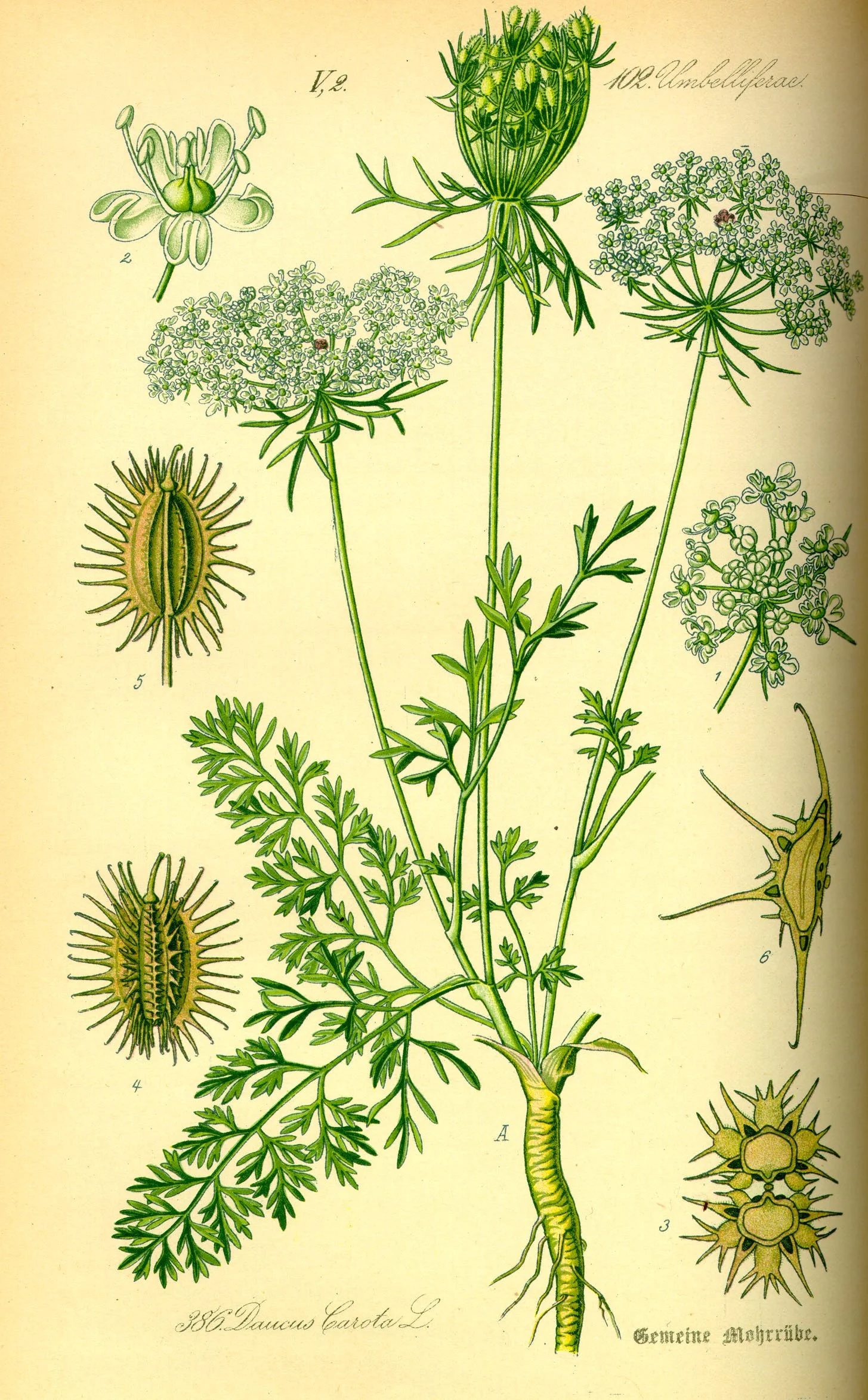
A taproot system drawn whole: carrot (Daucus carota) keeps one strong central root, with smaller side roots branching from it.
Daucus carota, plate 386 from Otto Wilhelm Thomé, Flora von Deutschland, Österreich und der Schweiz (1885). Public domain.
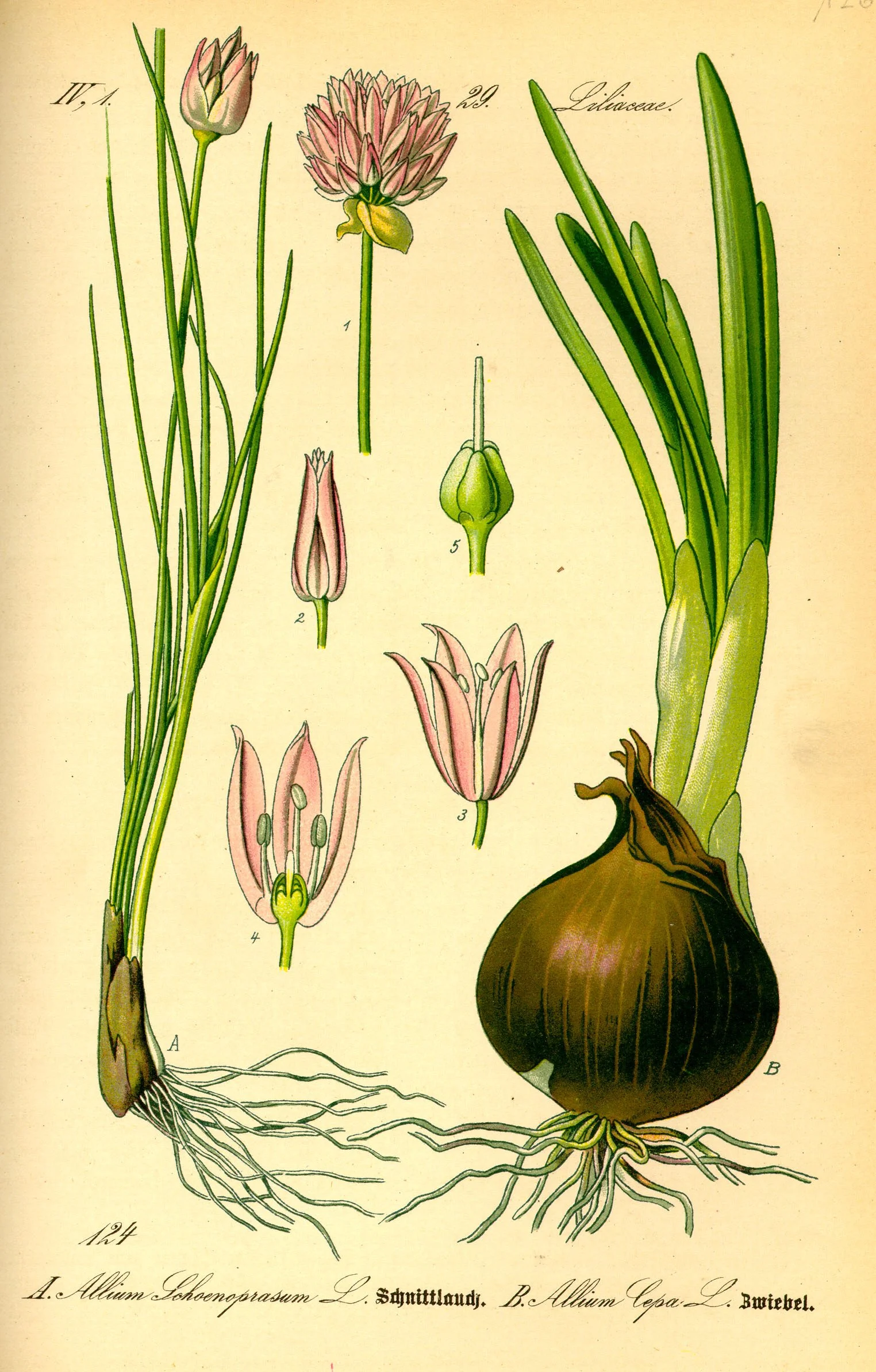
Two kitchen specimens on one plate: chives spread a fibrous mat of equal roots with no leader, while the onion beside them is a bulb — a short stem wrapped in fleshy leaf bases.
Chives and onion, plate 124 from Otto Wilhelm Thomé, Flora von Deutschland, Österreich und der Schweiz (1885). Public domain.
Walk through any garden and you will find two fundamental answers to the question of how roots should be arranged.
The Taproot System
★ In a taproot system, one strong central root grows straight downward from the seed, like a plumb line dropped into the earth. Smaller side roots branch from it, but the main root remains the unmistakable leader. This is the design of carrots, beets, radishes, dandelions, and most broadleaf trees in their youth.
Taproots excel at reaching deep water. In dry country, a taproot may plunge many times deeper than the plant is tall, finding moisture far below the sunbaked surface. They also anchor firmly, which is why you must work to pull a dandelion and why oaks stand through storms.
Many taproots double as storage organs. The carrot you eat is a swollen taproot packed with sugars. The plant grew it as a pantry for its second year of life, and gardeners harvest it at the end of the first.
The Fibrous Root System
★ In a fibrous root system, there is no single leader. Instead, a dense cluster of slender roots of similar size spreads outward from the base of the stem, forming a mat or network near the soil surface. Grasses, wheat, corn, and onions all use this design.
Fibrous roots are quick. They colonize the upper soil rapidly and drink surface water efficiently after rain. A lawn is a demonstration of the fibrous system at work: thousands of fine roots knitting the top inches of soil into a single fabric. That fabric also holds soil against erosion, which is why grasses are planted on slopes and riverbanks.
The tradeoff is depth. Fibrous roots rarely reach the deep reserves a taproot finds, so fibrous-rooted plants feel drought sooner. Each design pays for its strengths.
★ Here is a pattern worth noticing, one you will meet again in Lesson 4. Taproot systems are typical of dicots, the broadleaf flowering plants. Fibrous systems are typical of monocots, the grasses, lilies, and their kin. Root, leaf, and flower all tell the same story about a plant's family. Nature repeats her themes.
Check in: A gardener plants grass on a bare slope and a dandelion springs up beside it uninvited. Which root design is holding the slope against erosion, and which is reaching for deep water — and how do you know?
❦ In your workbook: record the two great designs in your own way — a taproot and a fibrous mat side by side, with one example plant under each — copy, sketch, or note what matters.
The Working Parts of a Root
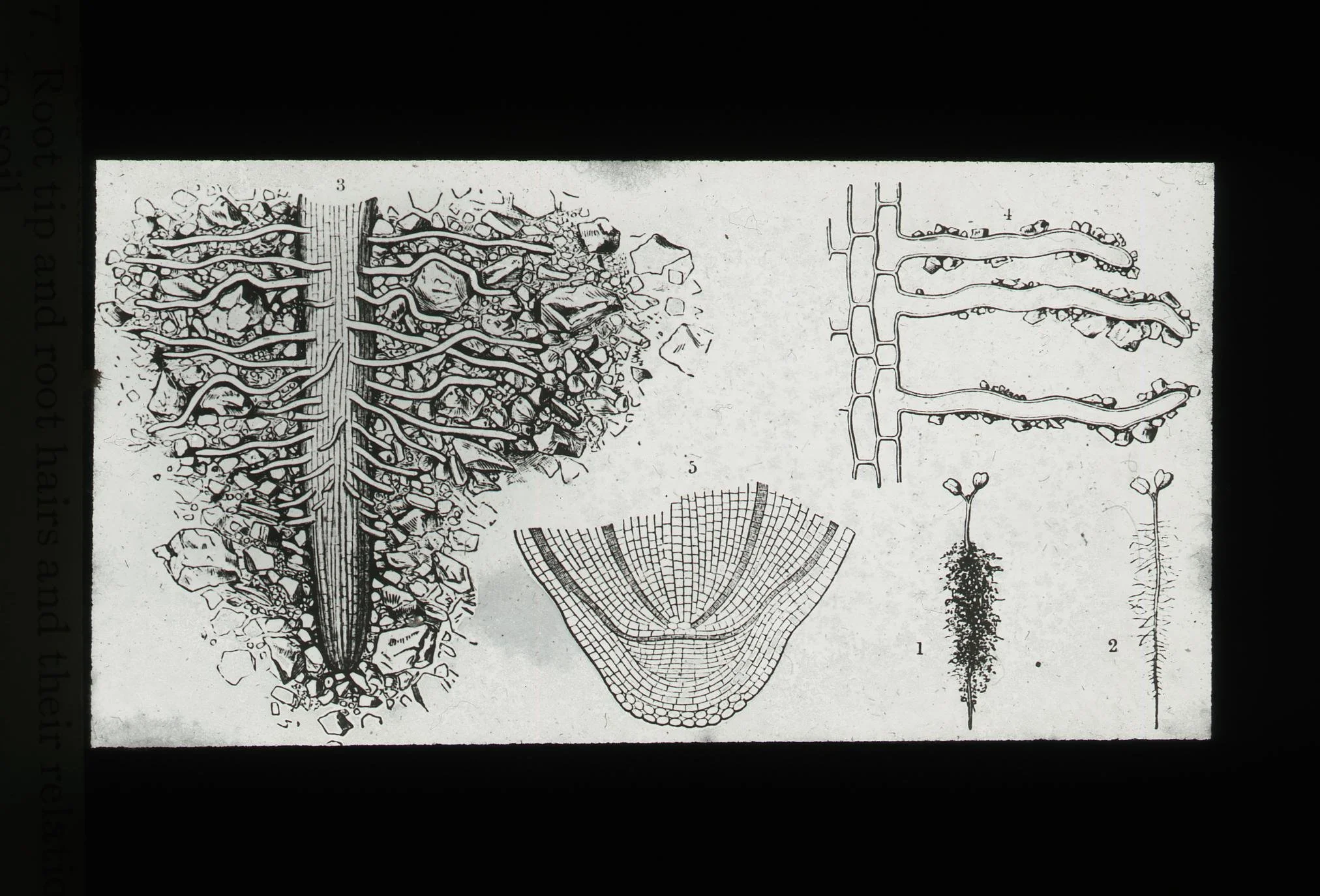
Root hairs at work, from a school lantern slide: hairs reach into soil pores too small for the root itself, and the tip's own section shows the protective root cap.
"Root tip and root hairs and their relation to soil," teaching lantern slide (Belleville Collegiate Institute and Vocational School, Ontario, possibly 1920s), Community Archives of Belleville and Hastings County. Public domain.
★ A growing root tip is a small factory with departments, each doing one job. From tip to base, the order is always the same.
The root cap is a thimble of protective cells over the very tip. As the root pushes through gritty soil, the cap takes the wear so the delicate growing cells behind it do not have to. It also releases a slippery mucilage that eases the root's passage, like oil on a hinge.
The zone of division sits just behind the cap. Here cells divide rapidly, producing the new cells that will become the root's future. This is the engine room.
The zone of elongation follows. The new cells stretch lengthwise, and this stretching is what actually drives the root forward through the soil. The root does not crawl; it grows itself forward.
The zone of maturation is where cells settle into their adult roles, and it is here that the root's great absorbers appear: the root hairs.
Root Hairs: The Quiet Workforce
★ Root hairs are tiny extensions of the root's surface cells, each one a single cell stretched into a fine tube. They are so small you need a magnifier to see them, yet they transform the root's ability to drink. By bristling outward in their thousands, they multiply the root's absorbing surface enormously, reaching into soil pores too small for the root itself to enter.
★ Here is something every gardener should know: root hairs are fragile. They are easily torn when a plant is roughly handled or left with bare roots exposed to air. This is why transplanting is done gently, why roots are kept covered and moist during the move, and why a plant sometimes wilts after repotting even when you were careful. Its hairs were damaged, and it must grow new ones before it can drink properly again. Handle roots like you would handle a spider's web: with respect for how easily it breaks.
Check in: In order, from the very tip of a growing root to its base: what are the four parts you pass, and which one actually makes the new cells?
❦ In your workbook: record the working parts of a root in your own way — cap, division, elongation, maturation, with the root hairs standing at their post — copy, sketch, or note what matters.
A Note from Professor Fernfoot
You are doing beautifully, scholars. I can tell, because you are slowing down.
That is the whole secret of this subject. The students who rush past the roots to get to the flowers always miss the most interesting part. The flower is the advertisement. The root is the business.
When you look at your Scholar's Familiar this week, remember that everything you admire about it, every leaf and stem, is being paid for by workers you cannot see. Take a moment to appreciate them. Gratitude is a fine fertilizer.
— Professor Beryl Fernfoot, Herbology Greenhouse • Master Herbalist • Head of House Oriens
❦ In your workbook: record Professor Fernfoot's note in your own way — why the root, not the flower, is the business — copy, sketch, or note what matters.
Underground Pantries: Storage Organs
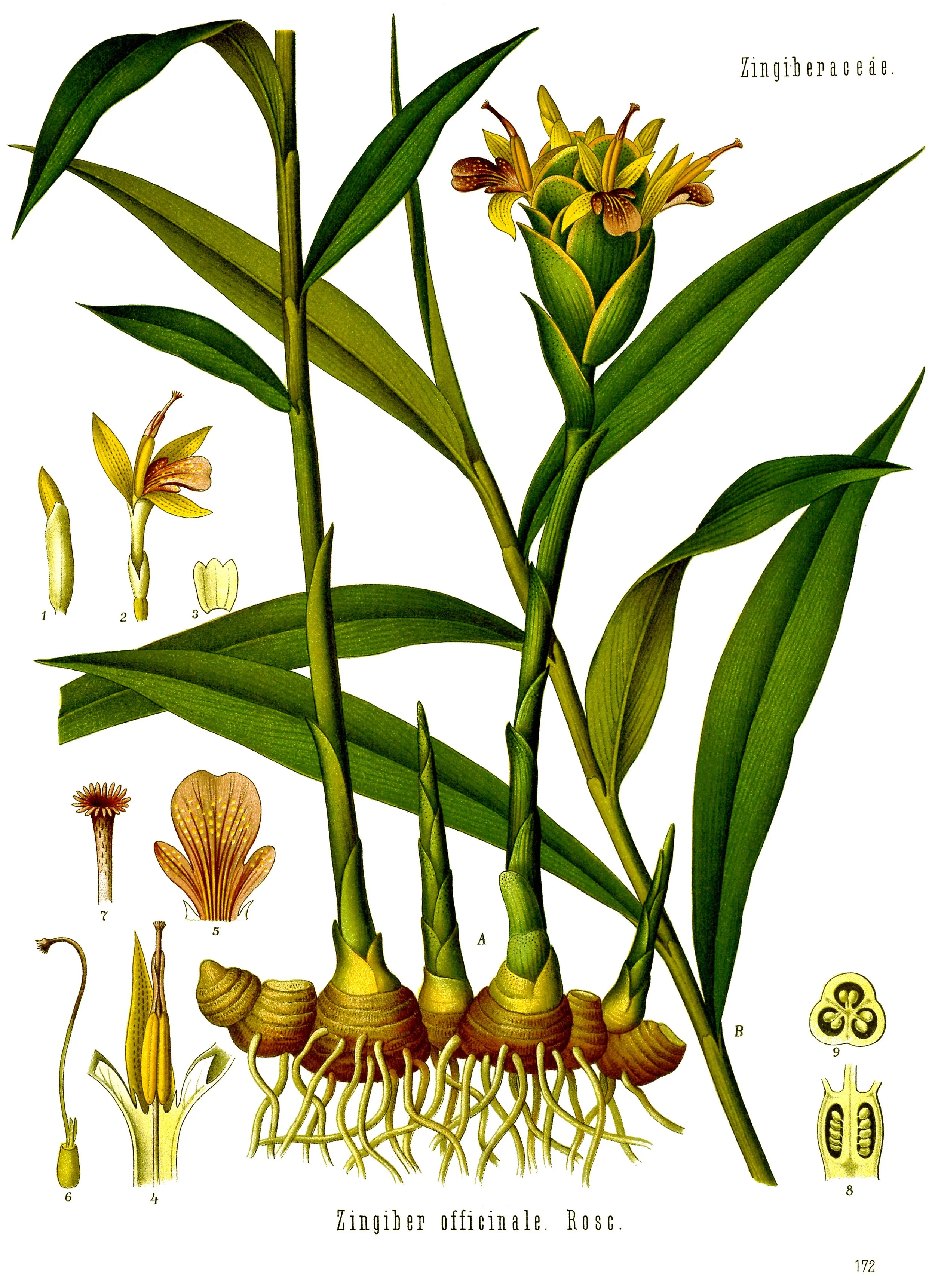
Ginger's "root" is no root: the creeping horizontal stem — a rhizome, ringed with nodes — sends up shoots above and lets true roots hang below.
Zingiber officinale, plate from Franz Eugen Köhler, Köhler's Medizinal-Pflanzen (1887–1914), via the Internet Archive. Public domain.
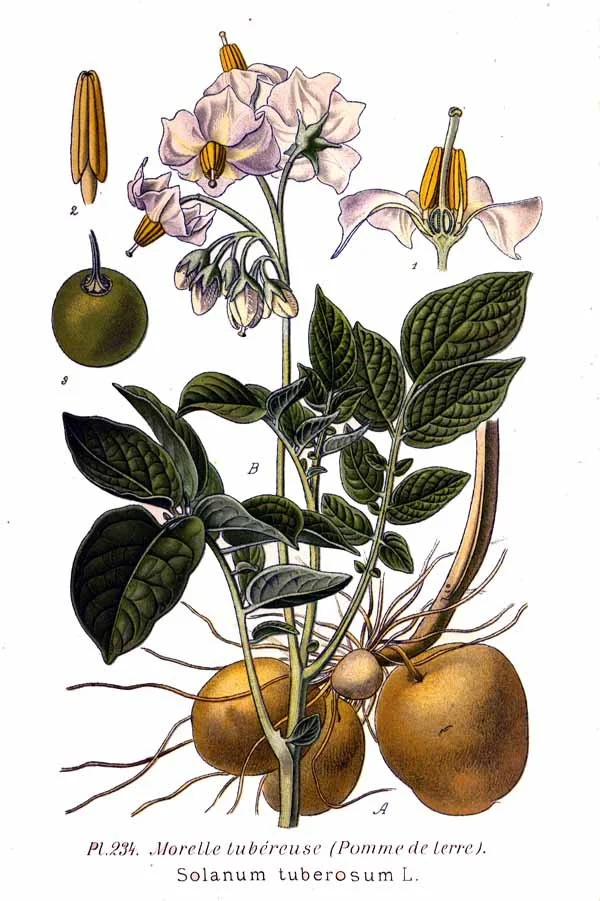
The potato plant with its tubers still attached: a stem tuber is a thickened underground stem, and its "eyes" are buds at nodes.
Solanum tuberosum, plate 234 by Amédée Masclef, from Atlas des plantes de France (1891). Public domain.
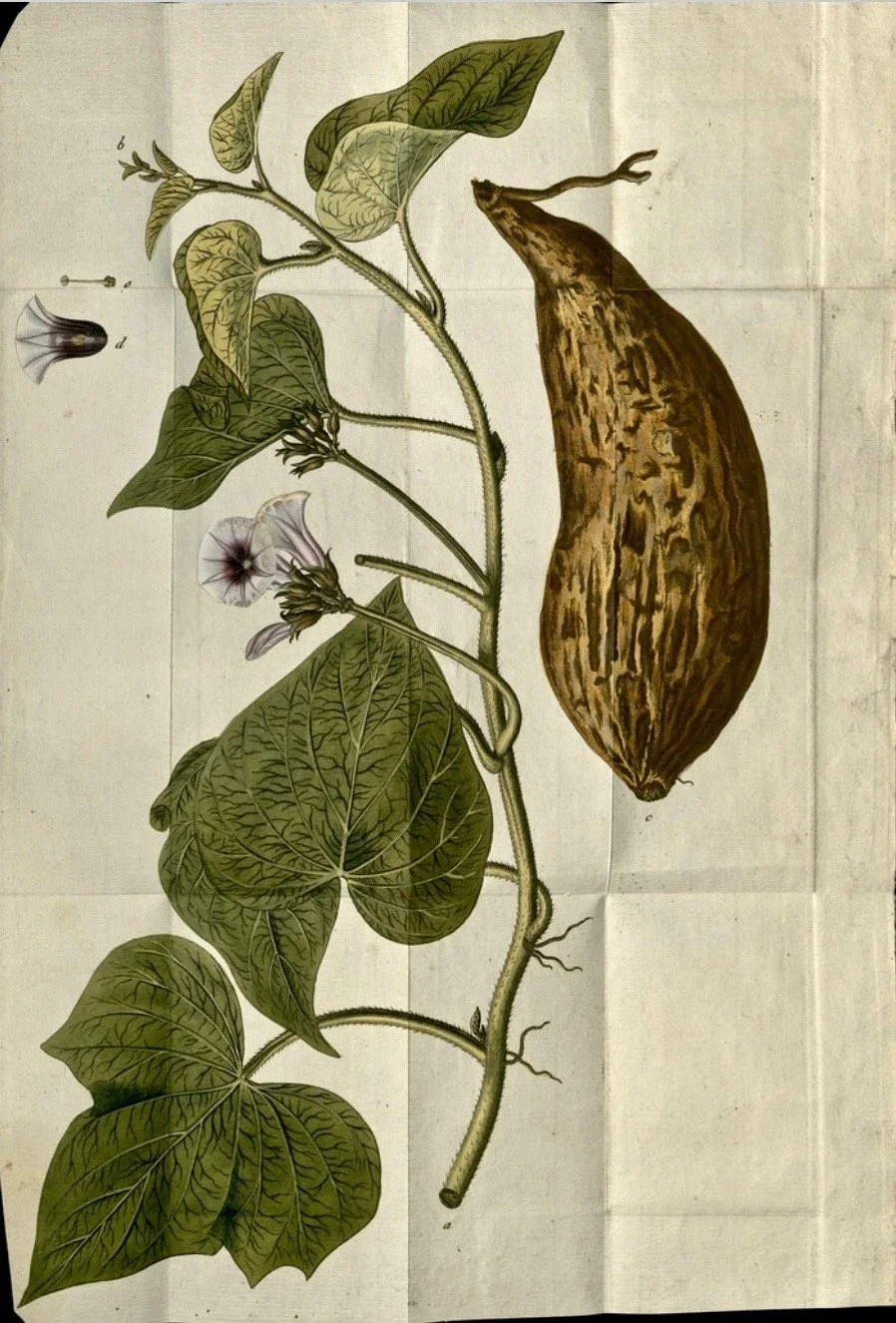
The sweet potato, drawn in 1797: one great thickened root, smooth and eyeless — a root tuber, built from a different plant part than the potato.
Sweet potato plate from Franz Joseph Märter, Naturgeschichte der Bataten (Vienna, 1797), via the University of Vienna (Phaidra). Public domain.
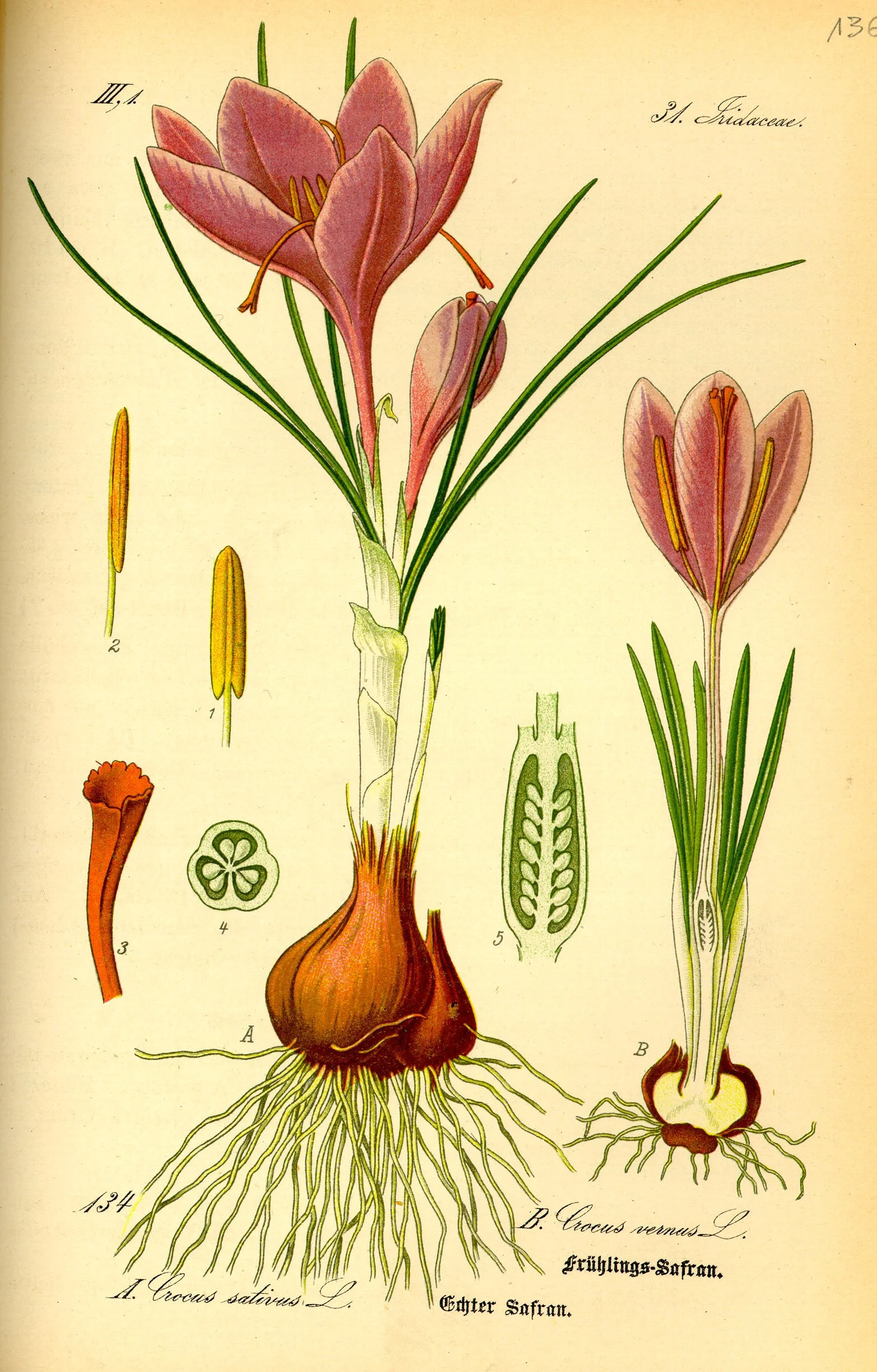
A corm in section: the spring crocus cut open is solid stem tissue all through — where an onion, cut the same way, would show layer upon layer.
Crocus sativus and Crocus vernus, plate 134 from Otto Wilhelm Thomé, Flora von Deutschland, Österreich und der Schweiz (1885). Public domain.
Some plants take the root's storage task and build entire organs around it. Your kitchen holds several, and learning to tell them apart is one of the great pleasures of botanical literacy.
★ Rhizomes are horizontal underground stems, not roots at all. They creep sideways beneath the soil, sending up new shoots as they go. Ginger is the classic example: break a piece and you will find nodes and buds, the telltale marks of stem tissue. Iris and many grasses spread the same way. A rhizome is a plant's way of walking without legs.
★ Tubers are swollen storage organs, but the word hides an important distinction. A stem tuber, like the potato, is a thickened underground stem. You can prove it in your kitchen: the "eyes" of a potato are buds sitting at nodes, and buds at nodes mean stem, wherever the stem happens to grow. A root tuber, like the sweet potato, is a thickened root. It has no nodes, no buds, no eyes. Potato and sweet potato look like cousins on the plate, but botanically they are built from entirely different parts. They are a fine example of different structures arriving at the same job.
★ Bulbs are short underground stems wrapped in fleshy leaves. Slice an onion and you see the design plainly: layer upon layer of leaf bases packed with food, all attached to a small disc of stem at the bottom, with roots dangling beneath. Tulips and daffodils use the same architecture to sleep through winter and burst into spring.
Corms are close cousins of bulbs but solid rather than layered. A crocus corm looks like a small bulb from outside, but cut it open and you find solid stem tissue instead of rings. Gladiolus grows from corms.
Why does any of this matter to a gardener? Because each organ has its own rules. Bulbs are planted at specific depths. Tubers are divided by their eyes. Rhizomes are cut into sections with a bud each. Knowing what you hold in your hand tells you what to do with it. The vocabulary is not decoration; it is instruction.
Check in: You hold a potato in one hand and a sweet potato in the other. One test settles which plant part each one is. What do you look for, and what does finding it — or not finding it — prove?
❦ In your workbook: record the underground pantries in your own way — rhizome, stem tuber, root tuber, bulb, and corm, with the kitchen example that proves each — copy, sketch, or note what matters.
In your packet: Exercise I — The Kitchen Root Laboratory ⚒ begins here. Work it now, or mark the place and take it as homework — your choice.
Partnerships in the Dark
Now for the most wonderful thing in this lesson, and I do not use that word lightly.
★ Roots do not work alone. Beneath the soil, most land plants, roughly four out of five species, form partnerships with fungi called mycorrhizae, from Greek words meaning fungus and root. The fungal threads, far finer than the finest root hair, spread through the soil like a second, vastly larger root system, gathering phosphorus, nitrogen, and other nutrients the plant cannot easily reach on its own. In return, the plant shares sugars it made in sunlight. Both partners eat better together than either could alone.
This partnership is ancient. It is older than forests, older than flowers, older by far than any gardener. Some scientists believe these fungal alliances helped the very first plants survive on dry land hundreds of millions of years ago. When you tend your Scholar's Familiar, you are tending not just a plant but a community, most of whose members you will never see.
What does this mean for your practice? Mainly this: healthy soil is living soil. The rich, crumbly earth full of fungal threads is doing quiet work on your plant's behalf. Heavy digging, harsh chemicals, and sterile potting mixes can damage these partnerships. Gentle cultivation protects them. The best thing you can do for the invisible workforce is, very often, simply to leave it alone and let it work.
Check in: In the mycorrhizal partnership, what does the fungus gather that the plant cannot easily reach — and what does the plant pay for it, and where did it make that payment?
❦ In your workbook: record the partnerships in the dark in your own way — what each partner gives, what each receives, and one garden habit that protects the partnership — copy, sketch, or note what matters.
In your packet: Exercise III — The Partnership Journal ✎ begins here. Work it now, or mark the place and take it as homework — your choice.
Guided Observation: Observing Roots Without Harming Them
Here is our iron rule, scholars, and I want it fixed firmly in your minds before you touch a single pot.
★ Never pull a living plant from its soil to look at its roots.
Curiosity is a virtue, but the plant pays the price. Torn root hairs, damaged partnerships, a setback the plant may take weeks to repair. There are kinder ways to learn, and they teach you just as much.
Look through the drainage holes. Tip a potted plant gently and peer underneath. Healthy roots often reach the drainage holes as fine white threads. Their color tells a story: white or cream means healthy and growing; brown and mushy means trouble, usually too much water.
Watch the soil surface. In a thriving pot, you may see fine roots threading just under the surface after watering. Notice how they follow moisture.
Observe at repotting time. When a plant genuinely needs a larger home, and you will learn to recognize that moment in a later unit, you will see the whole root system at once. That is your classroom. Work quickly, keep roots covered and damp, and settle the plant into its new home with care.
Compare kitchen vegetables. Your market basket is a root laboratory that harms nothing. A carrot shows you a taproot. A bunch of scallions shows you fibrous roots. A potato's eyes and a sweet potato's smooth skin let you feel the difference between stem tuber and root tuber with your own fingers. An onion sliced top to bottom reveals the bulb's architecture. No living plant need suffer for any of these lessons.
Your Scholar's Familiar This Week
Spend time with your plant's container rather than the plant itself this week. Note in your grow ledger: the size and material of the pot, whether roots are visible at the drainage holes, how quickly water drains through when you water, and whether the soil pulls away from the pot's edges between waterings (a sign the root mass is filling the space). Sketch what you observe. You are learning to read the underground story from surface clues, which is exactly what experienced gardeners do every day.
❦ In your workbook: record the kinder ways to learn in your own way — the iron rule, the drainage holes, the soil surface, repotting time, and the kitchen laboratory — copy, sketch, or note what matters.
In your packet: Exercise II — Reading the Underground from the Surface ◐ begins here. Work it now, or mark the place and take it as homework — your choice.
Materials
Required (Level One — household items)
- Kitchen vegetables (ask permission first): a carrot or radish, scallions with roots, a potato, a sweet potato, and an onion.
- Notebook or grow ledger and pencil: for observations, sketches, and the partnership journal.
- A potted plant: your Scholar's Familiar or another houseplant, for the root zone survey.
- A kitchen knife (adult supervision): for slicing the onion top to bottom.
Suggested (Level Two — historically closer)
- A 10x hand lens: to examine root hairs on a freshly repotted plant or germinating seed.
- Clean repotting supplies: a slightly larger pot and fresh potting mix, if a plant genuinely needs moving.
- A plant mister: to keep exposed roots damp during any repotting observation.
Reflection Questions
Answer the following questions in your workbook.
- Why is it wrong to pull a living plant from its soil just to look at its roots? What is harmed, and how long might recovery take?
- A gardener in a dry region and a gardener in a rainy region might prefer different root systems in their plants. Which system suits each climate, and why?
- The potato and the sweet potato do the same job with different plant parts. What does this tell you about how evolution solves problems?
- How does knowing whether you hold a bulb, a tuber, or a rhizome change what you do with it in the garden?
- Fernfoot calls the flower "the advertisement" and the root "the business." What does she mean, and do you think the comparison is fair?
Workbook Checklist — Lesson 3
In my workbook I have:
- ☐ distinguished a taproot system from a fibrous root system, and named examples of each
- ☐ identified the working parts of a growing root: root cap, zones of division and elongation, and root hairs
- ☐ explained the three great tasks of roots: anchorage, absorption, and storage
- ☐ recognized rhizomes, tubers, bulbs, and corms, and told a stem tuber from a root tuber
- ☐ described the partnership between roots and mycorrhizal fungi in simple terms
- ☐ observed a living plant's root zone safely, without pulling it from its soil
- ☐ kept the kitchen laboratory, the root zone survey, and the partnership journal in my grow ledger
☐ Lesson completed Date: ___ Signature: ___
The Professor's Closing Note
Well done, scholars. You have met the hidden half, and you have done it kindly.
Carry one thought out of the greenhouse with you this week. The next time you see a great tree or a field of wheat, remember the mirror image beneath it: as much life below as above, working in the dark so that beauty can happen in the light.
Roots remind us that the most important work is often the work nobody sees. Tend your own unseen work with the same patience, and see what grows.
The greenhouse doors stand open. I will see you in Lesson 4, where we give all these green citizens their proper names.
— Professor Beryl Fernfoot, Herbology Greenhouse • Master Herbalist • Head of House Oriens
Cross-Class Connections

Potions · Unit III, Lesson 18 — Roots, Bark & Resins
In order, scholars: you already know my heavy shelves' first citizens by name, because Professor Fernfoot taught you their systems — the taproot that arrives as a single dense piece to be sectioned, the fibrous roots that arrive as tangled masses to be sorted and cleaned. Come to my laboratory and learn to judge those roots as received materials: by density, by fracture, by the smell of the jar. Orderly shelves, orderly mind. — Professor Crimblebrew Muddlenook
Further Reading & Sources
- Roots — OpenStax Biology 2e (Louis Pressbooks) — A clear, illustrated walkthrough of root structure, zones, taproot and fibrous systems, from an open college biology text. - Roots — CliffsNotes Study Guide — A concise review of root functions, types, and tissues, useful for self-testing. - Potatoes, Sweet Potatoes, and Yams: What's the Difference? — Carnegie Museum of Natural History — Sorts out stem tubers, root tubers, and true yams with museum specimens. - Into the Rhizosphere — MDPI Blog — An accessible tour of the mycorrhizal partnership and the living world around roots. - Mycorrhizal Fungi — The Natural Farmer — A grower-focused explanation of how fungal partnerships work and which plants do not form them. Browse the Herbology shelf in the school Library for readable editions of these works.
Plants from this lesson stand in the Materia Botanica, the school's shared archive — each kept with its lessons, its keepings, and its cautions. This lesson's company:
BeetChivesCornGingerOnion The whole Materia BotanicaPROFESSOR BERYL FERNFOOT · HERBOLOGY GREENHOUSE
Submit your work for this lesson using the form below.
CONTINUE IN THE HERBOLOGY GREENHOUSE
← Previous · Lesson 2: Anatomical Architecture: Foliage & Stems Next · Lesson 4: The Binomial Classification Matrix →
Unit I — Morphology, Taxonomy & the Ancient Lore Herbology Greenhouse — All 37 Lessons
The rest of Unit I: Lesson 1 · Scholar's Familiar · Lesson 2 · Foliage & Stems · Lesson 4 · Binomial Classification · Lesson 5 · Historian's Herbarium · Lesson 6 · Baneful Greenhouse · Lesson 7 · Threshold Examination