

HERBOLOGY
Unit I · Lesson 6THE BANEFUL GREENHOUSE
PROFESSOR BERYL FERNFOOT
Herbology Greenhouse
Master Herbalist
UNIT I • LESSON 6
Morphology, Taxonomy & the Ancient Lore
Professor's Introduction

Come and sit a while, scholars,
For five lessons we have celebrated what plants give us: their architecture, their names, their stories. Today we turn to what plants demand of us, which is respect.
I want to be honest with you before we begin. This lesson is not meant to frighten you. Fear makes careless students. What I want to grow in you instead is something quieter and far more useful: caution, which is simply attention with its eyes open.
Every plant in this lesson is real. Every danger described here has happened to real people, most of whom were simply curious and in a hurry. Curiosity is a fine thing. Hurry is not.
Read carefully. Remember what you learn. And know that the whole point of this lesson is that you will never need the last section of it.
— Professor Beryl Fernfoot, Herbology Greenhouse • Master Herbalist • Head of House Oriens
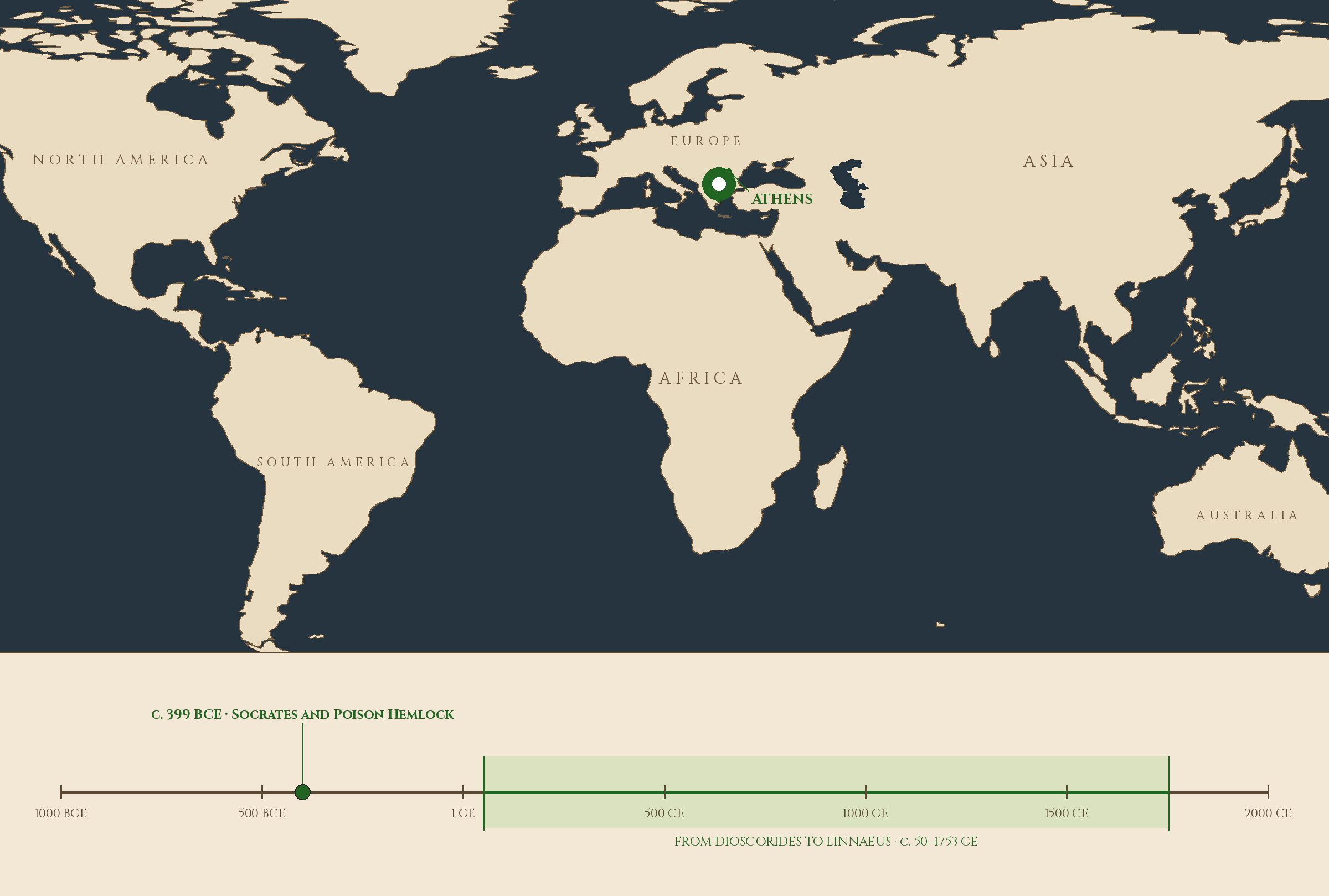
Where and when: Athens, c. 399 BCE — Socrates and Poison Hemlock. The pin is this lesson. The line beneath the map is our road: every stop a place where the knowledge of plants changed, every lesson a step along it.
Lesson Objectives
By the end of this lesson, you will be able to:
- Identify four dangerously poisonous plants by their key features: foxglove, poison hemlock, deadly nightshade, and oleander
- Distinguish poison hemlock from its look-alike, Queen Anne's lace, using stem, height, and flower cues
- Explain why toxic look-alikes are dangerous and how to avoid misidentification
- Describe contact hazards from plants such as rue and giant hogweed
- State the core safety rules of plant handling, including the rule against consuming unidentified plants
- Explain what to do in a suspected poisoning, including when to call Poison Control (1-800-222-1222) and when to call 911
- Describe basic foraging ethics: permissions, sustainability, and the observe-don't-touch rule for beginners
Reading this lesson: ★ marks the passages to remember. They return on the unit quiz and the class test. Check in questions ask the material back as you go; answer them in your workbook when you meet them.
Working this lesson: Your assignment packet is the first download on this page. Work in it as the lesson moves along, answering each assignment as its subject is taught — or read the lesson through for your notes and take the assignments as homework afterward. Both are proper ways to sit this class. Signposts in the reading tell you where each assignment belongs. Written answers are short answers in your own words; a few honest lines are worth more than a filled page.
Your Assignment Packet
This lesson's assignments live in its packet: the Lexicon Handout (every term, course terms marked ◆), Materials, Guided Practice, the Assignment Manual with its answer key for self-checking, the Reflection Questions, and the Workbook Checklist. Download the packet before you begin and keep it beside you as you read.
Why This Lesson Exists
A greenhouse is a place of care. We water, we prune, we watch for new growth, and we learn the particular needs of each plant under our charge. But care runs in two directions. The careful herbalist also learns which plants require distance, which demand gloves, and which should never be tasted under any circumstances.
Poisonous plants are not villains. They are not plotting against us. They simply contain chemistry that human bodies cannot tolerate, and they do not label themselves. The foxglove does not announce its cardiac glycosides. The hemlock does not post a warning beside its purple-blotched stem. It falls to us, the students of plants, to learn the signs and to teach our hands to be as knowledgeable as our eyes.
★ There is a comforting thought at the heart of this lesson, and I want you to hold it: every poisoning described here was preventable. Every single one. The knowledge in these pages is the prevention.
Check in: Fernfoot says every poisoning described in this lesson was preventable. What is the prevention, in her own words?
❦ In your workbook: record why this lesson exists in your own way — care that runs in two directions, and knowledge as prevention — copy, sketch, or note what matters.
The Baneful Four
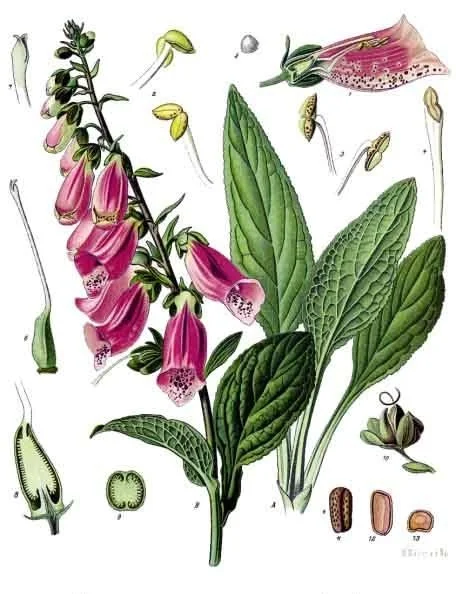
Foxglove (Digitalis purpurea) — for identification only. Know it by the tall spire of tubular purple-pink flowers with spotted throats, and by the soft, wrinkled leaves of its first-year rosette. Every part is poisonous, fresh or dried, and its leaves have been fatally mistaken for comfrey: never brew or taste any part of it.
From Köhler's Medizinal-Pflanzen (Franz Eugen Köhler, 1887–1914). Public domain.
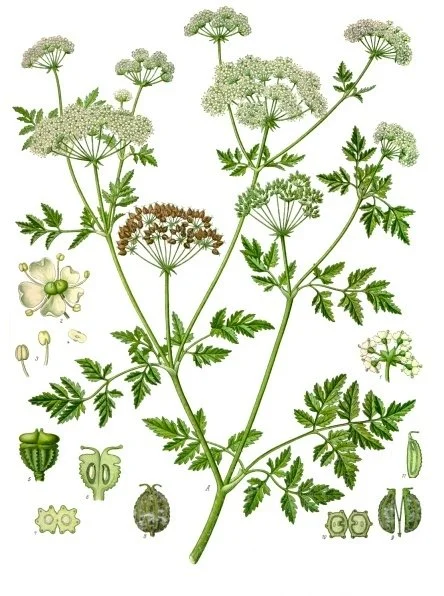
Poison hemlock (Conium maculatum) — for identification only. The plate shows what a plate can: the fern-like leaves and loose umbrella clusters of small white flowers. The decisive sign is one to learn from this lesson, not from handling: a smooth, hairless stem with purple blotches, on a plant that can tower six to ten feet. Never touch, taste, burn, or crush this plant to check it.
From Köhler's Medizinal-Pflanzen (Franz Eugen Köhler, 1887–1914). Public domain.
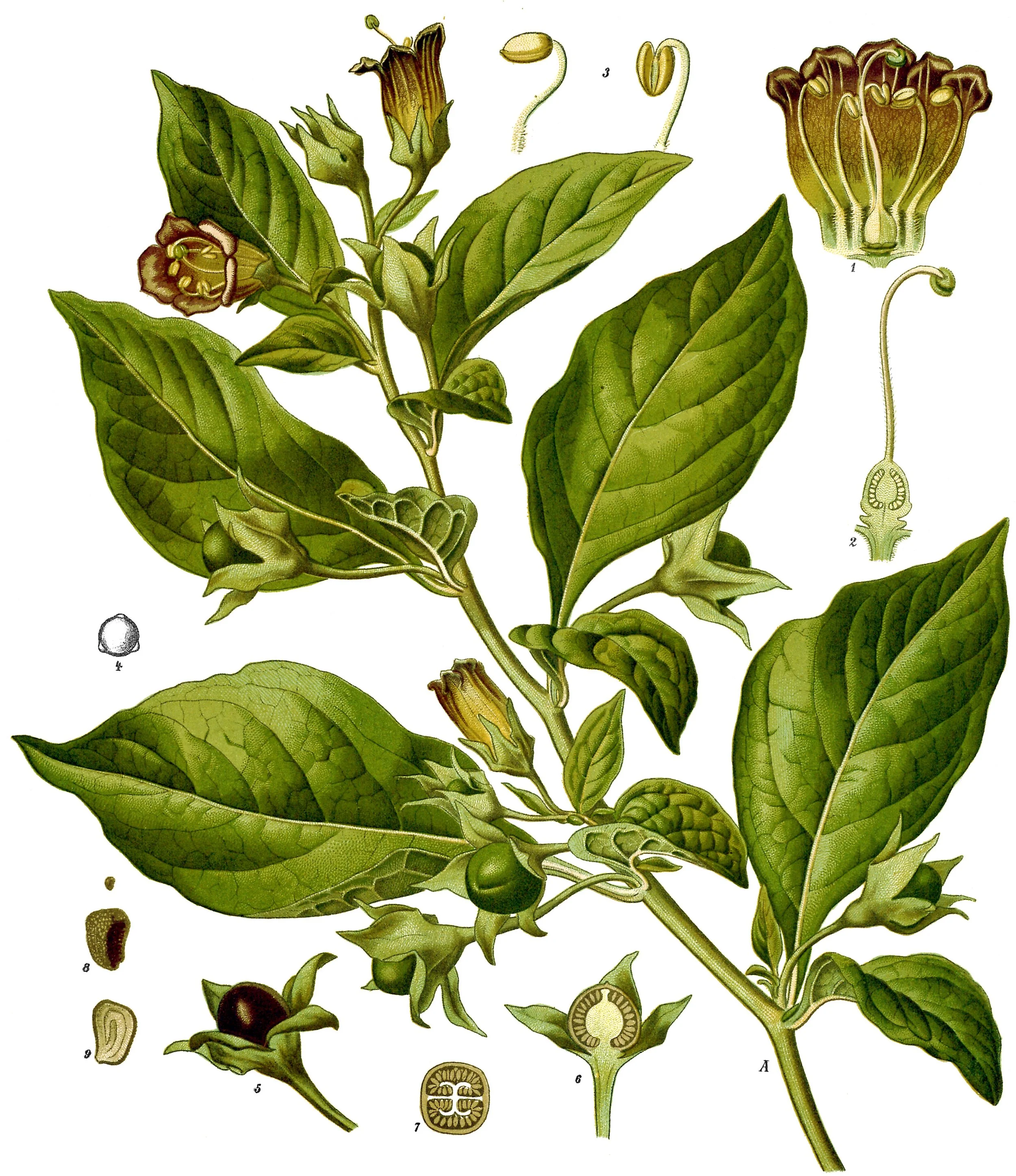
Deadly nightshade (Atropa belladonna) — for identification only. Know the fruit: single, glossy black berries, each about the size of a small cherry, under dusky purple-brown bell flowers. As few as two to five berries can kill a child. Never eat a wild berry you cannot name with certainty.
From Köhler's Medizinal-Pflanzen (Franz Eugen Köhler, 1887–1914). Public domain.
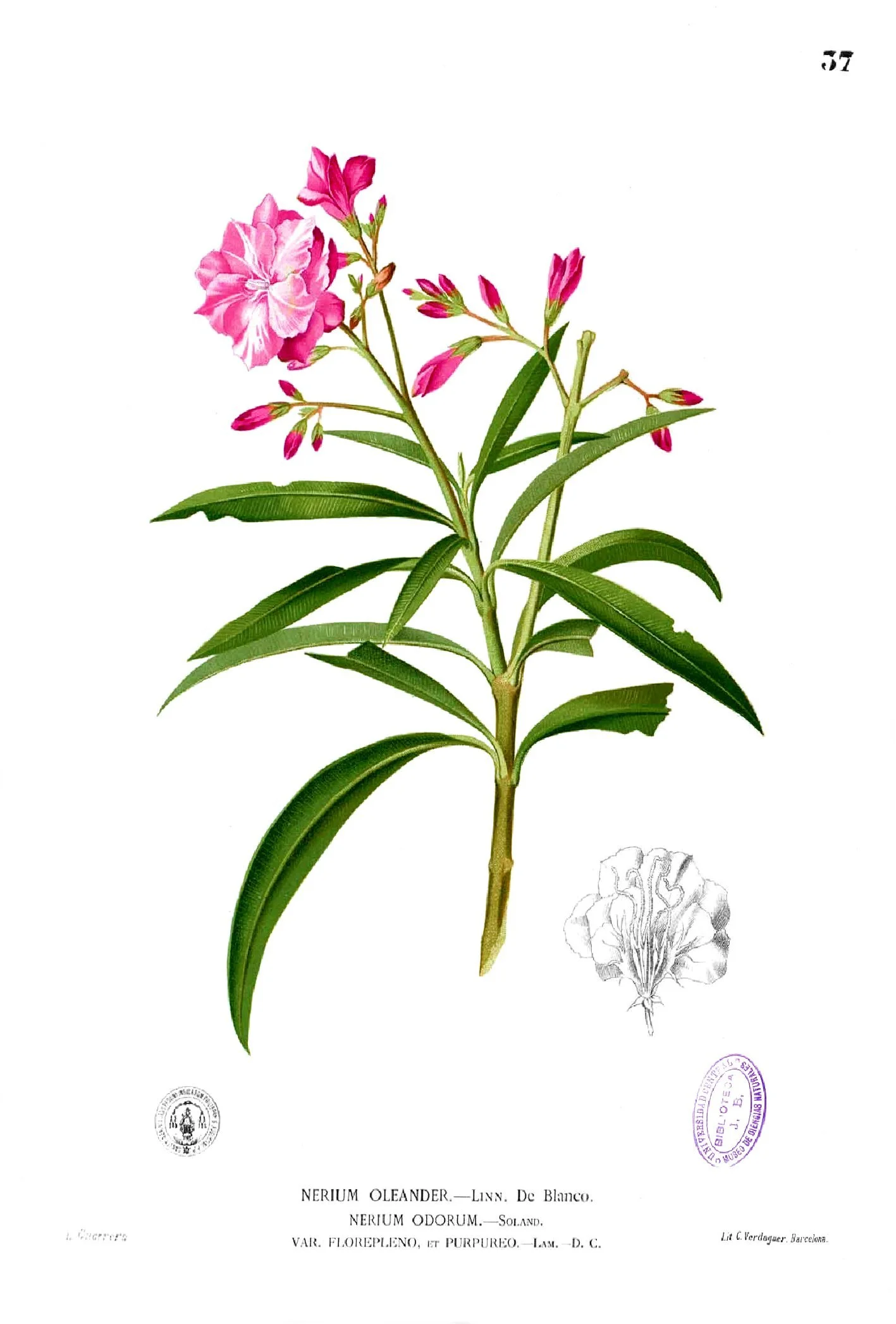
Oleander (Nerium oleander) — for identification only. Know it by the long, narrow, leathery evergreen leaves and the showy flower clusters; this plate draws a double-flowered garden variety. Every part is poisonous, fresh or dried: never burn its prunings, and never use an oleander stick to cook food.
From the illustrated posthumous edition of Flora de Filipinas by Francisco Manuel Blanco (1877–1883), plate 37. Public domain.
We will study four plants in detail. These are not the only poisonous plants in the world, not by any measure. But they are common, they are widespread, they grow where people walk and garden, and each one teaches a different lesson about how plant danger works.
Foxglove (Digitalis purpurea)
You may know foxglove as a cottage garden favorite, and it earns the admiration. In its second year it sends up a tall spire of tubular flowers, most often purple-pink with spotted throats, each blossom shaped like the finger of a glove. The first year it is only a rosette of soft, wrinkled, downy leaves close to the ground.
★ Every part of the foxglove is poisonous: leaves, flowers, and seeds. The plant contains cardiac glycosides, chiefly digitoxin and digoxin, compounds that act directly on the heart. In precise, purified, medically supervised doses, related compounds have been used as heart medicine since the physician William Withering pioneered their use in the eighteenth century. In the uncontrolled dose of a chewed leaf or a brewed tea, they are dangerous. Symptoms of foxglove poisoning include nausea, vomiting, stomach pain, a dangerously slow pulse, and irregular heartbeat that can progress to cardiac arrest.
★ Two facts deserve special emphasis. First, drying does not make foxglove safe. Dried leaves are as poisonous as fresh ones. Second, foxglove leaves have been fatally confused with comfrey, a harmless plant whose leaves are sometimes brewed into tea. The lesson is one we will repeat: never consume a plant on the strength of a guess.
Check in: Two facts about foxglove deserve special emphasis. Name both, and say why each one matters.
Foxglove's sap can also irritate the skin. Wear gloves when handling it, even in the garden.
Poison Hemlock (Conium maculatum)
Poison hemlock is the plant that ended the life of the philosopher Socrates, and it has not grown gentler with age. It is a biennial of the carrot family. In its first year it is a low rosette of fern-like leaves. In its second year it bolts upward on stout stems that can reach six to ten feet, topped with umbels, umbrella-shaped clusters of small white flowers.
All parts of poison hemlock are toxic. Its chief poison, coniine, disrupts the nervous system, and ingestion can lead to paralysis and respiratory failure. There is a particular cruelty in hemlock poisoning: the mind may remain clear while the body fails. This is history's lesson as much as botany's.
★ Identification matters enormously here, because poison hemlock has a famous look-alike, which we will study in its own section below. For now, learn hemlock's three signatures: stems that are smooth and hairless with distinctive purple blotches or streaks; great height at maturity, often towering over surrounding plants; and a musty, unpleasant odor when the foliage is crushed. Do not crush the foliage to check. Learn the other signs first.
Check in: Name hemlock's three signatures — and say which one you must never test by crushing the foliage, and why.
Never burn poison hemlock to dispose of it. The smoke can carry harmful compounds.
Deadly Nightshade (Atropa belladonna)
Deadly nightshade is a branching perennial, three to five feet tall, with dull green oval leaves and drooping bell-shaped flowers of a dusky purple-brown. Its fruits are the danger you must picture: single, glossy black berries, each about the size of a small cherry, sweet-looking and deceptively inviting.
★ The plant contains tropane alkaloids, including atropine, scopolamine, and hyoscyamine, which interfere with the nervous system. Symptoms include dilated pupils, blurred vision, rapid heartbeat, confusion, hallucinations, and in severe cases seizures and death. As few as two to five berries can be fatal to a child; ten to twenty can kill an adult.
Check in: How many deadly nightshade berries can be fatal to a child, and how many to an adult?
The name belladonna means "beautiful lady" in Italian, from the historical practice of using its extracts to dilate the pupils for cosmetic effect. History also records its use in folklore and, darkly, in poisonings across the centuries. We study it not for its stories but for its berries, which a child might mistake for an edible fruit. Teach every young person in your life this rule: never eat a wild berry you cannot name with certainty.
Note that deadly nightshade belongs to the Solanaceae family, which also includes tomatoes, potatoes, peppers, and eggplant. The family resemblance is botanical, not a safety rating. Never assume a plant is safe because its relatives are edible.
Oleander (Nerium oleander)
Oleander is the most likely plant in this lesson to be growing in your neighborhood. It is a beloved ornamental shrub of warm climates, planted along highways in California and Texas and in gardens across the Mediterranean world, with showy clusters of white, pink, red, or yellow flowers and long, narrow, leathery evergreen leaves.
★ All parts of oleander are highly toxic, whether fresh or dried: leaves, flowers, seeds, bark, and roots. Its poisons are cardiac glycosides, including oleandrin, which disrupt the heart's rhythm. Symptoms include nausea, vomiting, abdominal pain, dizziness, and dangerous cardiac arrhythmias.
★ Three practical warnings. First, never use an oleander stick as a skewer or for cooking food over a fire; the toxins survive heat. Second, never burn oleander prunings; the smoke itself has caused poisoning. Third, site oleander away from where children, pets, or livestock might chew it. It is a beautiful plant that asks only to be admired from a respectful distance, and that is a fair arrangement.
Check in: Name oleander's three practical warnings. Which two of them turn on the same fact about its toxins?
❦ In your workbook: record the baneful four in your own way — one plant, its danger, and its key safety rule at a time — copy, sketch, or note what matters.
In your packet: Assignment II — The Baneful Gallery ⚒ begins here. Work it now, or mark the place and take it as homework — your choice.
The Look-Alike Problem
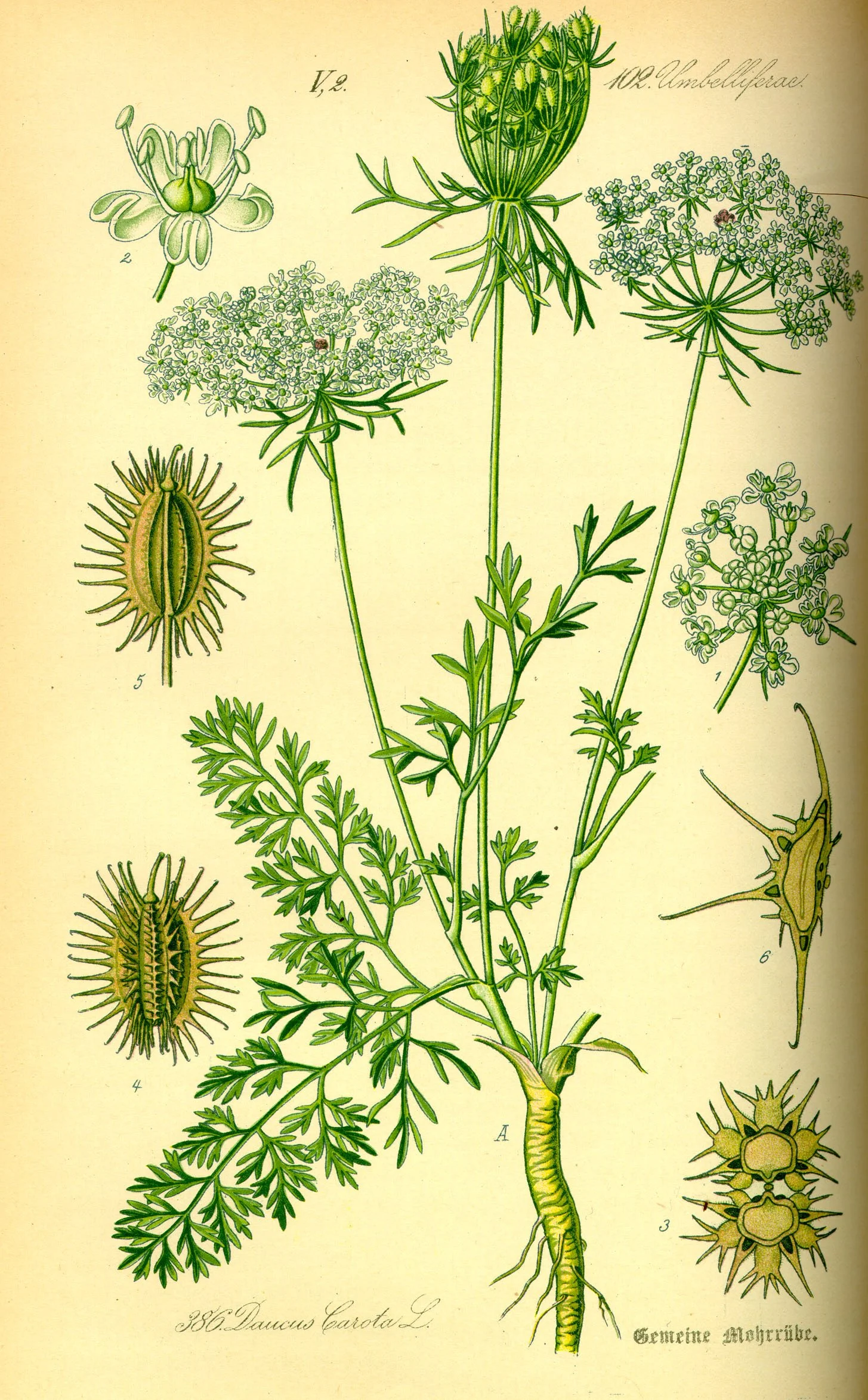
Queen Anne's lace — wild carrot (Daucus carota) — the look-alike, shown for comparison, not for gathering. Find the single tiny dark floret at the center of its flat-topped white umbels. Resemblance is not identification: confirm at least three signs, stem first — "Queen Anne has hairy legs"; hemlock's stem is smooth and purple-blotched — before trusting any white umbel, and never taste an unconfirmed plant.
Otto Wilhelm Thomé, Flora von Deutschland, Österreich und der Schweiz (1885), plate 386. Public domain.
My scholars,
I am going to speak to you now with all the seriousness I possess, which is considerable when the subject requires it.
Most plant poisonings do not happen because someone knowingly ate a poisonous plant. They happen because someone was certain they had identified a safe plant, and they were wrong. Certainty without knowledge is the most dangerous thing in the greenhouse.
The pair I am about to describe has caused more grief than any other in North America. Learn it as you would learn the faces of your friends, because mistaking one for the other can be fatal.
— Professor Beryl Fernfoot, Herbology Greenhouse • Master Herbalist • Head of House Oriens
Poison hemlock's most dangerous look-alike is Queen Anne's lace, also called wild carrot (Daucus carota). Both are members of the carrot family. Both have finely divided, fern-like leaves. Both produce flat-topped umbrella clusters of small white flowers. From a distance, in a roadside meadow in July, they can look like cousins. Up close, with knowledge, they are unmistakable. Here are the differences, and you should learn all of them, not just one:
★ The stem test. This is the most reliable field mark. Queen Anne's lace has hairy stems, green and slightly ribbed. There is a well-known memory aid: Queen Anne has hairy legs. Poison hemlock has smooth, hairless stems, often with purple blotches or streaks. If the stem is smooth with purple markings, walk away.
The height test. Queen Anne's lace is a modest plant, usually one to three feet tall. Poison hemlock is ambitious, commonly six feet or more at maturity, sometimes reaching ten. If the plant towers over its neighbors, treat it with suspicion.
The flower test. Queen Anne's lace typically bears a single flat-topped cluster per stem, often with one tiny dark purple or reddish floret at the very center. Its clusters fold inward as they mature, forming a shape like a bird's nest. Poison hemlock bears looser, more open clusters of small white flowers on branching stems, with no central dark floret.
The root test. Queen Anne's lace is wild carrot, and its root smells distinctly of carrot. But you should never dig up a plant to smell its root as an identification method. If you are close enough to dig, you are close enough to have checked the stem first.
The habitat hint. Poison hemlock favors damp ground: ditches, creek edges, low wet spots. Queen Anne's lace prefers drier, sunnier ground: fields, dry roadsides, open meadows. Habitat is a hint, not a rule. Always confirm with the stem.
Check in: A white-flowered plant has a smooth stem with purple blotches. Which plant does the stem test point to, and what do you do?
One more caution about Queen Anne's lace itself: its sap can irritate the skin and increase sensitivity to sunlight in some people. Even the safe twin deserves gloves.
★ The broader principle: never identify a wild plant by a single feature. Use at least three independent signs before you are confident, and if any sign disagrees, the plant is unidentified. An unidentified plant is never eaten, never brewed, never tasted "just to check." Tasting is not an identification method. It is a gamble, and the stakes are your health.
❦ In your workbook: record the look-alike problem in your own way — the stem, height, and flower tests, and the three-sign principle behind them — copy, sketch, or note what matters.
In your packet: Assignment III — The Look-Alike Study ◐ begins here. Work it now, or mark the place and take it as homework — your choice.
Contact Hazards: When Touch Alone Is Enough
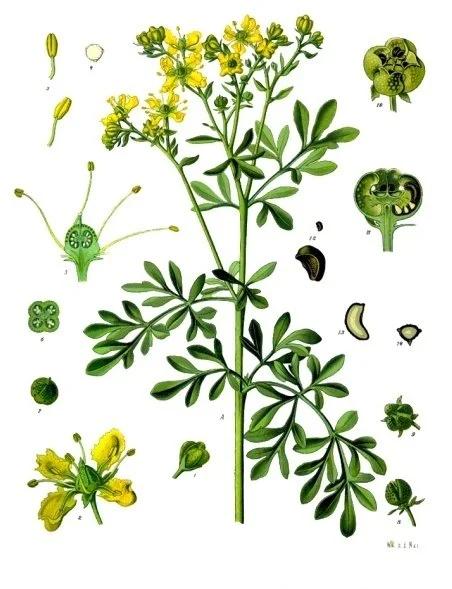
Rue (Ruta graveolens) — a contact hazard; you do not have to eat this one to be hurt by it. Blue-green divided leaves and small yellow flowers. Its sap on skin, followed by sunlight, causes blistering burns (phytophotodermatitis): wear gloves to handle it, and wash your hands afterward.
From Köhler's Medizinal-Pflanzen (Franz Eugen Köhler, 1887–1914). Public domain.
Not all plant dangers require ingestion. Some plants punish mere handling.
★ *Rue (Ruta graveolens) is a handsome Mediterranean herb with blue-green foliage and small yellow flowers, sometimes grown ornamentally and historically used in small amounts as a bitter flavoring. Its sap contains compounds called furocoumarins. On the skin, in combination with sunlight, these compounds cause phytophotodermatitis*: redness, blistering, and burns that can appear within a day of exposure. The mechanism is well documented, including in medical case reports. The rule is simple: wear gloves when handling rue, and wash your hands afterward.
Check in: What two things must meet on the skin for rue to cause its burns — and what is the reaction called?
Giant hogweed is a related and more dramatic example. Its clear sap, combined with sunlight, can cause severe burns and blistering, and eye exposure is a medical emergency. It is a very large plant, sometimes fourteen feet tall, with massive umbrella flower heads. If you encounter a giant suspicious umbellifer near water, do not touch it; report it to local authorities instead, as many regions track and manage it.
General contact rules for the greenhouse and the field:
- Wear gloves when handling any unfamiliar plant.
- Wash your hands after gardening, even if you wore gloves.
- Keep sap away from your eyes and mouth.
- If sap contacts skin, wash the area promptly with soap and water and keep it out of sunlight.
- Teach children to show you a plant before touching it, not after.
❦ In your workbook: record the contact hazards in your own way — rue, giant hogweed, and the five general contact rules — copy, sketch, or note what matters.
The Rules of the Baneful Greenhouse
★ These rules are not suggestions. A scholar of Herbology follows them as faithfully as a scribe follows the lines on a page.
- Never consume a plant you cannot identify with certainty. Not a leaf, not a berry, not a sip of tea. Certainty means at least three independent identifying features, confirmed, with no contradictions.
- Never consume a plant on someone else's identification alone. Even an expert can have an off day. Verify for yourself.
- Observe before you touch. Look at the whole plant: stem, leaves, flowers, habitat. Touch comes after identification, not before.
- Wear gloves with unfamiliar plants. Skin is an organ. Treat it as one.
- Keep the workspace honest. Label everything you harvest or collect. An unlabeled jar is a mystery, and mysteries in the greenhouse become accidents.
- Store baneful plants away from edibles. If you grow ornamentals that are toxic, such as foxglove or oleander, keep them clearly separated from anything you intend to eat, and make sure everyone in the household knows which is which.
- Supervise young scholars. Children learn by mouthing the world. Teach them early: we look with our eyes, we ask before we touch, and we never taste without permission from a knowledgeable adult.
- Respect the dose. "Natural" is not a synonym for "safe." Some of the most dangerous substances known come from plants. The difference between medicine and poison is so often the dose that the only safe dose of an unidentified plant is none.
Check in: Rule 1 defines certainty. State the definition in your own words, then name the rule that forbids trusting someone else's identification alone.
❦ In your workbook: record the Rules of the Baneful Greenhouse in your own way — all eight, in your own hand — copy, sketch, or note what matters.
If Something Goes Wrong
Read this section once, carefully, and then hope you never need it again.
★ Call Poison Control at 1-800-222-1222. This is the national toll-free Poison Help line for the United States, operated by America's Poison Centers. It is free, confidential, and staffed around the clock, every day of the year, by medical professionals with specialized training in toxicology. Program the number into your phone today, before you need it.
★ Call 911 first if the person is unconscious, not breathing, having seizures, or in immediate distress. Poison Control is for guidance; 911 is for emergencies. If you are unsure which applies, call 911.
Check in: A person who swallowed an unidentified plant is unconscious. Which number do you call first, and why?
Do not induce vomiting unless Poison Control or medical personnel specifically instruct you to. Vomiting can cause additional harm with certain substances.
When you call, be ready to share: the person's age and weight, what was taken or touched and how much, when it happened, and any symptoms so far. If you can safely do so, have the plant or a clear photograph of it available for identification. A photo of the whole plant, the leaves, and any flowers or berries is enormously helpful.
★ Do not wait for symptoms. Some plant poisons act quickly; others take hours. The absence of symptoms in the first minutes means nothing. Call promptly.
After the emergency, write down what happened while it is fresh: the plant, the circumstances, the timeline. This record helps medical professionals and becomes part of your own education. The greenhouse archives are built from observation, and even difficult observations have value.
❦ In your workbook: record if something goes wrong in your own way — the two numbers, which to call first, and what to have ready — copy, sketch, or note what matters.
Foraging Ethics: The Gatherer's Manners
Sooner or later, a student of plants will want to gather from the wild. The desire is natural and, handled properly, honorable. But wild gathering carries responsibilities that garden gathering does not.
Permissions. Never gather on private land without the owner's explicit permission. In parks, nature preserves, and public lands, check the rules first; many prohibit all collecting. When in doubt, the answer is to observe only.
Sustainability. Take only a small fraction of any population, never the only specimen, never from a struggling colony. For roots and whole plants, the ethics are stricter than for leaves: removing a root kills the plant. Ask whether the plant can spare what you want before you take it.
★ Beginners observe. Until you can identify plants confidently, your foraging should be entirely visual. Photograph, sketch, note the habitat, and confirm your identification at home with references. The field is for learning; the basket comes later, with experience.
Leave no trace. Close gates, stay on paths where they exist, and carry out everything you carried in. The wild places that teach us deserve our tidiness.
❦ In your workbook: record the gatherer's manners in your own way — permissions, sustainability, beginners observe, and leave no trace — copy, sketch, or note what matters.
In your packet: Assignment IV — The Household Safety Audit ◐ begins here. Work it now, or mark the place and take it as homework — your choice.
Guided Observation: Reading the Baneful Four Without Touching
This lesson's observation is done entirely from references — field guides, botanical illustrations, and photographs. No task in this lesson requires handling, seeking out, or standing beside a living toxic plant. Your eyes and your references are the whole field kit.
You will need:
- a field guide, botanical reference, or reputable website with clear images of foxglove, poison hemlock, deadly nightshade, and oleander
- your workbook and a pencil
- printed or drawn images of poison hemlock and Queen Anne's lace side by side, if your references offer them
Work plant by plant. For each of the baneful four, study the reference image and record three identifying features in your workbook — the features this lesson itself teaches. For foxglove, note the tubular flowers with spotted throats and the first-year rosette of soft, wrinkled, downy leaves. For poison hemlock, note the smooth stem with purple blotches, the great height, and the umbrella-shaped clusters of small white flowers. For deadly nightshade, note the single glossy black berries, each about the size of a small cherry. For oleander, note the long, narrow, leathery evergreen leaves and the showy flower clusters.
Apply the stem test on paper. Set the hemlock and Queen Anne's lace images side by side. Find the stem in each. Say the memory aid aloud — Queen Anne has hairy legs — then record the stem, height, and flower differences in a small table. This is the three-sign rule at work: no single feature decides.
Consider:
- Which of the four plants would be hardest to recognize outside its flowering season, and why?
- Which three signs separate hemlock from Queen Anne's lace most reliably in a photograph?
- Why does this lesson train your eye on references first, and living plants not at all?
Safety: observe only. Do not seek out living specimens of these plants, and never taste, pick apart, or handle an unidentified plant to check an identification.
Materials
Required (Level One — household items)
- Paper or index cards: for the Baneful Gallery reference cards.
- Pencils or pens: for sketches, tables, and the safety audit.
- Gloves: any household or garden gloves, for the household safety audit.
- Library or internet access: for reference images of the four baneful plants, and for the field guides and reputable references the Look-Alike Study uses.
- A workbook: for the guided observation, the workbook paths, and the written work.
Suggested (Level Two — historically closer)
- Heavy card stock: for durable reference cards in the style of a naturalist's file.
- Ink pens: for final reference cards and the bound naturalist's notebook.
- A regional field guide: for the look-alike study and safety audit.
- Pressed non-toxic specimens: for comparing leaf shapes safely (optional).
Safety note: No assignment in this packet requires handling, tasting, or seeking out any poisonous plant. All identification work uses references, images, and non-toxic comparisons.
Reflection Questions
Answer the following questions in your workbook.
- Why is "never consume an unidentified plant" a stronger rule than "learn which plants are poisonous"? What does the stronger rule protect against?
- The lesson states that most plant poisonings come from misidentification rather than deliberate risk-taking. What does this suggest about the relationship between confidence and knowledge?
- Why might a beautiful ornamental like oleander be more dangerous in practice than a plant with a frightening reputation? Consider where each one grows and who encounters it.
- How do the foraging ethics in this lesson connect to the stewardship themes of earlier lessons? Is restraint a form of care?
- Professor Fernfoot writes that "curiosity is a fine thing" but "hurry is not." Describe a situation, in the greenhouse or elsewhere, where slowing down changed an outcome.
Workbook Checklist — Lesson 6
In my workbook I have:
- ☐ identified the baneful four — foxglove, poison hemlock, deadly nightshade, and oleander — by their key features
- ☐ distinguished poison hemlock from Queen Anne's lace by stem, height, and flower cues, and said the stem-test memory aid
- ☐ explained why toxic look-alikes are dangerous, and stated the three-sign rule
- ☐ described the contact hazards of rue and giant hogweed, and the general contact rules
- ☐ written out the eight Rules of the Baneful Greenhouse, including the rule against consuming unidentified plants
- ☐ stated what to do in a suspected poisoning: Poison Control at 1-800-222-1222 for guidance, 911 first in an emergency, and never induce vomiting unless instructed
- ☐ described the foraging ethics: permissions, sustainability, leave no trace, and observe-don't-touch for beginners
- ☐ completed the Baneful Gallery, the Look-Alike Study, and the Household Safety Audit by observation and reference only — no toxic plant handled
☐ Lesson completed Date: ___ Signature: ___
The Professor's Closing Note
My scholars,
You have done serious work today, and I am proud of you. This was not the most joyful lesson of our course, but it may prove the most valuable, and there is a quiet satisfaction in that.
Here is what I want you to carry out of the Baneful Greenhouse: the world of plants is overwhelmingly generous. The great majority of green things you will meet in your life are harmless or helpful or simply beautiful. The baneful ones are the exception, and now you know their faces.
Knowledge has replaced your fear with something better. You are not afraid of the greenhouse. You are at home in it, and you know which corners to treat with respect. That is exactly what a herbalist is.
Walk gently, look closely, and never be in a hurry.
— Professor Beryl Fernfoot, Herbology Greenhouse • Master Herbalist • Head of House Oriens
Cross-Class Connections

Potions · Unit I, Lesson 1 — Welcome to the Potions Laboratory
Scholars, welcome — and read my Safety Covenant before you touch a single jar. Its promises are the cousins of the Rules you have just learned here: never taste an unidentified material, label everything the moment it is made, and call poison control the moment there is any doubt. Sign it with an adult beside you, and the Laboratory is yours.
Potions · Unit I, Lesson 9 — Hearth Clearance
Come and learn how a careful bench is closed: heat confirmed cold, labels checked and repaired, and the strong stores locked away in their cabinet, apart from everything else. It is this lesson's sixth Rule — baneful things stored away from edibles — kept as a nightly ritual, and I have kept the key on a ribbon for forty years.
Further Reading & Sources
- Poison Control — Contact Us (poison.org) — the national Poison Help line, webPOISONCONTROL tool, and guidance for suspected poisonings. Free, confidential, 24/7. - America's Poison Centers (Wikipedia) — how the 1-800-222-1222 hotline works and who answers. - Foxglove — Digitalis purpurea (Wikipedia) — toxicity, cardiac glycosides, and the William Withering history. - Queen Anne's Lace vs. Poison Hemlock — Ohio State Extension — side-by-side identification with photographs of stems, flowers, and height differences. - Deadly Nightshade — Atropa belladonna (Wikipedia) — tropane alkaloids, berry identification, and the distinction from edible nightshades. - Oleander toxicity review (PMC/NIH) — cardiac glycosides in Nerium oleander, symptoms, and case literature. - How to Identify Deadly Nightshade — Farmer's Almanac — five diagnostic cues with look-alike guidance. Browse the Herbology shelf in the school Library for readable editions of these works.
The greenhouse doors stand open. Walk gently, look closely, and never be in a hurry. — Professor Beryl Fernfoot, Herbology Greenhouse • Master Herbalist • Head of House Oriens
Plants from this lesson stand in the Materia Botanica, the school's shared archive — each kept with its lessons, its keepings, and its cautions. This lesson's company:
ChiliFoxglovePotatoTomatoWild carrot The whole Materia BotanicaPROFESSOR BERYL FERNFOOT · HERBOLOGY GREENHOUSE
Submit your work for this lesson using the form below.
CONTINUE IN THE HERBOLOGY GREENHOUSE
← Previous · Lesson 5: The Historian's Herbarium Next · Lesson 7: The Unit I Threshold Examination →
Unit I — Morphology, Taxonomy & the Ancient Lore Herbology Greenhouse — All 37 Lessons
The rest of Unit I: Lesson 1 · Scholar's Familiar · Lesson 2 · Foliage & Stems · Lesson 3 · Root Vaults · Lesson 4 · Binomial Classification · Lesson 5 · Historian's Herbarium · Lesson 7 · Threshold Examination