
HERBOLOGY
Unit I · Lesson 5THE HISTORIAN'S HERBARIUM
PROFESSOR BERYL FERNFOOT
Herbology Greenhouse
Master Herbalist
Professor's Introduction

Hello, gardeners,
Every plant you have ever met has a story longer than your own. The mint on your windowsill carries ten thousand years of human mornings in its leaves. The wheat in your bread was coaxed from wild grass by hands you will never shake, in fields you will never see, by people whose names are lost but whose work feeds you still.
Today we slow down and listen to those stories. A naturalist who knows only what a plant looks like knows only half the plant. The other half is history: where it came from, who carried it across the world, what people believed about it, and what they wrote down. Bring your journal. We are going traveling, and we will not even leave the greenhouse.
— Professor Beryl Fernfoot, Herbology Greenhouse • Master Herbalist • Head of House Oriens
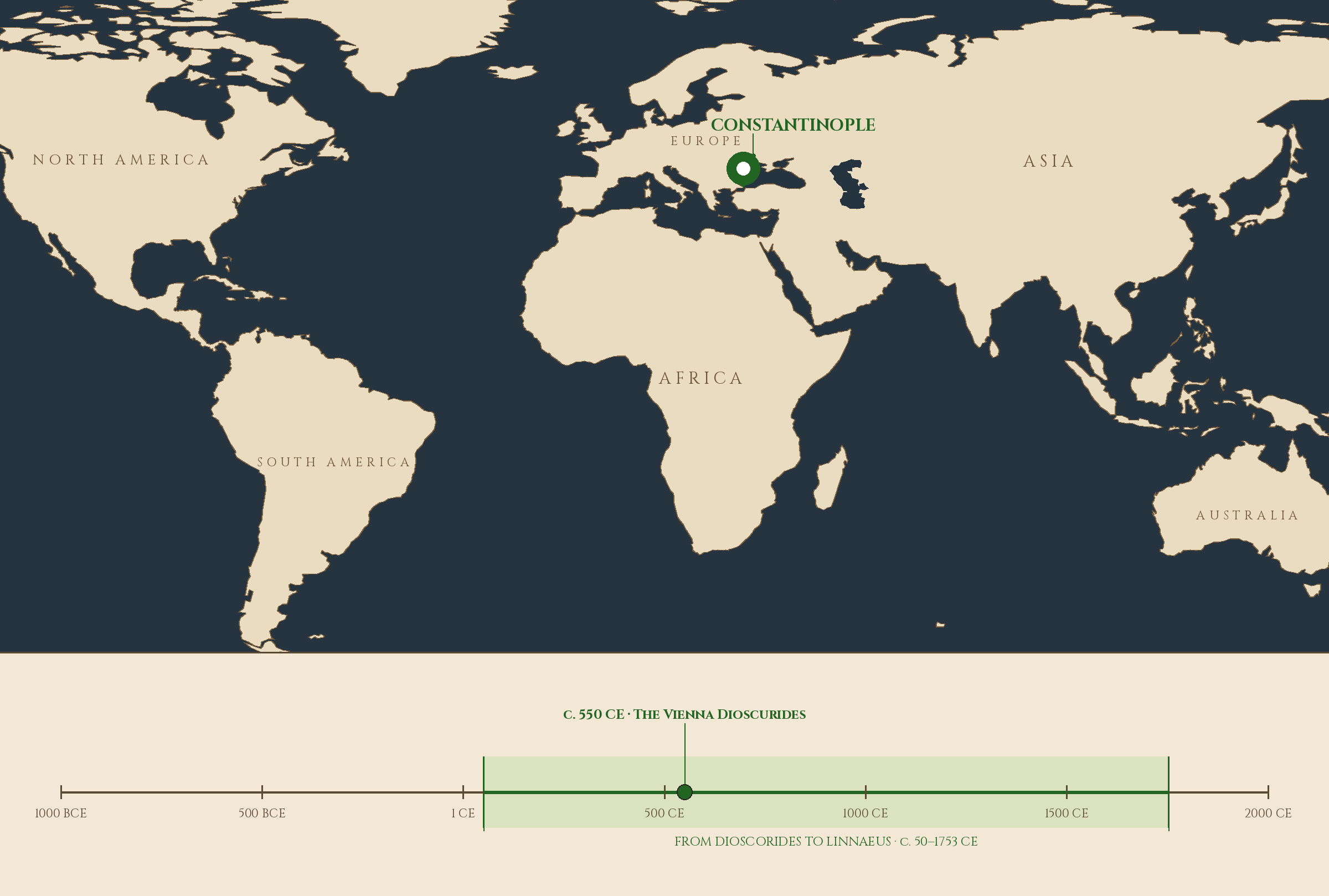
Where and when: Constantinople, c. 550 CE — The Vienna Dioscurides. The pin is this lesson. The line beneath the map is our road: every stop a place where the knowledge of plants changed, every lesson a step along it.
Lesson Objectives
By the end of this lesson, you will be able to:
- Describe how and where wheat and rice were first domesticated, and why those events mattered.
- Trace the journey of at least three spices from their native regions along historical trade routes.
- Explain what an herbal is, and name two landmark herbals and their authors.
- Distinguish between a plant's documented history and its folklore, and explain why both are worth studying.
- Research the historical story of your own Scholar's Familiar and record it in your journal.
Reading this lesson: ★ marks the passages to remember. They return on the unit quiz and the class test. Check in questions ask the material back as you go; answer them in your workbook when you meet them.
Working this lesson: Your assignment packet is the first download on this page. Work in it as the lesson moves along, answering each assignment as its subject is taught — or read the lesson through for your notes and take the assignments as homework afterward. Both are proper ways to sit this class. Signposts in the reading tell you where each assignment belongs. Written answers are short answers in your own words; a few honest lines are worth more than a filled page.
Your Assignment Packet
This lesson's assignments live in its packet: the Lexicon Handout (every term, course terms marked ◆), Materials, Guided Practice, the Assignment Manual with its answer key for self-checking, the Reflection Questions, and the Workbook Checklist. Download the packet before you begin and keep it beside you as you read.
The First Fields
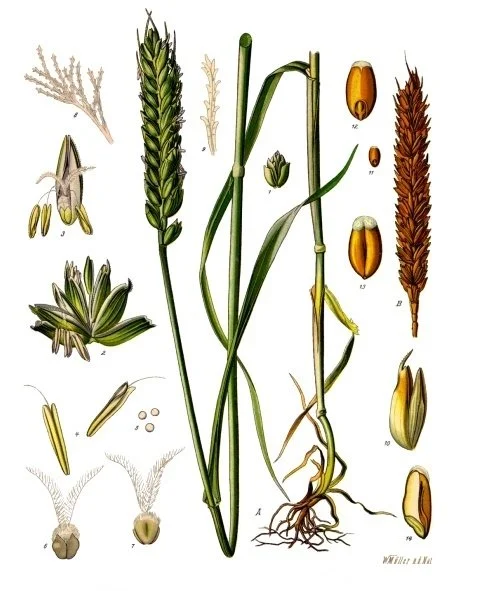
Wheat (Triticum aestivum). The ripe ear holds its grains on the stalk instead of scattering them — the non-shattering habit that generations of selection in the Fertile Crescent bred into the crop.
From Köhler's Medizinal-Pflanzen (Franz Eugen Köhler, 1887–1914). Public domain.
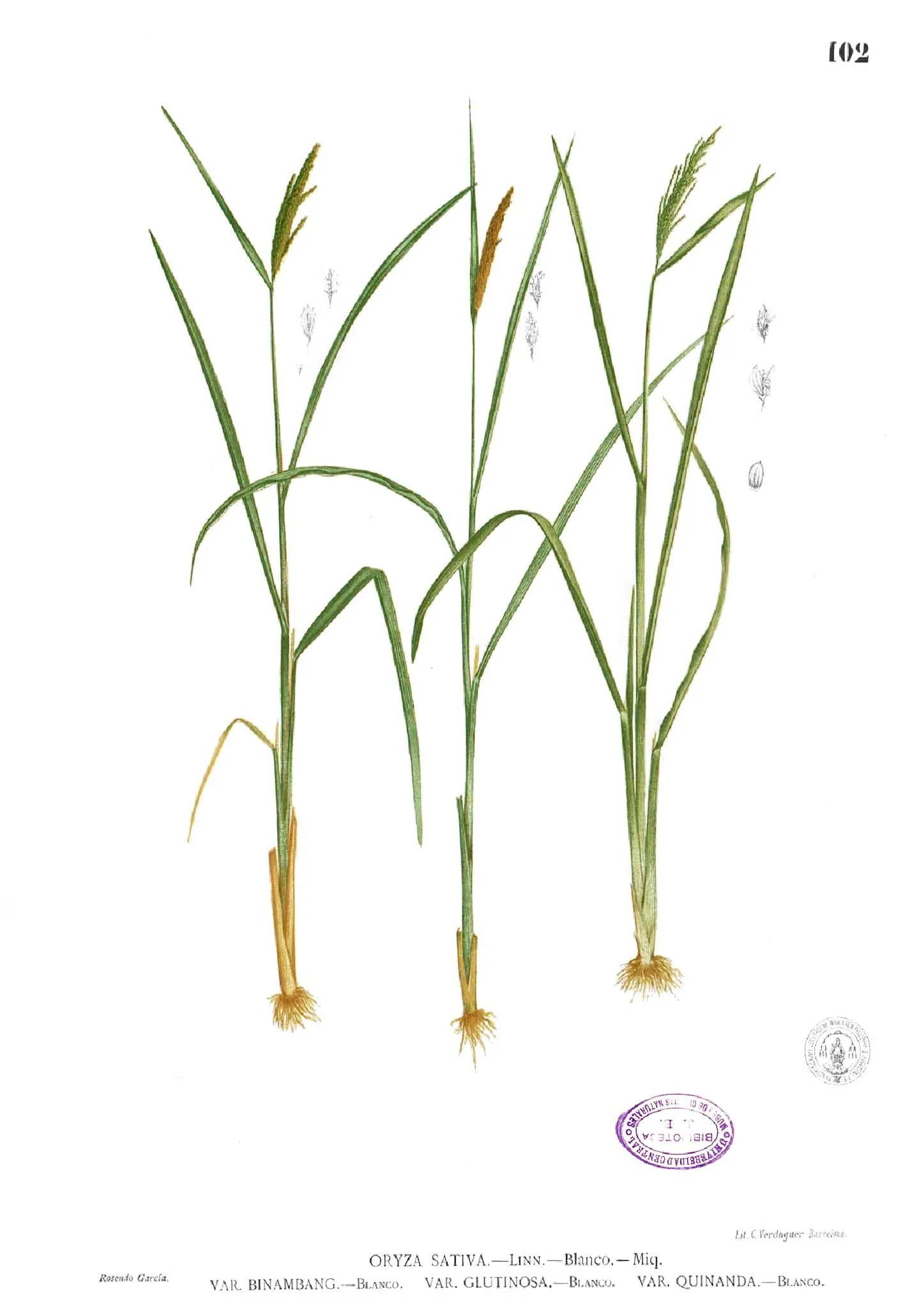
Rice (Oryza sativa), drawn for Blanco's Flora de Filipinas: three plants with their grain heads and roots. Rice was domesticated independently of wheat, in China's Yangtze River Valley — a second, separate answer to the same hunger.
From the illustrated posthumous edition of Flora de Filipinas by Francisco Manuel Blanco (1877–1883), plate 102. Public domain.
Long before anyone wrote a word about plants, people were already changing them. The story of cultivated plants begins with the slow, patient work of domestication: the process by which wild plants, through generations of human selection, became the crops that feed the world.
★ The earliest farming we know of took shape in the Fertile Crescent, the arc of land stretching from the Jordan Valley through Mesopotamia to the foothills of the Zagros Mountains. Around 12,000 to 10,000 years ago, people there began deliberately cultivating wild wheats, einkorn and emmer, along with barley, lentils, and peas. These were not sudden inventions. Archaeological sites show a long transition: first harvesting wild grain, then tending it, then selecting the plants whose seeds stayed on the stalk instead of scattering to the wind. That single trait, the non-shattering stalk, is one of the quiet signatures of domestication. A wild wheat plant drops its seeds to survive. A domesticated wheat plant holds them, waiting for human hands.
Check in: What is the non-shattering stalk, and why is it a signature of domestication rather than of wild wheat?
★ Half a world away, and at roughly the same time, another grain was beginning its own long partnership with people. In the Yangtze River Valley of China, wild rice was gathered as early as 24,000 years ago, and true domestication took hold around 11,000 years ago, confirmed by a landmark 2024 study tracing rice's evolution through 100,000 years of archaeological layers. Rice demanded different skills than wheat: flooded paddies, careful water management, and transplanting seedlings by hand. The techniques shaped entire landscapes and the societies that lived in them.
★ These were independent inventions. Wheat farming and rice farming arose separately, in different places, among people who knew nothing of each other. Agriculture was not one discovery carried outward from a single source. It was an answer that many different peoples arrived at on their own, because the wild plants around them offered the possibility, and hunger offered the motivation.
Other centers of domestication followed their own paths: maize, squash, and beans in Mesoamerica; potatoes and quinoa in the Andes; sorghum and millet in sub-Saharan Africa; sunflowers in eastern North America; bananas, taro, and yams in New Guinea. Every one of these represents thousands of years of observation, the same careful attention you are learning to practice with your Scholar's Familiar, stretched across generations.
❦ In your workbook: record the first fields in your own way — copy, sketch, or note what matters.
The Roads the Plants Traveled
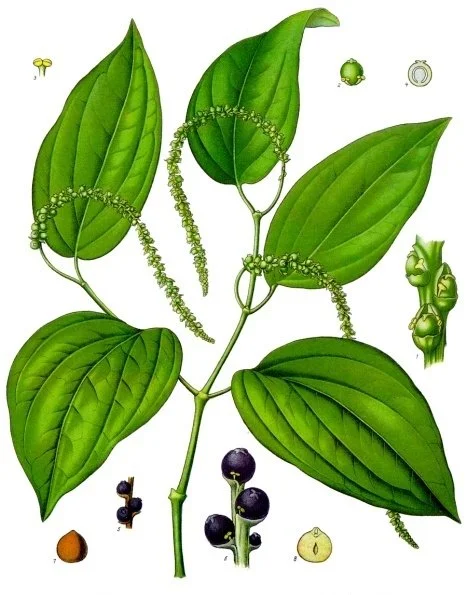
Black pepper (Piper nigrum), native to India's Malabar Coast. A peppercorn is a dried berry: the plate shows the berries green on the spike, ripe and dark, and the seed inside.
From Köhler's Medizinal-Pflanzen (Franz Eugen Köhler, 1887–1914). Public domain.
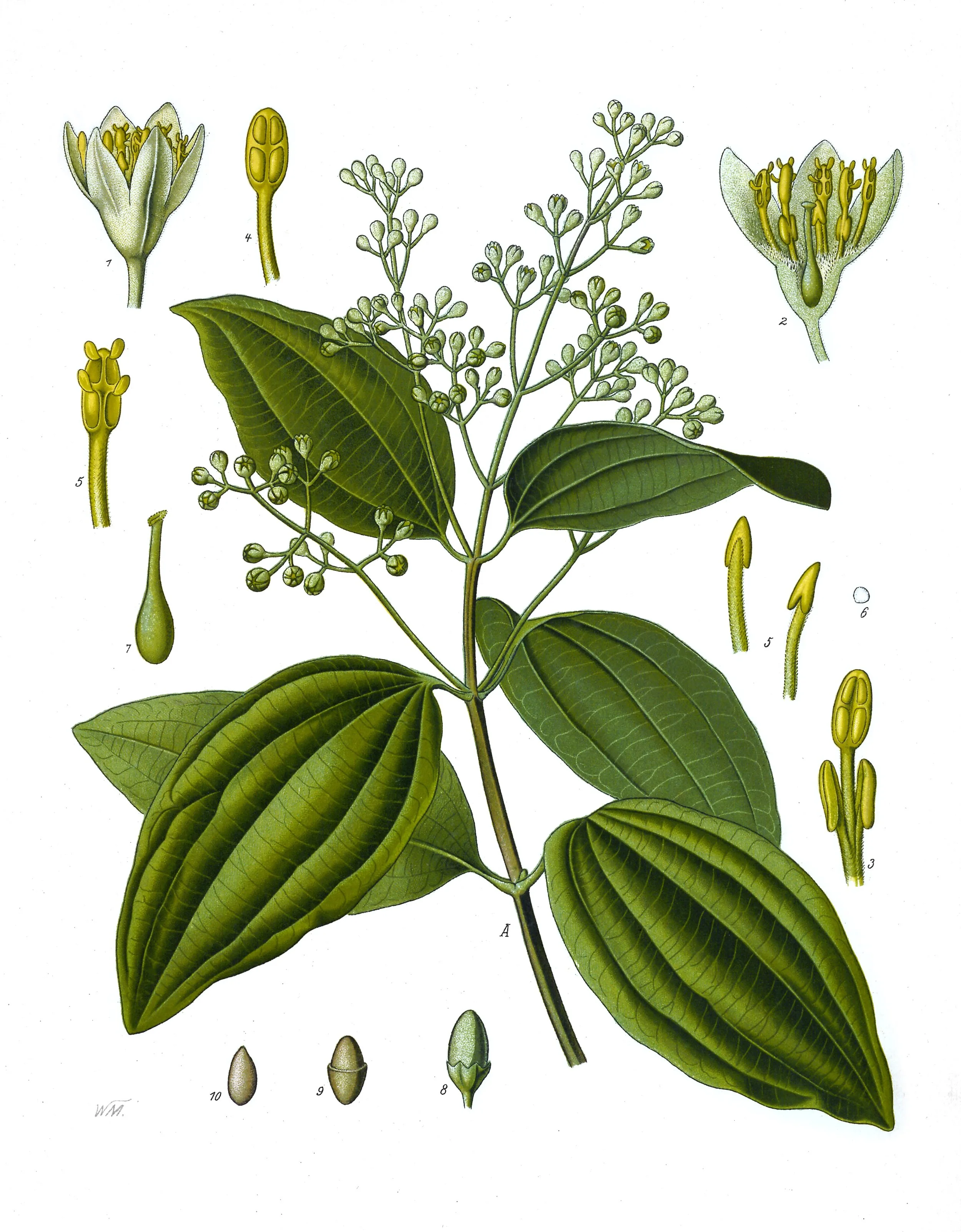
True cinnamon (Cinnamomum verum), from Sri Lanka. The spice is the tree's inner bark, which curls into quills as it dries; the plate shows the tree's flowering branch and its glossy, lengthwise-veined leaves.
From Köhler's Medizinal-Pflanzen (Franz Eugen Köhler, 1887–1914). Public domain.
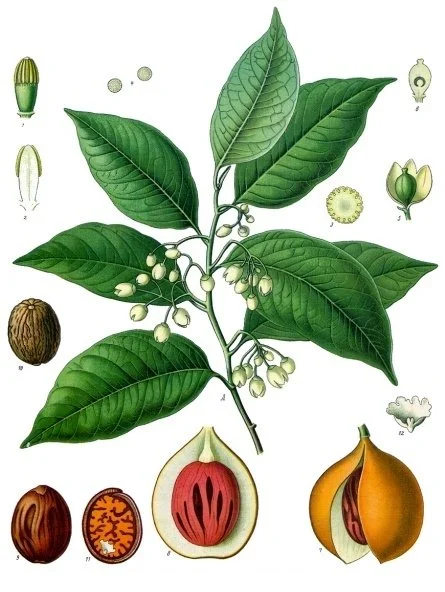
Nutmeg (Myristica fragrans) of the Moluccas, the Spice Islands. The split fruit shows the seed wrapped in red mace; the seed itself, ground, is nutmeg. Cloves grew on the same small group of islands — and nowhere else until the 1700s.
From Köhler's Medizinal-Pflanzen (Franz Eugen Köhler, 1887–1914). Public domain.
Once people grew plants worth wanting, the plants began to travel. And few things in history have traveled farther, or changed more, than spices.
★ Consider black pepper, the unremarkable-looking dried berry sitting in your kitchen. It is native to the Malabar Coast of India, where evidence of its use reaches back to 2000 BCE. The Romans called it precious enough to pay ransoms with. In medieval Europe it was worth its weight in gold, and the phrase "black gold" followed it for centuries.
★ True cinnamon comes only from Sri Lanka, where the inner bark of a particular tree yields the quills we know. Cloves and nutmeg grew nowhere in the world but the Moluccas, a scatter of small Indonesian islands Europeans called the Spice Islands, until the 1700s. For a thousand years, most of Europe had no idea where these things came from. Arab traders who carried them westward kept their sources secret, and told wonderful stories about winged serpents guarding cinnamon groves, because mystery protected their profits.
Check in: Name the native home of black pepper, of true cinnamon, and of cloves and nutmeg — and say why Europe did not know two of those sources for a thousand years.
★ The routes the spices traveled shaped the modern world. Overland, camel caravans carried them along the Silk Road through Persia and Central Asia. By sea, they crossed the Indian Ocean in the holds of Arab and Indian vessels. When the Ottoman Empire took Constantinople in 1453 and the old overland routes grew costly and uncertain, European kingdoms began looking for another way to the spice lands. Vasco da Gama's voyage around Africa to India in 1498 was, at its heart, a pepper run. The Age of Exploration that followed, with all its ships and colonies and consequences, began in large part because people wanted better access to flavored bark and dried berries.
★ This is worth sitting with. Plants did not only feed travelers on those roads. Plants were the reason for the roads.
As you study your Scholar's Familiar, ask where it came from. Many common garden plants are travelers too. The tomato crossed an ocean. The potato fed empires. Your familiar may have a passport stamped with more ports than you do.
❦ In your workbook: record the roads the plants traveled in your own way — copy, sketch, or note what matters.
Sealed with the mark of Professor Beryl Fernfoot, Master Herbalist of the Herbology Greenhouse, Head of House Oriens.
You are doing beautifully. I know this lesson asks you to hold a great deal of history at once, and I want you to know that no one expects you to memorize it all today. What matters is the habit: when you meet a plant, ask where it has been. That single question will teach you more botany over the years than any list of dates.
Take your time with the next sections. The herbalists we are about to meet waited centuries for their readers. They can wait a few more minutes for you.
— Professor Beryl Fernfoot, Herbology Greenhouse • Master Herbalist • Head of House Oriens
The Herbalists
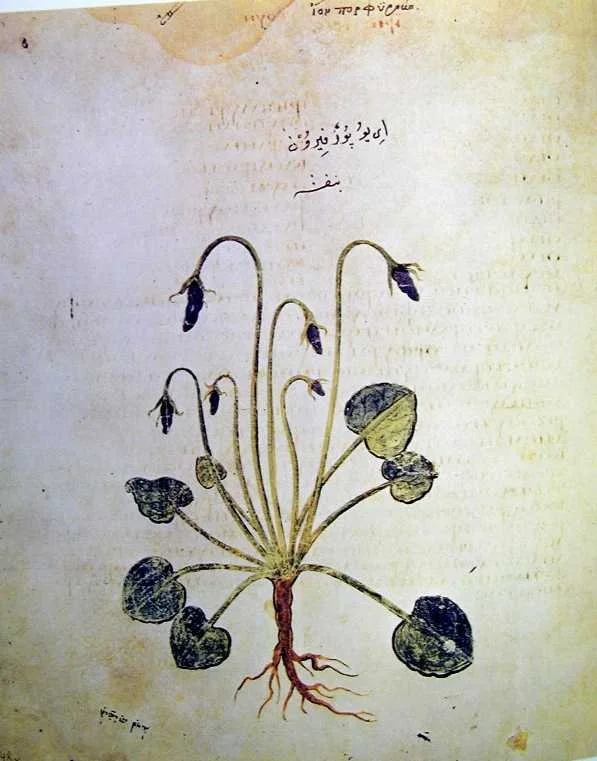
A page of the Vienna Dioscurides, the illustrated sixth-century copy of Dioscorides' De Materia Medica: a violet painted whole, root and all, on parchment. Herbals were working references — what the plant looks like, drawn to be recognized. Later readers added their own notes above the painting.
Vienna Dioscurides (Codex Vindobonensis med. gr. 1, fol. 148v), Österreichische Nationalbibliothek, Vienna, 6th century. Public domain.
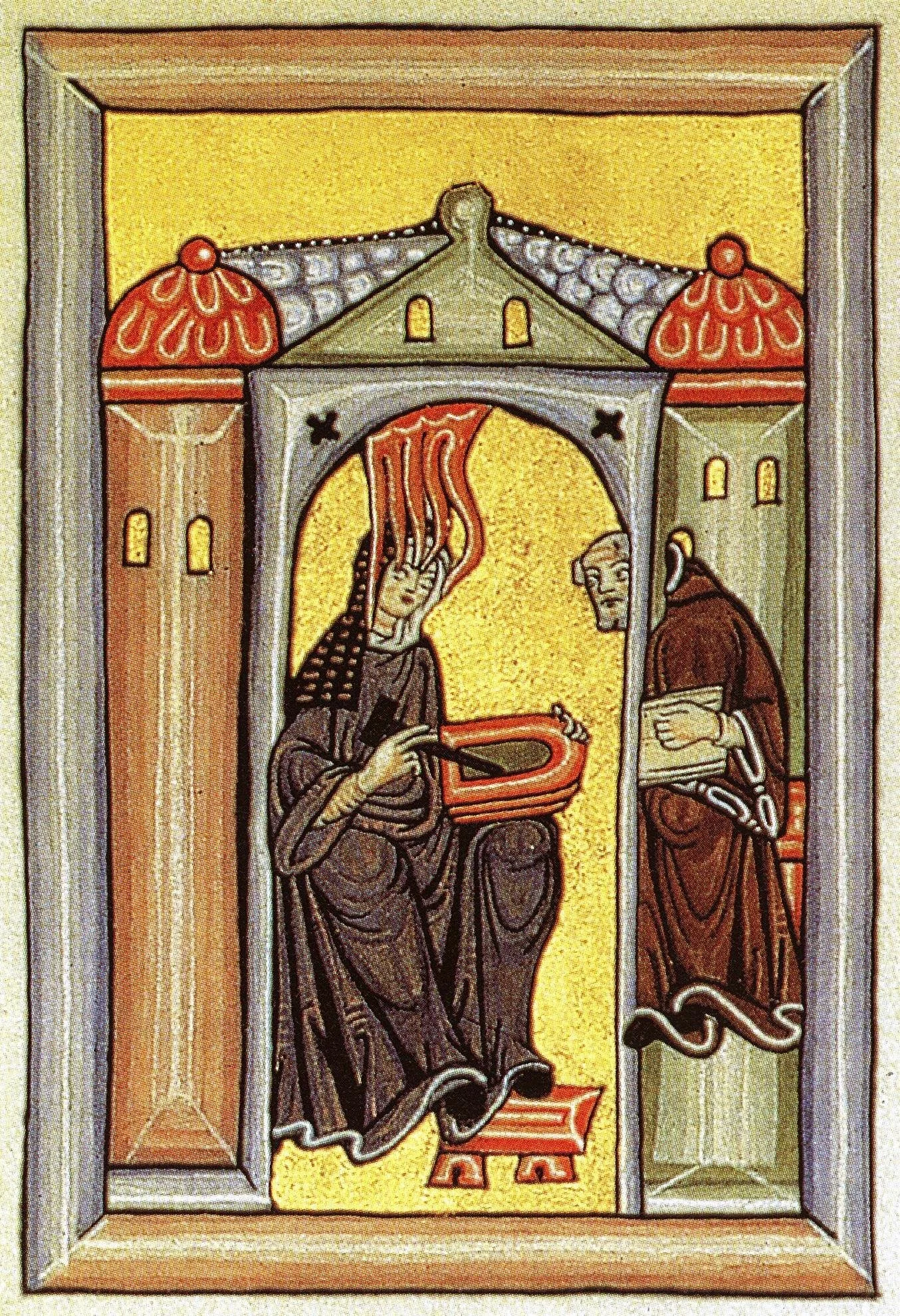
Hildegard of Bingen, shown writing in a medieval miniature from her Scivias: she records what she sees while her scribe waits with his book. Her Physica, compiled between 1151 and 1158, catalogues the natural world in 230 chapters on plants alone.
Miniature from a 12th-century manuscript of Hildegard's Scivias (Rupertsberg Codex tradition). Public domain.
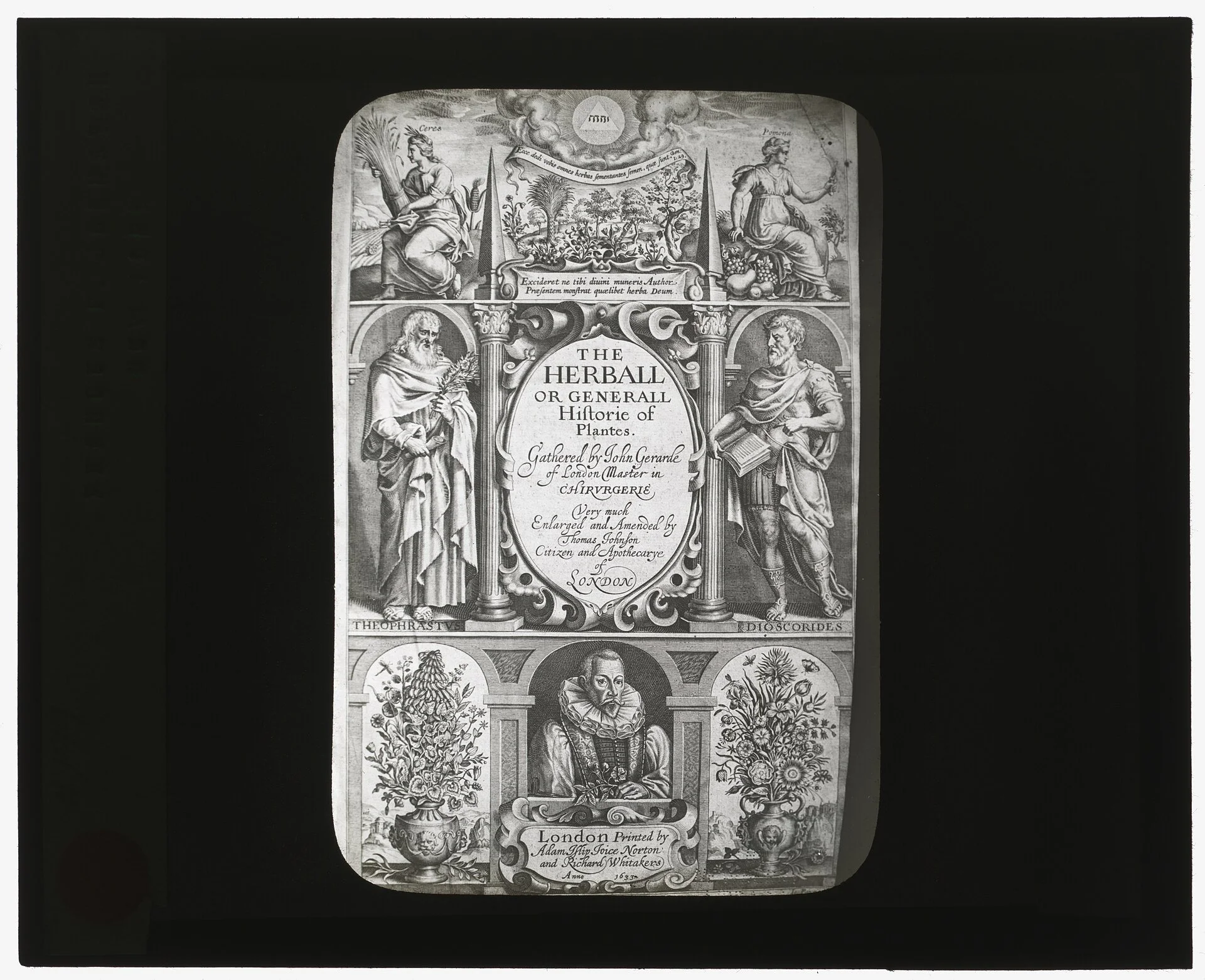
The printed herbal arrives: title page of John Gerard's Herball, or Generall Historie of Plantes (London, 1633). Gerard stands at the foot between two vases of flowers; above him, the book sets its own ancestry in the frame — Theophrastus at the left, and Dioscorides himself at the right.
Title page of Gerard's Herball (London, 1633), reproduction by the Library of Congress (lantern slide by Frances Benjamin Johnston). Public domain.
Sooner or later, someone writes it all down. The written record of plant knowledge is one of humanity's longest continuous conversations, and it begins, for our purposes, with a Greek physician in the Roman army.
★ Pedanius Dioscorides lived in the first century CE, around 40 to 90. As a military surgeon traveling with the legions, he saw plants across the ancient Mediterranean world, and he did something remarkable with what he saw: he organized it. His five-volume work De Materia Medica, written between 50 and 70 CE, describes around 600 plants, along with animal and mineral substances, and roughly a thousand preparations made from them. It was copied by hand in Greek, Latin, and Arabic for more than 1,500 years, making it one of the longest-used science books in history. The illustrated Vienna Dioscurides, a sixth-century copy made in Constantinople, served as a hospital reference for a thousand years. As late as 1934, a traveler reported finding a monk on Mount Athos still using a copy of Dioscorides to identify plants.
Check in: How many plants does De Materia Medica describe, when was it written, and for how long was it copied and used?
★ A thousand years after Dioscorides, another herbalist took up the work in a German convent. Hildegard of Bingen (1098 to 1179) was an abbess, composer, visionary, and naturalist, one of the most remarkable minds of the twelfth century. Between 1151 and 1158 she compiled the Physica, also called the Book of Simple Medicine, a nine-book survey of the natural world. Its first book alone contains 230 chapters on plants, each describing the plant's qualities in the framework of her time: hot or cold, wet or dry, and how those qualities balanced the human body. She drew on the Benedictine tradition of tending the sick, on the monastery's own herb garden, and on close observation. The Physica survives in manuscripts from as early as the thirteenth century, and it remains one of the only medieval medical works attributed to a woman.
★ Between these two landmarks stretches a whole tradition: Arabic scholars who preserved and extended Greek knowledge, medieval monastery gardens where monks grew both food and medicine, and the great printed herbals of the Renaissance, Fuchs, Gerard, and Dodoens among them, which gradually replaced Dioscorides with fresh observation. An herbal, in this tradition, is not a spellbook. It is a working reference: what the plant looks like, where it grows, what people have used it for, and what the author actually saw. That is the tradition your journal belongs to.
❦ In your workbook: record the herbalists in your own way — copy, sketch, or note what matters.
The Stories Plants Carry
★ Alongside documented history, plants carry folklore: the stories, sayings, and beliefs people attached to them. Folklore is not the same as fact, and this lesson asks you to keep the two carefully separated. But folklore is still worth studying, because it tells you what a plant meant to the people who lived with it.
A few examples, each clearly labeled as what people believed rather than what is proven:
In parts of Europe, rosemary was long associated with remembrance and fidelity. Brides carried it at weddings, mourners laid it on graves, and students in ancient Greece were said to wear it in their hair when studying, in the belief that it strengthened memory. Whether or not it sharpens thought, the association itself is real history: people acted on it for centuries.
Mandrake gathered some of the strangest folklore of any European plant. Its forked root can resemble a human figure, and medieval stories claimed it shrieked when pulled from the ground, a belief serious enough that harvest instructions in old herbals describe elaborate precautions. The stories are not true, but the fact that people told them, wrote them down, and shaped their behavior around them is genuine cultural history.
In many traditions, St. John's Wort gathered on Midsummer's Eve was hung in doorways to turn away misfortune. Across the British Isles, rowan trees were planted near homes for protection. In China, the peony became a symbol of prosperity and honor, painted and embroidered for a thousand years.
★ Notice what these stories have in common: they all grew out of long, close attention to living plants. Folklore is what happens when observation meets imagination over many generations. Study it the way a naturalist studies everything else: with interest, with care, and without confusing it for evidence.
Check in: The mandrake stories are not true. Why does this lesson still count them as genuine cultural history — and what must you never do with them in your journal?
❦ In your workbook: record the stories plants carry in your own way — copy, sketch, or note what matters.
In your packet: Assignment IV — The Story Circle ✎ begins here. Work it now, or mark the place and take it as homework — your choice.
How to Research Your Plant's History
You now have the tools to uncover your Scholar's Familiar's story. Here is a method you can use for any plant, in this course or beyond it.
★ Begin with the scientific name. You learned binomial nomenclature in Lesson 4. The Latin name is your key, because common names vary by region and language, but the scientific name is recognized everywhere. Write it at the top of a fresh journal page.
★ Find its native range. Where did this plant grow before people moved it? A good plant encyclopedia, botanical garden website, or flora reference will tell you. Note the continent, the region, and the habitat: mountainside, riverbank, forest edge.
★ Trace its journey. When did people begin cultivating it? Along what routes did it travel? Was it carried by traders, colonists, missionaries, or migrating peoples? Some plants have well-documented voyages. Others moved so gradually that no one recorded the trip, and saying "we do not know" is an honest and respectable finding.
★ Gather its documented uses. What have people verifiably used this plant for: food, fiber, dye, timber, medicine as recorded in herbals? Cite your sources. A claim from Dioscorides is a historical fact about what Dioscorides wrote, not proof that the preparation works.
★ Collect its folklore last, and label it clearly. Stories, sayings, symbolism, and traditional beliefs belong in your record, in their own section, marked as folklore. Future readers of your journal, including yourself, should never have to guess which is which.
★ Record what you cannot find. Gaps in the record are findings too. If no one seems to know when your plant reached your region, write that down. The honest "unknown" is the seed of someone's future research. It might be yours.
❦ In your workbook: record how to research your plant's history in your own way — copy, sketch, or note what matters.
In your packet: Assignment II — Your Familiar's Passport ◐ begins here. Work it now, or mark the place and take it as homework — your choice.
In your packet: Assignment III — The History Page ✎ begins here. Work it now, or mark the place and take it as homework — your choice.
Guided Observation: The Traveler in Your Kitchen
Before you research your own familiar, practice the historian's eye on a plant whose journey this lesson has already traced.
You will need:
- one whole spice from your kitchen — black pepper, true cinnamon, cloves, or nutmeg
- your journal and a pen or pencil
Look first, read second. Hold the spice and note what it actually is as a plant part, as this lesson has taught it: pepper is a dried berry, cinnamon is inner bark rolled into quills, cloves and nutmeg come from the Moluccas alone until the 1700s.
Ask the lesson's question. When you meet a plant, ask where it has been. For your chosen spice, write down its native home from this lesson, the roads or seas it traveled, and who carried it.
Separate the two records. Write one line of documented history and, beneath it, one line of anything you have only heard said about the spice. Label the second line folklore, or leave it out. Never let the two lines mix.
Consider:
- Which of this lesson's three spices did you choose, and where is it native?
- Along what routes did it travel to reach your kitchen?
- What did Arab traders gain by keeping its source secret?
- How is this small observation the same work as your familiar's passport, in miniature?
Materials
Required (Level One — household items)
- Scholar's Familiar Journal and a pen or pencil.
- Access to a library, library website, or reputable online encyclopedia for plant history research.
- A map (printed or hand-drawn) for the plant passport exercise.
- One whole spice from your kitchen: black pepper, true cinnamon, cloves, or nutmeg, for the Guided Observation.
Suggested (Level Two — going further)
- Two or three plant reference books to compare sources against each other.
- A visit to a botanical garden, herbarium collection, or historic garden, where available.
- Colored pencils or fine markers for the illustrated timeline.
Reflection Questions
Answer the following questions in your workbook.
- Why does it matter where a plant comes from? How might knowing a plant's native habitat change the way you care for it?
- The lesson says "plants were the reason for the roads." What does that claim mean, and do you find it convincing?
- Why keep folklore and documented history in separate sections of your journal? What could go wrong if they were mixed together?
- Which part of your familiar's story surprised you most, and why?
Workbook Checklist — Lesson 5
In my workbook I have:
- ☐ described how and where wheat and rice were first domesticated, and why those events mattered
- ☐ traced the journey of at least three spices from their native regions along historical trade routes
- ☐ explained what an herbal is, and named two landmark herbals and their authors
- ☐ distinguished a plant's documented history from its folklore, and said why both are worth studying
- ☐ researched the historical story of my own Scholar's Familiar and recorded it in my journal
☐ Lesson completed Date: ___ Signature: ___
Professor's Closing Note
Sealed with the mark of Professor Beryl Fernfoot, Master Herbalist of the Herbology Greenhouse, Head of House Oriens.
And so we close our first journey through time. You came to this lesson with a plant. You leave it with a plant that has a past: fields where it was first tamed, roads it traveled, hands that wrote about it, and stories people told in its shade.
Your assignment is simple and it is large: find your familiar's story and write it down. Work slowly. Enjoy the detective work. And when you find something wonderful, a strange old name, a voyage across an ocean, a story someone believed with all their heart, bring it back to your journal like a pressed flower. That is what the Historian's Herbarium has always been: a place where the stories are kept.
The greenhouse doors stand open, scholars. I will see you among the roots.
— Professor Beryl Fernfoot, Herbology Greenhouse • Master Herbalist • Head of House Oriens
Cross-Class Connections
Scrollwork · Unit V, Lesson 19 — Botanical Borders & Ornament
Come to the Library, Fernfoot's historians, and look at your plants with an illuminator's eye. In my lesson the leaf leaves the garden and enters the margin: acanthus and botanical ornament painted around the very kind of pages your herbals were written on. Bring your historian's care for what is real and what is imagined — you will need it to tell a botanical study from the idea of a leaf.

Potions · Unit II, Lesson 13 — Seeds, Spices & Culinary Botanicals
Your pepper, cinnamon, and cloves traveled far to reach my laboratory, and I invite you to profile them here as apothecaries do: by observation, by test, and by record. The same ships carried spices for the kitchen and for this bench. Come and learn how fragrance is stored inside seeds and bark, and how to judge whether a dried spice is still worth its jar. Benches clear — Muddlenook.
Potions · Unit I, Lesson 1 — Welcome to the Potions Laboratory
Dioscorides stands at the door of my laboratory as he stands in your greenhouse: my first lesson tells how his De Materia Medica, covering more than 600 plants, became the foundation of pharmacy texts for a thousand years. Come and see where your herbalist's book became the apothecary's craft — and sign the covenant every scholar signs before the bench work begins.
Further Reading & Sources
- De materia medica — Wikipedia — Full overview of Dioscorides' work, its contents, manuscript tradition, and 1,500 years of influence. - Physica (Hildegard) — Wikipedia) — Publication history and contents of Hildegard of Bingen's nine-book natural history. - Hildegard von Bingen — DailyArt Magazine — Accessible introduction to Hildegard as scientist, healer, and artist. - Rice's 100,000-year journey from wild to domesticated — Phys.org — The 2024 Science study tracing rice domestication in the Yangtze Valley. - Where Did the Spices Come From? — McCormick Science Institute via Alibaba — Verified origins and trade history of major spices. Browse the Herbology shelf in the school Library for readable editions of these works.
Plants from this lesson stand in the Materia Botanica, the school's shared archive — each kept with its lessons, its keepings, and its cautions. This lesson's company:
Black pepperCloveCornPotatoRosemary The whole Materia BotanicaPROFESSOR BERYL FERNFOOT · HERBOLOGY GREENHOUSE
Submit your work for this lesson using the form below.
CONTINUE IN THE HERBOLOGY GREENHOUSE
← Previous · Lesson 4: The Binomial Classification Matrix Next · Lesson 6: The Baneful Greenhouse →
Unit I — Morphology, Taxonomy & the Ancient Lore Herbology Greenhouse — All 37 Lessons
The rest of Unit I: Lesson 1 · Scholar's Familiar · Lesson 2 · Foliage & Stems · Lesson 3 · Root Vaults · Lesson 4 · Binomial Classification · Lesson 6 · Baneful Greenhouse · Lesson 7 · Threshold Examination