

HERBOLOGY
Unit I · Lesson 7The Unit I Threshold Examination
HERBOLOGY GREENHOUSE • UNIT I • LESSON 7
PROFESSOR BERYL FERNFOOT
Herbology Greenhouse
Master Herbalist
Professor's Introduction

Scholars, you have come further than you may realize.
Six lessons ago, many of you had never looked closely at a leaf. Now you can read leaf shapes the way a musician reads notes, name the parts of a stem, place a plant inside its family, trace its journey through human history, and judge whether it is safe to handle. That is real botany, and it belongs to you now.
This lesson asks you to prove it to yourself. Not to me. There is no one watching over your shoulder here. Choose your plant, work slowly, and let the four parts of the examination guide you the way a path guides a walker. I will show you the whole journey first, using peppermint as our companion, and then the path is yours.
The greenhouse doors stand open. Let us see how far you have walked.
— Professor Beryl Fernfoot, Herbology Greenhouse • Master Herbalist • Head of House Oriens
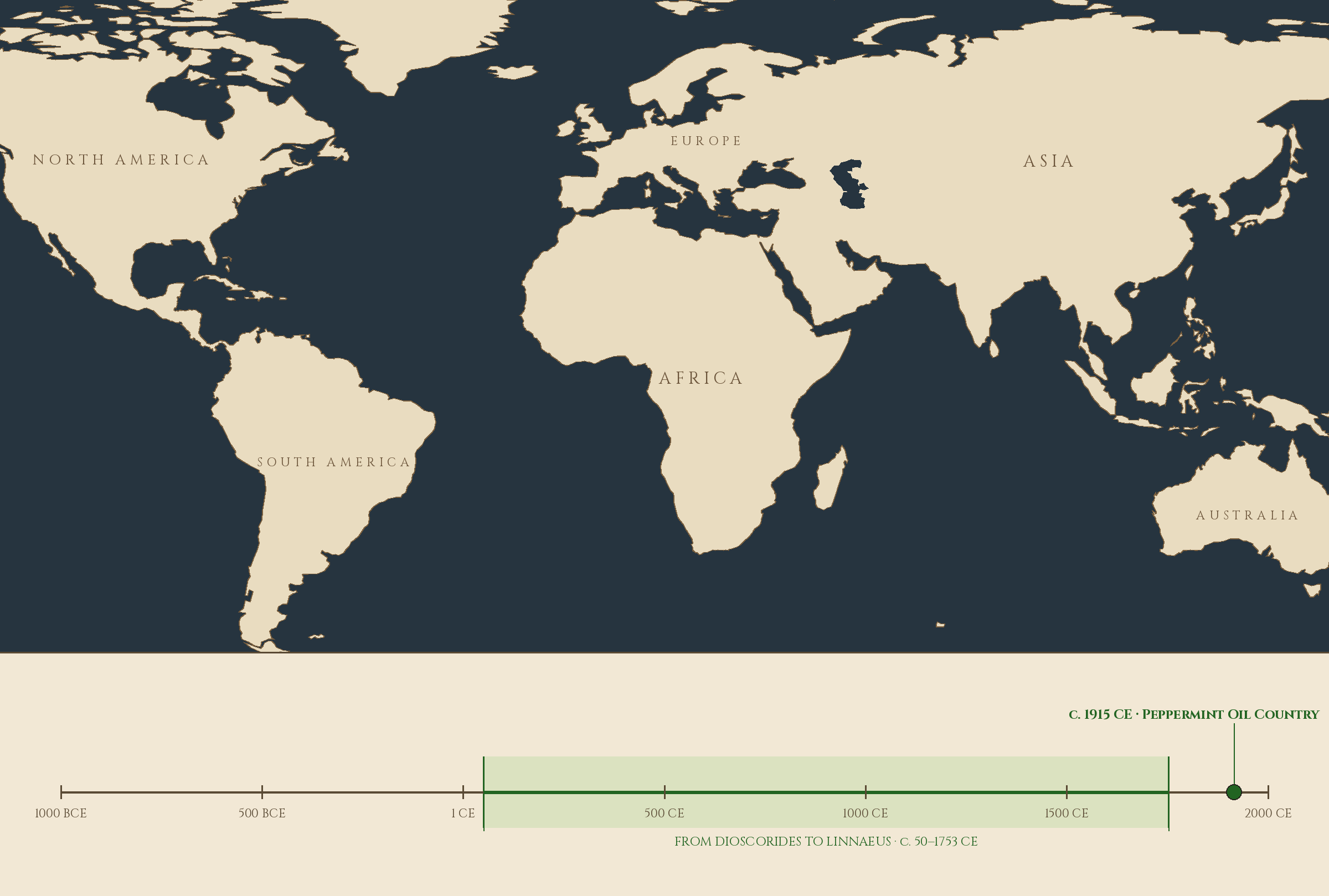
When: c. 1915 CE — Peppermint Oil Country. This lesson carries no pin of its own; its ground is nearer home. The line beneath the map is our road: every stop a place where the knowledge of plants changed, every lesson a step along it.
Lesson Objectives
By completing this lesson, you will be able to:
- Combine observation, classification, historical research, and safety assessment into one complete botanical profile.
- Produce a full archive entry for an unfamiliar plant, following the same structure professionals use.
- Evaluate your own work honestly with a self-assessment checklist.
- File your finished profile in your Scholar's Familiar Journal as the closing record of Unit I.
Reading this lesson: ★ marks the passages to remember. They return on the unit quiz and the class test. Check in questions ask the material back as you go; answer them in your workbook when you meet them.
Working this lesson: Your examination packet is the first download on this page. Work in it as the lesson moves along, working each part of the examination as its subject is taught — or read the lesson through for your notes and take the examination afterward. Both are proper ways to sit this class. Signposts in the reading tell you where each part of the examination belongs. Written answers are short answers in your own words; a few honest lines are worth more than a filled page.
Your Assignment Packet
This lesson's work lives in its examination packet: the Lexicon Handout (every term, course terms marked ◆), Materials, Guided Practice (the examination's four-part structure and the shape of the peppermint example, so you can plan your own profile before you begin), the Assignment Manual with the examination itself — its four parts and their checklists, printed as sheets you can work from — the Reflection Questions, which here are the examination's Overall Self-Assessment, and the Workbook Checklist. There is no answer key in this packet, and that is by design: this examination is self-assessed against its own checklists. Download the packet before you begin and keep it beside you as you read.
What Is a Threshold Examination?
Every unit of your Herbology studies ends at a threshold: a doorway you cross by showing, in one complete piece of work, everything the unit taught you. Unit I taught you four skills. They were presented separately so you could learn each one well. Now they come back together, because in real botanical work they are never separate. A botanist observing a new plant describes it, classifies it, researches its history, and checks its safety in one continuous act of attention.
★ Your examination has four parts:
- Observation and anatomical description. Look closely and record what is there, using the language of Lessons 1 through 3.
- Classification attempt. Place the plant in the great ordering system from Lesson 4, as far as your evidence allows.
- Historical and folklore research. Recover the plant's human story, as in Lesson 5, keeping documented history and tradition clearly apart.
- Safety assessment. Judge the plant's hazards with the seriousness of Lesson 6.
Check in: The four skills were taught separately, in Lessons 1 through 6. Why does real botanical work refuse to keep them separate?
★ The finished product is called a botanical profile: a complete, organized written record of one plant. Filed in your journal, it becomes an archive entry, the first of many you will build across this course. Future units will ask for more of these, on new plants, with new skills added each time. This first one is your foundation.
★ You will not be graded by anyone but yourself. The checklists at the end of each part are your examiners. Answer them honestly. An honest "not yet" is worth more than a hurried "done," because it tells you exactly where to grow next.
Check in: Why is an honest "not yet" worth more than a hurried "done" on this examination?
❦ In your workbook: record the threshold in your own way — what a threshold examination is, the four parts it asks of you, and what its finished product will be called — copy, sketch, or note what matters.
In your packet: The Unit I Threshold Examination ◐ begins here. Work it now, or mark the place and take it as homework — your choice.
A Worked Example: Peppermint
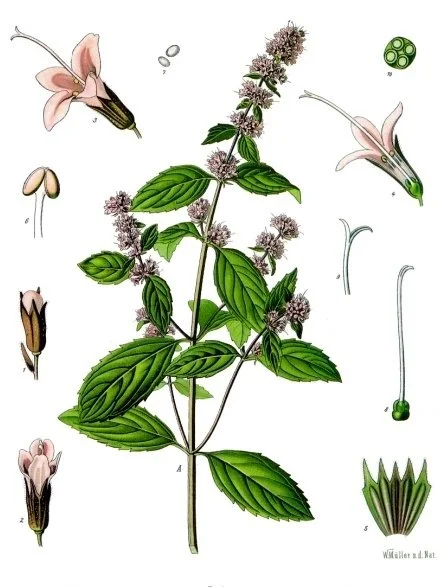
Peppermint (Mentha × piperita), the worked example. Opposite pairs of serrated leaves on an upright stem; dense spikes of small pink-to-purple flowers; and, drawn enlarged, one two-lipped mint flower. Fernfoot's sketch must show the square stem, one opposite leaf pair, and a flowering spike — all three are on this plate.
From Köhler's Medizinal-Pflanzen (Franz Eugen Köhler, 1887–1914). Public domain.
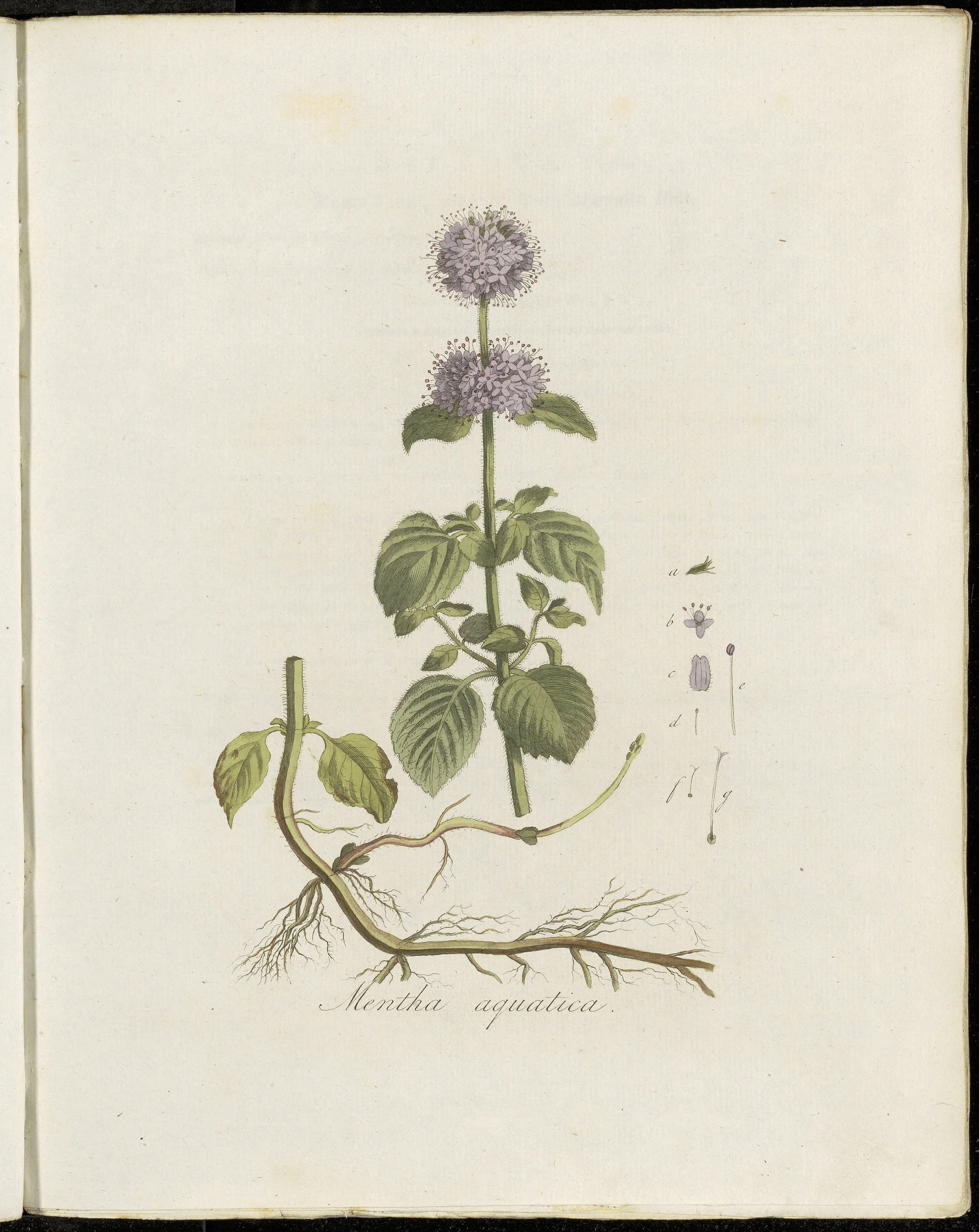
Water mint (Mentha aquatica), one of peppermint's two parents: rounded heads of lilac flowers — and, drawn below with its roots, the creeping underground stem that lets mints travel and gardeners despair. The × in Mentha × piperita records this parentage.
Flora Batava (Jan Kops and successors, 19th century), plate 165; drawn by Georgius Jacobus Johannes van Os. Public domain.
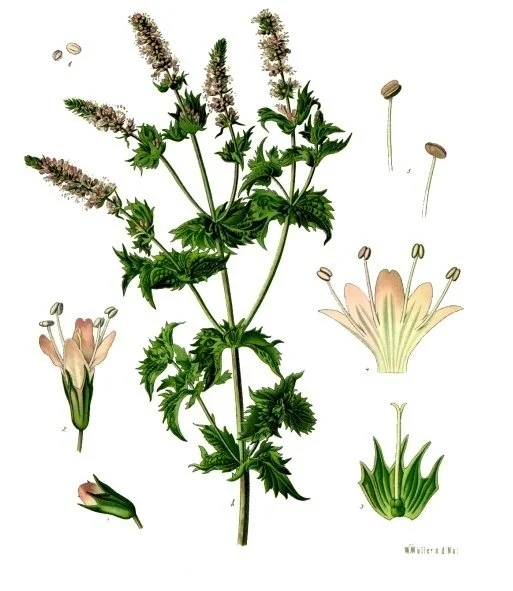
Spearmint (Mentha spicata), peppermint's other parent: slender spikes of small pinkish flowers and sharply toothed, stalkless leaves. Köhler drew it under its older name, Mentha viridis — the same plant wearing an earlier label, which is why a profile records the name it found and the name it uses.
From Köhler's Medizinal-Pflanzen (Franz Eugen Köhler, 1887–1914), as Mentha viridis. Public domain.
Before you examine your own plant, walk through a complete profile with me. I have chosen peppermint, a plant many of you already know by scent. Knowing the plant a little is an advantage here: it lets you concentrate on the method rather than struggling with a stranger. When it is your turn, you will choose a plant you have never profiled before.
Part 1: Observation and Anatomical Description
Begin with the whole plant, then move closer, the way you learned in Lessons 1 through 3. Record measurements. Sketch as you go. A profile without a sketch is like a map without landmarks.
Growth habit and size. Peppermint is an herbaceous perennial, growing upright to roughly 30 to 90 centimeters tall (about one to three feet). It forms spreading patches rather than single tidy clumps, because it travels underground.
Stems. The stems are square in cross-section. Roll one gently between your fingers and you will feel the four flat sides, a signature of the mint family. They range from green to purplish, branch freely in the upper part, and carry a light covering of fine hairs.
Leaves. The leaves grow in opposite pairs along the stem, one pair per node. Each leaf is simple (a single undivided blade), ovate to lanceolate in shape, about 4 to 9 centimeters long. The margins are sharply serrated, like a fine saw. The color is dark green, often with a purplish tinge, and the veins beneath carry slight hairs. Crush a leaf and the scent is immediate: strong, cool, unmistakably mint. Each leaf joins the stem by a short stalk, a petiole.
Roots and underground structures. Peppermint spreads by creeping underground rhizomes, horizontal stems that send up new shoots at intervals. This is why gardeners plant it in containers. Left alone in open soil, it will wander far beyond its welcome.
Flowers. In summer, the stem tips produce dense terminal spikes of small pink to purple flowers. Each tiny blossom follows the mint family pattern.
Sketch notes. A good peppermint sketch shows: the square stem (drawn with a slight edge to suggest it), one opposite leaf pair with serrated margins, and a flowering spike. Label each part.
❦ In your workbook: record the peppermint observation in your own way — the order Fernfoot works in, from the whole plant closer, and what her sketch must show — copy, sketch, or note what matters.
In your packet: The Unit I Threshold Examination ◐ — Part 1 — Observation and Anatomical Description ✎ begins here. Work it now, or mark the place and take it as homework — your choice.
Part 2: Classification Attempt
Now place the plant in the system from Lesson 4. Write the name correctly, even when you are only fairly confident. Correct form matters more than perfect certainty at this stage.
Scientific name: Mentha × piperita. Written in italics, genus capitalized, species in lowercase. The small × between the names is important: it marks peppermint as a hybrid, a natural cross between two parent species, water mint (Mentha aquatica) and spearmint (Mentha spicata). Hybrids occur in nature when closely related species grow side by side, and peppermint is one of the most successful examples.
Family: Lamiaceae, the mint family. Your evidence: square stems, opposite leaves, aromatic foliage, and small two-lipped flowers in spikes. When several family traits agree, your classification rests on solid ground.
Reasoning recorded: "Square stems plus opposite aromatic leaves place this plant in Lamiaceae. The hybrid symbol reflects its parentage, which I confirmed in two references."
★ Notice what I did not do: I did not guess beyond my evidence. If you cannot determine the species with confidence, write the genus and family, note the uncertainty, and explain what would settle it (flowers, fruit, an expert key). An honest partial classification outranks a confident wrong one.
Check in: Peppermint's family rests on several traits agreeing at once. Name the four pieces of evidence Fernfoot lists for Lamiaceae.
❦ In your workbook: record the classification attempt in your own way — the name in its correct form, the family, the evidence, and how an uncertainty is honestly recorded — copy, sketch, or note what matters.
In your packet: The Unit I Threshold Examination ◐ — Part 2 — Classification Attempt ✎ begins here. Work it now, or mark the place and take it as homework — your choice.
Part 3: Historical and Folklore Research
★ Every plant has traveled with people. Your task is to recover that journey from at least two sources, and to keep two categories strictly separate: what is documented, and what is tradition.
Documented history. Peppermint's oil has been distilled commercially on a large scale. In the early twentieth century, thousands of acres in New York, Indiana, and Michigan were planted with peppermint for oil distillation, and the oil went into flavoring for confectionery and similar preparations. Botanical writers of the period also warned that outside cultivation the plant is a troublesome weed, because its long underground runners continually push up new shoots where they are not wanted. Both facts come from published botanical sources, and both belong in the profile.
★ Tradition and household use. Mint as a group has flavored teas, foods, and drinks for a very long time, and peppermint's strong cooling scent made it a favorite for exactly those purposes. When you record traditional uses, phrase them as tradition: "long used to flavor teas and sweets," not as claims about what the plant does in the body. The history of belief about a plant is fascinating and worth recording. Presenting belief as fact is not.
Sources used. List every source you consulted, with enough detail that someone else could find it. A profile that cannot show its sources is a story, not a record.
Check in: In the peppermint profile, which facts are documented history, and which are recorded as tradition? What words keep the second kind honest?
❦ In your workbook: record the historical research in your own way — how documented history and tradition are kept apart, and why every source is listed in full — copy, sketch, or note what matters.
In your packet: The Unit I Threshold Examination ◐ — Part 3 — Historical and Folklore Research ✎ begins here. Work it now, or mark the place and take it as homework — your choice.
Part 4: Safety Assessment
Finish every profile the way Lesson 6 taught you: with a clear-eyed safety judgment.
★ Toxicity. Peppermint is not a baneful plant. It is a familiar culinary herb with a long history of ordinary kitchen use. That said, "not poisonous" is not the same as "handle without thinking." The concentrated essential oil is far stronger than the leaf and should be kept away from eyes and used only as its label directs. Wash your hands after handling any plant material, and keep plant matter away from young children who might taste it.
Look-alikes. In the garden, other mints resemble peppermint closely. That is a minor concern for a culinary herb, but the habit of checking matters: the same careful comparison that separates peppermint from spearmint will one day separate an edible plant from a dangerous one. Practice the habit on safe plants now.
Handling notes. No special protective equipment is needed for peppermint leaves. Standard practice applies: observe first, handle gently, wash hands after.
What I would tell a friend. "Peppermint is safe to grow and handle. Don't let it loose in a garden bed or it will take over. Keep the concentrated oil away from your eyes."
Check in: "Not poisonous" is not the same as "handle without thinking." What two cautions does Fernfoot still give for this familiar kitchen herb?
❦ In your workbook: record the safety assessment in your own way — toxicity, look-alikes, handling, and the plain-language summary a friend would hear — copy, sketch, or note what matters.
In your packet: The Unit I Threshold Examination ◐ — Part 4 — Safety Assessment begins here. Work it now, or mark the place and take it as homework — your choice.
Professor Fernfoot
Well. You have just watched a complete botanical profile being built, piece by piece, and nothing in it required genius. It required patience, honest recording, and the willingness to check rather than guess. Those are habits, not talents, which means they can be practiced.
One caution before your own examination begins. Choose a plant you have not profiled before, and choose one you can observe safely. A neighbor's garden with permission, a park specimen you do not pick, a houseplant on your own windowsill. You do not need rarity. You need a plant you can visit more than once, because good observation takes return visits.
Work the four parts in order. Do not skip the sketch. And when you reach the checklists, be the strict examiner you would want judging your work.
— Professor Beryl Fernfoot, Herbology Greenhouse • Master Herbalist • Head of House Oriens
Your Turn: The Examination
Choose your plant. Then work through the four parts exactly as demonstrated above, recording everything in your Scholar's Familiar Journal or on the examination sheets provided.
Part 1: Observation and anatomical description. Describe the whole plant first (growth habit, approximate size), then stems, leaves (shape, margin, arrangement, venation, surface, scent), roots or underground structures (only what you can observe without harming the plant), and flowers or fruit if present. Include measurements and a labeled sketch.
Part 2: Classification attempt. Write the scientific name in correct form, so far as you can determine it. Name the family and list the observed traits that support your placement. Record your reasoning and mark every uncertainty honestly.
Part 3: Historical and folklore research. Consult at least two sources. Separate documented history from tradition. List your sources fully.
Part 4: Safety assessment. Report what you found on toxicity, look-alikes, and handling precautions. Write the plain-language summary you would give a friend.
When all four parts are complete, work through the self-assessment checklists in the assignment packet. Then file the finished profile in your journal as your first full archive entry. It belongs near the front, where you will see it often. Future profiles will join it, and one day you will look back at this first one and smile at how far your eye has traveled.
❦ In your workbook: record your turn in your own way — the plant you have chosen, where you will observe it, and the order you will work the four parts in — copy, sketch, or note what matters.
Completing Your Archive Entry
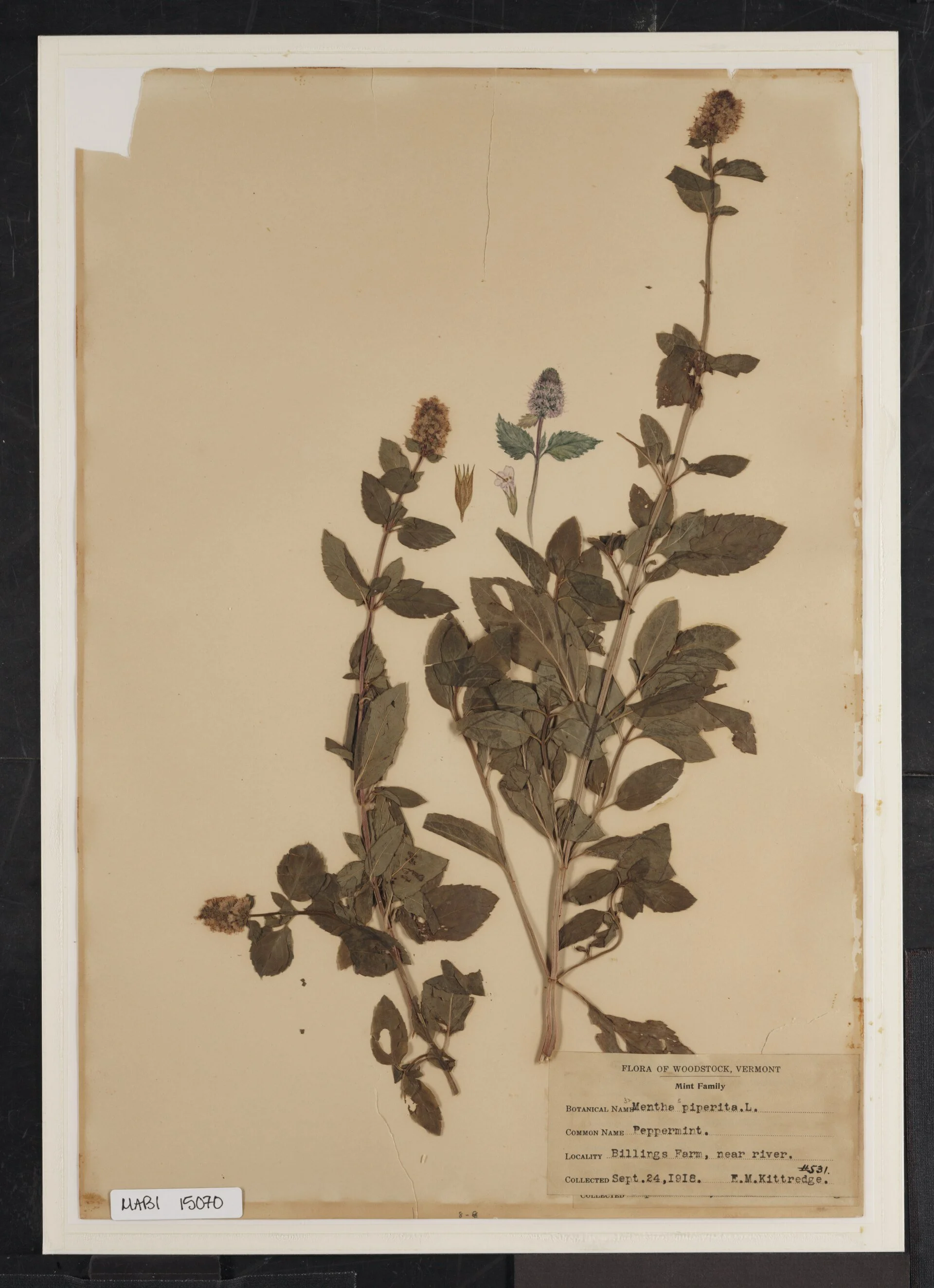
A real archive entry. Peppermint, pressed and filed at Woodstock, Vermont: the label gives the botanical name, the common name, the family, the place ("Billings Farm, near river"), the collector, and the date — September 24, 1918. Your Archive Entry 1 follows this same shape: name, description, classification, history, safety — dated, signed, and filed.
Peppermint specimen sheet, Billings-Kittredge Herbaria (collected by F. M. Kittredge, Woodstock, Vermont, 1918), photographed by the U.S. National Park Service. Public domain.
An archive entry is more than a pile of notes. Arrange your profile in this order: plant name (common and scientific), observation and description with sketch, classification with reasoning, history and folklore with sources, safety assessment with the plain-language summary. Date it. Sign it. Give it an entry number: this is Archive Entry 1.
★ Keep your language precise and your uncertainties visible. Cross out nothing; if you correct an observation, add a dated note explaining what changed and why. Real archives show their revisions. That is what makes them trustworthy.
❦ In your workbook: record the archive entry in your own way — the order its parts are filed in, and how a correction is honestly made — copy, sketch, or note what matters.
In your packet: The Unit I Threshold Examination ◐ — Filing Your Archive Entry begins here. Work it now, or mark the place and take it as homework — your choice.
Guided Observation: The Peppermint Profile, Walked Through Once More
Before you examine your own plant, walk through a complete profile with me. The worked example above is this lesson's guided practice: Fernfoot builds a whole botanical profile on peppermint, piece by piece, so that you can watch the method before the path is yours. Walk it once more with these questions beside you:
- In Part 1, what order does the observation work in — and what must the sketch show?
- In Part 2, what evidence carries the family, and how is the hybrid marked in the name?
- In Part 3, what separates the documented history from the tradition?
- In Part 4, what would you tell a friend?
Choose a plant you have not profiled before, and choose one you can observe safely. You do not need rarity. You need a plant you can visit more than once, because good observation takes return visits.
Materials
Required (Level One — household items)
- Your Scholar's Familiar Journal or a notebook
- Pencil and eraser
- A ruler or tape measure
- A magnifying glass if you have one
- Access to two reference sources (books, reputable websites, or a library)
Suggested (Level Two — historically closer)
- A bound blank book for your archive
- A hand lens (10× loupe)
- Plant identification field guides for your region
- Pressed specimen envelopes for keeping a dried leaf sample with your entry
Safety: Choose a plant you can observe without trespassing and without picking in protected areas. Do not taste any part of an unfamiliar plant. Wash your hands after handling plant material. If your plant proves to be a toxic species, complete the profile by observation only and note that clearly.
Reflection Questions
This examination's reflection is its Overall Self-Assessment: there are no separate questions to answer, because the examiner is you. Read your finished profile once through, slowly, as if someone else wrote it, and answer honestly:
- ☐ Every claim in the profile can be traced to an observation or a cited source.
- ☐ The sketch matches the written description.
- ☐ The language is precise throughout; vague words ("kind of," "sort of") have been replaced or removed.
- ☐ You can explain your classification reasoning aloud without reading it.
- ☐ You are honestly satisfied that each checklist above is complete. If any box is unchecked, return to that part before filing.
Workbook Checklist — Lesson 7
In my workbook I have:
- ☐ The four parts are arranged in order: description with sketch, classification, history with sources, safety assessment.
- ☐ The entry is dated, signed, and numbered as Archive Entry 1.
- ☐ Any corrections appear as dated notes, not erasures.
- ☐ The entry is filed at the front of your Scholar's Familiar Journal.
- ☐ Every claim in the profile can be traced to an observation or a cited source.
- ☐ The sketch matches the written description.
- ☐ The language is precise throughout; vague words ("kind of," "sort of") have been replaced or removed.
- ☐ You can explain your classification reasoning aloud without reading it.
- ☐ You are honestly satisfied that each checklist above is complete. If any box is unchecked, return to that part before filing.
☐ Lesson completed Date: ___ Signature: ___
Professor's Closing Note
You began this unit by choosing a single plant and learning to see it. You end it by taking an unfamiliar plant and making it known: described, classified, storied, and judged safe. That is the complete foundation of Herbology, and it is yours now.
Unit II will take you downward, into the soil, and outward, into light and season. Your eye is ready. Your journal is waiting. And your first archive entry stands at the front of it like a door you have already opened.
I am proud of the work you have done here. Walk gently into the next unit, scholars.
— Professor Beryl Fernfoot, Herbology Greenhouse • Master Herbalist • Head of House Oriens
PROFESSOR BERYL FERNFOOT
Herbology Greenhouse
Master Herbalist
Cross-Class Connections

Creative Arts · Unit II, Lesson 10 — The Field & Observation Kit
Set up, scholars, and bring your journal with you. My workshop assembles the field kit Fernfoot's scholars carry — the journal riding protected, the small finds riding separated, a collecting case in the spirit of the botanist's vasculum — and then we carry it on a real walk and fix what the walk complains about. Build the kit with me before your examination takes you outdoors, and your observations will arrive home as identifiable as you made them.
Creative Arts · Unit V, Lesson 21 — Building the Plant Press
Your Level Two materials ask for pressed specimen envelopes, and a dried leaf keeps honestly only if it was pressed honestly first. In my workshop we build the plant press itself, board by board, and prove it on plain paper before any plant goes near it. Come and build yours, patiently and square, and the leaf you file with Archive Entry 1 will keep its form for years.
Further Reading & Sources
- Montana State University Extension: Identifying Plants by Leaf Characteristics — a clear, practical guide to leaf shape, margin, and attachment for identification work. - Gardenish Plant Encyclopedia: Peppermint (Mentha × piperita) — a full botanical profile of our worked example, useful for comparing your own observations. - A Manual of Weeds: Peppermint (Ada E. Georgia, 1914) — a public-domain botanical description showing how professionals recorded plants a century ago. - Plant Identification Terminology: An Illustrated Glossary (PDF) — illustrated definitions of the morphological terms used in this unit. - LSU AgCenter: Leaf Key (PDF) — a dichotomous-style leaf key for practicing real identification technique. Browse the Herbology shelf in the school Library for readable editions of these works.
School of Evershade · Herbology Greenhouse · For personal educational use
Submit your work for this lesson using the form below.
THE UNIT I QUIZ
HERBOLOGY GREENHOUSE · UNIT I: MORPHOLOGY, TAXONOMY & THE ANCIENT LORE
Unit I is complete: you have chosen your Familiar, learned the architecture of leaves and roots, read a plant's two-part name, traced the herbarium's long history, and walked the Baneful Greenhouse with your eyes open. This quiz gathers the whole unit into one sitting. Take it from memory first, before you look back at your notes, because it measures what has stayed with you. If you completed the work marked ★ in your lesson packets, you have already practiced most of what it asks.
It stands beside this lesson's own Threshold Examination: the examination is one complete piece of work, the quiz is the unit remembered. Two different kinds of proof, both worth having.
The quiz packet is a single download. Part I gathers questions from across the unit, Part II matches the unit's vocabulary, and the answer key waits at the back for self-checking. When you have finished, score it honestly, note the result in your workbook, and revisit any lesson whose questions went wrong before you move on to Unit II.
Download the Unit I Quiz packet
One plant from this lesson stands in the Materia Botanica, the school's shared archive — kept with its lessons, its keepings, and its cautions.
Water mint The whole Materia BotanicaPROFESSOR BERYL FERNFOOT · HERBOLOGY GREENHOUSE
CONTINUE IN THE HERBOLOGY GREENHOUSE
← Previous · Lesson 6: The Baneful Greenhouse Next · Lesson 8: The Substrate Profile: Texture & Drainage →
Unit I — Morphology, Taxonomy & the Ancient Lore Herbology Greenhouse — All 37 Lessons
The rest of Unit I: Lesson 1 · Scholar's Familiar · Lesson 2 · Foliage & Stems · Lesson 3 · Root Vaults · Lesson 4 · Binomial Classification · Lesson 5 · Historian's Herbarium · Lesson 6 · Baneful Greenhouse
From the Greenhouse Shelf
The printed companions to this lesson, from Professor Fernfoot’s shelf in the shop.
Herbology — Familiar Journal Pages: Unit I Lesson Pages — Lessons 1–7 (22 Pages)
$4.99
View in the Shop