

HERBOLOGY
Unit I · Lesson 4THE BINOMIAL CLASSIFICATION MATRIX
PROFESSOR BERYL FERNFOOT
Herbology Greenhouse
Master Herbalist
UNIT I · LESSON 4
Morphology, Taxonomy & the Ancient Lore
Professor's Introduction

My dear scholars, settle in and breathe easy. Today we give our plants their proper names.
You have spent three lessons learning to look closely at leaves, stems, and roots. You have begun to see how much a plant can tell you before it ever speaks a word. But there is a moment in every naturalist's life when looking is not quite enough, and you must ask the oldest question in the greenhouse: what is your name?
Plants cannot answer, of course. So long ago, patient people invented a way to name them that the whole world could share. It is one of the kindest inventions in science, and by the end of this lesson it will belong to you as well.
Take your time with it. Latin is only a language, and languages are meant to be learned slowly, like gardens.
— Professor Beryl Fernfoot, Herbology Greenhouse • Master Herbalist • Head of House Oriens
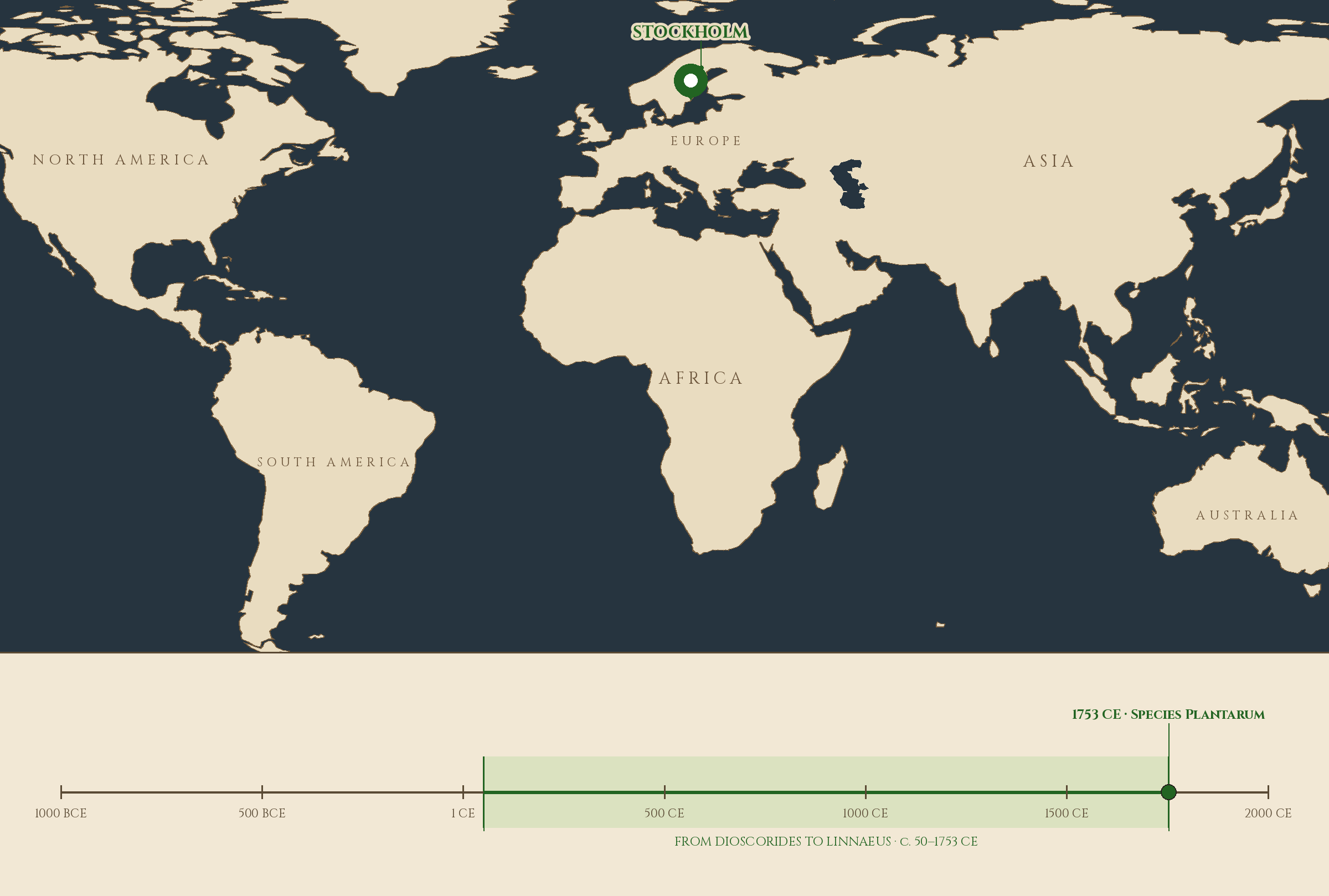
Where and when: Stockholm, 1753 CE — Species Plantarum. The pin is this lesson. The line beneath the map is our road: every stop a place where the knowledge of plants changed, every lesson a step along it.
Lesson Objectives
By the end of this lesson, you will be able to:
- Explain why common names are unreliable for identifying plants
- Describe the problem Carl Linnaeus solved with binomial nomenclature
- List the major ranks of the taxonomic hierarchy in order
- Read and write a scientific plant name correctly, including italics and capitalization
- Recognize the mint family (Lamiaceae) by its key traits
- Find and record the scientific name and family of your Scholar's Familiar
Reading this lesson: ★ marks the passages to remember. They return on the unit quiz and the class test. Check in questions ask the material back as you go; answer them in your workbook when you meet them.
Working this lesson: Your assignment packet is the first download on this page. Work in it as the lesson moves along, answering each exercise as its subject is taught — or read the lesson through for your notes and take the exercises as homework afterward. Both are proper ways to sit this class. Signposts in the reading tell you where each exercise belongs. Written answers are short answers in your own words; a few honest lines are worth more than a filled page.
Your Assignment Packet
This lesson's exercises live in its packet: the Lexicon Handout (every term, course terms marked ◆), Materials, Guided Practice, the Assignment Manual with its answer key for self-checking, the Reflection Questions, and the Workbook Checklist. Download the packet before you begin and keep it beside you as you read.
Why Names Matter
Imagine you are walking through a market in another country and someone offers you a bundle of fragrant leaves, calling them by a name you have never heard. You ask a fellow traveler what the plant is called, and they give you a completely different name. A third person shrugs and says both names are wrong. Whom do you believe?
★ This is not a puzzle I invented for the lesson. It is the daily reality of common names. The word bluebell means one flower in England, a different flower in Scotland, and yet another in Texas. The name cedar is given to trees on three continents that are not closely related to one another at all. Even the humble dandelion answers to dozens of folk names across Europe alone.
Common names are lovely. They carry history, poetry, and the voices of the people who coined them, and no one in this greenhouse will ask you to give them up. But they were never designed to be precise. A name that changes from village to village cannot serve as the foundation of a science, and botany needed a foundation.
So the scholars of Europe faced a question: how do we give every plant on Earth a name that means the same thing to everyone who reads it, in every country, for all time?
Check in: The word bluebell names three different flowers in three different places. In your own words, why can a name like that not serve as the foundation of a science?
❦ In your workbook: record why names matter in your own way — copy, sketch, or note what matters.
The Man Who Sorted the Garden
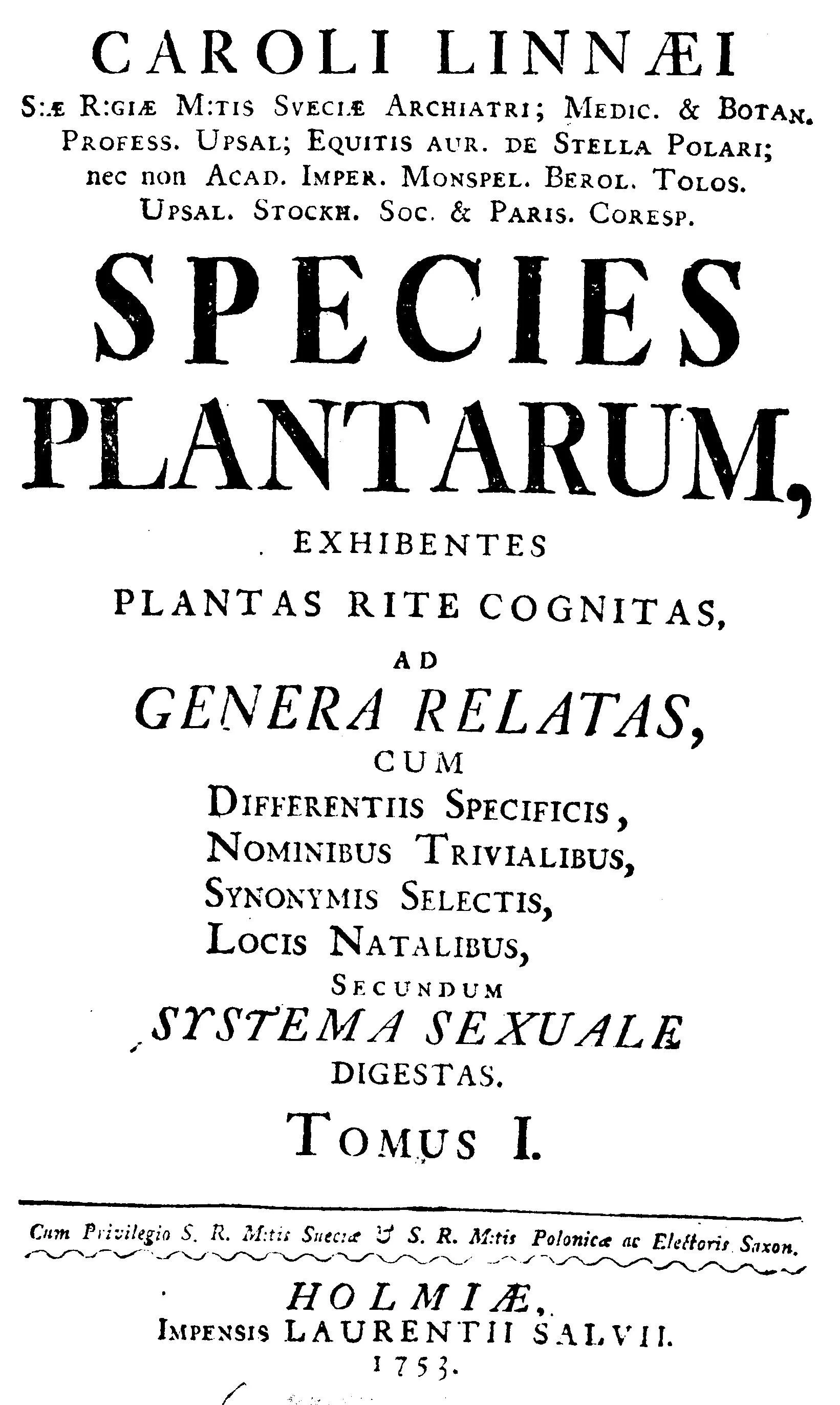
The book that renamed the plant kingdom: the title page of Species Plantarum, printed at Stockholm in 1753.
Carl Linnaeus, Species Plantarum, Tomus I, title page (Stockholm: Laurentius Salvius, 1753), scan via the Biodiversity Heritage Library. Public domain.
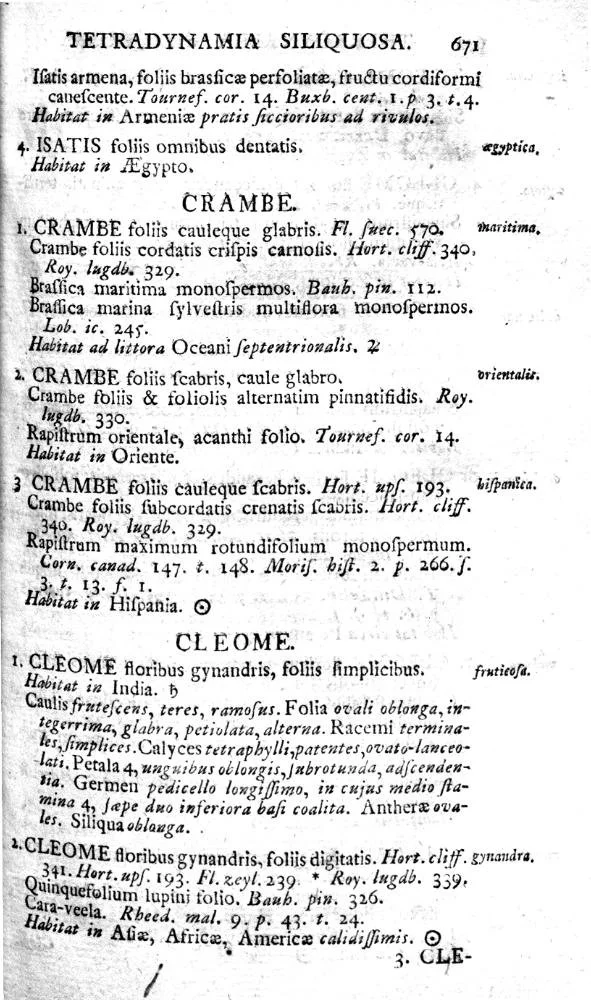
Inside the book, page 671: each plant stands under its genus, with its one-word trivial name in the margin — the binomial, at work — while the old sentence-long names are quoted beneath as synonyms.
Carl Linnaeus, Species Plantarum (1753), page 671, via Botanicus (Missouri Botanical Garden). Public domain.
The answer came from a Swedish botanist named Carl Linnaeus, who lived from 1707 to 1778. Linnaeus was the kind of person who sorted things the way other people breathe. As a young man he traveled through Lapland, the far north of Sweden, collecting and describing plants with a hunger that never really left him. He became a professor, then the most famous naturalist in Europe, and his students, whom he called his apostles, carried his methods to every continent.
Before Linnaeus, naming a plant meant writing a description. A plantain might be recorded under the name Plantago foliis ovato-lanceolatis pubescentibus, spica cylindrica, scapo tereti, which is Latin for "plantain with softly hairy oval-to-lance-shaped leaves, a cylindrical spike, and a rounded stalk." Every botanist wrote their own version of these long descriptive phrases, called polynomials, and no two lists quite agreed. Imagine trying to discuss hundreds of plants when each name is a full sentence, and your colleague in another country uses a different sentence for the same plant. Scholarship staggered under the weight of it.
★ Linnaeus had first tried a shorter system as a kind of shorthand in a student project about the plants eaten by cattle. Then, in 1753, he published a book called Species Plantarum, "The Species of Plants," printed in Stockholm in two volumes. In it he listed every plant species known at the time, organized into genera, and gave each one a name of just two words. The plantain with the long description above became simply Plantago media. Catnip, once Nepeta floribus interrupte spicatis pedunculatis, became Nepeta cataria. The two-word name, the binomial, did the work of the whole sentence.
Species Plantarum was the first work to apply this system consistently across the plant kingdom, and botanists still count the first of May 1753, its publication date, as the starting point for the naming of plants. Linnaeus had earlier published Systema Naturae in 1735, his great attempt at classifying all of nature, and its tenth edition in 1758 extended binomial naming to animals. But for plants, everything begins with Species Plantarum.
★ Latin had been the language of scholars for centuries before Linnaeus was born, so he did not invent Latin naming. His genius was the system: two words, consistent rules, the same name everywhere. That is what turned a tangle of descriptions into a matrix the whole world could share.
Check in: Before Linnaeus, what did recording a plant's name actually require of a botanist — and what single change did the binomial make to that work?
❦ In your workbook: record the man who sorted the garden in your own way — copy, sketch, or note what matters.
The Ranks of the Kingdom
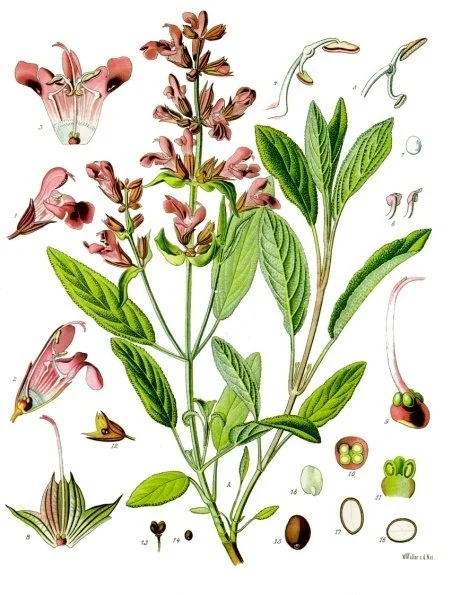
Garden sage, Salvia officinalis — the lesson's worked example, from kingdom to species: opposite leaves and two-lipped flowers, with the flower taken apart at the plate's edges.
Salvia officinalis, plate from Franz Eugen Köhler, Köhler's Medizinal-Pflanzen (1887–1914). Public domain.
Linnaeus organized living things into a hierarchy of ranks, like a set of nested boxes. Each plant belongs to a species, each species to a genus, each genus to a family, and so on upward. The full sequence, from largest to smallest, runs:
★ Kingdom, Phylum (botanists often say Division), Class, Order, Family, Genus, Species.
Generations of students have memorized this order with the sentence "King Philip Came Over For Good Soup," and you are welcome to borrow it. The greenhouse has heard it ten thousand times and never tires of it.
Let us walk down the ranks with a plant you already know. Take garden sage, the culinary herb:
- Kingdom: Plantae, the plants
- Division: Magnoliophyta, the flowering plants
- Class: Magnoliopsida, the dicotyledons
- Order: Lamiales
- Family: Lamiaceae, the mint family
- Genus: Salvia
- Species: Salvia officinalis
Notice how the boxes narrow as we descend. The kingdom holds every plant on Earth. The species holds only garden sage and its closest kin. By the time we reach the bottom, there is no room for confusion.
★ You will not need every rank every day. In practice, the working naturalist lives mostly among the last three: family, genus, species. The family tells you the plant's neighborhood. The genus tells you its street. The species knocks on the door.
Check in: Recite the ranks from largest to smallest without looking. Then say which three the working naturalist lives among — and what each of the three tells you.
❦ In your workbook: record the ranks of the kingdom in your own way — copy, sketch, or note what matters.
Professor's Mid-Lesson Note
You are doing beautifully. I can feel some of you tensing at the Latin, so let me loosen that knot.
Latin is not a wall. It is a bridge. When you learn that Mentha means mint and Salvia means sage, you have not memorized a dead language. You have learned two words that a gardener in Japan, a botanist in Brazil, and a hedgehog in Kansas all understand the same way. That is worth a little patience.
Say the names aloud if it helps. Roll them around like seeds in your palm. Salvia officinalis. Mentha spicata. There. You are already speaking the language of the greenhouse.
— Professor Beryl Fernfoot, Herbology Greenhouse • Master Herbalist • Head of House Oriens
How to Read and Write a Scientific Name
★ A scientific name has exactly two parts. The first is the genus, always capitalized. The second is the specific epithet, always lowercase. Together they name the species. In print, both words are italicized. When writing by hand, underline each word separately.
Salvia officinalis Mentha spicata Lavandula angustifolia
Read them slowly and the pattern holds every time: capital first word, small second word, slanting type or a careful underline beneath each.
★ A few more customs of the craft. The genus may be abbreviated to its first letter after it has been written in full once, so Salvia officinalis can become S. officinalis later in the same text. Sometimes you will see an author's name after the species, such as Salvia officinalis L., where the L. stands for Linnaeus himself, marking the botanist who first described it. And the specific epithet often carries meaning: officinalis marks plants with a long history of use in the workshop, vulgaris means common, spicata means spiked, describing the flower.
Common names mislead because they belong to places. Scientific names endure because they belong to everyone.
Check in: A name is written mentha Spicata. What two formatting errors does it carry — and what does each corrected rule tell the reader?
❦ In your workbook: record how to read and write a scientific name in your own way — copy, sketch, or note what matters.
Meeting a Family: The Lamiaceae
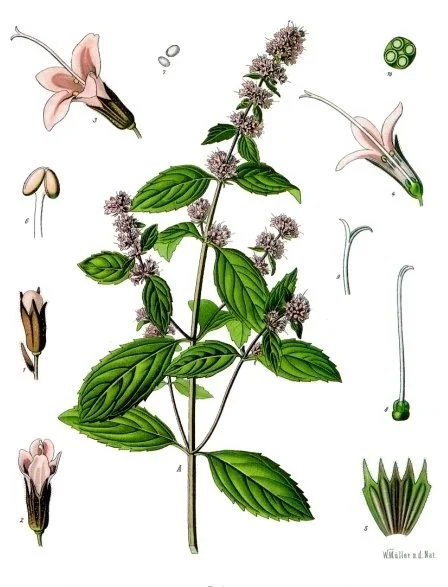
Peppermint, Mentha piperita: opposite leaves and whorls of small two-lipped flowers — the mint family's field marks on one plate.
Mentha × piperita, plate from Franz Eugen Köhler, Köhler's Medizinal-Pflanzen (1887–1914). Public domain.
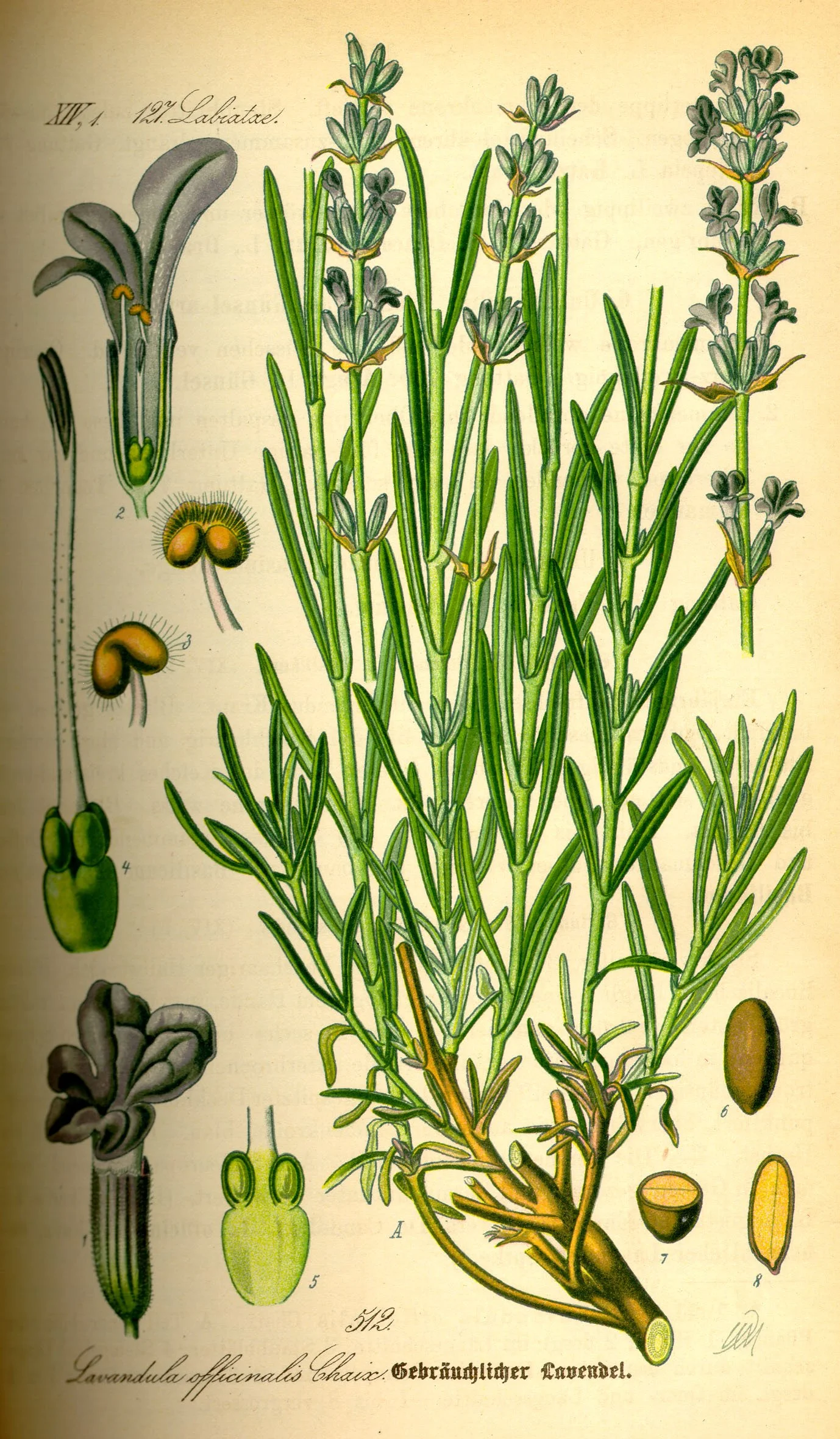
Lavender under its older papers: this plate heads the family "Labiatae" and names the plant Lavandula officinalis — the same lavender the lesson lists as Lavandula angustifolia. Names are revised as knowledge grows.
Lavender, plate 512 from Otto Wilhelm Thomé, Flora von Deutschland, Österreich und der Schweiz (1885). Public domain.
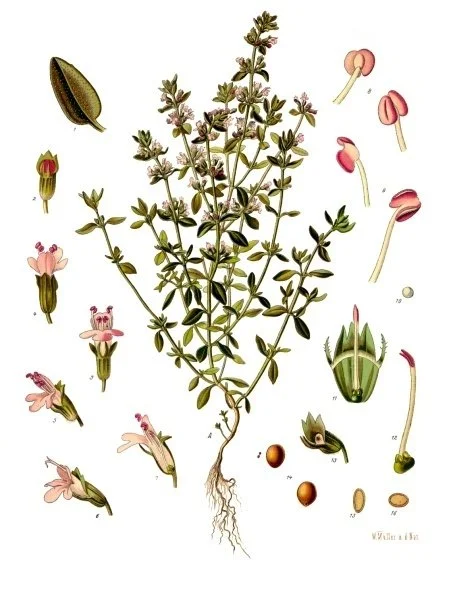
Common thyme, Thymus vulgaris: the whole plant, roots and all — small opposite leaves and two-lipped flowers, the family marks in miniature.
Thymus vulgaris, plate from Franz Eugen Köhler, Köhler's Medizinal-Pflanzen (1887–1914). Public domain.
Now we come to the part of the lesson I have been most looking forward to sharing, because it concerns a family you already know by smell.
Plant families group genera that share distinctive traits, and one of the finest families for a beginning botanist is the Lamiaceae, the mint family. Its older name, Labiatae, is still seen in old books, and it refers to the family's two-lipped, or labiate, flowers. Under either name, this is the family of nearly every culinary herb in your kitchen.
★ Learn its field marks and you will recognize it for the rest of your life. Members of the mint family usually have square stems: roll a stem between your fingers and feel the four corners. Their leaves grow in opposite pairs along the stem. Their flowers open into two lips, an upper and a lower, like a tiny mouth. And most are aromatic, carrying the volatile oils that make them so beloved in cooking.
Walk through the family and greet its members by their proper names:
- Basil, Ocimum basilicum
- Spearmint, Mentha spicata
- Peppermint, Mentha piperita
- Garden sage, Salvia officinalis
- Rosemary, Salvia rosmarinus (botanists moved it into the sage genus when they saw how closely related it truly is)
- Common thyme, Thymus vulgaris
- Lavender, Lavandula angustifolia
- Oregano, Origanum vulgare
- Lemon balm, Melissa officinalis
- Catnip, Nepeta cataria
★ Notice something wonderful: sage and rosemary share the genus Salvia, which tells you at a glance that they are closer kin than either is to mint. The names themselves carry the relationships. That is classification doing its quiet work.
★ The family holds around 7,000 species in more than 230 genera, and it keeps a few surprises. Teak, the great timber tree Tectona grandis, is a member of the mint family. So the same family gives us both the herbs in the kitchen garden and the wood of ships. Families are like that: wider than you expect, and full of character.
Other families you will meet as your studies deepen include the Asteraceae, the daisy family, with its composite flower heads; the Apiaceae, the carrot and parsley family, with its umbrella-like clusters; and the Rosaceae, the rose family, which gives us apples, strawberries, and roses themselves. Each has its own field marks, its own personality. But the Lamiaceae is where every young botanist should begin, because it is the family you can smell before you see.
Check in: You roll a kitchen herb's stem between your fingers and feel four corners, and its leaves stand in opposite pairs. Which family are you holding, and which two field marks have you still to test?
In your packet: Exercise III — Family Detective ◐ begins here. Work it now, or mark the place and take it as homework — your choice.
❦ In your workbook: record meeting the Lamiaceae in your own way — copy, sketch, or note what matters.
Why Classification Reflects Real Relationships
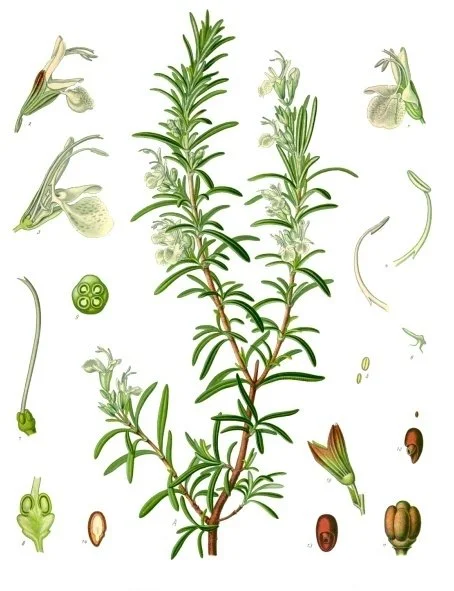
Rosemary as the old books knew it, Rosmarinus officinalis. Closer study nested it inside the sages, and its name is now Salvia rosmarinus — the names carry the relationships.
Rosmarinus officinalis (now Salvia rosmarinus), plate from Franz Eugen Köhler, Köhler's Medizinal-Pflanzen (1887–1914). Public domain.
Here is the deeper truth beneath the naming, and I want you to hold it gently, because it is one of the most beautiful ideas in botany.
Plants in the same family share traits because they are genuinely related. The square stems, opposite leaves, and two-lipped flowers of the mint family did not appear in each species by coincidence. They were inherited from shared ancestors, passed down and reshaped over long ages, the way grandchildren inherit a grandmother's eyes. When botanists group plants by their traits, they are tracing the lines of kinship.
★ This is why rosemary was moved into the genus Salvia. For centuries it sat in its own genus, Rosmarinus, because it looks so distinctive. But when botanists examined it more closely, comparing its flowers, its chemistry, and eventually its deepest inherited patterns, they found it nested within the sages. The name changed to reflect the relationship. Classification is not a set of labels pinned to a board. It is a living map of how plants are connected, and it is redrawn whenever we learn something truer.
You do not need the full story of how those relationships are uncovered. That belongs to later studies. For now, it is enough to know that every time you place a plant in its family, you are reading its history.
Check in: A friend insists rosemary cannot be a sage because it looks so different. Using this section, what evidence overruled the plant's appearance?
❦ In your workbook: record why classification reflects real relationships in your own way — copy, sketch, or note what matters.
Your Scholar's Familiar, Properly Named
It is time to give your Scholar's Familiar its proper name.
★ Using a plant identification resource, a field guide, or a reputable botanical reference, find the scientific name of your plant. Write it correctly: genus capitalized, specific epithet lowercase, both italicized in print or underlined separately by hand. Then trace its classification upward and record its family.
If your Familiar is a mint, a basil, or a rosemary, you will find yourself writing Lamiaceae, and I hope you feel the small thrill of recognizing an old friend by its family traits. If it belongs to another family, learn that family's field marks instead. Every family has them, and every one is worth knowing.
Record all of this in your grow ledger: the scientific name written correctly, the family, and one or two traits that confirm the placement. This entry becomes the title page of your plant's archive. Everything you have observed in Lessons 1 through 3 now stands under a name the whole world can read.
Check in: Your Familiar is the plant you chose in Lesson 1 and have observed through Lessons 1 to 3. Before you look its name up: which family do you expect it to land in, and which of its traits are you predicting from?
In your packet: Exercise II — Name Your Familiar ◐ begins here. Work it now, or mark the place and take it as homework — your choice.
❦ In your workbook: record your Familiar's proper name in your own way — copy, sketch, or note what matters.
Guided Observation: Reading the Matrix on a Living Plant
Before the exercises, walk the matrix once with your hands, on plants you can touch and names you can say aloud.
You will need:
- garden sage or another culinary herb, living or freshly cut (the lesson's worked example)
- one or two more kitchen herbs, whatever is at hand
- your grow ledger and a pencil
- a plant identification resource, field guide, or reputable botanical reference
Walk down the ranks. Take garden sage, the culinary herb, and descend its boxes one at a time, saying each rank and its name aloud: Kingdom Plantae, Division Magnoliophyta, Class Magnoliopsida, Order Lamiales, Family Lamiaceae, Genus Salvia, Species Salvia officinalis. Notice how the boxes narrow as you descend, until the species holds only garden sage and its closest kin.
Read the names. Read the lesson's three printed names slowly — Salvia officinalis, Mentha spicata, Lavandula angustifolia — and check each against the pattern: capital first word, small second word, slanting type in print. Then write Salvia officinalis by hand, underlining each word separately, and write it once more abbreviated: S. officinalis.
Test the family marks. Take a kitchen herb and roll its stem between your fingers to feel for the square shape. Check whether the leaves grow in opposite pairs along the stem. Crush a small leaf and test for aroma. If a flower is present, look for the two lips, an upper and a lower, like a tiny mouth.
Consider:
- At which rank does the narrowing leave no room for confusion — and what does that rank hold?
- What does the shared genus of sage and rosemary tell you at a glance?
- Which of the mint family's field marks could you test on a dried herb, and which need the living plant?
- Why does a name that belongs to everyone outlast a name that belongs to a place?
Materials
Required (Level One — household items)
- Paper and pencil: for writing scientific names and recording observations.
- Kitchen herbs: basil, mint, oregano, or whatever is at hand for the family detective exercise.
- A plant identification resource: a field guide, library book, or reputable botanical website.
Suggested (Level Two — historically closer)
- A bound ledger: for your grow journal, with a pen for underlining scientific names by hand.
- A hand lens: for examining flower structure in the family detective exercise.
- A regional field guide: a printed botanical reference for identifying your Scholar's Familiar.
- *Pressed specimens for your archive, and a copy of Species Plantarum descriptions from a library facsimile for comparison.*
Reflection Questions
Answer the following questions in your workbook.
- Why can two people in different countries use the same common name for different plants, and what problem does this create for science?
- What was cumbersome about polynomial names, and what did Linnaeus replace them with?
- Recite the taxonomic ranks from largest to smallest. Which three do working naturalists use most?
- Write the scientific name of garden sage correctly. What does each rule of formatting (capitalization, italics) tell the reader?
- A friend insists that rosemary cannot be a sage because it looks so different. How would you explain its reclassification?
- Why is the mint family a good starting family for a beginning botanist?
Workbook Checklist — Lesson 4
In my workbook I have:
- ☐ explained why common names are unreliable for identifying plants
- ☐ described the problem Linnaeus solved, and what the binomial replaced
- ☐ listed the taxonomic ranks in order, from largest to smallest
- ☐ written a scientific name correctly: genus capitalized, specific epithet lowercase, both italicized or underlined separately by hand
- ☐ recognized the mint family (Lamiaceae) by its square stems, opposite leaves, two-lipped flowers, and aroma
- ☐ found and recorded the scientific name and family of my Scholar's Familiar in my grow ledger
- ☐ examined three culinary herbs and recorded which family traits each one shows
☐ Lesson completed Date: ___ Signature: ___
The Professor's Closing Note
Look at what you have built, scholars. Four lessons ago you chose a plant. Then you learned its leaves, its stems, its roots. Today you gave it a name that would be understood in every greenhouse on Earth.
That is no small thing. Naming is the first act of knowing, and you have performed it properly.
Keep your ledger close. In the lessons ahead we will learn what can harm a plant and how to keep it safe, and every note you take will rest upon the foundation you laid today: careful observation, honest naming, and patience.
The greenhouse is proud of you. I am proud of you.
— Professor Beryl Fernfoot, Herbology Greenhouse • Master Herbalist • Head of House Oriens
Cross-Class Connections

Potions · Unit II, Lesson 10 — The Surface Matrix Compilation
You have learned the two-word name in Fernfoot's greenhouse; come and watch it earn its keep at my bench. In the Surface Matrix we record the Latin binomial of every simple as the archive's universal index key, because that is the name that lets one apothecary's ledger speak to every other archive in the world. Look it up; do not guess — and bring your naming hand with you.

Creative Arts · Unit V, Lesson 21 — Building the Plant Press
Linnaeus sorted more than names, scholars. In my workshop you will hear how he gave the herbarium its standard: one specimen on one sheet, every sheet one size, filed in cabinets by relationship, so a collection can grow without losing its order. When your properly named plants are ready to keep, come to the Workshop and we will build the press that holds them flat and honest. Build it true, and it will outlast us all.
Further Reading & Sources
- Species Plantarum — Wikipedia: the publication history and importance of Linnaeus's 1753 work, including the famous polynomial examples. - Carl Linnaeus — Encyclopaedia Britannica: a concise biography of Linnaeus, his travels, and his system. - Lamiaceae — Wikipedia: the mint family's traits, genera, and the surprising membership of teak. - All About Scientific Names — Iowa State University Extension: how a scientific name is built from genus and specific epithet, why the binomial ends the confusion of common names, and how to write one correctly. - Plant Nomenclature — Missouri Botanical Garden: a clear guide to reading and writing scientific names from one of the world's great botanical institutions. Browse the Herbology shelf in the school Library for readable editions of these works.
Plants from this lesson stand in the Materia Botanica, the school's shared archive — each kept with its lessons, its keepings, and its cautions. This lesson's company:
Lemon balmPeppermintRoseRosemarySage The whole Materia BotanicaPROFESSOR BERYL FERNFOOT · HERBOLOGY GREENHOUSE
Submit your work for this lesson using the form below.
CONTINUE IN THE HERBOLOGY GREENHOUSE
← Previous · Lesson 3: Anatomical Architecture: Root Vaults Next · Lesson 5: The Historian's Herbarium →
Unit I — Morphology, Taxonomy & the Ancient Lore Herbology Greenhouse — All 37 Lessons
The rest of Unit I: Lesson 1 · Scholar's Familiar · Lesson 2 · Foliage & Stems · Lesson 3 · Root Vaults · Lesson 5 · Historian's Herbarium · Lesson 6 · Baneful Greenhouse · Lesson 7 · Threshold Examination