

HERBOLOGY
Unit II · Lesson 10THE NITROGEN, PHOSPHORUS & POTASSIUM MATRIX
PROFESSOR BERYL FERNFOOT
Herbology Greenhouse
Master Herbalist
Plants require nutrients just as people do. This lesson introduces the three great macronutrients, how to read a fertilizer label, and how to recognize when a plant is asking for more, or warning you it has had too much.
Professor's Introduction

Come in out of the weather, gardeners.
In our last lessons we studied the soil your familiar sits in and the measure of its acidity. Today we turn to a quieter question, one the soil answers in its own slow language: what is your plant eating?
It is easy to think of soil as simply the stuff that holds a plant upright. But soil is a pantry. And like any pantry, it can be well stocked, nearly bare, or so overfilled that nothing in it can be reached. The gardener's work is to learn what the pantry holds and what the plant needs from it.
Three nutrients matter more than all the rest. Gardeners call them the big three, and by the end of this lesson you will know them the way you know old friends: nitrogen, phosphorus, and potassium. You will know what each one does, how to read the three numbers on a fertilizer bag, and how to recognize the signs when one of them is running low.
There is no hurry here. Nutrients work slowly, and so shall we.
— Professor Beryl Fernfoot, Herbology Greenhouse • Master Herbalist • Head of House Oriens
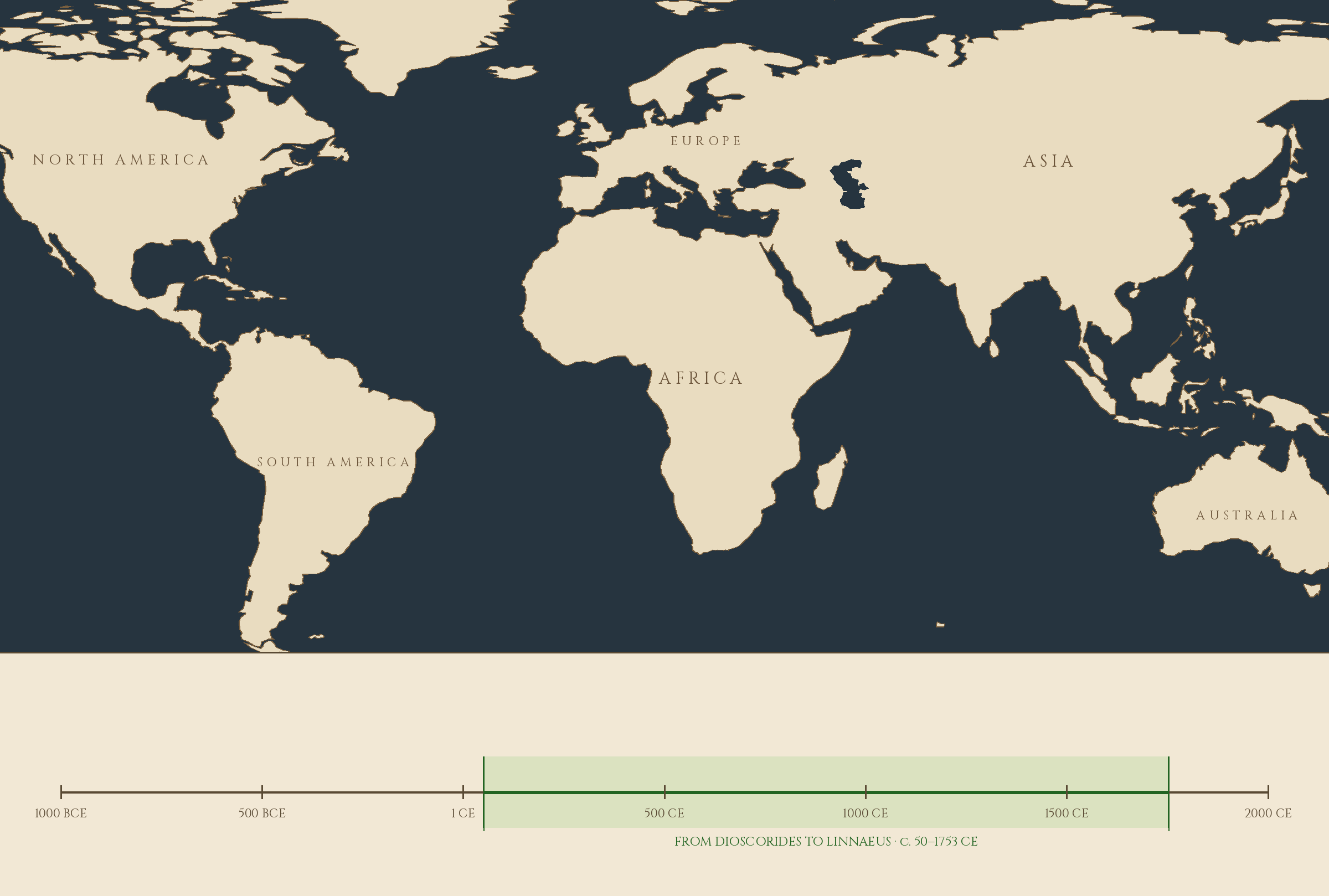
The line beneath the map is our road: every stop a place where the knowledge of plants changed, every lesson a step along it.
Lesson Objectives
By the end of this lesson, you will be able to:
- Describe the roles of nitrogen, phosphorus, and potassium in plant growth
- Read and interpret the three numbers on a fertilizer label
- Recognize the common visible signs of N, P, and K deficiency, and explain why they appear on older leaves first
- Explain why more fertilizer is not better, and what fertilizer burn is
- Assess your Scholar's Familiar for nutrient needs and write a conservative feeding plan
Reading this lesson: ★ marks the passages to remember. They return on the unit quiz and the class test. Check in questions ask the material back as you go; answer them in your workbook when you meet them.
Working this lesson: Your assignment packet is the first download on this page. Work in it as the lesson moves along, answering each exercise as its subject is taught — or read the lesson through for your notes and take the exercises as homework afterward. Both are proper ways to sit this class. Signposts in the reading tell you where each exercise belongs. Written answers are short answers in your own words; a few honest lines are worth more than a filled page.
Your Assignment Packet
This lesson's exercises live in its packet: the Lexicon Handout (every term, course terms marked ◆), Materials, Guided Practice, the Assignment Manual with its answer key for self-checking, the Reflection Questions, and the Workbook Checklist. Download the packet before you begin and keep it beside you as you read.
What Plants Eat

Justus von Liebig (1803–1873), the German chemist whose mineral theory of plant nutrition founded the science this lesson teaches: plants need particular minerals from the soil, in particular proportions — among them the big three, nitrogen, phosphorus, and potassium. His law of the minimum closes this lesson; his portrait (by Wilhelm Trautschold, 1845) opens it.
Wilhelm Trautschold (1815–1877), oil portrait of Justus von Liebig, 1845; via the Wellcome collection record on the Commons file page. Public domain.
A plant builds itself from air, water, and sunlight, but it cannot build itself from those alone. It also needs minerals drawn from the soil, and it needs them in particular proportions. Scientists have identified seventeen elements that plants require to complete their life cycles. Of these, three are needed in the largest quantities, and they are the subject of this lesson.
★ These three are called macronutrients: nitrogen, phosphorus, and potassium. The remaining elements are needed in smaller amounts. Some, like calcium, magnesium, and sulfur, are called secondary nutrients. Others, like iron, manganese, zinc, and boron, are called micronutrients, needed only in tiny traces. A trace does not mean unimportant. A plant without iron cannot make chlorophyll, no matter how much nitrogen surrounds it. But the big three are where the gardener begins, because they are the nutrients most often in short supply, and the ones most fertilizers are built around.
Think of it the way you might think of your own meals. You need protein, carbohydrates, and fats in quantity, and vitamins in traces. Neglect any of them and your body tells you. Plants are the same, except that they tell you in leaves.
A plant cannot walk to the kitchen when it is hungry. It must wait for the gardener to notice. Learning to notice is what this lesson is for.
Check in: Name the big three. Then say why a trace nutrient is not an unimportant one — which element does the lesson use to prove it, and what can the plant not make without it?
❦ In your workbook: record what plants eat in your own way — the seventeen elements, the big three, and the traces that still matter — copy, sketch, or note what matters.
Nitrogen: The Green Builder
Nitrogen is the nutrient of green, leafy growth. It is a core component of chlorophyll, the pigment that captures sunlight, and of the proteins and enzymes that carry out nearly every process inside the plant. When nitrogen is plentiful, leaves are deep green, stems are sturdy, and new growth comes quickly.
This is why lawn fertilizers are heavy in nitrogen. A lawn is almost entirely leaves, and leaves are what nitrogen builds. For leafy herbs like basil and mint, steady nitrogen keeps the foliage lush and productive.
Nitrogen is also the most easily lost of the three. In the soil it often exists as nitrate, which dissolves readily in water and washes downward with rain or heavy watering, out of the roots' reach. A plant in a container, watered regularly, can lose nitrogen faster than a plant in garden soil. This is one reason potted plants eventually need feeding even when they started in rich mix.
★ When nitrogen runs short, the plant shows it plainly. Growth slows. The whole plant looks pale. And because nitrogen is a mobile nutrient, one the plant can relocate from old tissue to new, the yellowing appears first on the older, lower leaves. The plant is quietly dismantling its past to fund its future. That image is worth holding onto, because it explains the pattern of nearly every deficiency in this lesson.
Check in: A plant's oldest, lowest leaves are yellowing while its new growth stays green. What is the plant doing with its nitrogen, and why does the yellowing start where it starts?
❦ In your workbook: record nitrogen the green builder in your own way — what it builds, how it is lost, and how its shortage shows — copy, sketch, or note what matters.
Phosphorus: The Root and Bloom Worker
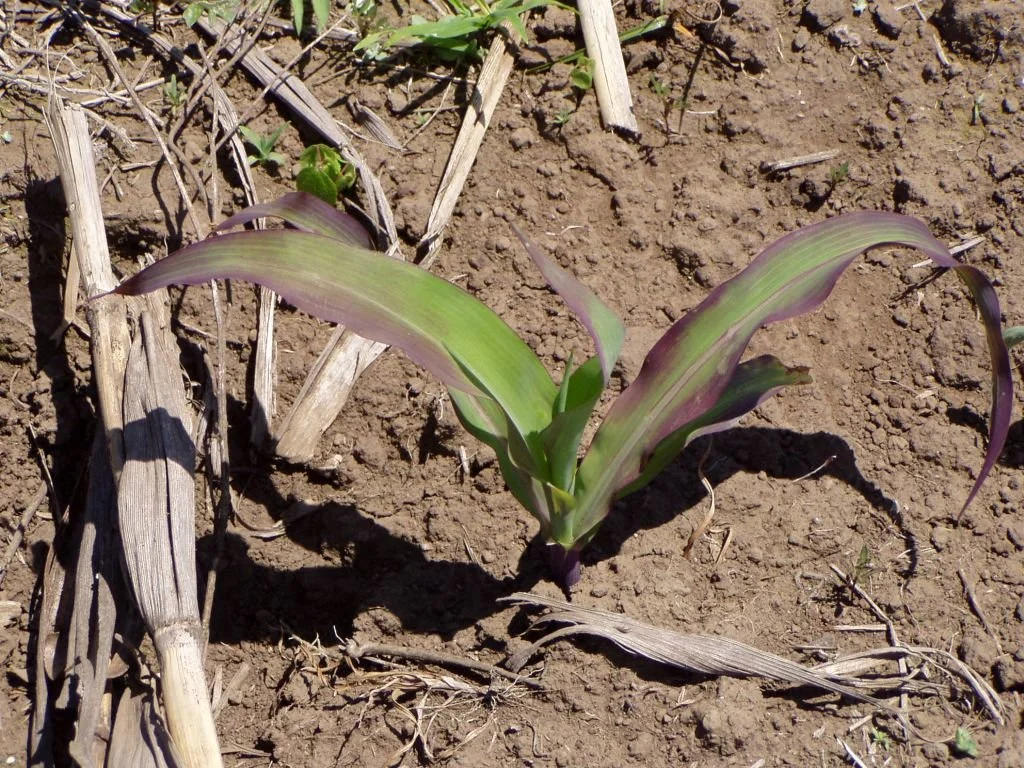
Phosphorus shortage, showing itself the way this lesson says it does: a maize seedling whose older leaves carry purplish tints while the newest growth stays green — phosphorus is mobile, so the plant moves it to new growth and the old leaves report the shortage first. The file record adds the careful-diagnosis lesson in one line: this field had received phosphorus fertilizer, but in its acid soil the roots could not take the nutrient up. Presence is not availability.
Photograph by Alandmanson, Hlokozi, KwaZulu-Natal, South Africa. CC0.
If nitrogen builds the green you can see, phosphorus builds much of what you cannot. It is essential for root development, for the transfer of energy within the plant's cells, and for flowering and fruiting. Young plants establishing their root systems and mature plants setting buds and blooms both draw heavily on phosphorus.
Gardeners have long associated phosphorus with the underground and the reproductive parts of the plant: strong roots, abundant flowers, ripening fruit and seed. Bone meal, one of the oldest phosphorus fertilizers, was traditionally added at planting time to encourage roots to take hold.
Phosphorus behaves very differently from nitrogen in the soil. It does not wash away easily. It tends to stay where it is placed, binding to soil particles, which means it must be positioned where roots can actually reach it. In established soil it is rarely the first nutrient to run short, but in new potting mixes or heavily cropped ground it can be.
★ A phosphorus shortage shows itself in stunted growth and in leaves that turn unusually dark green, sometimes with purplish or reddish tints, particularly on the undersides and stems. Like nitrogen, phosphorus is mobile in the plant, so these signs appear on older leaves first. The plant may also simply seem stuck, growing slowly while its neighbors move ahead.
Check in: How does a phosphorus shortage look different from a nitrogen shortage — and where on the plant do both appear first, and why?
❦ In your workbook: record phosphorus the root and bloom worker in your own way — its underground work, how it stays in the soil, and how its shortage shows — copy, sketch, or note what matters.
Potassium: The Quiet Guardian
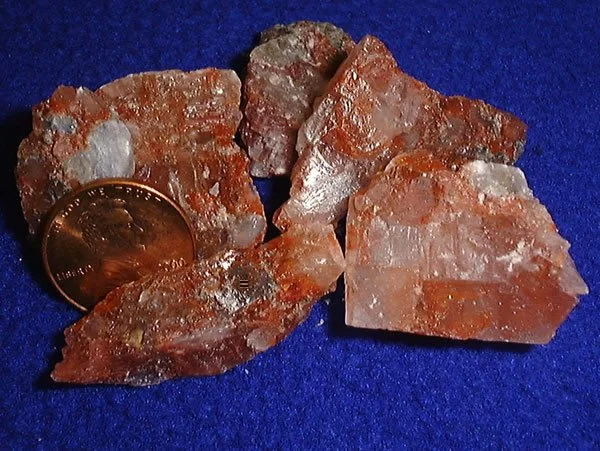
Potash — for identification. Chunks of the potassium-bearing mineral from which the third number's nutrient is drawn, with a penny for scale. The fertilizer trade's word "potash" is the one printed in the guaranteed analysis: a bag's last number gives potassium expressed as potash, by long-standing convention. Potassium itself does the quiet work: leaf pores, cell walls, disease resistance, composure under stress.
U.S. Geological Survey photograph (via the House Resources Committee USGS photo gallery record on the Commons file page). Public domain (U.S. federal work).
Potassium does not build tissue the way nitrogen does, nor does it drive flowering the way phosphorus does. Its work is quieter and harder to see, but no less vital. Potassium regulates the opening and closing of the tiny pores in leaves through which water escapes, helping the plant manage drought. It strengthens cell walls, supports disease resistance, and contributes to overall vigor: the general sturdiness and resilience of the plant.
Think of potassium as the nutrient of composure. A well supplied plant stands up to dry spells, resists infection more effectively, and weathers stress with less damage. Gardeners sometimes call it the quality nutrient, because it improves the hardiness of the whole plant rather than pushing any single kind of growth.
★ Potassium is mobile in the plant, like the other two. When it runs short, the older leaves show it first, typically as yellowing along the leaf margins that progresses to browning, giving the edges a scorched look. This marginal scorch is the classic signature of potassium shortage, though drought stress can produce a similar appearance, which is why careful diagnosis matters.
Check in: What is the classic signature of potassium shortage — and what other trouble can produce a similar appearance, so that you must diagnose carefully?
Three nutrients, three kinds of work: nitrogen builds the green, phosphorus builds the roots and blooms, potassium guards the whole. Remember them this way and you will rarely go wrong.
❦ In your workbook: record potassium the quiet guardian in your own way — its quiet work of composure, and the scorched margin that betrays its shortage — copy, sketch, or note what matters.
Reading the Three Numbers
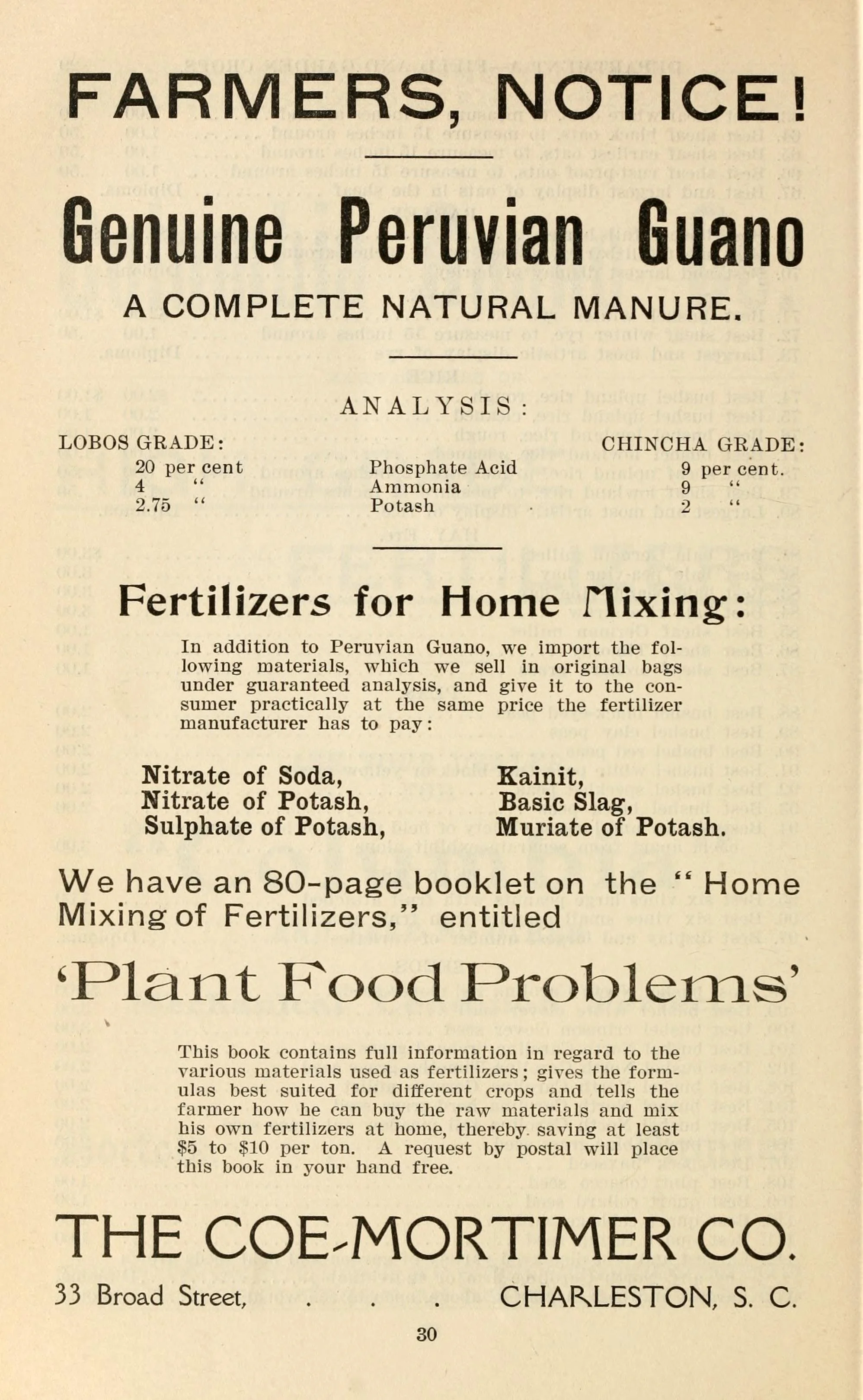
The three numbers, in 1907 dress. This genuine advertisement prints an "ANALYSIS" for its guano — phosphate acid, ammonia, and potash, in percents — and sells its other materials "under guaranteed analysis," the same promise your modern bag keeps in N–P–K order. Read it against the lesson: the nutrients are the big three, but the names and the order are the trade's older ones (ammonia for the nitrogen, phosphate acid for the phosphorus), and a grade's percents are its strength, not its ratio alone. Guano itself is the organic path in period form: a once-living material, sold as "a complete natural manure.
The Coe-Mortimer Co., Charleston, S.C.; advertisement in the List of Premiums and Rules and Regulations of the North Carolina State Fair, 1907, p. 30. Public domain.
Walk into any garden center and you will see bags printed with three numbers separated by dashes: 10-10-10, 5-10-5, 24-8-16. This is the fertilizer's guaranteed analysis, and learning to read it is one of the most practical skills in this course.
★ The three numbers always appear in the same order: nitrogen, phosphorus, potassium. A bag labeled 10-10-10 contains 10 percent nitrogen, 10 percent phosphorus expressed as phosphate, and 10 percent potassium expressed as potash, by weight. The remaining 70 percent is carrier material: the compounds holding the nutrients, conditioners, and inert ingredients that help the fertilizer spread evenly.
There is a subtlety worth knowing, and I will keep it simple. Only the nitrogen number describes the pure element. The phosphorus and potassium numbers are expressed as their oxide forms, phosphate and potash, by long standing convention in the fertilizer trade. You do not need to convert anything. You only need to know that a 10 in the middle position and a 10 in the last position do not mean equal amounts of elemental phosphorus and potassium. For comparing bags on the shelf, the numbers work exactly as printed.
★ What matters for choosing is the ratio, the relationship between the three numbers. A 10-10-10 fertilizer has a 1-1-1 ratio: equal parts of each. It is called a balanced fertilizer, and it is a reasonable general choice when you do not know what is missing. A 24-8-16 fertilizer has a 3-1-2 ratio: three times as much nitrogen as phosphorus, twice as much nitrogen as potassium. That is a leaf grower's formula, suited to lawns and leafy herbs. A 5-10-10 fertilizer, with its emphasis on the last two numbers, suits flowering and fruiting plants.
Check in: A bag reads 24-8-16. Reduce it to its ratio, and say what kind of growing it suits. Then say what a 10-10-10 bag is called, and when it is a reasonable choice.
★ Notice that 20-20-20 and 10-10-10 share the same 1-1-1 ratio. The difference is concentration. The 20-20-20 bag holds twice the nutrients per pound, so you would use half as much. A bigger number is not a better fertilizer. It is simply a stronger one, and stronger demands more care.
❦ In your workbook: record the three numbers in your own way — their order, what each percentage really describes, and the difference between ratio and concentration — copy, sketch, or note what matters.
In your packet: Exercise I — Read Three Labels ✎ begins here. Work it now, or mark the place and take it as homework — your choice.
When Something Is Missing
Plants cannot speak, but they can show. The visible signs of nutrient shortage are called deficiency symptoms, and learning to read them is a core skill of the observant gardener. Here is the honest truth about them, which I want you to carry through the rest of the course: deficiency symptoms overlap with each other, and they overlap with the signs of overwatering, underwatering, pests, disease, and plain old aging. Diagnosis takes care. Never rush it.
★ The single most useful rule is the mobility rule. Nitrogen, phosphorus, and potassium are all mobile nutrients, which means the plant can move them from old leaves to new growth when supplies run short. So their deficiency symptoms appear on the older, lower leaves first. If the yellowing is on the new growth at the tips, you are likely looking at something else entirely, perhaps an immobile nutrient like iron or calcium, or perhaps a watering problem.
Check in: The yellowing on a plant is on the new growth at its tips, not the older leaves. By the mobility rule, what are you likely looking at instead of an N, P, or K shortage?
With that rule in hand, here are the classic patterns:
- Nitrogen shortage: uniform yellowing that begins on older leaves and moves upward, a pale look across the whole plant, noticeably slowed growth.
- Phosphorus shortage: stunted growth, leaves darker green than normal, purplish or reddish tints especially on leaf undersides and stems.
- Potassium shortage: yellowing along leaf margins progressing to browning, a scorched edge on older leaves, sometimes weak stems.
★ Before you conclude that any of these is a nutrient problem, rule out the common mimics. Overwatering yellows leaves. Root rot yellows leaves. Natural aging yellows the lowest leaves of many plants as they grow. Pests and disease mark foliage in ways that can look nutritional at a glance. Check your watering habits, inspect for insects, and consider the plant's recent history before you reach for fertilizer. The naturalist observes first and intervenes second. That principle has not changed since Lesson 1.
❦ In your workbook: record when something is missing in your own way — the mobility rule, the three classic patterns, and the mimics to rule out first — copy, sketch, or note what matters.
In your packet: Exercise II — The Deficiency Detective ◐ begins here. Work it now, or mark the place and take it as homework — your choice.
Organic and Synthetic Sources
Nutrients reach the soil by two broad paths, and you will meet both in gardening life. It is worth understanding the difference plainly, without taking sides, because each suits different situations.
Organic fertilizers come from once living materials: compost, aged manure, bone meal, blood meal, fish emulsion, seaweed. Their nutrients are bound up in complex forms that soil microorganisms must break down before plants can use them. This makes them slow releasing and gentle. They are difficult to overapply, and they feed the soil life as well as the plant. Their drawback is patience. They act over weeks, not days, and their exact nutrient content varies.
Synthetic fertilizers are manufactured to contain precise, immediately available nutrients: the granular pellets and blue liquid concentrates sold in garden centers. They act quickly and their labels tell you exactly what you are applying. Their drawback is precision's shadow. Because they are concentrated and fast, they are easy to overapply, and overapplication harms plants. They also do nothing for the living community in the soil.
Neither path is morally superior. A gardener nursing a severely deficient plant may reasonably choose the fast acting option. A gardener maintaining healthy soil may prefer the slow one. Many gardeners use both. What matters is understanding what you are applying, at what rate, and why.
❦ In your workbook: record the two paths in your own way — where organic and synthetic fertilizers come from, how fast each acts, and what each drawback is — copy, sketch, or note what matters.
Why More Is Not Better
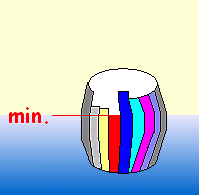
The law of the minimum, drawn as a barrel: the water rises only to the shortest stave. Growth is limited by whichever nutrient is in shortest supply, no matter how abundant the others are — piling on nitrogen cannot fix a phosphorus shortage. Print this diagram small; it was drawn small, and it teaches at a glance.
Illustration of the "Minimum-Gesetz" after Justus von Liebig; Commons file attributed to FMoeckel~commonswiki (assumed from copyright claims on the file page). Public domain.
Here is the most important sentence in this lesson: a struggling plant is more often harmed by extra fertilizer than helped by it.
★ Fertilizers are salts. In the right amount they dissolve into the soil water and roots drink them up. In excess they accumulate, and the concentrated salts begin pulling water out of the roots instead, a kind of reverse drinking that dehydrates the plant from below. The result is called fertilizer burn: browned leaf edges, wilting despite wet soil, white crusts forming on the soil surface, and in severe cases the death of the plant. The cruel irony is that fertilizer burn looks like several deficiencies at once, which tempts the gardener to add more, which makes it worse.
Check in: Fertilizer burn looks like several deficiencies at once. Why is that resemblance so dangerous — what does it tempt the gardener to do?
★ There is an old principle in agriculture, sometimes called the law of the minimum, that says growth is limited by whichever nutrient is in shortest supply, no matter how abundant the others are. Piling on nitrogen cannot fix a phosphorus shortage. More of everything cannot fix a watering problem. The answer is almost never more. The answer is the right thing, in the right amount, at the right time.
★ For your Scholar's Familiar, remember three cautions. First, most commercial potting mixes already contain starter fertilizer, enough for the first weeks or months. Check the bag. Second, never fertilize a plant that is already stressed by drought, disease, or recent repotting. Feeding a sick plant is like serving a heavy meal to someone with a fever. Third, when you do feed, use less than the label suggests for indoor plants, perhaps half strength, and always water the soil first so the roots are moist and receptive.
Restraint is a form of care. The gardener who reaches for the fertilizer bag last, after observation and thought, is usually the gardener whose plants thrive.
❦ In your workbook: record why more is not better in your own way — fertilizer burn, the law of the minimum, and the three cautions for your familiar — copy, sketch, or note what matters.
Your Familiar's Pantry
It is time to apply all of this to the plant on your windowsill.
Begin with the bag your potting mix came from, if you still have it, or look up the product. Does it contain starter fertilizer? Many do, often described as feeding for a certain number of weeks or months. Note the date you potted your familiar and count forward. If the starter period has passed, your plant may soon need its first feeding. If it has not, patience is the correct action.
Next, observe. Look at the older, lower leaves with the mobility rule in mind. Is there uniform yellowing creeping upward? Purplish tints? Scorched margins? Or is the foliage a healthy green, in which case the kindest conclusion is that the pantry is adequately stocked? Remember the mimics. Check your watering rhythm and look for pests before suspecting hunger.
If you decide feeding is warranted, choose a balanced, gentle option: a half strength liquid houseplant fertilizer, or a top dressing of compost for the organic path. Record in your grow ledger what you applied, how much, and when. Then watch. A correctly fed plant greens up over one to three weeks. There is no instant result, and that is as it should be. Nutrients work slowly, and so do we.
No familiar of your own? Adopt one for this lesson: choose a plant you can visit regularly, perhaps a tree in a park, a neighbor's garden bed, or even a sturdy weed along the sidewalk, and assess its foliage for the deficiency patterns in this lesson. You will not be feeding it, but the observation skills are identical, and wild or public plants often show the clearest examples of hunger.
❦ In your workbook: record your familiar's pantry in your own way — what the bag promised, what the older leaves show, and what you decided — copy, sketch, or note what matters.
In your packet: Exercise III — The Feeding Plan ✎ begins here. Work it now, or mark the place and take it as homework — your choice.
Safety Notes
Fertilizers are gardening supplies, not toys, and they deserve the same steady respect you give your pruners and shears.
★ Store all fertilizers in their original labeled containers, sealed, in a cool dry place, out of reach of children and pets. Some fertilizers, particularly concentrated synthetics, can irritate skin, eyes, and airways. Wear gloves when handling them, avoid breathing dust from granular products, and wash your hands thoroughly afterward.
★ Always follow the rate on the label, and remember that for indoor plants, less than the label rate is usually wiser. Never mix different fertilizer products together unless the labels say you may. Never transfer fertilizer into food containers or unmarked jars. If a fertilizer is spilled on skin, rinse with plenty of water. If swallowed, contact poison control at 1-800-222-1222.
★ Younger students should have an adult handle all measuring and application. There is no part of this lesson that requires a young scholar to work with concentrated products alone.
❦ In your workbook: record the safety notes in your own way — storage, handling, the label rate, and the poison control number — copy, sketch, or note what matters.
Guided Observation: Reading Your Familiar's Pantry
This lesson's observation is the pantry check itself, done in the lesson's own order: the bag first, the leaves second, the decision last. Nothing here requires feeding a plant — observation is the work, and a plant with no familiar of its own to check can be adopted for the lesson, exactly as the lesson itself allows.
You will need:
- your Scholar's Familiar — or a plant you can visit regularly: a tree in a park, a neighbor's garden bed, or even a sturdy weed along the sidewalk
- the bag your potting mix came from, or the product page for it
- your grow ledger and a pencil
- a magnifying glass (optional), for close inspection of leaf margins and color changes
Start with the bag. Does your potting mix contain starter fertilizer? Many do, often described as feeding for a certain number of weeks or months. Note the date you potted your familiar and count forward. If the starter period has passed, your plant may soon need its first feeding. If it has not, patience is the correct action.
Read the older leaves. Look at the older, lower leaves with the mobility rule in mind. Is there uniform yellowing creeping upward? Purplish tints? Scorched margins? Or is the foliage a healthy green, in which case the kindest conclusion is that the pantry is adequately stocked?
Rule out the mimics. Check your watering rhythm and look for pests before suspecting hunger. Overwatering yellows leaves, root rot yellows leaves, and natural aging yellows the lowest leaves of many plants as they grow.
Consider:
- Has the starter fertilizer's period passed for your familiar, or is patience still the correct action?
- Which pattern, if any, do the older, lower leaves show — and does the mobility rule support reading it as hunger?
- What did you rule out before suspecting a nutrient problem, and what is your conclusion: feed, or wait and watch?
Safety: this observation is eyes and ledger only. Do not apply fertilizer as part of the observation, and keep all fertilizer handling to the Safety Notes above: original labeled containers, gloves, the label rate, and an adult handling measuring and application for younger students.
Materials
Required (Level One — household items)
- Your grow ledger and pencil: for recording label readings and observations.
- Your Scholar's Familiar: for the foliage assessment in Exercise II.
- Fertilizer labels to compare: photograph labels in a garden center, or look up three products from an online garden retailer.
- Access to your potting mix bag or product page: to check for starter fertilizer in Exercise III.
- A magnifying glass (optional): for close inspection of leaf margins and color changes.
Suggested (Level Two — historically closer)
- A balanced liquid houseplant fertilizer: for the feeding plan in Exercise III, used at half the label rate.
- Gloves: for handling any fertilizer product safely.
- Compost or aged manure: the organic-path alternative for top dressing.
Reflection Questions
Answer the following questions in your workbook.
- Why are nitrogen, phosphorus, and potassium called the big three, and what does each one do for the plant?
- A fertilizer bag reads 12-6-6. What is its ratio, and what kind of plant or purpose would it suit best?
- Why do deficiency symptoms of nitrogen, phosphorus, and potassium appear on older leaves first?
- Explain why adding more fertilizer to a struggling plant is often harmful rather than helpful. What is fertilizer burn?
- Before diagnosing a nutrient deficiency, what other causes should a careful gardener rule out, and why?
Workbook Checklist — Lesson 10
In my workbook I have:
- ☐ named the big three and said what each one does: nitrogen builds the green, phosphorus builds the roots and blooms, potassium guards the whole
- ☐ read a fertilizer label: the three numbers in N-P-K order, their ratio, and the difference between ratio and concentration
- ☐ stated the mobility rule, and why N, P, and K deficiency symptoms appear on older, lower leaves first
- ☐ recognized the classic patterns: uniform yellowing (nitrogen), dark green with purplish tints (phosphorus), scorched margins (potassium)
- ☐ named the mimics to rule out before diagnosing hunger: overwatering, root rot, pests, disease, and natural aging
- ☐ explained fertilizer burn and the law of the minimum, and why more is almost never the answer
- ☐ told the organic path from the synthetic path: slow and gentle against precise and fast
- ☐ checked my familiar's pantry — the bag, the older leaves, the mimics — and written a conservative feeding plan at half strength
- ☐ written out the fertilizer safety notes: original labeled containers, gloves, the label rate, an adult for younger students, and poison control at 1-800-222-1222
☐ Lesson completed Date: ___ Signature: ___
The Professor's Closing Note
You now know the big three by name and by work: nitrogen the green builder, phosphorus the root and bloom worker, potassium the quiet guardian. You can read the three numbers on a bag and understand what they promise. You know how hunger shows in leaves, and you know the harder lesson, that more is not better.
Carry one image with you from this lesson. When supplies run short, the plant dismantles its past to fund its future, moving nutrients from old leaves to new. There is something deeply moving in that. The plant sacrifices what it has already made so that what is coming can live. Gardeners would do well to be so graceful about letting go.
In your ledger this week, write down what you found in your familiar's pantry. Fed or unfed, the observation itself is the work. I will see you in Lesson 11, where we learn to turn scraps and fallen leaves back into living soil.
— Professor Beryl Fernfoot, Herbology Greenhouse • Master Herbalist • Head of House Oriens
Cross-Class Connections

Potions · Unit I, Lesson 4 — Labels, Wax Seals & Ingredient Markings
Scholars, my first law, and I will be checking: label everything, before you fill it, every time. Your Professor Fernfoot tells you never to transfer fertilizer into food containers or unmarked jars, and she is right — an unlabeled jar is a mystery, and mysteries in a laboratory become accidents. Come and learn what a proper label carries, and write yours as if someone will read it in six hundred years.
Potions · Unit III, Lesson 20 — Salts, Clays & Mineral Materials
You have learned in the Greenhouse that fertilizers are salts, and that salts in excess pull the water out of a plant's roots. In my laboratory those same salts sit stoppered on the mineral shelf, because a salt drinks moisture from the air and must be kept from drinking it. Come and grow them into crystals, read their habits, and learn to judge a salt by its structure — slowly, and with everything labeled.
Further Reading & Sources
- Understanding a Turf Fertilizer Label — UMass Amherst — a clear university guide to the guaranteed analysis, ratios, and what the three numbers actually mean.
- Fertilizer Analysis — Iowa State University — open textbook chapter on guaranteed analysis, nutrient carriers, and why bag percentages do not sum to one hundred.
- Identifying Nutrient Deficiency Symptoms — Montana State University Extension — an illustrated diagnostic key for deficiency symptoms, including the mobile and immobile nutrient rule.
- Basic Concepts of Plant Nutrition — Cornell University — crop advisor study material on nutrient mobility in plants and in soil, and where symptoms appear.
Browse the Herbology shelf in the school Library for readable editions of these works.
One plant from this lesson stands in the Materia Botanica, the school's shared archive — kept with its lessons, its keepings, and its cautions.
Seaweed — marine macroalgae The whole Materia BotanicaPROFESSOR BERYL FERNFOOT · HERBOLOGY GREENHOUSE
Submit your work for this lesson using the form below.
CONTINUE IN THE HERBOLOGY GREENHOUSE
← Previous · Lesson 9: Soil Chemistry: The pH Scale Next · Lesson 11: The Compost Crucible →
Unit II — Soils, Sunlight & Growing Environments Herbology Greenhouse — All 37 Lessons
The rest of Unit II: Lesson 8 · Substrate Profile · Lesson 9 · Soil Chemistry: pH · Lesson 11 · Compost Crucible · Lesson 12 · Photoperiod Dynamics · Lesson 13 · Watering Matrix · Lesson 14 · Microclimate Calibration · Lesson 15 · Seasonal Growing Cycles · Lesson 16 · The Growing Plan