

HERBOLOGY
Unit II · Lesson 14MICROCLIMATE CALIBRATION
PROFESSOR BERYL FERNFOOT
Herbology Greenhouse
Master Herbalist
Every growing space contains its own weather. Learn to read it.
Professor's Introduction

Come in, gardeners.
When you check the weather forecast, you are reading about your region. Your plants do not live in your region. They live in your yard, on your balcony, on your windowsill. And the weather in those small places is often quite different from what the forecast describes.
A single garden can hold several small climates at once. The strip of soil against a sunny wall may stay frost free on a night when the low corner of the same yard glitters white. The corner behind the shed may bake in still, hot air while the open bed a few steps away catches every breeze. These small, local climates have a name, and learning to find them is one of the most practical skills a gardener can develop.
In this lesson you will learn what shapes these hidden climates, how to map the ones in your own growing space, and how to place each plant where its particular patch of weather suits it best. Your Scholar's Familiar has been living in one of your microclimates all along. By the end of this lesson, you will know exactly which one. If you are following the adopted-plant path rather than keeping a familiar at home, every observation in this lesson applies equally to the plant you visit regularly.
Let us step outside and pay attention.
— Professor Beryl Fernfoot, Herbology Greenhouse • Master Herbalist • Head of House Oriens
The line beneath the map is our road: every stop a place where the knowledge of plants changed, every lesson a step along it.
Lesson Objectives
By the end of this lesson, you will be able to:
- Define microclimate and explain why it matters more to a plant than the regional forecast
- Describe how walls, slopes, and structures create warmer or cooler pockets
- Explain frost pockets and cold air drainage in your own words
- Identify wind effects on plants and describe how windbreaks help
- Map the microclimates in your own growing space using simple observation
- Evaluate your Scholar's Familiar's current placement and decide whether it should move
Reading this lesson: ★ marks the passages to remember. They return on the unit quiz and the class test. Check in questions ask the material back as you go; answer them in your workbook when you meet them.
Working this lesson: Your assignment packet is the first download on this page. Work in it as the lesson moves along, answering each exercise as its subject is taught — or read the lesson through for your notes and take the exercises as homework afterward. Both are proper ways to sit this class. Signposts in the reading tell you where each exercise belongs. Written answers are short answers in your own words; a few honest lines are worth more than a filled page.
Your Assignment Packet
This lesson's exercises live in its packet: the Lexicon Handout (every term, course terms marked ◆), Materials, Guided Practice, the Assignment Manual with its answer key for self-checking, the Reflection Questions, and the Workbook Checklist. Download the packet before you begin and keep it beside you as you read.
What Is a Microclimate?
★ A microclimate is a small area whose temperature, moisture, or airflow differs from the land around it. The prefix micro means small, and these climates can be very small indeed. A walled garden has its own microclimate. So does the sheltered strip along a hedge, the warm paving beside a doorstep, and even the lee side of a single large stone.
What makes the concept powerful is scale. Your hardiness zone tells you, roughly, what the winters are like in your part of the world. Your microclimates tell you what tonight will be like for the actual plant in the actual pot. A gardener who knows her microclimates can grow tender plants that the zone map says should fail, simply by placing them where the yard is kindest. She can also avoid the quiet heartbreak of planting something delicate in the one corner where cold air pools every winter.
★ Microclimates are shaped by four forces working together: sunlight, wind, water, and mass. Sunlight you studied in Lesson 12, when you tracked photoperiod and learned how light moves across a space. The other three deserve a closer look, because they are the ones most gardeners overlook.
Check in: Name the four forces that shape a microclimate. Which three does this lesson say gardeners most often overlook?
You do not need instruments to begin. You need only the willingness to notice that one corner of your space feels different from another, and the patience to ask why.
❦ In your workbook: record what a microclimate is — a small area whose temperature, moisture, or airflow differs from the land around it, and the four forces that shape it in your own way — copy, sketch, or note what matters.
Walls That Remember the Sun
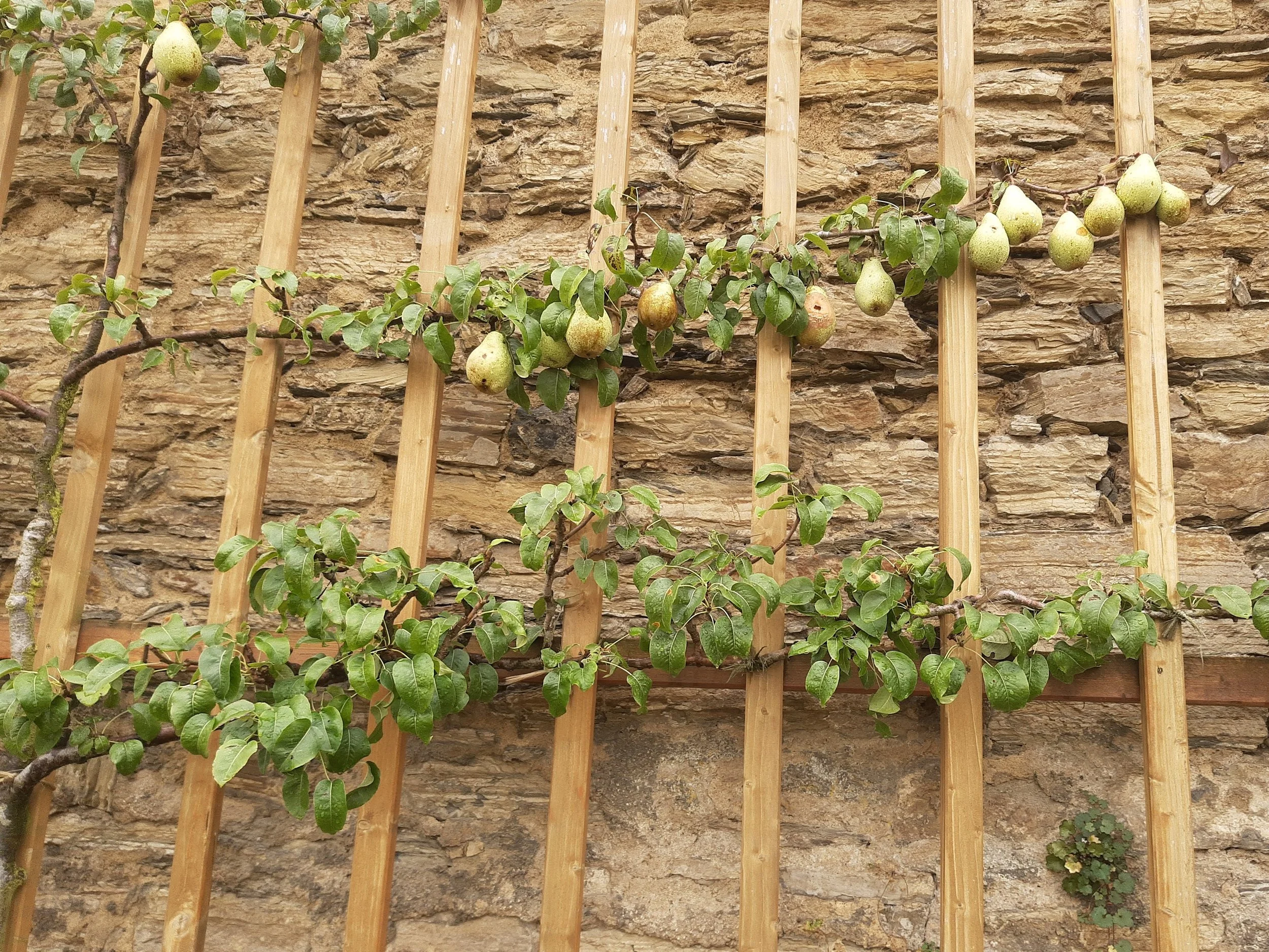
A pear espalier ripening against a stone wall. Stone is thermal mass: it drinks in the day's warmth and gives it back slowly after dark, so fruit trained flat against it ripens where the open garden might fail. Keep plants about a foot out from the wall itself — crowding blocks airflow and invites mildew.
Photograph by Gerda Arendt, Schloss Weilburg baroque garden, 2024. CC0.
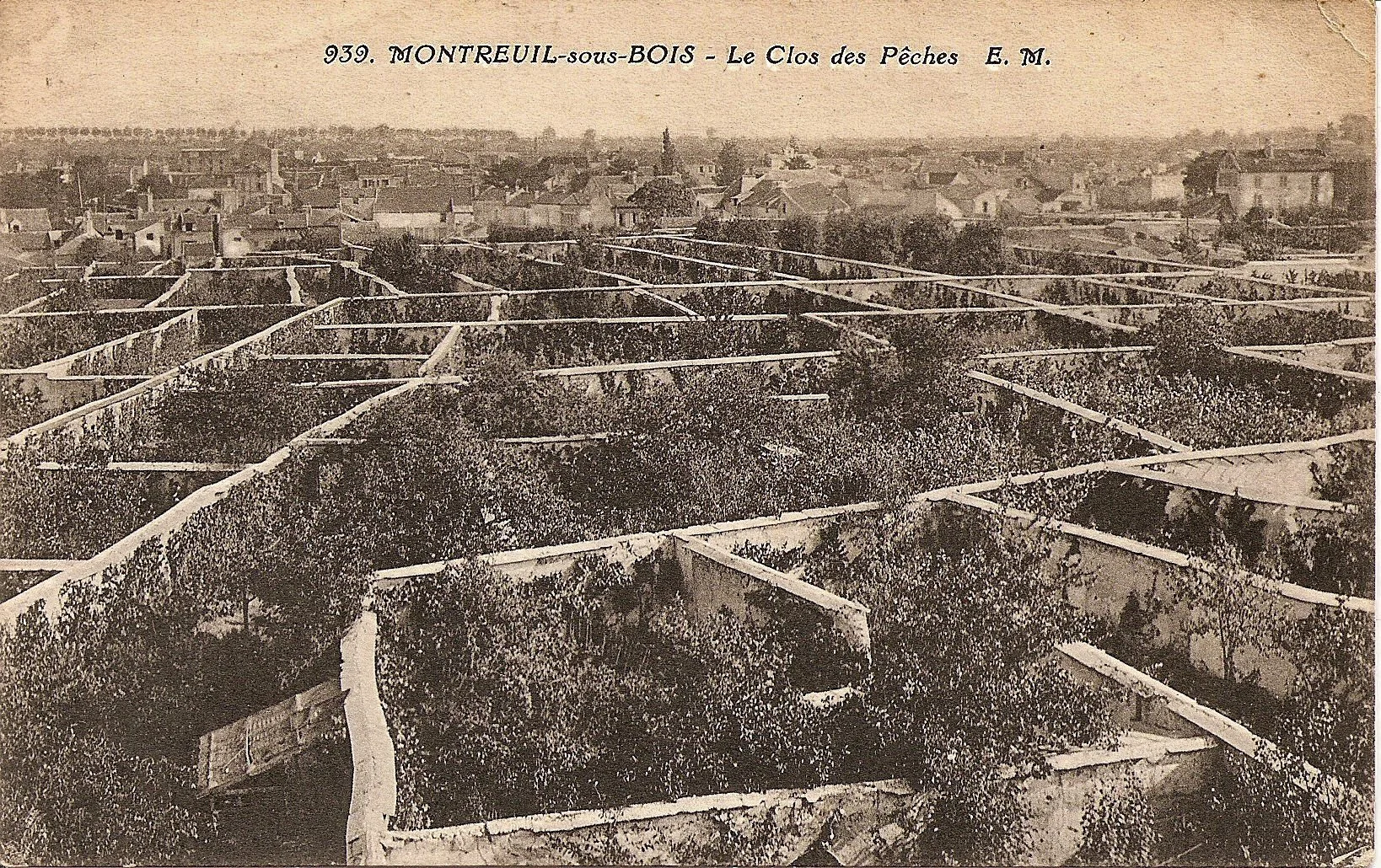
The peach walls of Montreuil, outside Paris, on an early-1900s postcard. Generations of growers ripened peaches in a cool climate by training them against high masonry walls — each small walled enclosure is a made microclimate of stored heat and sheltered air.
Postcard no. 939, "Le Clos des Pêches," Montreuil-sous-Bois (early 20th century), from the collection of Claude Villetaneuse. Public domain.
★ Some materials drink in the day's warmth and give it back slowly after dark. Brick, stone, and concrete are the great heat keepers of the garden. Gardeners call this stored warmth thermal mass: a material that absorbs heat during the day and releases it slowly after dark. A south facing wall soaks up sunshine all day long, and after sunset its stored heat drifts back out into the nearby air. Plants tucked close by enjoy a few extra degrees of comfort on chilly nights. Gardeners have used this for centuries, ripening figs and tomatoes against sunny walls in climates where the open garden would defeat them.
Check in: Brick, stone, and concrete keep nearby plants warmer at night. How, in your own words?
Patios and driveways work the same way. Paved surfaces heat up fast and radiate warmth into the evening, while drying the nearby soil more quickly. That combination, warm and dry, suits Mediterranean herbs like rosemary and lavender beautifully, and it punishes plants that prefer cool, moist feet.
The direction a wall or slope faces is its aspect, and it decides how much sun that wall receives: in the northern hemisphere, a south facing aspect is the warmest and brightest, while a north facing one stays cooler and moister. Dark materials absorb the most heat. A dark painted wall or a black water jug set near plants will collect warmth by day and release it after dark. Light colored siding, by contrast, reflects sunlight rather than storing it, so it creates far less of this effect.
A few cautions belong here. Keep plants about a foot away from the wall rather than crowding them against it. Tight crowding blocks airflow and invites mildew and other leaf troubles, trading one problem for another. And be thoughtful about which plants get the warmest spots. Early blooming shrubs whose flowers are vulnerable to spring frost can be fooled by a warm wall into budding too soon, only to lose their blossoms to a late cold snap. The warm pocket is a tool. Like any tool, it rewards a thoughtful hand.
❦ In your workbook: record walls that remember the sun — which materials store the day's heat, which plants love the warm, dry pocket, and the cautions that come with it in your own way — copy, sketch, or note what matters.
Where the Cold Sleeps
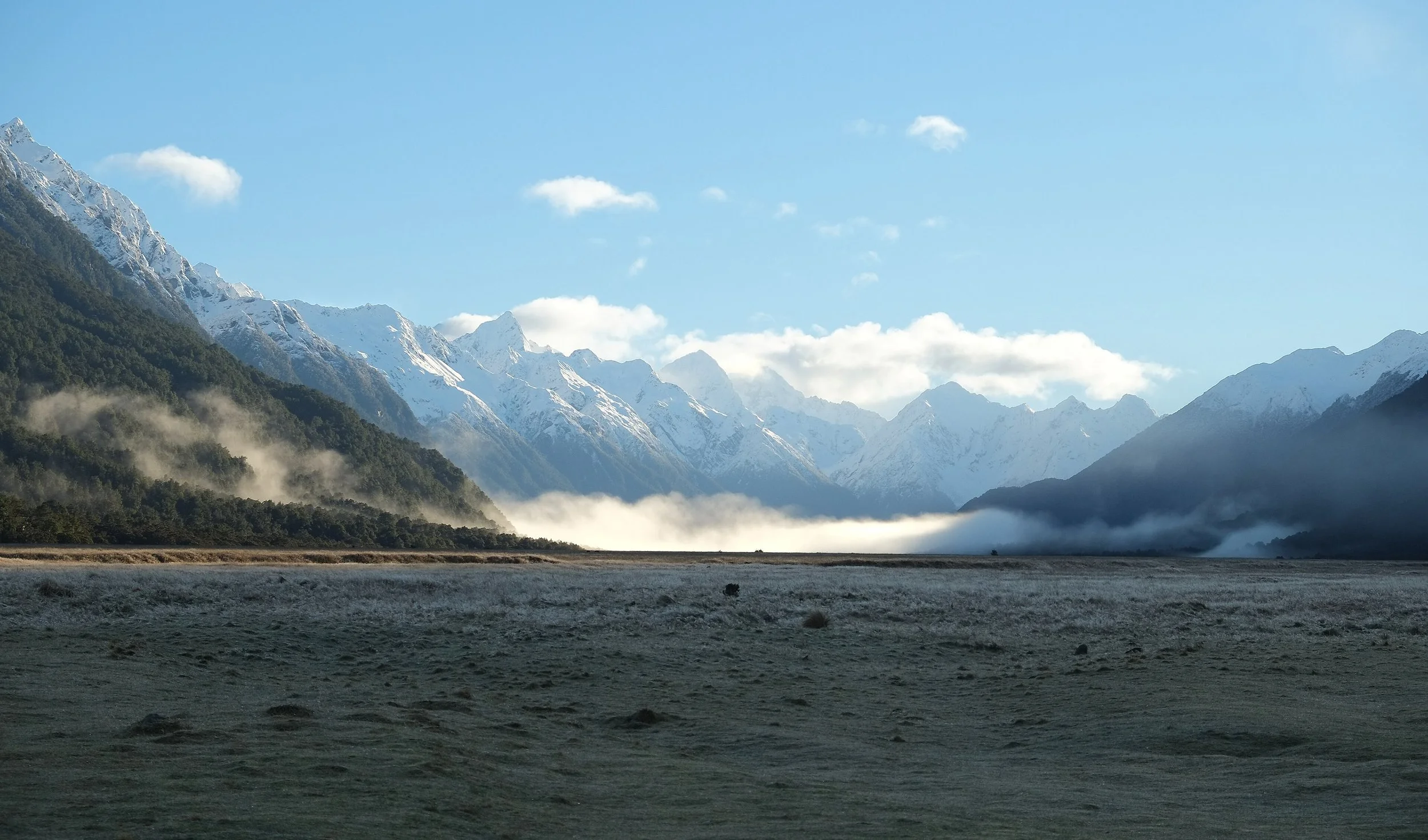
Cold air is heavy: on a calm, clear night it slides downhill like water and pools in the low ground. Here the pooled cold shows itself — frost whitening the valley floor and fog lying along the bottom while the slopes stand clear. Your garden's frost pockets are the same thing at yard scale: find them on the dawn walk, and never plant tender things in them.
Photograph by Pseudopanax, Eglinton Valley, Fiordland, New Zealand, July 2018. Public domain (released by the photographer).
★ Cold air is heavy. On a calm, clear night, it slides downhill the way water does, flowing off slopes and ridges and pooling in low spots. Gardeners call these low collection points frost pockets, and they are the coldest places in any yard.
Check in: What is a frost pocket, and how can you find one without any equipment?
You can find them without any equipment. After a cold, still night, walk your growing space at sunrise and look at where frost has settled and where the ground is clear. The white patches are your frost pockets. Low lying dips, the bottoms of slopes, and hollows behind barriers that block the downhill flow of air will all show frost while higher or more open ground stays clear. Frost pockets warm slowly in spring and are the first places touched by autumn frost, so they are poor addresses for tender plants and perfectly fine ones for hardy greens.
★ The practical lesson is simple: never fight a frost pocket. Work around it. Put your hardiest plants in the low spots and save the warm pockets near walls and on gentle slopes for the plants that need coddling. Cold air drainage is one of those quiet forces that explains a great deal once you know to look for it, including why two identical plants in the same yard can have completely different winters.
❦ In your workbook: record where the cold sleeps — how cold air drainage pools cold air in low spots, and the rule for planting around a frost pocket, never against it in your own way — copy, sketch, or note what matters.
In your packet: Exercise I — The Dawn Walk ◐ begins here. Work it now, or mark the place and take it as homework — your choice.
Wind: The Invisible Gardener
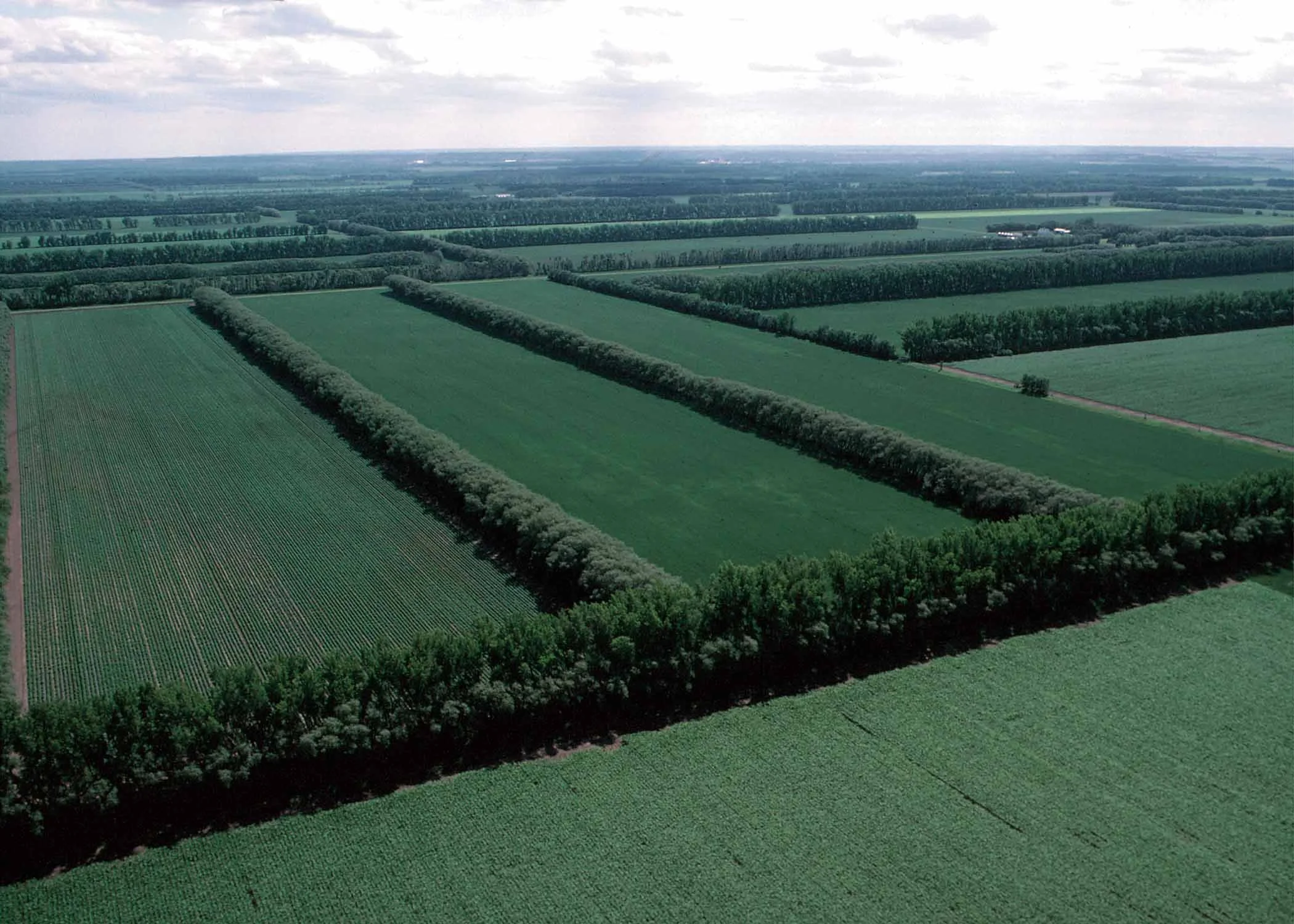
Field windbreaks in North Dakota, seen from the air. A windbreak slows the wind and shelters the ground on its lee side: there the air stays more humid, the soil dries more slowly, and plants hold their moisture. A garden hedge or fence does the same work at yard scale.
Photograph by Erwin Cole, USDA Natural Resources Conservation Service, 1997. Public domain (U.S. government work).
Wind shapes a garden as surely as sun does, and it is easier to overlook because you cannot see where it has been. A steady wind strips moisture from leaves faster than the roots can replace it, batters stems, chills tender growth, and can even deform plants over time, bending them permanently away from the prevailing blast.
★ A windbreak changes all of this. Hedges, fences, walls, and dense plantings slow the wind and create a sheltered zone on their lee side, the side away from the wind. In that calm pocket, the air stays more humid, the soil dries more slowly, and plants hold their moisture instead of losing it to the sky. Even in summer, a windbreak that blocks hot drying winds keeps a planting cooler and less thirsty.
Check in: What does a windbreak change about the air on its lee side — and why does that help a plant keep its moisture?
Watching the wind is a skill worth practicing. On a breezy day, tie short ribbons to stakes around your growing space and watch how they move. Some will stream straight out in the full current. Some will flutter lazily or hang nearly still in sheltered spots. A ribbon survey takes ten minutes and tells you more about your yard's airflow than any amount of guessing.
There is a temptation, once you start seeing microclimates, to try to control every one of them. Resist it. The goal is not a perfect yard. The goal is knowing your yard well enough to give each plant the corner it prefers.
❦ In your workbook: record wind, the invisible gardener — how wind harms plants, what a windbreak does, and what a ten-minute ribbon survey can tell you in your own way — copy, sketch, or note what matters.
Indoor Microclimates
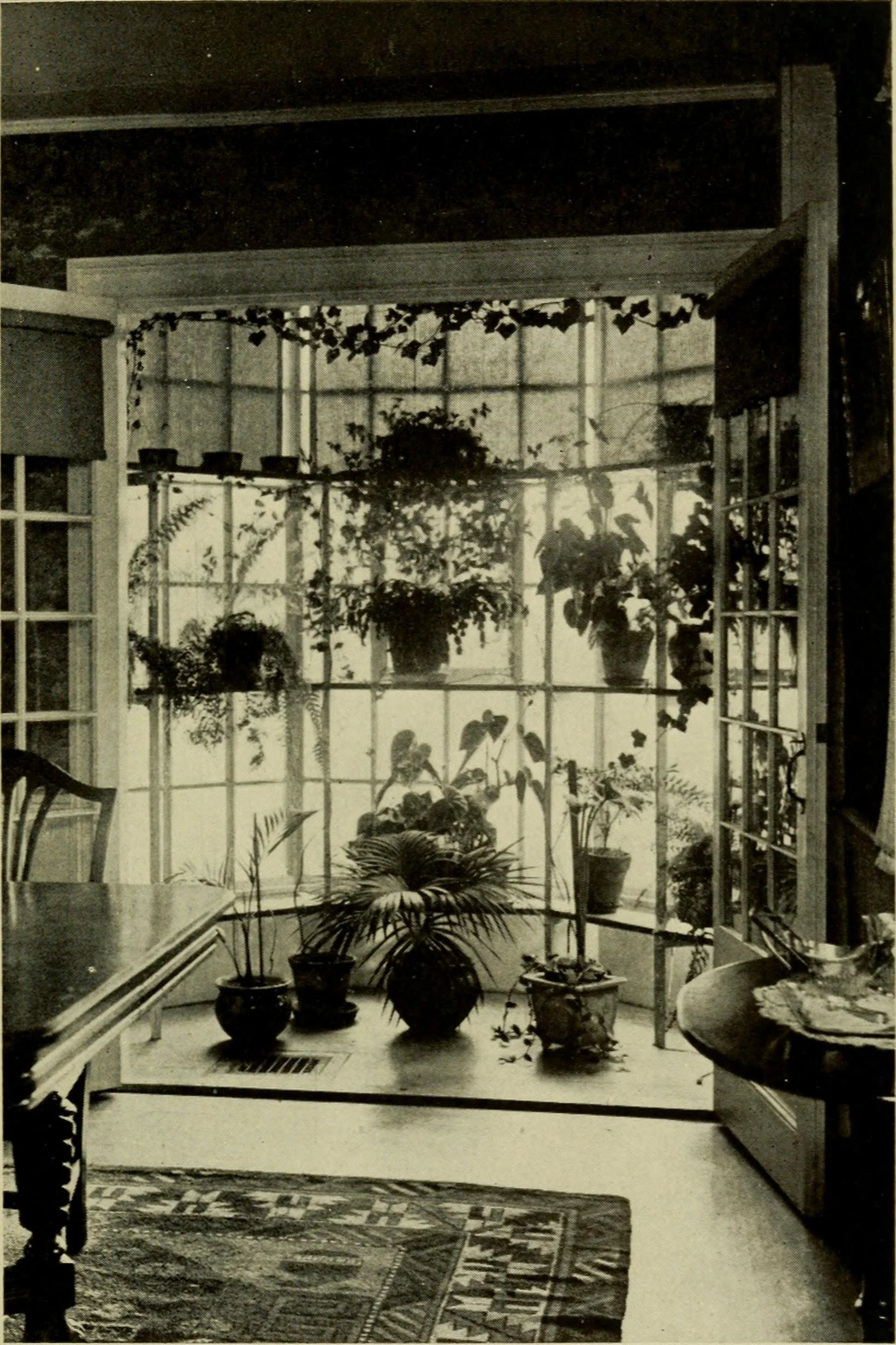
A window garden of 1912. Glass is the great indoor climate maker: bright by day, cold at night where heat escapes through the pane. Note the heating vent in the floor at the front — the spot in hot, dry air above a heat source is one of the harshest microclimates in any home, then and now.
From Gardening Indoors and Under Glass (1912), via Internet Archive Book Images. No known copyright restrictions.
Microclimates do not stop at the back door. Every room has them, and indoor plants live or die by them just as surely as outdoor ones.
Glass is the great indoor climate maker. A windowsill that is bright and pleasant by day can turn cold at night as heat escapes through the pane. Tender plants pressed against cold glass on a winter night may suffer leaf damage while the same plant a foot back on the table stays comfortable. In winter, draw plants back from the glass after dark, or hang a curtain between the plant and the window.
★ Radiators and heating vents create the opposite extreme: blasts of hot, dry air that desiccate leaves and stress roots. The spot directly above a radiator is one of the harshest microclimates in any home. Move plants away from direct heat, and remember that heated indoor air is dry air. Grouping pots together raises the humidity in their small shared pocket of air, which most houseplants appreciate.
Check in: Why is the spot directly above a radiator one of the harshest microclimates in a home — and what simple habit protects a tender plant on a winter windowsill?
Drafts matter too. A plant beside a frequently opened exterior door endures repeated blasts of cold air all winter. A plant in a still hallway corner may sit in stagnant air. Neither is ideal, and both are easily fixed once noticed. The indoor gardener's advantage is mobility: unlike a planted bed, a pot can simply be moved when its microclimate stops suiting it.
❦ In your workbook: record indoor microclimates — cold glass, hot dry radiator air, and drafts, and the indoor gardener's one great advantage: a pot can simply be moved in your own way — copy, sketch, or note what matters.
Mapping Your Microclimates
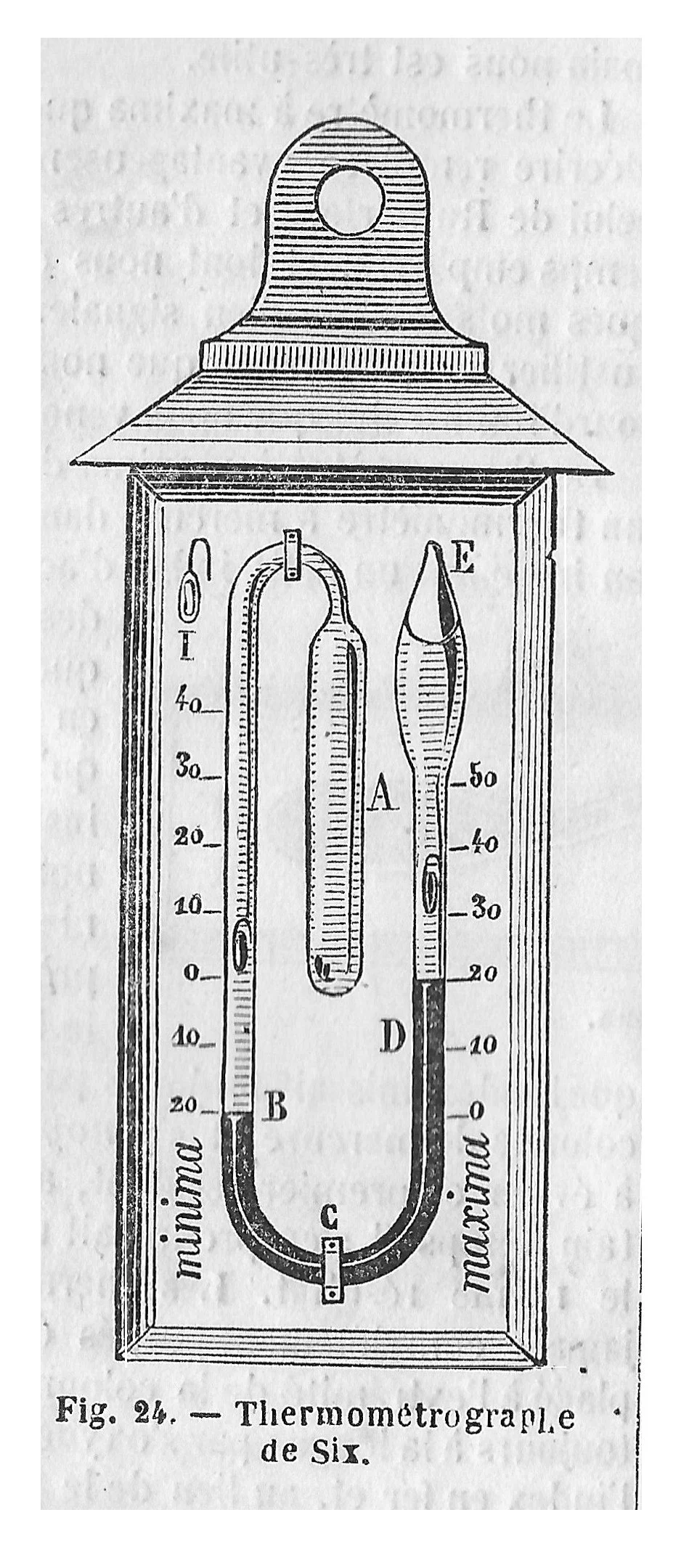
Six's maximum–minimum thermometer, the instrument this lesson's mapping work asks for: it records the highest and lowest temperatures since it was last read, so one instrument left in a pocket of your garden tells you that pocket's true range — often several degrees from the spot a few steps away.
Engraving from Encyclopédie pratique de l'agriculteur, tome 13 (Firmin-Didot, 1877). Public domain.
Knowing about microclimates is useful. Mapping your own is transformative. Here is how to do it with simple tools.
The dawn walk. After a cold, calm night, walk your growing space at sunrise. Note where frost lies and where the ground is clear. Note which walls feel warm to the touch from yesterday's sun. Sketch what you see. This single walk reveals your frost pockets and your warmest walls in one morning.
★ Thermometers in several spots. Place inexpensive thermometers, ideally min-max thermometers that record the highest and lowest readings, in different parts of your space for a few weeks. Check them at the same time each day. Gardeners are often surprised to find several degrees of difference between the front step and the back corner. A few degrees is the difference between a plant that survives and one that thrives.
Check in: Gardeners are often surprised by their thermometer readings. How large a difference does this lesson say a few spots in one space can show — and why does that difference matter so much?
Watch the wind and the sun. Use the ribbon survey described above for airflow. For sun, remember that sun paths change with the seasons: a spot that basks in full sun in July may sit in total shade by October as the sun drops lower and shadows lengthen. Track this across the year in your ledger.
Feel the soil. Check soil temperature at root depth in different spots. Soil in a raised bed against a sunny wall warms weeks earlier in spring than soil in an open low bed. That difference decides when seeds can safely go in.
Record everything in your grow ledger. A microclimate map, even a rough sketch with notes, becomes one of the most referenced pages you will ever make. Update it seasonally. Your yard's hidden weather changes through the year, and your map should change with it.
❦ In your workbook: record mapping your microclimates — the dawn walk, thermometers in several spots, the ribbon survey, and soil felt at root depth, all recorded in your grow ledger in your own way — copy, sketch, or note what matters.
In your packet: Exercise II — The Microclimate Map ⚒ begins here. Work it now, or mark the place and take it as homework — your choice.
Placing Plants Deliberately
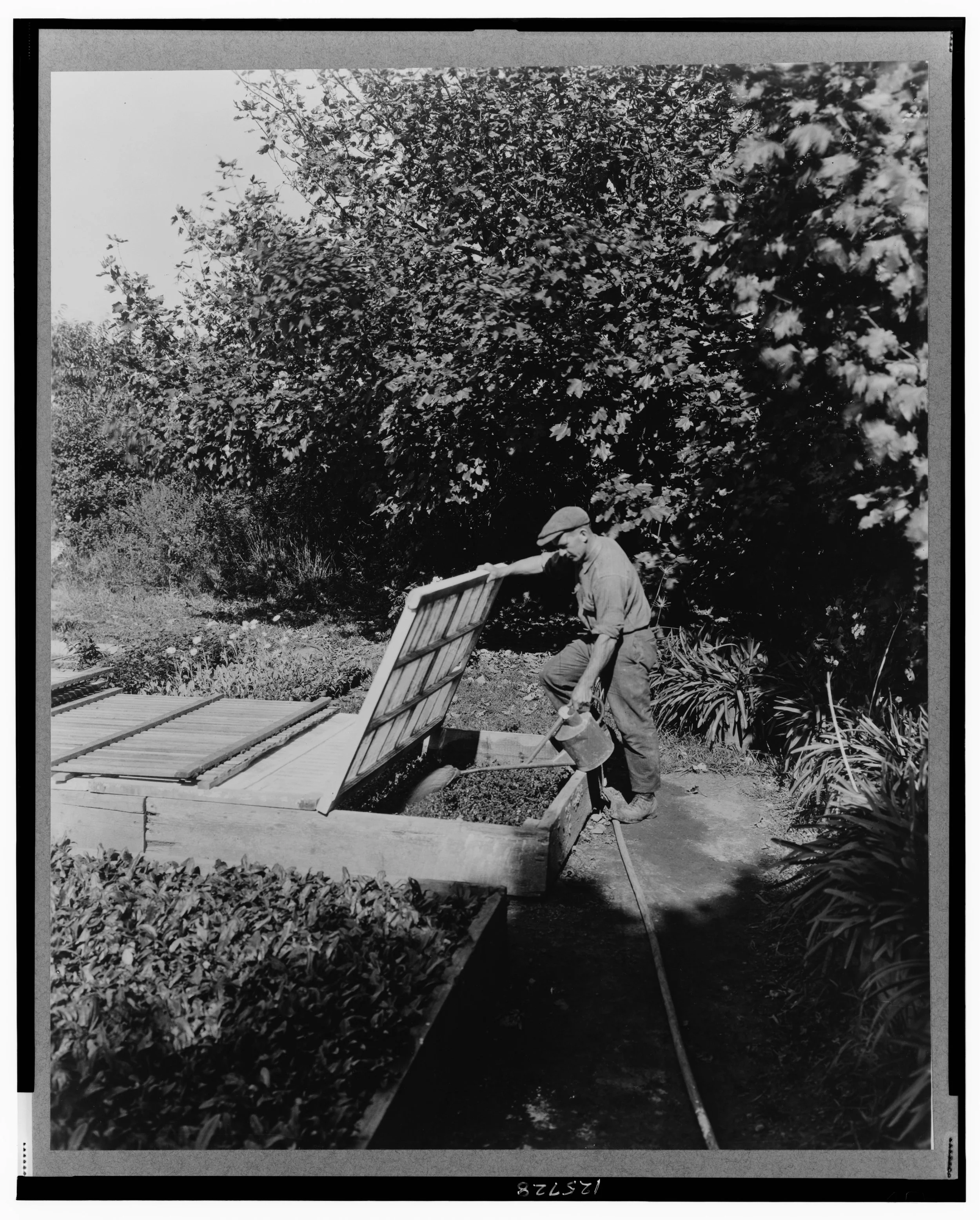
Watering seedlings in a cold frame, photographed in 1917. A cold frame is a built microclimate — a pocket of still, sun-warmed air held in walls and glass — and it belongs where its lid meets the sun and its back meets shelter, exactly as your microclimate map tells you.
Photograph by Frances Benjamin Johnston, 1917; Library of Congress (LCCN 00651263). Public domain.
★ Once you know your microclimates, you can practice the oldest and wisest gardening rule: right plant, right place.
Heat lovers go to the warm pockets. Basil, peppers, and tender herbs belong against the sunny wall or on the warm patio edge. Shade lovers go to the cool, sheltered spots: the north side of a structure, beneath the dappled cover of a larger plant, where the air stays moist and calm. Hardy plants can hold the frost pockets and the windy corners, the places where fussier specimens would struggle.
Tall plants can create microclimates for shorter ones. Lettuce tucked between tomato plants stays cooler on scorching afternoons. Short, leafy herbs beneath a trellis of beans enjoy shade and steadier moisture. This is companion placement at its simplest: using one plant's bulk to shelter another.
★ And remember that containers are microclimate tools in themselves. A pot can be moved from the sunny wall to the shady corner as the seasons turn, following the weather the plant prefers. No bed can do that. If your Scholar's Familiar lives in a pot, you hold one of the gardener's quiet superpowers in your hands: relocation. (If you are on the adopted-plant path, your plant stays where it is, and your work is pure observation: map its microclimate, assess whether it suits the plant, and record what you find. The skills are identical; only the ownership differs.)
Check in: Your Scholar's Familiar has been living in one of your microclimates all along. What is the question this lesson teaches you to ask about its address?
Your familiar has been sitting in one of your microclimates since the day you chose it. Now you have the knowledge to ask whether it is sitting in the right one. That question, asked with care, is the whole lesson in a single sentence.
❦ In your workbook: record placing plants deliberately — right plant, right place: heat lovers to the warm pockets, shade lovers to the cool shelter, hardy plants to the frost pockets and windy corners in your own way — copy, sketch, or note what matters.
In your packet: Exercise III — The Familiar's Address ◐ begins here. Work it now, or mark the place and take it as homework — your choice.
Safety Notes
Microclimate study takes you outdoors in all weathers, and a few steady habits keep it safe.
Dress for the conditions. The dawn walk happens on cold mornings, so wear warm layers, sturdy closed shoes, and watch your footing: frosty paths and steps are slippery. Do not go out in severe weather, high winds, or lightning to observe your garden. The observations can wait. You cannot.
Secure loose structures before wind arrives. An unsecured cold frame lid, a top-heavy pot, or a leaning trellis becomes a hazard in a gust. Check stakes, ties, and supports as part of your regular rounds, and bring lightweight pots indoors or lay them on their sides when strong winds are forecast.
Protect yourself from the sun during long mapping sessions. A hat, water, and sunscreen turn a pleasant survey into a safe one. Younger students should explore the yard's microclimates with an adult, especially near streets, ponds, or steep slopes.
❦ In your workbook: record the safety notes — dressing for the dawn walk, securing loose structures before wind arrives, and sun protection on long mapping sessions in your own way — copy, sketch, or note what matters.
Guided Observation: The Dawn Walk and the Ribbon Survey
This lesson's observation is the mapping work itself, done slowly and in order. No instrument is required to begin: the lesson's own first tools are your eyes at sunrise, your hand on a wall, and a pocketful of ribbons. Work through the four readings below in your growing space — yard, balcony, or indoor growing area — and record everything in your grow ledger.
You will need:
- your grow ledger and a pencil
- short ribbons or strips of cloth and garden stakes, for the wind survey
- one inexpensive outdoor thermometer if you have one — a single thermometer, carried from spot to spot and read at the same hour, does the work of several; if you have none, your hand on walls and paving and the frost and dew patterns themselves are the lesson's own starting instruments
The dawn walk. After a cold, calm night, walk your growing space at sunrise. Note where frost lies and where the ground is clear. Note which walls feel warm to the touch from yesterday's sun. Sketch what you see. This single walk reveals your frost pockets and your warmest walls in one morning.
Thermometers in several spots. Place inexpensive thermometers, ideally min-max thermometers that record the highest and lowest readings, in different parts of your space for a few weeks. Check them at the same time each day. Gardeners are often surprised to find several degrees of difference between the front step and the back corner. A few degrees is the difference between a plant that survives and one that thrives. Household path: with one thermometer, visit each spot in the same order at the same hour each day and record the readings in turn; with none, record the frost, dew, and hand-warmth evidence from the dawn walk across several mornings instead.
Watch the wind and the sun. Use the ribbon survey for airflow: on a breezy day, tie short ribbons to stakes around your growing space and watch how they move — some stream straight out in the full current, some flutter lazily or hang nearly still in sheltered spots. For sun, remember that sun paths change with the seasons: a spot that basks in full sun in July may sit in total shade by October as the sun drops lower and shadows lengthen. Track this across the year in your ledger.
Feel the soil. Check soil temperature at root depth in different spots. Soil in a raised bed against a sunny wall warms weeks earlier in spring than soil in an open low bed. That difference decides when seeds can safely go in.
Consider:
- Where did frost settle, and where was the ground clear? What does that pattern tell you about how cold air moves through your space?
- Which wall or paving felt warmest to the touch, and what is it made of?
- Where did the ribbons stream, and where did they hang nearly still? Which of your plants live in each kind of air?
- If your space is indoors or a balcony, where are its cold glass, its hot dry air, and its drafts?
Safety: dress for the conditions on the dawn walk — warm layers, sturdy closed shoes, and care on frosty paths and steps. Never go out in severe weather, high winds, or lightning to observe the garden. The observations can wait. You cannot.
Materials
Required (Level One — household items)
- Your grow ledger and pencil: for the microclimate map, which becomes a permanent reference page.
- An outdoor thermometer: any inexpensive one will do; two is better, so you can compare spots at once. One thermometer carried from spot to spot at the same hour does the same work, and the dawn walk's frost, dew, and hand-warmth evidence needs no instrument at all.
- Short ribbons or strips of cloth and garden stakes: for the ten-minute wind survey.
- Paper for sketching: your microclimate map begins as a rough drawing.
- A phone weather app or local forecast: to know when a cold, calm, clear night is coming for the dawn walk.
Suggested (Level Two — historically closer)
- A min-max thermometer: records the highest and lowest temperatures between readings, revealing the true range of each pocket.
- A soil thermometer: measures temperature at root depth, where it matters most for planting decisions.
- A compass: for determining aspect precisely when planning permanent plantings.
Reflection Questions
Answer the following questions in your workbook.
- Why does a plant's microclimate matter more to it than the regional hardiness zone?
- Explain, in your own words, how a south facing brick wall keeps nearby plants warmer at night.
- What is cold air drainage, and why should tender plants never be placed in a frost pocket?
- How does wind harm plants, and what does a windbreak change about the air behind it?
- Your friend insists her yard has only one climate because it is small. Using this lesson, explain why she is almost certainly wrong.
Workbook Checklist — Lesson 14
In my workbook I have:
- ☐ defined microclimate, and said why it matters more to a plant than the regional forecast
- ☐ explained how walls, paving, and other thermal mass store the day's heat and return it after dark
- ☐ explained cold air drainage, and identified my own frost pockets on the dawn walk
- ☐ described how wind harms plants, and what a windbreak changes on its lee side
- ☐ mapped the microclimates of my own growing space — warm pockets, frost pockets, windy corridors, sheltered spots, wet and dry zones — with a week's readings
- ☐ audited my Scholar's Familiar's address and decided, with reasons, whether it should stay or move
☐ Lesson completed Date: ___ Signature: ___
The Professor's Closing Note
You began this unit by studying what lies beneath your plants. Today you studied the invisible weather that surrounds them. Soil and sky, scholars. A plant lives between the two, and now you are learning to read both.
Your microclimate map is more than an exercise. It is a conversation with your growing space, and like any good conversation, it deepens with time. Walk the dawn walk again in spring and compare. Move a thermometer and be surprised. Notice the corner you overlooked. The yard will keep teaching as long as you keep noticing.
Look at your Scholar's Familiar with your new knowledge. Is it in the warmest spot, the calmest spot, the spot its nature prefers? If not, you know what to do, and you know why. That is what calibration means: adjusting with understanding, not guessing.
I will see you in the next lesson, where we turn from the air around the garden to the rhythm of the seasons within it.
— Professor Beryl Fernfoot, Herbology Greenhouse • Master Herbalist • Head of House Oriens
Cross-Class Connections

Potions · Unit II, Lesson 16 — Ingredient Stability & Storage Behavior
Apprentices, your shelves have a microclimate too — I use the word exactly as Professor Fernfoot taught it to you here. Bring me seven evenings of readings from your storage corner: the temperature, whether the air feels dry or damp, and what sunlight reaches the jars. A household thermometer makes it precise; your own senses make it adequate. Map the shelf before you trust it with anything you value.

Celestial Studies · Unit I, Lesson 3 — The Tilted Year: Why We Have Seasons
Scholars, you have wondered why the sunny corner of July is the shaded corner of October. Come to the Tower and I will show you the tilt that does it: the sun climbs high and throws short shadows in June, and skulks low with long shadows in December, all from the same spot. Your garden map is my sky, read at ground level.

Creative Arts · Unit V, Lesson 22 — Garden Structures: Supports, Cold Frames & Garden Models
Fernfoot has taught you to find the warm pocket. In my workshop you will build one: a cold frame is a pocket of still, sun-warmed air held in walls and glass, and it belongs where its lid meets the sun and its back meets the wind's shelter. Bring your microclimate map to the bench — siting is part of the build, and your map is where siting mistakes are cheap.
Further Reading & Sources
- Microclimates: Your Garden Zone Might Not Be What You Think — Gardening Know How; common microclimate spots and how to map your own
- Mastering Your Garden's Microclimates — Garden.org (National Gardening Association); identifying warm and cool pockets
- Thwarting Frosts — Garden.org; frost protection and making the most of microclimates
- Getting to Know Your Yard's Microclimates — Penn State Extension Master Gardener; sun paths, wind, and frost in the home yard
- How to Determine Your Garden Microclimate — Washington State University Extension; rain shadows, cold air, and local observation (PDF)
Browse the Herbology shelf in the school Library for readable editions of these works.
Plants from this lesson stand in the Materia Botanica, the school's shared archive — each kept with its lessons, its keepings, and its cautions. This lesson's company:
RosemaryTomatoFig The whole Materia BotanicaPROFESSOR BERYL FERNFOOT · HERBOLOGY GREENHOUSE
Submit your work for this lesson using the form below.
CONTINUE IN THE HERBOLOGY GREENHOUSE
← Previous · Lesson 13: The Watering Matrix: Capillary Action & Root Hydration Next · Lesson 15: Seasonal Growing Cycles →
Unit II — Soils, Sunlight & Growing Environments Herbology Greenhouse — All 37 Lessons
The rest of Unit II: Lesson 8 · Substrate Profile · Lesson 9 · Soil Chemistry: pH · Lesson 10 · The N-P-K Matrix · Lesson 11 · Compost Crucible · Lesson 12 · Photoperiod Dynamics · Lesson 13 · Watering Matrix · Lesson 15 · Seasonal Growing Cycles · Lesson 16 · The Growing Plan