
HERBOLOGY
Unit II · Lesson 12PHOTOPERIOD DYNAMICS: UNDERSTANDING SUNLIGHT
PROFESSOR BERYL FERNFOOT
Herbology Greenhouse
Master Herbalist
Professor's Introduction

Sealed with the mark of Professor Beryl Fernfoot, Master Herbalist of the Herbology Greenhouse, Head of House Oriens.
Gently does it, scholars,
Everything your familiar has done since you chose it, every new leaf, every inch of stem, every root reaching quietly downward, has been paid for in sunlight. Light is the currency of the greenhouse. Plants spend it the way we spend breath: constantly, without thinking, and they cannot live long without it.
And yet light is the thing new gardeners misunderstand most. "Bright spot," the label says, and we nod, and we place the plant where it looks bright to us. But our eyes are poor instruments for this work. We see a cheerful room. The plant sees a ration, measured in hours, and it knows exactly whether the ration is enough.
Today we learn to see light the way plants do. Bring your journal, a pencil, and your patience. We are going to spend a day watching the sun move, and it will be time well spent.
— Professor Beryl Fernfoot, Herbology Greenhouse • Master Herbalist • Head of House Oriens
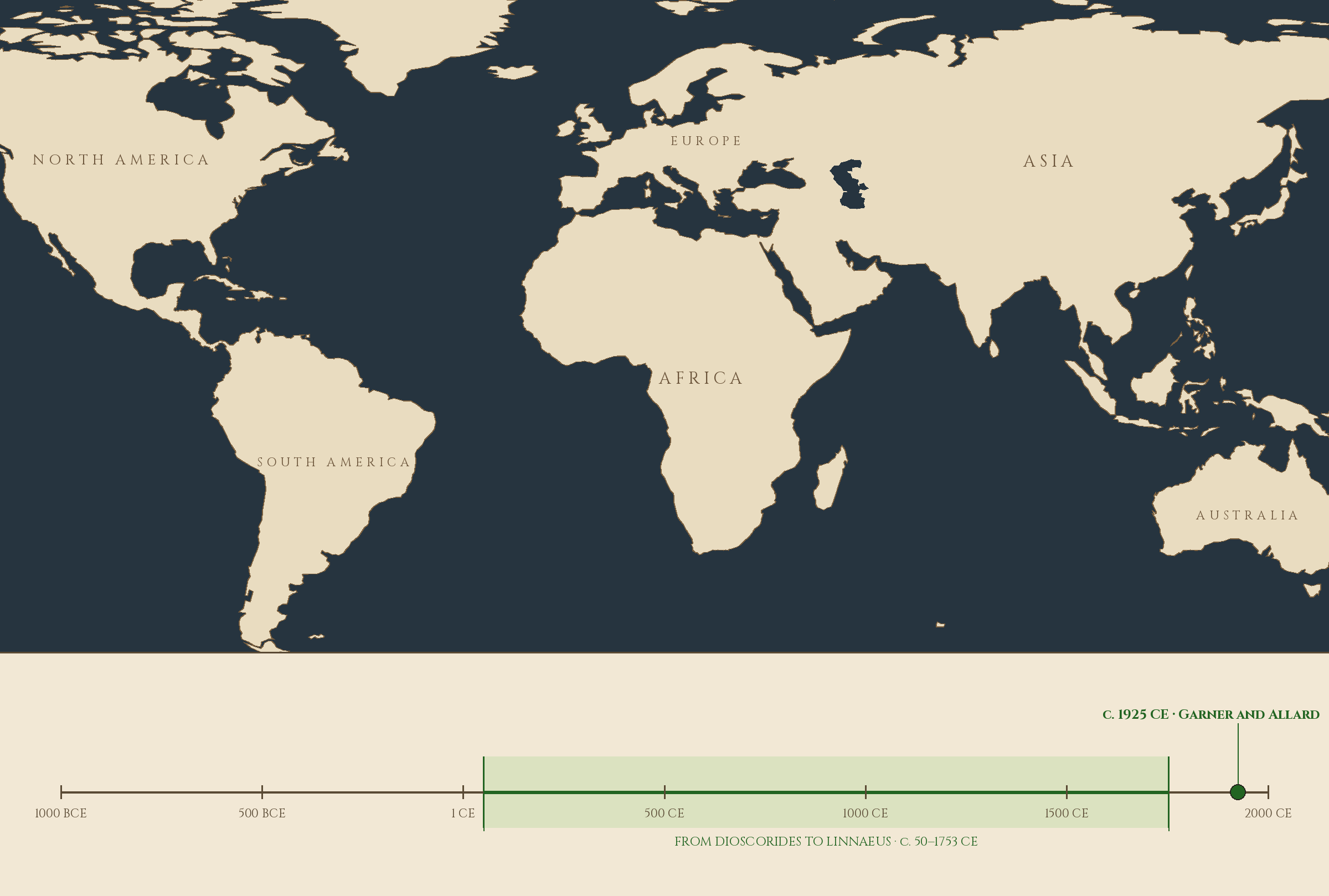
When: c. 1925 CE — Garner and Allard. This lesson carries no pin of its own; its ground is nearer home. The line beneath the map is our road: every stop a place where the knowledge of plants changed, every lesson a step along it.
Lesson Objectives
By the end of this lesson, you will be able to:
- Define full sun, partial sun, partial shade, and full shade in hours of direct light, and read a plant label's light requirement with understanding.
- Explain why morning sunlight and afternoon sunlight are not the same thing for a plant.
- Create a sun map of your growing space by tracking light through the day and across seasons.
- Describe phototropism, etiolation, and sunscald, and recognize each in a living plant.
- Explain photoperiodism: how the length of uninterrupted night, not day, tells many plants when to flower.
- Assess your Scholar's Familiar's light conditions and decide whether its placement serves it well.
Reading this lesson: ★ marks the passages to remember. They return on the unit quiz and the class test. Check in questions ask the material back as you go; answer them in your workbook when you meet them.
Working this lesson: Your assignment packet is the first download on this page. Work in it as the lesson moves along, answering each assignment as its subject is taught — or read the lesson through for your notes and take the assignments as homework afterward. Both are proper ways to sit this class. Signposts in the reading tell you where each assignment belongs. Written answers are short answers in your own words; a few honest lines are worth more than a filled page.
Your Assignment Packet
This lesson's assignments live in its packet: the Lexicon Handout (every term, course terms marked ◆), Materials, Guided Practice, the Assignment Manual with its answer key for self-checking, the Reflection Questions, and the Workbook Checklist. Download the packet before you begin and keep it beside you as you read.
The Vocabulary of Light
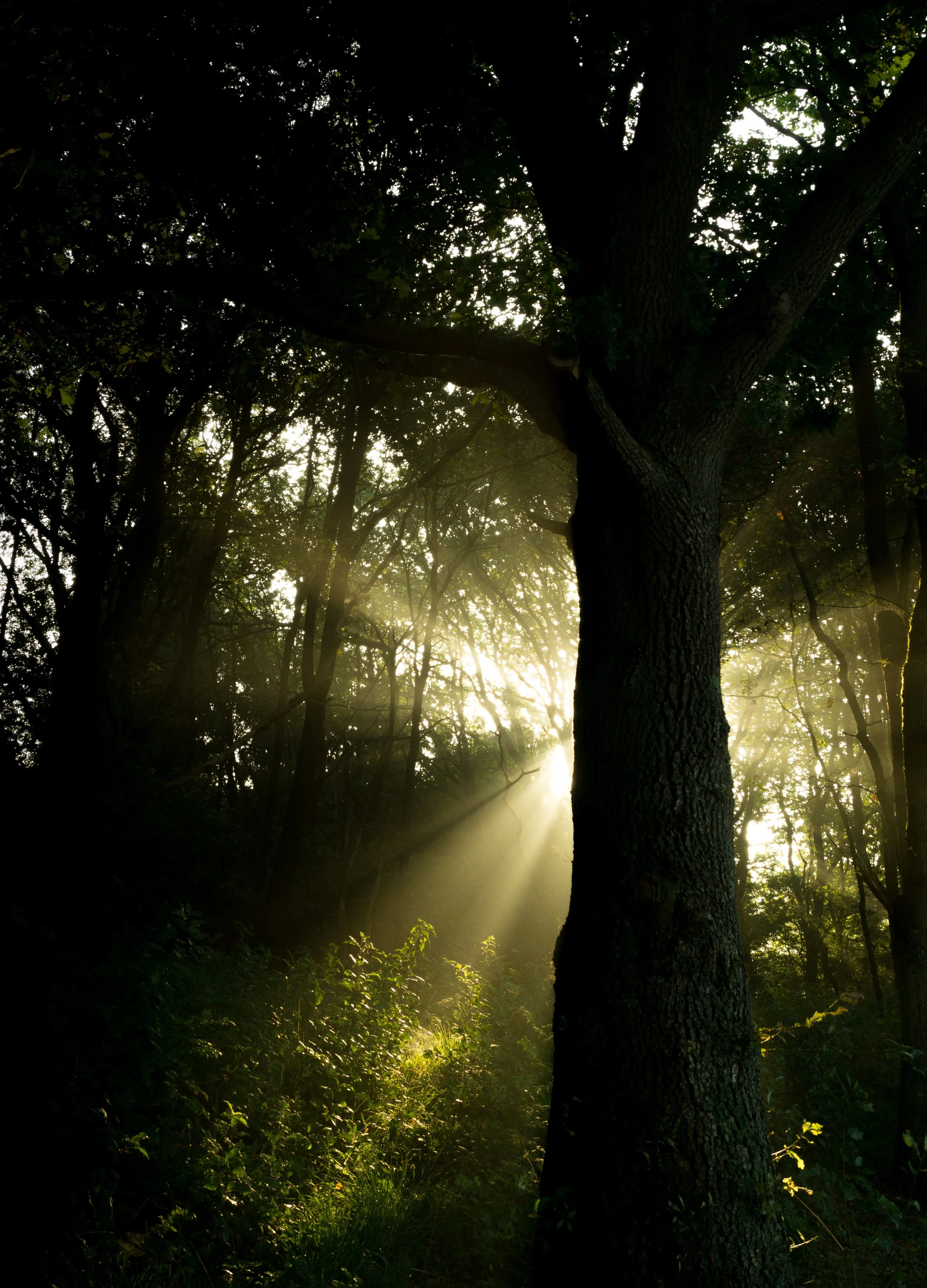
Dappled light: sunlight filtered through leaves overhead, falling on the woodland floor in bright patches. A dappled spot can suit a woodland plant perfectly — what matters is the total hours of light by the end of the day, not one sunny minute. The low slant of the beams is morning light, gentler than the steep sun of midday.
Photograph by Pixel.la free stock photos, released as CC0. Public domain.
Gardeners speak of light in a shorthand that confuses beginners, because the words sound casual and the meanings are precise. Let us make them precise for you now, so that every plant label you ever read becomes legible.
You already know two of the building blocks from Lesson 1. Direct sunlight reaches a plant in unfiltered rays, striking the leaves without passing through any barrier. Indirect light arrives filtered, reflected, or diffused, softened by a curtain, a wall, or a canopy of leaves above. Keep those definitions close. Everything in this lesson builds on them.
Now the standard categories, as most horticultural sources define them:
★ Full sun means six or more hours of direct sunlight each day. Those hours do not need to be continuous. Four hours in the morning, shade at midday, and three hours in the afternoon still count, because the plant adds up the total. What matters is that the light is direct.
Check in: A bed gets four hours of direct sun in the morning and three in the afternoon, with shade at midday. Does it count as full sun — and why?
Partial sun means roughly three to six hours of direct sun daily. Many growers use it interchangeably with the next term, but there is a useful distinction: a partial sun plant generally wants the sunnier end of that range and tolerates stronger light.
★ Partial shade also means roughly three to six hours of direct sun, but with an important condition: the plant needs protection from the intense midday sun, typically from late morning through mid-afternoon. Give it morning light or evening light, and shade when the sun stands highest.
Check in: Partial sun and partial shade cover the same hours. What condition separates them?
★ Full shade means fewer than three hours of direct sun per day. Note carefully that this does not mean darkness. Shade plants still need light. A spot under a tree canopy, bright with filtered and reflected light but touched by almost no direct rays, is full shade, and ferns and hostas thrive in it.
There is one more term worth knowing. Dappled light is sunlight filtered through leaves overhead, arriving in shifting patches. It is the light of the woodland floor, and many shade-loving plants prefer it to the flat, unchanging shade of a building's shadow.
Read a plant label now and you can translate it. "Full sun" is a demand for six honest hours. "Part shade" is a request for gentleness at noon. The label was never vague. We were only missing the dictionary.
❦ In your workbook: record the vocabulary of light in your own way — the four categories in hours, and the one condition that separates partial shade from partial sun — copy, sketch, or note what matters.
Morning Light Is Not Afternoon Light
Here is something the hour-counts do not tell you: not all sunlight hours are equal.
★ Morning sun arrives at a slant, having traveled through more of Earth's atmosphere, and it strikes while the air is still cool from the night. It is bright enough for photosynthesis but gentle enough that few plants burn in it. Afternoon sun comes down steeper and hotter, landing on leaves and soil already warmed by hours of exposure. In high summer, the difference can be dramatic. A plant that basks happily in six hours of morning light may scorch in six hours of afternoon light, even though the label's hour count is satisfied either way.
Check in: The label's hour count is satisfied either way, yet the plant scorches. What two things make afternoon sun the harsher ration?
This is why experienced gardeners speak of eastern exposures with such fondness. An east-facing bed or windowsill receives the gentle morning hours and rests in shade through the fiercest heat. A west-facing position gets the brunt of the afternoon. Neither is better in itself. They are simply different, and matching the plant to the exposure matters as much as counting the hours.
Heat-absorbing surfaces make the difference sharper. A bed beside asphalt, concrete, or a sun-baked brick wall runs hotter than the same bed beside a lawn. Pots on a dark deck heat from below as well as above. When you assess a spot, consider not only the light but the warmth that rides with it.
Your Scholar's Familiar has been telling you about its light all along, if you know how to listen. That is our next subject.
Sealed with the mark of Professor Beryl Fernfoot, Master Herbalist of the Herbology Greenhouse, Head of House Oriens.
You are doing well. I know this is a great deal of careful distinction for something as ordinary as sunshine, and I want you to know that every experienced gardener you will ever meet learned it exactly this way: by getting it wrong a few times, watching closely, and adjusting.
There is no shame in a plant placed badly. There is only information. The plant that leans is teaching you about light. The leaf that scorches is teaching you about afternoons. Listen, adjust, and carry on. That is the whole of gardening, and you are already doing it.
— Professor Beryl Fernfoot, Herbology Greenhouse • Master Herbalist • Head of House Oriens
❦ In your workbook: record morning light against afternoon light in your own way — the slant, the cool air, the surfaces that store the heat — copy, sketch, or note what matters.
Mapping Your Light: The Sun Map
The most reliable way to understand the light in a growing space is also the simplest: watch it, hour by hour, and write down what you see.
Choose a day when you will be home, or able to check in regularly. Beginning early in the morning, look at each area where you grow plants, or might grow them, and note whether it is in sun or shade. Repeat every hour until evening. A simple chart works beautifully: areas down the left side, hours across the top, a mark in each cell for sun or shade. By day's end you will have a sun map, and it will almost certainly surprise you. Spots you thought were sunny turn out to catch only two hours. Corners you dismissed sit in bright reflected light all afternoon.
★ If you can, make your map more than once. Light changes with the seasons, and this matters enormously. A bed that basks in full March sun may sit in deep shade by May, once the nearby tree leafs out. A windowsill that glows in winter, when the sun rides low, may lose its direct light entirely in summer when the sun climbs high overhead and the roof overhang blocks it. Map in spring and again in midsummer if you are planning anything permanent, like a raised bed or a perennial planting.
Check in: A bed basks in full March sun. Why might the same bed sit in deep shade by May — and what does that mean for a map made only once?
For houseplants and windowsill gardens, the map is simpler but no less useful. Note which window the plant sits in, which direction that window faces, how many hours of direct sun cross the sill, and whether anything outside, an awning, a neighboring building, a tree, interrupts it. South-facing windows in the northern hemisphere receive the most light overall. East-facing windows give gentle morning sun. West-facing windows deliver strong afternoon light. North-facing windows offer only indirect light, kind to shade lovers, starvation to sun lovers.
Record your sun map in your journal. It becomes part of your growing space's permanent record, and you will consult it every time you bring home a new plant.
❦ In your workbook: record the sun map in your own way — how the chart is built, and why one season's map is never the whole story — copy, sketch, or note what matters.
In your packet: Exercise I — The Sun Map ◐ begins here. Work it now, or mark the place and take it as homework — your choice.
How Plants Answer Light
Plants cannot walk toward better light, but they are far from passive about it. They respond, adjust, and sometimes complain, and a gardener who reads those responses can correct course early.
★ Phototropism is the most charming of the responses. A plant's growing tip bends toward light, guided by hormones that redistribute when one side of the stem is brighter than the other. You have seen it in every windowsill plant that leans toward the glass. It is not a flaw. It is the plant doing its best with what it has. The remedy is simple: rotate the pot a quarter turn each week, and the plant will grow evenly.
★ Etiolation is what happens when the light is truly insufficient. The plant stretches toward the brightness it cannot reach, producing pale, leggy stems with long spaces between leaves and small, washed-out foliage. An etiolated plant is not merely ugly. It is starving, spending its stored energy on a search that is not succeeding. The cure is more light, given gradually. A starved plant moved straight into blazing sun will burn, which brings us to the third response.
Check in: An etiolated plant is starving, yet moving it straight into blazing sun will harm it. Why must the cure be given gradually?
★ Sunscald is damage from sudden, intense light, most often when a plant raised indoors or in shade is moved into direct sun without adjustment. Leaves develop bleached, papery patches where the tissue has been overwhelmed. The plant was not given time to build its defenses. Gardeners avoid it by hardening off: moving plants into stronger light a little more each day over a week or two, the way you would wade into cold water rather than dive.
Learn to read these three signs and your plants will rarely suffer long. The leaning plant wants turning. The stretched, pale plant wants more light. The bleached plant wants a gentler transition. They are always telling you. The skill is in listening.
❦ In your workbook: record how plants answer light in your own way — the lean, the stretch, and the bleached patch, and what each one asks of you — copy, sketch, or note what matters.
In your packet: Exercise III — The Turning Experiment ⚒ begins here. Work it now, or mark the place and take it as homework — your choice.
The Calendar in the Leaves: Photoperiodism
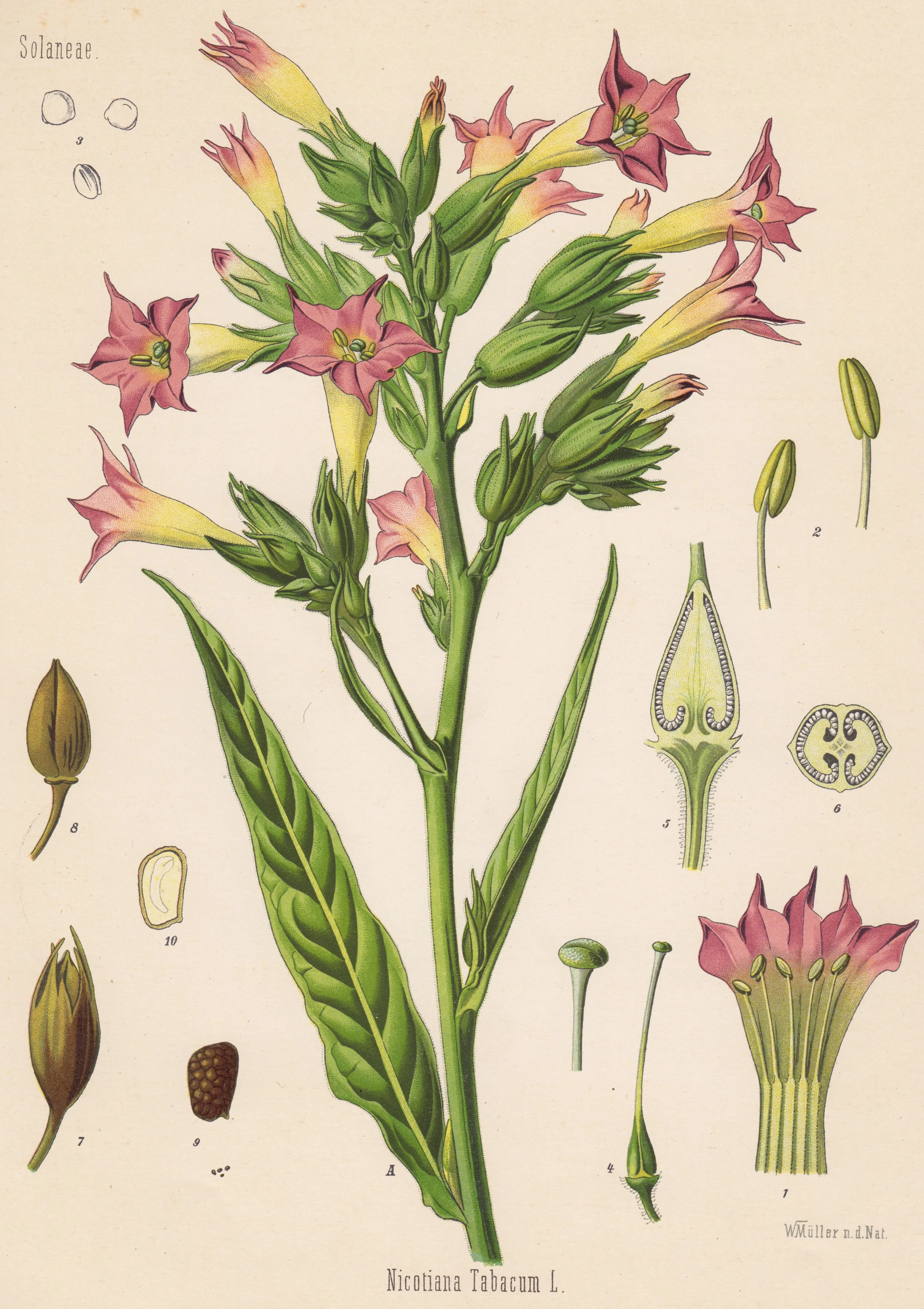
Tobacco, Nicotiana tabacum, drawn for Köhler's Medizinal-Pflanzen — the genus that changed how gardeners understand light. In the 1920s, USDA botanists Wightman Garner and Harry Allard studied a freak tobacco plant, Maryland Mammoth, that grew huge all summer and flowered only as the days shortened, and discovered photoperiodism: plants measure the season by the length of the night.
Köhler's Medizinal-Pflanzen plate (artist line in the file: W. Müller; plate credited on the Commons file to Franz Eugen Köhler's atlas). Public domain.
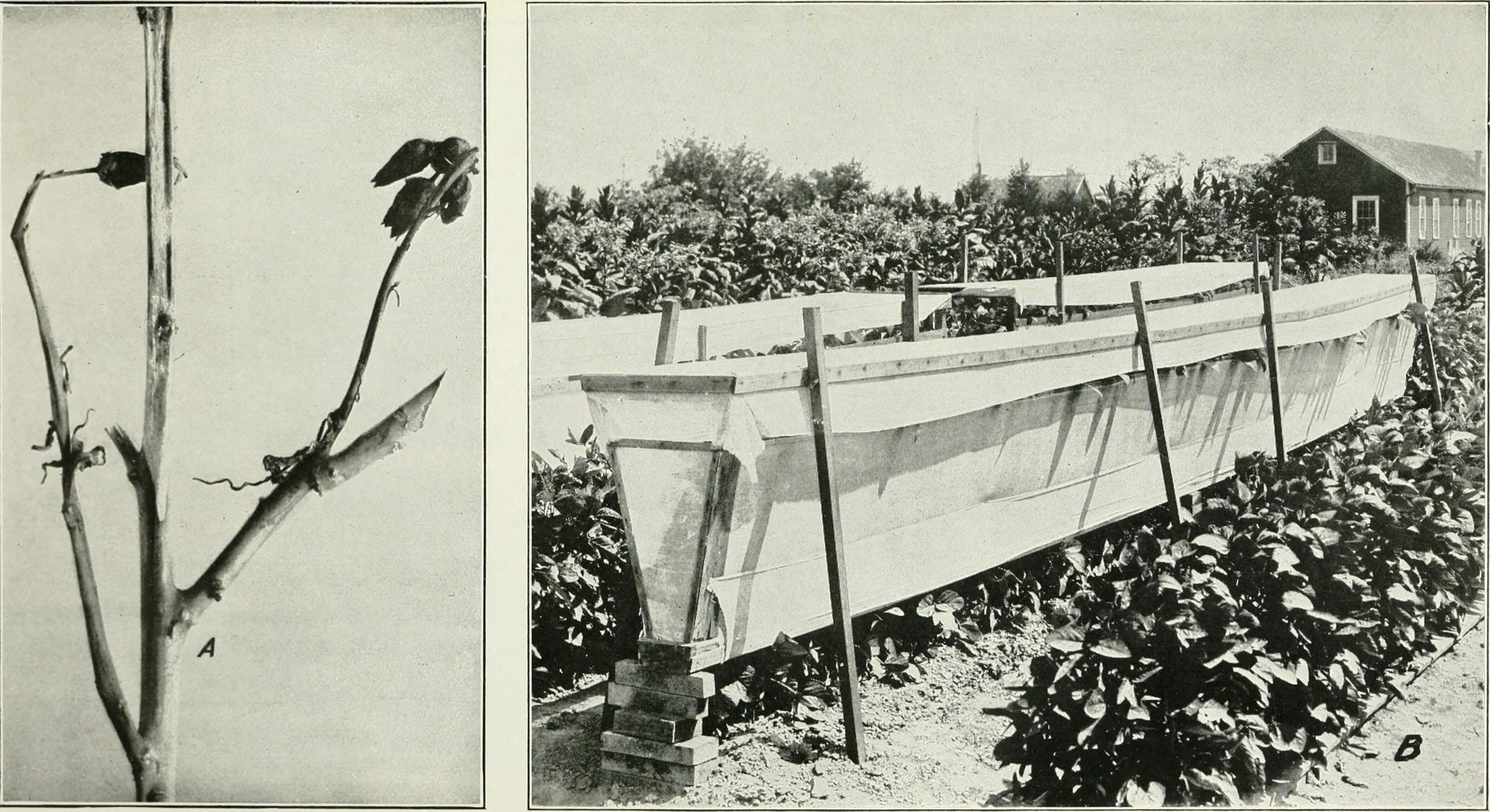
How the first photoperiod experiments were done, Journal of Agricultural Research, 1919: the long pale chamber in panel B is a darkening house built over a field row. Rolled or set over the plants each afternoon, it gave them an artificially long night in the middle of summer — and short-day plants under it bloomed as if autumn had come. Garner and Allard's insight was that the plant is counting the hours of uninterrupted darkness.
Journal of Agricultural Research (U.S. Department of Agriculture and the Association of American Agricultural Colleges and Experiment Stations), 1919, via the Biodiversity Heritage Library. No known copyright restrictions.
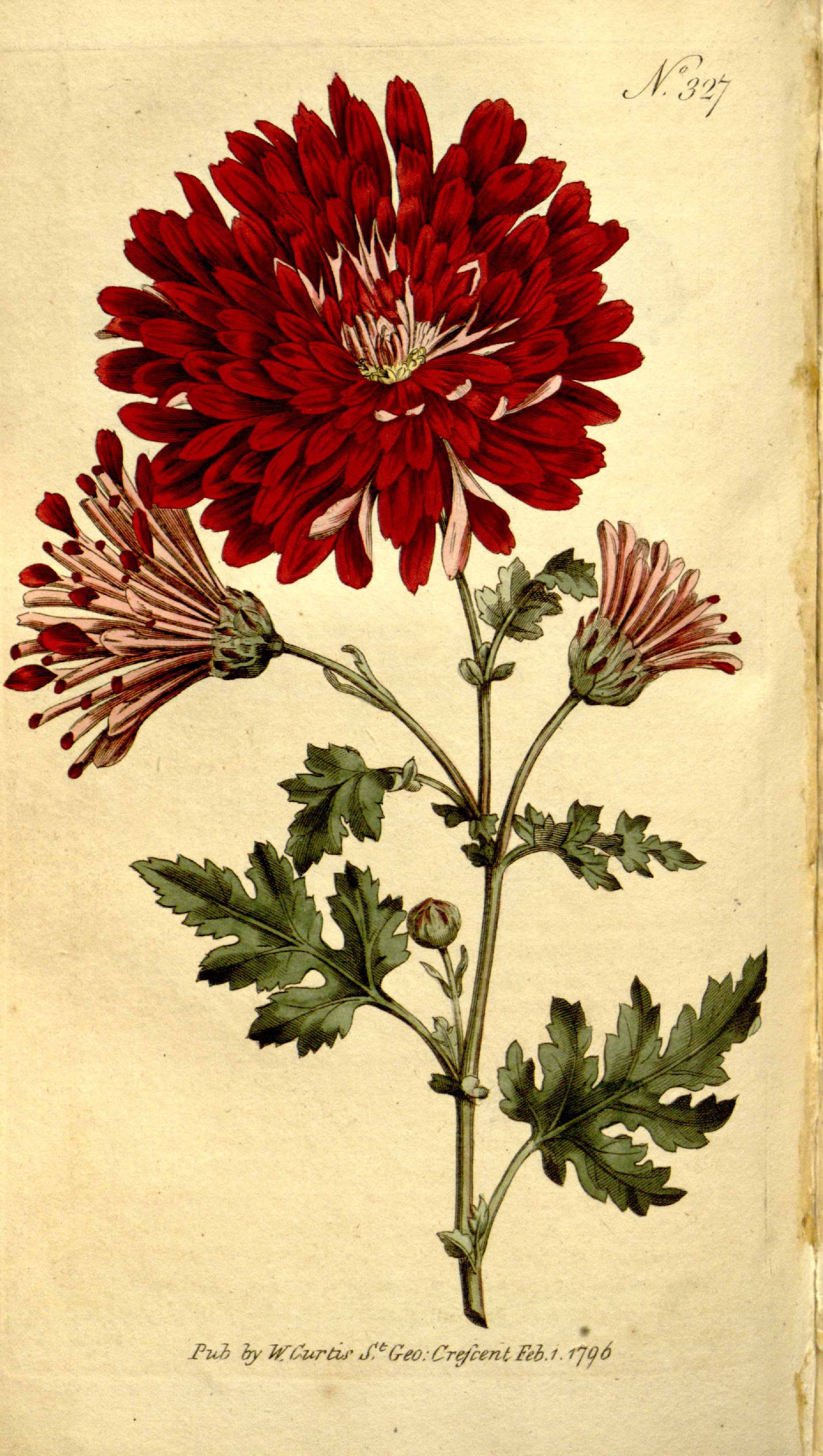
A chrysanthemum in full bloom, Curtis's Botanical Magazine, plate 327 (1796). Chrysanthemums are short-day — really long-night — plants: they set bud as the nights lengthen toward autumn, which is why they are the fall flower. One porch light breaking up the night can be enough to keep a mum in leaves and out of bloom.
William Curtis, The Botanical Magazine, plate 327 (1796). Public domain.
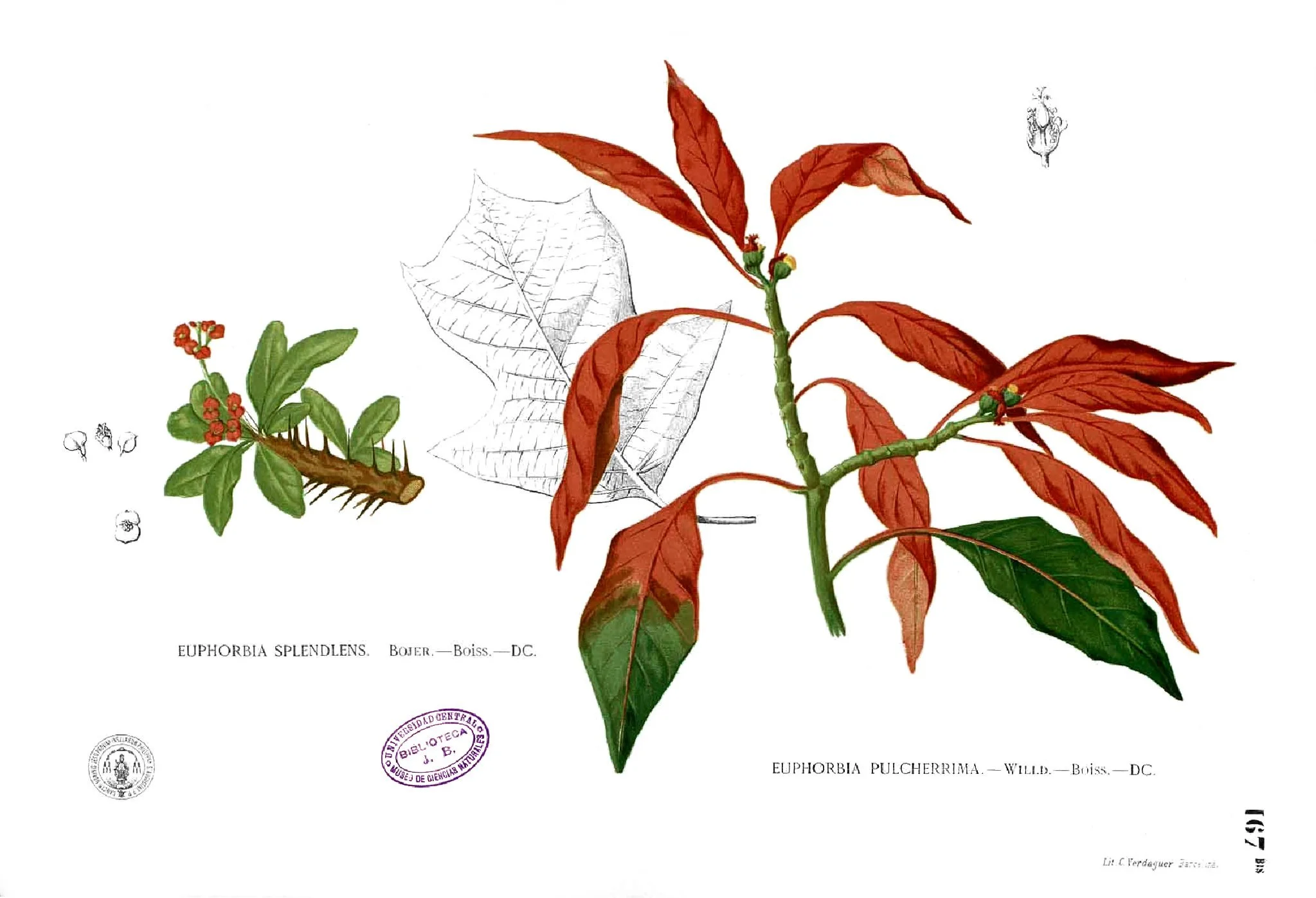
The poinsettia, Euphorbia pulcherrima, from Blanco's Flora de Filipinas — the plant on the right, in red bracts (the plate's smaller left-hand plant is a relative, Euphorbia splendens). Poinsettias are short-day plants: growers give them long, unbroken nights in autumn to bring the red bracts on in time for winter, by the same clock the chrysanthemum keeps.
Francisco Manuel Blanco, Flora de Filipinas, plate 167bis. Public domain.
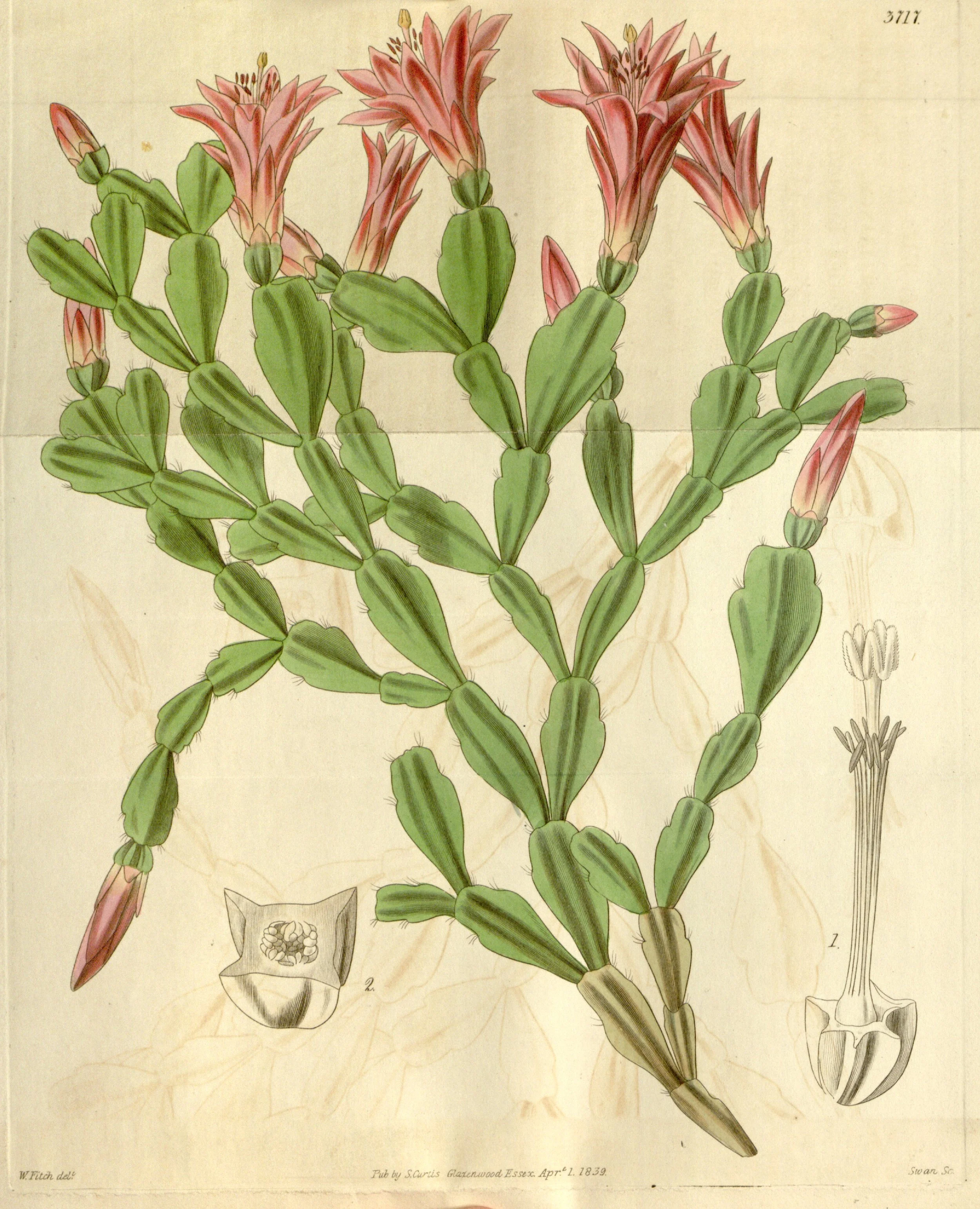
A Christmas cactus relative, Schlumbergera russelliana (drawn here under its old name, Epiphyllum russellianum), Curtis's Botanical Magazine, plate 3717, 1839. The flat segmented stems are the leaves' stand-ins. Christmas cactus is a short-day plant: buds form as nights lengthen in fall, which is why a plant kept under evening lamplight may stay stubbornly green.
W. Fitch (drawing), Swan (engraving), Curtis's Botanical Magazine, plate 3717 (1839). Public domain.
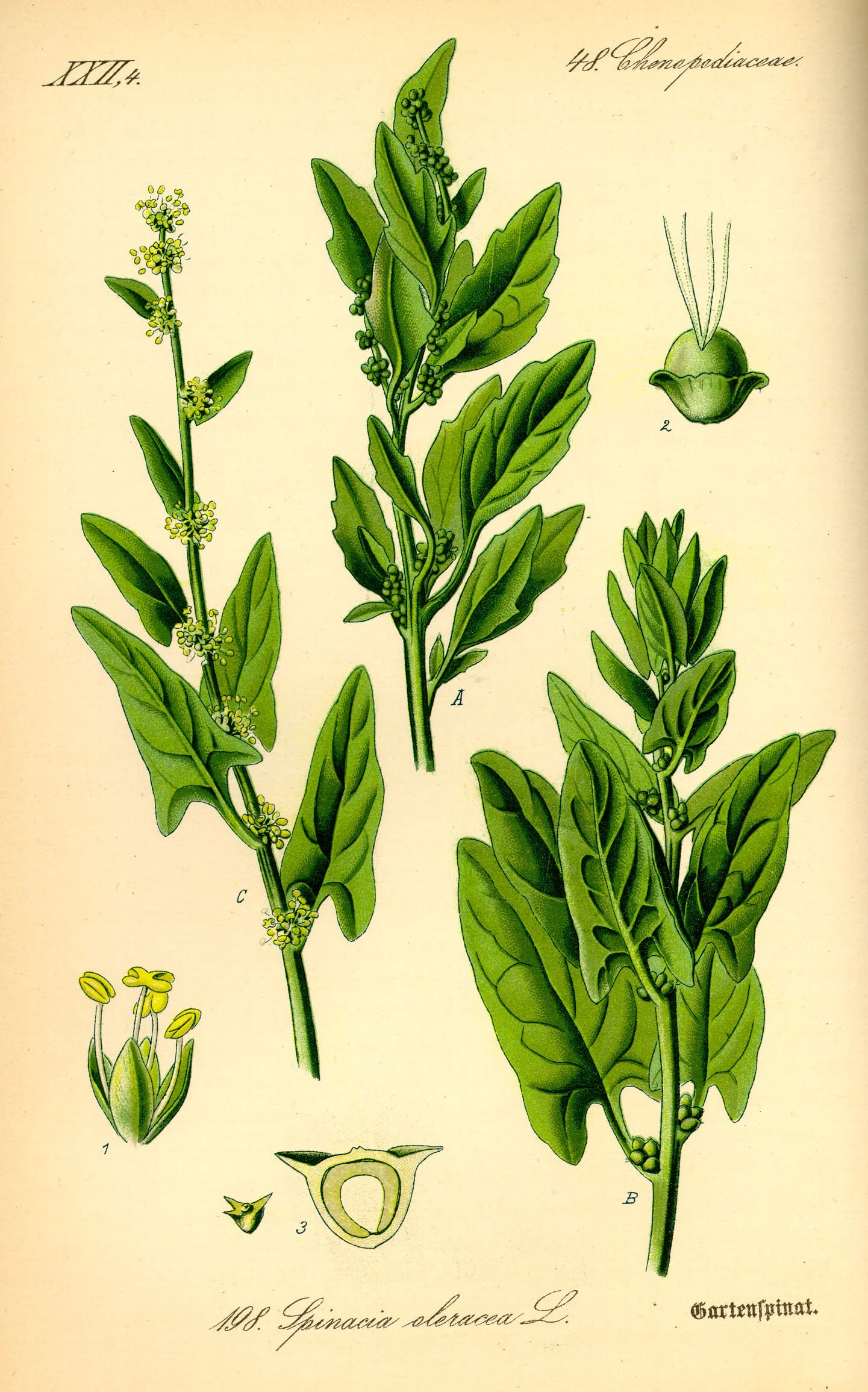
Spinach, Spinacia oleracea, Thomé's Flora von Deutschland, plate 198 — shown the way a long-day plant ends: bolted. As days lengthen toward summer, spinach stops making leaves and sends up a flowering stalk instead, which is why it is sown for the cool, short days of spring and fall.
Otto Wilhelm Thomé, Flora von Deutschland, Österreich und der Schweiz, plate 198. Public domain.
Now we come to the subtlest thing light does, and the most wonderful. Plants do not only measure how much light they receive. Many of them measure how long the days are, and they use that measurement as a calendar.
In the 1920s, two American agricultural scientists, W. W. Garner and H. A. Allard, were puzzling over a giant tobacco variety called Maryland Mammoth. It grew enormous through the summer but refused to flower until autumn. Through careful experiments, they discovered that the plant was not responding to the amount of light at all. It was responding to the length of the uninterrupted night. They named the phenomenon photoperiodism, and it changed how we understand plant timing.
★ Here is the part that surprises most students: it is the night that matters, not the day. A flash of light in the middle of a long night can prevent flowering in some plants, while the same total hours of darkness, broken up, will not do. Plants sense night length through light-sensitive proteins called phytochromes, which shift between forms in light and darkness like a slow chemical hourglass. The plant is, in a very real sense, counting the dark.
Check in: A short-day plant's long night is broken by a flash of light, though its total hours of darkness stay the same. Why can that flash still prevent its flowering?
Botanists group plants by how they answer this calendar:
★ Short-day plants flower when the night grows longer than a critical length. The name is old and slightly misleading. They are really long-night plants. Chrysanthemums, poinsettias, Christmas cactus, and soybeans belong here. This is why your poinsettia blooms in December and your chrysanthemums in autumn: the lengthening nights tell them the season has turned.
Long-day plants flower when the night grows shorter than a critical length, in the long days of late spring and summer. Spinach, lettuce, radishes, asters, and coneflowers are in this group. Gardeners know the practical consequence well: lettuce planted too late "bolts," rushing to flower in the lengthening days, turning bitter as it does.
Day-neutral plants flower when they are ready, regardless of day length. Tomatoes, cucumbers, corn, and roses follow their own internal schedule, flowering at a certain age or size rather than by the calendar.
Why does this matter to you as a grower? Because it explains mysteries. The chrysanthemum that will not bloom under your porch light is not broken. The porch light is breaking up its night. The spinach that bolts in June is not failing. It is succeeding at exactly what long days tell it to do. And if you ever grow plants under artificial lights indoors, you now know that leaving the lights on all night can confuse them as thoroughly as any drought.
Temperature varies too much from year to year to serve as a reliable seasonal signal. Day length never varies. That is why plants trust it, and why you should too.
❦ In your workbook: record the calendar in the leaves in your own way — Garner and Allard's tobacco, the night that matters, and the three groups of plants — copy, sketch, or note what matters.
Matching Plants to Light
We end where we began: with your Scholar's Familiar, and the question of whether its place serves it.
Take your sun map and your plant's label, or your memory of its needs from your earlier research. How many hours of direct sun does its spot actually receive? Is the strongest light morning or afternoon? Does the spot match what the plant asks for?
If it does not match, you have options, and none of them require drama. Move the pot. Shift it a few feet toward or away from the window. If the plant is in the ground, note the mismatch in your journal and let it inform your next planting choice. If more light is needed indoors and no brighter spot exists, a simple full-spectrum bulb in a desk lamp, run for part of the day, can supplement what the window provides. If less light is needed, a sheer curtain softens a harsh window beautifully.
★ Make the change gradually if the plant has been in deep shade and you are moving it toward brightness. Remember sunscald. A week of transition is a small kindness that prevents real harm.
Record your assessment: the spot, the hours, the match or mismatch, and what you decided to do. This entry belongs in your journal's growing record, alongside everything else you have learned about your familiar. You chose this plant in Lesson 1. You have studied its leaves, its roots, its name, its history, and its dangers. Now you understand its light. The portrait is nearly complete.
❦ In your workbook: record matching plants to light in your own way — the options when a spot does not match, and the gradual change that kindness requires — copy, sketch, or note what matters.
In your packet: Exercise II — Your Familiar's Light Assessment ✎ begins here. Work it now, or mark the place and take it as homework — your choice.
Guided Observation: Reading Your Plant's Answer to Light
This lesson's observation needs no special day and no special season: take any plant you can visit — your Scholar's Familiar above all — and read what its light has already written on it, using the three signs this lesson teaches.
You will need:
- a plant to observe: your Scholar's Familiar, a windowsill plant, or a plant growing against a wall or fence outdoors
- your workbook and a pencil
Read the lean. Look at the plant's growing tip and stem. If it bends toward the light, you are seeing phototropism at work: note which direction the light comes from, and how far the plant has bent to reach it.
Read the stretch. Look at the spaces between the leaves and the color of the foliage. Pale, leggy stems with long spaces between leaves and small, washed-out foliage are etiolation: the plant is spending its stored energy on a search that is not succeeding.
Read the leaf surface. Look for bleached, papery patches. That is sunscald, the mark of a move into strong light made without a gradual transition.
Consider:
- Which of the three signs, if any, does your plant show — and what is that sign asking you to do?
- If the plant leans, what would a quarter turn each week do to its growth?
- If it is etiolated, why must its extra light come gradually rather than all at once?
Safety: observe only, and judge light by where it falls and where shadows lie — never look directly at the sun, not even briefly.
Materials
Required (Level One — household items)
- A notebook or journal: your existing Scholar's Familiar journal gains a sun-map section in this lesson.
- Pencil and eraser: for the hourly sun-map chart.
- A watch, clock, or phone: to check the time on each hourly observation round.
- A ruler: for drawing the sun-map grid neatly.
- Any potted plant or seedling: for the phototropism turning experiment. A kitchen windowsill plant works.
- A workbook: for the guided observation, the workbook paths, and the written work.
Suggested (Level Two — historically closer)
- A bound garden diary: gardeners have kept daily weather and light records for centuries; a stitched journal continues the tradition.
- A simple compass: for determining true window and bed orientation, as kitchen gardeners did when planning by aspect.
- A full-spectrum bulb in a desk lamp: to supplement winter windowsill light, as greenhouse growers have long done.
Safety Notes
- Sun safety for the gardener: When mapping sunlight or working outdoors, wear a hat, drink water, and use sunscreen. Take breaks in the shade on hot days. Younger students should garden alongside an adult during the warmest hours.
- Never look directly at the sun, not even briefly, when judging light direction or intensity. Judge by where light falls and where shadows lie, never by staring at the source.
- When moving plants to brighter positions, harden them off gradually over a week to prevent sunscald. A plant moved from deep shade to full sun in one day can be seriously damaged.
Reflection Questions
Answer the following questions in your workbook.
- Why is it the length of the night, rather than the day, that tells photoperiodic plants when to flower? What does that suggest about how plants "think" about time?
- A friend says their windowsill is "bright, so it must be full sun." How would you explain the difference between bright indirect light and full sun to them?
- Your chrysanthemum sits beside a porch light that burns all night, and it never blooms. Using this lesson, explain what is happening and how to fix it.
- The lesson says "the shade garden is not a failed sun garden." What does that mean for how you choose and value plants?
Workbook Checklist — Lesson 12
In my workbook I have:
- ☐ defined full sun, partial sun, partial shade, and full shade in hours of direct light, and read a plant label's light requirement with understanding
- ☐ explained why morning sunlight and afternoon sunlight are not the same thing for a plant
- ☐ made a sun map of my growing space, and labeled each area by its direct-sun hours
- ☐ described phototropism, etiolation, and sunscald, and recognized each sign in a living plant
- ☐ explained photoperiodism: how the length of uninterrupted night, not day, tells many plants when to flower
- ☐ assessed my Scholar's Familiar's light conditions and recorded whether its placement serves it well — and what I decided to do
☐ Lesson completed Date: ___ Signature: ___
The Professor's Closing Note
Sealed with the mark of Professor Beryl Fernfoot, Master Herbalist of the Herbology Greenhouse, Head of House Oriens.
And so we close our study of sunlight. I hope you will never again walk past a patch of light without wondering what a plant would make of it. That wondering is the naturalist's habit, alive and well in you.
One last thought before you go. Gardeners sometimes speak of "good light" and "bad light," but I have never found those words useful. There is only light that suits a plant and light that does not. The shade garden is not a failed sun garden. It is a different country, with its own citizens, and they are just as splendid. Match the plant to the place, and everything thrives.
Work gently, observe closely, and I will see you in the next lesson, where we turn our attention downward, to water and the hidden rivers beneath the soil.
— Professor Beryl Fernfoot, Herbology Greenhouse • Master Herbalist • Head of House Oriens
Cross-Class Connections

Celestial Studies · Unit I, Lesson 3 — The Tilted Year: Why We Have Seasons
Scholars, the days lengthen and shorten because the Earth walks its year tilted, and the sun's path climbs and sinks with the turning. Your sun maps are that tilt, written on a windowsill. Come and learn why the light you measured keeps its appointments — solstice, equinox, and the long slide between.

Potions · Unit II, Lesson 16 — Ingredient Stability & Storage Behavior
In my laboratory the same sunlight is a thief: it bleaches color and degrades the compounds behind fragrance and flavor, and my scholars map their storage microclimate exactly as you map your beds — noting every hour of direct sun that reaches the shelves. Learn here what light gives a living plant. Then come and learn what it takes from a stored one, and why we keep our jars in the dark.
Further Reading & Sources
- Planting in Sun or Shade — Penn State Extension — Precise hour-based definitions of full sun, partial sun, partial shade, and shade, with guidance on matching plants to conditions.
- Light Matters: Mapping Sun and Shade in Your Yard — Buncombe County Master Gardeners — How to create a sun map, why morning and afternoon sun differ, and why mapping in multiple seasons matters.
- What are short-day and long-day plants? — Oregon State University — Clear explanation of photoperiodism, night length, and why porch lights stop mums from blooming.
- Photoperiodism — Wikipedia — Full overview including Garner and Allard's discovery, phytochrome, and the three plant categories with examples.
- Defining Sun Requirements for Native Plants — Dyck Arboretum — How plant labels use sun terminology and how to interpret light requirements for your region.
Browse the Herbology shelf in the school Library for readable editions of these works.
Plants from this lesson stand in the Materia Botanica, the school's shared archive — each kept with its lessons, its keepings, and its cautions. This lesson's company:
CornLettuceRadishRoseTomato The whole Materia BotanicaPROFESSOR BERYL FERNFOOT · HERBOLOGY GREENHOUSE
Submit your work for this lesson using the form below.
CONTINUE IN THE HERBOLOGY GREENHOUSE
← Previous · Lesson 11: The Compost Crucible Next · Lesson 13: The Watering Matrix: Capillary Action & Root Hydration →
Unit II — Soils, Sunlight & Growing Environments Herbology Greenhouse — All 37 Lessons
The rest of Unit II: Lesson 8 · Substrate Profile · Lesson 9 · Soil Chemistry: pH · Lesson 10 · The N-P-K Matrix · Lesson 11 · Compost Crucible · Lesson 13 · Watering Matrix · Lesson 14 · Microclimate Calibration · Lesson 15 · Seasonal Growing Cycles · Lesson 16 · The Growing Plan