POTIONS
Course CapstoneTHE APOTHECARY'S SIGNATURE FORMULA
Professor Crimblebrew Muddlenook
Master Apothecary • Potions
Head of House Meridies • School of Evershade
Professor's Introduction

Scholars, in good order,
You entered this laboratory knowing nothing of vessels, ledgers, or the patience of steeping jars. You leave it, if you have done the work, as something rarer: a person who can be trusted with a process from intention to archive. That is what an apothecary is. Not a keeper of secrets. A keeper of records.
This final project asks you to prove it. You will design a preparation of your own devising, make it, document it, and present it as a finished entry in your potions journal. It must draw on at least three units of everything you have studied. It must be safe. It must be honest: every failure recorded, every revision explained.
I will be exacting. I make no apology for that. A seal means something because it is not given lightly.
Begin.
— Professor Crimblebrew Muddlenook, Potions Laboratory • Master Apothecary • Head of House Meridies
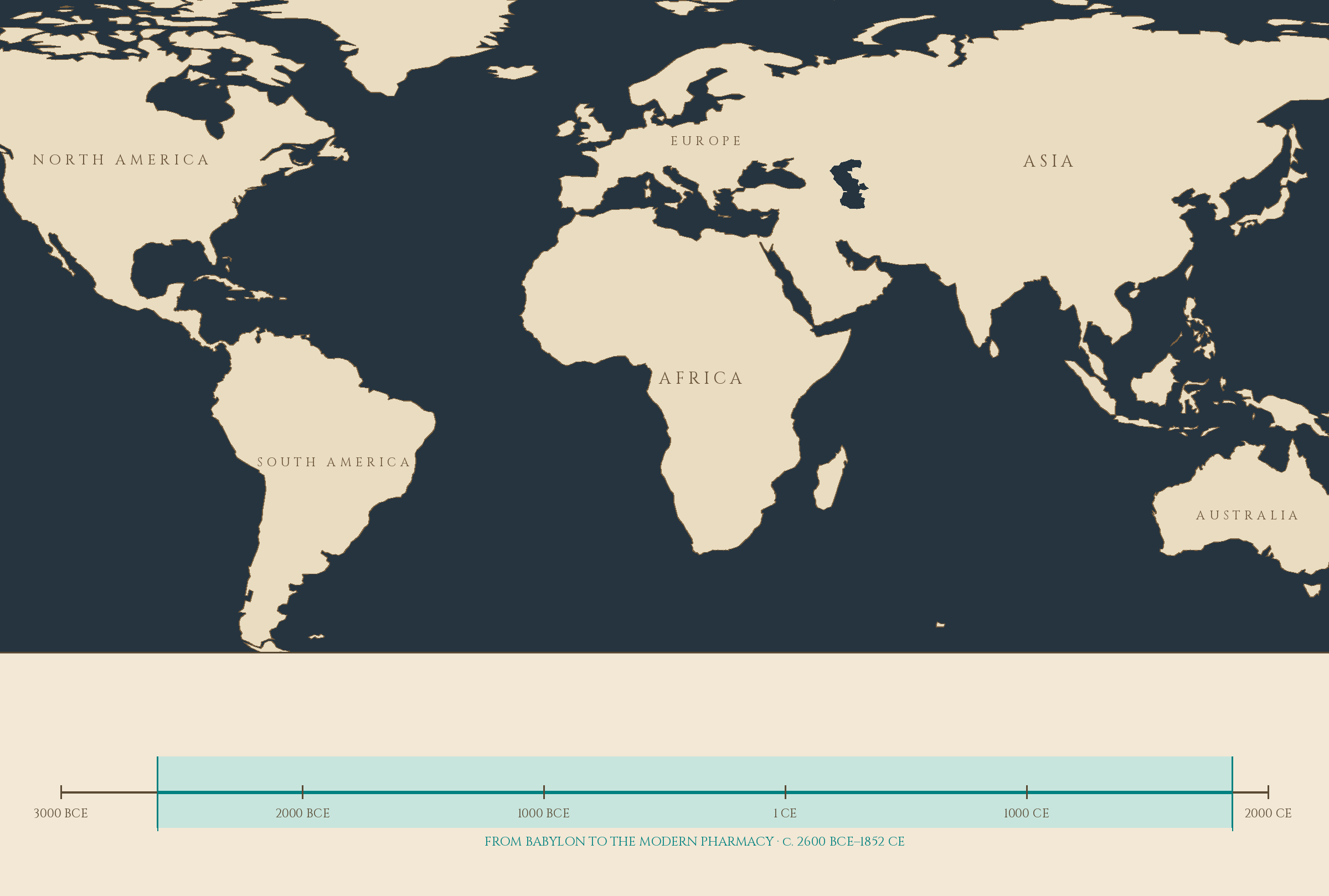
Potions map — the class base map, unmarked for this lesson.
Lesson Objectives
By completing this capstone, you will be able to:
- Design an original preparation that draws on techniques from at least three units of the course.
- Write a complete formulation brief: intention, materials, method, and safety plan, before touching a single vessel.
- Execute your preparation following the full laboratory rhythm, documenting every step in a batch record.
- Maintain a revision log that records what went wrong, what changed, and why.
- Present your finished preparation in archival format and contribute a Signature Formula entry to your potions journal.
- Assess your own work honestly against the Master Apothecary rubric.
Reading this capstone: There are no ★ marks in this document, and that is honest: the Signature Formula is not material for a later assessment — it is the course's final assessment itself, standing beyond the class test as the Defense stands beyond Herbology's. Its course-◆ lexicon terms stay with the capstone itself: nothing in this document is drawn into the class test. Check in questions ask the capstone's own standards back as you go; answer them in your workbook when you meet them.
Working this capstone: Your project packet is the first download on this page. Work in it as the capstone moves along, writing each part of the project as its subject is presented — or read through for notes and build afterward. Both are proper ways to sit this class. Signposts in the reading tell you where each exercise belongs. Written answers are short answers in your own words; a few honest lines are worth more than a filled page.
Your Assignment Packet
This capstone's work lives in its project packet: the Lexicon Handout (every term of the capstone, course terms marked ◆), Materials, Guided Practice — the Design Worksheet in full, with the brief checklist and the supervisor's safety-plan sign-off — the Assignment Manual (Exercises I–III, with the Master Apothecary Rubric printed whole), the Reflection Questions, the Workbook Checklist, and Answers & Self-Check, which carries the source's assessor guidance verbatim. Download the packet before you begin and keep it beside you as you read.
About this capstone's assessment, plainly: there is no quiz in the capstone, in either source, and none is taken from it for any unit quiz or for the class test. Assessment is by rubric and review: the Master Apothecary Rubric, scored honestly against your own package, and the assessor guidance printed in the packet's Answers & Self-Check. The capstone stands beside the class test as the course's second closing assessment — the test checks what was retained, the capstone checks the work. Nothing of this capstone enters the class test, its course-◆ terms included.
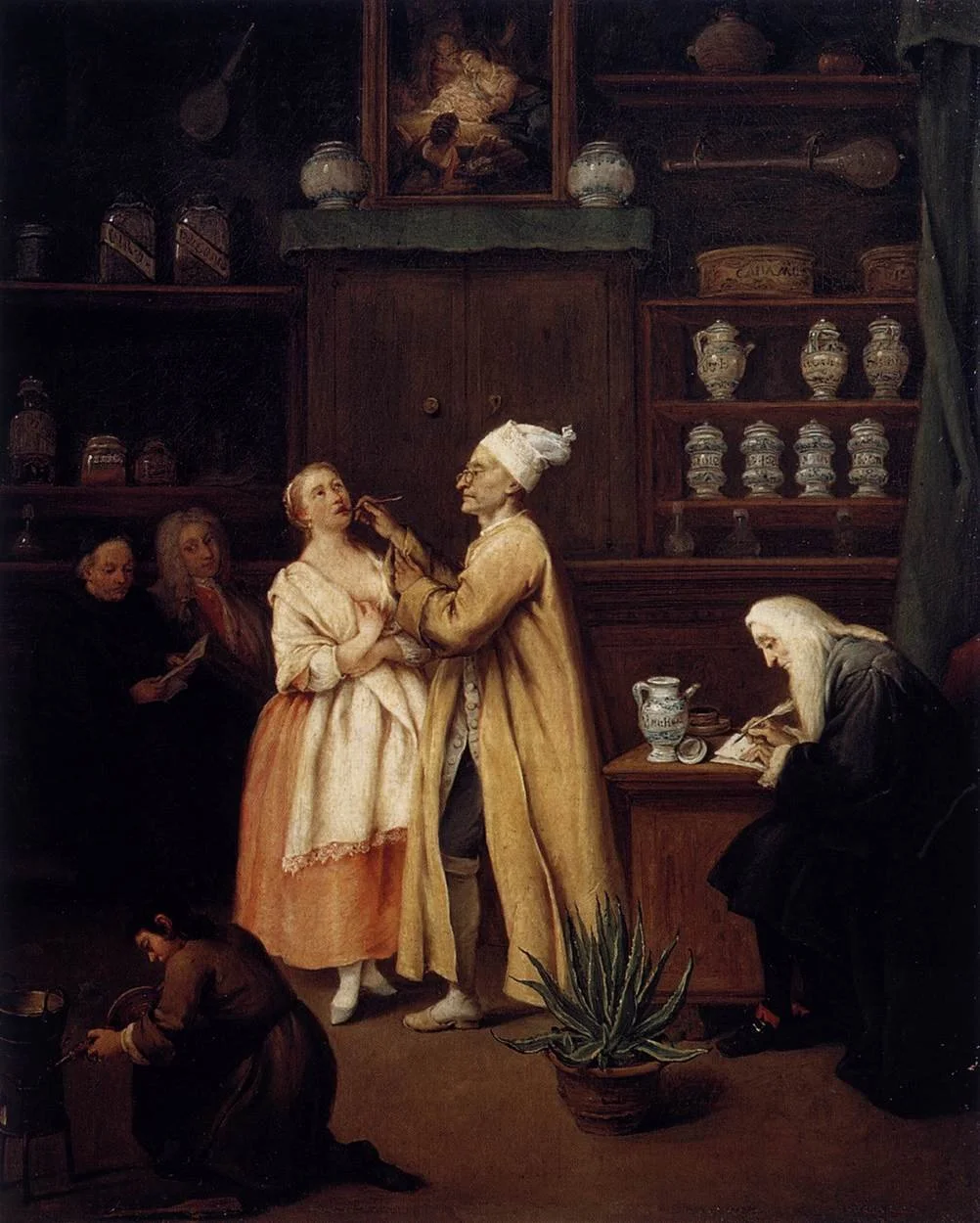
Pietro Longhi, The Apothecary, 1752: the dispensary the Capstone Address remembers — a preparation compounded under the master's eye, and at the desk beside it, the archive being kept in real time. The documentation matters as much as the preparation itself.
Pietro Longhi, The Apothecary, 1752, Gallerie dell'Accademia, Venice, via Wikimedia Commons (Web Gallery of Art scan). Public domain.
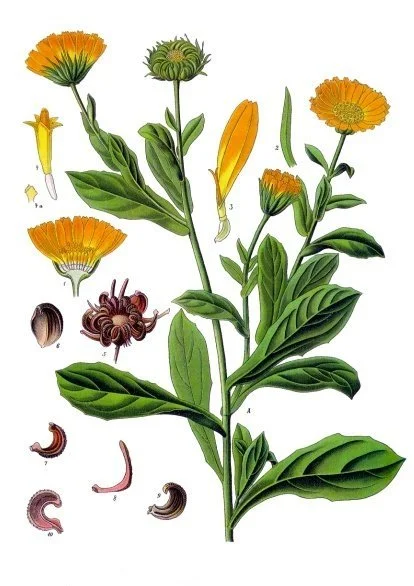
Calendula officinalis in Köhler's Medizinal-Pflanzen: the Address's own example of a masterwork — not grand, but perfect. Some of the finest masterworks Muddlenook has examined were humble things done perfectly, and this is the plant he names first.
Calendula officinalis plate, Köhler's Medizinal-Pflanzen, via Wikimedia Commons. Public domain.
Muddlenook's Capstone Address
Read this once, slowly, before you plan anything.
Every craft with a guild history ends the apprenticeship the same way: with a masterwork. The joiner builds a cabinet with no nails showing. The silversmith raises a vessel from a flat sheet. The apothecary's apprentice, in the old dispensaries, compounded a preparation from prescription to finished jar under the master's eye, and the jar was shelved where every future apprentice could read the label and learn.
Your Signature Formula is that jar.
It does not need to be grand. Some of the finest masterworks I have examined were humble things done perfectly: a calendula oil with a flawless infusion log, a beeswax balm whose ratio worksheet reads like a proof in geometry, a set of ink sticks ground to a consistency the maker could defend particle by particle. Ambition impresses no one here. Rigor does.
What it must be is yours. Not a recipe copied from a book and followed. A preparation you designed, for a reason you can state, using judgment you can defend. The documentation matters as much as the preparation itself, because in this laboratory the archive is the work. A brilliant preparation with no batch record is a rumor. A modest preparation with a complete record is knowledge.
You have fifty-two lessons behind you. Use them.
Check in: Ambition impresses no one here. What does — and what is a brilliant preparation with no batch record?
❦ In your workbook: record the Capstone Address in your own way — the masterwork tradition, the jar on the shelf, and rigor over ambition — copy, sketch, or note what matters.
The Project Brief
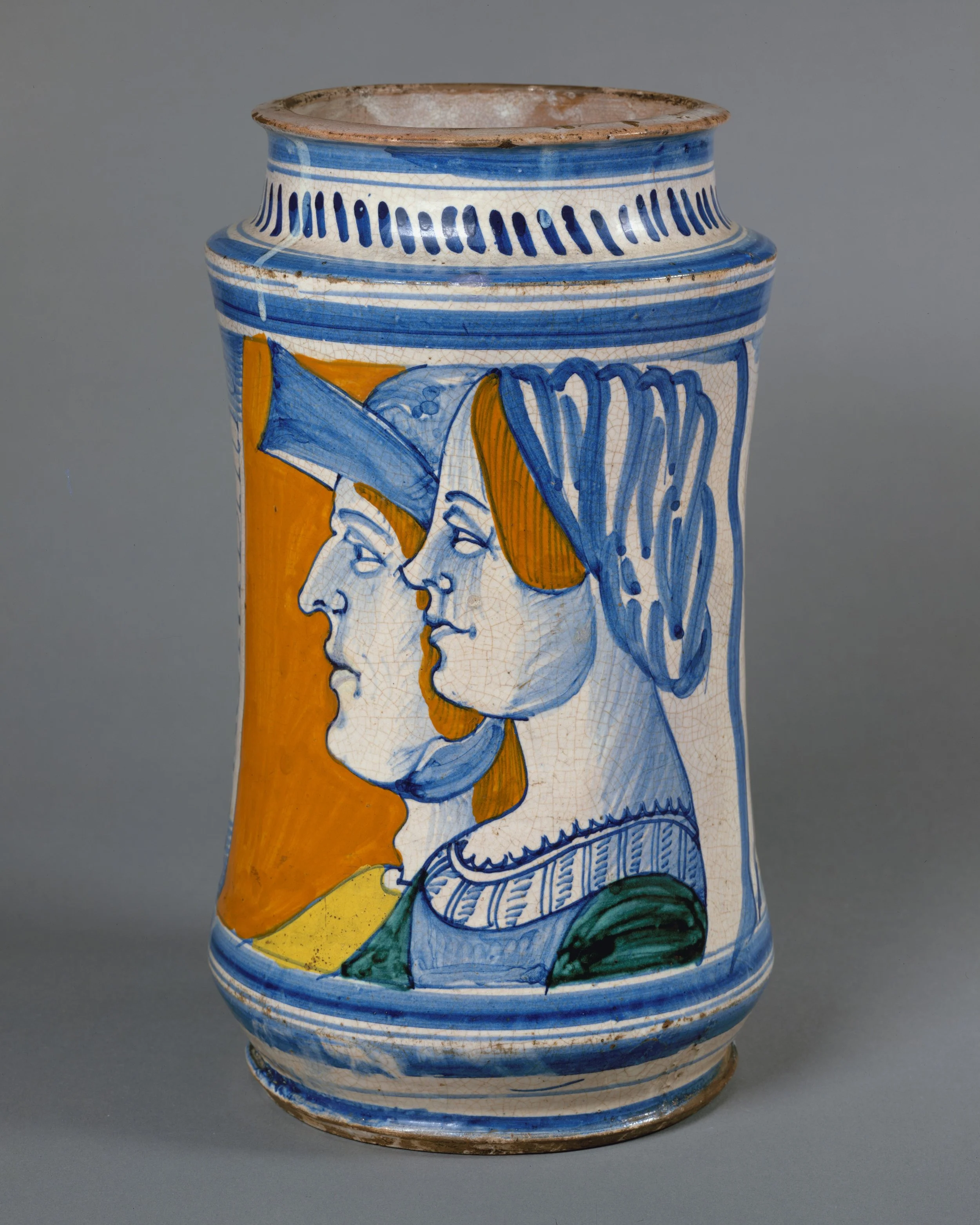
An apothecary jar (albarello), Italian, Faenza or Naples, about 1480–1500: the masterwork's vessel. Your Signature Formula is that jar — a preparation designed, documented, and labeled so that its record can be read long after its maker has left the bench.
Apothecary jar (albarello), Italian, Faenza or Naples, ca. 1480–1500, Robert Lehman Collection, The Metropolitan Museum of Art (Object 1975.1.1052). Public domain.
What you will produce
One finished preparation, presented archivally, with complete documentation:
- A formulation brief (written before you begin work).
- A batch record (written during the work, in real time).
- A revision log (every deviation, failure, and correction).
- A finished preparation, labeled to laboratory standard.
- A Signature Formula entry in your potions journal, in permanent form.
- A presentation of the whole, as described below.
The constraints
These are not suggestions. A project that breaks a constraint is returned unsealed.
- Three-unit rule. Your preparation must employ techniques from at least three different units of the course (Units I through VI). Name the units and the techniques in your brief. A preparation using only Unit IV extractions, however fine, does not qualify.
- Display-only default. Your finished preparation is a study piece and must be labeled as display-only and not for consumption, unless it meets the exception below.
- The consumption exception. A preparation may be made for ordinary household use only if every ingredient is an ordinary food-safe kitchen material, the method uses only techniques already taught as food-safe in this course, and a competent adult supervises and approves. Alcohol-based preparations are never consumable in this course. When in doubt, display-only.
- Safety plan required. Your brief must include a safety plan covering every hazard your preparation involves: heat, steam, open flame, alcohol, lye, smoke, dust, pigments, or blades. If your preparation involves lye, open flame near alcohol, or any step you cannot perform with complete confidence, you must choose the supervised or observational path for that step and say so in the brief. If your preparation is ever to touch skin, the plan must also include a patch test: a little of the finished preparation on the inside of the wrist, a full day's wait, and no use if the skin reddens, itches, or stings — and no preparation is ever used on broken or irritated skin.
- No medicinal claims. Your preparation makes no claim to heal, treat, cure, or affect health. Describe what it is and what it does as a material. "A beeswax and oil balm with a smooth, firm texture" is a description. Anything beyond that is a claim, and claims are forbidden.
- Honest documentation. The batch record is written during the work, not reconstructed afterward. Times, temperatures, observations, and mistakes go in as they happen. A revision log with no entries will be read as either a miracle or a fiction, and I do not believe in miracles in the laboratory.
Check in: Name the six constraints — and state the three conditions, all of them, under which the consumption exception may apply.
❦ In your workbook: record the Project Brief in your own way — the six things you will produce, and the six constraints that govern them — copy, sketch, or note what matters.
In your packet: Exercise I — The Formulation Brief ✎ begins here. Work it now, or mark the place and take it as homework — your choice.
Choosing your preparation
You are not required to invent a new category of preparation. Combining known techniques in a considered way is invention enough. The table below offers starting points. Each draws on at least three units.
| Starting idea | Units drawn upon |
|---|---|
| A layered botanical candle with a documented fragrance blend and a full burn log | II (fragrance), IV (infused oil), V (wax casting) |
| A labeled specimen set of one botanical prepared four ways (whole, crushed, infused oil, tincture-style maceration for observation only) | II (sensory), III (grinding), IV (extraction) |
| An archival gift set: sealing wax sticks, a labeled ink bottle (oak gall or carbon), and stained paper, presented as a scribe's kit | I (labels/seals), III (grinding), VI (inks, wax) |
| A pomander with a documented spice blend, built archive entry, and storage study | II (spices/aromatics), III (grinding), VI (pomander) |
| A "failed batch" study: deliberately vary one variable across three small batches, document the failures, present the diagnosis | III (preparation), V (formulation, failure analysis), I (records) |
| A soap duo: one melt-and-pour artistic bar and one fully documented cold-process batch (supervised), with cure logs | III (materials), V (both soap methods), I (records) |
You may propose anything else that meets the constraints. Originality is welcome; recklessness is not.
❦ In your workbook: record the starting points in your own way — the six ideas and the units each one draws upon, and which of them your own bench could honestly attempt — copy, sketch, or note what matters.
The Design Worksheet (summary)
The full worksheet appears in the assignment packet. In brief, your formulation brief must answer:
- Intention. What are you making, and why? One paragraph.
- Techniques and units. Which three (or more) units contribute, and which specific techniques from each?
- Materials. Complete list with quantities, sources, and storage notes.
- Method. Step-by-step procedure in laboratory order, with times and temperatures where relevant.
- Safety plan. Every hazard named, every control stated, supervision confirmed.
- Documentation plan. How the batch record, revision log, and archive entry will be kept.
- Success criteria. How you will judge the finished preparation, stated before you begin.
Write the brief first. Then, and only then, set out your vessels.
❦ In your workbook: record the Design Worksheet in your own way — the seven headings your brief must answer, in their order — copy, sketch, or note what matters.
Documentation Standards
An apothecary's record must be readable by a stranger ten years from now. That is the standard. It implies:
- Dates and times on every entry. "Tuesday afternoon" is not a time.
- Quantities in weights and measures, using the systems from Unit I, Lesson 6. "A handful" is not a quantity.
- Observations in plain language. Color, texture, smell, sound, behavior. What you saw, not what you hoped.
- Legibility. If your handwriting fails under laboratory conditions, print.
- Permanence. The Signature Formula entry in your potions journal is written in ink, on archival paper, suitable for binding. Pencil fades. Memory fades faster.
- Completeness. A batch record that ends mid-procedure is worse than none, because it pretends to be a record.
Your Unit I archive training, your Unit II specimen records, your Unit IV extraction ledgers: all of it was rehearsal for this.
Check in: What is the standard every record is held to — and why is a batch record that ends mid-procedure worse than none?
❦ In your workbook: record the Documentation Standards in your own way — dates and times, weights and measures, plain language, legibility, permanence, completeness — copy, sketch, or note what matters.
In your packet: Exercise II — Build and Document ◐ begins here. Work it now, or mark the place and take it as homework — your choice.
The Independent Worker's Code (full-course safety recap)
You now work without a lesson telling you what comes next. The safety habits must therefore be yours, not mine.
- Survey before you start. Read your safety plan aloud before touching materials. If anything is missing, stop.
- Heat. Heat-safe vessels only. Never leave heating unattended. Handles turned inward. Steam burns faster than flame; respect the kettle, the double boiler, and the still.
- Alcohol. No open flame in the same workspace, ever. Sealed, labeled jars. "Laboratory study only, not for consumption" on every alcohol preparation.
- Lye. Goggles, gloves, long sleeves, ventilation, adult present. Lye and water: always add lye to water, never the reverse. On skin: flood with water, seek help. There is no casual lye work.
- Smoke and dust. Ventilation for incense, resin work, and grinding. Dust masks for fine powders. Pigments stain permanently; protect surfaces, skin, and clothing.
- Blades. Cut away from the body, on a stable surface, with attention. A distracted cut is the most common laboratory injury in history.
- Labels. Everything labeled: contents, date, hazards, "display-only" where required. An unlabeled jar is a failure of the whole project.
- Children, pets, and the curious. Preparations stored out of reach. Your laboratory is your responsibility.
- Emergencies. Know the location of your water source, your phone, and your adult supervisor before you begin. For ingestion or eye exposure, call Poison Control (1-800-222-1222 in the United States) or your local emergency number immediately.
If any step of your plan cannot be made safe, change the plan. There is no preparation worth an injury, and I will honor a student who scales back wisely over one who pushes through blindly.
Check in: State the lye rule word for word — which is added to which, and what happens on skin — and the alcohol rule on open flame.
❦ In your workbook: record the Independent Worker's Code in your own way — the survey, heat, alcohol, lye, smoke and dust, blades, labels, storage, and emergencies — copy, sketch, or note what matters.
Presentation
Present your work as a single archival package, in this order:
- The formulation brief.
- The batch record.
- The revision log.
- The finished preparation, labeled to standard (or photographs of it, if it is perishable, with the photographs dated and filed).
- The Signature Formula entry, as it appears in your potions journal.
- Your self-assessment, scored against the rubric below.
Arrange it as you would shelve it: clean, ordered, complete. A presentation that must be explained is not finished.
❦ In your workbook: record the Presentation in your own way — the six parts of the package, in their shelving order — copy, sketch, or note what matters.
In your packet: Exercise III — Present and Archive ◐ begins here. Work it now, or mark the place and take it as homework — your choice.
The Master Apothecary Rubric
Score each row honestly. Total your score at the end.
| Criterion | 0 | 1 | 2 | Your score |
|---|---|---|---|---|
| Three-unit integration | Fewer than three units, or units named but not genuinely used | Three units present but one is superficial | Three or more units, each contributing a real technique, named and traceable | |
| Formulation brief | Missing, or written after the work | Complete but vague on method or safety | Complete, specific, written before work began | |
| Batch record | Missing or reconstructed afterward | Present but gaps in times, quantities, or observations | Real-time, dated, quantified, legible | |
| Revision log | Missing, or claims no revisions | Records changes but not reasons | Every deviation recorded with cause and correction | |
| Safety plan and execution | Hazards unaddressed | Plan present but incomplete | Every hazard named, controls stated and followed | |
| Finished preparation | Absent or unlabeled | Present and labeled, but labeling or finish incomplete | Labeled to laboratory standard, display-only marked where required | |
| Signature Formula entry | Missing | Present but in pencil or incomplete | Inked, archival, complete, suitable for binding | |
| Presentation order | Disordered or partial | Complete but poorly ordered | Clean, ordered, shelvable as presented | |
| Self-assessment honesty | Inflated or evasive | Reasonable but avoids the weakest point | Names the weakest point plainly and states what would improve it | |
| Craft quality | Careless execution | Competent with visible flaws unaddressed | Careful, finished work; flaws acknowledged in the log |
Scoring. 18 to 20: Master Apothecary standard. 14 to 17: pass with distinction noted. 10 to 13: pass; revise the weakest row and resubmit. Below 10: not yet; confer with your supervisor and try again. There is no shame in "not yet." There is only the work.
❦ In your workbook: record the Master Apothecary Rubric in your own way — the ten criteria, and the band your honest total falls in — copy, sketch, or note what matters.
Materials
Everything on this list serves the project your brief designs: the capstone asks for no fixed kit, because the preparation is yours. Gather, against your own brief's Materials list, in the professor's own packet words: draw your materials from the kitchen, garden, and craft drawer first, and where you can source traditional materials, use them and note the difference they make.
- Your formulation brief's complete materials list — every item with quantities in weights and measures, sources, and storage notes, as the Design Worksheet requires. The brief must still list every item with quantities.
- Your batch record and revision log — kept in real time during the work, in your laboratory journal or the packet's working pages.
- Labels to laboratory standard — contents, date, hazards, and "display-only" marking where required, applied the moment the preparation is made.
- Ink and archival paper — for the Signature Formula entry in your potions journal, written in ink, on archival paper, suitable for binding.
- A camera or phone, for dated photographs — of key stages during the build, and of the finished preparation if it is perishable, the photographs dated and filed in the portfolio.
- Your Master Archive — your potions journal together with your ledgers, specimen entries, extraction records, and formulation notes from the whole course, shelved as one body of work beside the finished package.
Level One — household items: draw your materials from the kitchen, garden, and craft drawer first. The brief must still list every item with quantities.
Level Two — historically closer: where you can source traditional materials (proper waxes, glass vessels, archival paper), use them and note the difference they make.
The Independent Worker's Code governs how all of it is handled: your safety plan must address every hazard in the Code — heat, steam, alcohol, lye, smoke, dust, pigments, and blades — and if any step of your plan cannot be made safe, change the plan.
Reflection Questions
Answer in your laboratory journal, in complete sentences.
- Which of your three (or more) units contributed the technique you understand most deeply now, and what did the capstone teach you about it that the lesson alone did not?
- Describe one thing that went wrong during your build. What did the revision log entry for it say, and what would you change in the formulation brief next time?
- Why does this course insist that the batch record be written during the work rather than afterward? Give a reason grounded in your own experience of keeping one.
- Look at your self-assessment rubric. Which row scored lowest, and what is the plain truth about why?
- An apothecary's archive outlives the apothecary. What does your Signature Formula entry need to contain so that a stranger could understand and respect your work ten years from now?
Workbook Checklist — Capstone
In my workbook I have:
- ☐ written my complete formulation brief under all seven headings — Intention; Techniques and Units; Materials; Method; Safety Plan; Documentation Plan; Success Criteria — before any practical work, and had my adult supervisor read and sign the safety plan
- ☐ named at least three units and the specific technique each contributes, meeting the three-unit rule
- ☐ read my safety plan aloud before touching materials, and followed the Independent Worker's Code throughout
- ☐ kept my batch record in real time — times, temperatures, observations, and mistakes entered as they happened
- ☐ kept my revision log as deviations occurred, every entry with cause and correction
- ☐ labeled my finished preparation to laboratory standard: contents, date, hazards, "display-only" marking where required
- ☐ assembled my presentation portfolio in the lesson's six-part order: brief, batch record, revision log, finished preparation, Signature Formula entry, self-assessment
- ☐ written my Signature Formula entry in ink on archival paper and filed it in my potions journal
- ☐ scored my package honestly against every row of the Master Apothecary Rubric and named my weakest point plainly
☐ Capstone completed Date: ___ Signature: ___
The Professor's Closing Note
When your package is shelved, come and find me in the laboratory. I will open it, read every page, examine the preparation, and check the labels. If it meets the standard, I will seal it, and your Signature Formula will take its place in the archive as the last entry of your course and the first entry of whatever you do next.
Whether you ever compound another preparation or not, you will keep one thing from this laboratory: the habit of writing down what is true, as it happens, so that someone else can follow. That habit is the whole of the craft. Everything else is technique.
It has been an honor to keep the order of this laboratory with you.
— Professor Crimblebrew Muddlenook, Potions Laboratory • Master Apothecary • Head of House Meridies
PROFESSOR CRIMBLEBREW MUDDLENOOK
Potions Laboratory
Master Apothecary • Head of House Meridies
Cross-Class Connections

Herbology · Unit V, Lesson 36 — The Materia Botanica: Building Your Herbal
Come up to the Greenhouse, formula-makers, and see the shared Materia Botanica your Signature Formula entry stands companion to. In my herbal every plant gets its entry — what it is, how it grows, how it is gathered — and Professor Muddlenook's laboratory adds what was made from it and how. One plant, one entry, both kinds of knowledge side by side. Bring your entry, and we will set it beside the book it belongs with.
PROFESSOR BERYL FERNFOOT
Herbology Greenhouse • Master Herbalist • Head of House Oriens
Scrollwork · Unit VI, Lesson 22 — Wax Seals & Authentication
Professor Muddlenook seals the package that meets his standard. Come and learn what that seal means in mine. In the Scriptorium we press a carved matrix into warm wax so a document can prove it is what it claims to be — the same promise his seal makes over your Signature Formula. A seal means something because it is not given lightly, scholars. Come and see why.
Scrollwork · Unit VI, Lesson 23 — Archive Labels & Library Systems
Your presentation portfolio is arranged as it would be shelved: clean, ordered, complete. Now come and see the system that keeps a whole library that way. In my Scriptorium we take up the label, the list, and the shelfmark at the scale of collections — how a record stays findable for the stranger who opens it ten years from now. Your Documentation Standards have ancestors, scholars. Come and meet them.
PROFESSOR QUILLBERRY NOCTURNE
Scrollwork Library

Creative Arts · Unit II, Lesson 11 — Case Binding & Archival Boxes
An entry written in ink on archival paper, suitable for binding, deserves a binding built to suit it, scholars. In my workshop you will learn to case a book to measure and to build the archival box in which a great record rests — Professor Muddlenook's own recipe journals and the school's Materia Botanica are housed by these very rules. Build the practice corner first, on scrap, as always. Then bring your Signature Formula when its archive has grown into a volume, and we will house it properly.
PROFESSOR COGBRANCH TIMBERCLANK
Creative Arts Workshop
Further Reading & Sources
- The Worshipful Society of Apothecaries of London: history of the apothecary's training
- Science History Institute: "The Apothecary's Cabinet" and early pharmacy collections
- The Metropolitan Museum of Art: apothecary jars and pharmaceutical vessels
- Wellcome Collection: pharmacy and apothecary archives
- Colonial Williamsburg: the apothecary shop and 18th-century practice
Browse the Potions shelf in the school Library for readable editions of these works.
Submit your work for this lesson using the form below.
THE CLASS TEST
POTIONS LABORATORY · ALL SIX UNITS · LESSONS 1–52
The lessons are done, all fifty-two of them, and the scholar who cleared a first shelf in Lesson 1 now stands at the capstone with an archive that can be searched, audited, and followed by another worker. This test covers the whole of the Potions Laboratory, and it measures retention: not what you can look up, but what has stayed with you now that the class is complete. Take it from memory, in one sitting if you can, before you consult your notes, and attempt every part before you turn to the answer key at the back of the packet.
This test stands beside the capstone itself, and the two are not the same instrument. The capstone — your Signature Formula, designed, documented, and presented under the Master Apothecary Rubric — checks the work. This test checks what was retained. The test packet is a single download. Its parts move from multiple choice and true or false drawn across every unit, through a ten-term vocabulary matching, to short written answers and applied questions that put the craft to work. When you have finished, score it honestly, note the result in your workbook, and let any question that went wrong point you back to the lesson worth rereading. Then the class is complete, and the craft is yours.
CONTINUE IN THE POTIONS LABORATORY
← Previous · Lesson 52: The Apothecary's Continuing Ledger
Unit VI — Fragrance, Pigments & Botanical Arts Potions Laboratory — All 52 Lessons
The rest of Unit VI: Lesson 45 · Pomanders · Lesson 46 · Volatile Spirits · Lesson 47 · Burn Blends · Lesson 48 · Carbon & Oak Gall Inks · Lesson 49 · Plant & Berry Stains · Lesson 50 · Paper Aging · Lesson 51 · Wax Seals · Lesson 52 · Continuing Ledger
From the Apothecary Cabinet
The printed companions to the capstone, from Professor Muddlenook’s shelf in the shop.