
POTIONS
Unit VI · Lesson 46VOLATILE BOTANICAL SPIRITS
Professor Crimblebrew Muddlenook
Master Apothecary • Potions
Head of House Meridies • School of Evershade
Professor's Introduction
Scholars, in Lesson 32 you steeped botanicals in alcohol and watched a tincture take shape. Alcohol drew the plant's properties into solution, and you recorded the result. Today we ask a different question about that same liquid: not what it holds, but how fast it leaves.
Alcohol is the most restless liquid in our laboratory. Set out a dish of water, a dish of oil, and a dish of spirits, and return in an hour. The water will have shrunk a little. The oil will sit exactly as you left it, patient as stone. The spirits will be gone, vanished into the air, and the whole room will know where they went. That restlessness is the entire history of modern perfumery.
We will not make perfume today. We will study the vehicle that made modern perfume possible, measure its behavior with our own hands, and understand why a single change of solvent — a liquid able to dissolve or draw out other materials — rewrote an industry. Order. Observation. Record.
— Professor Crimblebrew Muddlenook, Potions Laboratory • Master Apothecary • Head of House Meridies
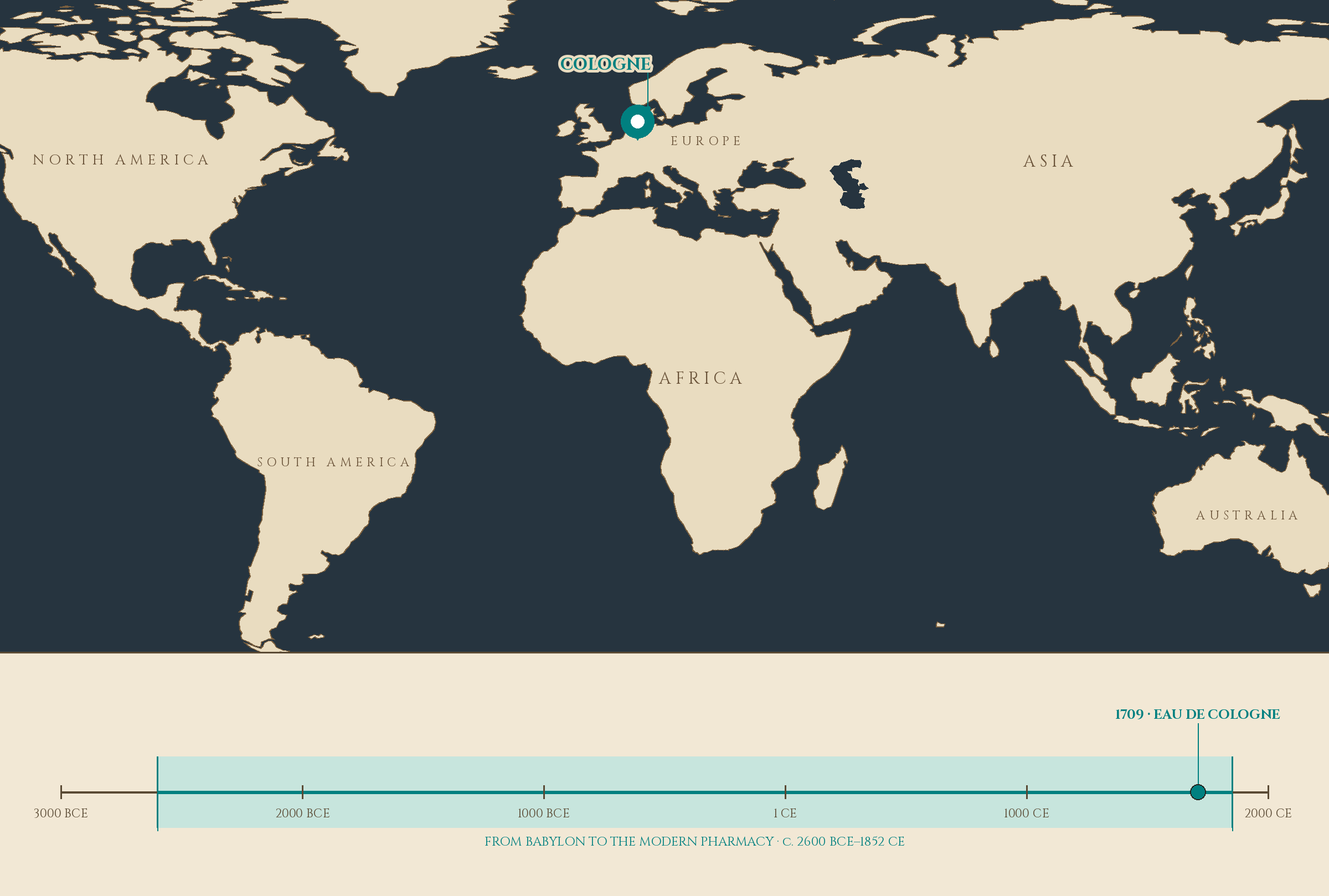
Pin: Cologne. Timeline stop: 1709 · EAU DE COLOGNE.
Lesson Objectives
By completing this lesson, you will be able to:
- Explain why alcohol replaced oil as the principal vehicle of European perfumery.
- Describe the relationship between volatility, vapor pressure, and evaporation rate.
- Compare the evaporation behavior of water, alcohol, and oil through direct observation.
- Define a fragrance accord and explain how the solvent shapes its timing.
- Trace the historical line from Hungary Water to Eau de Cologne with honest attention to what is documented and what is legend.
- Record an evaporation study in your laboratory archive using the standard entry format.
Reading this lesson: ★ marks the passages to remember. They return in the Unit VI Quiz, in the units ahead, and on the class test. Check in questions ask the material back as you go; answer them in your workbook when you meet them.
Working this lesson: Your assignment packet is the first download on this page. Work in it as the lesson moves along, answering each exercise as its subject is taught — or read the lesson through for your notes and take the exercises as homework afterward. Both are proper ways to sit this class. Signposts in the reading tell you where each exercise belongs. Written answers are short answers in your own words; a few honest lines are worth more than a filled page.
Your Assignment Packet
This lesson's exercises live in its packet: the Lexicon Handout (every term, course terms marked ◆), Materials, Guided Practice — the evaporation trial's five steps and its observation schedule, printed in full so you can run the trial from the packet at the bench — the Assignment Manual with its answers and self-check, the Reflection Questions, and the Workbook Checklist. Download the packet before you begin and keep it beside you as you read.
Safety Briefing
Read this entire section before touching any material.
Alcohol is flammable. This is the single most important fact of today's lesson. The small quantity of rubbing alcohol used in the evaporation trial must be kept far from every flame, spark, hot plate, and heated vessel in the laboratory. No candles, no matches, no stove burners anywhere near your work surface while the alcohol is out. Work in a ventilated room, keep the bottle capped except while dispensing, and store it sealed and labeled when you are finished.
Ventilation is required. Alcohol vapors in a closed room cause headache and dizziness. Open a window or work where air moves. If you feel lightheaded at any point, stop, step into fresh air, and tell your adult supervisor.
Adult supervision is required for this lesson. An adult must be present for the full procedure, must dispense or directly supervise the dispensing of the alcohol, and must confirm the work area is free of ignition sources before you begin.
Eye and skin rules. Do not rub your eyes during the procedure. If alcohol splashes into eyes, flush with clean water for several minutes and tell your adult. Wash your hands when you finish.
Label everything. The three test dishes must be labeled before any liquid is poured: WATER, ALCOHOL, OIL. An unlabeled dish in this laboratory is a failure of discipline, and in this lesson it is also a hazard.
No tasting, no wearing, no ingesting. Nothing prepared or observed in this lesson is for the body. The alcohol used here is rubbing alcohol, which is poisonous if swallowed. This lesson studies evaporation. It does not produce anything to wear, apply, or consume, and no part of it should be presented as a recipe for personal fragrance.
Check in: Before any liquid is poured, what must the three dishes be labeled — and who must dispense, or directly supervise the dispensing of, the alcohol?
❦ In your workbook: record the safety briefing in your own way — flammability and ignition sources, ventilation, adult supervision, eye and skin rules, labeling, and the no-tasting, no-wearing, no-ingesting rule — copy, sketch, or note what matters.
Before the Spirit: Oil and the Ancient Perfume
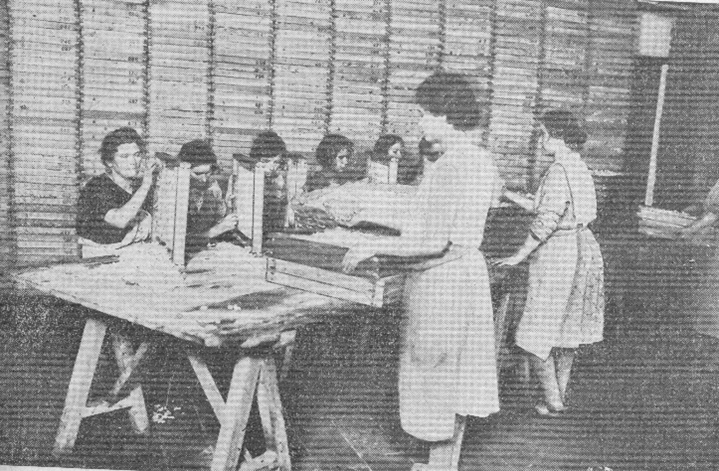
Enfleurage at work in Grasse: workers handling the glass frames in which fresh blossoms were laid, the frames stacked high behind them. Grasse came to scent through leather — tanners perfuming their gloves against the tannery's reek — and the flower work pictured here is the trade that eventually swallowed the leather business whole.
Enfleurage photograph (A. Chiris factory, Grasse), via Wikimedia Commons. Public domain.
For most of human history, perfume was oil. The earliest named perfumer known to history is Tapputi, a Mesopotamian woman whose work is recorded on cuneiform tablets from the second millennium BCE: she distilled and refined flowers, oils, and aromatics through repeated filtering. In Egypt, Greece, and Rome, the perfumer's art meant steeping fragrant materials in pressed oils, olive and almond above all, sometimes for weeks. The oil held the scent the way a jar holds preserves.
Oil had a serious limitation, and the Romans knew it. Pliny the Elder, writing his Natural History in the first century CE, complained that oil-based perfumes were a supreme luxury precisely because they failed so fast: they lost their scent, in his telling, almost as soon as they were applied. An oil sits heavily on the skin. It releases its fragrance slowly and unevenly, and much of the scent never reaches the nose at all. The ancient perfumer could make a beautiful oil, but the oil kept half its beauty to itself.
The medieval world began to find a way out. In the ninth century, the Arab scholar al-Kindi compiled more than a hundred perfume recipes and described the alembic, the distillation apparatus that would reshape both chemistry and perfumery. Monastic houses kept the art alive in Europe: the friars of Santa Maria Novella in Florence recorded perfume recipes as early as 1221. And in the south of France, the town of Grasse, famous first for leather tanning, began its long turn toward scent when tanners started perfuming their gloves to hide the reek of the tannery, a trade that would eventually swallow the leather business whole and make Grasse the perfume capital of the world.
All of this was preparation. The revolution needed a new liquid.
Check in: What was oil's serious limitation, in Pliny's telling — and what did the oil keep to itself?
❦ In your workbook: record the age of oil perfume in your own way — Tapputi and the cuneiform tablets, the pressed oils of Egypt, Greece, and Rome, Pliny's complaint, al-Kindi and the alembic, Santa Maria Novella, and Grasse's turn from leather to scent — copy, sketch, or note what matters.
The Arrival of the Spirit
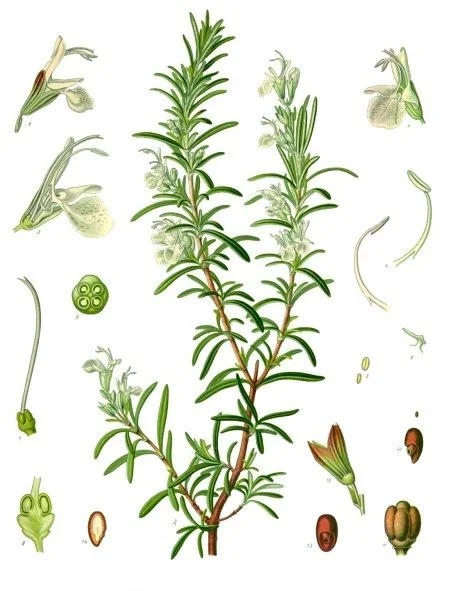
Rosemary, Rosmarinus officinalis, plate 258 of Köhler's Medizinal-Pflanzen (1897). Hungary Water was a rosemary-centered preparation in distilled spirits, and rosemary remained the signature botanical of the alcohol-based scented waters that circulated through late medieval courts. The needle leaves this plate draws are where the plant keeps its volatile character.
Rosemary plate 258, Köhler's Medizinal-Pflanzen (1897), via Wikimedia Commons. Public domain.
Distilled alcohol entered European workshops in the later Middle Ages, and perfumers were among the first to understand what it offered. The old word for it tells the story: they called it spirits of wine, as if something lively had been coaxed out of the fermented grape. Compared with oil, spirits behaved like a different element. Where oil was patient and heavy, spirits were quick and generous. A fragrance dissolved in alcohol did not sit on the skin waiting to be noticed. It rose into the air at once, carried on the alcohol's own eagerness to evaporate, and announced itself across a room.
Tradition holds that the first famous alcohol-based perfume of Europe was made for a queen. Hungary Water, a rosemary-centered preparation in distilled spirits, is said to date to about 1370 and to have been created for Elizabeth of Hungary. I give you this story the way a careful apothecary gives any old recipe: with the label honest. The exact date is lost to history, the surviving legends were written down in the seventeenth century, two hundred years after the fact, and scholars disagree about which queen the stories even mean. What is certain is that by the late medieval period, alcohol-based scented waters were circulating through European courts, that rosemary was their signature botanical, and that Hungary Water remained the most celebrated fragrance in Europe until the eighteenth century. A legend with a true core is still worth studying, as long as you mark which part is which.
The pattern was now set: fragrance dissolved in spirits, spirits eager to carry it into the air. What remained was for someone to perfect it.
Sealed note from Professor Muddlenook: Scholars, notice what the perfumers did NOT do. They did not set out to invent a new chemistry. They took a liquid the distillers had already made, observed its behavior honestly, and asked what that behavior was good for. Half of laboratory discovery is exactly this: watching a material do what it does, and having the sense to write it down. — C.M.
Check in: For Hungary Water, what is certain — and what belongs to the legend, written down two hundred years after the fact?
❦ In your workbook: record the arrival of the spirit in your own way — spirits of wine against patient oil, Hungary Water with its honest label, and the pattern the perfumers set — copy, sketch, or note what matters.
Why Alcohol Changed Everything: The Science of Evaporation
Evaporation is the quiet escape of molecules from a liquid's surface into the air. Not every liquid escapes at the same pace, and the pace is governed by a property called vapor pressure: roughly, how strongly a liquid's molecules push to become vapor at a given temperature. Molecules held tightly together by strong attractions stay put. Molecules held loosely break away easily.
Consider our three laboratory liquids. Cooking oil is made of large, heavy molecules that cling to one another; its vapor pressure at room temperature is near zero, so it effectively does not evaporate at all. Water's molecules grip each other through hydrogen bonds, a respectable attraction, so water evaporates at a moderate, steady pace. Alcohol's molecules are smaller and their grip on one another is weaker, so alcohol's vapor pressure is far higher than water's, and it evaporates several times faster at the same temperature.
★ This single physical fact explains the whole perfume revolution. A fragrance is made of volatile molecules, compounds light enough to leave a surface and drift to a nose. Dissolve those molecules in oil, and the oil's reluctance to evaporate holds them back; the scent emerges slowly, faintly, and fades almost at once, exactly as Pliny complained. Dissolve the same molecules in alcohol, and the alcohol's own rapid evaporation sweeps them into the air in a bright, generous cloud. The perfumer did not change the fragrance. The perfumer changed the vehicle, and the vehicle changed everything.
There is a trade in every bargain. Alcohol's swiftness is also its short memory: because the vehicle leaves quickly, an alcohol perfume blooms fast and fades fast, which is why perfumers learned to build their compositions in timed layers. We will study that architecture next.
Check in: Why does oil effectively not evaporate at room temperature — and why does alcohol evaporate several times faster than water at the same temperature?
❦ In your workbook: record the science of evaporation in your own way — vapor pressure and molecular grip, the three liquids in their order, and the trade: blooms fast, fades fast — copy, sketch, or note what matters.
In your packet: Guided Practice — the evaporation trial begins here in the reading: its five steps and observation schedule are printed in full in the packet. Work it as you reach it, or mark the place and take it as homework — your choice.
The Architecture of a Scent: Accords
In Lesson 14 you met the perfumer's vocabulary of time: top notes, the bright first impression; heart notes, the character that follows; base notes, the slow farewell. A fragrance accord is the deliberate stacking of these layers so that a scent unfolds in sequence rather than arriving all at once, the way a chord in music stacks tones that the ear hears together and apart.
Alcohol is what makes the stacking legible. In an oil perfume, the layers blur: everything emerges slowly, and the top notes never get their bright moment because the vehicle will not release them quickly. In spirits, each layer keeps its appointment. The lightest molecules, the citrus sparkle and green freshness, ride the alcohol's fast evaporation and arrive first. The middle florals follow as the alcohol thins. The heavy resins and woods, barely volatile at all, remain on the skin for hours, the long memory of the composition. The solvent does not merely carry the accord. It conducts it, setting the tempo at which each section enters.
This is why the evaporation trial you are about to perform matters beyond its three little dishes. You are measuring the tempo of the vehicle itself.
Check in: In an oil perfume, why do the top notes never get their bright moment — and in spirits, what arrives first, and why?
❦ In your workbook: record the architecture of a scent in your own way — the accord's three layers, the solvent as conductor, and each layer keeping its appointment — copy, sketch, or note what matters.
In your packet: Exercise II — The Accord in Time ◐ begins here. Work it now, or mark the place and take it as homework — your choice.
A Sealed Note Before the Trial
You are about to measure something no instrument in this laboratory can measure for you: the speed at which a scent leaves. Watch closely, scholars, and trust your nose over your expectations. The strip that smells strongest at minute one is rarely the strip that smells at minute thirty, and that difference is the entire science of perfumery in miniature.
Record what you actually observe, not what you think should happen. An honest unexpected result is worth ten tidy expected ones. The archive has no use for results that were decided before the trial began.
— Professor Crimblebrew Muddlenook, Potions Laboratory • Master Apothecary • Head of House Meridies
❦ In your workbook: record the sealed note in your own way — trust your nose over your expectations, and record what you actually observe — copy, sketch, or note what matters.
Eau de Cologne and the Modern Perfume
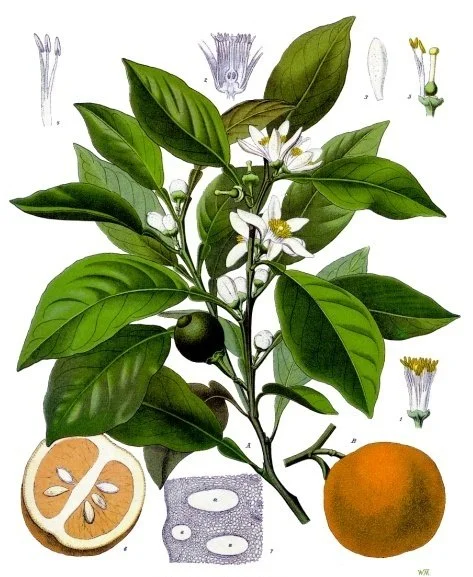
Bitter orange, Citrus aurantium, in Köhler's Medizinal-Pflanzen: the tree whose blossom is orange blossom — one of the citrus voices in Farina's 1709 composition, dissolved in pure alcohol. The plate shows the whole vocabulary at once: blossom above, fruit whole and halved below.
Citrus aurantium plate, Köhler's Medizinal-Pflanzen, via Wikimedia Commons. Public domain.
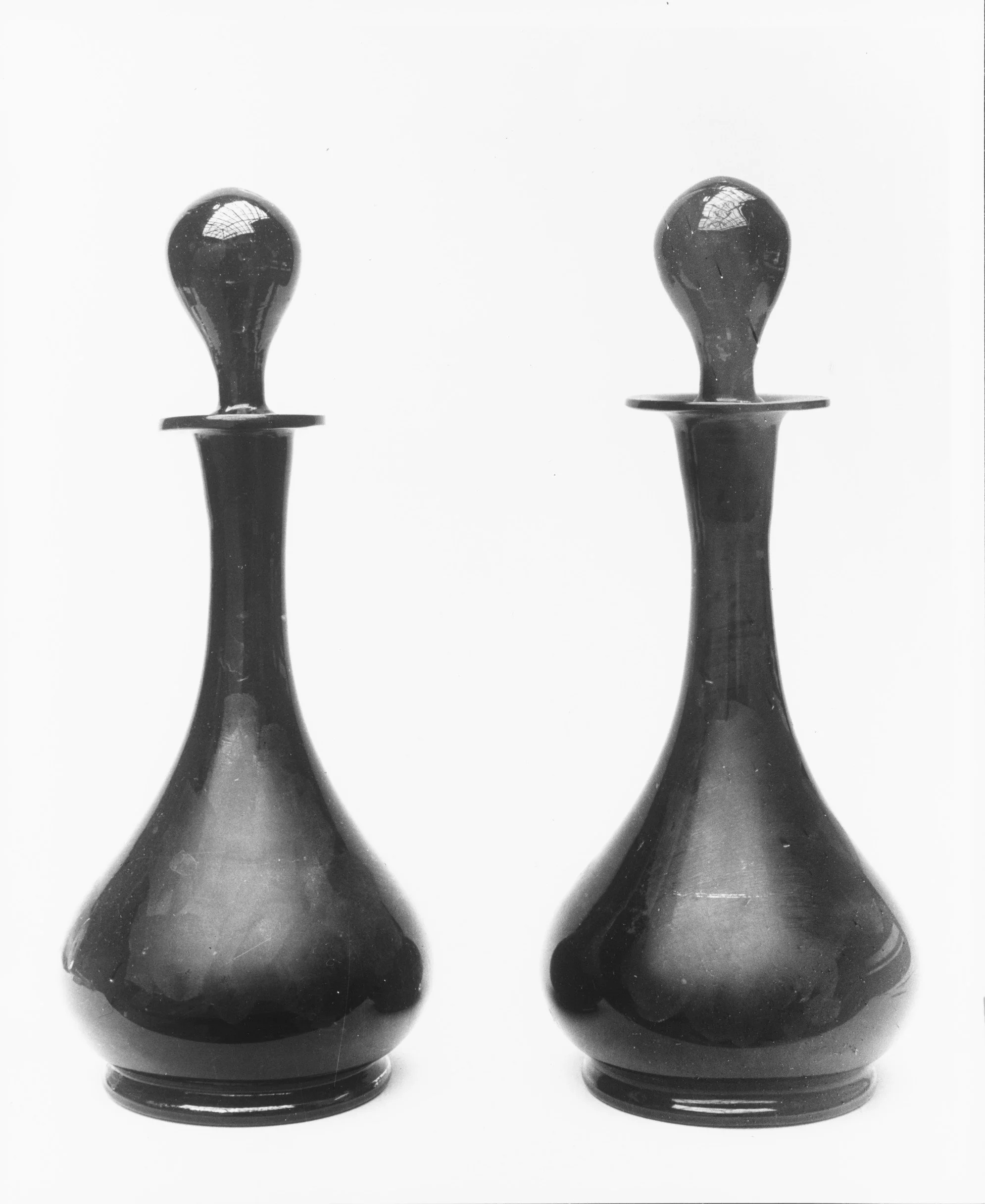
A pair of cologne bottles, Czech, 1890–1900: the vessel the modern perfume age settled into — a stoppered glass flacon for a light spirit-based fragrance, of the class Farina's 1709 Eau de Cologne created. The stopper is the lesson in glass: a vehicle this eager to evaporate is kept under seal until the moment it is wanted.
Cologne Bottle, Czech, 1890–1900, The Metropolitan Museum of Art (Object 20.109.20; Met Open Access record 2172). Public domain.
In 1709, in the German city of Cologne, an Italian perfumer named Giovanni Maria Farina launched the fragrance that would define modern perfumery. He called it Eau de Cologne, in honor of his adopted city. A year earlier he had written to his brother describing a scent that reminded him of an Italian spring morning, of mountain flowers and orange blossoms after rain. His composition was revolutionary in its lightness: citrus oils, bergamot and lemon and orange blossom among them, dissolved in pure alcohol. Where the great court perfumes of the age were heavy with resins and animalic notes, Farina's creation was sparkling, weightless, transparent.
Europe noticed at once. Eau de Cologne traveled to nearly every royal house on the continent; Napoleon carried flacons of it, Goethe praised it, and a single vial of the celebrated aqua mirabilis, the "miracle water," was said to cost half a civil servant's yearly salary. When the French established free trade in Cologne in 1797, imitators rushed in, and "cologne" eventually became the generic name for an entire class of light citrus-alcohol fragrances. The original house still stands in Cologne, still in the founding family's hands, the oldest fragrance house in the world.
Farina changed no law of nature. He simply understood the vehicle better than anyone before him: light molecules, fast solvent, bright arrival, clean departure. Three hundred years later, every modern perfume still runs on the principle he bottled.
Check in: What made Farina's composition revolutionary in its lightness — and what did he understand better than anyone before him?
❦ In your workbook: record Eau de Cologne in your own way — Cologne, 1709, Farina's letter and his citrus composition, the aqua mirabilis, and the principle he bottled — copy, sketch, or note what matters.
The Procedure: The Evaporation Trial
Confirm safety first. Adult present. No flames, sparks, or hot appliances in the room. Window open or air moving. Alcohol bottle capped except while dispensing.
Step 1 — Label. Label the three dishes WATER, ALCOHOL, and OIL. Label the three paper strips the same way. An unlabeled vessel is a failed vessel.
Step 2 — Measure. Pour the same small amount into each dish: about one teaspoon, or 5 ml if you are working at Level Two. Use the same dish size for all three. Note the room temperature and the exact start time in your journal.
Step 3 — Dip the strips. Dip the bottom centimeter of each labeled strip into its matching dish, then lay each strip flat on a clean dry surface, labeled end visible, strips well separated so vapors do not mingle. Start your timer.
Step 4 — Observe on schedule. At 5 minutes, 15 minutes, 30 minutes, and 60 minutes, record for each dish and strip: the liquid level in the dish (mark the dish side with your pen at the start so you can compare), the wetness of the strip (fully wet, damp at the base, dry), and any odor you detect when you waft gently toward your nose from a hand's breadth away. Do not lean over the alcohol dish. Waft only.
Step 5 — The one-hour verdict. At sixty minutes, make your final readings. Then cap the alcohol bottle, seal it, and put it away before you do anything else.
Check in: At which four times do you record your observations — and what is the first thing you do after the final readings?
❦ In your workbook: record the evaporation trial in your own way — label, measure, dip, observe on schedule, and the one-hour verdict, with the safety confirmation first — copy, sketch, or note what matters.
In your packet: Exercise I — The Evaporation Ledger ◐ begins here. Work it now, or mark the place and take it as homework — your choice.
Observation: Reading the Strips
Your results should show the three vehicles keeping three very different appointments. The alcohol dish will have lost the most liquid by far, and its strip will likely be dry well before the hour ends, the alcohol having carried itself completely into the air. The water dish will show a modest loss, its strip damp long after the alcohol strip dried. The oil dish will sit nearly unchanged, its strip still frankly oily at sixty minutes, because oil's molecules decline the invitation to evaporate.
Write the verdict in your journal in plain sentences, then answer these questions in your archive entry: Which vehicle would carry a fragrance fastest into a room? Which would hold a fragrance longest on a surface? Why did the ancient oil perfumes, for all their beauty, struggle to announce themselves? And what does your one-hour verdict suggest about why Hungary Water and Eau de Cologne had to be alcohol-based to achieve their effects?
❦ In your workbook: record the reading of the strips in your own way — three vehicles, three appointments, and the four questions the verdict must answer — copy, sketch, or note what matters.
Cleanup
Cap the alcohol bottle tightly and return it to its labeled storage place, out of reach of younger children, away from heat. Pour the water dish down the drain. Wipe the oil dish with a paper towel before washing; oil poured straight down a drain builds trouble in pipes. The paper strips go in the rubbish once your readings are recorded; they are not keepsakes. Wash the dishes with soap and hot water, dry them, and return every tool to its place. Wash your hands. Confirm with your adult that the work area is clear and the alcohol is stored.
❦ In your workbook: record the cleanup in your own way — the alcohol stored first, the oil wiped before washing, the strips to the rubbish, and the final confirmation with your adult — copy, sketch, or note what matters.
Archive Entry
File this lesson's work in your laboratory archive under Unit VI, Lesson 46. Your entry must include: the date, room temperature, and start time; your three labeled dish readings at each interval in a small table; the one-hour verdict in complete sentences; your answers to the four observation questions; and one paragraph connecting this trial to Lesson 32, explaining how the same alcohol that extracts botanical properties in a tincture also governs how quickly a spirit-based preparation releases its character into the air. Sign and date the entry. An unsigned entry is an unfinished entry.
❦ In your workbook: record the archive entry's requirements in your own way — the table of readings, the verdict, the four answers, and the paragraph connecting this trial to Lesson 32 — copy, sketch, or note what matters.
In your packet: Exercise III — The Archive Connection ✎ begins here. Work it now, or mark the place and take it as homework — your choice.
Guided Observation: Reading the Strips as a Working Document
This lesson's observation is the trial itself, read back with discipline: you compare three dishes and three strips against the starting marks you made, and you let the recorded readings — not your expectations — carry the verdict.
Work through it in order.
Follow the alcohol. The alcohol dish will have lost the most liquid by far, and its strip will likely be dry well before the hour ends, the alcohol having carried itself completely into the air.
Follow the water. The water dish will show a modest loss, its strip damp long after the alcohol strip dried.
Follow the oil. The oil dish will sit nearly unchanged, its strip still frankly oily at sixty minutes, because oil's molecules decline the invitation to evaporate.
Consider:
- Which vehicle would carry a fragrance fastest into a room?
- Which would hold a fragrance longest on a surface?
- Why did the ancient oil perfumes, for all their beauty, struggle to announce themselves?
- What does your one-hour verdict suggest about why Hungary Water and Eau de Cologne had to be alcohol-based to achieve their effects?
❦ In your workbook: record the guided observation in your own way — the three vehicles followed in order, and the four questions answered from your own readings — copy, sketch, or note what matters.
Materials
Lay out all materials before you begin. Check the room: no open flames, no hot appliances, window open or air moving, adult present. Muddlenook's rule stands in every unit of this course: the laboratory is prepared before the work begins, not during it.
Level One — household items
- Three small identical dishes or saucers (ramekins, jar lids, or saucers; identical matters, because dish shape affects evaporation)
- Rubbing alcohol (isopropyl alcohol) from the medicine cabinet, in its original labeled bottle; you will need only a few teaspoons
- Tap water
- A cooking oil (olive, sunflower, or any plain vegetable oil); a few teaspoons
- Three paper strips cut from plain white paper or coffee filters, each about 2 cm wide and 10 cm long, labeled at the top: WATER, ALCOHOL, OIL
- A ruler with millimeter markings
- A watch, timer, or phone for timing observations
- Your laboratory journal and a pencil
- Paper labels or masking tape and a pen for the dishes
Level Two — historically closer
- Small glass evaporating dishes or watch glasses instead of saucers, for uniform surfaces
- A graduated cylinder or measuring pipette so each dish receives exactly the same volume (5 ml)
- A thermometer to record the room temperature at the start and end of the trial, since warmth accelerates evaporation
- Blotting paper strips rather than plain paper, for even wicking
Safety Notes
- Alcohol is flammable. Keep the rubbing alcohol far from every flame, spark, hot plate, and heated vessel. No candles, matches, or stove burners near your work surface while the alcohol is out. Keep the bottle capped except while dispensing.
- Ventilate. Work with a window open or air moving. If you feel lightheaded, stop, step into fresh air, and tell your adult at once.
- Adult supervision is required for the full procedure. An adult dispenses or directly supervises dispensing, and confirms the area is free of ignition sources before you begin.
- Do not rub your eyes during the procedure. If alcohol splashes into eyes, flush with clean water for several minutes and tell your adult. Wash your hands when finished.
- Label all three dishes before pouring anything. Store the sealed, labeled alcohol bottle out of reach of younger children and away from heat when finished.
- Rubbing alcohol is poisonous if swallowed. Nothing in this lesson is for wearing, applying, tasting, or ingesting. This is a study of evaporation, not a recipe.
Reflection Questions
Answer the following questions in your workbook.
- Pliny the Elder complained that oil perfumes lost their scent almost as soon as they were used. Using vapor pressure, explain exactly what he was observing.
- Why is it honest to call the Hungary Water story a legend with a true core, rather than simply a fact or simply a myth?
- A student proposes making a perfume with oil instead of alcohol because oil is cheaper and the scent will last longer on the skin. Give Muddlenook's answer: what would actually happen, and why?
- Your evaporation trial shows the alcohol dish nearly empty at one hour while the oil dish is unchanged. A classmate says this proves alcohol is "stronger" than oil. What is wrong with that conclusion, and what is the correct interpretation?
- Farina's Eau de Cologne succeeded in a market full of heavy resin perfumes. What did lightness offer that heaviness could not, in terms of how a scent behaves in air?
Workbook Checklist — Lesson 46
In my workbook I have:
- ☐ run the evaporation trial under adult supervision in a ventilated, flame-free room, with the three dishes labeled WATER, ALCOHOL, OIL before any liquid was poured — or completed it as a marked workbook study from the lesson's Observation section
- ☐ ruled the five-column evaporation ledger and entered readings at 0, 5, 15, 30, and 60 minutes: liquid level, strip condition, and odor on wafting
- ☐ written the one-hour verdict in at least five complete sentences, naming the fastest and slowest vehicles and the physical property that explains the difference
- ☐ described one familiar scent's arrival in three timed layers — top, heart, base — and written the paragraph on how alcohol versus oil would change its timing
- ☐ written "The Spirit's Two Labors," the one-page entry comparing alcohol as extractor in Lesson 32 and as carrier in perfumery, with its concluding sentence
- ☐ answered the four observation questions in my archive entry
- ☐ filed the signed and dated archive entry under Unit VI, Lesson 46, with the date, room temperature, start time, and the table of readings
- ☐ capped, sealed, and stored the alcohol bottle, cleaned the bench, and confirmed with my adult that the work area is clear
☐ Lesson completed Date: ___ Signature: ___
The Professor's Closing Note
Scholars, you have now measured the most consequential physical property in the history of fragrance, and you did it with saucers and paper strips. The great perfumers of Grasse and Cologne worked from the same observation you made today: that alcohol leaves quickly, water leaves slowly, and oil does not leave at all. They built an industry on that difference. You have built a page in your archive on it, which is the more durable achievement.
Next, we turn from the invisible to the visible: from spirits that vanish into air to pigments that stain, endure, and remember. Bring your orderliness with you. The laboratory grows more colorful from here, and color is a demanding guest.
— Professor Crimblebrew Muddlenook, Potions Laboratory • Master Apothecary • Head of House Meridies
PROFESSOR CRIMBLEBREW MUDDLENOOK
Potions Laboratory
Master Apothecary • Head of House Meridies
Cross-Class Connections

Herbology · Unit IV, Lesson 27 — Timing the Harvest
Come up to the Greenhouse, spirit-watchers, and learn when a plant's volatile oils are richest. In my garden we time the harvest itself: the aromatic compounds that Professor Muddlenook's spirits lift so eagerly into the air accumulate in the cool of the night and dissipate in the heat of the day, which is why the hour you gather changes what you gather. Measure his evaporation in the laboratory; then come and see where those eager molecules live before they ever leave the leaf.
PROFESSOR BERYL FERNFOOT
Herbology Greenhouse • Master Herbalist • Head of House Oriens
Further Reading & Sources
- Hungary Water — Wikipedia — the rosemary spirit's history, with honest treatment of the uncertain dating and legendary origins.
- History of Perfume — Wikipedia — the long line from ancient oil perfumes through Hungary Water to the modern industry, including Santa Maria Novella and Catherine de' Medici's perfumer.
- Eau de Cologne — Wikipedia — Farina's 1709 creation, the citrus-alcohol formula, and how "cologne" became a generic term.
- Farina Fragrance Museum, Cologne — the founding house's own museum, in the building where Eau de Cologne was first composed.
- Grasse and the International Perfume Museum — Provence-Alpes-Côte d'Azur Tourism — how a leather-tanning town became the perfume capital, from scented gloves to flower fields.
- Evaporation — Wikipedia — the physics behind the trial: vapor pressure, surface area, and why different liquids keep different appointments with the air.
Browse the Potions shelf in the school Library for readable editions of these works.
Submit your work for this lesson using the form below.
CONTINUE IN THE POTIONS LABORATORY
← Previous · Lesson 45: Pomanders & Solid Perfumery Next · Lesson 47: Atmospheric Resin & Botanical Burn Blends →
Unit VI — Fragrance, Pigments & Botanical Arts Potions Laboratory — All 52 Lessons
The rest of Unit VI: Lesson 45 · Pomanders · Lesson 47 · Burn Blends · Lesson 48 · Carbon & Oak Gall Inks · Lesson 49 · Plant & Berry Stains · Lesson 50 · Paper Aging · Lesson 51 · Wax Seals · Lesson 52 · Continuing Ledger · The Capstone · The Apothecary's Signature Formula