
POTIONS
Unit VI · Lesson 47ATMOSPHERIC RESIN & BOTANICAL BURN BLENDS
Professor Crimblebrew Muddlenook
Master Apothecary • Potions
Head of House Meridies • School of Evershade
Professor's Introduction

Sealed with the teal wax of Professor Crimblebrew Muddlenook, Master Apothecary of the Potions Laboratory, Head of House Meridies.
Scholars, we have spent this course learning to coax properties out of botanicals with oil, water, glycerin, vinegar, alcohol, and steam. Today we study the oldest extraction of all: fire.
Long before anyone wrote a formula, human beings dropped resin onto coals and watched fragrance rise with the smoke. Temples, monasteries, archives, and apothecary workshops across every continent shaped their very atmosphere this way. The laboratory you sit in has its own smell, and the scholars who came before you chose it deliberately.
But fire is the one laboratory tool that does not forgive carelessness, and smoke is the one preparation you cannot put back in the jar. So this lesson is built differently from every lesson before it. You will choose between two complete paths: a supervised observation of a single burning incense stick, or a no-burn cold study of aromatic blending that is every bit as rigorous. Neither path is lesser. A scholar who cannot burn safely, or who should not breathe smoke, loses nothing by taking the cold path. The observation skills are identical. Only the flame differs.
Order. Observation. Record. And above all, respect the flame.
— Professor Crimblebrew Muddlenook, Potions Laboratory • Master Apothecary • Head of House Meridies
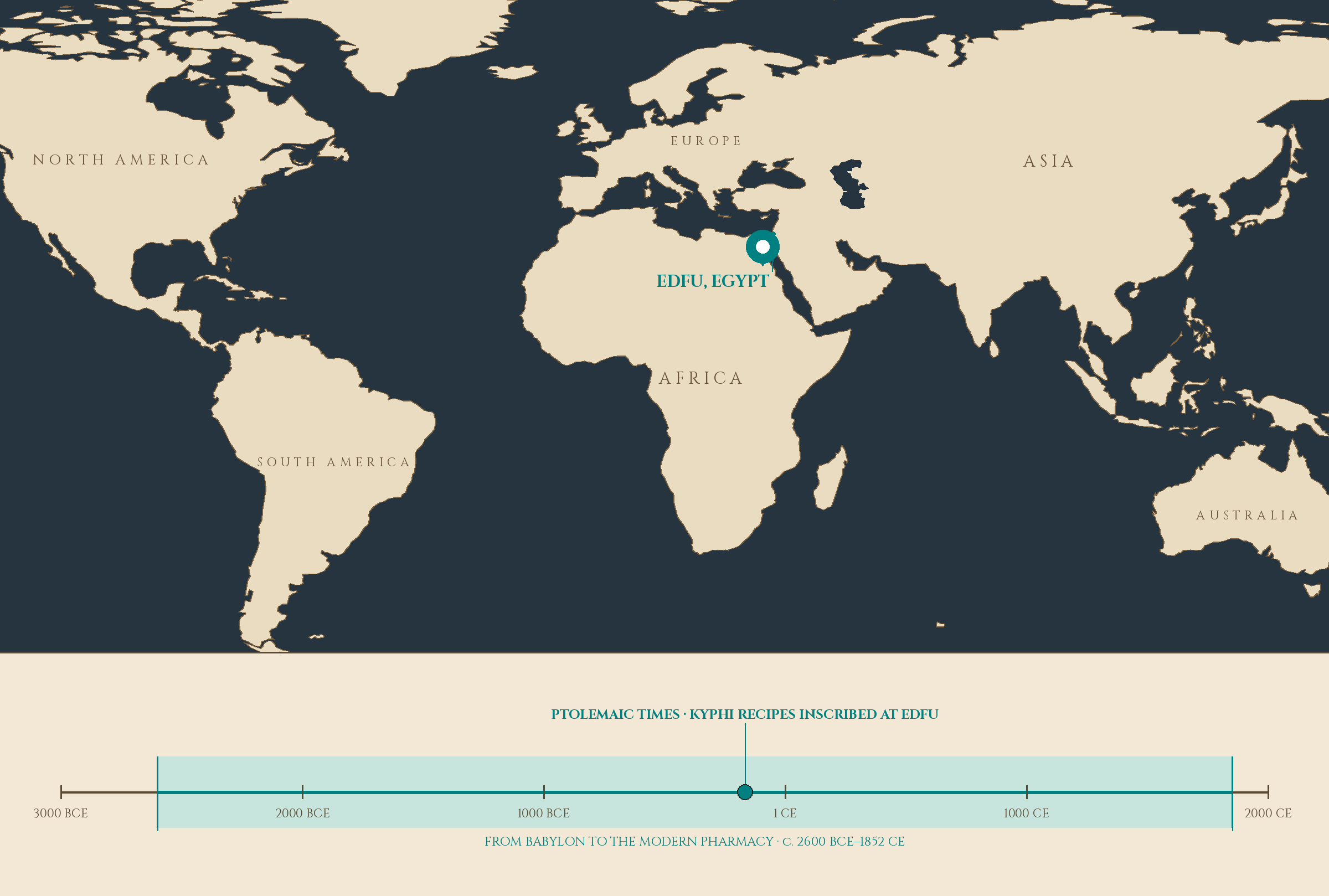
Pin: Edfu, Egypt. Timeline stop: PTOLEMAIC TIMES · KYPHI RECIPES INSCRIBED AT EDFU.
Lesson Objectives
By completing this lesson, you will be able to:
- Describe how incense traditions shaped the atmosphere of temples, monasteries, and workshops across at least three civilizations.
- Explain the difference between flaming combustion and smoldering, and describe what smoke is made of.
- Identify frankincense, myrrh, copal, and benzoin by source tree, region, and historical use.
- Complete either a supervised single-stick burn observation or a full cold aromatic blend study, with a written observation log.
- Explain why ventilation and fire discipline are non-negotiable in any work involving smoke.
Reading this lesson: ★ marks the passages to remember. They carry the fire science and the safety discipline this lesson is assessed by, and they return in the Unit VI Quiz, in the lessons ahead, and at the capstone. Check in questions ask the material back as you go; answer them in your workbook when you meet them.
Working this lesson: Your assignment packet is the first download on this page. Work in it as the lesson moves along, answering each exercise as its subject is taught — or read the lesson through for your notes and take the exercises as homework afterward. Both are proper ways to sit this class. Signposts in the reading tell you where each exercise belongs. Written answers are short answers in your own words; a few honest lines are worth more than a filled page.
Your Assignment Packet
This lesson's exercises live in its packet: the Lexicon Handout (every term, course terms marked ◆), Materials, Guided Practice — Procedures A and B and the observation-log requirements, printed in full so you can work either path at your own bench — the Assignment Manual with its self-check, the Reflection Questions, and the Workbook Checklist. Download the packet before you begin and keep it beside you as you read.
About this lesson's assessment, plainly: this lesson's own quiz (7 multiple choice + 5 true/false, from the source packet) leaves the manual under the classroom model and pools for the Unit VI Quiz; its key travels with the unit quiz, not here. The Safety Briefing below promises a quiz question about it, and the promise is kept there. The exercises below — the observation log, the resin profiles, and the archive atmosphere plan — are the lesson's practical layer, standing beside the quiz.
Safety Briefing
Read every word of this section before you gather a single material. There will be a quiz question about it, and Professor Muddlenook will know if you skipped it.
Fire discipline. Any burning requires a heat-safe holder on a heat-safe surface, a bowl of water within arm's reach, and a competent adult present for the entire burn. The stick is never left unattended, not for one minute. When the observation ends, the ember goes into the water, not the bin. Cold ash only, ever, in the waste.
Smoke and air. ★ Ventilation is mandatory: an open window, a cracked door, or better yet, work outdoors. Smoke alarms stay on. Never disable a smoke alarm for a lesson. If anyone in the household has asthma, a respiratory condition, or a fragrance sensitivity, that person takes the no-burn path, without discussion and without penalty.
The two paths. Path A (the burn observation) is the Level Two practical and requires an adult present. Path B (the cold aromatic blend study) is the Level One practical, needs no flame at all, and is a complete lesson in itself. Choose honestly. There is no shame in the cold path; there is only wisdom in knowing your own laboratory.
What we do NOT do. Students do not burn raw resins on charcoal. Loose resin on hot charcoal burns unpredictably, spits, and produces far more smoke than a single stick. Resins in this lesson are studied as specimens: looked at, smelled cold, documented. Only the single manufactured incense stick is lit, and only under the full safety protocol.
Label everything. The jar from Path B looks like potpourri and smells wonderful. Label it with its contents and the date so nobody mistakes it for anything else.
No dosage recipes appear in this lesson. No medicinal claims are made. Nothing here is medicine, and nothing burned or blended is for consumption.
Check in: What does fire discipline require within arm's reach, and who must be present for the entire burn — and what is never disabled for a lesson?
❦ In your workbook: record the Safety Briefing in your own way — fire discipline, ventilation and alarms, the two paths and who takes which, what we do NOT do, and labeling — copy, sketch, or note what matters.
In your packet: Guided Practice — Procedures A and B begin here in spirit; the briefing above is their gate. Work them as you reach them in the reading, or mark the place and take them as homework — your choice.
The History: Smoke as Architecture
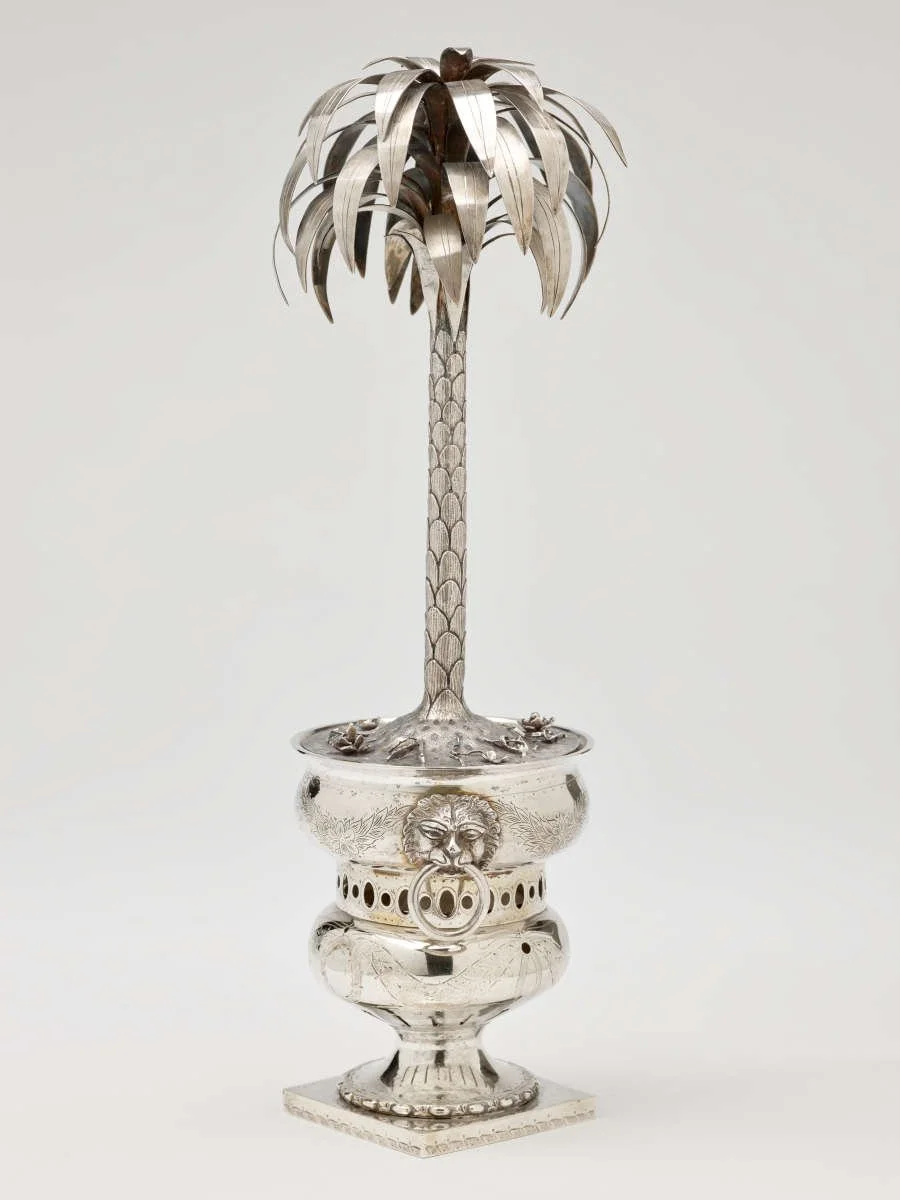
An incense burner by Andreas Blytt, Bergen, Norway, about 1795: the smoke rose from the vase and came out between the palm leaves. The lesson's history is full of such vessels — the atmosphere was engineered, vessel by vessel, room by room.
Incense Burner, ca. 1795, Andreas Blytt (Norwegian), RISD Museum, object 09.719. Public domain (CC0 1.0).
Walk into a medieval monastery, a Buddhist temple, or an ancient Egyptian sanctuary, and the first thing that met you was not the architecture. It was the air itself. Human beings have shaped enclosed spaces with burning botanicals for thousands of years, and the practice tells us as much about trade, religion, and daily life as any wall or manuscript.
Egypt: Kyphi, the Compound Incense
The most famous incense of the ancient Mediterranean world was Egyptian kyphi, a compound blend of resins, aromatics, honey, wine, and raisins, rolled into balls and set on hot coals to release perfumed smoke. ★ Three kyphi recipes from Ptolemaic times are inscribed on the temple walls of Edfu and Philae. The Greek writers Dioscorides, Plutarch, and Galen all recorded versions of the recipe, each with ten to sixteen ingredients. Plutarch reports that Egyptian priests burned incense three times daily: resin at sunrise, myrrh at midday, and kyphi at sunset, when, he wrote, the blended smoke suited the blended air of dusk. Whether or not one accepts his reasoning, the schedule itself is well attested: smoke marked the hours of the temple day.
Arabia: The Incense Road
Frankincense and myrrh, the resins of Boswellia and Commiphora trees, grew in the dry highlands of southern Arabia and the Horn of Africa. From there they traveled the Incense Road: camel caravans carrying the harvest north through desert waystations to the Mediterranean, to Egypt, to Rome. The Greek historian Herodotus wrote of frankincense harvests in southern Arabia; Pliny the Elder described the trade in his Natural History. These resins were worth, at times, nearly their weight in gold, and they filled temples, funeral rites, and apothecary shelves across the classical world. When you smell frankincense, you are smelling one of the oldest global commodities on earth.
Check in: Which three resins did Plutarch's priests burn across the temple day, in their order — and along what road did frankincense and myrrh travel north?
❦ In your workbook: record the Egyptian and Arabian traditions in your own way — kyphi and its inscribed recipes, the three appointed burnings of the temple day, and the Incense Road's caravans — copy, sketch, or note what matters.
China: The Joss Stick
In China, incense took the form of the slender stick: powdered aromatics bound around a bamboo core, burned in Buddhist temples and household shrines. The bamboo core is the engineering insight. It gives the stick rigidity, carries the ember steadily downward, and lets a single stick burn for a predictable time. Temple timekeeping itself was once measured in sticks burned. The stick you will observe in Path A descends directly from this tradition.
Medieval Europe: The Thurible
In Christian worship the vessel for burning incense is the censer, commonly called the thurible: a metal cup on chains, holding hot charcoal on which resin is spooned, then swung so the moving air feeds the ember and spreads the smoke. Medieval examples were often worked in gold and silver. The most famous is the Botafumeiro of Santiago de Compostela in Spain, a great silver thurible swung from the cathedral ceiling since the eleventh century. One explanation given for its size is entirely practical: it freshened air thick with travel-worn pilgrims. Atmosphere, in other words, was also sanitation, or at least the attempt at it.
Mesoamerica: Copal, the Blood of Trees
Across the ocean, the peoples of Mesoamerica burned copal, the aromatic resin of Protium copal and related torchwood trees. The word comes from the Nahuatl copalli, meaning incense; in Maya languages it is called pom. Copal was burned as an offering, and its collection carried deep symbolism: the sap was likened to blood, and gathering it resembled the ritual bloodletting that was central to Maya ceremonial life. Copal is still burned in ceremonies across Mexico and Central America today, one of the longest continuous incense traditions in the world.
Check in: What does the bamboo core of the joss stick make possible — and what was the Botafumeiro's size, on one explanation, for?
❦ In your workbook: record the Chinese, European, and Mesoamerican traditions in your own way — the bamboo core's steady ember, the swinging thurible, and copal gathered like blood — copy, sketch, or note what matters.
The Laboratory's Own Atmosphere
Apothecary workshops and monastery archives stood at the intersection of all these traditions. They received resins through the same trade networks, burned them in the same vessels, and kept their records in rooms the smoke perfumed. But the archive keepers learned a hard lesson that this course will return to: smoke that sweetens the air also blackens the page. Soot settles on manuscripts, and centuries of candle and incense smoke have darkened more than one medieval page. Atmosphere has a cost, and the wise keeper weighs it. We will take up that weighing in Lesson 50, Paper Aging & Manuscript Staining.
Scholars, note what all five traditions share. Nobody burned these materials casually. The resin — a hardened plant secretion, sticky when fresh, that hardens on exposure to air — was measured, the hour was appointed, the vessel was chosen, and someone was responsible for the flame. That is laboratory discipline wearing ceremonial dress, and it is older than any formula in your journals.
— Professor Crimblebrew Muddlenook, Potions Laboratory • Master Apothecary • Head of House Meridies
❦ In your workbook: record the laboratory's own atmosphere in your own way — the traditions meeting in the workshop, soot on the page as atmosphere's cost, and the discipline all five traditions share — copy, sketch, or note what matters.
The Science: What Burning Actually Is
Before you observe a flame, understand it. Muddlenook insists.
Combustion is rapid oxidation: a fuel combining with oxygen so quickly that it releases heat and light. Three things must be present, and every fire-safety rule you have ever heard is about removing one of them: fuel, oxygen, and heat. Take away any one and the fire stops. Your bowl of water works by stealing heat. Your ventilation works, paradoxically, by feeding oxygen to the room while carrying smoke away from your lungs; the stick itself needs only the air immediately around its ember.
Smoldering is slow, flameless combustion. ★ An incense stick does not flame; it smolders. The ember creeps down the stick at a steady rate, hot enough to vaporize aromatic compounds and char the binder, cool enough never to burst into open flame under normal conditions. "Under normal conditions" is doing heavy work in that sentence, which is why the safety briefing exists.
Smoke is not a gas. It is a visible cloud of tiny solid particles and liquid droplets suspended in hot gases. That is why smoke behaves the way it does in your observation: the hot gases rise because hot air is less dense than the cool air around it, carrying the particles upward in a column. Near the ember the column is smooth and laminar. Higher up, it breaks into turbulence, curling and spreading as it cools and mixes with room air. This spreading has a name you already know from earlier lessons: diffusion, the same process that carries fragrance from an unstoppered vial, now made visible.
Heat transforms; it does not merely release. ★ This is the central scientific point of the lesson. When you studied fragrance in cold materials, bruising released volatile oils that were already there. Burning goes further. The heat vaporizes compounds, yes, but incomplete combustion also builds new ones: the sweet, deep note of frankincense smoke is not the smell of cold frankincense made stronger. It is a new profile, created by fire. The apothecary who understands this understands why the same resin can serve two different purposes, cold and burned, and be honestly described as two different materials.
Check in: What three things must be present for combustion — and why is frankincense smoke not simply cold frankincense made stronger?
❦ In your workbook: record the science of burning in your own way — combustion and its three requirements, smoldering's creeping ember, smoke as particles in rising gases, and heat that transforms rather than releases — copy, sketch, or note what matters.
The Materials: Four Resins of the Archive
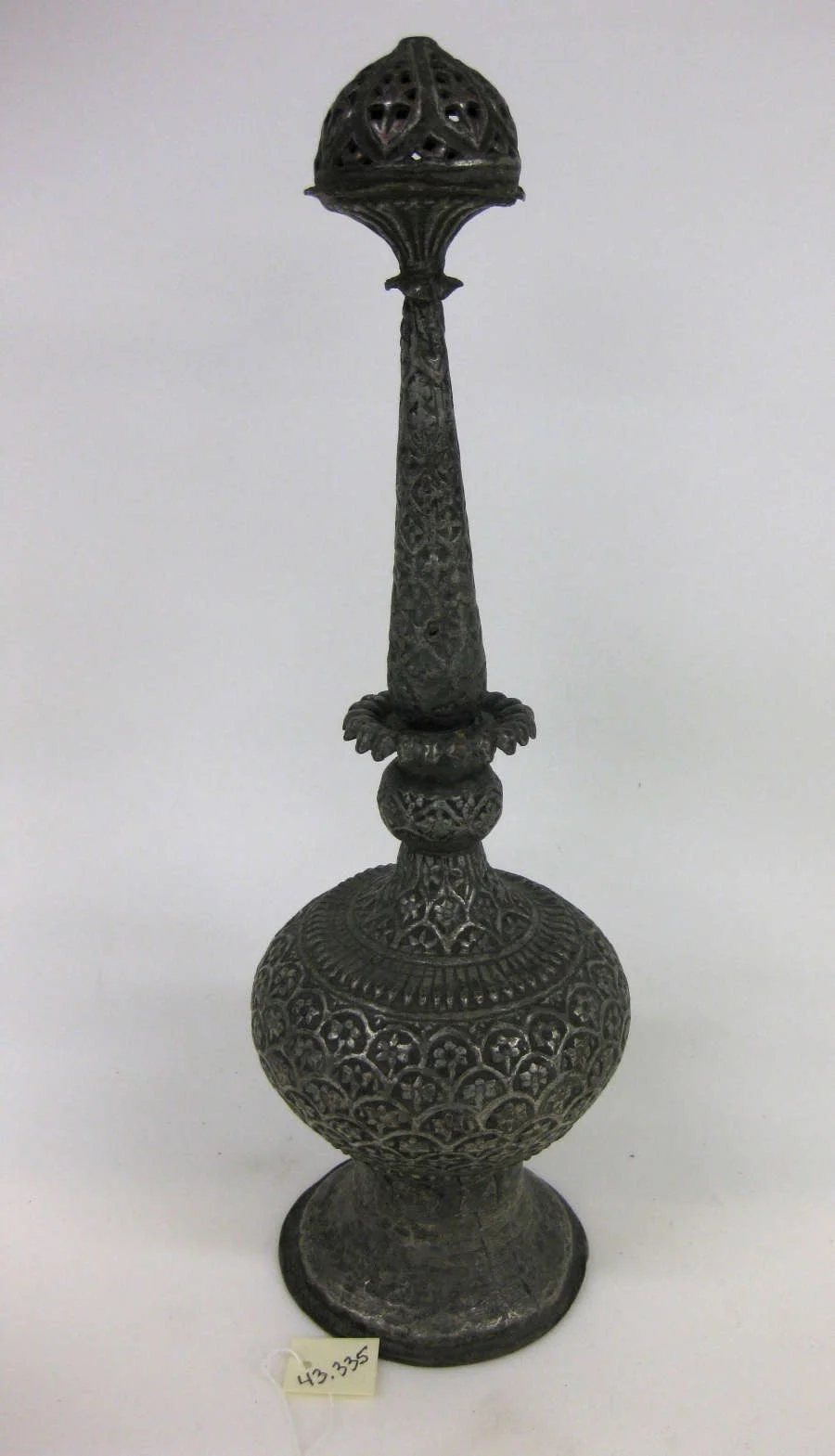
A Turkish censer of the 1800s: the pierced dome lets the smoke out in threads while the ember breathes beneath it. Your lexicon's censer, "often suspended on chains," stands here at rest — the instrument the burn blends of the lesson's history were compounded to feed.
Censer, 1800s, Turkish, RISD Museum, object 43.335. Public domain (CC0 1.0).
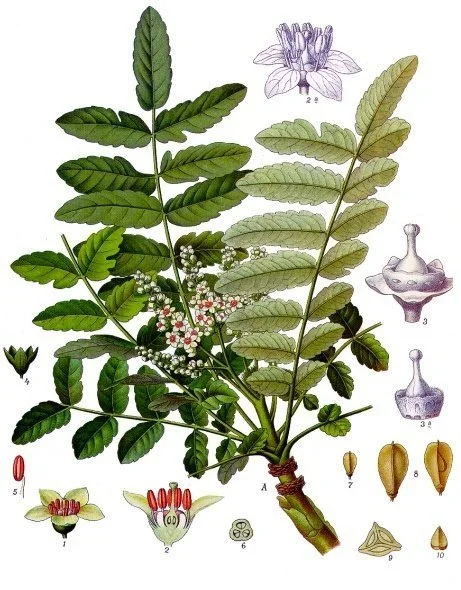
Boswellia sacra, the frankincense tree, from Köhler's Medizinal-Pflanzen: the lesson's first resin begins here, as a living tree in southern Arabia, scored for its tears. The apothecary receives the tear; the herbalist knows the tree.
Franz Eugen Köhler, Köhler's Medizinal-Pflanzen, plate 022 (Boswellia sacra). Public domain, via Wikimedia Commons.
Study these as specimens. Look at them. Smell them cold. Write down what you observe. Do not burn them.
Frankincense. The dried resin of Boswellia trees, chiefly Boswellia sacra in southern Arabia. Harvested by scoring the bark and collecting the hardened tears. Pale gold to greenish lumps with a piney, citrus-tinged scent when cold. The great temple resin of the ancient Mediterranean and the church resin of medieval Europe.
Myrrh. The resin of Commiphora myrrha and related species of the Horn of Africa and Arabia. Darker, reddish-brown tears, bitter and earthy cold. Famous as one of the Magi's gifts and as an embalming material in Egypt. Heavier and darker in smoke than frankincense.
Copal. The resin of Protium copal and related Burseraceae trees of Mexico and Central America. Ranges from milky white to golden. Sharp, clearing scent. The ceremonial incense of Mesoamerica, burned as an offering for millennia and still burned today.
Benzoin. The resin of Styrax trees of Southeast Asia. Warm, vanilla-like sweetness; the softening agent in countless historical incense blends. If frankincense is the bright note of the archive's smoke, benzoin is the low one.
Record each in your potions journal: source tree, region, appearance cold, scent cold, historical use. One line of your own observation is worth more than a paragraph of mine.
Check in: Name the four resins with their source trees — and which is the bright note of the archive's smoke, and which the low one?
❦ In your workbook: record the four resins in your own way — frankincense's pale tears, myrrh's dark bitterness, copal's sharp clarity, and benzoin's warm sweetness, each with its tree and region — copy, sketch, or note what matters.
In your packet: Exercise II — Resin Profiles ✎ begins here. Work it now, or mark the place and take it as homework — your choice.
Mise en Place
Choose your path now, and gather only what it requires.
Path A: The Single Stick Observation (Level Two)
- One manufactured incense stick, any scent (unscented or sandalwood is ideal for clear observation)
- A heat-safe incense holder on a heat-safe surface: ceramic tile, stone coaster, or metal tray
- A bowl of water, within arm's reach
- Matches or a lighter, handled by the adult
- A timer or clock
- Your journal and a pencil
- An adult present for the entire observation
- Ventilation arranged: window open, or work outdoors in still air
Path B: The Cold Aromatic Blend Study (Level One)
- A clean glass jar with a tight lid
- Dried aromatic botanicals from the kitchen: a cinnamon stick, 6 to 8 whole cloves, a strip of dried orange peel, one star anise, a few cardamom pods if available
- Small dishes for holding each botanical separately during the first examination
- Your journal and a pencil
- Labels and a pen
Check in: Which path is Level One and which is Level Two — and what does each path's list contain that the other's does not?
❦ In your workbook: record the mise en place in your own way — your chosen path, its gathered list checked item by item, and the path not taken noted honestly — copy, sketch, or note what matters.
Procedure A: The Single Stick Observation
For Level Two, with an adult present. If at any point you feel unsure, extinguish the stick in the water. There is no observation worth an accident.
- Set the holder on the heat-safe surface. Place the bowl of water beside it. Confirm ventilation. The adult lights the stick and lets the flame burn for ten seconds, then blows it out gently, leaving the ember.
- Minutes 0 to 2: the column. Watch the smoke rise. Sketch the column. Note where it runs smooth and where it begins to curl. This is laminar flow breaking into turbulence, and you are watching physics draw itself.
- Minutes 2 to 5: the scent. Without putting your face near the stick, note the fragrance at arm's length. Write three words for it. Compare with the cold scent of the unburned stick, which you recorded before lighting. Heat has transformed it; describe the difference.
- Minutes 5 to 10: the ember and ash. Observe the ember's steady advance. Note the ash: its color, its length before it falls, whether it holds or crumbles. Ash tells you about complete versus incomplete combustion.
- Minute 10: extinguish. The adult presses the ember into the water. Confirm it is out. Observe the wet ash; note how the scent changes the moment burning stops.
In your packet: Exercise I — The Observation Log ◐ begins here, for whichever path you took. Work it now, or mark the place and take it as homework — your choice.
Check in: At which minutes do you watch the column, the scent, and the ember and ash — and who extinguishes the stick, and how?
❦ In your workbook: record Procedure A in your own way — the setup and the adult's lighting, the column sketched, three words for the scent, the ash read, and the ember drowned at minute ten — copy, sketch, or note what matters.
Procedure B: The Cold Aromatic Blend Study
For Level One. No flame, no heat, full rigor.
- Examine each botanical separately. Write a cold scent profile: three words each for cinnamon, clove, orange peel, star anise.
- Layer them into the jar in any order. Seal the lid. Label the jar with contents and date.
- Immediate observation: open the jar and note the combined fragrance. Which botanical dominates? Write it down before your nose adapts.
- One hour: open and note again. Has the blend changed? The volatile compounds are mingling in the sealed air; the profile shifts as they do.
- Next day: open and note a third time. Write a short paragraph: how does the sealed blend differ from the sum of its separate parts? This is fragrance layering without fire, and it is the same skill the kyphi makers used when they compounded sixteen ingredients before a single coal was lit.
- Seal the jar and file it as a specimen. It will keep for months.
Check in: At what three times do you open the Path B jar and note its fragrance — and what must be written down before your nose adapts?
❦ In your workbook: record Procedure B in your own way — the four cold scent profiles, the layered jar labeled and sealed, and the blend's character at once, at one hour, and next day — copy, sketch, or note what matters.
Observation and Recording
Whichever path you took, your log needs four things: what you did, in order; what you observed, in your own words; one sketch (the smoke column, or the jar's layered contents); and one sentence connecting your observation to the lesson's science. Muddlenook reads the sentence first. It tells him whether you were watching or merely looking.
❦ In your workbook: record the observation standard in your own way — the four things every log needs, and the connecting sentence your professor reads first — copy, sketch, or note what matters.
Cleanup
Path A: confirm the ember is drowned and cold. Cold ash goes in the bin. Wash the holder. Air the room. Path B: seal and label the jar; wipe the work surface; return botanicals to their proper storage. Both paths: wash your hands.
❦ In your workbook: record the cleanup in your own way — your path's closing tasks in their order, ending with washed hands on both paths — copy, sketch, or note what matters.
Archive Entry
File your observation log in your laboratory archive under Unit VI, with the date and the path letter. If you took Path B, add the jar's label information to your potions journal specimen records. The archive does not distinguish between the paths. Neither do I.
❦ In your workbook: record the archive entry in your own way — the log filed under Unit VI with its date and path letter, and the jar's label information added to your specimen records if you took Path B — copy, sketch, or note what matters.
Guided Observation: Reading the Two Procedures as Working Documents
This lesson's observation is the practical itself, and this reading prepares it: you walk both procedures on paper the way your professor will read your log afterward, testing whether each timed stage earns its minutes — because a log that only records that something burned will fail the watching test.
Work through it in order.
Follow the column. Minutes 0 to 2: the smoke rises smooth and laminar near the ember, then breaks into turbulence as it climbs. The sketch is not decoration; it is smoke diffusion drawn from life.
Follow the transformation. Minutes 2 to 5: the scent at arm's length, in three words, compared with the cold scent recorded before lighting. Heat has transformed it; the log's work is to describe the difference, not merely to admire it.
Follow the jar instead. Path B's three openings — immediate, one hour, next day — run the same discipline without flame: the blend noted before the nose adapts, then watched as its volatile compounds mingle in the sealed air.
Consider:
- Which stage of either procedure would you challenge first, and what would you look at, smell, or compare to settle it?
- The connecting sentence is the one your professor reads first. What single sentence from this lesson's science would yours carry?
- Path A's ash and Path B's third opening both arrive at the end of their procedures. What does each one tell you that the earlier stages could not?
❦ In your workbook: record the guided observation in your own way — the column followed, the transformation compared cold and burned, and the jar's three openings read as one discipline in two forms — copy, sketch, or note what matters.
Materials
Everything in its place, before we begin. For this lesson you will need one path's list, not both:
Level One — household items (the no-burn path)
Level One is the no-burn path: complete, rigorous, and flame-free.
- A clean glass jar with a tight lid, for the cold aromatic blend study.
- Dried aromatic botanicals from the kitchen: a cinnamon stick, 6 to 8 whole cloves, a strip of dried orange peel, one star anise, and a few cardamom pods if available.
- Small dishes or saucers for holding each botanical separately during the first examination.
- Labels and a pen, for marking the jar with its contents and the date.
- Your laboratory journal and a pencil.
Level Two — the supervised burn observation
Level Two requires a competent adult present for the entire burn.
- One manufactured incense stick, any scent; unscented or sandalwood is ideal for clear observation.
- A heat-safe incense holder on a heat-safe surface: ceramic tile, stone coaster, or metal tray.
- A bowl of water, within arm's reach, for extinguishing the ember.
- Matches or a lighter, handled by the adult.
- A timer or clock, for the timed observations.
- Ventilation arranged: an open window, a cracked door, or work outdoors in still air.
- Your laboratory journal and a pencil.
Safety Notes
- Fire discipline: a heat-safe holder on a heat-safe surface, a bowl of water within arm's reach, and a competent adult present for the entire burn. Never leave a burning stick unattended, not for one minute. Extinguish the ember in water; only cold ash ever goes in the bin.
- Ventilation is mandatory. Open a window, crack a door, or work outdoors. Smoke alarms stay on; never disable one for a lesson.
- Health first: anyone with asthma, a respiratory condition, or a fragrance sensitivity takes the no-burn path, without discussion and without penalty. The cold path is a complete lesson.
- Students do not burn raw resins on charcoal. Loose resin burns unpredictably and produces far more smoke than a single stick. Resins are studied as specimens only.
- Label everything. The Path B jar smells wonderful and looks like potpourri; mark it with its contents and the date so nobody mistakes it for anything else.
- Nothing in the Potions Laboratory is medicine, and no lesson gives amounts to take. Nothing burned or blended here is for consumption.
Reflection Questions
Answer the following questions in your workbook.
- Plutarch reports that Egyptian priests burned resin at sunrise, myrrh at midday, and kyphi at sunset. What work was the smoke doing in the temple beyond smelling pleasant? Consider timekeeping, signaling, and the masking of odors.
- Describe in your own words the difference between what bruising does to a fragrant botanical and what burning does to it. Why does the lesson insist these are different processes?
- Historical practitioners burned incense indoors for centuries. Why does this lesson still require modern ventilation, and what does that tell you about the difference between historical practice and safe modern study?
- In Path A, what did the ash tell you? What would very dark, sooty ash suggest about the completeness of the combustion?
- Copal collection was likened to bloodletting, and the resin was treated as the tree's blood. Without adopting anyone's beliefs, what does this tell you about how the Maya understood their relationship to the trees they harvested?
Workbook Checklist — Lesson 47
In my workbook I have:
- ☐ recorded the Safety Briefing whole: fire discipline, mandatory ventilation with alarms left on, the two paths, what we do NOT do, and labeling
- ☐ written the history of the five traditions — kyphi at Edfu and Philae, the Incense Road, the joss stick, the thurible, and copal — and the laboratory's own atmosphere and its cost
- ☐ recorded the science: combustion and its three requirements, smoldering, smoke as particles in rising gases, and heat that transforms rather than releases
- ☐ profiled the four resins cold as specimens — frankincense, myrrh, copal, benzoin — and recorded each in my potions journal with source tree, region, appearance cold, scent cold, and historical use
- ☐ chosen my path honestly and gathered only what it requires, with an adult present for the entire burn if I took Path A
- ☐ completed my observation log with its timed observations or three-stage fragrance notes, its sketch, and its connecting sentence, and filed a clean copy in my archive under Unit VI with the date and the path letter
- ☐ written two half-page resin profiles with their Further Reading citation
- ☐ written my one-page Archive Atmosphere Plan: when incense burns and when it does not, the archive's ventilation, and soot monitoring
- ☐ answered the five Reflection Questions in my own words
☐ Lesson completed Date: ___ Signature: ___
The Professor's Closing Note
Sealed with the teal wax of Professor Crimblebrew Muddlenook, Master Apothecary of the Potions Laboratory, Head of House Meridies.
Order, scholars: a final note on what you have just done. The temple priests measured their resin (a hardened plant secretion, sticky when fresh, that hardens on exposure to air). The monks appointed their hours. You measured your minutes and appointed your observations. The scale differs; the discipline does not. Whether you watched smoke climb or watched a jar change its mind overnight, you practiced the oldest laboratory art there is: paying attention on purpose.
— Professor Crimblebrew Muddlenook, Potions Laboratory • Master Apothecary • Head of House Meridies
PROFESSOR CRIMBLEBREW MUDDLENOOK
Potions Laboratory
Master Apothecary • Head of House Meridies
Cross-Class Connections

Herbology · Unit V, Lesson 36 — The Materia Botanica: Building Your Herbal
Come up to the Greenhouse, resin-keepers, and bring your cold specimens with you. In my greenhouse we keep the book your professor sends your profiles to: one shared Materia Botanica, where every material gets its entry — what the plant is, where it grew, how it was gathered — beside what his laboratory makes of it. Your four resins began as living trees in my keeping before they were tears in his. Come and write the tree's half of their entries.
PROFESSOR BERYL FERNFOOT
Herbology Greenhouse • Master Herbalist • Head of House Oriens
Scrollwork · Unit II, Lesson 5 — Soot & Charcoal Ink
You have watched smoke climb and worried, rightly, about where its soot settles. Now come and gather that black deliberately. In the Scriptorium we take up soot — the black left behind by flame, in Pliny's account prepared from the soot of resin and pitch fires — ground with gum and water into atramentum, the oldest writing ink we know. What darkens your professor's pages by accident, we darken ours with on purpose. Come and learn the difference.
Scrollwork · Unit VI, Lesson 23 — Archive Labels & Library Systems
Your professor files his observation logs under a unit, with a date and a path letter, and trusts the filing to find them again. In my Scriptorium we keep whole collections the same way: the label, the shelfmark, the catalog, and the armarius who answers for them all. Come and see the system your archive entry belongs to — and why a record that cannot be found again might as well never have been kept.
PROFESSOR QUILLBERRY NOCTURNE
Scrollwork Library
Further Reading & Sources
- Kyphi, the compound incense of ancient Egypt
- Frankincense: the resin, the tree, and the trade
- The censer and thurible across traditions
- Copal: Mesoamerica's ceremonial resin
- NASA Earth Observatory: Following the Frankincense Trail
Browse the Potions shelf in the school Library for readable editions of these works.
Submit your work for this lesson using the form below.
CONTINUE IN THE POTIONS LABORATORY
← Previous · Lesson 46: Volatile Botanical Spirits Next · Lesson 48: Midnight Carbon & Oak Gall Inks →
Unit VI — Fragrance, Pigments & Botanical Arts Potions Laboratory — All 52 Lessons
The rest of Unit VI: Lesson 45 · Pomanders · Lesson 46 · Volatile Spirits · Lesson 48 · Carbon & Oak Gall Inks · Lesson 49 · Plant & Berry Stains · Lesson 50 · Paper Aging · Lesson 51 · Wax Seals · Lesson 52 · Continuing Ledger · The Capstone · The Apothecary's Signature Formula