

POTIONS
Unit VI · Lesson 45POMANDERS & SOLID PERFUMERY
Professor Crimblebrew Muddlenook
Master Apothecary • Potions
Head of House Meridies • School of Evershade
Professor's Introduction

Sealed with the teal wax of Professor Crimblebrew Muddlenook, Master Apothecary of the Potions Laboratory, Head of House Meridies.
Welcome, scholars. Today we begin the final unit of our course, and we begin it with something you can hold in your hand.
Before perfume came in glass bottles with sprayers, it traveled in stranger vessels. A lady of the sixteenth century might wear a golden ball at her waist, pierced with tiny holes, and inside that ball would sit a lump of scented paste worth more than the gold around it. A sailor might carry an orange stuck full of cloves in his sea chest. An apothecary might keep a tin of scented wax, opened for a moment when a customer leaned close, then sealed again.
All of these are the same idea wearing different clothes: fragrance, made portable and made to last. The perfumer's problem has always been that scent wants to escape. It evaporates, it fades, it drifts away on the air. The whole art of portable perfumery is the art of persuading it to stay.
Today you will learn how they did it, and you will make a pomander yourself. Everything in its place, scholars. Let us begin.
— Professor Crimblebrew Muddlenook, Potions Laboratory • Master Apothecary • Head of House Meridies

Potions map — the class base map, unmarked for this lesson.
Lesson Objectives
By the end of this lesson, you will be able to:
- Explain what a pomander is and where its name comes from, and describe how pomanders were worn and used from the thirteenth through the seventeenth centuries
- Describe the historical theory of miasma that made scented objects seem protective, and explain in your own words why that theory is no longer held
- Identify the materials historically placed inside pomanders: ambergris, musk, civet, dried botanicals, and spices
- Explain how a wax or fat base acts as a fixative matrix that slows the release of volatile fragrance compounds
- Construct a clove-studded orange pomander and maintain a four-week fragrance observation log
- Compare the scent behavior of a solid perfume, a dried sachet, and a pomander, using the vocabulary of top, heart, and base notes
Reading this lesson: ★ marks the passages to remember. They carry the three strategies of scent preservation this lesson is assessed by, and they return in the Unit VI Quiz, in the lessons ahead, and at the capstone. Check in questions ask the material back as you go; answer them in your workbook when you meet them.
Working this lesson: Your assignment packet is the first download on this page. Work in it as the lesson moves along, answering each exercise as its subject is taught — or read the lesson through for your notes and take the exercises as homework afterward. Both are proper ways to sit this class. Signposts in the reading tell you where each exercise belongs. Written answers are short answers in your own words; a few honest lines are worth more than a filled page.
Your Assignment Packet
This lesson's exercises live in its packet: the Lexicon Handout (every term, course terms marked ◆), Materials, Guided Practice — the five-step pomander procedure and the four-week fragrance log, printed in full so you can build and tend your own the same way — the Assignment Manual with its self-check, the Reflection Questions, and the Workbook Checklist. Download the packet before you begin and keep it beside you as you read.
About this lesson's assessment, plainly: this lesson's own quiz (7 multiple choice + 5 true/false, from the source packet) leaves the manual under the classroom model and pools for the Unit VI Quiz; its key travels with the unit quiz, not here. The exercises below — the clove pomander build with its four-week log, the scent matrix comparison, and the solid perfume study — are the lesson's practical layer, standing beside the quiz.
Safety Briefing
Read this section completely before touching any materials. Professor Muddlenook's first rule of the laboratory is that no procedure begins until the safety briefing is understood.
Sharp cloves. Whole cloves are small, hard, and pointed. Pushing dozens of them into an orange requires steady pressure, and a slipped clove can jab a finger or fly toward an eye. Younger students must have an adult present for the studding step. Work on a stable table, keep the orange braced in your non-dominant hand with fingers curled away from the point of pressure, and stop if your hand tires. Tired hands make mistakes.
Clove dust and fragrance sensitivity. Crushing or handling large quantities of cloves releases fine dust and strong volatile oils into the air. Work in a ventilated room. If you have asthma, a fragrance sensitivity, or a known allergy to spices, keep the pomander at arm's length during construction, take breaks in fresh air, and ask an adult to help with the dustiest steps. Anyone who develops a headache, sneezing that will not stop, or skin redness should step away and wash their hands and face.
Mold watch. A clove orange is a drying fruit. If it is stored somewhere damp or airless, it can mold instead of drying. Inspect your pomander weekly. If you see fuzzy growth, do not try to rescue it: wrap the pomander, discard it, wash your hands, and record the failure honestly in your log. Failed batches are data.
Wax work. The solid perfume exercise uses gentle heat to melt a wax base. All melting must be done by or with an adult, in a heat-safe vessel, never with an open flame directly under wax. Hot wax burns. Keep a damp cloth nearby and never leave melting wax unattended.
A standing rule for this class. Nothing in the Potions Laboratory is ever presented as medicine, and no lesson will ever give you amounts to take. We study how materials behave, how they were used historically, and how to handle them safely. The historical beliefs described in this lesson, including the idea that scented objects could ward off illness, are presented as history, not as fact. That is the whole of it, and it is plenty.
Before any preparation touches more than a fingertip: test a little on the inside of your wrist, wait a full day, and do not use it if the skin reddens, itches, or stings. Never use a preparation on broken or irritated skin.
Check in: What must never be done with melting wax — and what do you do, step by step, if your pomander shows fuzzy growth?
❦ In your workbook: record the safety briefing in your own way — sharp cloves and the braced hand, dust and ventilation, the mold watch and its honest discard, wax work with an adult, and the standing rule that nothing here is medicine — copy, sketch, or note what matters.
In your packet: Guided Practice — the five-step procedure and the four-week log begin here in spirit, and Exercises I and III carry this briefing into bench work. Work them as you reach them in the reading, or mark the place and take them as homework — your choice.
The Apple of Amber
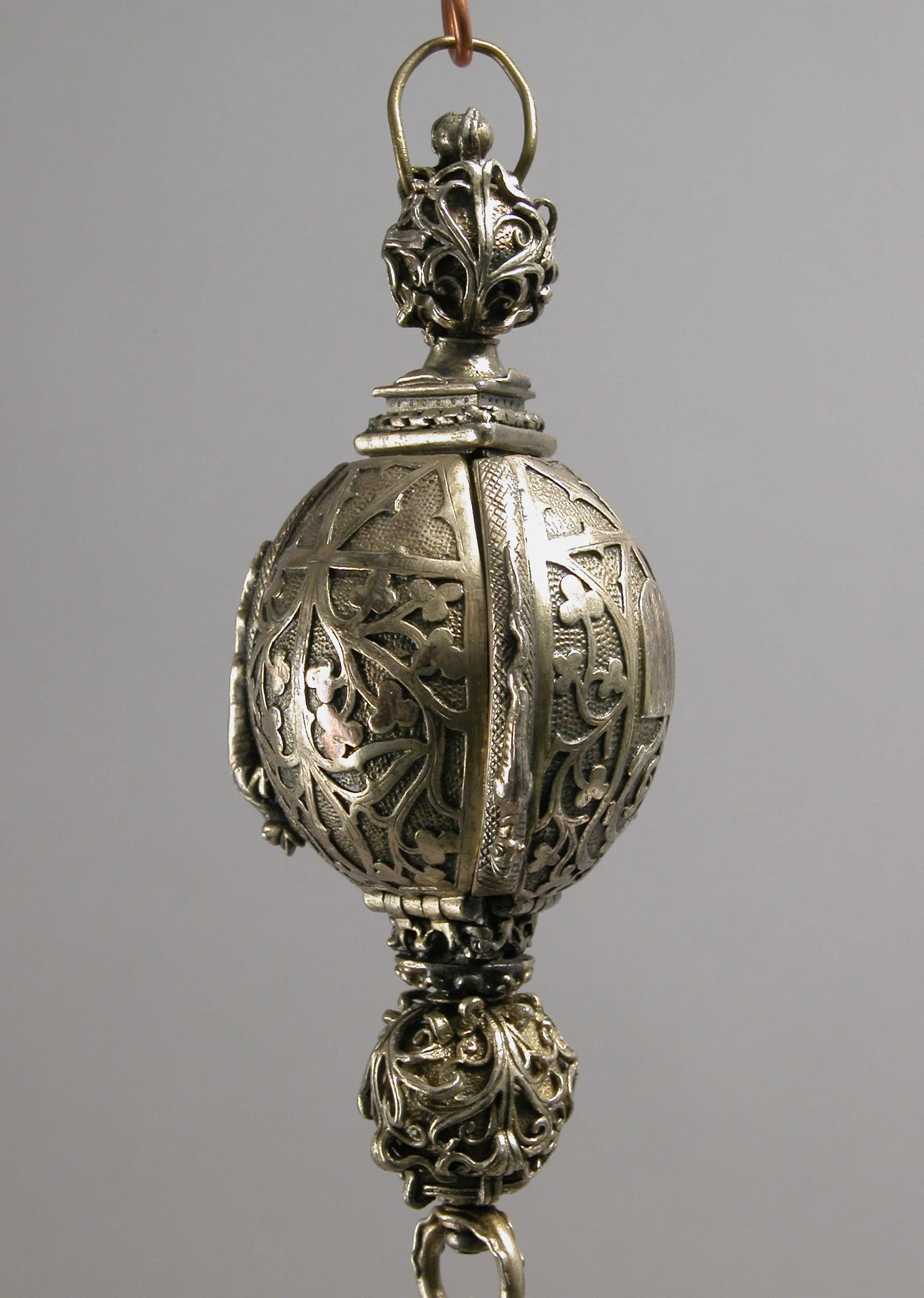
A pomander bead from a rosary or devotional pendant, in late 15th- or early 16th-century style: the pierced container half of the pomander, its openwork cut so the scented ball inside could breathe. This is the very object this lesson's Further Reading sends you to.
Pomander Bead from a Rosary or Devotional Pendant, The Metropolitan Museum of Art (Object 464302). Public domain.
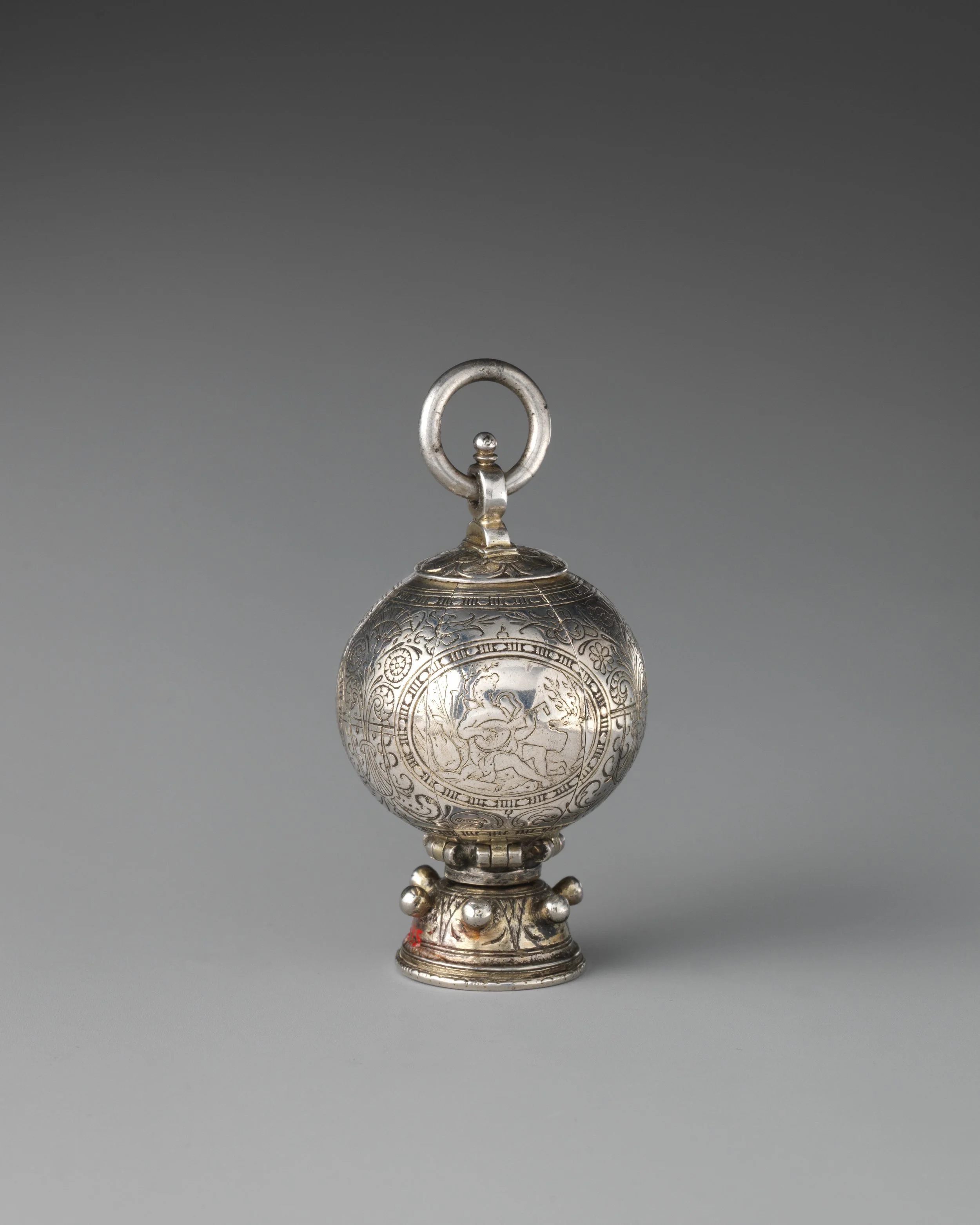
A silver pomander of the 16th century, closed and engraved: the case as jewelry, made to be worn at the waist or neck and opened only for a moment. Inside sat the compounded ball that gave the object its name — pomme d'ambre, the apple of amber.
Pomander, 16th century, The Metropolitan Museum of Art (Object 196980). Public domain.
The word pomander comes from the French pomme d'ambre, the apple of amber. It did not originally mean the orange stuck with cloves that most people picture today. It meant a ball of perfume, and the amber in the name was ambergris, the waxy, sweet-smelling substance that gave the costliest pomanders their heart.
Pomanders are first mentioned in literature in the middle of the thirteenth century, and they were worn and carried from the late Middle Ages through the seventeenth century. The scented ball itself might be a lump of paste compounded from ambergris, musk, civet, dried flowers, spices, and scented oils. It was carried in a case, and the cases were often the more magnificent half of the pair: globular containers of gold or silver, pierced in openwork patterns so the scent could escape, hung from a neck chain or a belt or fastened at the girdle. Some opened into segments, each holding a different perfume, so the wearer could choose a scent for the occasion the way one might choose a ring. Surviving examples have been made in the shapes of nuts, skulls, hearts, books, and ships. Smaller ones hung from finger rings; the smallest served as buttons.
One sixteenth-century German pomander, preserved in a London collection, opens to reveal six hollow compartments around a central stem, each with a sliding lid labeled for its contents: cinnamon, cloves, nutmeg, a composite of ambergris with musk and civet, amber, and rosemary. Six perfumes, each kept separate, each chosen for its own purpose, all carried in a ball barely wider than a hen's egg. That is portable perfumery at its most deliberate.
Scholars, a note on the thinking of the time, because you will meet it in every old text you read. For centuries, European medicine held that many diseases traveled in foul air, in miasmas, corrupt vapors rising from filth and stagnant places. If sickness came on bad smells, then good smells stood to reason as protection, and carrying a ball of concentrated fragrance was, to the people of the time, a sensible precaution, particularly in years of pestilence. The theory was wrong. Disease does not travel in smells, and no pomander — a ball of compounded perfume, or the pierced container that holds it — ever stopped a plague. But you should understand why intelligent people believed it, because the belief shaped centuries of perfumery, and the objects it produced are beautiful regardless. We study the history honestly, and we keep the history separate from the science. That discipline is part of your training.
By the eighteenth century, the great pierced pomanders had largely given way to the vinaigrette, a small box holding a sponge soaked in aromatic vinegar, carried for much the same purpose. Fashions in scent change. The laboratory remembers them all.
Check in: What did the word pomander originally mean — and what theory made carrying one seem a sensible precaution, in years of pestilence?
❦ In your workbook: record the apple of amber in your own way — the name and its ambergris heart, the pierced cases and how they were worn, the six-compartment German example, and the miasma thinking, held as history — copy, sketch, or note what matters.
What Went Inside
A pomander was only as fine as its filling, and the fillings tell you what the perfumer's world valued.
Ambergris. The namesake. A waxy substance produced in the digestive system of the sperm whale, expelled into the sea, where years of sun and salt water transform it from foul-smelling waste into a gray, marbled lump with a sweet, musky, tobacco-like scent. Beachcombers still find it; it has been called floating gold. Perfumers prized it above almost everything as a fixative, the material that anchors volatile top notes and keeps a composition together. Its trade is now restricted in many countries because the sperm whale is protected, and modern perfumery uses laboratory-made substitutes. We study it as history. No student needs to seek it out.
Musk. The dried secretion of the male musk deer, intensely animal and sweet, used in tiny amounts to give depth and warmth to a composition. Like ambergris, it was a fixative as much as a fragrance. The deer were hunted hard for it, and modern perfumery has almost entirely replaced it with synthetic musks. History again, not a shopping list.
Civet. A buttery secretion from the civet cat, sharp and animalic, used in traces to add warmth. The same story: valued, then replaced.
The botanicals. Dried rose petals, lavender, rosemary, cinnamon, cloves, nutmeg. These were the honest, obtainable fillings, and they are the ones that concern us as students. A pomander of dried lavender in a pierced wooden ball is the same idea as the golden one, at the scale of an ordinary household. The principle does not require the gold.
Notice the pattern: the animal materials were prized as fixatives, the slow heavy base notes that hold the bright fleeting ones. The botanicals supplied the bright notes themselves. Every pomander was an exercise in fragrance layering, whether its maker used those words or not.
Check in: What pattern joins the fillings — which materials anchored, and which supplied the bright notes?
❦ In your workbook: record what went inside in your own way — ambergris, musk, and civet as history, the honest botanicals as our fillings, and the fixative pattern beneath them all — copy, sketch, or note what matters.
The Clove-Studded Orange
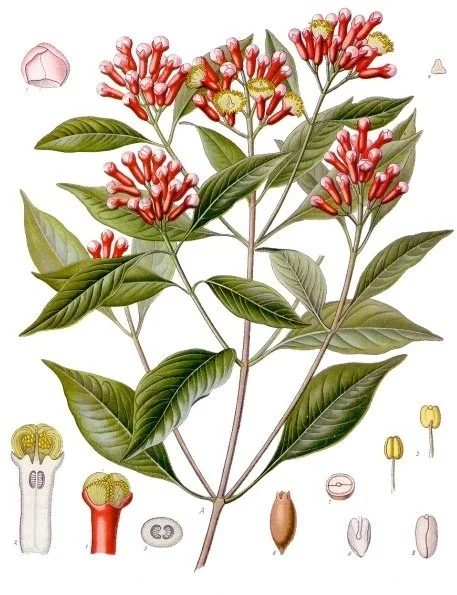
Syzygium aromaticum in Köhler's Medizinal-Pflanzen: the clove in flower, its red unopened buds the very spice of the pomander build — pointed, oil-rich, and doing three jobs at once on the drying orange.
Syzygium aromaticum plate, Köhler's Medizinal-Pflanzen, via Wikimedia Commons. Public domain.
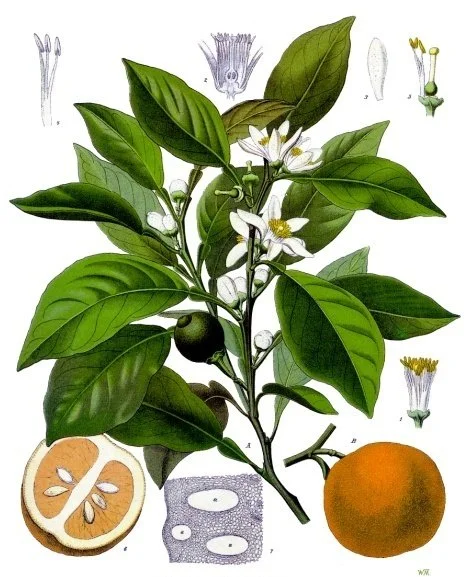
Citrus aurantium in Köhler's Medizinal-Pflanzen: the bitter orange, the traditional pomander fruit — the lesson's Level Two choice, shown whole, halved, and in flower before a single clove goes in.
Citrus aurantium plate, Köhler's Medizinal-Pflanzen, via Wikimedia Commons. Public domain.
Somewhere in the late Middle Ages, as citrus fruit became more available in Europe through expanding trade, someone had the plain good sense to combine the fruit and the spice directly. The clove-studded orange is the folk pomander: no gold case, no ambergris, just an orange, a quantity of cloves, and patience.
It works because of drying. A fresh orange is mostly water, and water is what allows decay. Studded thickly with cloves and hung in dry air, the orange slowly gives up its moisture over two to four weeks. The rind tightens, the fruit shrinks and hardens, and what remains is a light, shrunken, intensely fragrant ball that can scent a drawer or closet for months, sometimes years. The cloves do three jobs at once: their volatile oils perfume the air, their pointed buds physically armor the surface, and their own drying chemistry helps preserve the whole.
Traditional makers dusted the finished orange with orris root powder, the ground rhizome of the iris, which added its own violet-like scent and helped the drying. Cinnamon dust serves the same purpose in a modern kitchen. A ribbon tied around the orange before studding gives you a hanger and divides the fruit into decorative quarters, the classic pattern.
This is desiccation put to work: the same water loss that ruins a fresh specimen, directed and controlled until it becomes preservation. You have met this principle before in the drying lessons. Here it wears festive clothes.
Check in: Why does the clove orange last — and what three jobs do the cloves do at once?
❦ In your workbook: record the clove-studded orange in your own way — water leaving over two to four weeks, the cloves' three jobs, the orris dusting, and desiccation directed into preservation — copy, sketch, or note what matters.
In your packet: Exercise I — The Clove Pomander Build ⚒ begins here. Work it now, or mark the place and take it as homework — your choice.
A Sealed Note on Slow Work
Scholars, your pomander will not be finished today, nor tomorrow, nor this week. The cloves must give up their water slowly, the orange must dry without molding, and no amount of wishing hurries either. This is the lesson inside the lesson, and it is worth sealing: some laboratory work cannot be hurried, only tended.
Check your pomander when you pass it. Note the weight, the scent, the firmness. Write it down. The four-week log you keep will teach you more about preservation than any paragraph I could write, because you will have watched preservation happen, one dry day at a time.
— Professor Crimblebrew Muddlenook, Potions Laboratory • Master Apothecary • Head of House Meridies
Aromatic Waxes & Solid Perfumes
There is a second solution to the perfumer's problem, older than the pomander and quieter. Instead of carrying the scent in a pierced container, you suspend it in a solid base and carry the base itself.
A solid perfume is fragrance held in wax, in fat, or in a blend of the two. The base does the work of a fixative on a grand scale: volatile compounds that would flash off a blotter in minutes instead release slowly from the wax matrix over hours. Warm the tin in your palm and the release quickens; seal the tin and it nearly stops. The perfumer controls time itself, or something close to it.
You have already met the cousin of this technique. In an earlier lesson you studied enfleurage, the cold-fat method of Grasse, in which fresh flowers were laid on purified fat so the fat would drink in their scent over days. A solid perfume is enfleurage made portable: the scented fat, cleaned and blended with wax, carried in a tin instead of washed out with alcohol.
The base matters. Beeswax gives body and a faint honeyed note of its own. A neutral oil softens the wax so it can be touched to the skin of the wrist, where body heat does the releasing. Historically, the bases ran from costly (spermaceti, a wax from the sperm whale's head cavity, now long abandoned) to humble (tallow, lard). The principle is identical at every price: a solid matrix, a fragrance folded through it, and time slowed to the perfumer's liking.
Check in: How does warming the tin change the release — and what is a solid perfume, in the lesson's own comparison to enfleurage?
❦ In your workbook: record aromatic waxes in your own way — the wax matrix slowing release over hours, enfleurage made portable, and the base from spermaceti to tallow — copy, sketch, or note what matters.
In your packet: Exercise III — The Solid Perfume Study ⚒ begins here. Work it now, or mark the place and take it as homework — your choice.
Layering & Keeping Scent
Now put the pieces together, because this is the thinking the whole unit has been building toward.
A fragrance is not one smell. As you learned in the aromatics lesson, perfumers speak of top notes (the bright first impression, quick to arrive and quick to leave), heart notes (the middle, the character of the composition), and base notes (the slow, heavy, long-lasting foundation). A pomander or a solid perfume is a small machine for managing those three arrivals.
In the clove orange, the top notes are the citrus oils in the fresh rind, bright for the first days and then gone as the rind dries. The heart is the clove itself, warm and steady for months. The base is the dried, concentrated whole, the deep sweet mustiness of a fully cured pomander. The object changes its scent as it dries, and your fragrance log will capture that change week by week. Nothing about this is accidental. It is the same layering a perfumer builds deliberately, happening here on its own schedule.
In the solid perfume, the maker does the layering on purpose: bright volatile oils folded into the wax, a fixative base note to anchor them, the wax itself slowing everything down. Open the tin and the top notes greet you; an hour later the heart remains; the base notes are still there at evening. That controlled release is what separates a solid perfume from a sachet of dried lavender, which gives up its scent to the air as fast as the air will take it.
★ Scent preservation, the craft of keeping fragrance stable and available over time, comes down to three strategies, and you now know all three: contain it behind piercings (the pomander case), slow it in a matrix (the wax base), or dry the source until there is little left to lose (the clove orange). Every portable perfume in history uses one of these, or a blend of them.
Check in: Name the three strategies of scent preservation — and which object in this lesson carries each one?
❦ In your workbook: record layering and keeping scent in your own way — top, heart, and base in the drying orange, the maker's deliberate layering in the wax, and the three strategies named — copy, sketch, or note what matters.
In your packet: Exercise II — The Scent Matrix Comparison ◐ begins here. Work it now, or mark the place and take it as homework — your choice.
The Procedure: Building a Clove Pomander
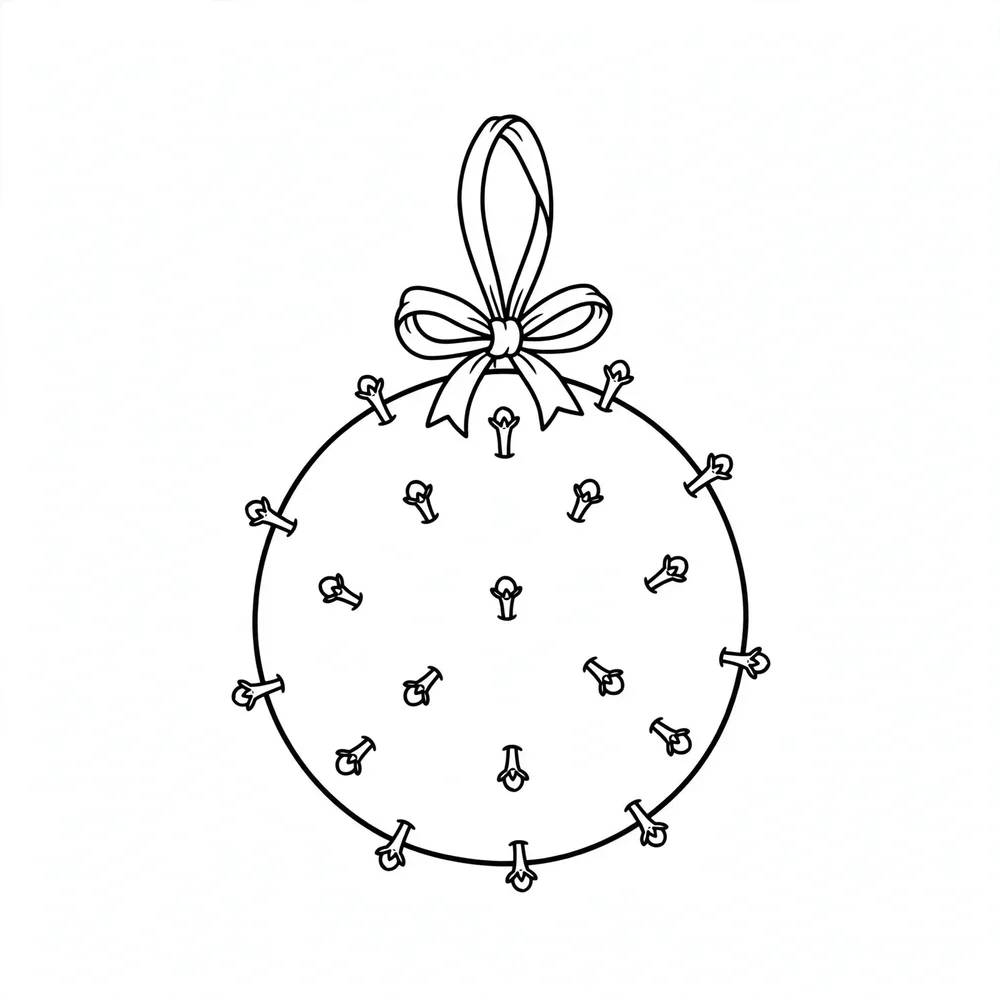
Step 1: Prepare the bench. Cover your work surface with newspaper or a tray. Cloves roll. Assemble the orange, the cloves in a small bowl, the ribbon, the toothpick, and the dusting powder if you are using it. Tie the ribbon around the orange now, knotting it at the top to form a hanging loop and dividing the fruit into quarters, before any cloves go in. It is far harder to tie afterward.
Step 2: Plan the pattern. Decide whether you will cover the whole orange or leave ribbon-divided channels of bare rind. Full coverage preserves longest and smells strongest. A simple, orderly approach: begin at the top and work downward in rings, each clove head a clove-width from its neighbors.
Step 3: Stud the orange. Hold the orange braced in one hand. Push each clove straight in, bud first, with firm steady pressure. If the rind resists, pre-pierce the spot with the toothpick and follow with the clove. This is slow work by design; a full orange takes thirty to forty-five minutes. Take a break if your hand tires. Count roughly as you go, so your log can record how many cloves the orange accepted.
Step 4: Dust and bag. If you are using orris root powder or ground cinnamon, dust the finished orange lightly all over, turning it gently. Slip the orange into the paper bag. The bag slows the drying just enough to prevent the rind from cracking while the inside is still wet, and it catches any drips in the first days.
Step 5: Hang and wait. Hang the bagged orange somewhere dry, airy, and out of direct sun: a closet, a hallway, a dry corner of a room. Not the bathroom, not above the stove. Record the date, the location, the orange's weight if you have a kitchen scale, and your first fragrance notes in the log. Then leave it alone. Check weekly, not daily. The laboratory rewards patience more than hovering.
Check in: Why is the ribbon tied before any cloves go in — and where must the bagged orange never hang?
❦ In your workbook: record the procedure in your own way — bench, pattern, studding, dust and bag, hang and wait, in their order — copy, sketch, or note what matters.
Guided Observation: The Four-Week Fragrance Log
Your pomander is now an experiment with a one-month runtime. Open your journal and begin the log.
Week 0 (construction day). Record the date, the orange variety if you know it, the clove count, the ribbon pattern, the hanging location, and the starting weight. Describe the fragrance in the vocabulary of the course: which notes strike first (top), what sits beneath them (heart), what lingers (base). Note the texture of the rind and the firmness of the fruit.
Week 1. Unbag briefly and inspect. Record any soft spots, any sharp or fermented smell (a warning sign), the weight if you are tracking it, and how the fragrance has changed. Most oranges lose their bright citrus top notes in the first week as the rind begins to dry. Write down what replaced them.
Week 2. The orange should feel noticeably lighter and the rind should be tightening. Record weight, texture, and fragrance. Note whether the clove scent has grown relatively stronger as the citrus fades. This is the layering principle made visible: the top notes departing on schedule while the heart notes hold.
Week 3. By now the fruit is usually hard and shrunken. Record the final weight and compute the total water lost if you tracked it. Describe the cured fragrance fully. Is it pleasant? Would you hang it in a closet? Your honest verdict goes in the log, whatever it is.
Week 4. Final entry. Remove the bag. The pomander is done when it feels light, hard, and dry through. Write the complete profile: construction notes, the drying curve in your own words, the fragrance at each stage, and one thing you would do differently next time. File the log in your archive. A finished pomander, hung in a drawer or closet, is both a specimen and a trophy.
If at any weekly check you find mold, record it, discard the pomander as described in the safety briefing, and write up the failure. Note the hanging location and the weather that week. Failure analyzed is worth more than success unexamined.
Check in: What changes first in the log's first week — and what does the Week 2 entry make visible about layering?
❦ In your workbook: record the guided observation in your own way — five dated entries from construction day to the finished ball, the notes departing in their order, and the honest verdict at the end — copy, sketch, or note what matters.
Cleanup
Brush loose cloves and dust into the bin. Wipe the bench with the damp cloth; clove dust gets everywhere and the next person to use the table should not inherit your experiment. Wash your hands thoroughly, especially before touching your face. Store leftover whole cloves sealed and labeled. The dusting powder, if used, goes back in its jar with the date. Return the toothpick and ribbon spool to their places. A tidy bench is the signature of a trained scholar.
❦ In your workbook: record the cleanup in your own way — dust binned, bench wiped, hands washed, leftovers sealed and labeled with the date — copy, sketch, or note what matters.
Archive Entry
File the following in your potions journal under a new section for portable perfumery:
- The construction record: date, materials, clove count, pattern, hanging location
- The four-week fragrance log, complete with weekly weights if tracked
- A small sketch of the finished pomander, or a photograph taped to the page
- Your verdict: what worked, what you would change, and whether the layering behaved as the lesson predicted
- The solid perfume formula from Exercise III, with its own observation notes
Label everything with the lesson number. Future you will thank present you.
Your potions journal, as this lesson uses it. File the following in your potions journal under a new section for portable perfumery — the scholar's own working book, kept in their own hand, is where this lesson files its work.
❦ In your workbook: record the archive entry in your own way — the construction record, the four-week log, the sketch or photograph, the verdict, and the solid perfume formula, all labeled with the lesson number — copy, sketch, or note what matters.
Materials
Everything in its place, before we begin. A meticulous laboratory begins with everything gathered before work starts. Assemble the following.
Required (Level One — household items)
- One thin-skinned orange, firm and heavy for its size. Thin skin takes cloves more easily than thick, pithy rind.
- Whole cloves, at least 60 to 80. Buy them whole, not ground; you need the pointed buds intact.
- A ribbon or cord, about 60 centimeters, for hanging the finished pomander.
- A toothpick or bamboo skewer, for pre-piercing the rind if your orange resists.
- Ground cinnamon or orris root powder (optional, traditional): a tablespoon for dusting.
- A small paper bag for the drying stage.
- Your laboratory journal and a pencil for the fragrance log.
- A small heat-safe jar or tin for the solid perfume exercise, plus a teaspoon of a plain lip balm or petroleum jelly as the wax base, and a few drops of a kitchen vanilla extract or a pinch of ground cinnamon for scent. (Level One uses what the kitchen provides.)
- A damp cloth for wiping surfaces and hands.
Suggested (Level Two — historically closer)
- A Seville or bitter orange, the traditional pomander fruit, if you can find one in season.
- Orris root powder from an herbal supplier, the classic dusting powder of the pomander maker.
- Beeswax pellets and a neutral oil (such as jojoba or fractionated coconut oil) for building the solid perfume base from scratch, instead of the kitchen shortcut.
- A small metal tin with a tight lid, the historical vessel for solid perfume.
- Dried lavender buds or rose petals for a comparative sachet.
Safety Notes
- Whole cloves are small, hard, and pointed. Younger students must have an adult present for the studding step. Brace the orange, keep fingers curled away from the point of pressure, and stop if your hand tires.
- Work in a ventilated room when handling large quantities of cloves. If you have asthma, a fragrance sensitivity, or a spice allergy, take breaks in fresh air and ask an adult to help with the dustiest steps.
- Inspect the drying pomander weekly. If you see fuzzy mold growth, do not try to rescue it: wrap it, discard it, wash your hands, and record the failure in your log.
- All wax melting must be done by or with an adult, in a heat-safe vessel, never with an open flame directly under wax. Hot wax burns. Never leave melting wax unattended.
- Nothing in the Potions Laboratory is medicine, and no lesson gives amounts to take. The historical beliefs in this lesson, including the idea that scented objects could ward off illness, are presented as history, not as fact.
Reflection Questions
Answer the following questions in your workbook.
- The word "pomander" came to mean both the scented ball and the pierced container that held it. Why do you think one word stretched to cover both, and what does that tell us about which half people valued more?
- Physicians and fashionable people carried pomanders against pestilence for centuries, on the theory that good smells countered bad air. The theory was wrong, yet the practice persisted. What does that suggest about how people judge whether a precaution is working?
- A fresh orange rots in days, but a clove-studded orange can last for months or years. Explain the difference in terms of water, using what you know about drying and preservation.
- A sachet of dried lavender gives up its scent quickly, while a solid perfume releases the same kind of fragrance slowly over hours. Explain the difference using the idea of a fixative matrix.
- Imagine you are packing a pomander for a long sea voyage in the year 1600, choosing from everything in this lesson. What would you put inside, and what would each ingredient contribute? (Answer as a design problem, not a medical one.)
Workbook Checklist — Lesson 45
In my workbook I have:
- ☐ explained what a pomander is and where its name comes from, and how pomanders were worn and used from the thirteenth through the seventeenth centuries
- ☐ described the historical theory of miasma and explained in my own words why that theory is no longer held
- ☐ identified the materials historically placed inside pomanders: ambergris, musk, civet, dried botanicals, and spices
- ☐ explained how a wax or fat base acts as a fixative matrix that slows the release of volatile fragrance compounds
- ☐ built the clove pomander by the five-step procedure (or completed its workbook study) and kept the four-week fragrance log, Week 0 through Week 4
- ☐ completed the Scent Matrix Comparison: three sources, daily openings for one week, and a half-page conclusion in the vocabulary of the three strategies
- ☐ completed the Solid Perfume Study on one path (or its workbook design) and labeled the tin — or its paper record — with contents and date
- ☐ filed the Archive Entry in my potions journal under portable perfumery, labeled with the lesson number
☐ Lesson completed Date: ___ Signature: ___
The Professor's Closing Note
Sealed with the teal wax of Professor Crimblebrew Muddlenook, Master Apothecary of the Potions Laboratory, Head of House Meridies.
Well done, scholars. You have built the oldest portable perfume in the European tradition with your own hands, and you have watched it change week by week the way all materials change: water leaving, scent shifting, the bright notes departing first and the deep ones holding their ground.
Remember the three strategies, because they are the whole of scent preservation: contain the fragrance behind piercings, slow it in a wax matrix, or dry the source until there is little left to lose. You will meet these three again everywhere in this unit, in inks and pigments and sealing wax, each time wearing a different disguise.
Hang your pomander where you will smell it in passing. Keep your tin sealed when you are not studying it. And keep your log honest, especially the weeks when nothing seemed to happen. Nothing happening, carefully recorded, is still data.
In good order,
— Professor Crimblebrew Muddlenook, Potions Laboratory • Master Apothecary • Head of House Meridies
PROFESSOR CRIMBLEBREW MUDDLENOOK
Potions Laboratory
Master Apothecary • Head of House Meridies
Cross-Class Connections

Herbology · Unit IV, Lesson 28 — Drying Herbs the Traditional Way
Come up to the Greenhouse, pomander-makers, and learn drying as the grower practices it. In my greenhouse we hang herbs in moving air and judge them ready by hand and nose, the same water loss Professor Muddlenook's clove orange undergoes on its ribbon — his fruit dries to keep its scent; mine dry to keep their virtue. Bring your pomander log, and we will compare drying curves.
PROFESSOR BERYL FERNFOOT
Herbology Greenhouse • Master Herbalist • Head of House Oriens
Scrollwork · Unit II, Lesson 5 — Soot & Charcoal Ink
You have folded fragrance through wax so the scent cannot flee. Now come and persuade soot to stay on a page. In my Scriptorium we grind carbon into water with gum arabic, a binder that holds a stubborn pigment the way Professor Muddlenook's wax holds a volatile scent — the same fixative logic, wearing a scribe's apron. Come and watch it change coats.
PROFESSOR QUILLBERRY NOCTURNE
Scrollwork Library
Further Reading & Sources
- Pomander Bead from a Rosary or Devotional Pendant — The Metropolitan Museum of Art — a French pomander bead whose name comes from the French pomme d'ambre; filled with perfume or musk and worn as a belt accessory.
- Pomander — Wikipedia — overview of the form: first literary mention in the mid-thirteenth century, use through the seventeenth century, replacement by vinaigrettes in the eighteenth.
- A Silver-Gilt Pomander, German, 16th Century — Wartski — a six-compartment pomander with labeled lids for cinnamon, cloves, nutmeg, an ambergris-musk-civet composite, amber, and rosemary.
- Ambergris — The Perfume Society — the history of ambergris as perfumery's legendary fixative, its transformation at sea, and its modern synthetic replacements.
- A Whale of a Tale — Scientific American — how ambergris forms in the sperm whale's digestive tract and why scientists believe it is expelled rather than vomited.
Browse the Potions shelf in the school Library for readable editions of these works.
LESSON 45 · POMANDERS & SOLID PERFUMERY
Try It in the Laboratory
Clove-studded oranges, and the miasma theory honestly retired — this lesson taught the pomander. The Experiment builds your own: fruit, clove pattern, and spice dust, then tells you how long to wait while it cures.
— Professor Crimblebrew Muddlenook, Potions Laboratory
Submit your work for this lesson using the form below.
CONTINUE IN THE POTIONS LABORATORY
← Previous · Lesson 44: The Formulation Matrix Next · Lesson 46: Volatile Botanical Spirits →
Unit VI — Fragrance, Pigments & Botanical Arts Potions Laboratory — All 52 Lessons
The rest of Unit VI: Lesson 46 · Volatile Spirits · Lesson 47 · Burn Blends · Lesson 48 · Carbon & Oak Gall Inks · Lesson 49 · Plant & Berry Stains · Lesson 50 · Paper Aging · Lesson 51 · Wax Seals · Lesson 52 · Continuing Ledger · The Capstone · The Apothecary's Signature Formula