POTIONS
Unit V · Lesson 44THE FORMULATION MATRIX
Professor Crimblebrew Muddlenook
Master Apothecary • Potions
Head of House Meridies • School of Evershade
Professor's Introduction

Sealed with the teal wax of Professor Crimblebrew Muddlenook, Master Apothecary of the Potions Laboratory, Head of House Meridies.
Scholars, this is the tenth and final lesson of Unit V, and I intend to enjoy it. Nine lessons ago you had a bench, some jars, and good intentions. Today you have balms and candles, sachets — small cloth bags filled with dried fragrant botanicals — and emulsions (mixtures in which droplets of one liquid are dispersed through another liquid it does not mix with), scrubs and soaps, a catalog of instructive failures, and at least one formula that is entirely your own. That is not a pile of crafts. That is a body of work. But a body of work scattered across nine sets of notes is a library with no catalog, and a library with no catalog might as well be an attic. Today we build the catalog. Bring every journal, every ledger page, every stained worksheet from Lessons 35 through 43, and lay them out where you can see them all. We are going to file the whole unit, and when we are finished, any preparation you ever made will be findable in under a minute. That is the standard. Let us begin.
— Professor Crimblebrew Muddlenook, Potions Laboratory • Master Apothecary • Head of House Meridies

Potions map — the class base map, unmarked for this lesson.
Lesson Objectives
By completing this lesson, you will be able to:
- Construct a complete Formulation Matrix: a master index linking every preparation you made in Unit V to its recipe, batch records, texture observations, stability notes, and revisions.
- Write a proper Batch Record for any preparation, with batch numbering, conditions, yield, and dated observations.
- Maintain a Texture Log and a Stability Record that track how a preparation changes over days and weeks.
- Keep a Revision Ledger that turns failures and experiments into usable knowledge.
- Assess your own archive against the Master Formulation Standard rubric.
Reading this lesson: ★ marks the passages to remember. They set the matrix standard this lesson is assessed by, and they return in the units ahead and at the capstone. This lesson contributes no items to the Unit V Quiz — its assessment is the matrix and archive work itself, set out in the Assignment Manual below. Check in questions ask the material back as you go; answer them in your workbook when you meet them.
Working this lesson: Your assignment packet is the first download on this page. Work in it as the lesson moves along, answering each exercise as its subject is taught — or read the lesson through for your notes and take the exercises as homework afterward. Both are proper ways to sit this class. Signposts in the reading tell you where each exercise belongs. Written answers are short answers in your own words; a few honest lines are worth more than a filled page.
Your Assignment Packet
This lesson's exercises live in its packet: the Lexicon Handout (every term, course terms marked ◆), Materials, Guided Practice — the worked example of one balm fully filed and the six-step consolidation procedure, printed in full so you can file your own unit the same way — the Assignment Manual with its self-check, the Reflection Questions, and the Workbook Checklist. Download the packet before you begin and keep it beside you as you read.
About this lesson's assessment, plainly: this lesson has no quiz, and no quiz items are taken from it for the Unit V Quiz. The matrix work itself is the assessment: Exercises I–III in the manual below — the complete Recipe Index, the audited Batch Records with their Texture and Cure Logs, and the Stability Record and Revision Ledger closed by the stranger test — stand beside the Unit V Quiz as the unit's practical layer. The lesson's course-◆ terms do travel to the Unit V Quiz, where they belong to its vocabulary matching.
Safety Briefing
This lesson's safety spine is its own Unit V Safety Consolidation, carried here word for word, because the consolidation is the briefing: it is written at the front of your matrix, with every preparation of the unit in front of you.
Unit V Safety Consolidation
Unit V asked more of your laboratory discipline than any unit before it, and the habits you built are the real qualification this course confers. Consolidate them here, in writing, at the front of your matrix.
Heat discipline. Every heated preparation this unit used controlled, attended heat: double boilers, monitored temperatures, heat-safe vessels. That discipline is permanent. No heated vessel is ever left unattended, in this laboratory or any other.
Alkali respect. Lesson 41's cold-process soap introduced active chemistry. The rules from that lesson do not expire at the unit's end: protective gloves and eye protection, careful measurement, full ventilation, adult supervision for every lye-handling step, and immediate, calm response to spills (flood with water, then clean). Treat every alkali with the same respect, every time.
Labeling. Every preparation in your archive is labeled with its contents, its batch number, and its date. Unlabeled jars are not mysterious; they are hazards. The matrix is useless if the jars do not match it.
Storage. Finished preparations live cool, dark, and sealed, away from children and pets. Anything showing mold, rancidity, or separation beyond the expected is discarded, and the discard is recorded in the Stability Record with the reason.
The standing rules. Nothing in the Potions Laboratory is medicine, and no lesson gives amounts to take. Preparations made for study are for study: observed, recorded, and displayed, not consumed. Fragrance sensitivities are real; ventilate, and step back when a scent overwhelms. When in doubt about any material or step, stop and ask an adult. The archive will wait.
Check in: What three things does every label in your archive carry — and what is the spill response the alkali rule requires, word for word?
❦ In your workbook: record the safety consolidation in your own way — heat discipline, alkali respect, labeling, storage, and the standing rules — copy, sketch, or note what matters.
In your packet: Guided Practice — the worked example and the consolidation procedure begin here, and the Self-Assessment Rubric in the Assignment Manual is this consolidation turned into a score. Work them as you reach them in the reading, or mark the place and take them as homework — your choice.
What Is the Formulation Matrix?
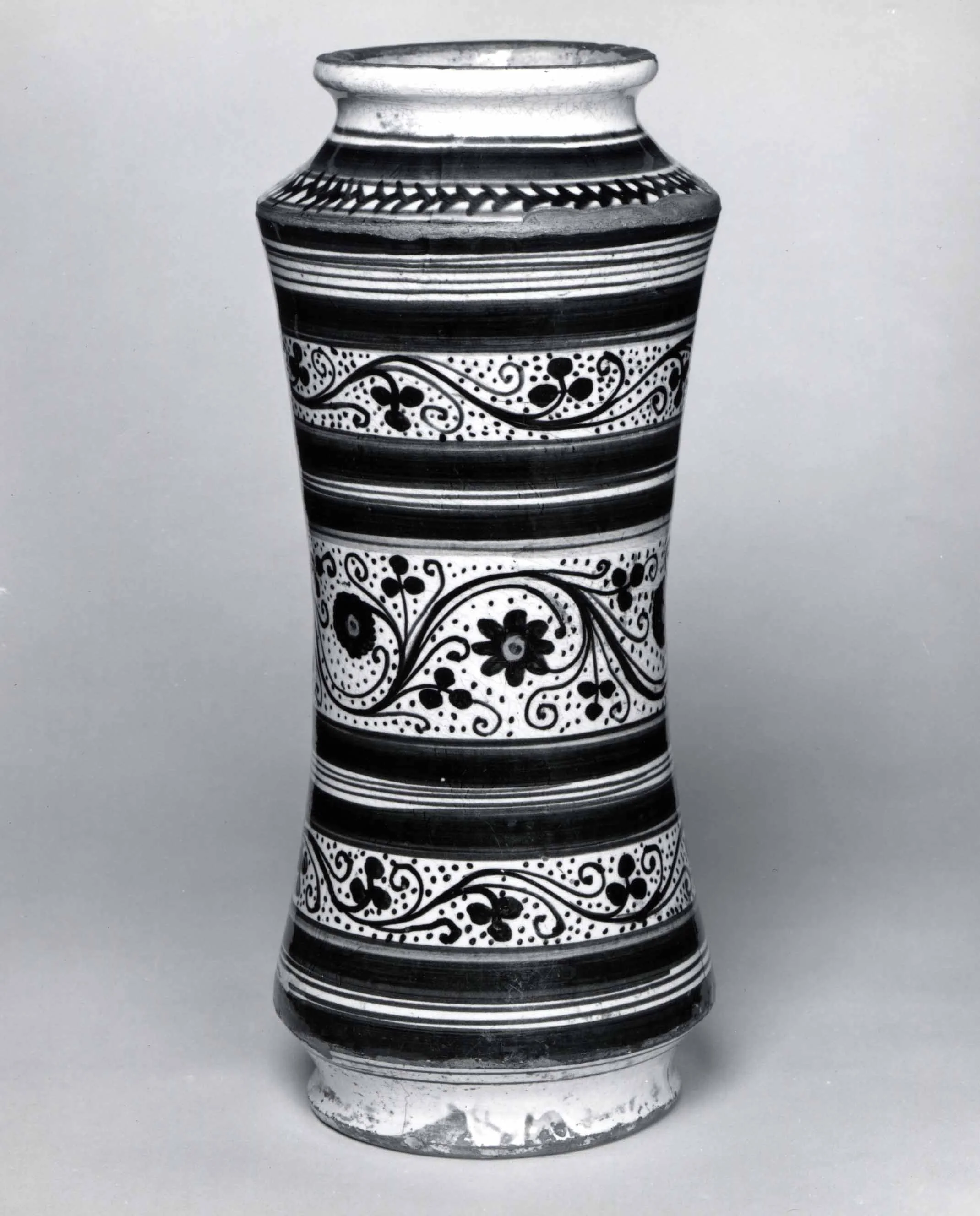
An apothecary jar (albarello), Italian, Faenza or Pesaro, about 1470–80: beautiful, durable, and — without its record — silent about what it held, when, and in what amounts. The Formulation Matrix is the instrument that keeps a shelf of such jars from becoming a shelf of rumors.
Apothecary jar (albarello), Italian, Faenza or Pesaro, ca. 1470–80, Robert Lehman Collection, The Metropolitan Museum of Art (Object 1975.1.985). Public domain.
Every historical apothecary who lasted more than a season kept batch books. The surviving ones, in collections like the Wellcome and the Smithsonian, show the same discipline on every page: what was made, when, from what, in what amounts, under what conditions, and what happened next. ★ A formula without its history is a rumor. A formula with its history is a tool.
The Formulation Matrix is your batch book for Unit V, organized as a single master index. It does not replace your journals. It sits above them and points to them. One row per preparation. Each row carries the preparation's index number, its name, the lesson where its method was taught, the location of its recipe, the location of its batch records, the current state of its texture and stability observations, and the location of any revision notes. When the matrix is complete, you can answer any question about any preparation you made this unit without hunting: which batch of balm went grainy, what you changed, whether the change worked, and where the evidence is written down.
Think of it as the map of a territory you have already explored. The exploring was Lessons 35 through 43. Today we draw the map.
Check in: What does each row of the matrix carry — and what can you answer, without hunting, when the matrix is complete?
❦ In your workbook: record what the Formulation Matrix is in your own way — the batch-book tradition behind it, a rumor against a tool, and one row per preparation pointing to everything else — copy, sketch, or note what matters.
The Five Archives
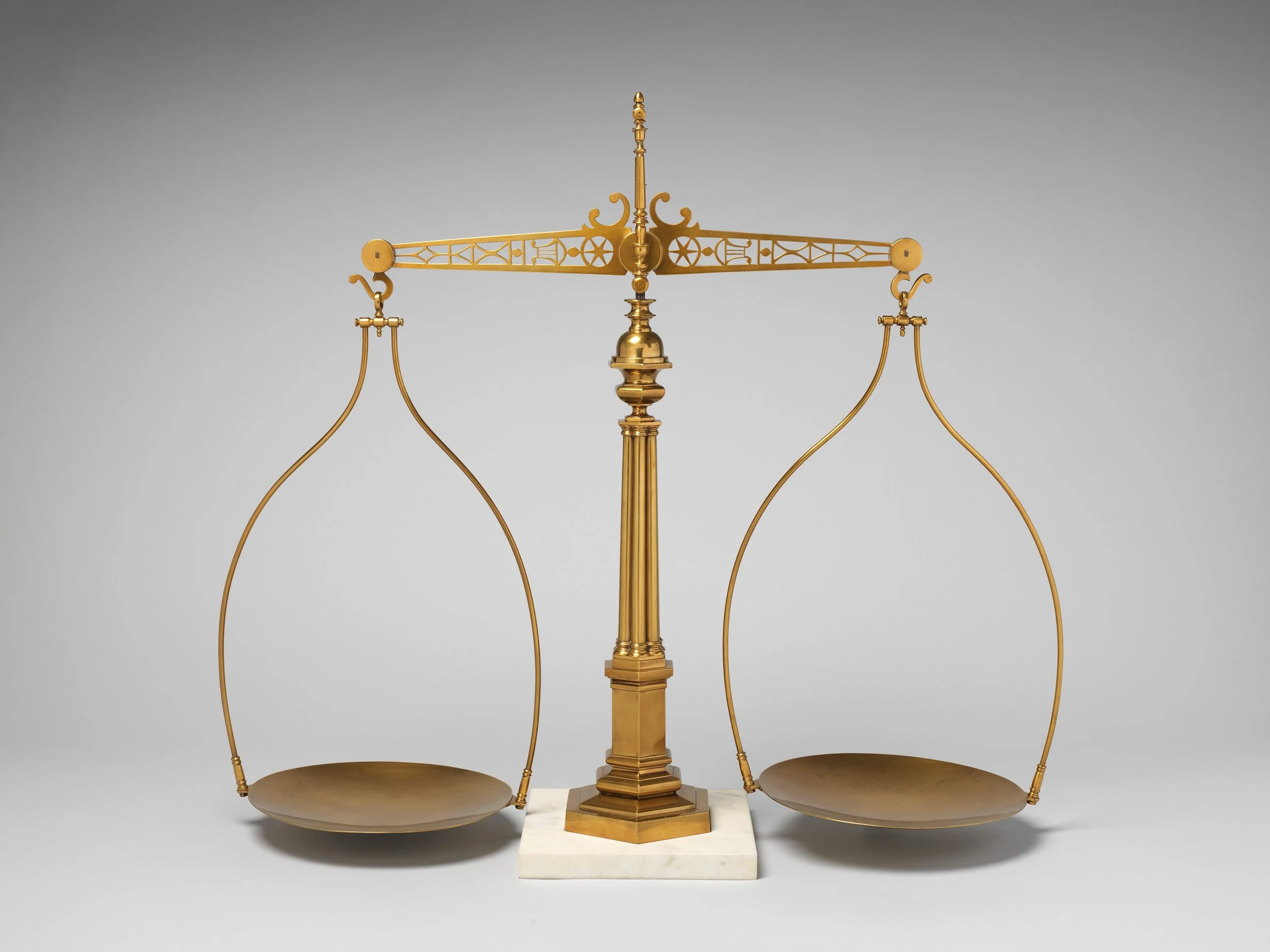
A balance scale of about 1845–55: the Batch Record's first discipline made brass. Every record in the matrix begins the same way this beam does — materials and amounts, weighed and written down at the time of making, never reconstructed from memory.
Balance scale, ca. 1845–55, The Metropolitan Museum of Art (Met Open Access). Public domain.
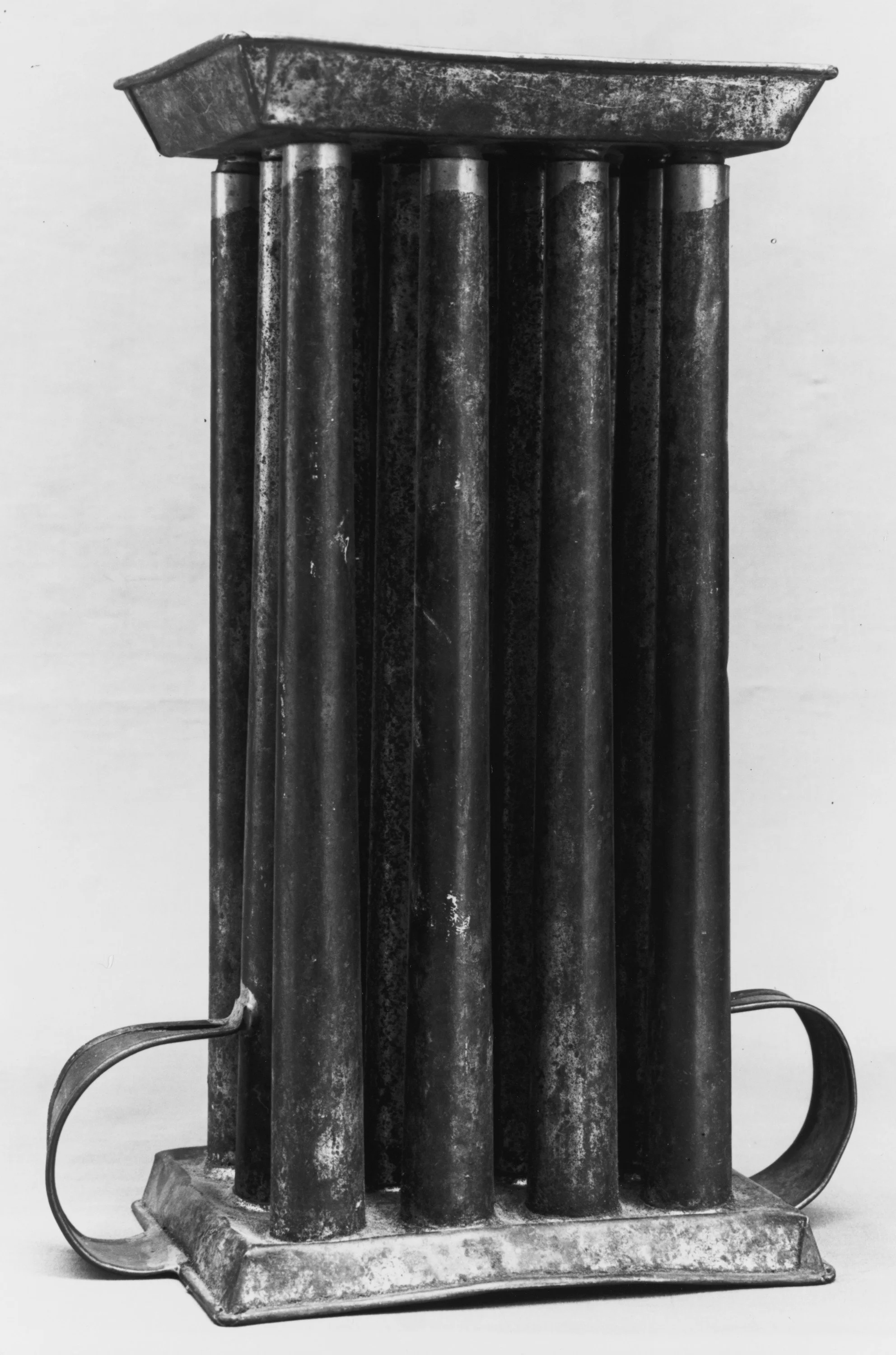
A candle mold of 1800–1830, its tubes dark with work: the tool behind Lesson 36's candles, whose long-term notes the Stability Record now files. A preparation you stopped watching is a preparation you stopped learning from — the mold made the candles once; the record keeps teaching from them.
Candle Mold, 1800–1830, The Metropolitan Museum of Art (Met Open Access). Public domain.
Your matrix points to five archives. You have been building all five all unit, some of them without realizing it. Today each one gets its proper form.
1. The Recipe Index
The Recipe Index lists every formula you used or created, each with a permanent index number. Format: F-35-01, meaning Formulation, Lesson 35, first formula of that lesson. Your original experimental formula from Lesson 43 gets the same treatment: F-43-01. Each entry records the formula name, its source (the lesson, or "original" for your own), the page where the full recipe lives, and one line describing what it is. The index never changes once written. If you revise a formula, the revision gets a new batch record, not a new index number. The recipe is the idea. Batches are the attempts.
In your packet: Exercise I — Building the Recipe Index ⚒ begins here. Work it now, or mark the place and take it as homework — your choice.
2. The Batch Record
Every time you make a preparation, you open a Batch Record. One making, one record, one batch number: the index number plus the batch sequence, so the second time you make formula F-35-01, that making is F-35-01-B2. The record carries the date, the exact materials and amounts you used, the conditions (room temperature, humidity if you track it, who supervised), the yield, and your observations at the time of making. Then it stays open: you return to it with dated entries as the preparation ages. A batch record is a living document for the life of the preparation.
3. The Texture Log
Texture is the first language of formulation, and it changes over time. The Texture Log is a dated table for each preparation: date, age of the preparation in days, and your observations of firmness, spreadability, graininess, separation, and scent. You already kept versions of this in Lessons 35, 38, and 39. Today those scattered observations get filed under their batch numbers, in order, so the life story of each preparation reads straight through.
In your packet: Exercise II — Auditing the Batch Records ◐ begins here. Work it now, or mark the place and take it as homework — your choice.
4. The Stability Record
The Stability Record answers one question per preparation: does it last, and how does it change? Separation, weeping, rancidity, drying out, mold, fragrance fade, color change: each gets a dated entry with your verdict (stable, changing, failed) and what you did about it. Your soap cure observations from Lesson 41 belong here. So do the long-term notes on your candles from Lesson 36. A preparation you stopped watching is a preparation you stopped learning from.
5. The Revision Ledger
The Revision Ledger is where Lesson 42 (The Failed Batch) and Lesson 43 (The Experimental Formula) pay their dividends. Each entry records what you changed, why you changed it, what you predicted, and what actually happened. A failed batch with a complete revision entry is worth more than a lucky success with no notes, because the failure teaches and the luck does not. ★ Muddlenook's rule, which you will hear once more: write down the failure while it is fresh, or you will repeat it while it is stale.
Check in: A formula is revised. What gets a new record, and what never gets a new number — and what four things does every Revision Ledger entry record?
❦ In your workbook: record the five archives in your own way — the Recipe Index and its permanent numbers, the Batch Record that stays open, the Texture Log, the Stability Record and its three verdicts, and the Revision Ledger — copy, sketch, or note what matters.
In your packet: Exercise III — The Stability and Revision Ledger ◐ begins here. Work it now, or mark the place and take it as homework — your choice.
A Worked Example: One Balm, Fully Filed
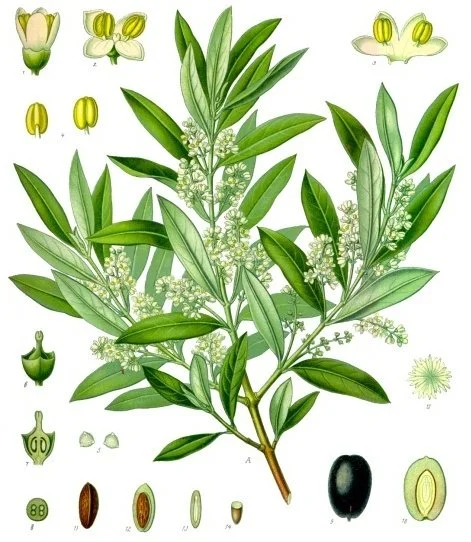
Olea europaea in Köhler's Medizinal-Pflanzen: the olive whose oil fills the worked example's jar — F-35-01, one part wax to three parts oil. The example files this plant's preparation through all five archives; this plate is what the eye records before the record begins.
Olea europaea plate, Köhler's Medizinal-Pflanzen, via Wikimedia Commons. Public domain.
Follow one preparation through all five archives. Take the simple beeswax and olive oil balm from Lesson 35, the first formulation most of you made this unit.
Recipe Index. F-35-01. Beeswax and olive oil balm, plain. Source: Lesson 35. Recipe location: laboratory journal, page 4. Description: firm protective balm, approximately one part wax to three parts oil by weight.
Batch Record. F-35-01-B1. Made on the lesson date. Materials and amounts as measured. Conditions noted: kitchen bench, adult present, double boiler method. Yield: one small jar, about 60 milliliters. Observation at making: poured smooth, set firm within the hour, surface glossy.
Texture Log. Day 1: firm, smooth, spreads with pressure. Day 7: slightly firmer, still smooth, no grain. Day 14: surface matte, edges pulling very slightly from the jar wall. Each entry dated, each under the same batch number.
Stability Record. Week 2 verdict: stable. Week 6: faint change in scent, still pleasant; texture unchanged. No separation, no mold, no rancidity. Verdict: stable with normal aging.
Revision Ledger. Second making, F-35-01-B2: reduced wax slightly after finding B1 too firm for comfortable spreading. Prediction: softer set, same stability. Result, two weeks later: softer and still stable. Revision confirmed and kept.
That is five archives, one preparation, fully filed. Every preparation you made this unit deserves the same treatment, though your entries will be shorter now that you know the form. The matrix row for this balm reads: F-35-01 | Beeswax-olive balm | L35 | recipe: journal p.4 | batches: B1, B2 | texture: filed through day 14 | stability: stable at 6 weeks | revisions: 1 (wax reduction, confirmed).
Scholars, a confession from your professor: my own first batch book, kept as an apprentice, contains an entry that reads only "the green one: FAILED, do not repeat." No formula, no amounts, no date. It took me a full season to work out which green one, and I never did work out why it failed. I keep that page to remind myself what an archive is for. Yours will be better than mine was. That is rather the point of school.
— Professor Crimblebrew Muddlenook, Potions Laboratory • Master Apothecary • Head of House Meridies
Check in: In the worked example, what change did the second making carry, what was predicted for it — and what did the result, two weeks later, confirm?
❦ In your workbook: record the worked example in your own way — one balm through all five archives, its batch numbers, its dated texture entries, and its confirmed revision — copy, sketch, or note what matters.
A Sealed Note on Consolidation
You have now seen one preparation fully filed across five archives. The work ahead of you is to do the same for every preparation in this unit, and I will not pretend it is small work. It is, however, the work that turns a shelf of jars into a laboratory. A jar without a record is a rumor. A jar with a matrix row, a batch record, a texture log, and a stability entry is evidence.
Do not file from memory at the end of the week. File as you go, date everything, and initial what you check. The matrix is only as honest as its most hurried row.
— Professor Crimblebrew Muddlenook, Potions Laboratory • Master Apothecary • Head of House Meridies
Assembling Your Matrix: The Consolidation Procedure
Work through your Unit V materials in lesson order, oldest first.
First, gather. Collect every journal, worksheet, ledger page, and loose sheet from Lessons 35 through 43. Sort them by lesson. Count your preparations: most scholars will have between eight and fifteen distinct preparations, plus experimental variants.
Second, index. Open a fresh spread or a new document titled "Formulation Matrix, Unit V." Rule the columns: Index No. | Preparation | Lesson | Recipe Location | Batch Records | Texture Filed Through | Stability Verdict | Revisions. Assign index numbers F-35-01 onward in the order the formulas appear in your notes.
Third, file the batches. For each preparation, gather its batch records under its index number. Number the batches B1, B2, and so on in the order made. Check each record for the essentials: date, materials and amounts, conditions, yield, making-day observations. Where a record is thin, annotate it now with what you remember, marked clearly as recollection rather than contemporary notes. Honest gaps beat invented details.
Fourth, file the observations. Pull your texture notes into the Texture Log under the right batch numbers, oldest first. Do the same for stability observations. Date every entry. If you stopped observing a preparation weeks ago, write a final entry dated today with its current state, examined fresh. The archive closes no earlier than today.
Fifth, file the revisions. Every failure from Lesson 42 gets a revision entry: what failed, your diagnosis, what you would change. Every experiment from Lesson 43 gets its entry: what you attempted, what happened, what is worth repeating. Unfiled experiments evaporate. Filed ones compound.
Sixth, audit. ★ Read down the matrix and ask of every row: could a stranger find this preparation's complete history from this row alone? If not, the row is unfinished. Finish it.
Check in: A record is thin and you fill it from memory. How must that repair be marked — and what is the audit question asked of every row?
❦ In your workbook: record the consolidation procedure in your own way — gather, index, file the batches, file the observations, file the revisions, audit, in their order — copy, sketch, or note what matters.
Guided Observation: Reading the Worked Example as a Working Document
This lesson's observation is desk work, done with the worked example open: you read one balm's filing the way a stranger will read your matrix in Unit VI, and you test whether its five archives are evidence rather than memory — because a row that only remembers its jar will fail the stranger test.
Work through it in order.
Follow the index number. F-35-01. Beeswax and olive oil balm, plain. Source: Lesson 35. Recipe location: laboratory journal, page 4. The index number never changes; the batches beneath it are the attempts.
Follow the batches. F-35-01-B1 was made on the lesson date and observed at making: poured smooth, set firm within the hour, surface glossy. The second making, F-35-01-B2, carries the revision: reduced wax slightly after finding B1 too firm for comfortable spreading.
Follow the dates. The Texture Log runs Day 1, Day 7, Day 14, each entry under the same batch number; the Stability Record gives a Week 2 verdict and a Week 6 verdict: stable with normal aging.
Consider:
- Which archive would you challenge first, and what would you open, look at, or smell to settle it?
- The matrix row compresses five archives into one line. What does the row itself claim, and where does each claim point?
- What single sentence in this lesson would you write at the head of your own matrix?
❦ In your workbook: record the guided observation in your own way — the index number followed, the two batches compared, and the dated entries read in order — copy, sketch, or note what matters.
Materials
Everything in its place, before we begin. For this matrix lesson you will need:
Required (Level One — household items)
- Every journal, worksheet, ledger page, and loose sheet from Lessons 35 through 43, sorted by lesson.
- A fresh notebook spread or several blank pages for the Formulation Matrix itself (or a printed matrix template if you made one).
- Ruler, pencil, and pen: the matrix is ruled work, and ruled work wants straight lines.
- Adhesive labels and a marker for any jar whose label has faded, smudged, or gone missing.
- A box, binder, or folder to file the completed Unit V archive as one body.
Suggested (Level Two — historically closer)
- An archival binder with tab dividers, one tab per Unit V lesson, so the matrix and its archives live as a single volume.
- Acid-free paper for the matrix pages themselves, so the catalog outlasts the course.
- A batch-number stamp or a fine archival pen for marking jars to match their matrix rows.
Safety Notes
- This is a paperwork lesson: no heating, no chemicals, no new preparations. The bench stays cool today.
- When you re-examine preparations for fresh texture and stability entries, do not taste anything. Look, touch with clean hands, waft, and record.
- Discard failed preparations (mold, rancidity, separation beyond the expected) into the household trash, sealed in a bag. Record every discard in the Stability Record with its reason.
- Cold-process soaps are handled with the same respect as on making day until their cure is confirmed complete. If you re-examine an uncured soap, gloves on.
- If any step of the consolidation requires re-heating a preparation, that step needs an adult present, exactly as in the original lesson.
- Nothing in the Potions Laboratory is medicine, and no lesson gives amounts to take. Study preparations are for study: observed, recorded, and displayed, never consumed.
Reflection Questions
Answer the following questions in your workbook.
- Which of your Unit V preparations changed the most between making day and today, and what does that change teach you about the formulation?
- Look at your Revision Ledger: is there a failure you now understand better than the success that followed it? What made the failure the better teacher?
- Which archive (recipe index, batch records, texture log, stability record, revision ledger) was hardest for you to complete, and what does that difficulty reveal about your working habits?
- If you could add one column to the Formulation Matrix, what would it track, and why?
- How does the discipline of the batch book change the way you will approach your first preparations in Unit VI?
Workbook Checklist — Lesson 44
In my workbook I have:
- ☐ built the Formulation Matrix with its eight ruled columns and indexed every distinct Unit V preparation, originals included, with the total counted at the foot of the page
- ☐ numbered every batch B1, B2, and so on in the order made, and checked every batch record against the full standard: date, materials and amounts, conditions and supervision, yield, and making-day observations
- ☐ marked anything reconstructed from memory clearly as recollection, and invented no details to fill a gap
- ☐ built the Texture Log for each batch in dated order and added a fresh entry dated today for every preparation not examined recently
- ☐ filed my soap cure observations from Lesson 41 as Cure Log entries under their batch numbers
- ☐ given every preparation a current stability verdict — stable, changing, or failed — with dated evidence, and recorded every discard with its reason
- ☐ completed the Revision Ledger: one entry for every Lesson 42 failure and one for every Lesson 43 experiment, each with diagnosis or outcome
- ☐ performed the stranger test on every row and repaired every row that failed it
- ☐ scored my completed matrix against the Master Formulation Standard rubric, honestly, 0 to 2 points per row
- ☐ written the Unit V Safety Consolidation at the front of my matrix
☐ Lesson completed Date: ___ Signature: ___
The Professor's Closing Note
Sealed with the teal wax of Professor Crimblebrew Muddlenook, Master Apothecary of the Potions Laboratory, Head of House Meridies.
The matrix is complete, the jars are labeled, the failures are filed, and the successes can be repeated. That is what an apothecary is: not someone who once made a fine balm, but someone who can make it again, explain why it works, and prove it from the books. You are that person now, for everything in Unit V.
Unit VI waits beyond this page: perfumery, inks, pigments, and the atmospheric arts, where everything you have learned about materials meets color, scent, and craft. Bring the matrix with you. It will only grow more valuable.
In good order, scholars. You have earned the satisfaction.
— Professor Crimblebrew Muddlenook, Potions Laboratory • Master Apothecary • Head of House Meridies
PROFESSOR CRIMBLEBREW MUDDLENOOK
Potions Laboratory
Master Apothecary • Head of House Meridies
Cross-Class Connections

Herbology · Unit V, Lesson 36 — The Materia Botanica: Building Your Herbal
Come up to the Greenhouse, matrix-keepers, and see the other half of the apothecary's library. Here every plant gets its entry — what the material is, where it grew, how it was handled — while Professor Muddlenook's matrix records what you made from it and what happened. The two archives belong beside each other, never inside each other. Bring your matrix rows, and we will make sure the entries they point to are worth pointing to.
PROFESSOR BERYL FERNFOOT
Herbology Greenhouse • Master Herbalist • Head of House Oriens

Scrollwork · Unit VI, Lesson 22 — Wax Seals & Authentication
You have labeled every jar in Professor Muddlenook's laboratory. Now come and seal a document in mine. In the Scriptorium we press a carved matrix into warm wax so a letter can prove it means what it says — his labeling discipline, wearing a scribe's apron. The virtues transfer, scholars. Come and watch them change coats.
Scrollwork · Unit VI, Lesson 23 — Archive Labels & Library Systems
You have built a catalog for nine lessons of preparations. Now come and build one for a library. In my Scriptorium we take up the label, the list, and the shelfmark at the scale of whole collections — how a record is made findable, and why a preparation that cannot be found again might as well never have been made. Your matrix has a thousand-year pedigree, scholars. Come and meet its ancestors.
PROFESSOR QUILLBERRY NOCTURNE
Scrollwork Library

Creative Arts · Unit II, Lesson 11 — Case Binding & Archival Boxes
A catalog deserves a housing built to fit it, scholars. In my workshop you will learn to case a book to measure and to build the archival box in which a great record rests: boards cut square, a case built to fit the book it houses, a box that will outlast everyone in the room. Build the practice corner first, on scrap, as always. Then bring your Formulation Matrix when its pages have grown into a volume, and we will house it properly.
PROFESSOR COGBRANCH TIMBERCLANK
Creative Arts Workshop
Further Reading & Sources
- Science History Institute — Museum and Library Collections
- Wellcome Collection — Library and Archives
- Smithsonian Libraries and Archives
- The Metropolitan Museum of Art — Heilbrunn Timeline of Art History
- Colonial Williamsburg — The Apothecary
Browse the Potions shelf in the school Library for readable editions of these works.
Submit your work for this lesson using the form below.
THE UNIT V QUIZ
POTIONS LABORATORY · UNIT V: BOTANICAL FORMULATIONS
Unit V is complete: extractions become preparations — balms and cerates, candles, sachets, emulsions, crystalline scrubs, and soap by both methods, including the cold-process crucible and its lye protocol — and failure itself studied as a teacher. This quiz gathers the whole unit into one sitting. Take it from memory first, before you look back at your notes, because it measures what has stayed with you. If you completed the work marked ★ in your lesson packets, you have already practiced most of what it asks.
It stands beside this lesson's own Formulation Matrix — the recipe index, batch-record audit, and stability ledger of its Exercises — in which nine lessons of preparations become one consultable catalog. The matrix is the unit organized; the quiz is the unit remembered. Two different kinds of proof, both worth having.
The quiz packet is a single download. Part I gathers questions from across the unit, Part II matches the unit's vocabulary, and the answer key waits at the back for self-checking. When you have finished, score it honestly, note the result in your workbook, and revisit any lesson whose questions went wrong before you move on to Unit VI.
CONTINUE IN THE POTIONS LABORATORY
← Previous · Lesson 43: The Experimental Formula Next · Lesson 45: Pomanders & Solid Perfumery →
Unit V — Botanical Formulations Potions Laboratory — All 52 Lessons
The rest of Unit V: Lesson 35 · Balms & Salves · Lesson 36 · Candles & Wax · Lesson 37 · Sachets & Blends · Lesson 38 · Whipped Emulsion · Lesson 39 · Crystalline Scrubs · Lesson 40 · Melt & Pour Soap · Lesson 41 · Cold-Process Soap · Lesson 42 · The Failed Batch · Lesson 43 · Experimental Formula
From the Apothecary Cabinet
The printed companions to this lesson, from Professor Muddlenook’s shelf in the shop.