

POTIONS
Unit V · Lesson 41SOAPMAKING: THE COLD-PROCESS CRUCIBLE
Professor Crimblebrew Muddlenook
Master Apothecary • Potions
Head of House Meridies • School of Evershade
Professor's Introduction

Scholars, every lesson before this one asked for your care. This one requires your obedience. In the crucible today we work with sodium hydroxide, called lye, a substance that does not forgive inattention. It will burn skin, blind eyes, and ruin a careless afternoon. Handled with discipline, it performs one of the great transformations of the laboratory: oil becomes soap. There is no middle ground between those two outcomes, and the difference is entirely in your conduct. Read the Safety Covenant twice. Memorize it. Then, and only then, read on. In good order, scholars. In perfect order.
— Professor Crimblebrew Muddlenook, Potions Laboratory • Master Apothecary • Head of House Meridies
Sealed with the teal wax of Professor Crimblebrew Muddlenook, Master Apothecary of the Potions Laboratory, Head of House Meridies.

Pin: Marseille, France. Timeline stop: 1688 · THE MARSEILLE EDICT — PURE OLIVE OIL REQUIRED.
Lesson Objectives
By completing this lesson, you will be able to:
- Explain saponification: the reaction of triglycerides with sodium hydroxide that produces soap and glycerol.
- Recite the non-negotiable lye safety protocol: protective equipment, the lye-to-water order, ventilation, adult supervision, and the correct emergency response.
- Identify trace and explain what it tells the soapmaker.
- Calculate a lye requirement from an oil weight and a SAP value, including a superfat margin.
- Describe what happens during the four-to-six-week cure and why a new bar must wait.
Reading this lesson: ★ marks the passages to remember. They carry the covenant, the reaction, and the cure this lesson is assessed by, and they return in the Unit V Quiz and at the capstone. Check in questions ask the material back as you go; answer them in your workbook when you meet them. Read the Safety Briefing before anything else in this lesson. It is not background. It is the lesson.
Working this lesson: Your assignment packet is the first download on this page. Work in it as the lesson moves along, answering each exercise as its subject is taught — or read the lesson through for your notes and take the exercises as homework afterward. Both are proper ways to sit this class. Signposts in the reading tell you where each exercise belongs. Written answers are short answers in your own words; a few honest lines are worth more than a filled page. Level One handles no lye, ever; Level Two observes an adult's demonstration under the full Safety Covenant. There is no shame in the observing path. There is only sense.
Your Assignment Packet
This lesson's exercises live in its packet: the Lexicon Handout (every term, course terms marked ◆), Materials, Guided Practice — the observation log frame and the saponification calculation set worked step by step — the Assignment Manual with its self-check, the Reflection Questions, and the Workbook Checklist. Download the packet before you begin and keep it beside you as you read.
About this lesson's safety, plainly: the packet prints the Safety Covenant's emergency rules again in its Materials, because paper that travels to the bench must carry them. The covenant in the briefing below governs; the packet repeats it, it never replaces it.
Safety Briefing
Read this section before anything else in the lesson. It is not background. It is the lesson.
What lye is. Lye is sodium hydroxide, NaOH, also called caustic soda. It is a white crystalline solid that looks like coarse salt or sugar. It reacts violently with water, releasing heat, and it destroys living tissue on contact. A splash can cause a severe chemical burn. In the eyes it can cause blindness. Treat every crystal as if it intends harm, because chemically speaking, it does.
Protective equipment is mandatory, not suggested. Chemical splash goggles that seal against the face. Ordinary spectacles are not enough. Nitrile gloves, long sleeves, closed shoes, and an apron. Work in a ventilated area and do not breathe the fumes that rise when lye first meets water. If you wear contact lenses, remove them before you begin; lye trapped under a lens is a catastrophe.
Always add lye to water. Never add water to lye. Sprinkle the dry lye slowly into the water while stirring with a stainless steel spoon or heat-safe plastic utensil. Pouring water onto a pile of dry lye causes a violent, volcano-like eruption of caustic spray. This rule has no exceptions and no shortcuts.
No reactive metals. Lye reacts with aluminum, producing flammable hydrogen gas and destroying the container. Use stainless steel, heat-safe glass, or heavy-duty polypropylene plastic (marked PP or number 5). Never use aluminum, copper, cast iron, or nonstick pans with scratched coatings.
Dedicated tools. Every spoon, pitcher, mold, and thermometer used for soapmaking is retired from kitchen service permanently. Label them. Store them apart. Lye looks exactly like salt; an unlabeled jar is a loaded trap.
No children or pets in the soaping space. Not watching from the doorway. Not "just for a minute." The workspace is closed until cleanup is complete and every surface is wiped.
A competent adult must be present. No student works with lye alone. For younger scholars, the adult handles the lye while the student observes, records, and learns. There is no shame in the observing path. There is only sense.
Emergency response. If lye or fresh soap batter touches skin, remove contaminated clothing at once and flood the area with cool running water for at least fifteen to twenty minutes. Then call Poison Control at 1-800-222-1222 and seek medical attention. If lye reaches the eyes, hold the eyelids open and flush with lukewarm water continuously for at least fifteen minutes while someone calls for emergency help. Do not delay.
Vinegar does not help. It harms. You will hear the old advice to neutralize a lye splash with vinegar. Do not follow it. Vinegar is an acid, and acid on alkali releases heat. Pouring vinegar on a lye burn starts a second chemical reaction on top of the injury and makes the burn worse. Water, in great quantity, is the only correct first response. Dilution, not neutralization.
Commit this covenant to memory. You will be tested on it before you touch a single crystal.
Before any preparation touches more than a fingertip: test a little on the inside of your wrist, wait a full day, and do not use it if the skin reddens, itches, or stings. Never use a preparation on broken or irritated skin.
Check in: State, in order, the emergency response for lye on skin — and the one substance that must never be poured on a lye burn, and why.
❦ In your workbook: record the Safety Covenant in your own way — what lye is, the mandatory equipment, the lye-to-water order, the metals rule, dedicated tools, the closed workspace, the adult's presence, the emergency response, and the vinegar rule — copy, sketch, or note what matters. This page is the lesson.
A Short History of Soap
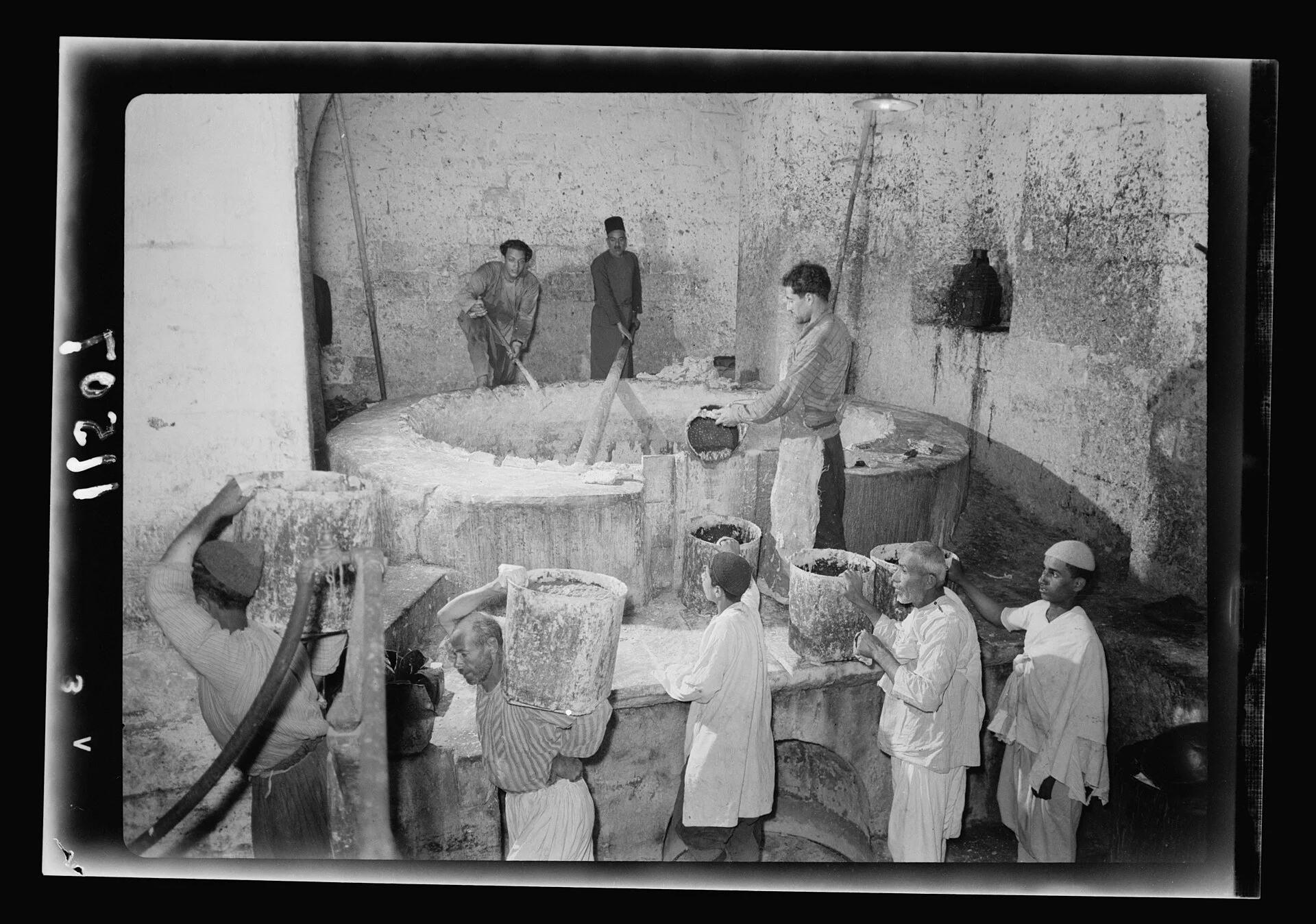
The boiling vat of a Nablus soap factory, photographed in the early 1900s: olive-oil soap made at city scale, stirred by paddle and carried by the bucket. This is the industry the lesson's history describes — and its bare hands and bare feet are history too. No scholar of this laboratory works this way; the Safety Covenant governs every bench in this lesson.
American Colony photographers, Nablus soap factory (Library of Congress, Matson Collection, LOC matpc.20375), via Wikimedia Commons. Public domain.
Soap is one of the oldest manufactured substances in human history. Clay tablets from Babylon, dating to around 2800 BCE, record recipes for boiling fats with wood ash. That early product was not for bathing; it was for cleaning wool and textiles, the same fibrous work that first taught humans the value of the mixture.
By about 1550 BCE, an Egyptian medical papyrus known as the Ebers Papyrus described combining animal and vegetable oils with alkaline salts into a soap-like paste. In the first century CE, the Roman writer Pliny the Elder described a substance called sapo, used by the Celtic and Germanic peoples, notably as a hair treatment. A later Roman legend claims the word comes from Mount Sapo, where sacrificial animal fat and wood ash supposedly washed down the hillside together in the rain. Treat the legend as legend; the chemistry it describes is sound.
The great soap cities rose on olive oil. Aleppo, in Syria, produced a hard soap of olive and laurel oils that is among the oldest surviving soap traditions. In 1688, an edict governing Marseille soap required it to be made from pure olive oil, with confiscation as the penalty for adulteration. Castile, in Spain, gave its name to the olive-oil soap prized across Europe.
The science caught up with the craft in the nineteenth century. The French chemist Michel Chevreul explained saponification in 1823, and Nicolas Leblanc's 1791 process for making soda ash from common salt gave industry a reliable alkali. What Babylonian fullers did by feel, chemists could finally describe by formula. You are about to learn both the feeling and the formula.
Check in: Which city's soap did the 1688 edict govern, what did it require, and what was the penalty — and which chemist explained saponification, in what year?
❦ In your workbook: record the history of soap in your own way — Babylon's tablets and textile work, the Ebers Papyrus, Pliny's sapo and the Mount Sapo legend marked as legend, Aleppo, the Marseille edict, Castile, Chevreul, and Leblanc — copy, sketch, or note what matters.
The Chemistry: Saponification
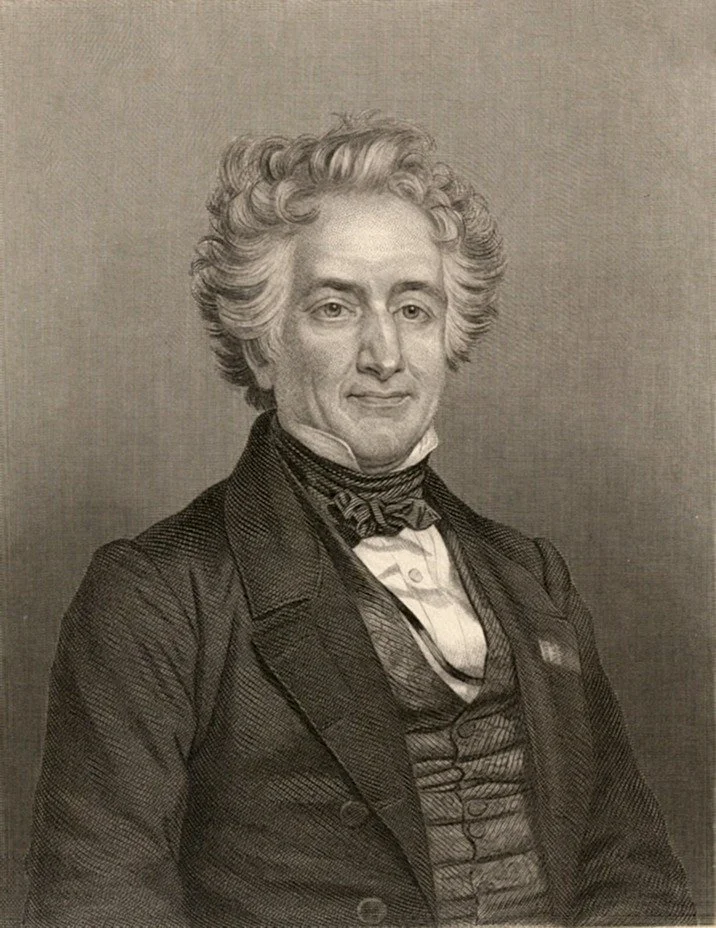
Michel Eugène Chevreul, who explained saponification in 1823: the moment the soapmaker's ancient craft became a chemist's formula. What Babylonian fullers did by feel, his generation could finally write down — Triglyceride + 3 NaOH → Glycerol + 3 Soap.
Engraved portrait of Michel Eugène Chevreul, via Wikimedia Commons. Public domain.
Every fat and oil you have handled in this course, from olive oil to coconut oil to tallow, belongs to a family of molecules called triglycerides. Picture a small backbone of glycerol with three long fatty acid chains attached by ester bonds. That is a triglyceride.
Saponification is the alkaline hydrolysis of those ester bonds. When a triglyceride meets sodium hydroxide, the hydroxide ions attack the ester bonds and break them apart. The glycerol backbone is released, and each fatty acid chain joins with a sodium ion to form a sodium salt of a fatty acid. That salt is soap.
The reaction, in its simplest form:
Triglyceride + 3 NaOH → Glycerol + 3 Soap
Three things about this reaction matter for everything that follows.
First, it is exothermic. It gives off heat. The batter will warm itself as it works, and in an insulated mold it can grow surprisingly hot. Heat is both a tool and a hazard in this lesson.
Second, the choice of alkali decides the product. Sodium hydroxide makes a hard bar. Potassium hydroxide makes a soft or liquid soap. This lesson uses sodium hydroxide exclusively.
★ Third, the reaction is effectively one-way. Once the fatty acids become soap salts, they do not turn back into oil. This is why a properly made and fully cured bar contains no active lye: the lye has been consumed by the reaction, transformed into soap and glycerol. The glycerol, a natural humectant, remains in handmade soap and is part of what makes it feel different from commercial bars, from which glycerol is often removed and sold separately.
The word itself tells the story. Saponification comes from the Latin sapo, soap. It means, literally, the making of soap.
Scholars, you have now met the only reaction in this entire course that can injure you faster than you can apologize to it. Respect it the way you respect a sharp blade or a hot crucible: with attention, with equipment, and without hurry. Chemistry rewards the methodical and punishes the casual. You have been warned by a toad who has seen both outcomes.
— Professor Crimblebrew Muddlenook, Potions Laboratory • Master Apothecary • Head of House Meridies
Check in: Write the reaction in its simplest form — and state the three things about it that matter for everything that follows.
❦ In your workbook: record saponification in your own way — the triglyceride's backbone and chains, the ester bonds broken, glycerol released, soap salts formed, and the reaction written out — copy, sketch, or note what matters.
The Measure of Lye: SAP Values
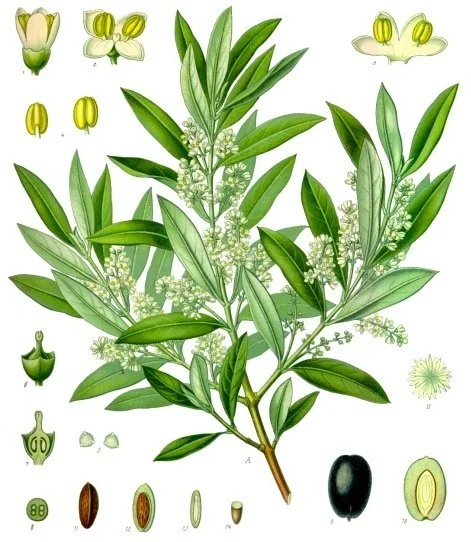
Olea europaea in Köhler's Medizinal-Pflanzen: leaf, blossom, fruit, and stone. Olive oil is the soap cities' foundation and this lesson's worked example — 500 grams of it at SAP 0.135 needs 67.5 grams of lye before the superfat margin is taken.
Olea europaea plate, Köhler's Medizinal-Pflanzen, via Wikimedia Commons. Public domain.
Not every oil needs the same amount of lye. A coconut oil molecule and an olive oil molecule are both triglycerides, but their fatty acid chains differ in length, so each oil requires its own precise quantity of sodium hydroxide for complete saponification. That quantity is the oil's saponification value, the SAP value.
The SAP value is the weight of sodium hydroxide needed to saponify one unit weight of a given oil. Coconut oil has a SAP value near 0.183. Olive oil sits near 0.135. The arithmetic is simple:
Lye required = oil weight × SAP value
Five hundred grams of olive oil needs 500 × 0.135 = 67.5 grams of sodium hydroxide for complete saponification.
★ No responsible soapmaker uses the exact figure. Every formula includes a superfat, also called a lye discount: a percentage of extra oil deliberately left unsaponified. A five percent superfat means using five percent less lye than the full SAP calculation, so that five percent of the oils remain free in the finished bar. Superfat does two things: it makes the bar milder on skin, and it provides a safety margin, guaranteeing that no free lye remains even if a scale reads slightly off. For our example: 67.5 × 0.95 = 64.1 grams of lye. That missing 3.4 grams is not an error. It is the margin that keeps the bar gentle and safe.
Weigh lye with a digital scale, to the gram. In this crucible, measurement is morality.
Check in: Olive oil's SAP value and coconut oil's — which is which — and what does a five percent superfat do to the lye weight, and why?
❦ In your workbook: record the SAP method in your own way — the formula, the worked olive-oil example at full saponification, and the same example discounted by the superfat — copy, sketch, or note what matters.
In your packet: Exercise I — Path A: The Observed Demonstration, or Path B: The Paper Laboratory ◐ begins here, in its calculation half. Work it now, or mark the place and take it as homework — your choice.
Trace: Reading the Batter
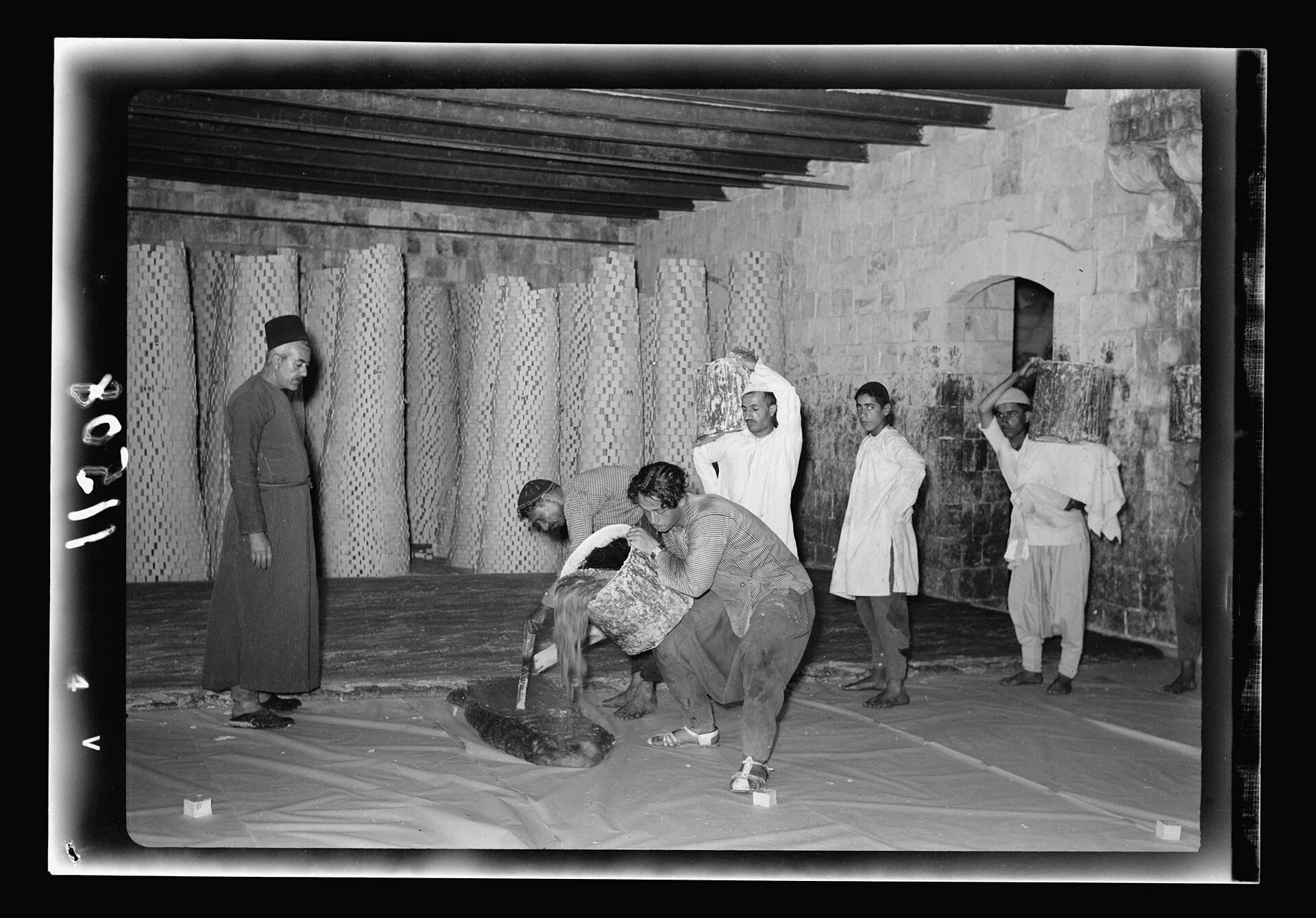
Liquid soap poured out to harden on the factory floor at Nablus, the cut bars of earlier batches stacked in towers behind. Your crucible pours into a mold at light to medium trace; the principle — batter laid down while it still flows, then left alone to become soap — is the same at every scale.
American Colony photographers, Nablus soap factory (Library of Congress, Matson Collection, LOC matpc.20377), via Wikimedia Commons. Public domain.
Mix the lye solution into the warmed oils and stir, and at first nothing seems to happen. The liquids swirl, separate, reunite. Keep stirring, or blend in short bursts, and the mixture begins to thicken. Lift the spoon and drizzle batter across the surface. If the drizzle leaves a faint visible trail before sinking back in, like a footprint in wet sand, you have reached trace.
★ Trace is the signal that the oils and lye solution have formed a stable emulsion and saponification is properly underway. It is the green light of soapmaking. Pour into the mold at light to medium trace, when the batter still flows. Pour too early, before the emulsion holds, and the batch may separate in the mold. Stir far past trace and the batter sets in the pot.
Trace is also where the soapmaker's judgment lives. A thin trace gives time for swirls and layers. A thick trace suits a simple, honest pour. Watch the batter, not the clock.
Check in: What does trace signal — and what are the two risks of pouring at the wrong moment, too early and too late?
❦ In your workbook: record trace in your own way — the thickening batter, the drizzle that leaves its trail, and the pour window at light to medium trace — copy, sketch, or note what matters.
The Two Paths
This lesson offers two practical paths. Both teach the crucible. Only one involves lye, and it involves an adult.
Path A: The Observed Demonstration (Level Two)
With a competent adult present and the full Safety Covenant in force, observe a complete cold-process demonstration from preparation through molding. You do not handle the lye. The adult measures, pours, and stirs the caustic stages while you stand clear, in goggles, recording everything.
Your observation log must record: the PPE check before work begins; the lye added to water, slowly, with stirring; the temperatures of the lye solution and the oils at mixing; the time stirring begins and the time trace is reached; the pour into the mold; the insulation of the mold; and the condition of the workspace after cleanup. Note the heat of the molded soap the next day. Note the discipline of the adult. That discipline is half the lesson.
Path B: The Paper Laboratory (Level One)
No lye is handled on this path, and nothing is lost. Complete the saponification calculation set: for 500 grams of olive oil at SAP 0.135 with a five percent superfat, show the full lye requirement and the discounted lye weight. Repeat for a two-oil blend of 300 grams olive oil and 200 grams coconut oil at SAP 0.183, same superfat. Show every step.
Then conduct the curing study. Build the six-week weight record yourself within this exercise: weigh one cold-process bar (the demonstration batch, if you observed one, or the store-bought bar of Exercise III) once a week for six weeks, on the same scale, at the same hour, and plot its weight against time. Identify the week when weight loss slows, and explain in your own words what the slowing curve tells you about the water leaving the bar and the saponification completing. Paper, pencil, and arithmetic: the oldest laboratory instruments.
Check in: What seven entries must the Path A observation log record — and what does Path B ask you to show, step by step, for each of its two calculations?
❦ In your workbook: record the two paths in your own way — Path A's observation discipline under an adult's hands, Path B's paper laboratory of calculations and the curing curve — copy, sketch, or note what matters. The workbook path claims no batch was made; it records, calculates, and studies.
In your packet: Exercise I — Path A: The Observed Demonstration, or Path B: The Paper Laboratory ◐ begins here. Work it now, or mark the place and take it as homework — your choice. Exercise II — The Safety Covenant Drill ✎ belongs with the briefing at the head of this lesson; if you have not drilled it yet, drill it before you go further.
The Cure: Patience as an Ingredient

Wrapping finished bars at Nablus, with the curing towers behind him: hundreds of bars stacked open to the air, losing water week by week until they are hard, long-lasting soap. The scholar's ventilated rack is this tower at bench scale — and the wait, four to six weeks, is the same ingredient.
American Colony photographers, Nablus soap factory (Library of Congress, Matson Collection, LOC matpc.20379, cropped), via Wikimedia Commons. Public domain.
Saponification finishes its main work within twenty-four to forty-eight hours. The bar can be unmolded and cut after a day or two. But it is not soap yet, not truly. It must cure for four to six weeks.
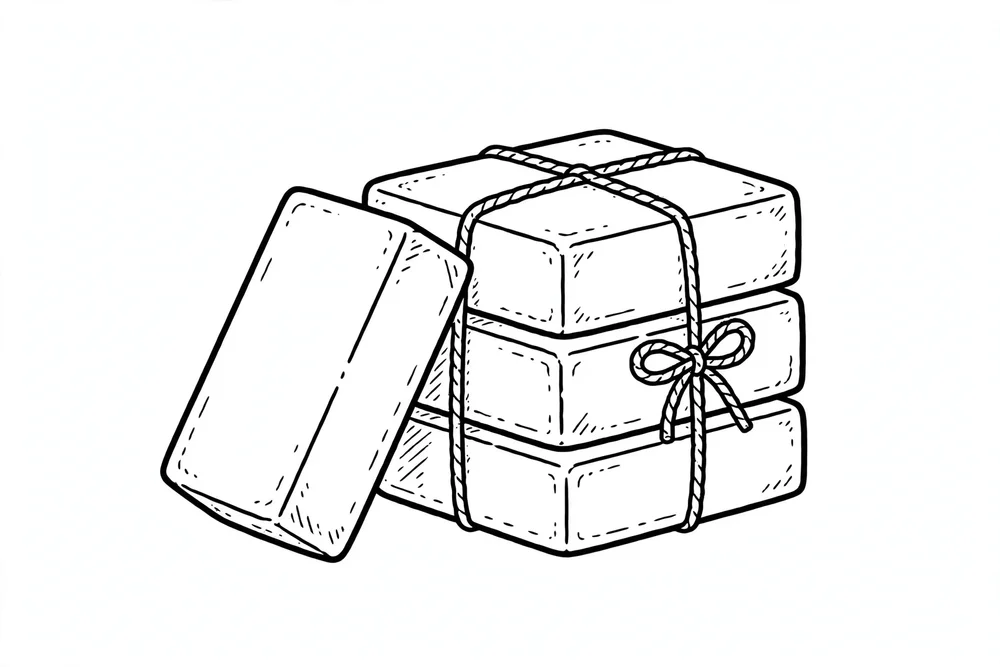
★ During the cure, water evaporates from the bar, the last of the saponification completes, and the crystalline structure of the soap settles. A fresh bar is soft, and its lather is thin. A cured bar is hard, long-lasting, and lathers richly. Time is an ingredient, and it cannot be hurried by any honest method.
Cure bars on a ventilated rack, out of direct sun, turned occasionally so air reaches every face. Weigh a test bar weekly; when the weight stops falling, the cure is substantially complete.
Old soapmakers tested a new batch with the zap test: touching the bar to the tongue and feeling for a sharp tingle that betrayed free lye. You will not do this. It belongs to history, along with tasting unknown botanicals and other practices this laboratory has retired. The modern scholar uses pH test strips: a properly cured cold-process bar reads mildly alkaline, and any reading of strong alkalinity sends the batch back for more curing or to the discard bin.
A white powdery film sometimes blooms on curing bars. That is soda ash, formed when carbon dioxide in the air reacts with trace alkali at the surface. It is harmless and cosmetic, a dusting of history on the bar, and it washes off in first use.
Check in: Saponification finishes its main work in a day or two, yet the bar must cure for four to six weeks. What three things is the cure doing — and what has replaced the zap test, which you will not perform?
❦ In your workbook: record the cure in your own way — the rack, the turning, the weekly weighing, the pH strips in place of the retired zap test, and soda ash named as harmless — copy, sketch, or note what matters.
In your packet: Exercise III — The Curing Log ◐ begins here. Work it now, or mark the place and take it as homework — your choice.
When Batches Misbehave
Even disciplined laboratories meet failure. Muddlenook's diagnostic notes:
- Separation in the mold. The batter was poured before a true emulsion formed. Next time, blend to a confident trace.
- The batter seizes in the pot. It thickened too fast to pour, often from overheating or over-blending. Work cooler and blend in shorter bursts.
- Soft, weeping bars after weeks. Too much water in the formula, or too short a cure. Extend the cure and check the water-to-lye ratio.
- Soda ash blooming. Harmless. Cover the mold during the first day to reduce air contact, or accept it as the batch's honest face.
- Lye pockets or crumbly, caustic spots. The batch is unsafe. Do not attempt rescue. Discard it, record the failure fully, and begin again. A failed batch, honestly recorded, teaches more than a lucky one.
Check in: A batch shows lye pockets and crumbly, caustic spots. What does the laboratory do with it — and what does it never attempt?
❦ In your workbook: record the five failures in your own way — separation, seizing, weeping bars, soda ash, and the unsafe batch discarded and honestly recorded — copy, sketch, or note what matters.
Guided Practice: Working the Crucible on Paper
This lesson's guided practice is the paper laboratory itself, done with the lesson open: you work the calculation set the way the crucible will demand it at the bench, and you rehearse the observation log before any demonstration asks it of you — because in this lesson, arithmetic and attention are practiced before lye is ever weighed.
Work through it in order.
Work the single-oil calculation. Five hundred grams of olive oil needs 500 × 0.135 = 67.5 grams of sodium hydroxide for complete saponification. Apply the superfat: 67.5 × 0.95 = 64.1 grams of lye. That missing 3.4 grams is not an error. It is the margin that keeps the bar gentle and safe.
Work the two-oil blend. For each oil, multiply its weight by its own SAP value, add the two full requirements, then apply the superfat once to the total. Show every step, as Path B requires: the olive oil's share, the coconut oil's share, the total, and the discounted weight.
Rehearse the observation log. Your observation log must record: the PPE check before work begins; the lye added to water, slowly, with stirring; the temperatures of the lye solution and the oils at mixing; the time stirring begins and the time trace is reached; the pour into the mold; the insulation of the mold; and the condition of the workspace after cleanup. Rule the log page now, headings first, so the demonstration fills a form instead of testing your memory.
Consider:
- Why is the superfat applied to the total in a blend, oil by oil first — what would go wrong if one oil's SAP value were used for the whole batch?
- The curing study's curve slows as the weeks pass. What two processes does the slowing curve report on?
- Which single line of the Safety Covenant would you write at the head of your log page, and why that one?
❦ In your workbook: record the guided practice in your own way — both calculations with every step shown, the ruled log headings, and the slowing curve explained in your own words — copy, sketch, or note what matters.
Materials
Everything in its place, before we begin. For this crucible lesson you will need:
Level One — no lye handled (Path B)
- A calculator, pencil, and your laboratory journal.
- A kitchen scale for the weighing exercises in the curing study.
- pH test strips (optional, for the curing log).
- One store-bought cold-process soap bar for the six-week curing observation.
- A ventilated rack or slatted dish for curing.
- Graph paper or a printed plotting sheet for the weight-loss curve.
Level Two — observed demonstration (Path A, competent adult present)
- Chemical splash goggles that seal against the face, for every person in the room.
- Nitrile gloves, long sleeves, an apron, and closed shoes.
- A digital scale weighing to the gram.
- A stainless steel or heavy-duty plastic (PP) pitcher for the lye solution. No aluminum, ever.
- A stainless steel spoon for stirring the lye.
- A thermometer, a silicone mold, and dedicated soapmaking utensils, labeled and stored apart from kitchen tools.
- A competent adult who handles all lye measuring, pouring, and stirring while the student observes and records.
Safety Notes
- The Safety Covenant in the lesson is mandatory reading and will be tested. Path A requires a competent adult present for every moment lye is out of its container.
- Full protective equipment: sealed chemical splash goggles, nitrile gloves, long sleeves, apron, closed shoes. Ventilated workspace. Remove contact lenses before beginning.
- Always add lye to water, slowly, while stirring. Never pour water onto dry lye. Never use aluminum, copper, cast iron, or scratched nonstick vessels.
- No children or pets in the soaping space, not even to watch. Lye looks like salt or sugar; store it labeled and locked away from food and young hands.
- Emergency: lye on skin — remove contaminated clothing, flood with cool running water for fifteen to twenty minutes, call Poison Control at 1-800-222-1222, seek medical care. Lye in eyes — flush continuously fifteen minutes minimum while someone calls for emergency help. Never apply vinegar to a lye burn.
- Nothing in the Potions Laboratory is medicine, and this lesson gives no amounts to take or apply. Soap made in class is for study; decorative bars are display-only until fully cured and checked.
Reflection Questions
Answer the following questions in your workbook.
- Why must lye always be added to water, never water to lye? Describe what happens in the forbidden order.
- Vinegar feels like the logical answer to an alkali splash. Why is it the wrong one? What does the acid actually do on the burn?
- What does trace tell the soapmaker, and what are the two risks of pouring at the wrong moment?
- Saponification finishes in a day or two, yet the bar must cure for four to six weeks. What is the cure actually doing?
- A friend says homemade soap is dangerous because it is made with lye. Using what you learned, how do you answer?
Workbook Checklist — Lesson 41
In my workbook I have:
- ☐ recorded the Safety Covenant in my own way, complete: what lye is, mandatory equipment, the lye-to-water order, the metals rule, dedicated tools, the closed workspace, the adult's presence, the emergency response, and the vinegar rule
- ☐ recorded the history of soap, from Babylon's tablets to Chevreul's formula, with the Mount Sapo story marked as legend
- ☐ written the saponification reaction in its simplest form and recorded the triglyceride, its ester bonds, and the soap salts it becomes
- ☐ worked both SAP calculations with every step shown, including the five percent superfat applied oil by oil in the blend
- ☐ recorded trace, its stable-emulsion signal, and the pour window at light to medium trace
- ☐ completed one full path of Exercise I: the Path A observation log with all its entries, or the Path B paper laboratory claiming no batch was made
- ☐ passed the Safety Covenant Drill from memory, corrected in a different color, repeated until perfect
- ☐ kept the six-week curing log: weekly weight, dimensions, and appearance, with soda ash, hardness, and lather noted
- ☐ recorded the five batch failures and their diagnoses, including the unsafe batch that is discarded, never rescued
☐ Lesson completed Date: ___ Signature: ___
The Professor's Closing Note
You came to this lesson as students of preparation. You leave it as students of consequence. Saponification — the reaction of fats or oils with a strong alkali that produces soap — is the most serious chemistry in our laboratory: the only reaction here that transforms its maker along with its materials if the maker is careless. But look at what discipline earns. Fat and ash, the humblest substances in the ancient world, become soap, the foundation of every clean hand in history. Babylon knew the mixture. Chevreul knew the formula. You now know both, and you know the covenant that stands between them. Carry it with you into every laboratory you ever enter.
— Professor Crimblebrew Muddlenook, Potions Laboratory • Master Apothecary • Head of House Meridies
PROFESSOR CRIMBLEBREW MUDDLENOOK
Potions Laboratory
Master Apothecary • Head of House Meridies
Cross-Class Connections

Creative Arts · Unit VII, Lesson 27 — First Cuts: Carving Safely
Your cured bars have a second classroom waiting for them, scholars. In my workshop we learn the first cuts of carving in soap and basswood — soap first, because it teaches the hand honestly and forgives the beginner — layout before cutting, and the brush moving before the chisel, every time. Bring a plain, fully cured bar and your patience. We will lay out the design before any blade touches it, and you will learn what a keen edge asks of a steady hand.
PROFESSOR COGBRANCH TIMBERCLANK
Creative Arts Workshop
Further Reading & Sources
- Saponification — Wikipedia
- Saponification Definition and Reaction — ThoughtCo
- Saponification in the Soap Making Process — The Spruce Crafts
- Saponification: The Soap-Making Reaction Explained — Science Notes
- Chemical Burns Treatment: First Aid — WebMD
- Lye Safety Information Sheet — Bramble Berry (PDF)
Browse the Potions shelf in the school Library for readable editions of these works.
LESSON 41 · COLD-PROCESS SOAP · DEEP SHELF
Try It in the Laboratory
This lesson taught the lye arithmetic and why the formula is locked. The Soap Cauldron keeps it locked — pass the safety gate, choose your batch size and your trace add-in, and it writes the batch exactly as this lesson teaches it.
— Professor Crimblebrew Muddlenook, Potions Laboratory
Submit your work for this lesson using the form below.
CONTINUE IN THE POTIONS LABORATORY
← Previous · Lesson 40: Soapmaking: Melt & Pour Artistry Next · Lesson 42: The Failed Batch →
Unit V — Botanical Formulations Potions Laboratory — All 52 Lessons
The rest of Unit V: Lesson 35 · Balms & Salves · Lesson 36 · Candles & Wax · Lesson 37 · Sachets & Blends · Lesson 38 · Whipped Emulsion · Lesson 39 · Crystalline Scrubs · Lesson 40 · Melt & Pour Soap · Lesson 42 · The Failed Batch · Lesson 43 · Experimental Formula · Lesson 44 · Formulation Matrix