

POTIONS
Unit V · Lesson 43THE EXPERIMENTAL FORMULA
Professor Crimblebrew Muddlenook
Master Apothecary • Potions
Head of House Meridies • School of Evershade
Professor's Introduction

Sealed with the teal wax of Professor Crimblebrew Muddlenook, Master Apothecary of the Potions Laboratory, Head of House Meridies.
Scholars, for forty-two lessons you have followed in the footsteps of apothecaries who came before you. You have weighed, ground, steeped, strained, melted, whipped, and poured according to formulas refined over centuries. That discipline was not busywork. It was apprenticeship. You cannot write a trustworthy formula until you have learned what a trustworthy formula feels like in the hand.
Today the bench turns toward you. Today you stop asking "what does the recipe say" and begin asking "what happens if." That question is the whole of invention, and it is asked in the same orderly handwriting as everything else in this laboratory. Experimentation is not the opposite of discipline. It is discipline pointed at the unknown.
We will design on paper first, build small, change one thing at a time, and write down everything, especially the parts that go wrong. The wrong parts are where the learning lives.
Measure twice, pour once, and then tell me truly what you saw.
— Professor Crimblebrew Muddlenook, Potions Laboratory • Master Apothecary • Head of House Meridies

Potions map — the class base map, unmarked for this lesson.
Lesson Objectives
By completing this lesson, you will be able to:
- Explain the difference between following a formula and designing one.
- Apply the one-variable rule: change a single element at a time so results can be read.
- Keep an experimenter's ledger with a baseline, a trial record, and a revision log.
- Design an original formulation on paper with full documentation.
- Prepare a small display-only trial batch and record its behavior honestly.
- Read a failure as information and plan a reasoned revision.
Reading this lesson: ★ marks the passages to remember. They carry the experimenter's discipline this lesson is assessed by, and they return in the Unit V Quiz, in the units ahead, and at the capstone. Check in questions ask the material back as you go; answer them in your workbook when you meet them.
Working this lesson: Your assignment packet is the first download on this page. Work in it as the lesson moves along, answering each exercise as its subject is taught — or read the lesson through for your notes and take the exercises as homework afterward. Both are proper ways to sit this class. Signposts in the reading tell you where each exercise belongs. Written answers are short answers in your own words; a few honest lines are worth more than a filled page.
Your Assignment Packet
This lesson's exercises live in its packet: the Lexicon Handout (every term, course terms marked ◆), Materials, Guided Practice — the Worked Example, Muddlenook's Wax Variation, and the trial-batch build order, printed in full so you can work through them at your own bench — the Assignment Manual with its self-check, the Reflection Questions, and the Workbook Checklist. Download the packet before you begin and keep it beside you as you read.
About this lesson's assessment, plainly: this lesson's own quiz (7 multiple choice + 5 true/false, from the source packet) leaves the manual under the classroom model and pools for the Unit V Quiz; its key travels with the unit quiz, not here. The exercises below — the formula dossier, the trial batch, and the revision log — are the lesson's practical layer, standing beside the quiz.
Safety Briefing: The Inventor's Rules
Original work carries original responsibility. Every safety rule from every earlier lesson applies here, and three new ones join them.
First: new combinations get new caution. A formula you invent has no history. Ingredients that are safe apart may behave unexpectedly together, especially under heat. Treat every original batch as an unknown until it has proven itself ordinary. Work small, work slowly, and keep your bench clear.
Second: an adult supervises all original work. Following an established lesson procedure with an adult nearby was the rule; designing your own procedure requires an adult present and aware of the plan before you begin. Show your formula dossier to your adult supervisor first. If they say no to any step, that step does not happen.
Third: trial batches are display-only and never tasted. Everything you make in this lesson is a laboratory specimen for observation, not a product for use. Label every vessel "LABORATORY STUDY — NOT FOR USE" before you begin. Nothing in the Potions Laboratory is medicine, no lesson gives amounts to take, and original preparations are never applied to skin, hair, or any person or animal.
Ventilation, heat-safe vessels, labeling discipline, and cleanup rules from earlier lessons all remain in force. Heated oils and waxes burn; alcohol stays far from flame; dust masks for powders.
Before any preparation touches more than a fingertip: test a little on the inside of your wrist, wait a full day, and do not use it if the skin reddens, itches, or stings. Never use a preparation on broken or irritated skin.
Check in: What are the Inventor's three new rules — and what exact words go on every vessel before you begin?
❦ In your workbook: record the Inventor's Rules in your own way — new combinations get new caution, an adult supervises all original work, and trial batches are display-only and never tasted, with the vessel label written out in full — copy, sketch, or note what matters.
From Following Recipes to Writing Them
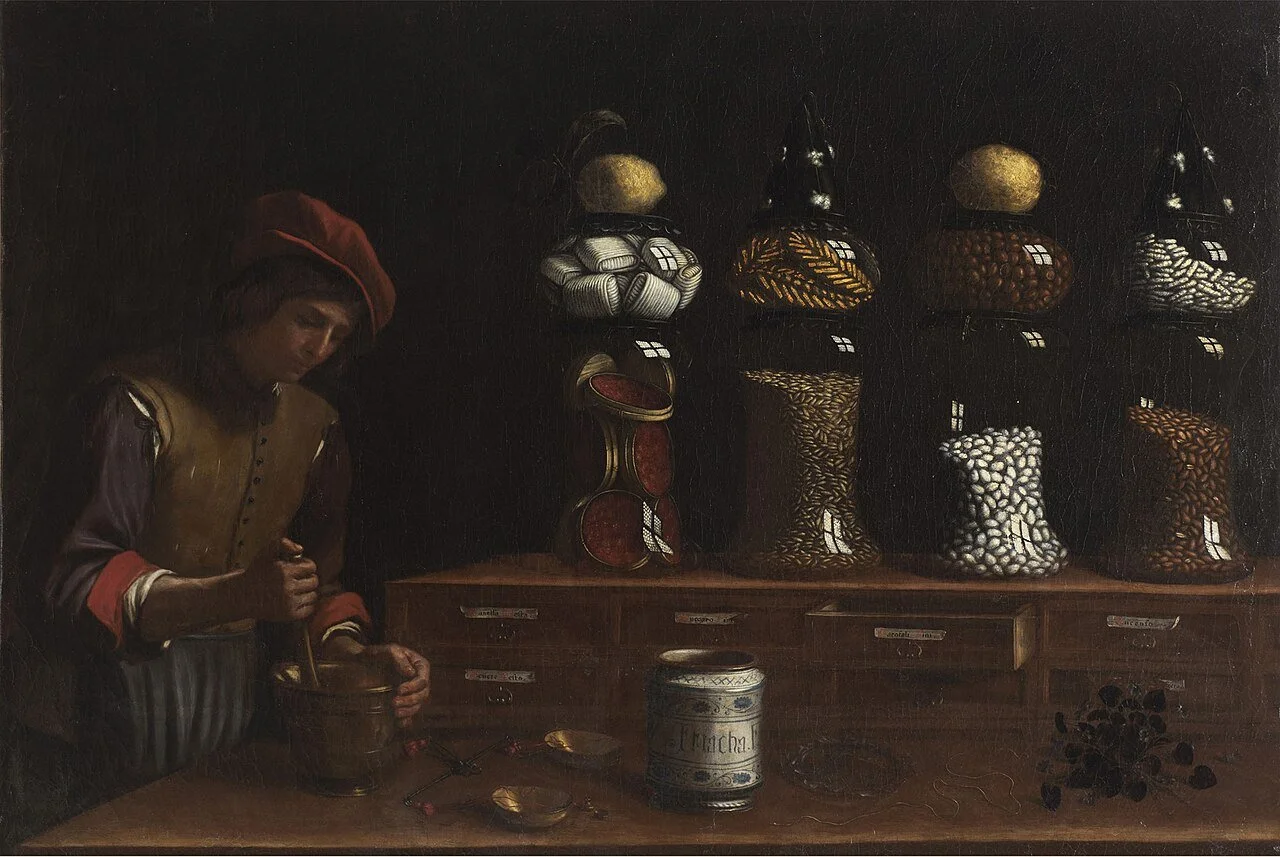
An apothecary at his mortar, painted by Paolo Antonio Barbieri: labeled drawers, ranked jars of stock, and one named jar on the counter. Every formula this lesson asks you to vary began at a bench like this one — weighed, ground, and made the same way every time, until somebody asked what happens if.
Paolo Antonio Barbieri, Apothecary Shop, via Wikimedia Commons. Public domain.
Every formula you have made in this unit began as somebody's experiment. The wax-to-oil ratios in your salve lesson, the lye calculations in cold-process soap, the suspension that keeps a scrub from separating: each was once a guess, tested, revised, and tested again until it earned its place in the book. Printed formulas look inevitable. They are not. They are survivors.
The historical record agrees. Across early modern Europe, households and workshops kept manuscript recipe books in which formulas were copied, annotated, corrected, and invented outright; scholars today transcribe thousands of these books to study how ordinary people experimented with materials centuries before the modern laboratory existed. The printed "books of secrets" of sixteenth-century Italy collected hundreds of such workshop formulas, each one somebody's trial preserved in ink. Your experimenter's ledger joins a very old tradition: the book in which the workshop talks to itself across time.
The shift from follower to designer is smaller than it feels. You already know the materials, the ratios that work, the failures that warn. Designing a formula means assembling those known things in a new arrangement, on paper first, and then testing whether the arrangement behaves. The paper comes before the vessel. Always.
Check in: What does it mean to say that printed formulas are survivors — and what comes before the vessel, always?
❦ In your workbook: record the shift from follower to designer in your own way — formulas as survivors of somebody's experiments, the manuscript recipe books and the books of secrets behind them, and paper before vessel — copy, sketch, or note what matters.
The One-Variable Rule
Here is the entire science of formulation experiments in one sentence: ★ change one thing at a time.
If you alter the wax ratio AND the fragrance AND the pouring temperature in a single batch, and the result separates, you have learned nothing except that something went wrong. You cannot know which change caused it. But if you hold everything constant and change only the wax ratio, then the difference between this batch and the last one belongs to the wax ratio alone. That is the difference between guessing and knowing.
Professional formulators call the unchanging batch the baseline and the altered batch the trial. The baseline is your earlier, working formula. The trial is the baseline with exactly one deliberate change. Everything else, every temperature, every timing, every measurement method, stays identical. This is not fussiness. It is the only way the batch can speak clearly.
Choose your one variable with intent. Good first variables are ratios (slightly more wax, slightly less), single-ingredient swaps (one oil for another of similar character), or single process changes (poured warmer, cooled slower). Poor first variables are everything-at-once redesigns, untested ingredient combinations, or changes to safety-critical steps. Boldness belongs in the question, not in the procedure.
Scholars, a confession from your professor's early bench years: my first original salve changed four things at once, because four improvements obviously meant four times the excellence. What it meant was a grainy, weeping jar and no idea which of my four brilliant ideas had caused it. I remade it four times, changing one thing each time, and found the culprit on the second attempt. The one-variable rule is not a restriction on your creativity. It is the thing that lets your creativity be legible.
— Professor Crimblebrew Muddlenook, Potions Laboratory • Master Apothecary • Head of House Meridies
Check in: A batch changes the wax ratio, the fragrance, and the pouring temperature at once, and then separates. What has been learned — and what is the one variable rule that prevents it?
❦ In your workbook: record the one-variable rule in your own way — baseline held constant, trial carrying exactly one deliberate change, and good first variables against poor ones — copy, sketch, or note what matters.
The Experimenter's Ledger
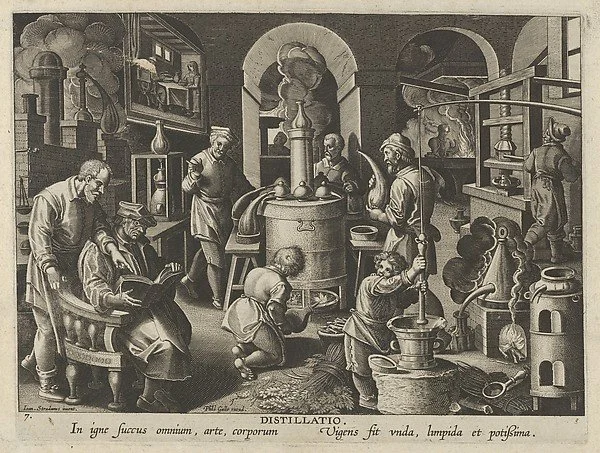
Distillatio, plate 7 of the Nova Reperta (c. 1600), engraved by Jan Collaert I after Stradanus: a workshop in full production, and at the left the reason this lesson exists — two men reading the great book while the work goes on around them. The experimenter's ledger is that book, kept by your own hand.
Jan Collaert I, after Jan van der Straet (Stradanus), New Inventions of Modern Times [Nova Reperta], The Invention of Distillation, plate 7 (ca. 1600), The Metropolitan Museum of Art, Open Access. Public domain.
An experiment that is not written down is a rumor. The ledger is what turns trying into learning, and it has three parts.
The baseline record. Before you change anything, write down the working formula exactly: every ingredient, every amount, every temperature, every timing, and how the finished batch behaved (texture, appearance, stability over days). If your baseline lives in an earlier lesson's batch record, copy it here so the experiment stands on its own page.
The trial record. Write the plan before you make it: the single variable you are changing, the direction of the change, and what you predict will happen. Then make the batch and record what actually happened, in the same categories as the baseline, plus anything unexpected. Predictions matter because the gap between prediction and result is where discoveries hide.
The revision log. After comparing trial to baseline, write your verdict: keep the change, reject it, or modify it. If you modify it, that becomes the next trial, with its own record. Number your trials. Date everything. Future you, reading this page in a year, should be able to repeat the entire sequence without asking present you a single question.
Check in: What three parts does the experimenter's ledger carry — and what should future you be able to do from its page alone?
❦ In your workbook: record the experimenter's ledger in your own way — the baseline record written exactly, the trial record planned before making, and the revision log with its verdict — copy, sketch, or note what matters.
In your packet: Exercise I — The Formula Dossier ✎ begins here. Work it now, or mark the place and take it as homework — your choice.
A Worked Example: Muddlenook's Wax Variation
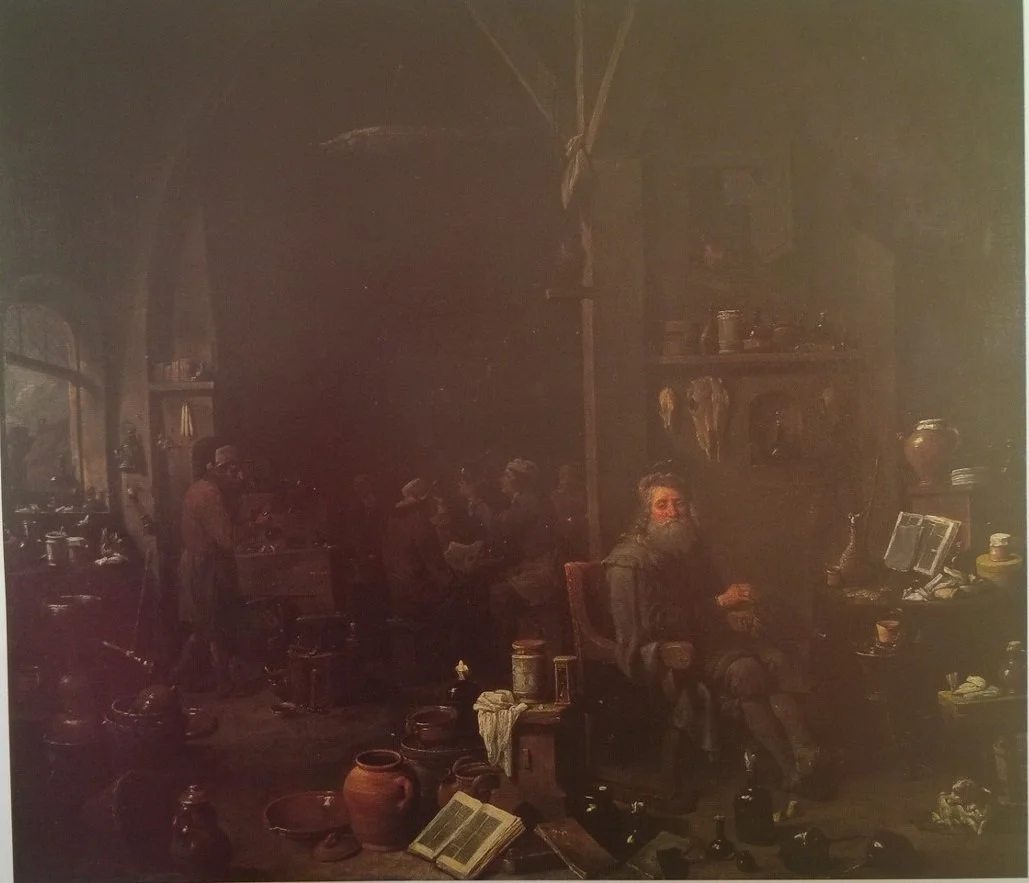
The Alchemist in His Laboratory, by David Teniers the Younger: jars on every shelf, work at every bench, and the book open on the floor where the work can reach it. Professor Muddlenook's first original salve — four changes at once, one grainy, weeping jar — was made in a room that felt like this.
David Teniers the Younger, The Alchemist in His Laboratory, via Wikimedia Commons. Public domain.
Watch me do it once, on paper, before you do it yourself.
Baseline. My standard simple salve from earlier lessons: a fixed wax-to-oil ratio I have made a dozen times, poured at the same temperature, cooled undisturbed. Behavior: firm at room temperature, spreads smoothly, stable for months. I copy the full record onto a fresh ledger page.
The question. What happens if I raise the wax content slightly? My prediction: a firmer bar, slightly less spreadable, possibly better shape-holding in warm weather.
The trial. Trial 1: the baseline formula with the wax increased by a small, measured step and nothing else changed. Same oil, same temperature, same cooling. I make a small batch, a few ounces, in a labeled jar marked for laboratory study.
Observation. I record texture at one day, one week, and one month beside the baseline's notes: firmer, as predicted, but with a slightly grainy surface the baseline never showed. The graininess is new information.
The revision log. Verdict: the firmness is welcome, the graininess is not. Hypothesis: the extra wax cooled too quickly at the surface. Trial 2 will repeat Trial 1's ratio but pour slightly warmer and cool more slowly. One variable again, the cooling this time, the ratio held constant.
★ Notice what did not happen: I did not change the oil, the fragrance, and the jar at the same time. I did not scale up to a full batch before the small one proved itself. And I wrote the prediction down before I saw the result, so the graininess surprised me honestly instead of being explained away.
Check in: In the worked example, what did Trial 1 change, what surprised the professor — and what single variable does Trial 2 change while the ratio is held constant?
❦ In your workbook: record the wax variation in your own way — baseline, question and prediction, Trial 1, the grainy surprise, and the revision log verdict that plans Trial 2 — copy, sketch, or note what matters.
The Trial Batch
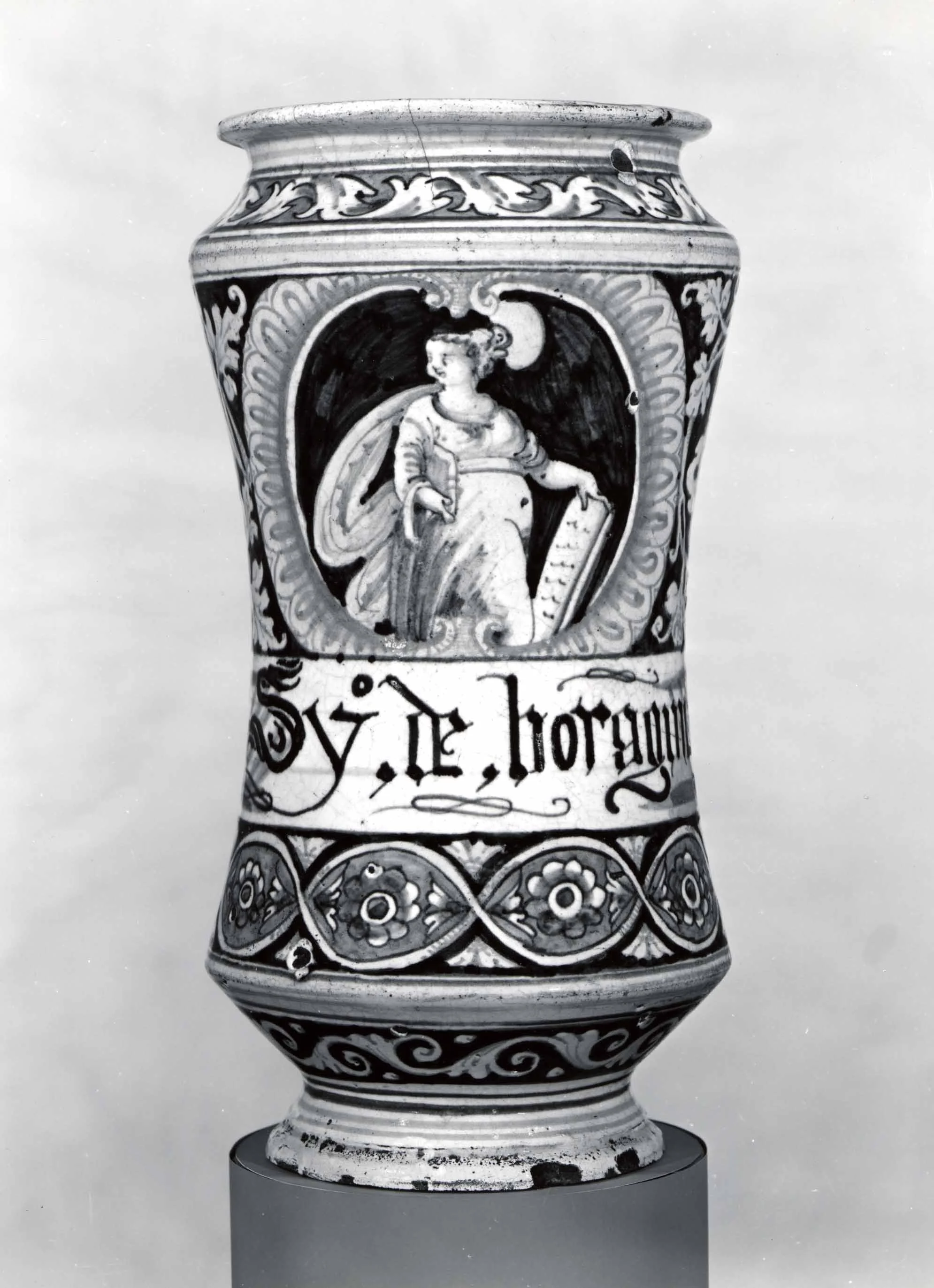
An Italian albarello of about 1550–1600, painted with its contents' name in a band beneath a figure holding a book: the books-of-secrets era labeled its vessels as carefully as this lesson labels yours. Your trial jar's band reads "LABORATORY STUDY — NOT FOR USE," with its trial number and date — the same discipline, plainer words.
Apothecary jar (albarello), Italian, probably Faenza (or Palermo), probably 1550–1600, The Metropolitan Museum of Art (Robert Lehman Collection, 1975.1.991), Open Access. Public domain.
Your trial batch is small on purpose. A few ounces is enough to judge texture, appearance, and stability, and small means a failure costs little and teaches the same lesson. Scale is not courage; clarity is.
Build your trial in this order:
- Write the dossier first. Baseline record, the single variable, the prediction. Show it to your adult supervisor.
- Label before you pour. Every vessel gets "LABORATORY STUDY — NOT FOR USE" plus the trial number and date.
- Make it exactly as written. No mid-batch inspiration. If inspiration strikes, write it down for the next trial.
- Observe on schedule. Record at making, at one day, at one week. Note texture, color, scent, separation, surface, and anything you did not expect.
- Retain a sample. Keep a small sealed portion of each trial as a reference specimen, labeled with trial number and date, so later trials can be compared side by side.
If anything behaves unexpectedly, stop and record. Unexpected behavior is not failure. It is the batch telling you something your prediction missed.
Check in: In what order is a trial built — and why is the trial batch kept to a few ounces on purpose?
❦ In your workbook: record the trial batch in your own way — dossier first, label before pouring, make it exactly as written, observe on schedule, retain a sample — copy, sketch, or note what matters.
In your packet: Exercise II — The Trial Batch ⚒ begins here. Work it now, or mark the place and take it as homework — your choice.
Reading Failure
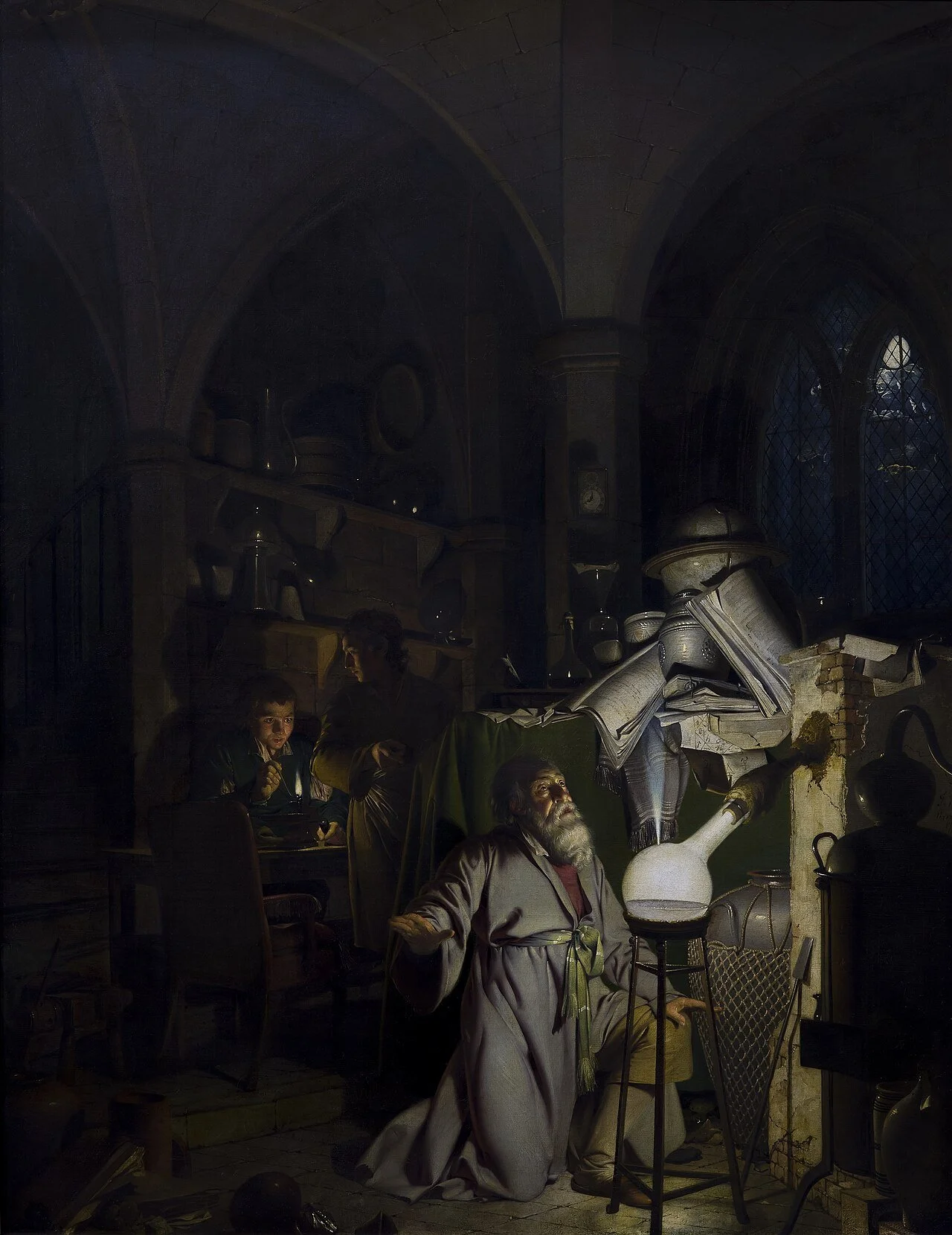
Joseph Wright of Derby's The Alchymist (1771): the flask glows with a light its maker never predicted, and the whole room stops to look. That is this lesson's reading of failure in one image — unexpected behavior is not the end of the trial. It is the batch telling you something your prediction missed.
Joseph Wright of Derby, The Alchemist Discovering Phosphorus (1771), via Wikimedia Commons. Public domain.
The previous lesson taught you to diagnose failed batches, and every skill from it applies here with interest, because now the failure is yours. Read it the same disciplined way: describe exactly what happened, compare against the baseline, and ask which single changed variable could explain the difference.
Common honest verdicts: the variable moved the batch in the predicted direction but too far (reduce the step); the variable caused an unrelated defect (the graininess in my example); the variable did nothing measurable (the change was too small to matter, or the property is controlled by something else). Each verdict suggests the next trial. "It didn't work" is never the whole entry. The entry is what didn't work, how you know, and what you will try next.
★ Keep every failed trial's record. A ledger full of successes teaches one formula. A ledger that includes the failures teaches formulation.
Check in: What three honest verdicts does a failed trial commonly earn — and why is "it didn't work" never the whole entry?
❦ In your workbook: record the reading of failure in your own way — describe exactly, compare against the baseline, name the one variable that could explain it, and keep every failed record — copy, sketch, or note what matters.
In your packet: Exercise III — The Revision Log ✎ begins here. Work it now, or mark the place and take it as homework — your choice.
Revision and Iteration
Revision is the experimenter's craft: each trial answers one question and poses the next. Iterate in small steps, one variable per trial, until the formula does what you intended or until the ledger tells you the goal needs rethinking. Most historical workshop formulas were not invented in a flash. They were iterated into existence across many small, well-recorded trials, and the recipe books that survive are the condensed ledgers of that patient work.
Know when to stop. A formula that is stable, documented, and does what you asked of it is finished, even if you can imagine further improvements. Write the final formula cleanly on its own page, with the full trial history behind it. That clean page is your original preparation: designed, tested, revised, and recorded in good order.
Check in: When is a formula finished — and what stands on the clean final page, and what stands behind it?
❦ In your workbook: record revision and iteration in your own way — small steps, one variable per trial, and the stopping rule: stable, documented, and doing what was asked — copy, sketch, or note what matters.
Cleanup & Archive Entry
Clean as after any formulation lesson: wash vessels while residues are warm, wipe the bench, return materials to labeled storage, and file the retained trial samples with the archive. Then complete the archive entry: the formula dossier, the trial records in numbered order, the revision log, and the final formula page, all dated and signed. Your experimenter's ledger becomes a permanent section of your laboratory archive.
Check in: What four things does the completed archive entry file, in numbered order — and where does the experimenter's ledger live from now on?
❦ In your workbook: record the cleanup and archive entry in your own way — vessels washed warm, samples filed, and the dossier, trial records, revision log, and final formula page dated and signed — copy, sketch, or note what matters.
Guided Observation: Reading the Worked Example as a Working Document
This lesson's observation is desk work, done with the Worked Example open: you read the professor's wax variation the way its keeper will read your own ledger in a year, and you test whether its prediction was written before its result — because a prediction adjusted after the fact teaches nothing.
Work through it in order.
Check the baseline. My standard simple salve from earlier lessons: a fixed wax-to-oil ratio I have made a dozen times, poured at the same temperature, cooled undisturbed. Behavior: firm at room temperature, spreads smoothly, stable for months. I copy the full record onto a fresh ledger page.
Follow the one variable. Trial 1: the baseline formula with the wax increased by a small, measured step and nothing else changed. Same oil, same temperature, same cooling.
Read the gap. I record texture at one day, one week, and one month beside the baseline's notes: firmer, as predicted, but with a slightly grainy surface the baseline never showed. The graininess is new information.
Consider:
- Which sentence in the example is the working hypothesis, and where does it stand in relation to the trial?
- The verdict keeps one result and rejects the other. Which is which — and what evidence separates them?
- Trial 2 changes the cooling and holds the ratio. What would Trial 2 teach that changing both at once could not?
❦ In your workbook: record the guided observation in your own way — the baseline checked, the one variable followed, and the gap between prediction and result read honestly — copy, sketch, or note what matters.
Materials
Everything in its place, before we begin. For this experimental lesson you will need:
Level One — household items
- Your laboratory journal or experimenter's ledger pages, and a pencil
- The formulas and batch records from your earlier Unit V lessons (L35 through L41), for reference
- Small heat-safe jars or tins for trial batches (a few ounces each, not full-size vessels)
- Labels and a pen ("LABORATORY STUDY — NOT FOR USE")
- A ruler or measuring spoons for consistent small measurements
- A timer or clock
- A damp cloth for wiping the bench
Level Two — historically closer
- A bound laboratory notebook with numbered pages, in the style of historical workshop ledgers
- A small brass or glass graduate for precise small-volume measuring
- Sample vials for retaining a small portion of each trial batch as a reference specimen
- Paper labels and sealing wax or string for marking retained specimens with trial number and date
Safety Notes
- An adult must supervise all original work. Show your completed formula dossier to your adult supervisor before any vessel is touched; if they refuse any step, that step does not happen.
- New combinations get new caution. Treat every original batch as an unknown: work small, work slowly, keep the bench clear, and ventilate the room.
- Label every vessel "LABORATORY STUDY — NOT FOR USE" before you begin. Trial batches are display-only specimens and are never tasted, used on skin or hair, or given to any person or animal.
- Heated oils and waxes cause serious burns. Use heat-safe vessels, never leave heating unattended, and keep alcohol far from any flame or heat source.
- Nothing in the Potions Laboratory is medicine, and no lesson gives amounts to take. Wash hands after handling materials and clean the bench fully when finished.
Reflection Questions
Answer the following questions in your workbook.
- Why does changing more than one variable at a time make a trial's result unreadable?
- What is the purpose of writing your prediction before making the trial batch?
- Why must trial batches be small, and why must they be labeled before you begin?
- How does the revision log turn a failed trial into useful information?
- What does it mean to say that printed formulas are "survivors"?
Workbook Checklist — Lesson 43
In my workbook I have:
- ☐ written the Inventor's three rules and the full vessel label, "LABORATORY STUDY — NOT FOR USE," before any making
- ☐ recorded the one-variable rule: baseline held constant, trial carrying exactly one deliberate change
- ☐ set up my experimenter's ledger in its three parts: baseline record, trial record, and revision log
- ☐ completed my formula dossier on paper — baseline record, single variable with my reason, written prediction, and numbered procedure — and recorded my supervisor's signature and date
- ☐ labeled my trial vessel before pouring, made the small trial batch exactly as written, and observed it at making, at one day, and at one week
- ☐ retained a small sealed reference sample, labeled with trial number and date
- ☐ written my revision log: what matched, what surprised me, my verdict with its reasoning, and a complete Trial 2 plan
- ☐ filed the archive entry — dossier, trial records in numbered order, revision log, and final formula page — dated and signed
☐ Lesson completed Date: ___ Signature: ___
The Professor's Closing Note
Sealed with the teal wax of Professor Crimblebrew Muddlenook, Master Apothecary of the Potions Laboratory, Head of House Meridies.
You came to this lesson as a maker of other people's formulas, and you leave it as the author of your own. That is no small promotion, and it was earned the orderly way: one variable, one trial, one honest page at a time.
Keep the ledger. Years from now, when some future scholar asks how you learned to invent, you will open it and show them: here is where I guessed, here is where I was wrong, and here is where the work got better. There is no finer record of a laboratory education.
File your dossier with pride, scholars. The archive grows by your hand now.
— Professor Crimblebrew Muddlenook, Potions Laboratory • Master Apothecary • Head of House Meridies
PROFESSOR CRIMBLEBREW MUDDLENOOK
Potions Laboratory
Master Apothecary • Head of House Meridies
Cross-Class Connections

Herbology · Unit V, Lesson 36 — The Materia Botanica: Building Your Herbal
Come up to the Greenhouse, experimenters, and see the book your ledger is modeled on. In my greenhouse we keep one shared Materia Botanica for both our classes: my growing notes beside Professor Muddlenook's preparation notes, every entry honest about its cautions and dated at every revision. Bring the habit his ledger taught you — write it when it happens, not when you remember it — and we will write the growing half together.
PROFESSOR BERYL FERNFOOT
Herbology Greenhouse • Master Herbalist • Head of House Oriens

Scrollwork · Unit VI, Lesson 23 — Archive Labels & Library Systems
You have numbered your trials and dated your entries. Now come and keep a library. In my Scriptorium we take up the label, the list, and the shelfmark at the scale of whole collections — how a record is made findable, and why an entry that cannot be found again might as well never have been written. Your experimenter's ledger has a thousand-year pedigree, scholars. Come and meet its ancestors.
PROFESSOR QUILLBERRY NOCTURNE
Scrollwork Library

Creative Arts · Unit II, Lesson 11 — Case Binding & Archival Boxes
A ledger that will be read in a year deserves a case built to fit it, scholars. In my workshop you will learn to case a book to measure and to build the archival box in which a great record rests: boards cut square, a case built to fit the book it houses, a box that will outlast everyone in the room. Build the practice corner first, on scrap, as always. Then bring your experimenter's ledger when its pages have grown into a book, and we will house it properly.
PROFESSOR COGBRANCH TIMBERCLANK
Creative Arts Workshop
Further Reading & Sources
- Early Modern Recipes Online Collective (EMROC) — scholars and students transcribing manuscript recipe books from 1550–1800; see how historical experimenters recorded their trials.
- The Recipes Project — essays on the history of recipes across food, medicine, and craft.
- Wellcome Collection — extensive holdings of historical recipe and receipt manuscripts.
- Science History Institute — histories of chemistry, alchemy, and laboratory practice.
- Smithsonian Institution — apothecary and scientific instrument collections.
Browse the Potions shelf in the school Library for readable editions of these works.
Submit your work for this lesson using the form below.
CONTINUE IN THE POTIONS LABORATORY
← Previous · Lesson 42: The Failed Batch Next · Lesson 44: The Formulation Matrix →
Unit V — Botanical Formulations Potions Laboratory — All 52 Lessons
The rest of Unit V: Lesson 35 · Balms & Salves · Lesson 36 · Candles & Wax · Lesson 37 · Sachets & Blends · Lesson 38 · Whipped Emulsion · Lesson 39 · Crystalline Scrubs · Lesson 40 · Melt & Pour Soap · Lesson 41 · Cold-Process Soap · Lesson 42 · The Failed Batch · Lesson 44 · Formulation Matrix