

POTIONS
Unit V · Lesson 37SACHETS & HOUSEHOLD STORAGE BLENDS
Professor Crimblebrew Muddlenook
Master Apothecary • Potions
Head of House Meridies • School of Evershade
Professor's Introduction

Welcome. Everything in its place. Today we leave the workbench and walk into the house.
Every preparation you have studied so far has lived in the laboratory: the infused oil in its jar, the tincture on its shelf, the salve in its tin. But the historical apothecary did not stop at the laboratory door. The same hands that weighed simples — single-ingredient botanical materials, one plant, one part, used alone — for the dispensary also filled small cloth bags with dried lavender for the linen chest, mixed rose petals and spices for the still room, and kept the household's stored textiles sweet through the winter. Order, you see, is not only a laboratory virtue. A well-kept house is a laboratory that never closes.
Our subject today is the dry aromatic preparation: sachets, household storage blends, drawer herbs, and potpourri. No heat. No solvents (liquids able to dissolve or draw out other materials). No chemistry beyond what dried plant material does on its own, which turns out to be a great deal. The tools are a square of cloth, a ribbon, a steady hand, and the record-keeping discipline you have practiced all year.
Everything in its place, scholars. Let us begin.
— Professor Crimblebrew Muddlenook, Potions Laboratory • Master Apothecary • Head of House Meridies
Potions map — the class base map, unmarked for this lesson.
Lesson Objectives
By the end of this lesson, you will be able to:
- Explain what a sachet is and how it differs from a pomander, and describe the historical sweet bag tradition
- Tell the story of the word potpourri, and distinguish the moist method from the dry method
- Describe how dried botanicals release fragrance without heat or solvents, and what a fixative does in a dry blend
- Design a blend using a simple ratio structure, and explain the role of each part
- Blend, fill, and seal a sachet at Level One or Level Two, and file a complete Blend Record in your archive
- Judge a sachet's condition over time, and refresh or retire it by rule rather than by guess
Reading this lesson: ★ marks the passages to remember. They return on the unit quiz and the class test. Check in questions ask the material back as you go; answer them in your workbook when you meet them.
Working this lesson: Your assignment packet is the first download on this page. Work in it as the lesson moves along, answering each exercise as its subject is taught — or read the lesson through for your notes and take the exercises as homework afterward. Both are proper ways to sit this class. Signposts in the reading tell you where each exercise belongs. Written answers are short answers in your own words; a few honest lines are worth more than a filled page.
Your Assignment Packet
This lesson's exercises live in its packet: the Lexicon Handout (every term, course terms marked ◆), Materials, Guided Practice — the blending and filling procedure in its six steps, with the Blend Record fields and the scent diary method, printed in full so you can work at your own bench — the Assignment Manual with its self-check, the Reflection Questions, and the Workbook Checklist. Download the packet before you begin and keep it beside you as you read.
About this lesson's quiz, plainly: the original packet's Lesson Quiz does not sit in this manual. Per the classroom model, its questions are preserved whole in the unit quiz pool and return in the Unit V Quiz; the three Exercises below are this lesson's assignment work.
Safety Briefing
Read this section completely before you touch any materials. It is short, and every line in it has earned its place.
Dust. Dried botanicals shed fine dust when poured, crushed, or mixed. Work on a tray or a sheet of newspaper, keep your face back from the bowl, and do not lean over the mixture to sniff it directly. If you are sensitive to dust, wear a simple dust mask. Sweep or wipe the work surface when you finish, because dried petal dust travels further than you expect.
Fragrance sensitivities. Strong scents affect people differently. What delights one scholar gives another a headache. Work in a ventilated room, and do not press a finished sachet to anyone's face. If you make sachets as gifts, ask first. A gift that must be tolerated is not a gift.
Small parts. Buttons, beads, dried beans, and pins are choking hazards for small children and curious pets. Keep them off the work table unless your design truly requires them, and store finished sachets out of reach of small children. Dried botanicals are not food; nothing in this lesson is to be tasted.
Needles. Level Two asks you to sew. Needles are sharp tools. Younger scholars will sew with an adult beside them, keep the needle in a pincushion when it is not in hand, and never walk with a needle in hand. This is not negotiable.
Pets. Some dried botanicals are unsafe for cats and dogs if chewed. Keep sachets, loose botanicals, and work materials away from pets, and do not place sachets where an animal sleeps.
Label everything. A sachet without a date is a rumor. You will label every sachet you make with its contents and the date it was filled. This is the Muddlenook rule, and it applies to sachets exactly as it applies to tinctures.
Check in: Which rule in this briefing applies to sachets exactly as it applies to tinctures — and what two things must every sachet you make carry because of it?
❦ In your workbook: record the safety briefing in your own way — dust, fragrance sensitivities, small parts, needles, pets, and labeling everything — copy, sketch, or note what matters.
In your packet: the Safety Notes stand with the Materials. Read them before you gather a single botanical.
The Sweet Bag: A Short History
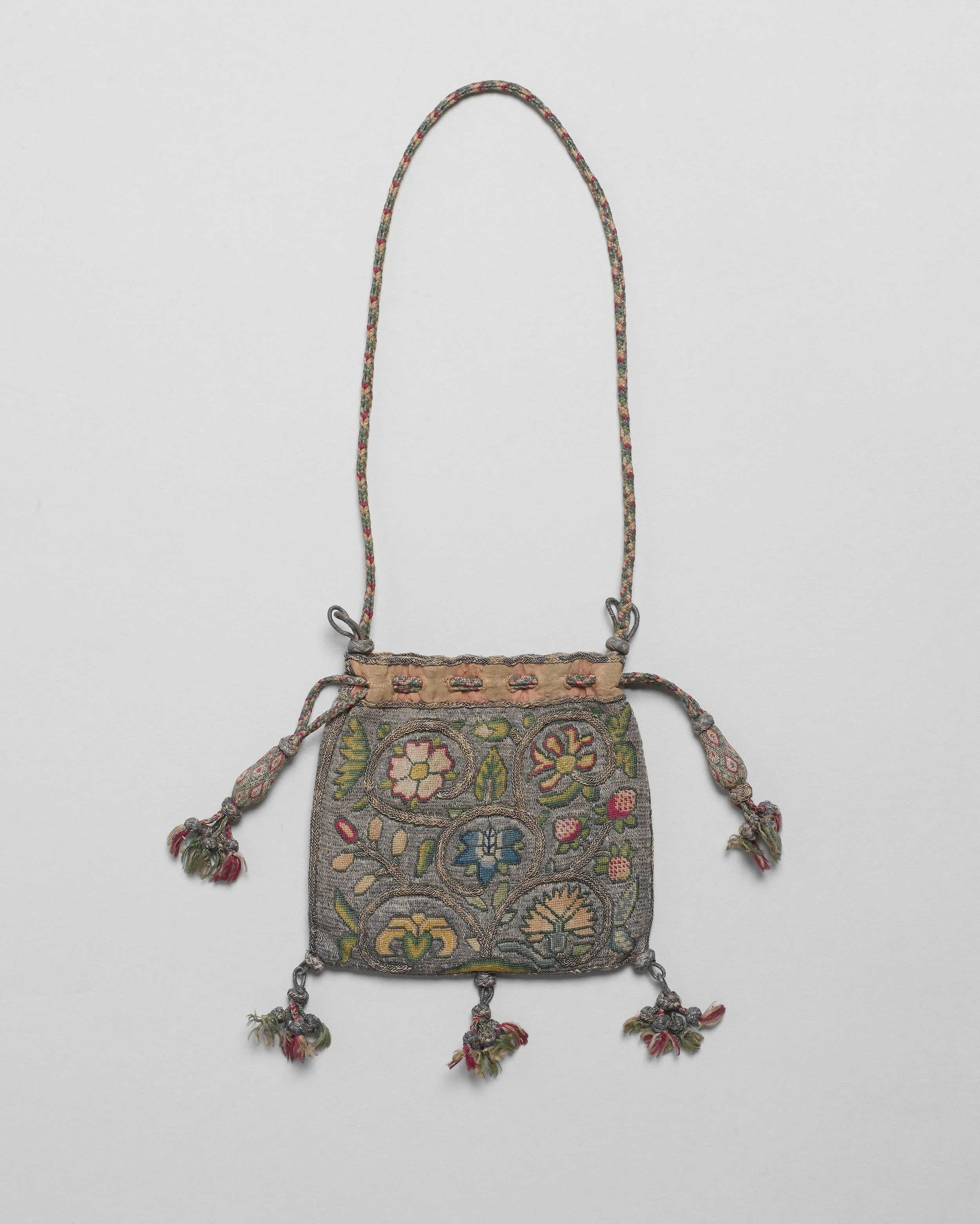
A British embroidered purse of the first quarter of the seventeenth century — the sweet bag's surviving form: silk and metal thread, flowers and strawberries in roundels, a drawstring mouth, and tassels. Bags like this held perfumed powder or dried flowers and herbs, and were perhaps lifted to the nose like a pomander when the air grew unpleasant.
Purse, British, first quarter 17th century, canvas embroidered with silk, silver, and silver-gilt thread (Metropolitan Museum of Art, 64.101.1259), via the Met Open Access. Public domain.
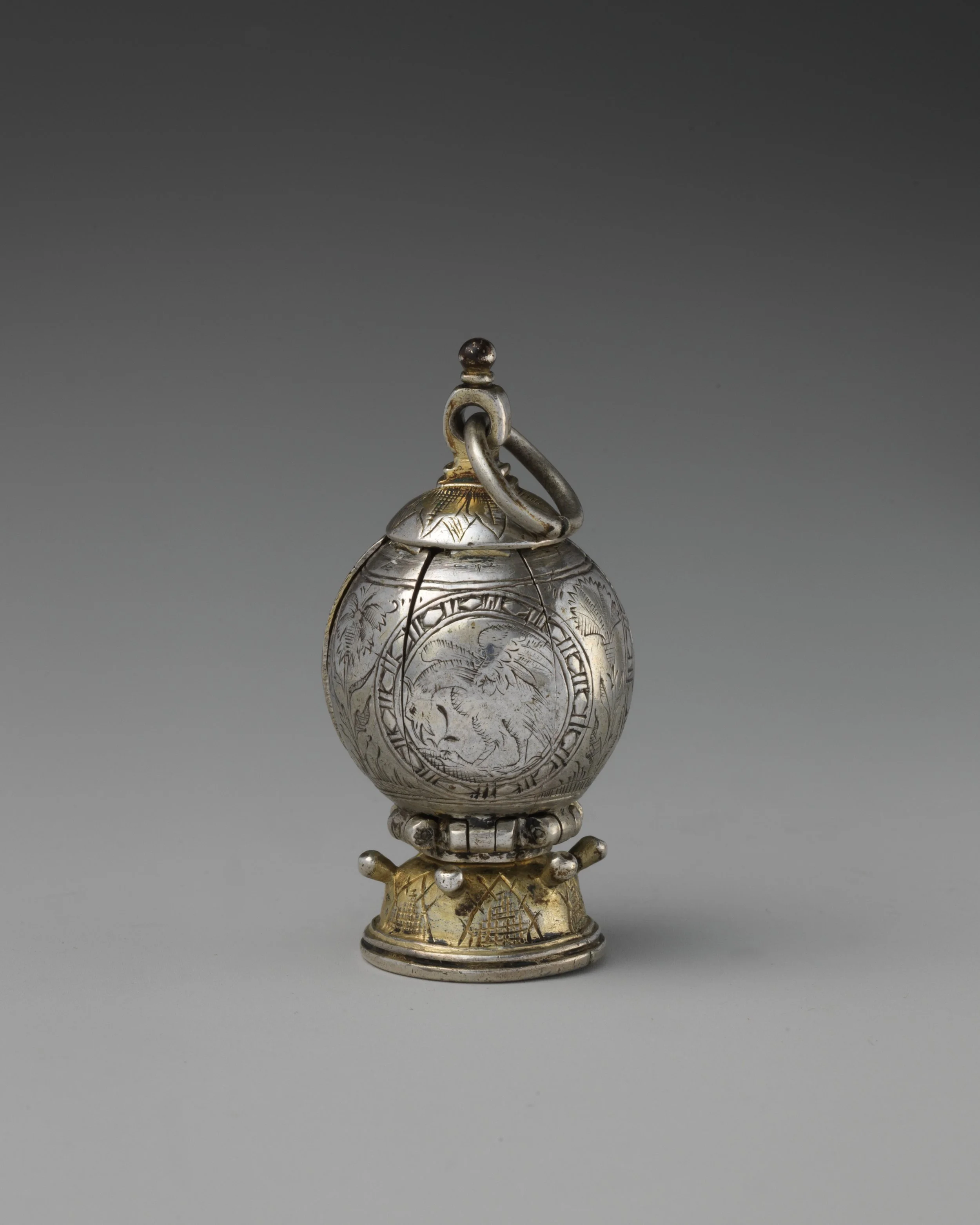
A small pomander with six sections, possibly Dutch, first half of the seventeenth century: a segmented silver ball worn on the body, each hinged section holding its own aromatic. Set it beside the sweet bag above and the lesson's distinction is visible — this perfumed the person; the bag perfumed the household.
Small pomander with six sections, possibly Dutch, first half 17th century, silver, parcel-gilt (Metropolitan Museum of Art, 1974.356.668a–j), via the Met Open Access. Public domain.
Long before the sachet became a humble drawer freshener, its ancestor was a luxury object. In the sixteenth and seventeenth centuries, wealthy English households owned embroidered sweet bags: small drawstring pouches of silk and metal thread, stitched with flowers and fruits, filled with perfumed powder or dried flowers and herbs. Surviving examples sit in museum collections today, including the Victoria and Albert Museum in London, whose catalog notes that these bags held perfumed powder or dried botanicals and were perhaps lifted to the nose like a pomander when the air grew unpleasant.
The sweet bag teaches two lessons. The first is about status: fragrance was wealth made invisible, and a beautiful bag of dried roses announced its owner's refinement without a word. The second is about function: these bags did real work. They sweetened clothing stored in wooden chests, they perfumed the air around their owners, and they represented the household's own small apothecary tradition, maintained by the women of the still room who dried the harvest and filled the bags each year.
★ Do not confuse the sweet bag with the pomander. A pomander was worn on the body, often a jeweled case of ambergris, musk, and spices carried on a chain at the waist. A sweet bag was kept with things: in a chest, among linens, in a drawer. The pomander perfumed the person; the sweet bag perfumed the household. You will study pomanders properly in Lesson 45, when we reach solid perfumery. For today, remember the distinction: sachets serve the shelf, not the skin.
By the eighteenth century the embroidered sweet bag had faded from fashion, but the plain working sachet never left. Linen chests, wardrobes, and clothes presses across Europe and America held small cloth bags of dried lavender well into the modern era. The luxury object became a household habit, which is often the more interesting fate.
Check in: What single distinction separates the sweet bag from the pomander — what does each one perfume?
❦ In your workbook: record the sweet bag in your own way — the luxury embroidered ancestor, its two lessons of status and function, and the line between the bag that serves the shelf and the pomander that serves the skin — copy, sketch, or note what matters.
Potpourri: The Rotted Pot
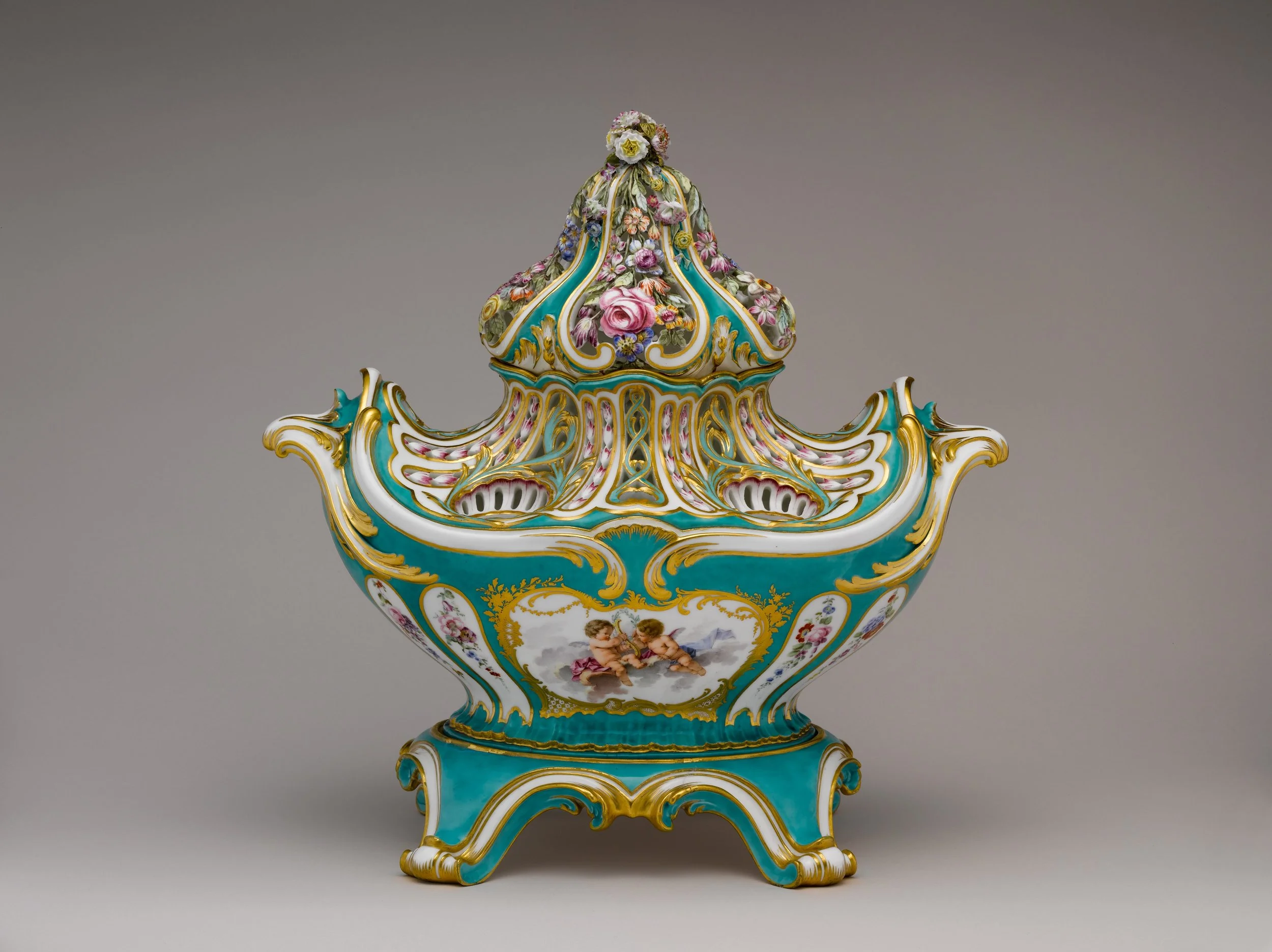
A Sèvres potpourri vase of 1757, its first owner Madame de Pompadour: the pierced lid and openwork neck are not decoration for its own sake — they are how a room perfume breathes. The lesson's finished potpourri was set out in special pots with perforated lids, and it perfumed rooms for months.
Potpourri vase (pot-pourri gondole), Sèvres Manufactory, 1757, soft-paste porcelain (Metropolitan Museum of Art, 58.75.88a–c), via the Met Open Access. Public domain.
The word potpourri carries one of the strangest histories in the household arts. It comes from the French pot pourri, meaning rotten pot, which was itself a translation of the Spanish olla podrida, a slow-cooked stew of mixed meats. The name traveled from the kitchen to the still room: a medley of many ingredients, left to soften and merge, first as stew, then as fragrance.
The original potpourri was not the dry bowl of colored petals you may know. In seventeenth-century France, the moist method ruled. Fresh herbs and flowers were gathered through spring and summer, left a day or two to wilt, then layered in a crock with coarse sea salt. The mixture was stirred as new layers were added, and it fermented through the summer, sometimes molding, until autumn, when spices were added and the whole mass was judged by nose. Fixatives were added last. The finished potpourri was set out in special pots with perforated lids, and it perfumed rooms for months.
★ The dry method, which is what most people make today, is simpler and cleaner: fully dried botanicals, spices, and a fixative, mixed and left to cure in a closed jar for a few weeks before being set out. No fermentation, no salt, no gray autumnal mass. The dry method is the one this lesson teaches, because it is the method a student can perform safely and repeat reliably. But the moist method deserves your respect: it was chemistry before chemistry had a name, and it worked.
One caution about modern potpourri. Much of what is sold today is decorative material with synthetic fragrance sprayed on, and the scent often has no relation to the plant matter in the bowl. That is decoration, not preparation. An apothecary's potpourri smells like the plants it contains, because it is the plants it contains.
Check in: What did the original moist method layer its fresh flowers with, and leave to ferment through the summer — and how does the dry method this lesson teaches differ from it?
❦ In your workbook: record potpourri in your own way — the rotten-pot name and its journey from the stew pot, the moist method in its crock, and the dry method this lesson teaches — copy, sketch, or note what matters.
The Household Front: Moths, Linen, and Lavender
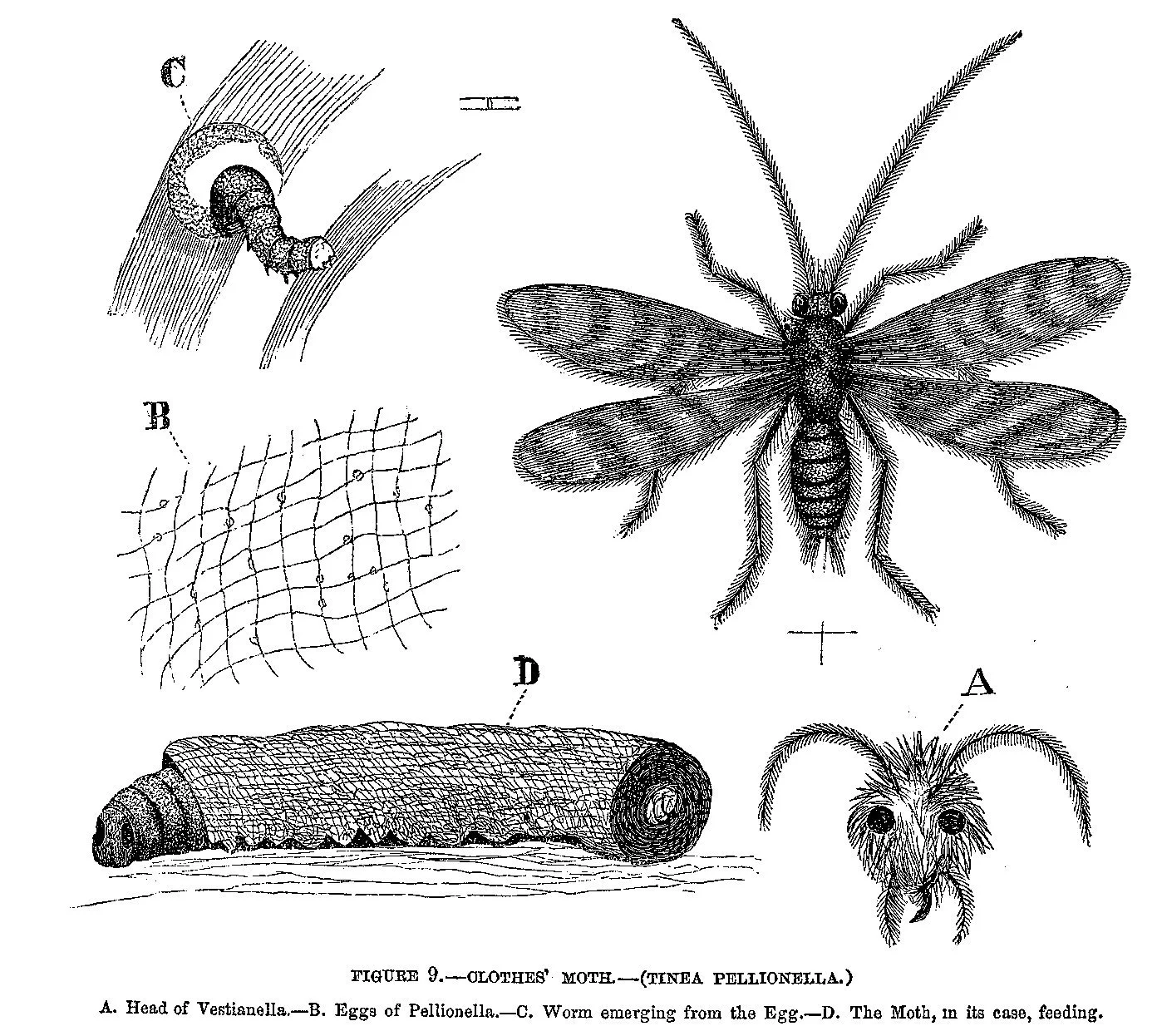
The clothes moth, Tinea pellionella, in a nineteenth-century natural-history figure: the adult at right, and at D the larva in its case, feeding — the stage that eats the wool. A single season of neglect could ruin a household's stored winter clothing; this small, unremarkable insect is why the wardrobe needed defending.
"Clothes' moth (Tinea pellionella)," figure 9, unidentified illustrator, via Wikimedia Commons. Public domain.
Here is the practical reason sachets survived for centuries: the clothes moth.
The clothes moth is a small, unremarkable insect whose larvae feed on wool, silk, fur, and other animal fibers. A single season of neglect could ruin a household's stored winter clothing. Before modern pest control, the defense of the wardrobe was a domestic art, and dried botanicals were among its tools. Lavender, cedar, rosemary, and tansy were traditionally placed among stored textiles, in the belief, widely held and long practiced, that their strong scents discouraged moths.
★ A word of honest laboratory caution, because Muddlenook insists on it: the historical practice is real and well documented, but the evidence for how well dried lavender actually repels moths is mixed. Strong scent may confuse the male moth's sense of smell, making it harder to find a mate, which is a plausible mechanism, but a sachet is not a guarantee. The lesson here is the practice itself: how households organized this defense, what they used, and why. Cleanliness, regular shaking and airing of stored textiles, and sealed storage do more than any sachet. The sachet is the finishing touch, not the fortress.
This is worth understanding because it shows the apothecary's mindset applied to the whole house. The same observational discipline you use at the workbench, notice, test, record, applies to a linen chest. The household was the laboratory's larger room.
Check in: What does the lesson say does more against moths than any sachet — and what is the sachet's own honest place in the defense?
❦ In your workbook: record the household front in your own way — the clothes moth and its larvae, the traditional botanicals placed against it, and the honest caution that the sachet is the finishing touch, not the fortress — copy, sketch, or note what matters.
In your packet: Exercise I — The Wardrobe Survey ◐ begins here. Work it now, or mark the place and take it as homework — your choice.
The Science of Dry Fragrance
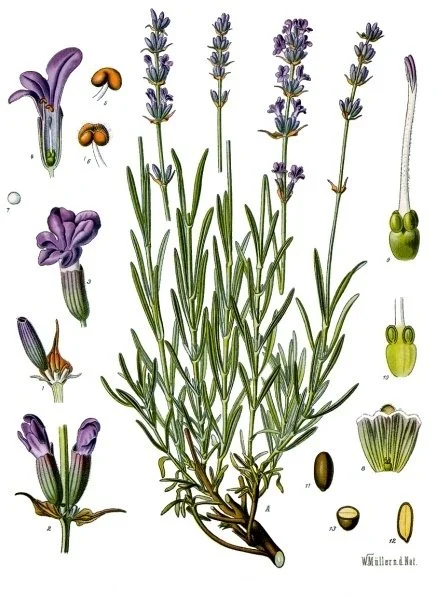
Lavandula angustifolia in Köhler's Medizinal-Pflanzen: the classic base of the sachet blend, drawn whole and in section. The lesson's test for this material is not the eye but the fingers and nose — crush a pinch and sniff; if the fragrance is strong, the material is good.
Lavandula angustifolia plate, Köhler's Medizinal-Pflanzen, via Wikimedia Commons. Public domain.
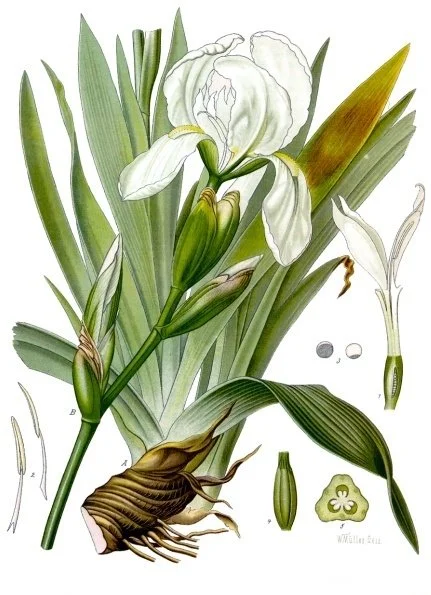
Iris germanica florentina in Köhler's Medizinal-Pflanzen, its rhizome drawn at the base: dried and ground, that rhizome is orris root, the traditional fixative. It absorbs the volatile oils and releases them gradually, extending the sachet's life from weeks to months.
Iris germanica florentina plate, Köhler's Medizinal-Pflanzen, via Wikimedia Commons. Public domain.
A sachet works on principles you have already studied. Dried botanicals still contain volatile oils, the same compounds you met in Lesson 14, locked inside the plant's tissues. Drying slows their escape but does not stop it. At room temperature, those molecules drift off the dried material into the surrounding air, pass through the weave of the cloth, and reach your nose. That slow, steady release is the sachet's entire mechanism. No heat, no solvent, no action required beyond time.
Three factors govern how well a sachet performs.
The material. Only fragrant, fully dry botanicals serve. Test every ingredient before it goes into the bowl: crush a pinch between your fingers and sniff. If the fragrance is strong, the material is good. If it is faint or dusty-smelling, it is spent, and no sachet can rescue it. This is the sniff test from Lesson 11, applied to the household.
★ The fixative. Some fragrance molecules are light and quick; they leave the material in weeks. A fixative is a substance that slows their escape, historically orris root, the dried rhizome of the iris, ground to powder. The fixative absorbs the volatile oils and releases them gradually, extending the sachet's life from weeks to months. You studied fixatives in Lesson 14; here is their household application.
The cloth. The sachet bag is a permeable vessel. A tight weave holds fragrance in too well and the sachet smells of nothing. An open weave releases everything at once and the sachet is spent by spring. Muslin and light cotton sit in the useful middle: they breathe, but they do not exhale all at once. Hold your cloth to the light. If you can see light through it but cannot read through it, it will serve.
Check in: What three factors govern how well a sachet performs — and what test judges the material before anything goes into the bowl?
❦ In your workbook: record the science of dry fragrance in your own way — the volatile oils drifting at room temperature, and the three governing factors: the material, the fixative, and the cloth — copy, sketch, or note what matters.
Blend Ratios: Designing by Number
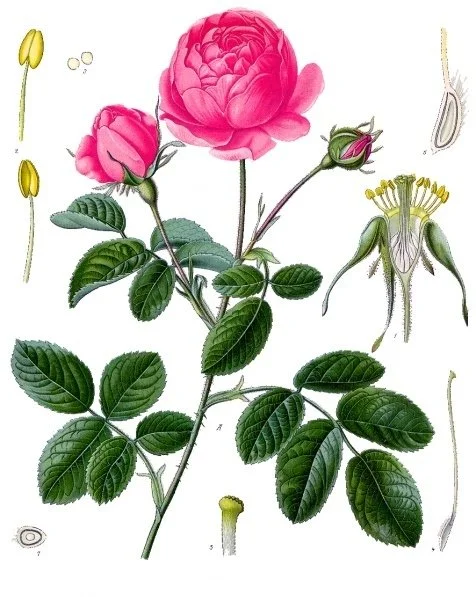
Rosa centifolia in Köhler's Medizinal-Pflanzen: the rose whose dried petals serve as an alternative base and a classic accent. In the 3:2:1 ratio the rose may carry the blend's character or support it — the ratio, written down before mixing, is what makes either choice repeatable.
Rosa centifolia plate, Köhler's Medizinal-Pflanzen, via Wikimedia Commons. Public domain.
Apothecaries work by ratio, and so will you. A sachet blend has three parts, and giving each part a number keeps your work repeatable.
The base (3 parts). The main fragrant botanical, the character of the blend. Dried lavender buds are the classic base. Dried rose petals, dried lemon balm, or dried mint serve as alternatives.
The accent (2 parts). A supporting botanical that adds complexity: dried rosemary, dried chamomile, dried orange peel, or a few whole cloves.
The fixative (1 part). Orris root powder, or plain rice if orris root is unavailable. The fixative extends the blend's life and gives the sachet pleasant weight.
★ A 3:2:1 blend, by volume, is the student's standard ratio. Three spoonfuls of base, two of accent, one of fixative. Write the ratio in your Blend Record before you mix, because a blend you cannot repeat is an anecdote, not a preparation. As you gain experience you may adjust, more accent for a brighter sachet, more fixative for a longer-lived one, but always write the numbers down first.
Scholars, a note on orderliness. Mix your blend in the bowl before it goes into the cloth. Do not layer ingredients into the sachet — a small cloth bag filled with dried fragrant botanicals — one at a time and hope they mingle. They will not. The bowl is where blending happens; the bag is where the blend lives. This is the mise en place principle applied to dry work, and I expect it observed.
— Professor Crimblebrew Muddlenook, Potions Laboratory • Master Apothecary • Head of House Meridies
Check in: In a 3:2:1 blend ratio, what does each number stand for — and where must the ratio be written before you mix?
❦ In your workbook: record blend ratios in your own way — base, accent, and fixative in their 3:2:1 parts, and the professor's rule that the bowl is where blending happens — copy, sketch, or note what matters.
The Procedure: Blending and Filling a Sachet
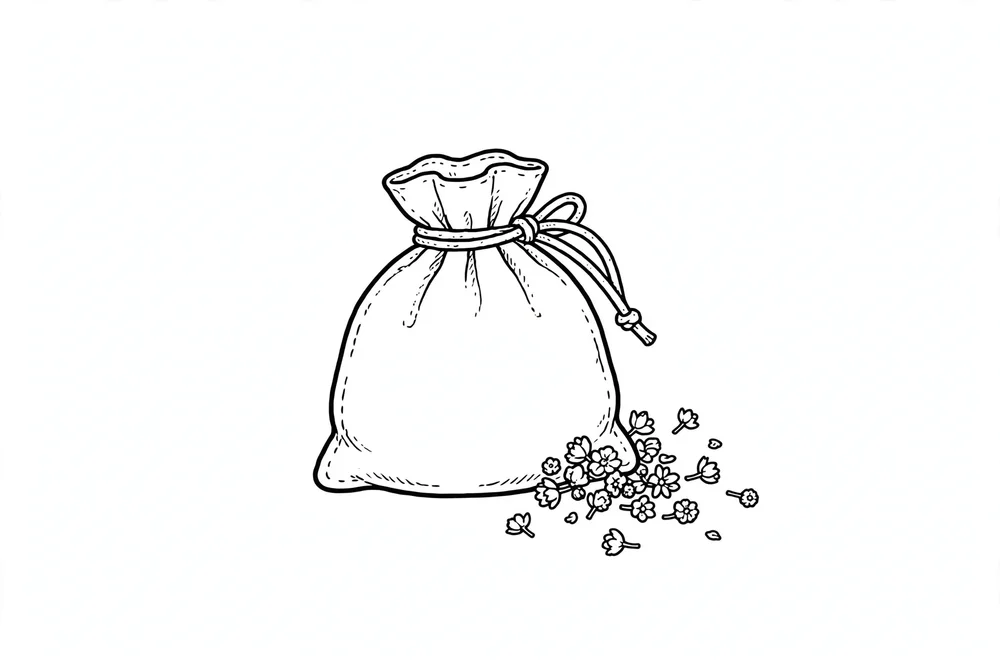
Step 1 — Inspect. Spread your dried botanicals on the tray. Remove any stems, dust, discolored pieces, or fragments that smell of nothing. Test each ingredient with the crush-and-sniff test. Discard anything spent.
Step 2 — Measure. Using your chosen ratio, measure the base, the accent, and the fixative into the bowl. Level One: use a tablespoon as your unit. Three tablespoons of base, two of accent, one of fixative.
Step 3 — Blend. Stir gently with the spoon until the mixture looks uniform. Do not crush or grind; you are mixing, not milling. The botanicals should remain recognizable.
Step 4 — Fill (Level One). Lay your cloth square flat. Spoon the blend into the center, about half a cup. Gather the corners up, twist the neck firmly, and tie it closed with the ribbon or cord. The sachet should feel full but not bursting; the botanicals need a little air among them.
Step 4 — Fill (Level Two). Fold your linen rectangle in half to make a square. Sew two sides closed with small, even stitches, leaving the top open. Turn it right side out. Spoon in the blend. Fold the top edge down, sew or tie it closed, and add a button or bead if you wish.
Step 5 — Label. Write the contents, the ratio, and today's date on the paper label. Attach it to the sachet with the ribbon, or tuck it inside the fold. A sachet without a date is a rumor.
Step 6 — Rest. Place the finished sachet in a closed jar or tin for three days before judging it. Fresh blends need this short curing rest for the fragrances to settle together. Judge it on the fourth day.
Check in: How long does a finished sachet rest before you judge it — and what are the fragrances doing in that rest?
❦ In your workbook: record the procedure in your own way — inspect, measure, blend, fill, label, rest, in their six steps, with the bowl before the bag — copy, sketch, or note what matters.
In your packet: Exercise II — The Sachet Build ⚒ begins here. Work it now, or mark the place and take it as homework — your choice.
Observation: The Scent Diary
A sachet is a slow preparation, and slow preparations are observed slowly. Keep a scent diary for your sachet: once a week, hold it at arm's length, then bring it gradually closer, and note at what distance you first detect the fragrance. Record the date, the distance, and a word or two about the character of the scent.
★ You will notice the scent throw shrink over the weeks. This is normal and expected; it is the volatile oils doing exactly what volatile oils do. When the sachet smells faint at close range, it has two possible futures. Refreshing: empty the sachet, crush the contents gently to expose new surfaces, add a spoonful of fresh base botanical, and refill. A refreshed sachet earns a new date on its label, with the word refreshed beside it. Retiring: when refreshing no longer restores the fragrance, usually after two or three cycles, the botanicals are spent. Empty them into the compost or the garden, wash the cloth, and begin again. A retired sachet is not a failure. It is a preparation that completed its work.
Check in: When a sachet smells faint at close range, what are its two possible futures — and what decides between them?
❦ In your workbook: record the scent diary in your own way — the weekly distance test, the shrinking scent throw, and the refresh-or-retire rule — copy, sketch, or note what matters.
In your packet: Exercise III — The Two-Blend Comparison ◐ begins here. Work it now, or mark the place and take it as homework — your choice.
Cleanup
Shake the tray or newspaper outdoors, or fold it carefully and empty it into the bin. Dried botanical dust settles everywhere if you carry the tray carelessly through the house. Wipe the work surface with a damp cloth. Seal all jars of dried botanicals tightly; every minute a jar stands open is fragrance leaving the archive. Wash the bowl and spoon. File your Blend Record before you leave the bench, while the numbers are still fresh in your mind.
Check in: Why must every jar of dried botanicals be sealed tightly the moment the work is done — what is leaving it while it stands open?
❦ In your workbook: record cleanup in your own way — the tray emptied with care, the surface wiped, the jars sealed, and the Blend Record filed before you leave the bench — copy, sketch, or note what matters.
Guided Observation: Judging by Test, Not by Hope
This lesson's observation is bench judgment, done with the lesson's own three tests open in front of you: you judge cloth, material, and finished sachet the way the lesson judges them — by a test you can repeat, never by a guess you cannot.
Work through it in order.
Test the cloth. Hold your cloth to the light. If you can see light through it but cannot read through it, it will serve. Muslin and light cotton sit in the useful middle: they breathe, but they do not exhale all at once.
Test the material. Test every ingredient before it goes into the bowl: crush a pinch between your fingers and sniff. If the fragrance is strong, the material is good. If it is faint or dusty-smelling, it is spent, and no sachet can rescue it.
Test the throw. Once a week, hold it at arm's length, then bring it gradually closer, and note at what distance you first detect the fragrance. Record the date, the distance, and a word or two about the character of the scent.
Consider:
- Which of the three tests could condemn a blend before it is ever mixed — and what would you do with material it condemns?
- Your cloth passes light but print is readable through it. Which failure does the lesson predict for that sachet, and by when?
- At what distance did you first detect this week's fragrance, and what does a shrinking scent throw tell you is happening inside the cloth?
❦ In your workbook: record the guided observation in your own way — the cloth held to the light, the crush-and-sniff verdicts, and the weekly scent-throw distances — copy, sketch, or note what matters.
Materials
Gather everything before you begin. A prepared bench is a safe bench.
Level One — household items
- A square of clean, breathable cloth about 20 centimeters (8 inches) across: muslin, a cotton handkerchief, or a clean cotton bandana. The cloth must let air through; hold it to the light and confirm you can see light through the weave.
- Dried botanicals, about half a cup total: dried lavender buds are the classic choice. Dried rose petals, dried rosemary, dried chamomile flowers, or dried mint leaves also serve. Use material that is fully dry and still fragrant. If it smells of nothing in the jar, it will smell of nothing in the sachet.
- A fixative or volume filler, two tablespoons: orris root powder (dried iris root, the traditional fixative), or plain uncooked rice as a neutral filler that gives the sachet body.
- A ribbon, cord, or strip of cloth about 30 centimeters long for tying.
- A bowl for mixing, a spoon, a tray or newspaper to work over.
- Small paper labels and a pen.
- Your laboratory journal or potions journal pages.
Level Two — historically closer
- A rectangle of linen or cotton, about 20 by 40 centimeters, for a sewn sachet bag.
- Needle, thread, and small sharp scissors.
- A button or bead for the closure, if you wish.
- Whole dried botanicals from a bulk supplier rather than pre-ground material: lavender buds, rosebuds, dried orange peel, whole cloves, cinnamon pieces.
- Orris root pieces or powder as the fixative, as the historical recipes specify.
- Paper labels, pen, and your archive pages.
Safety Notes
- Dried botanicals shed fine dust when poured or mixed. Work over a tray or newspaper, keep your face back from the bowl, and do not lean over the mixture to sniff it directly. Wear a simple dust mask if you are dust-sensitive.
- Work in a ventilated room. Strong scents affect people differently; never press a finished sachet to anyone's face, and ask before giving sachets as gifts.
- Keep buttons, beads, pins, loose botanicals, and finished sachets away from small children and pets. Dried botanicals are not food; nothing in this lesson is to be tasted.
- Level Two sewing requires an adult beside younger scholars. Keep the needle in a pincushion when not in hand, and never walk with a needle in hand.
- Label every sachet with its contents, ratio, and the date it was filled. A sachet without a date is a rumor.
Reflection Questions
Answer the following questions in your workbook.
- Why does the lesson insist that the bowl is where blending happens and the bag is where the blend lives? What goes wrong if you layer ingredients directly into the sachet?
- The V&A's sweet bags were luxury objects; the linen-chest sachet is a household habit. What changed between them, and what does that change tell you about how crafts survive?
- Why is a sachet without a date called a rumor? Give two specific ways a missing date could mislead you later.
- The lesson says cleanliness and sealed storage do more against moths than any sachet. Does that make the sachet pointless? Explain your answer using the lesson's own reasoning.
- You open a drawer and find a sachet you made a year ago. It smells faintly of dust. Walk through the decision: refresh or retire? What do you check, and what decides it?
Workbook Checklist — Lesson 37
In my workbook I have:
- ☐ surveyed every place textiles are stored at home, recorded what each holds and what it smells like now, and chosen one shelf or drawer as my sachet's destination, with my reasons written
- ☐ written my Blend Record before mixing: blend name, ratio, every ingredient with its crush-and-sniff verdict, the cloth, and the date
- ☐ blended in the bowl first — never layered into the bag — and filled and sealed one sachet at my level, full but not bursting
- ☐ labeled my sachet with its contents, its ratio, and the date it was filled
- ☐ rested the finished sachet three days in a closed jar or tin and judged it on the fourth day, with my first scent diary entry recorded
- ☐ recorded the three factors that govern a sachet — the material, the fixative, and the cloth — and the light test that judges the cloth
- ☐ kept, or ruled ready, scent diaries for two blends across a fortnight, with scent throw measured weekly and the comparison written
- ☐ recorded the refresh-or-retire rule: refresh while refreshing restores the fragrance, retire when it no longer does, and give a refreshed sachet a new date marked refreshed
☐ Lesson completed Date: ___ Signature: ___
The Professor's Closing Note
Well done, scholars. You have made something with your hands that asks nothing of fire, nothing of solvents (liquids able to dissolve or draw out other materials), and nothing of haste. That is rarer than it sounds, and it is worth noticing.
File your Blend Record beside your extraction ledgers and your formulation notes. It belongs there. The sachet — a small cloth bag filled with dried fragrant botanicals — is a formulation, as truly as any salve (a thick ointment spread on as a protective layer): measured ingredients, a defined procedure, an observed result, and a record that lets you repeat it. The laboratory does not end at the workbench. It extends to every shelf in the house that holds something you made with attention.
Next lesson, we return to heat and chemistry. Enjoy the quiet of this one.
— Professor Crimblebrew Muddlenook, Potions Laboratory • Master Apothecary • Head of House Meridies
PROFESSOR CRIMBLEBREW MUDDLENOOK
Potions Laboratory
Master Apothecary • Head of House Meridies
Cross-Class Connections

Herbology · Unit IV, Lesson 28 — Drying Herbs the Traditional Way
Come up to the Greenhouse, sachet-makers, and learn to dry what his bowl will ask of you. In my greenhouse we hang bundles, screen-dry delicate leaves, and judge by crispness when drying is done, so the lavender and rose that reach Professor Muddlenook's bench are fully dry and still fragrant. A sachet can only keep what drying kept first — bring your harvest, and we will dry it properly.
PROFESSOR BERYL FERNFOOT
Herbology Greenhouse • Master Herbalist • Head of House Oriens
Scrollwork · Unit VI, Lesson 23 — Archive Labels & Library Systems
You have labeled a sachet. Now come and label a library. In my Scriptorium we take up the label, the list, and the shelfmark at the scale of whole collections — how a record is made findable, and why an undated thing, as your professor tells you, is only a rumor. Your paper label has a thousand-year pedigree, scholars. Come and meet its ancestors.
PROFESSOR QUILLBERRY NOCTURNE
Scrollwork Library

Creative Arts · Unit III, Lesson 13 — Pouches, Tool Rolls & Storage Bags
Bench set, sachet-makers. Professor Muddlenook blends and judges what fills his sachets; in my workshop we sew the container that holds the blend. Bring your cloth square and your measurements, and we will sew a drawstring pouch — channel hemmed clean, seams measured against its burden — that keeps his blend safe, dry, and findable on its shelf.
PROFESSOR COGBRANCH TIMBERCLANK
Creative Arts Workshop
Further Reading & Sources
- Sweet bag, early 17th century — Victoria and Albert Museum: the museum's catalog entry on an embroidered sweet bag, noting it held perfumed powder or dried flowers and herbs.
- Sweet Bags — Larsdatter.com: a catalog of surviving seventeenth-century sweet bags with museum accession numbers, from the V&A to the Met to Colonial Williamsburg.
- Redefining Sweet Bags as Olfactory Heritage — Arts (MDPI): a 2025 scholarly article treating sweet bags as objects of sensory history, with close study of a V&A example.
- Three Pots-pourris — The Frick Collection: Sèvres porcelain potpourri vases, ca. 1762, showing how seriously the eighteenth century took its room fragrance.
- Pot-pourri — Merriam-Webster: the dictionary's account of the word's journey from Spanish stew to fragrant medley.
- Clothes Moths: The Pest Intentions — The Field: on traditional moth defenses including lavender and cedar, with commentary from the National Trust's textile conservation adviser.
Browse the Potions shelf in the school Library for readable editions of these works.
LESSON 37 · SACHETS
Try It in the Laboratory
The lesson taught the main botanical and the fixative that keeps it. The Experiment builds your own sachet: choose your plant, your accent, and whether it scents a drawer, a closet, or a gift.
— Professor Crimblebrew Muddlenook, Potions Laboratory
Submit your work for this lesson using the form below.
CONTINUE IN THE POTIONS LABORATORY
← Previous · Lesson 36: Candles & Aromatic Wax Casting Next · Lesson 38: The Whipped Emulsion →
Unit V — Botanical Formulations Potions Laboratory — All 52 Lessons
The rest of Unit V: Lesson 35 · Balms & Salves · Lesson 36 · Candles & Wax · Lesson 38 · Whipped Emulsion · Lesson 39 · Crystalline Scrubs · Lesson 40 · Melt & Pour Soap · Lesson 41 · Cold-Process Soap · Lesson 42 · The Failed Batch · Lesson 43 · Experimental Formula · Lesson 44 · Formulation Matrix