
POTIONS
Unit VI · Lesson 49FLUID COLOR: PLANT & BERRY STAINS
Professor Crimblebrew Muddlenook
Master Apothecary • Potions
Head of House Meridies • School of Evershade
Professor's Introduction

Sealed with the teal wax of Professor Crimblebrew Muddlenook, Master Apothecary of the Potions Laboratory, Head of House Meridies.
Scholars, every extraction you have performed this year has had a color. The golden oil of Lesson 26. The ruby tincture — an alcoholic preparation made by soaking a botanical in spirit — of Lesson 32. The deep brown of a long decoction (a water extraction made by simmering dense material, such as roots or bark). You recorded those colors in your ledgers as observations, and rightly so. Today we turn the observation around and make color itself the subject of study.
The laboratory extracts many things from plants: fragrance, flavor, and medicinal compounds are only part of the story. Color is a compound too, or rather a family of compounds, and the apothecary who understands how color is drawn out, shifted, fixed, and lost understands extraction — drawing compounds out of a material with a liquid — at its deepest level. What you learn here about coaxing pigment from a cabbage leaf applies to every solvent (a liquid able to dissolve or draw out other materials), every menstruum (the liquid that does the extracting), and every preparation you will ever make.
A warning before we begin, and I do not give it lightly: plant stains are permanent. They will mark your work surface, your apron, your fingers, and anything else they touch. Prepare your bench as if you were handling ink, because in a sense, you are. Order first. Then color.
— Professor Crimblebrew Muddlenook, Potions Laboratory • Master Apothecary • Head of House Meridies

Potions map — the class base map, unmarked for this lesson.
Lesson Objectives
By completing this lesson, you will be able to:
- Name the four great plant pigment families and the colors each produces.
- Extract visible color from three different botanical materials using water, heat, and crushing.
- Demonstrate that anthocyanin pigments change color with pH, using red cabbage and household acids and bases.
- Explain what a mordant does and name two historical mordants.
- Distinguish fugitive colors from colorfast ones and explain why plant colors fade.
- Record a complete color-extraction entry in your laboratory archive.
Reading this lesson: ★ marks the passages to remember. They return in the Unit VI Quiz, in the units ahead, and at the capstone. Check in questions ask the material back as you go; answer them in your workbook when you meet them.
Working this lesson: Your assignment packet is the first download on this page. Work in it as the lesson moves along, answering each exercise as its subject is taught — or read the lesson through for your notes and take the exercises as homework afterward. Both are proper ways to sit this class. Signposts in the reading tell you where each exercise belongs. Written answers are short answers in your own words; a few honest lines are worth more than a filled page.
Your Assignment Packet
This lesson's exercises live in its packet: the Lexicon Handout (every term, course terms marked ◆), Materials, Guided Practice — the Three-Jar Extraction and the pH Trials, printed in full so you can work them at the bench — the Assignment Manual with its self-check, the Reflection Questions, and the Workbook Checklist. Download the packet before you begin and keep it beside you as you read.
Safety Briefing
Read this section completely before touching any materials.
Stains are permanent. Berry juice, beet juice, and turmeric stain skin, fabric, wood, and paper on contact. Turmeric in particular will mark everything it touches a lasting yellow. Cover your entire work surface with newspaper, a disposable tablecloth, or a washable tray. Wear an apron or old clothing. Consider disposable gloves; at minimum, wash your hands promptly after handling pigmented materials.
Heat safety. You will use hot or boiling water to steep botanical material. Use a heat-safe pot or kettle, pour carefully, keep handles turned inward, and never leave heating water unattended. Younger students: an adult must handle the boiling water.
The tasting rule stands. Do not taste or ingest any botanical material unless it is an ordinary culinary item from your own kitchen and an adult confirms it. Never taste unidentified berries. Many wild berries are toxic, and this lesson is about color, not consumption.
Label everything. Every jar you fill gets a label with the material name and the date. An unlabeled jar of dark liquid is a hazard and a disgrace to the laboratory.
Cleanup. Wipe spills immediately, before they set. Wash all vessels with hot soapy water. Dispose of spent plant material in compost or refuse, never down a sink with a garbage disposal running.
Check in: What must every jar you fill carry — and what is the tasting rule, exactly as the briefing states it?
❦ In your workbook: record the safety briefing in your own way — permanent stains, heat safety, the tasting rule, labeling, and cleanup — copy, sketch, or note what matters.
In your packet: Guided Practice — the Three-Jar Extraction and the pH Trials begin here. Work them as you reach them in the reading, or mark the place and take them as homework — your choice.
Where Color Lives in Plants
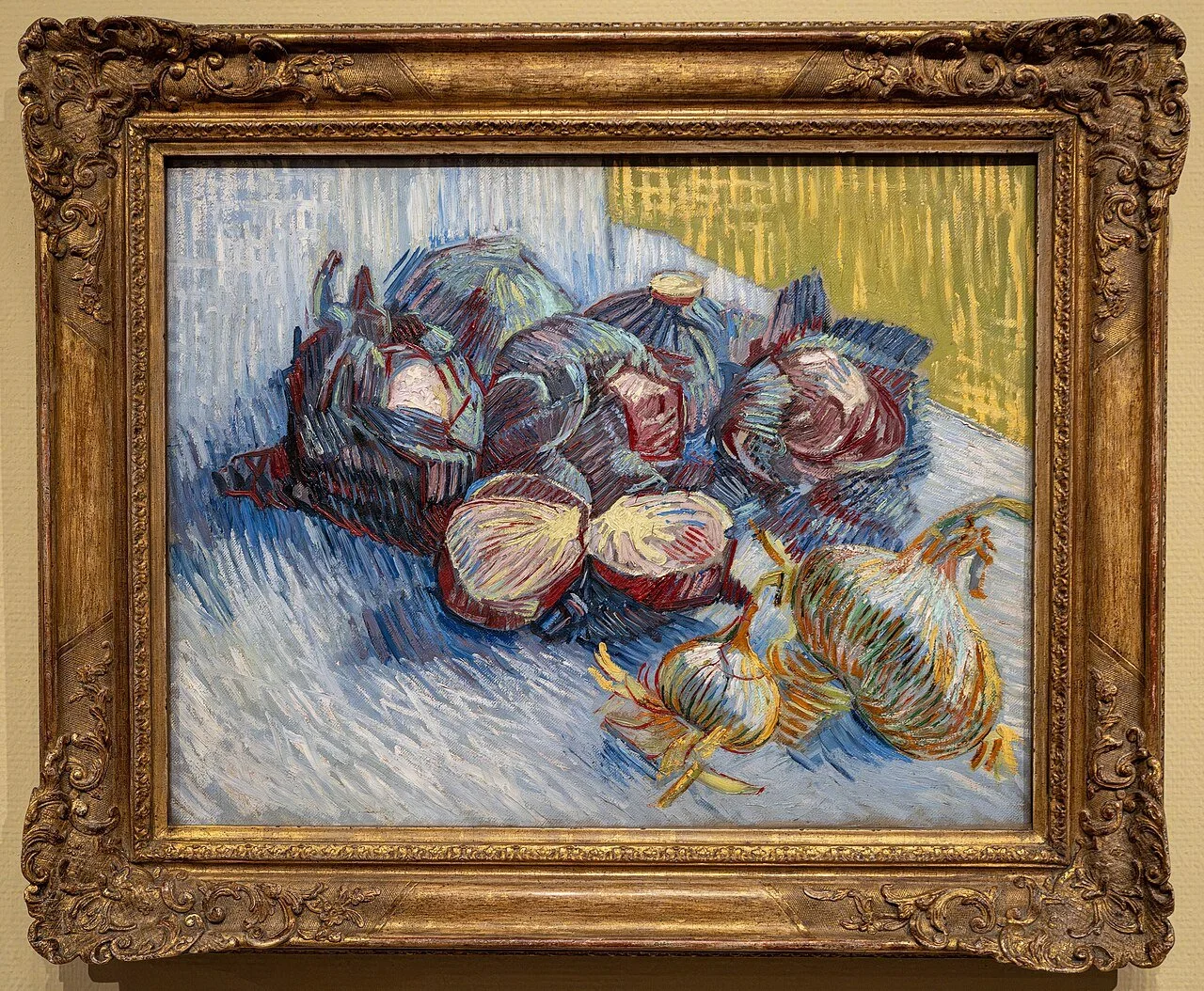
Red cabbages and garlic, Vincent van Gogh, 1887: the star of this lesson as a painter saw it — the purple-red that is not paint on the leaf's surface but anthocyanin chemistry all the way through, waiting for hot water to draw it out.
Vincent van Gogh, Red Cabbages and Garlic (1887), via Wikimedia Commons. Public domain.
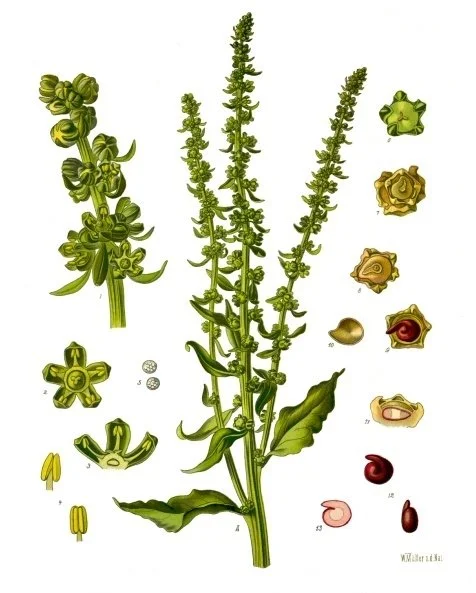
Beta vulgaris in Köhler's Medizinal-Pflanzen — beet in flower and seed, not in root: the betalain red of this lesson lives below the soil in the root the plate does not show, which is itself the lesson — a pigment's family, not its plant's portrait, predicts its behavior in the jar.
Beta vulgaris plate, Köhler's Medizinal-Pflanzen, via Wikimedia Commons. Public domain.
A plant's color is not paint spread on its surface. It is chemistry: molecules built by the plant for its own purposes, which happen to absorb some wavelengths of light and reflect others. The laboratory recognizes four great families of plant pigments, and a competent apothecary can name which family is responsible for nearly any plant color placed before them.
Anthocyanins produce the reds, purples, and blues of berries, grapes, plums, red cabbage, and autumn leaves. They are water-soluble, which is why berry juice runs so freely, and they are famously sensitive to acidity, a property we will exploit today. Their name comes from Greek roots meaning "blue flower," though they produce far more than blue.
Carotenoids produce yellows, oranges, and some reds: the gold of turmeric, the orange of carrots and marigolds, the red-orange of annatto seeds. They are poorly soluble in water and far more willing to dissolve in oil or alcohol, a fact with direct consequences for extraction. Turmeric's curcumin is a carotenoid-type pigment, and it will behave very differently from cabbage juice in your jars today.
Chlorophylls produce the greens of leaves. They are the pigments of photosynthesis itself, and they are fugitive: heat and acid destroy them, turning bright green to a dull olive-brown. Any cook who has watched green vegetables dull in the pot has witnessed chlorophyll chemistry. For the color-worker, chlorophyll is a lesson in impermanence.
Betalains produce the deep red-violet of beetroot and the magenta of bougainvillea. Here is a misconception worth correcting: beet red is not an anthocyanin. Betalains are a separate pigment family found in only one plant order, and they respond to heat and pH in their own way. When two reds behave differently in your jars, you are seeing two chemistries, not one.
There is a fifth color-maker you already know: tannin, the browns of bark, tea, and oak galls, defined canonically in Scrollwork Unit II, Lesson 6 (Oak Gall Ink). Tannins will appear again in this lesson wearing a second hat, as you will see.
Order in the laboratory begins with naming things correctly. Call each color by its family, and the families will tell you how to extract them. — Professor Crimblebrew Muddlenook, Potions Laboratory • Master Apothecary • Head of House Meridies
Check in: Beet red is not an anthocyanin — which family makes it, and why does the distinction show itself in your jars?
❦ In your workbook: record the four pigment families in your own way — anthocyanins, carotenoids, chlorophylls, and betalains, with the colors and the solubility or fragility each carries, and tannin as the fifth color-maker — copy, sketch, or note what matters.
Drawing Color Out
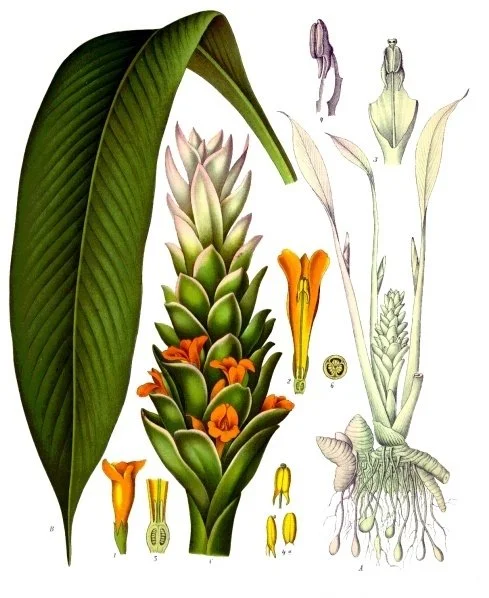
Curcuma longa in Köhler's Medizinal-Pflanzen: turmeric's color lives in the rhizome at the plate's right, and its family — the carotenoids — shrugs at water. The menstruum must match the molecule.
Curcuma longa plate, Köhler's Medizinal-Pflanzen, via Wikimedia Commons. Public domain.
Color extraction follows the same principles as every extraction you have studied. The pigment is a compound locked inside plant tissue; your task is to choose the method that releases it.
Crushing and maceration rupture cell walls and expose pigment to the solvent. Berries surrender their color almost at once when crushed, because their anthocyanins sit dissolved in the cell sap, ready to run. Reference the maceration principles of Lesson 23: the same logic applies, with color as the target compound.
Hot water steeping works where pigments are water-soluble. Red cabbage gives up its anthocyanins to hot water within minutes, exactly as an infusion draws flavor from leaves in Lesson 27. Heat accelerates the process, but remember chlorophyll's lesson: heat also destroys some pigments even as it extracts others.
Alcohol extraction reaches what water cannot. Carotenoids shrug at water; turmeric stirred into cold water makes a cloudy suspension that settles out, not a true solution. In alcohol, or in oil as you learned with infused lipids in Lesson 26, these pigments dissolve properly. ★ The menstruum must match the molecule: a standing rule of this laboratory, first stated in Lesson 19.
Observe and record which of your three materials gives its color most freely, and which resists. That resistance is data.
Check in: Why does turmeric stirred into cold water settle out rather than dissolve — and which menstruums does the lesson name for pigments like it?
❦ In your workbook: record the three extraction methods in your own way — crushing and maceration, hot water steeping, and alcohol extraction, with the pigment each reaches and the resistance each material shows — copy, sketch, or note what matters.
The pH Rainbow
Now the heart of the lesson. ★ Anthocyanin molecules change their structure as the acidity of their surroundings changes, and because structure determines color, the color changes too. In acidic surroundings the pigment appears red or pink. In neutral surroundings it appears purple. In basic or alkaline surroundings it shifts through blue toward green and yellow. One molecule, a spectrum of answers: this is why red cabbage juice is a genuine laboratory pH indicator, used in classrooms and outreach laboratories for generations.
Turmeric performs its own version of the trick. Its curcumin stays yellow in acidic and neutral surroundings but turns reddish-brown to red in basic ones. It cannot distinguish acid from neutral, both read yellow, but as a detector of alkalinity it is reliable and historical.
Your practical today will build both indicators and test them against vinegar and baking-soda solution. Watch closely: you are watching molecules rearrange themselves in real time, and the color is the report they file.
There is a venerable cousin to these plant indicators worth knowing by name: litmus, the classic red-and-blue test paper, is extracted from lichens, not flowering plants. Generations of students have met acids and bases through litmus before ever hearing the word anthocyanin. The principle is identical; only the source differs.
In your packet: Exercise I — The pH Rainbow Chart (Assignment II) ⚒ begins here. Work it now, or mark the place and take it as homework — your choice.
Check in: Turmeric cannot distinguish acid from neutral — what does it read in both, and what is it reliable for instead?
❦ In your workbook: record the pH rainbow in your own way — the anthocyanin's red, purple, and blue-to-green answers, turmeric's narrower trick, and litmus, the lichen cousin — copy, sketch, or note what matters.
Mordants: Fixing the Fugitive
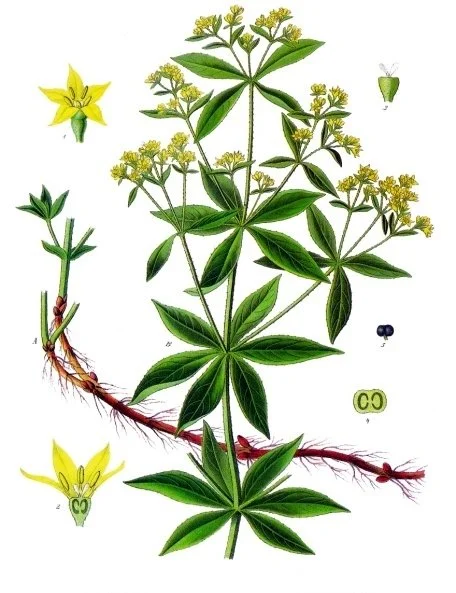
Rubia tinctorum in Köhler's Medizinal-Pflanzen: madder — its red lives in the rootstock drawn diagonally behind the stem, the same dye scientific analysis found on an Egyptian leather quiver of roughly 2100 BCE. The mordant mattered more than the dye.
Rubia tinctorum plate, Köhler's Medizinal-Pflanzen, via Wikimedia Commons. Public domain.
A color that washes out at the first rinse is a curiosity, not a craft. For most of human history, making plant color stay was the harder problem, and the solution was the mordant: a substance, usually a metal salt, that binds the colorant to the fiber or surface so it cannot leave.
The great historical mordant was alum, a soluble aluminum salt, often potassium aluminum sulfate. The Metropolitan Museum's dye researchers describe the mechanism plainly: mordants are substances that combine with colorants to set them on fibers, and alum is the classic example used with flavonoid plant dyes. Iron served as a second mordant, shifting colors darker and sadder; tannin itself could act as a mordant for other dyes, the brown pigment moonlighting as a fixative.
The historical dye plants read like a roll call of the pigment families: madder root for red, weld for yellow, woad and later indigo for blue. ★ Scientific analysis has found madder dye on an Egyptian leather quiver dating to roughly 2100 BCE, which means apothecaries and dyers were managing this chemistry more than four thousand years ago. When your cabbage juice fades on a cloth strip by tomorrow, you will understand viscerally why the mordant mattered more than the dye.
Note the boundary of this lesson with care: the application of dyes and inks to writing and art belongs to the Scrollwork Library, which teaches ink-making and dye craft in its own lessons. This laboratory studies the extraction chemistry: how color leaves the plant, how it shifts, how it is fixed, and how it fails. Two classes, one shared body of knowledge, each teaching its own half.
In your packet: Exercise II — The Mordant Observation (Assignment III) ◐ begins here. Work it now, or mark the place and take it as homework — your choice.
Check in: Name the lesson's two historical mordants beyond alum's class — and what second hat does tannin wear here?
❦ In your workbook: record the mordants in your own way — alum, iron, and tannin as fixative, the dye plants madder, weld, and woad, and the quiver that dates the craft — copy, sketch, or note what matters.
Oxidation and Fading
Plant colors fade because the world attacks them. Light breaks pigment molecules apart. Air oxidizes them. Heat accelerates both. Chlorophyll surrenders first, then anthocyanins, while some carotenoids endure longer. ★ A color's resistance to this assault is its permanence: fugitive colors flee, colorfast colors hold.
You met oxidation as a general principle in Scrollwork's ink lessons; here is its botanical face. Every extraction you have ever made has been a race against the same enemies. The darkening of a tincture, the dulling of dried herbs judged in Lesson 15, the browning of a cut apple: one chemistry, many costumes.
Record your extracted colors today, then look at them again in one week and in one month. Which held? Which fled? Your archive becomes, over time, a museum of fading: honest data about impermanence, which is precisely what the historical dyer needed to know.
In your packet: Exercise III — The Fading Watch (Assignment IV) ◐ begins here. Work it now, or mark the place and take it as homework — your choice.
Check in: Which pigment surrenders first to light, air, and heat — and which family endures longer?
❦ In your workbook: record oxidation and fading in your own way — light, air, and heat as the attackers, the order in which the families surrender, and fugitive against colorfast — copy, sketch, or note what matters.
The Practical: The Three-Jar Extraction and the pH Trials
Safety Briefing
Review the Safety Briefing at the top of this lesson before proceeding. In particular: protect every surface, wear old clothing, keep boiling water under adult control, and taste nothing.
Procedure
Part One: The Three Extractions
- Chop the red cabbage roughly and place it in your heat-safe pot. Cover with just enough water to submerge it. Bring to a boil (adult handles this), then reduce to a simmer for ten minutes, until the water is a deep purple-red. Strain the liquid into Jar 1. Label it: Red cabbage, hot-water extraction, today's date.
- Place one teaspoon of ground turmeric in Jar 2. Add half a cup of warm (not boiling) water and stir. Observe: does it dissolve, or suspend and settle? Label it: Turmeric, warm-water trial, today's date.
- Crush your berries (or grate the beetroot) in a bowl, pressing firmly to release the juice. Strain the juice into Jar 3 through cloth or a strainer. Label it: Berry/beet, crushed-juice extraction, today's date.
Part Two: The pH Trials
- Pour a small amount of the red cabbage liquid into three small cups. Leave the first as your control. Add a spoonful of vinegar to the second and stir. Add a spoonful of your baking-soda solution to the third and stir.
- Record the three colors immediately, using the most precise color words you own: not just "red" but "rose-pink" or "wine-red"; not just "green" but "sage" or "olive."
- Repeat the trial with the turmeric mixture: one cup control, one with vinegar, one with baking-soda solution. Record.
- If you have pH test strips from earlier lessons, test each liquid and record the approximate pH beside the color. If not, note simply acid, neutral, or base.
Observation
Answer in your journal, in complete sentences:
- Which extraction released its color most readily? Which resisted? What does that tell you about where each pigment lives in the plant tissue?
- Describe the red cabbage color changes precisely. At what point in the procedure did each change occur?
- Did the turmeric distinguish the acid from the neutral control? What does that tell you about its limits as an indicator?
- Compare your berry/beet juice to the cabbage juice. Both are red: do they behave the same in the pH trials? What does your answer suggest about their pigment families?
Cleanup
Wipe every spill immediately. Wash all jars, cups, pots, and tools in hot soapy water; turmeric may leave a yellow film, which is normal and harmless on glass. Compost or discard the spent plant material. Remove your surface covering and inspect the bench: any stain you find now is a lesson in why the briefing insisted on protection.
Archive Entry
File a complete color-extraction record: the three materials, the method used for each, the observed colors at each stage, the pH trial results in a small table, and a note on which samples you predict will prove fugitive. Date the entry. You will revisit these samples in one week.
You have now performed the fundamental operation of the dye laboratory with your own hands. Everything else in the history of color is refinement. Record it as such. — Professor Crimblebrew Muddlenook, Potions Laboratory • Master Apothecary • Head of House Meridies
Check in: In the pH trials, what is the first cup for — and what must your color words do that "red" and "green" alone cannot?
❦ In your workbook: record the practical in your own way — the three extractions and their labels, the pH trials with their control, and the archive entry you filed — copy, sketch, or note what matters.
Guided Observation: Reading the Three Jars
This lesson's observation is bench work, done with the three labeled jars in front of you: you read color as evidence — which jar surrendered its pigment, which resisted, and what the pH cups reported — because a stain read precisely is data, and a stain glanced at is only a mess.
Work through it in order.
Follow the readiness. Berries surrender their color almost at once when crushed, because their anthocyanins sit dissolved in the cell sap, ready to run. Red cabbage gives up its anthocyanins to hot water within minutes. Turmeric stirred into water makes a cloudy suspension that settles out, not a true solution.
Follow the pH cups. The control stands unchanged. The vinegar cup reddens or pinks. The baking-soda cup shifts through blue toward green and yellow. The turmeric cups answer more narrowly: yellow, yellow, then reddish-brown to red in the base.
Follow the two reds. Berry juice and beet juice can look nearly identical in the jar, and cabbage juice reddens in acid like both — yet the families differ, and their behavior in the trials, and under heat, is where the difference declares itself.
Consider:
- Which extraction released its color most readily, and what does that tell you about where each pigment lives in the plant tissue?
- At what point in the procedure did each red cabbage color change occur — and what changed in the cup at that moment?
- What single sentence in this lesson would you write at the head of your color-extraction archive entry?
❦ In your workbook: record the guided observation in your own way — the readiness of the three jars, the pH cups read against their control, and the two reds compared — copy, sketch, or note what matters.
Materials
Everything in its place, before we begin. For this stain lesson you will need:
Level One — Household Items
- One quarter of a small red cabbage, chopped roughly (the star of this lesson)
- One teaspoon of ground turmeric (a second pigment family for comparison)
- A small handful of dark berries or a quarter of a raw beetroot: blackberries, blueberries, or elderberries from your own kitchen (adult-confirmed), or beetroot. Choose one.
- A heat-safe pot or kettle for boiling water
- Three clean glass jars or clear cups (at least cup-sized), plus three more small cups or test glasses for the pH trials
- White vinegar (your acid) and baking soda dissolved in water (your base: one teaspoon in half a cup of water)
- A strainer or piece of clean cloth for filtering
- Newspaper or a disposable tablecloth to protect the work surface
- An apron or old shirt, and soap for handwashing
- Your laboratory journal or archive pages, and a pencil
- Labels and a pen
Level Two — Historically Closer Materials
- A ceramic mortar and pestle for crushing berries and cabbage, as the apothecary's grinding bench
- Small glass vials with stoppers for keeping your extracted color samples, labeled and dated
- A strip of undyed wool or cotton cloth for the mordant observation
- A pinch of alum (potassium aluminum sulfate, sold for pickling) for the historical mordant demonstration
- Parchment-style paper labels tied with string, in the archival manner
Safety Notes
- Plant stains are permanent. Cover the entire work surface before you begin, wear an apron or old clothing, and wash your hands promptly after handling pigmented materials. Turmeric marks everything it touches a lasting yellow.
- Boiling water is handled by an adult only. Younger students: do not pour or carry pots of hot liquid.
- Do not taste or ingest any botanical material unless it is an ordinary culinary item from your own kitchen and an adult confirms it. Never taste unidentified berries; many wild berries are toxic.
- Label every jar with the material name and the date. An unlabeled jar of dark liquid is a hazard.
- Wipe spills immediately, before they set. Nothing in the Potions Laboratory is medicine, and no lesson gives amounts to take.
Reflection Questions
Answer the following questions in your workbook.
- Why does the Potions Laboratory study color extraction separately from the Scrollwork Library's ink-making and dyeing lessons? What does each class own?
- In your own words, explain why red cabbage juice changes color when vinegar is added. What is happening at the molecular level, in plain language?
- Historical dyers went to great trouble to obtain and use mordants like alum. Why was fixing the color worth so much effort? What problem were they solving?
- Beetroot juice and blackberry juice can look nearly identical in the jar, yet they belong to different pigment families. Why does that distinction matter to the apothecary?
- Design a fair test to prove whether a plant stain is fugitive or colorfast. What would you control, what would you measure, and how long would you run it?
Workbook Checklist — Lesson 49
In my workbook I have:
- ☐ named the four great plant pigment families and the colors each produces, with tannin as the fifth color-maker
- ☐ extracted visible color from three different botanical materials using water, heat, and crushing, and labeled every jar with the material name and the date
- ☐ demonstrated that anthocyanin pigments change color with pH, using red cabbage and household acids and bases, recording the colors in precise color words
- ☐ explained what a mordant does and named two historical mordants
- ☐ filed a complete color-extraction archive entry: the three materials, the method for each, the observed colors at each stage, the pH trial results in a small table, and a note on which samples I predict will prove fugitive
- ☐ completed Exercise I — the pH Rainbow Chart over at least five household liquids, with a verdict for each
- ☐ completed Exercise II — the Mordant Observation, at the bench with alum or as the source's research task, with sources cited on the research path
- ☐ kept the Fading Watch for one month with weekly dated entries, or begun it with its first entries dated and its verdicts to follow
- ☐ distinguished fugitive colors from colorfast ones and explained why plant colors fade
☐ Lesson completed Date: ___ Signature: ___
Professor's Review
Scholars, review what the jars taught you. Color is a compound, and compounds obey rules: like dissolves like, heat hurries, acid and base reshape. The anthocyanin — a water-soluble pigment behind the reds, purples, and blues of berries, grapes, and many flowers — that reddened in your vinegar is the same molecule that purples in plain water and greens in baking soda. You did not add color or remove it. You only changed the room it stood in.
Remember the boundary lines. The Scrollwork Library will teach you to turn these extractions into writing inks and dyed cloth; the Herbology Greenhouse grew the plants you have just taken apart. This laboratory's charge is the middle passage: drawing the color out, understanding its behavior, and writing down exactly what happened so the next preparation benefits.
Keep your three jars where you can see them. Watch them fade. Fading is also data, and a laboratory that records only successes is keeping half a ledger.
In good order, scholars. — Professor Crimblebrew Muddlenook, Potions Laboratory • Master Apothecary • Head of House Meridies
PROFESSOR CRIMBLEBREW MUDDLENOOK
Potions Laboratory
Master Apothecary • Head of House Meridies
Cross-Class Connections

Scrollwork · Unit II, Lesson 5 — Soot & Charcoal Ink
Your jars hold color drawn out of plants, scholars. In my Scriptorium we make the black that writes beside it: soot and charcoal ground into ink, the carbon pigment that does not fade as your berry colors will. Come and make the ink here; Professor Muddlenook has taught you why it holds. Test everything on scrap first, as always.
Scrollwork · Unit II, Lesson 6 — Oak Gall Ink
You have met tannin in Professor Muddlenook's laboratory wearing its second hat, as a mordant and a brown colorant. In my Scriptorium it wears its first: the astringent heart of oak gall ink, the ink that darkens on the page as it meets the air. Come and see what the same compound does when a scribe, not a dyer, asks it to work.
Scrollwork · Unit II, Lesson 7 — Red Inks & Rubrication
You have drawn madder red out of a root in Professor Muddlenook's laboratory, and watched berry stains fade as your own berry ink will. Now come to the Scriptorium and put that red to work: madder is one of my four reds, the plant red a rubricator lays in headings and initials while the black text waits. Make the ink here; he has taught you why the mordant mattered more than the dye.
Scrollwork · Unit VIII, Lesson 26 — The Evershade Manuscript
Your plant and berry colorants are the scribe's palette grown in a garden, scholars: the reds and purples a manuscript initial can wear without a mine or a merchant. The initial's gold is my lesson to teach; its colors may be Professor Muddlenook's. Test every stain on scrap before it touches your page — a color that behaves in his cauldron still has to behave on your parchment. Come and finish a manuscript in the Scriptorium, and let its initial wear a color his laboratory grew.
PROFESSOR QUILLBERRY NOCTURNE
Scrollwork Library
Further Reading & Sources
- Cabbage Chemistry: Finding Acids and Bases — Scientific American's classic home-laboratory guide to the red cabbage pH indicator.
- How to Make a Red Cabbage pH Indicator — ThoughtCo's step-by-step preparation with the color chemistry explained.
- Red Cabbage Rainbows — The Royal Society of Chemistry's education team demonstrates the indicator rainbow.
- Identifying Natural Dyes to Understand a Tapestry's Origin — The Metropolitan Museum of Art on mordants, flavonoid dyes, and alum in historical textiles.
- Artful Science: Peering into Ancient Pigments — Scientific American on the Met's analysis of ancient dyes, including madder on a 4,000-year-old Egyptian quiver.
Browse the Potions shelf in the school Library for readable editions of these works.
Submit your work for this lesson using the form below.
CONTINUE IN THE POTIONS LABORATORY
← Previous · Lesson 48: Midnight Carbon & Oak Gall Inks Next · Lesson 50: Paper Aging & Manuscript Staining →
Unit VI — Fragrance, Pigments & Botanical Arts Potions Laboratory — All 52 Lessons
The rest of Unit VI: Lesson 45 · Pomanders · Lesson 46 · Volatile Spirits · Lesson 47 · Burn Blends · Lesson 48 · Carbon & Oak Gall Inks · Lesson 50 · Paper Aging · Lesson 51 · Wax Seals · Lesson 52 · Continuing Ledger · The Capstone · The Apothecary's Signature Formula