

POTIONS
Unit VI · Lesson 48MIDNIGHT CARBON & OAK GALL INKS
Professor Crimblebrew Muddlenook
Master Apothecary • Potions
Head of House Meridies • School of Evershade
Professor's Introduction

Sealed with the teal wax of Professor Crimblebrew Muddlenook, Master Apothecary of the Potions Laboratory, Head of House Meridies.
Scholars, tonight the laboratory turns its attention to the darkest fluid on the apothecary's shelf.
Every ink you will ever meet belongs to one of two families. The first family is honest and simple: tiny black particles floating in water, held there by a binder (a substance that holds color or particles together and fixes them in place), laid upon the page to dry. That is carbon ink, and it has served writers for more than four thousand years. The second family is a quiet piece of chemistry: a pale liquid that meets the air and turns black upon the page, bonding with the fibers themselves. That is iron gall ink, and it wrote most of what the Middle Ages left us.
Our business tonight is the laboratory's business: what these inks ARE, how their chemistry works, and why one endures by sitting still while the other endures by biting in. The Scriptorium owns the pen and the hand that guides it. Professor Nocturne's Scrollwork lessons will teach you to make iron gall ink and write with it. Here, we study the reactions.
Measure honestly. Label everything. And protect your work surfaces, because ink remembers.
— Professor Crimblebrew Muddlenook, Potions Laboratory • Master Apothecary • Head of House Meridies

Pin: Egypt. Timeline stop: c. 2500 BCE · CARBON INKS IN EGYPT.
Lesson Objectives
By completing this lesson, you will be able to:
- Distinguish pigment inks from reactive inks and explain how each one fixes color to the page.
- Describe how a binder keeps carbon particles suspended and adhered to a writing surface.
- Explain the two-stage chemistry of iron gall ink: pale ferrous tannate oxidizing into black ferric tannate.
- Identify the formulation variables a laboratory chemist watches when preparing ink.
- Prepare a small batch of carbon ink and test its permanence through water, rubbing, and light exposure.
- Record ink experiments in your laboratory archive using proper batch documentation.
Reading this lesson: ★ marks the passages to remember. They return on the Unit VI Quiz and the class test. Check in questions ask the material back as you go; answer them in your workbook when you meet them.
Working this lesson: Your assignment packet is the first download on this page. Work in it as the lesson moves along, answering each exercise as its subject is taught — or read the lesson through for your notes and take the exercises as homework afterward. Both are proper ways to sit this class. Signposts in the reading tell you where each exercise belongs. Written answers are short answers in your own words; a few honest lines are worth more than a filled page.
Your Assignment Packet
This lesson's exercises live in its packet: the Lexicon Handout (every term, course terms marked ◆), Materials, Guided Practice — the Carbon Ink Bench procedure and the permanence trials, printed in full so you can run them at your own bench — the Assignment Manual with its answer key for self-checking, the Reflection Questions, and the Workbook Checklist. Download the packet before you begin and keep it beside you as you read.
Safety Briefing
Read this entire section before touching any material.
Ink stains permanently. Carbon ink will mark skin for a day and fabric forever. Cover your work surface with newspaper or a disposable cloth. Wear an apron or old shirt. Wash your hands when you finish.
Do not ingest anything in this lesson. Iron compounds are not food. Gum arabic is a food-safe gum in the kitchen, but laboratory preparations are not for tasting. Nothing leaves the bench for the mouth.
Dust discipline. Grinding charcoal produces fine black dust. Work in a ventilated area, keep your face back from the mortar, and do not blow across the powder. A simple dust mask is wise if you are sensitive.
Iron compounds require adult supervision. If your Level Two work involves iron sulfate, an adult must be present. Store it labeled, sealed, and out of reach of young children and pets.
Label every jar. An unlabeled jar of black liquid is a disaster waiting for a thirsty moment. Every vessel gets the ink name and the date, in Muddlenook's own hand if he must do it himself.
Check in: Which materials in this lesson require an adult present — and what does every vessel get, without exception?
❦ In your workbook: record the safety briefing in your own way — permanent stains, no ingestion, dust discipline, adult supervision for iron compounds, and a label on every jar — copy, sketch, or note what matters.
The Two Families of Black Ink
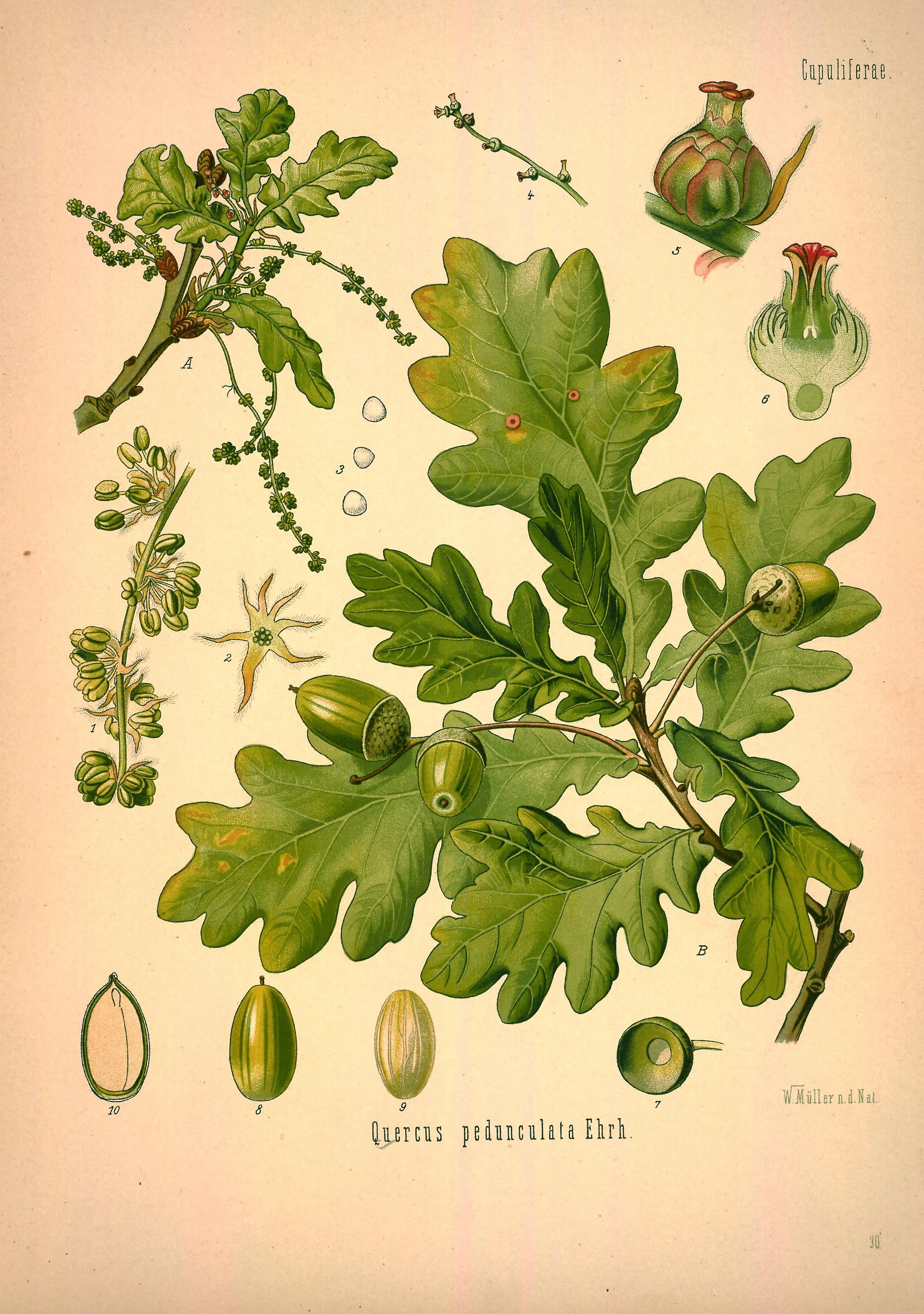
Quercus pedunculata in Köhler's Medizinal-Pflanzen: the oak. Its leaves and acorns fill this plate; the ink-makers' harvest grew on such trees as hard, marble-sized galls, rich in the tannins that meet iron and turn black. One family of tonight's inks begins on this branch.
Quercus pedunculata Ehrh. (Quercus robur), Plate 30, Köhler's Medizinal-Pflanzen, via Wikimedia Commons (Biodiversity Heritage Library scan). Public domain.
Every black writing ink in history belongs to one of two families, and the difference between them is the difference between parking a cart and building a house.
Pigment inks carry their color as solid particles. Carbon ink is the great example: microscopic grains of soot suspended in water with a binder to hold them. When the water dries, the particles remain, sitting upon the page like dust settled on a shelf. They are chemically quiet. Light does not fade them easily, which is why Egyptian carbon writing still reads after four thousand years. But because the particles only rest on the surface, they can be smudged, rubbed, or washed away. The ink endures by refusing to change.
★ Reactive inks carry their color as a chemistry waiting to happen. Iron gall ink goes onto the page pale and unremarkable. Then the air touches it, and a reaction begins: the pale iron compound oxidizes into a black, insoluble pigment that bonds directly with the page's fibers. It does not sit upon the sheet. It becomes part of it. That is why iron gall writing cannot be washed off, and why it wrote the laws, scriptures, and ledgers of Europe for the better part of a thousand years. But the same chemistry that makes it indelible leaves acid behind in the page, and over centuries that acid can eat the very manuscripts the ink was meant to preserve. The ink endures by changing, and charges a price for it.
| Pigment Ink (Carbon) | Reactive Ink (Iron Gall) | |
|---|---|---|
| Color carrier | Solid carbon particles | Dissolved iron-tannin complex |
| How it fixes | Particles dry onto the surface | Chemical reaction bonds it into the fibers |
| Appearance over time | Stable black, may smudge | Darkens after writing, may brown with age |
| Weakness | Can rub or wash off | Acid can corrode the page |
| Laboratory view | A suspension to manage | A reaction to control |
The apothecary's question is never which ink is better. It is: what does each one demand of the person who makes it, and what does it promise the page in return?
Check in: One ink endures by refusing to change; the other endures by changing. Which is which — and what price does the changing one charge?
❦ In your workbook: record the two families in your own way — particles resting on the surface against a reaction bonding into the fibers, and what each promises the page — copy, sketch, or note what matters.
Carbon Ink: A Suspension, Not a Solution
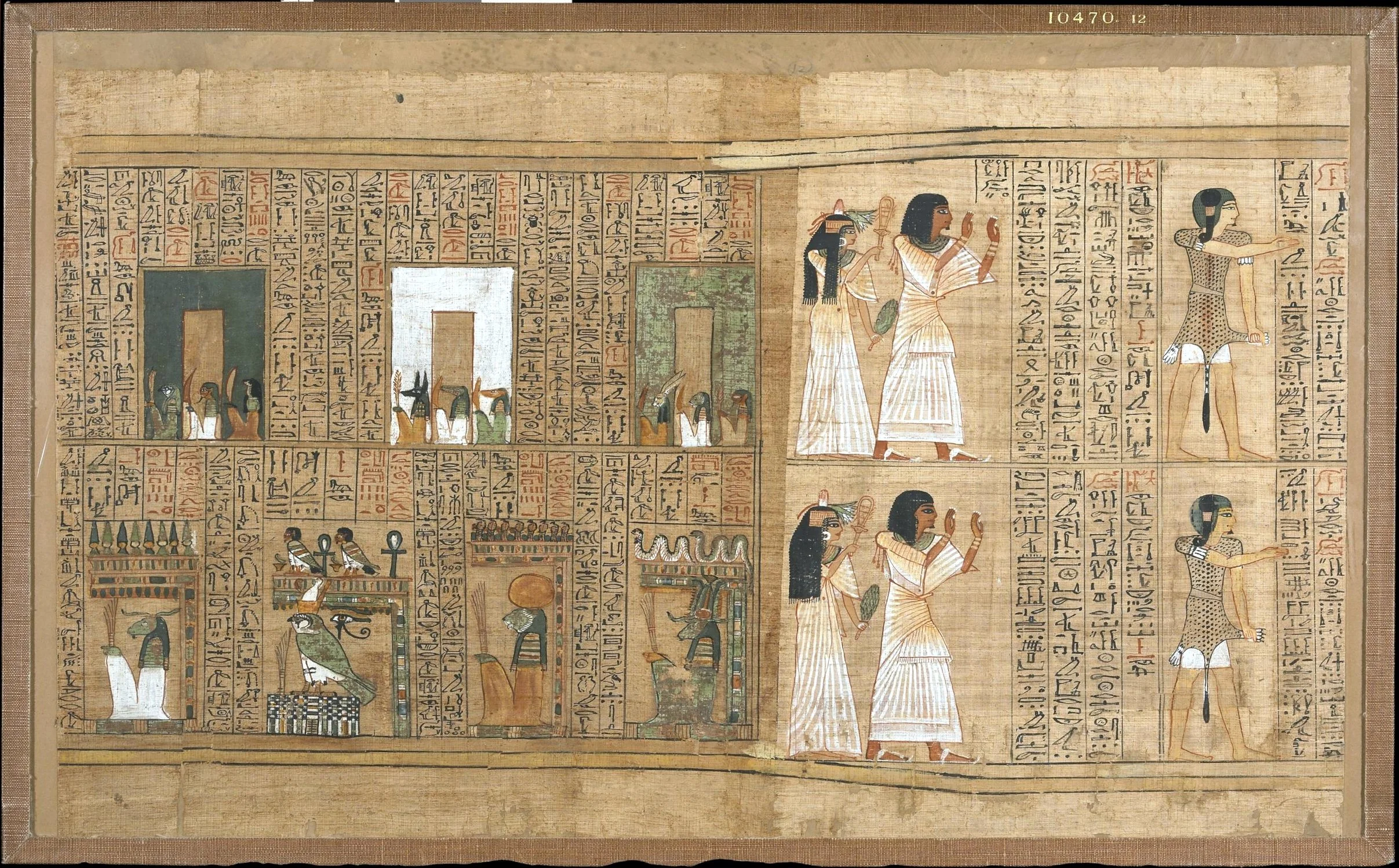
Sheet 12 of the Papyrus of Ani, the Egyptian Book of the Dead: black text laid down in orderly columns and still legible millennia later. Carbon ink — soot, water, and a gum binder — was writing in Egypt by around 2500 BCE; this is what its endurance looks like.
Papyrus of Ani (Book of the Dead of Ani), Sheet 12, 19th Dynasty, New Kingdom; British Museum (EA10470,12), via Wikimedia Commons. Public domain.
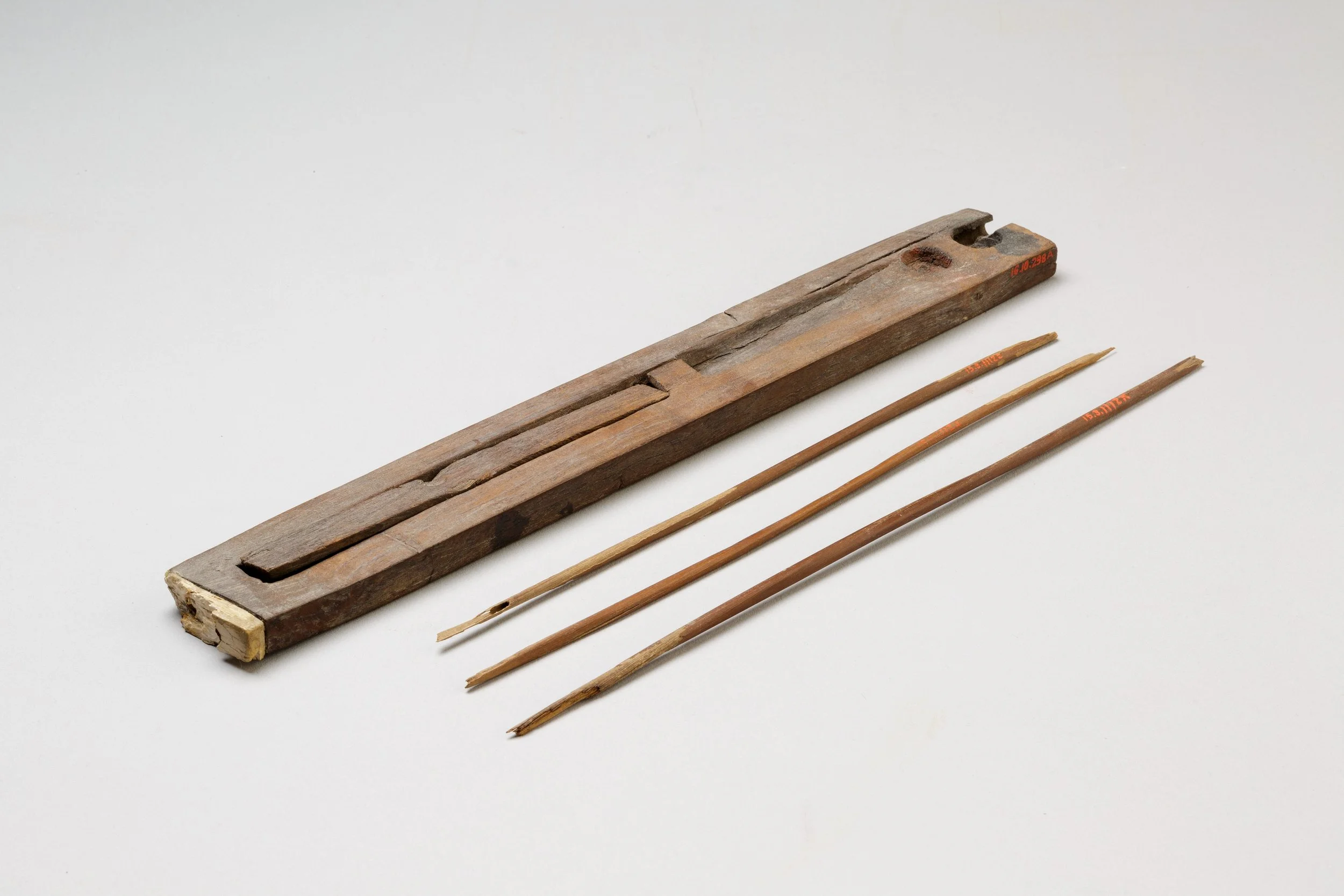
An Egyptian scribal palette, about 1580–1458 BCE, with its reed pens: the wells held the cakes and liquids of carbon ink, ground and mixed at the desk. Tonight's three jars stand in a line of benches that begins with this one.
Scribal Palette, ca. 1580–1458 BCE, The Metropolitan Museum of Art (Object 546931; accession 16.10.298a). Public domain.
Here is the first laboratory truth of the evening: carbon ink is not dissolved. It is suspended.
Soot, which the old workshops called lampblack, is nearly pure carbon left behind when oil, resin, or wood burns without enough air. Ground fine, it is a powder of particles far too small to see individually but far too large to dissolve. Stirred into water, the particles drift. Left alone, they settle. This is a suspension, the same kind of mixture you studied in the mineral lesson when clay refused to dissolve in water. The ink is only an ink for as long as those particles stay afloat and spread evenly.
★ That is the binder's whole job. Gum arabic, the dried sap of acacia trees, dissolves in water into a slightly thick, sticky liquid. Mixed with the carbon, it does two things at once: it keeps the particles separated and floating longer, and when the water dries, it acts as a glue that holds the carbon to the page. Too little binder and the ink is thin and dusty, rubbing off at a touch. Too much and the ink turns gummy, dries with a shine, and may crack or flake. The old ink makers judged the ratio by eye and by brush, and the good ones could feel it in the stirring stick.
Particle size matters as well. Coarse-ground charcoal makes a grey, gritty wash that catches on the brush. Charcoal ground to a fine powder makes a deep, smooth black that flows. This is the same principle you met at the grinding bench: smaller particles, more surface, more even behavior. The finest lampblack, collected deliberately from burning oils, was prized precisely because its particles were already tiny.
The history is worth knowing because it is so long. Carbon inks made from soot and gum were writing in Egypt by around 2500 BCE, and analysis of Roman inks from the first century shows the same recipe: carbon black in a gum binder, sometimes with animal glue. Chinese ink makers pressed pine soot with glue into ink sticks centuries before the common era. Carbon ink was the standard black of the ancient world, and medieval recipes were still calling for it into the thirteenth century. When a technology lasts four thousand years, the laboratory pays attention.
Order. Observation. Record. A suspension — a mixture in which solid particles are spread through a liquid without dissolving — is a promise that must be kept stirred.
Check in: Why is carbon ink a suspension and not a solution — and what two things does the binder do at once?
❦ In your workbook: record carbon ink as a suspension in your own way — particles that drift and settle, the binder's two jobs, and why particle size decides grey wash against true black — copy, sketch, or note what matters.
Iron Gall Ink: Chemistry on the Page
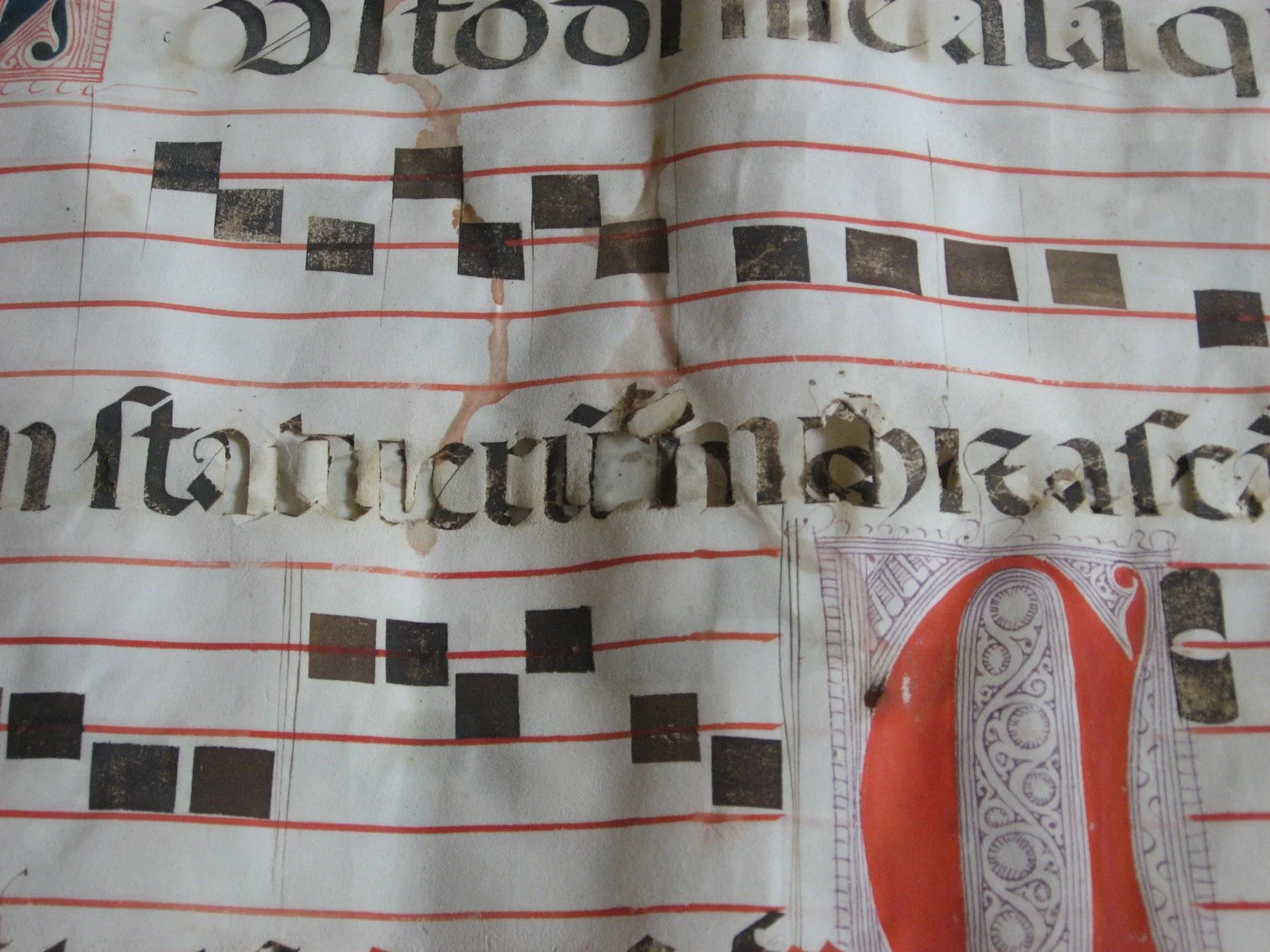
Ink corrosion, photographed in Évora, Portugal: iron gall ink has oxidized the page itself, and the letters of the middle line have fallen out as holes. The same chemistry that bonds the ink into the fibers leaves acid behind — permanence, purchased with the page.
Manuscript from Igreja de São Francisco, Évora, Portugal; photograph via Wikimedia Commons (File:InkErosion.jpg). Public domain.
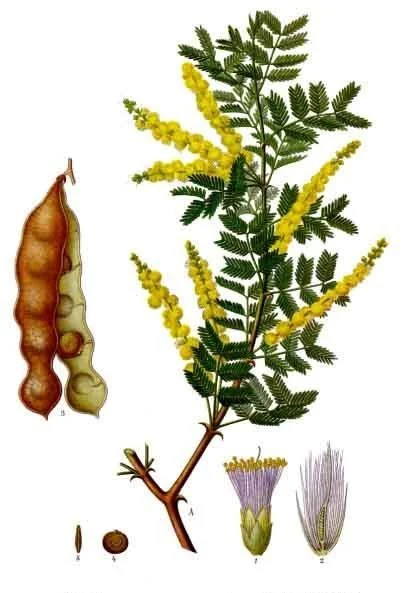
Acacia senegal in Köhler's Medizinal-Pflanzen: the tree whose dried sap is gum arabic, the binder of both ink families — it keeps carbon floating in the first, and controls flow in the second. The good ink makers could feel its ratio in the stirring stick.
Acacia senegal plate, Köhler's Medizinal-Pflanzen, via Wikimedia Commons. Public domain.
Now the second family, viewed through the laboratory's lens. What follows is the chemistry. For the scribe's craft, the measuring, the writing, and the hand that guides the quill, you are directed to Scrollwork Unit II Lesson 6, where Professor Nocturne teaches iron gall ink as the writer's art. Here we study what happens inside the jar and upon the page.
Iron gall ink is built from three ingredients: tannins extracted from oak galls, an iron salt historically called vitriol, and gum arabic as binder. The laboratory interest begins the moment the first two meet.
Stage one: the pale complex. When the iron salt dissolves into the tannin extract, the two combine into a compound called ferrous tannate. It is soluble, which means it stays dissolved, and it is pale, nearly grey. A freshly mixed iron gall ink looks like dirty water. There is nothing black about it yet.
★ Stage two: the darkening. Once the ink leaves the jar and meets the air, oxygen goes to work. The ferrous tannate oxidizes, which is to say the iron in it takes up oxygen and changes state, becoming ferric tannate. Ferric tannate is black and insoluble. It drops out of solution as a true pigment and locks itself to the page's fibers. This is why iron gall writing goes on pale and darkens over hours: you are watching oxidation happen on the page.
A laboratory chemist watching this process tracks several variables, and each one is a lesson in formulation:
- Tannin strength. Not all gall extracts are equal. Galls richer in tannin give deeper, faster blackening. The old makers learned which galls to trust.
- The iron ratio. More iron deepens the color but increases the acid left behind, which increases the ink's appetite for the page over centuries. Too little iron gives a weak, brownish mark. The ratio is a bargain struck between blackness now and survival later.
- The binder ratio. Gum arabic controls flow and keeps the forming particles even. Too little and the ink feathers and sinks unevenly; too much and it sits glossy on the surface.
- Acidity. Iron gall ink is naturally acidic, often strongly so. That acidity is part of why it bites into fibers so well, and part of why conservators still fight its effects in old manuscripts. A chemist measures it; a wise one respects it.
The bargain of iron gall ink is the most instructive in the laboratory: permanence purchased with reactivity. Carbon ink asks nothing of the page and gives a mark that can be rubbed away. Iron gall ink gives a mark nothing can remove, and asks the page to endure acid for centuries. Neither is wrong. Each is a choice, and the laboratory's work is to understand exactly what is being chosen.
Check in: Name the ink's state in the jar and its state on the page — and what does more iron buy, and what does it cost?
❦ In your workbook: record the chemistry on the page in your own way — pale ferrous tannate, black ferric tannate, and the four variables a chemist watches — copy, sketch, or note what matters.
The Carbon Ink Bench: Practical
Tonight you join the four-thousand-year tradition. You will make carbon ink, vary the binder, and test what you have made the way a laboratory tests anything: with water, with friction, and with light.
Procedure.
- Grind. Crush your charcoal to the finest powder you can manage. Sift it through a fine strainer if you have one; return the coarse bits to the mortar and grind again. Fineness is the whole game.
- Divide. Put one level teaspoon of your fine carbon into each of three small jars. Label them A, B, and C.
- Mix. To jar A, add two teaspoons of water and nothing else. Stir well. To jar B, add two teaspoons of water and a pea-sized amount of gum arabic (or half a teaspoon of honey as your stand-in). Stir until dissolved. To jar C, add two teaspoons of water and three times the binder you used in B. Stir until dissolved.
- Lay down. With your brush or stick, paint a thick stripe of each ink on its own paper strip. Label each strip immediately: A, B, C, and the date.
- Observe wet. Note how each flows off the brush. Which spreads evenly? Which drags or clumps? Write it down before the inks dry, because memory is a poor witness.
Observation: the permanence trials. Once the strips are fully dry, usually within the hour, run three tests.
- The water test. Place one drop of water on each stripe and wait one minute, then blot gently. Record what happens: does the black lift, run, or stay?
- The rub test. Rub each stripe firmly once with a dry fingertip. Record how much black transfers.
- The light test. Cover half of each stripe with opaque tape and set the strips in a sunny window for one week. Then remove the tape and compare the covered half to the exposed half. Record any fading.
Cleanup. Wash jars, brushes, and hands. Wipe the work surface. Charcoal dust rinses away if caught promptly; dried carbon ink does not. Store your labeled strips in your archive.
Archive entry. File a batch record for each jar: carbon source, grind fineness, binder type and amount, water amount, date, and the full results of all three permanence trials. A laboratory that does not write down its ratios will make the same ink twice only by accident.
The ink you made tonight is the ink of pharaohs' scribes. Treat the result with the respect its ancestors earned.
Check in: What is the one difference between jar A and jar B — and why is jar A expected to perform worst in the rub test?
❦ In your workbook: record the carbon ink bench in your own way — the grinding, the three jars and their one difference, and the three permanence trials — copy, sketch, or note what matters.
In your packet: Exercise I — The Binder Variable (Laboratory Report) ✎ and Exercise II — The Permanence Trials (Record Sheet) ◐ begin here. Work them now, or mark the place and take them as homework — your choice.
In your packet: Exercise III — The Formulation Notebook (Design Study) ✎ begins here: it redesigns your best jar from this bench. Work it now, or mark the place and take it as homework — your choice.
A Note from Professor Muddlenook
Scholars, a word about honesty at the bench.
Your three jars will not behave identically, and jar A, with no binder at all, will likely perform the worst. That is not a failure. That is the experiment working. The binder — a substance that holds color or particles together and fixes them in place — variable exists so you can see with your own eyes what the old workshops knew in their hands: that an ink is not its color alone, but its color plus the chemistry that keeps that color where it was put.
If your honey stand-in behaves differently from true gum arabic, write that down too. A stand-in that teaches you something is worth more than a perfect material that teaches you nothing. The laboratory rewards the scholar who records what happened, not the scholar who records what should have happened.
— Professor Crimblebrew Muddlenook, Potions Laboratory • Master Apothecary • Head of House Meridies
Guided Observation: Reading the Three Jars as a Laboratory Record
This lesson's observation is bench work, done with your three labeled strips dry in front of you: you read jars A, B, and C the way the laboratory reads anything — by what the water, the fingertip, and the week of light actually did, not by what the recipe promised.
Work through it in order.
Follow the binder. Jar A carries water and carbon and nothing else. Jar B carries the same carbon and water with a pea-sized amount of gum arabic (or the honey stand-in). Jar C carries three times the binder you used in B. One variable moves; everything else stands still.
Follow the stripes. Each stripe was labeled immediately — A, B, C, and the date — and observed wet before the inks dried: which spread evenly, which dragged or clumped.
Follow the trials. The water test set one drop on each stripe for one minute before a gentle blot. The rub test rubbed each stripe firmly once with a dry fingertip. The light test covered half of each stripe with opaque tape and set the strips in a sunny window for one week.
Consider:
- Which stripe's black lifted, ran, or stayed under the water drop — and what held it, or failed to?
- How much black transferred in the rub test, jar by jar, and what does the order of the three results say about the binder's dose?
- After a week of light, does any stripe's exposed half differ from its covered half? What would fading have pointed to, if it had appeared?
❦ In your workbook: record the guided observation in your own way — the one moving variable, the three labeled stripes, and the three trials read in order — copy, sketch, or note what matters.
Materials
Everything in its place, before we begin.
Level One — Household Items
- Charcoal: two or three plain charcoal briquettes (unlit, no lighter fluid) or artist's charcoal sticks. These are your carbon source.
- A mortar and pestle, or a sturdy zip bag and a rolling pin for crushing.
- Gum arabic: powdered gum arabic from a craft or art supply store. If you cannot obtain it, clear honey will serve as your experimental stand-in binder, and the lesson will show you how to read the difference.
- Three small jars or cups, a teaspoon, and stirring sticks.
- Paper strips: plain white paper or card, cut into strips for test swatches.
- Opaque tape, for masking half of each test stripe during the light test.
- A soft brush, cotton swab, or sharpened stick for laying down ink.
- Newspaper or a disposable cloth to protect the work surface, plus an apron.
- Your laboratory journal for the batch record.
Level Two — Historically Closer
- Lampblack pigment from an art supplier: true collected soot, the historical carbon.
- Gum arabic in lump form, dissolved overnight in water, as the old workshops prepared it.
- A glass muller or small mortar for fine grinding.
- pH test strips, for measuring the acidity of ink samples.
- A small scale for weighing pigment and binder honestly.
Safety Notes
- Ink stains permanently. Cover your work surface, wear an apron or old shirt, and wash your hands when you finish. Charcoal dust rinses away if caught promptly; dried carbon ink does not.
- Nothing in this lesson is for tasting or ingestion. Iron compounds are not food, and laboratory preparations are never tasted.
- Work in a ventilated area when grinding charcoal. Keep your face back from the mortar and do not blow across the powder. A simple dust mask is wise if you are sensitive to dust.
- If your Level Two work involves iron sulfate, an adult must be present. Store it labeled, sealed, and out of reach of young children and pets.
- Label every jar with the ink name and the date. An unlabeled jar of black liquid is a disaster waiting for a thirsty moment.
Reflection Questions
Answer the following questions in your workbook.
- Why is carbon ink described as a suspension rather than a solution, and what practical difference does that make at the writing bench?
- Explain the two stages of iron gall ink's chemistry in your own words: what is the ink when it leaves the jar, and what does the air do to it?
- A manuscript written in iron gall ink survives a flood unharmed, while a carbon-ink manuscript from the same shelf loses half its text to the water. Explain why, using what you learned about how each ink fixes to the page.
- Why would a laboratory chemist care about the ratio of iron to tannin when mixing iron gall ink? What is being traded off?
- You have only soot, water, and time. A fellow scholar has soot, water, gum arabic, and time. Whose ink will likely survive handling better, and what exactly is the gum arabic doing to earn its place?
Workbook Checklist — Lesson 48
In my workbook I have:
- ☐ distinguished pigment inks from reactive inks, and explained how each one fixes color to the page
- ☐ described how a binder keeps carbon particles suspended and adhered to a writing surface
- ☐ explained the two-stage chemistry of iron gall ink: pale ferrous tannate oxidizing into black ferric tannate
- ☐ named the formulation variables a laboratory chemist watches when preparing ink
- ☐ prepared a small batch of carbon ink and tested its permanence through water, rubbing, and light exposure
- ☐ recorded my ink experiments in my laboratory archive using proper batch documentation — carbon source, grind fineness, binder type and amount, water amount, date, and all three trials
- ☐ labeled every jar with the ink name and the date
☐ Lesson completed Date: ___ Signature: ___
The Professor's Closing Note
Sealed with the teal wax of Professor Crimblebrew Muddlenook, Master Apothecary of the Potions Laboratory, Head of House Meridies.
The bench is clean. The jars are labeled. The strips are drying.
You have now stood where four thousand years of ink makers stood, and you have asked the laboratory's question of both great families: not which is better, but what each one IS. Carbon asks for grinding, binder (a substance that holds color or particles together and fixes them in place), and patience, and gives a black that light cannot fade. Iron gall asks for chemistry, ratio, and respect, and gives a black that water cannot lift.
File your batch records. Date your strips. And the next time you see medieval writing, dark and permanent on its page, you will know the pale liquid it once was, and the air that turned it black.
In good order, scholars.
— Professor Crimblebrew Muddlenook, Potions Laboratory • Master Apothecary • Head of House Meridies
PROFESSOR CRIMBLEBREW MUDDLENOOK
Potions Laboratory
Master Apothecary • Head of House Meridies
Cross-Class Connections
Scrollwork · Unit II, Lesson 5 — Soot & Charcoal Ink
You have ground charcoal in Professor Muddlenook's laboratory and watched a binder decide whether it stayed on the page. Now come to my desk and make this same ink as a scribe makes it: carbon ink as the writer's first black, gum arabic as the writer's binder, judged by the line it lays down. He studies what the ink is. I will teach you what it does in the hand.
Scrollwork · Unit II, Lesson 6 — Oak Gall Ink
Tonight Professor Muddlenook showed you the reaction inside the jar: pale ferrous tannate, black ferric tannate, and the acid that rides along. In my library we make this very ink and write with it — the galls crushed, the vitriol dissolved, the pale line darkening in the air as you watch. His bench owns the chemistry. Mine owns the making, the writing, and the watching-it-darken. Come and put your hands where his variables were.
Scrollwork · Unit II, Lesson 8 — Ink Flow & Preservation
You have seen what iron gall ink's acid does to a page across centuries, in a laboratory that measures it. Come and read that same corrosion from the keeper's side: how ink flows from the nib, how it feathers, bleeds, and bites, and what conservation can and cannot save. His jars explain the reaction; my shelves show its long result.
Scrollwork · Unit I, Lesson 3 — Writing Surfaces Through History
Professor Muddlenook's inks must land somewhere, scholars, and the landing decides half their fate. In my library we test papyrus, parchment, and paper fiber by fiber: which surface drinks the ink, which holds it on the skin, which lets it feather. Bring his stripes with you — your water, rub, and light trials were surface trials too, whether you named them so or not.
Scrollwork · Unit I, Lesson 4 — Inkwells, Sand, & Scribal Tools
An ink is only as honest as the vessel that keeps it. In my library you will learn the inkwell's keeping: how a scribe stores, covers, and cares for the fluid Professor Muddlenook teaches you to make, and why sand, patience, and a covered well stood between a good ink and a ruined page. He makes the ink. Come and learn how the desk keeps it.
PROFESSOR QUILLBERRY NOCTURNE
Scrollwork Library

Herbology · Unit II, Lesson 9 — Soil Chemistry, the pH Scale
Come up to the Greenhouse, ink-makers, and learn the scale your Level Two strips only point at. Here we measure acidity in soil — what pH is, how to test it, and how half a point changes what a plant can reach. Professor Muddlenook's iron gall ink is naturally acidic, often strongly so, and his chemists measure it and respect it. The scale you learn in my soil will let you say how much.
PROFESSOR BERYL FERNFOOT
Herbology Greenhouse • Master Herbalist • Head of House Oriens
Further Reading & Sources
- A Multidisciplinary Study of a Roman Ink of the I Century AD (Scientific Reports) — laboratory analysis of a real Roman carbon ink: soot, gum binder, and two thousand years of survival.
- Medieval Inks (UCLA, Alan Cole / Museum of Writing Research Collection) — carbon versus metal-gall inks, with a period 1540 ink recipe.
- Iron Gall Ink FAQ (IFLA Preservation and Conservation Programme) — the conservator's view: ingredients, acidity, and why old manuscripts corrode.
- Making Ink from Oak Galls: Some History & Science (New York Almanack) — galls, wasps, tannic acid, and the ink that wrote the Magna Carta.
- Chemical Composition of Archival Iron Gall and Pigment Inks (Vectree) — ferrous to ferric tannate, binders, and why pigment inks sit on the surface.
Browse the Potions shelf in the school Library for readable editions of these works.
LESSON 48 · OAK GALL INKS · DEEP SHELF
Try It in the Laboratory
Galls, iron, and gum arabic — this lesson taught the ink that wrote the manuscripts. The Ink Cauldron mixes it to your shade, pale, standard, or deep, and writes the batch around your choice. Dip pens only, mind.
— Professor Crimblebrew Muddlenook, Potions Laboratory
Submit your work for this lesson using the form below.
CONTINUE IN THE POTIONS LABORATORY
← Previous · Lesson 47: Atmospheric Resin & Botanical Burn Blends Next · Lesson 49: Fluid Color: Plant & Berry Stains →
Unit VI — Fragrance, Pigments & Botanical Arts Potions Laboratory — All 52 Lessons
The rest of Unit VI: Lesson 45 · Pomanders · Lesson 46 · Volatile Spirits · Lesson 47 · Burn Blends · Lesson 49 · Plant & Berry Stains · Lesson 50 · Paper Aging · Lesson 51 · Wax Seals · Lesson 52 · Continuing Ledger · The Capstone · The Apothecary's Signature Formula