
POTIONS
Unit VI · Lesson 50PAPER AGING & MANUSCRIPT STAINING
Professor Crimblebrew Muddlenook
Master Apothecary • Potions
Head of House Meridies • School of Evershade
Professor's Introduction
Sealed with the teal wax of Professor Crimblebrew Muddlenook, Master Apothecary of the Potions Laboratory, Head of House Meridies.
Scholars, everything you have made in Unit VI has needed one thing you have not yet studied: a surface worthy of it. Your inks from Lesson 48 need paper that drinks them properly. Your stains from Lesson 49 need a ground that answers their color. And so today we study the canvas itself, and the strange fact that paper, like everything else in the laboratory, changes with time.
Old paper tells the truth about its life. The yellowed edges of a newspaper, the brown freckles on a grandmother's letter, the page that crackles when you turn it: each is a record of chemistry at work. Our task today is to read those records, and then, with honest hands and open eyes, to learn how the apothecary recreates the look of age for craft and study.
One rule before we begin, and it is not negotiable. ★ We age paper to learn, to practice, and to make beautiful things. We never age paper to deceive anyone about what a document is or when it was made. An honest laboratory has no use for forgery.
— Professor Crimblebrew Muddlenook, Potions Laboratory • Master Apothecary • Head of House Meridies

Potions map — the class base map, unmarked for this lesson.
Lesson Objectives
By completing this lesson, you will be able to:
- Explain the three main processes that age paper: lignin oxidation, acid hydrolysis, and light damage.
- Identify foxing, ink corrosion, cockling, and toning on real or photographed aged paper.
- Prepare and apply an oxidation wash (tea or coffee) safely, and record its effect.
- Compare four aging techniques in a controlled trial and judge which suits a given purpose.
- State the laboratory's honesty rule: aged appearance is a craft technique, never a deception.
Reading this lesson: ★ marks the passages to remember. They carry the honesty rule, the one-way chemistry of aging, and the safety rules this lesson is assessed by, and they return on the Unit VI Quiz and at the capstone. Check in questions ask the material back as you go; answer them in your workbook when you meet them.
Working this lesson: Your assignment packet is the first download on this page. Work in it as the lesson moves along, answering each exercise as its subject is taught — or read the lesson through for your notes and take the exercises as homework afterward. Both are proper ways to sit this class. Signposts in the reading tell you where each exercise belongs. Written answers are short answers in your own words; a few honest lines are worth more than a filled page.
Your Assignment Packet
This lesson's exercises live in its packet: the Lexicon Handout (every term, course terms marked ◆, and the six cross-referenced terms with their Lesson 50 context notes), Materials, Guided Practice — the Aging Trials procedure, printed in full so you can run the four-sheet trial the same way — the Assignment Manual with its answer key, the Reflection Questions, and the Workbook Checklist. Download the packet before you begin and keep it beside you as you read.
Safety Briefing
This lesson's safety spine stands here word for word — the Practical's own briefing first, then the lesson's Safety Briefing list. Heat, flame, and staining guardrails are carried exactly as the source states them; nothing in the workbook paths below softens any of them.
Safety briefing. Hot tea and coffee scald. Any oven use is done by or with an adult, and oven mitts are not optional. Cover your work surface completely; tannin washes stain wood, cloth, and skin, and the stains on skin last for days. Work near a sink. No open flame anywhere near paper, for any reason, at any stage.
- Hot liquids scald: let all washes cool to warm before brushing, and keep mugs away from the paper's edge where they can tip.
- Oven work belongs to an adult. Lowest setting only, mitts on, never leave the oven unattended while paper is inside.
- Protect every surface before you begin. Tannin washes stain wood, fabric, and skin; the stains are harmless but stubborn.
- No open flame near paper at any stage. Edge-darkening is done with a damp tea bag, never a candle.
- Ventilate normally; no fumes are involved, but a damp workspace invites the very mold this lesson teaches you to recognize. Dry everything thoroughly.
Check in: What is done with a damp tea bag instead of a candle — and who does every piece of oven work in this lesson?
❦ In your workbook: record the safety briefing in your own way — hot liquids, adult oven work, protected surfaces, no open flame at any stage, and thorough drying — copy, sketch, or note what matters.
In your packet: Guided Practice — the Aging Trials begin here. Work them as you reach them in the reading, or mark the place and take them as homework — your choice.
What Time Does to Paper
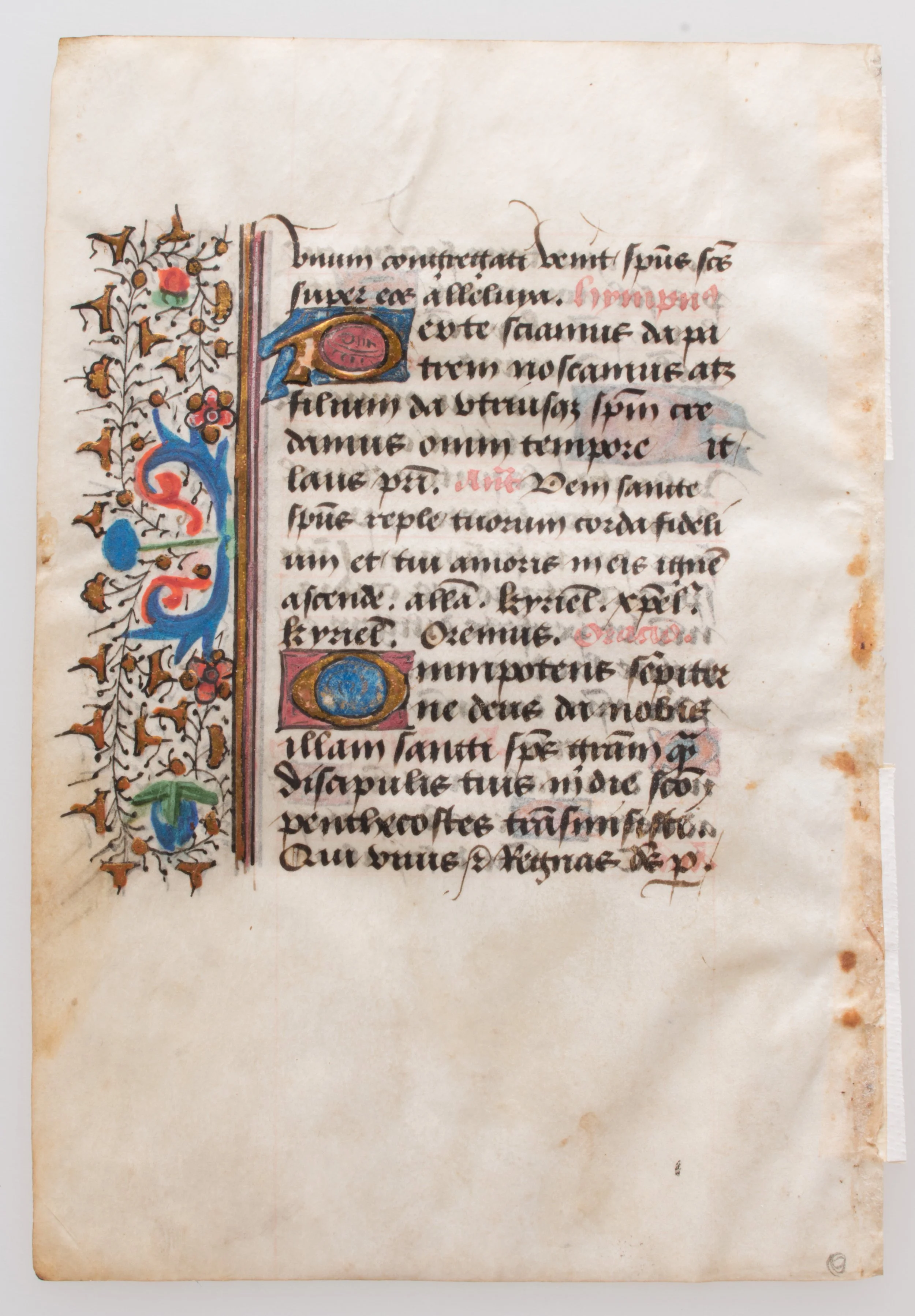
A manuscript leaf from a Book of Hours, French, 15th century: tempera and gold leaf on parchment. Read its edges before its words — the brown toning down the right side, the spots, the slight ripple in the skin are the three processes of this lesson, at centuries-long scale. Old paper tells the truth about its life; this leaf is still telling it.
Manuscript Leaf, from a Book of Hours, French, 15th century, The Metropolitan Museum of Art (Object 2003.493). Public domain.
Paper is mostly cellulose: long chains of plant fiber pressed into a sheet. Left alone in a perfect world, cellulose is patient stuff. But the world is not perfect, and three processes gnaw at every sheet that survives long enough to be called old.
The first is oxidation. Wood pulp contains lignin, the stiff compound that held the living tree together. (The full account lives in the Scrollwork Lesson 3 lexicon; here is what the laboratory needs.) When lignin meets oxygen, especially in sunlight, it oxidizes into yellow-brown compounds. That is why newspapers yellow at the edges within months while a cotton-rag letter from 1800 may still be white: newsprint is full of lignin, rag paper has almost none. Oxidation is the reason conservators speak of paper's "slow fires": a gradual chemical burning, needing no flame.
The second is acid hydrolysis. In the mid-1800s, papermakers began adding alum-rosin size to their pulp, and the aluminum sulphate left behind reacts with moisture to form acids inside the sheet. Acids snip the long cellulose chains apart. Each snip makes the paper a little weaker and a little stiffer, until a book printed in 1920 can crumble when you turn the page. Archivists call this, too, a slow fire. Heat, pollution, and damp all hurry it along.
The third is light. Ultraviolet light fades inks and dyes, bleaches some colors, darkens others, and feeds the oxidation already underway. This is why museums keep their manuscripts in dim rooms and why your laboratory should never store its archive in a sunny window.
★ Notice what the three processes share: none of them is instant, and none of them is reversible. Paper aging is a one-way journey. Our craft today imitates its appearance, never its chemistry.
Check in: Name the three processes that age paper — and what do acids do, snip by snip, to the cellulose chains?
❦ In your workbook: record what time does to paper in your own way — cellulose and lignin, oxidation, acid hydrolysis, light, and the one-way journey — copy, sketch, or note what matters.
The Three Thieves of the Archive
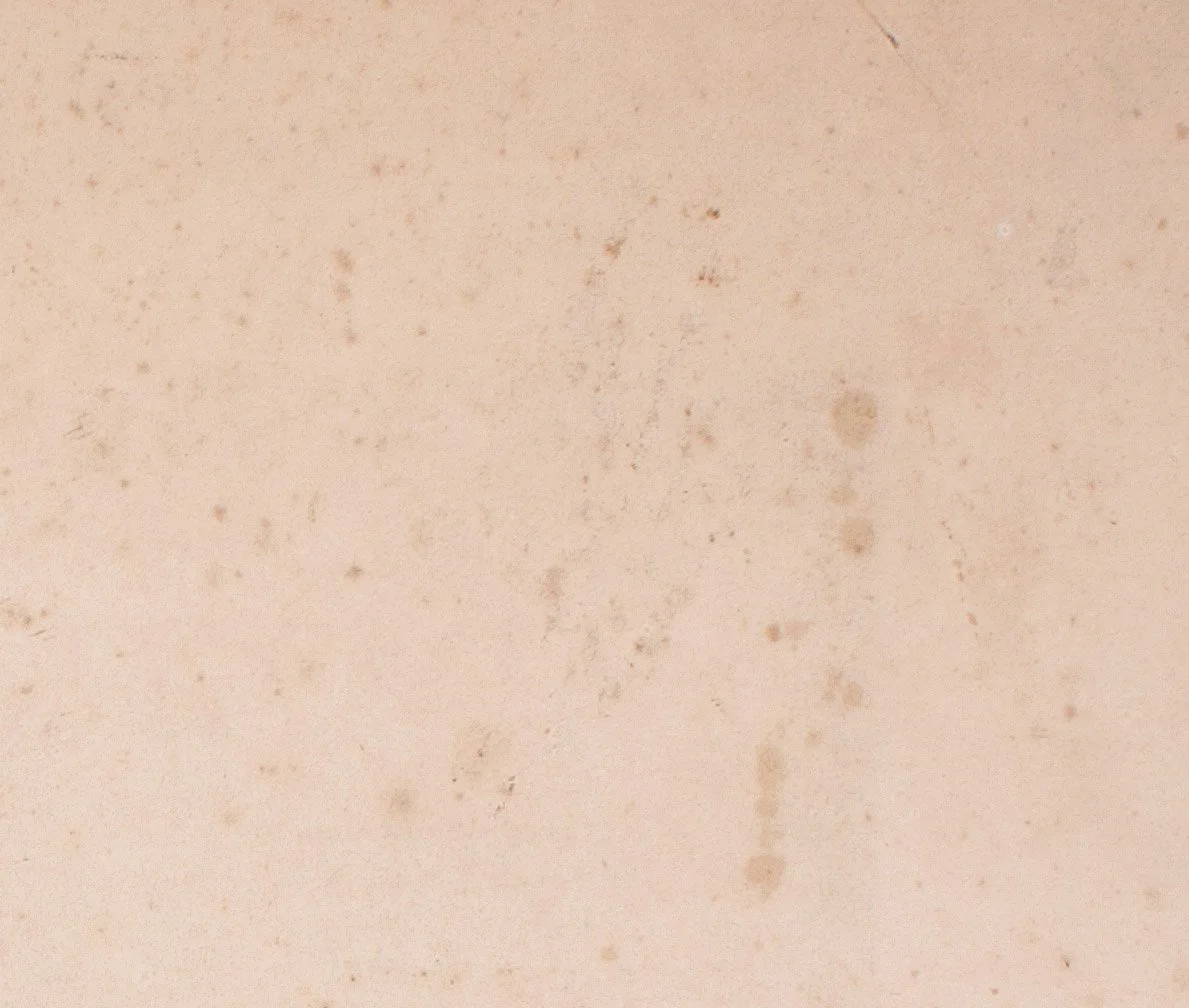
Foxing, up close: the small brown freckles moisture leaves on a sheet. Foxing tells the archivist the storage was once damp, even if it is dry now — learn its face here, and you will read it on every old page you ever open.
Foxing detail, via Wikimedia Commons. Public domain.
Muddlenook's conservators' shorthand names the three great enemies of any paper collection. Learn to recognize their work.
Light steals color. Inks fade, berry stains from Lesson 49 bleach toward gray, and the sheet itself darkens at the exposed edges while the covered center stays pale. Pick up any old paperback and look at the page edges: the dark rim is light's signature.
Moisture steals flatness and invites company. Paper cockles, which is the trade word for the wavy rippling that appears when fibers swell unevenly and dry that way. Worse, damp invites mold, and mold leaves foxing: the small brown freckles Scrollwork Lesson 8 names as the paper's own record of the iron and microorganisms it carried from its making.
Acids steal strength. Acid migration means acids travel: a newspaper clipping stored inside a book will yellow the pages it touches, because the acids migrate out of the clipping into its neighbors. Iron gall ink, the subject of your Lesson 48, can even burn through its own page over centuries, a condition conservators call ink corrosion. The ink that wrote the words slowly eats the words' home.
Your archive defeats the three thieves with three habits: keep it dark, keep it dry, keep the acids out. Acid-free folders, cool steady rooms, and handling with clean dry hands. The laboratory that preserves its records preserves its knowledge.
Check in: Name the three thieves and the three habits that defeat them — and what condition does iron gall ink cause over centuries?
❦ In your workbook: record the three thieves in your own way — light, moisture, and acids, what each steals, and the dark, dry, acid-free defense — copy, sketch, or note what matters.
Oxidation Washes & the Apothecary's Stains
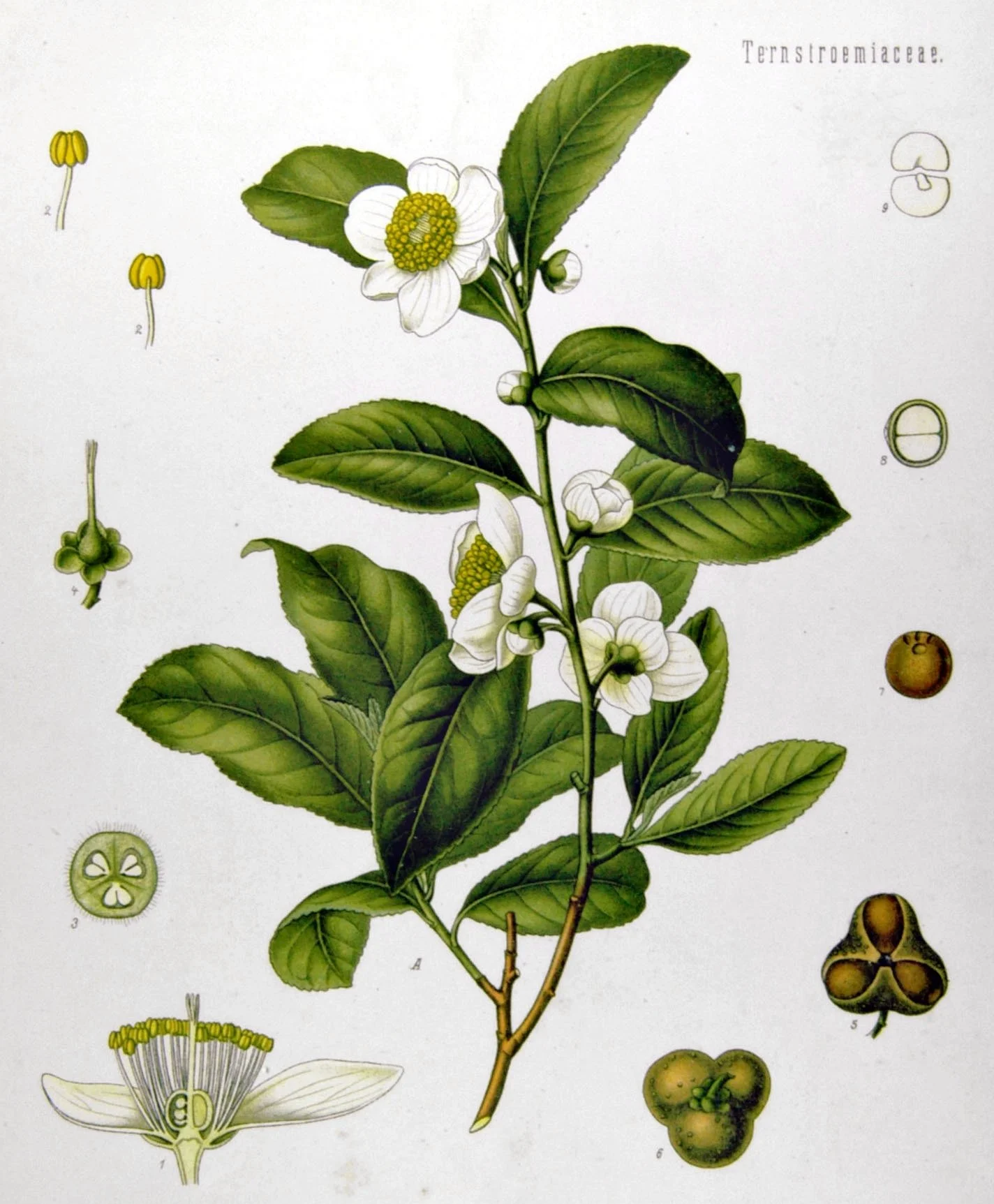
Camellia sinensis in Köhler's Medizinal-Pflanzen: the tea plant. Its brewed leaves carry the tannins of the apothecary's first wash — the same bitter compounds that stain your cup stain paper by the same mechanism, deepening from amber toward brown as the sheet dries.
Camellia sinensis plate, Köhler's Medizinal-Pflanzen, via Wikimedia Commons. Public domain.
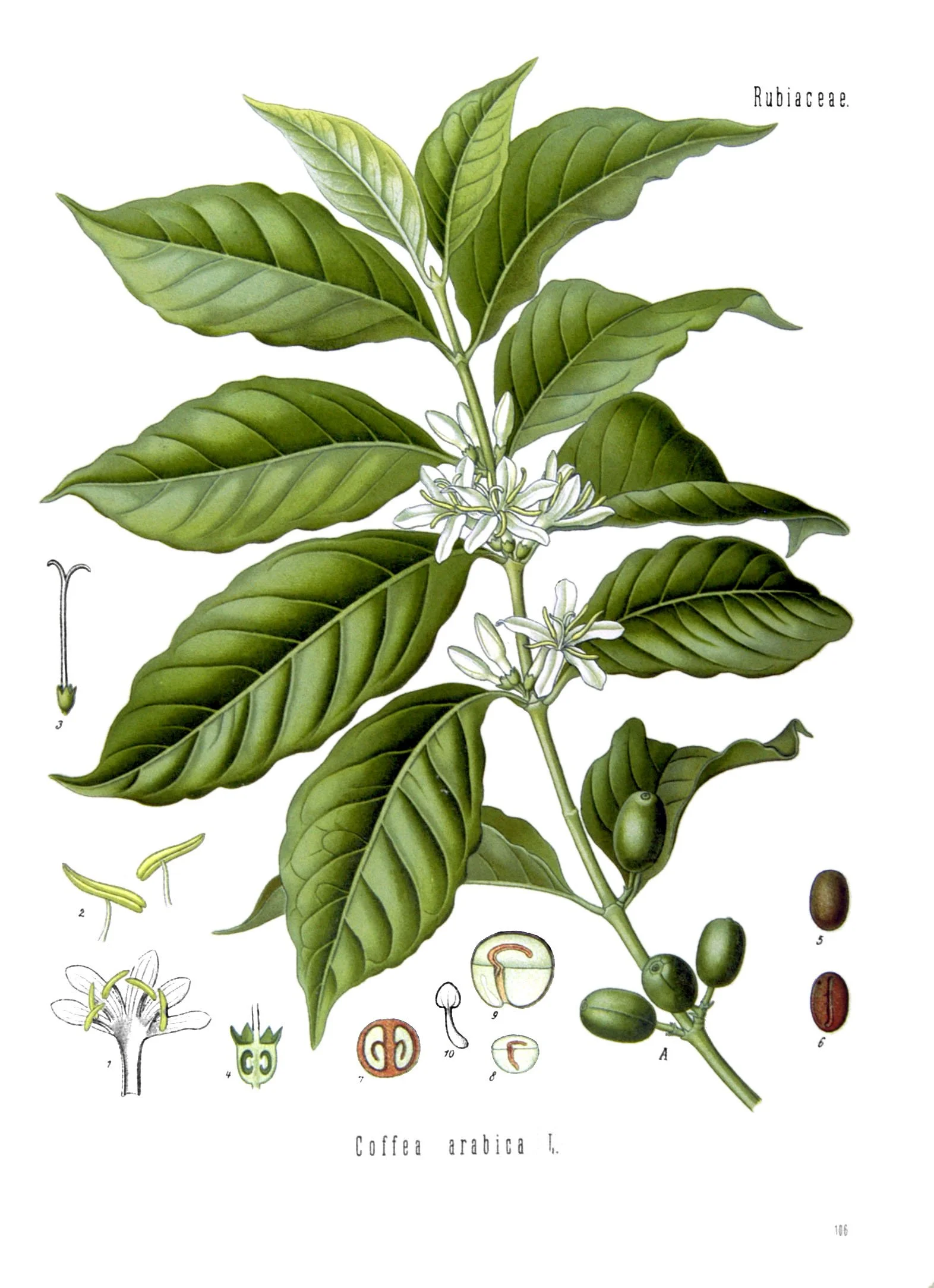
Coffea arabica in Köhler's Medizinal-Pflanzen: the coffee plant. Sheet B of the Aging Trials takes its wash from this plant's roasted seed — applied the same way as the tea, and dabbed slightly stronger at the edges, where true age darkens first.
Coffea arabica plate, Köhler's Medizinal-Pflanzen, via Wikimedia Commons. Public domain.
Now the craft. An oxidation wash is a liquid applied to paper to imitate the toning of age: the warm darkening that centuries lay onto a sheet. The historical apothecary's washes were tannin brews, most often strong tea or coffee, and the chemistry is honest: tannins are the same bitter compounds that stain your cup, and they stain paper by the same mechanism.
A wash works in three movements. First, the liquid carries color into the fibers. Second, as it dries, the tannins oxidize in air, deepening from amber toward brown. Third, the sheet's sizing decides how the wash behaves: a well-sized sheet holds the wash on its surface in an even film, while a thirsty unsized sheet drinks it into blotches. (Sizing's full definition stands in the Scrollwork Lesson 8 lexicon.) This is why the same tea wash gives you an even antique tone on one paper and a mottled map on another, and why ★ the apothecary tests every wash on a scrap first.
Two honest cautions. A wash imitates the look of age, not the substance: washed paper is still young paper, and anyone who knows the craft can tell the difference. That is exactly as it should be, per the honesty rule above. And a wash is not archival: tea-stained paper will itself keep aging, and the stain may deepen or spot over the years. ★ Record what you used and when, on the back of every stained sheet, so the archive never lies to its future readers.
Check in: A wash works in three movements — name them. And why does the same tea wash tone one paper evenly and mottle another?
❦ In your workbook: record oxidation washes in your own way — the tannin brews, the three movements, sizing's deciding role, and the two honest cautions — copy, sketch, or note what matters.
Scholars, a word about fire. You may have seen craft instructions that darken paper edges with a candle flame. In this laboratory, that technique does not exist. ★ Open flame near paper is not a craft method; it is an accident waiting for its moment. If you want darkened edges, dab them with a damp tea bag and let them dry. The result is safer, more even, and entirely sufficient. Muddlenook's laboratory has stood for generations because no one in it was ever in a hurry.
— Professor Crimblebrew Muddlenook, Potions Laboratory • Master Apothecary • Head of House Meridies
Practical: The Aging Trials
Mise en place. Level One (household items): - Four sheets of plain white printer paper, plus scraps for testing - Two tea bags (black tea) and a mug - Instant coffee or leftover brewed coffee - A baking tray lined with foil or parchment paper, and paper towels - A soft brush or sponge for applying the washes - A pencil and your laboratory journal - Access to a sunny windowsill and, with an adult, an oven
Level Two (historically closer): - Laid or cotton-rag paper from an art supplier, which takes a wash the way old sheets did - Loose-leaf black tea brewed strong in a pot - A soft natural-bristle brush for laying the wash evenly
Procedure. 1. Label four sheets A, B, C, D in pencil on the back. Label the front nowhere; pencil on the front will show. 2. Sheet A (tea wash): Brew the tea bags strong in the mug, about five minutes. Let it cool until merely warm, never hot. Lay the sheet on the lined tray and brush or sponge the tea across it evenly. Note the time. 3. Sheet B (coffee wash): Apply the coffee the same way, slightly stronger at the edges by dabbing with the brush tip. Note the time. 4. Sheet C (heat toning, adult only): Place the dry, untreated sheet on the lined tray. An adult sets the oven to its lowest setting (no hotter than 200°F / 95°C), places the tray inside for 10 minutes, and removes it with mitts. Watch through the window; if the paper darkens quickly, stop early. 5. Sheet D (light, the slow trial): Tape the untreated sheet to the inside of a sunny window. Leave it for the rest of the unit. This is the honest control: real aging, in miniature. 6. Let A, B, and C dry completely flat. Do not stack damp sheets.
Observation. When dry, lay the four sheets side by side and complete the comparison table in your journal: evenness of tone, depth of color, edge behavior, paper feel (stiff? cockled?), and how each compares to a genuinely old paper if you have one (an old letter, a yellowed book page). Which wash most resembles true age? Which looks most artificial, and why?
Cleanup. Pour leftover wash down the sink and rinse the mug at once; dried tea stains ceramic. Wipe the tray. Wash your hands; tannin stains linger on skin.
Archive entry. File the three finished sheets (A, B, C) in your archive with a dated label on the back of each: wash used, strength, drying method. Photograph or sketch Sheet D in place, and revisit it when Unit VI ends to record what two weeks of sunlight accomplished.
Check in: Which sheet is the honest control, and what makes it honest — and how is each finished sheet labeled for the archive?
❦ In your workbook: record the Aging Trials in your own way — the four sheets and their treatments, the adult-only heat trial with its limit, and the comparison you will make when they are dry — copy, sketch, or note what matters.
In your packet: Exercise I — The Aging Trials Record ◐ begins here. Work it now, or mark the place and take it as homework — your choice.
Guided Observation: Reading Aged Paper
This lesson's observation is close looking, done with real or photographed aged paper open in front of you: you read a sheet the way the lesson has taught you — process by process, thief by thief — because identifying age's marks is the skill the trials then imitate.
Work through it in order.
Read the tone. Is the sheet's darkening even, like a well-sized sheet's wash, or mottled, where a thirsty sheet drank unevenly? Where is it darkest — the exposed edges, as light leaves them, or across the whole sheet?
Read the spots. Look for foxing: the small brown freckles that tell the archivist the storage was once damp, even if it is dry now. Note their size, color, and where they gather.
Read the flatness and the feel. Is the sheet cockled — wavy rippling from fibers that swelled unevenly and dried that way? Does it feel stiff or brittle, as acid-shortened cellulose does, or supple, as rag paper stays?
Read the ink. Where iron gall ink has stood for centuries, look for ink corrosion: the ink slowly eating the words' home, browning or burning through its own page.
Consider:
- Which of the three processes — oxidation, acid hydrolysis, light — has left the clearest mark on this sheet, and what is your evidence?
- Which thief has been here, and which defense would have stopped it?
- If this sheet had been washed yesterday instead of aged for a century, what would give the costume away?
❦ In your workbook: record the guided observation in your own way — the tone read, the spots read, the flatness and feel, and the ink examined — copy, sketch, or note what matters.
Materials
Everything in its place, before we begin. For the Aging Trials you will need:
Required (Level One — household items)
- Four sheets of plain white printer paper, plus scraps for testing
- Two tea bags (black tea) and a mug
- Instant coffee or leftover brewed coffee
- A baking tray lined with foil or parchment paper, and paper towels
- A pencil and your laboratory journal
- Access to a sunny windowsill and, with an adult, an oven
- A soft brush or sponge for laying washes evenly (packet-only item, restored from the original packet script)
Suggested (Level Two — historically closer)
- Laid or cotton-rag paper from an art supplier, which takes a wash the way old sheets did
- Loose-leaf black tea brewed strong in a pot
- A soft natural-bristle brush for laying the wash evenly
- Acid-free tissue for interleaving finished sheets in the archive (packet-only item, restored from the original packet script)
Safety Notes
- Let all washes cool to warm before brushing, and keep mugs back from the paper's edge where they can tip.
- Oven work belongs to an adult: lowest setting only, mitts on, never leave the oven unattended while paper is inside.
- Cover every work surface completely before you begin. Tannin washes stain wood, fabric, and skin; the stains are harmless but stubborn.
- No open flame near paper at any stage. Edge-darkening is done with a damp tea bag, never a candle.
- Dry everything thoroughly when finished. A damp workspace invites the very mold this lesson teaches you to recognize.
Reflection Questions
Answer the following questions in your workbook.
- Why does newspaper yellow faster than a cotton-rag letter from 1800?
- Name the three thieves of the archive and one defense against each.
- Why must a wash be tested on a scrap before it touches the real sheet?
- A friend suggests burning the edges of a letter to make it look old. What is Muddlenook's answer, and what is the safe alternative?
- Why does the laboratory require an honesty label on every artificially aged sheet?
Workbook Checklist — Lesson 50
In my workbook I have:
- ☐ explained the three processes that age paper — lignin oxidation, acid hydrolysis, and light damage — and why none of them is reversible
- ☐ identified foxing, ink corrosion, cockling, and toning on real or photographed aged paper, and named which thief left each mark
- ☐ recorded the safety briefing whole: washes cooled to warm, oven work adult-only at the lowest setting with mitts, surfaces protected, no open flame at any stage, everything dried thoroughly
- ☐ run or studied the four Aging Trials (tea wash, coffee wash, adult heat toning, sunlight control) and completed the comparison table with its three-sentence verdict
- ☐ compared the same line on washed and unwashed paper and stated, in one paragraph, how sizing and wash together decide whether a manuscript succeeds
- ☐ written the complete honesty label — wash and strength, date, drying method, and the sentence "This paper was aged by craft on [date]; it is not an old document" — and initialed it
- ☐ recorded what I used and when on the back of every stained sheet, so the archive never lies to its future readers
- ☐ stated the laboratory's honesty rule in my own words: aged appearance is a craft technique, never a deception
☐ Lesson completed Date: ___ Signature: ___
The Professor's Closing Note
Sealed with the teal wax of Professor Crimblebrew Muddlenook, Master Apothecary of the Potions Laboratory, Head of House Meridies.
Well ordered, scholars. You have read the three thieves in old paper, laid honest washes, and compared your craft against time's own work. Remember the two truths of this lesson: the wash is a costume, not a disguise, and the archive defeats age's thieves with darkness, dryness, and acid-free habits.
Next, your stained sheets become the canvas for everything Unit VI has taught you. Bring them to the next bench.
— Professor Crimblebrew Muddlenook, Potions Laboratory • Master Apothecary • Head of House Meridies
PROFESSOR CRIMBLEBREW MUDDLENOOK
Potions Laboratory
Master Apothecary • Head of House Meridies
Cross-Class Connections
Scrollwork · Unit I, Lesson 3 — Writing Surfaces Through History
You have watched lignin yellow a newspaper in Professor Muddlenook's laboratory. Now come and learn it where its full account lives. In my Scriptorium we take up the surfaces themselves — papyrus, parchment, and paper — and lignin's own entry stands in this lesson's lexicon, as his aging lesson tells you by name. Learn it here; watch it yellow there.
Scrollwork · Unit I, Lesson 4 — Inkwells, Sand, & Scribal Tools
Professor Muddlenook watches ink and paper across centuries, corrosion and all. Come and watch ink in its first vulnerable minutes instead: the inkwell and its keeping, why ink needed drying, and the tools a careful hand keeps beside the page. His honesty rule stands in my room too, scholars — an aged appearance is a craft technique, never a deception.
Scrollwork · Unit II, Lesson 6 — Oak Gall Ink
The bite has a first classroom, and it is mine. In the Scriptorium we make iron gall ink, watch the pale line darken as it oxidizes, and study the manuscripts that are eating themselves — the same ink corrosion Professor Muddlenook teaches you to identify as evidence on the sheet. Make the ink here; read its centuries there.
Scrollwork · Unit II, Lesson 8 — Ink Flow & Preservation
Two of Professor Muddlenook's working words are defined in my room: foxing, the paper's own record of the iron and microorganisms it carried from its making, and sizing, the treatment that decides how his washes behave. Come and learn them at the nib, where ink flow and preservation are one subject — then carry them back to his bench and test every wash on a scrap, as he bids you.
PROFESSOR QUILLBERRY NOCTURNE
Scrollwork Library

Runes · Lesson 17 — The Need for Speed
Skin remembers moisture the way skin does, scholars. My Lesson 17 lexicon defines parchment, and Professor Muddlenook's aging lesson sends you to it by name: parchment cockles and relaxes with humidity far more dramatically than paper. Come and read the definition where it lives, then watch a skin do over centuries what his washes imitate in an afternoon.
Runes · Lesson 21 — The Shorthand Abbreviation Matrix
Vellum takes an oxidation wash beautifully and evenly — Professor Muddlenook says so in his Lesson 50 note, and sends you to my Lesson 21 lexicon for vellum's own definition. Come and learn the word where it is kept. The honesty label he requires applies to vellum-toned facsimiles exactly as to paper, and my room honors it.
PROFESSOR THISTLELOOM WEBBLETHORN
Runes & Ancient Writing
Further Reading & Sources
- Caring for Your Paper Collections — Library of Congress
- Preservation Leaflets: Paper — Northeast Document Conservation Center
- Acidic paper and the "slow fires" of libraries — Wikipedia
- American Institute for Conservation
- Preservation at the National Archives
Browse the Potions shelf in the school Library for readable editions of these works.
Submit your work for this lesson using the form below.
CONTINUE IN THE POTIONS LABORATORY
← Previous · Lesson 49: Fluid Color: Plant & Berry Stains Next · Lesson 51: Wax Seals & Colored Matrix Blends →
Unit VI — Fragrance, Pigments & Botanical Arts Potions Laboratory — All 52 Lessons
The rest of Unit VI: Lesson 45 · Pomanders · Lesson 46 · Volatile Spirits · Lesson 47 · Burn Blends · Lesson 48 · Carbon & Oak Gall Inks · Lesson 49 · Plant & Berry Stains · Lesson 51 · Wax Seals · Lesson 52 · Continuing Ledger · The Capstone · The Apothecary's Signature Formula